

Analog IC Design Engineer: Career Path, Skills, and Industry Scope
Navigate through this article using the table of contents below
Table of Contents
No headings found in this article.
The semiconductor industry is evolving rapidly, and Analog IC Design Engineers are playing a critical role in shaping the future of modern electronics. From smartphones and electric vehicles to medical devices and IoT systems, analog integrated circuits form the backbone of many real-world electronic applications. Unlike digital circuits that process binary data, analog circuits handle continuous signals such as voltage, current, sound, and radio frequencies. This makes the role of an Analog IC Design Engineer highly specialized and essential in the VLSI ecosystem. As global demand for high-performance chips continues to rise, the need for skilled analog design engineers is also growing significantly across semiconductor companies.
An Analog IC Design Engineer focuses on designing, simulating, and optimizing circuits such as amplifiers, voltage regulators, data converters, PLLs, and RF blocks used in integrated circuits. This career path requires strong fundamentals in electronics, semiconductor physics, and circuit theory, along with expertise in industry tools like Cadence, SPICE simulations, and layout verification techniques. In this blog, we will explore the complete career roadmap for becoming an Analog IC Design Engineer, the essential technical skills required, job opportunities in the semiconductor industry, and the future scope of analog IC design in the rapidly expanding VLSI domain.
Introduction to Analog IC Design in the Semiconductor Industry
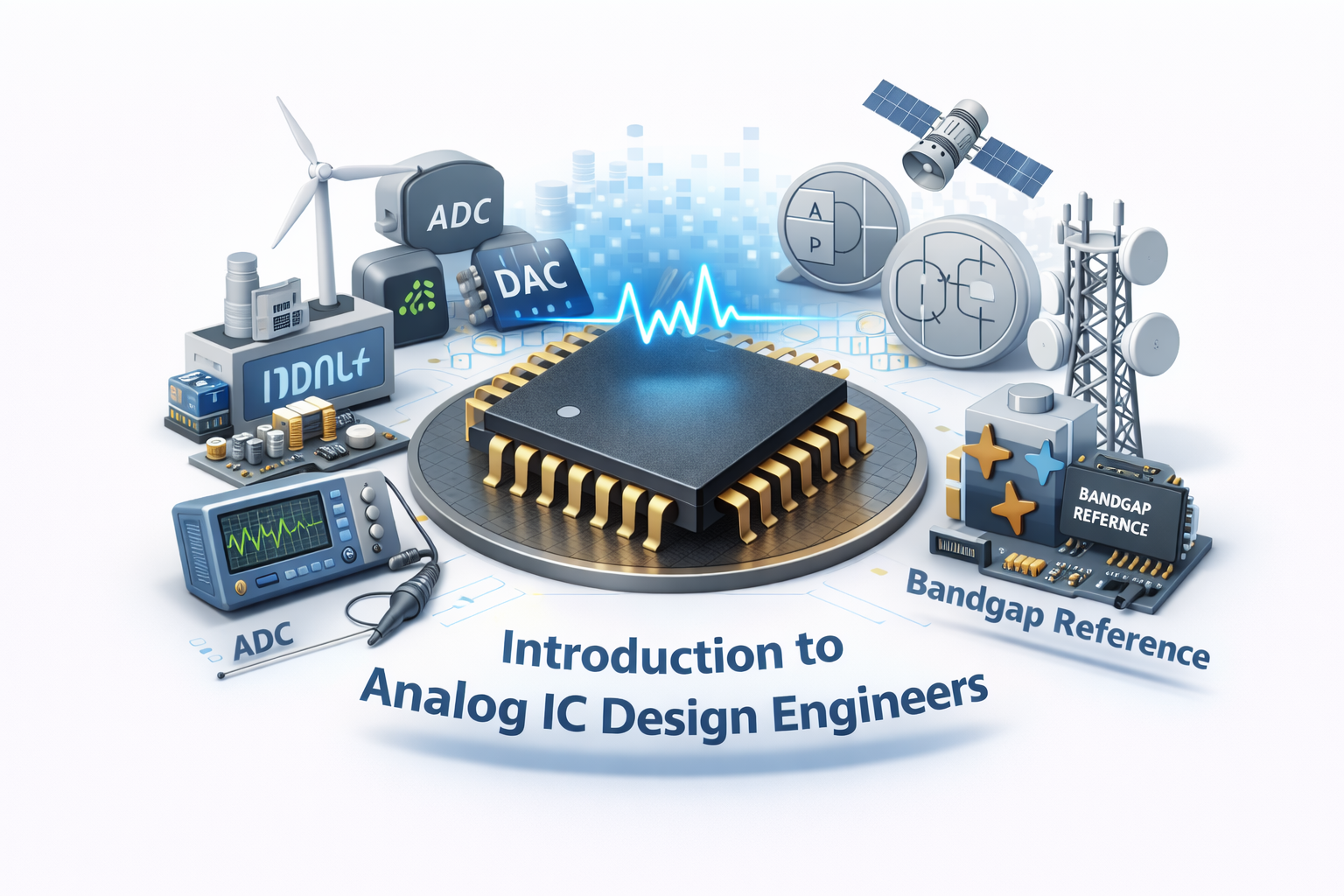
Analog IC design is a fundamental area of the semiconductor industry that focuses on creating integrated circuits capable of processing continuous signals such as voltage, current, sound, and radio frequencies. Unlike digital circuits that operate using binary logic, analog circuits interact directly with real-world signals, making them essential for applications like audio processing, wireless communication, sensor interfaces, and power management systems. Analog ICs are used in a wide range of electronic devices including smartphones, automotive systems, medical equipment, and IoT devices. As modern electronics continue to demand higher performance, efficiency, and miniaturization, analog circuit design has become a critical component in advanced semiconductor technologies.
In the semiconductor design flow, analog IC design involves creating and optimizing circuits such as amplifiers, oscillators, voltage regulators, data converters (ADC/DAC), and phase-locked loops (PLLs). Engineers use specialized electronic design automation (EDA) tools like Cadence Virtuoso and SPICE simulators to design, simulate, and verify circuit performance before fabrication. Analog designers must carefully consider parameters such as noise, power consumption, gain, linearity, and signal integrity to ensure reliable operation. With the rapid growth of industries like electric vehicles, artificial intelligence hardware, and wireless communication technologies, the demand for skilled analog IC designers continues to increase across global semiconductor companies.
What is an Analog IC Design Engineer? Roles and Responsibilities
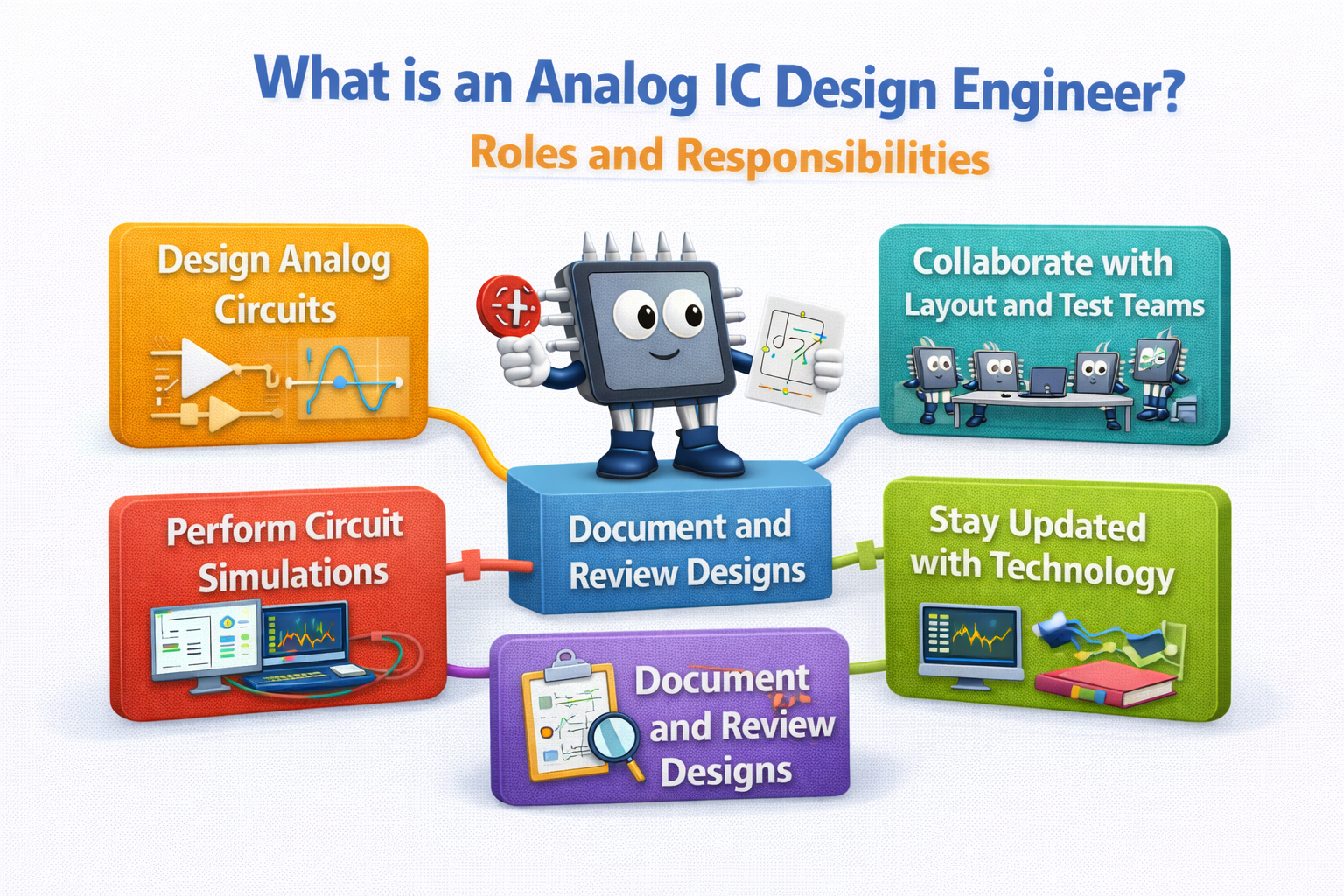
An Analog IC Design Engineer is a semiconductor professional responsible for designing and developing integrated circuits that process continuous electrical signals such as voltage, current, frequency, and analog waveforms. These engineers work at the transistor and circuit level to create high-performance analog blocks used in modern electronic systems. Analog IC designers play a critical role in developing components like operational amplifiers, voltage regulators, data converters (ADC/DAC), phase-locked loops (PLLs), and RF circuits. Their work ensures that electronic devices can accurately interact with real-world signals, which is essential for applications in smartphones, automotive electronics, communication systems, and medical devices.
One of the primary responsibilities of an Analog IC Design Engineer is to design circuit schematics and perform detailed simulations to verify performance before chip fabrication. Engineers use advanced Electronic Design Automation (EDA) tools such as Cadence Virtuoso, SPICE simulators, and layout tools to analyze parameters like gain, bandwidth, noise, power consumption, and signal integrity. They must also collaborate closely with layout engineers to ensure that the physical layout of the circuit meets design specifications while minimizing parasitic effects that can impact circuit performance. Thorough testing and verification are essential steps to guarantee that the analog circuits function correctly across different operating conditions.
In addition to design and simulation, Analog IC Design Engineers are responsible for debugging, optimizing, and validating circuits during different stages of the chip development process. They analyze silicon test results after fabrication, identify performance issues, and refine designs for future revisions. Strong knowledge of semiconductor physics, device modeling, and circuit theory is crucial for solving complex design challenges. As semiconductor technologies continue to evolve with smaller process nodes and more complex systems-on-chip (SoCs), the role of analog IC designers remains highly important in ensuring reliable and efficient electronic products.
Importance of Analog IC Design in Modern Electronic Systems
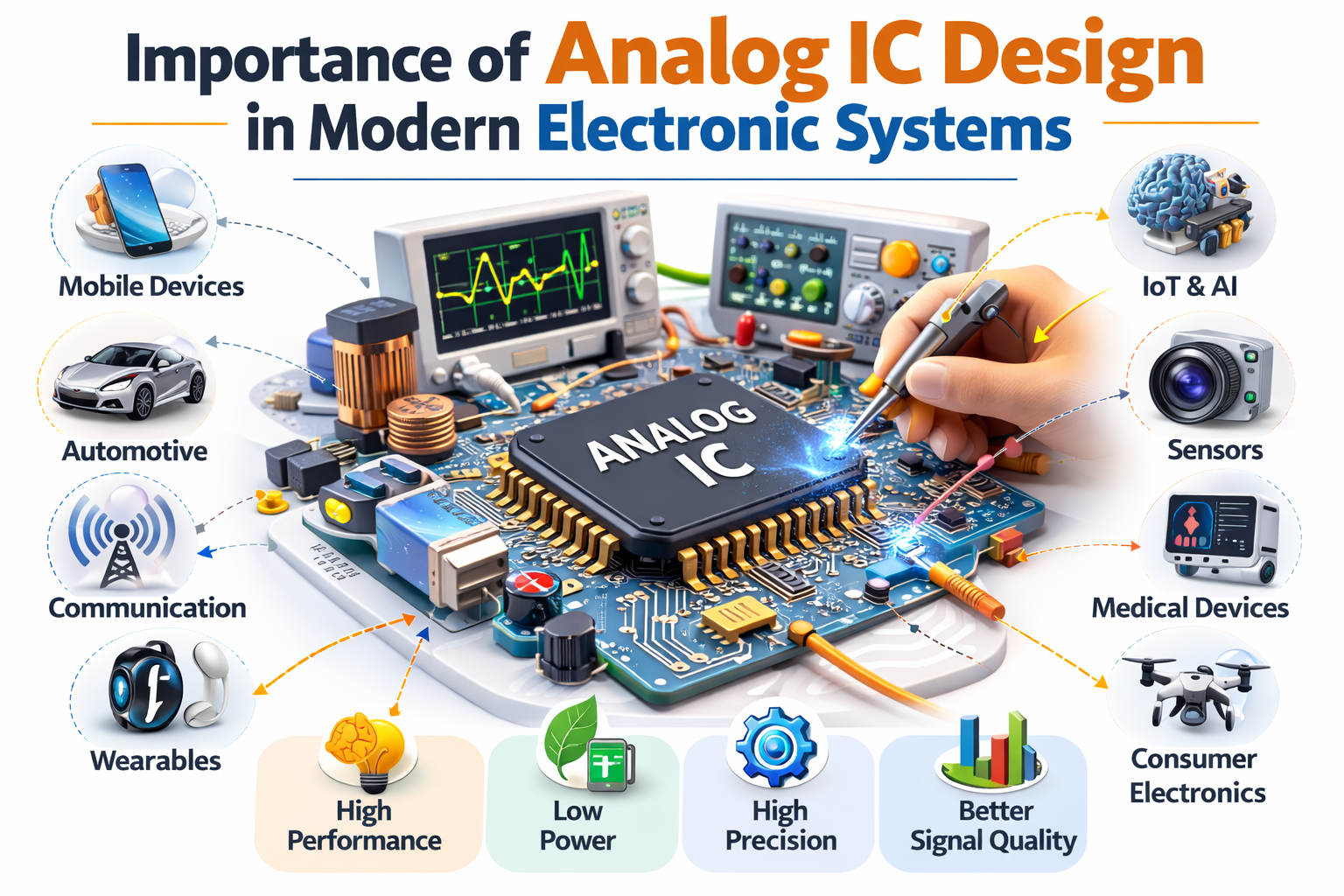
Analog IC design plays a crucial role in modern electronic systems because it enables devices to interact with real-world signals such as sound, temperature, light, and radio frequencies. While digital circuits process binary data, analog circuits serve as the bridge between the physical environment and digital processing units. Components such as amplifiers, voltage regulators, filters, and data converters are essential analog blocks that ensure signals are accurately captured, conditioned, and converted for digital processing. Without efficient analog IC design, modern technologies like smartphones, wireless communication systems, and medical electronics would not function reliably.
In today’s semiconductor industry, the importance of analog IC design has grown significantly with the rise of technologies such as IoT, electric vehicles, artificial intelligence hardware, and 5G communication. Analog circuits are responsible for power management, sensor interfaces, signal conditioning, and high-frequency communication, all of which are critical for performance and energy efficiency. Engineers must carefully design these circuits to handle challenges such as noise reduction, power optimization, and signal integrity. As electronic systems become more complex and integrated, analog IC design remains a fundamental element in delivering reliable, high-performance semiconductor solutions.
Key Analog Circuits Designed by Analog IC Engineers
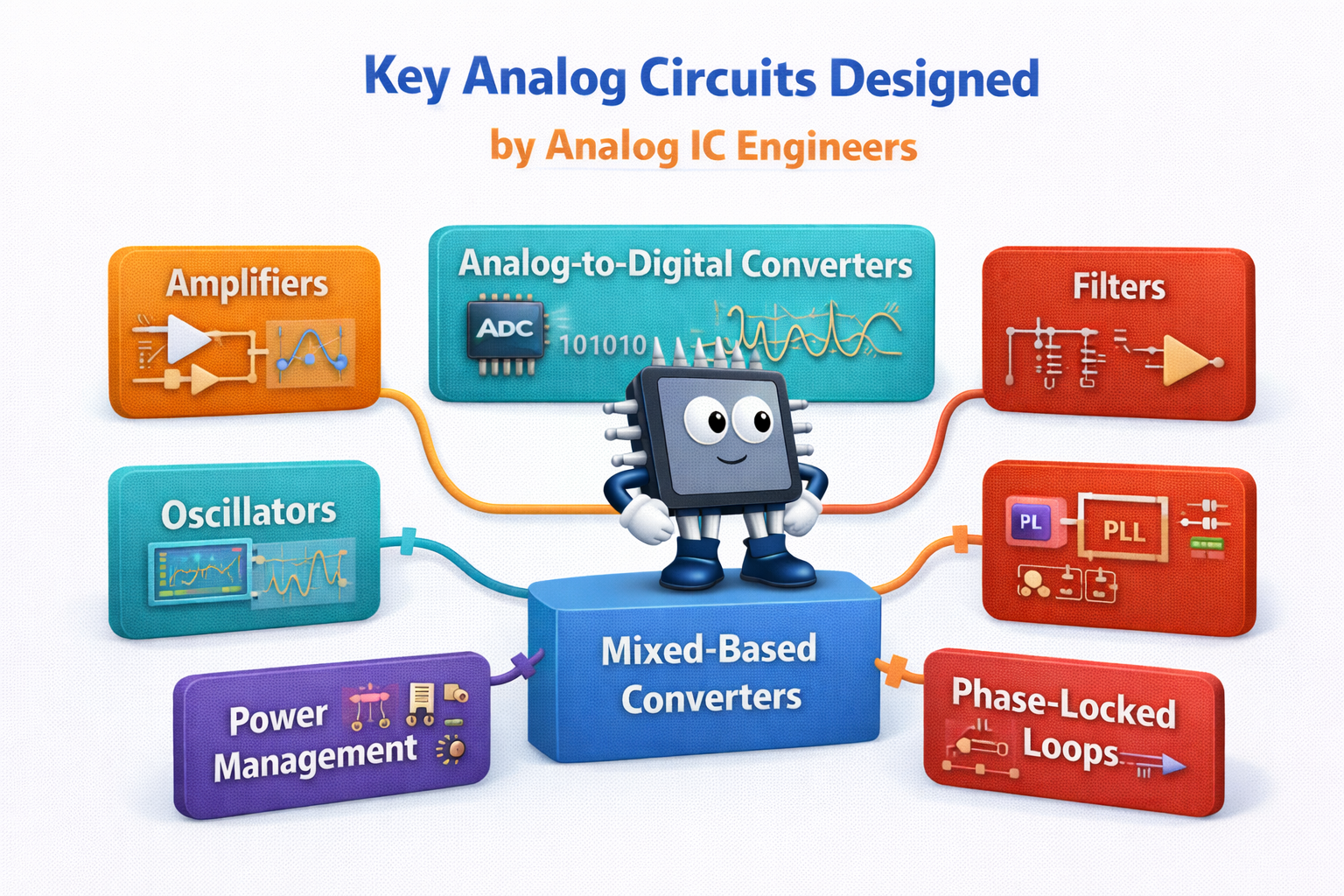
Analog IC engineers design a wide range of fundamental circuits that enable electronic systems to process real-world signals efficiently. One of the most common analog circuits is the operational amplifier (op-amp), which is widely used for signal amplification, filtering, and mathematical operations in electronic systems. Amplifiers are essential in applications such as audio devices, sensor interfaces, and communication systems where weak signals must be strengthened for further processing. Analog designers also create comparators and filters that help analyze and condition signals by removing noise and extracting useful information from continuous waveforms.
Another important category of analog circuits includes data converters, such as Analog-to-Digital Converters (ADCs) and Digital-to-Analog Converters (DACs). These circuits act as a bridge between the analog and digital worlds by converting real-world signals into digital data that processors can understand, and vice versa. ADCs are commonly used in sensors, imaging systems, and communication devices, while DACs are used in audio systems, control systems, and signal generation. Designing these circuits requires careful consideration of parameters such as resolution, sampling rate, accuracy, and power consumption to ensure reliable performance in integrated circuits.
Analog IC engineers also design critical power management and timing circuits that support the operation of modern semiconductor devices. Examples include voltage regulators, Low Dropout Regulators (LDOs), DC-DC converters, oscillators, and Phase-Locked Loops (PLLs). Power management circuits ensure stable voltage supply and energy efficiency in devices like smartphones, laptops, and automotive electronics. Timing circuits such as oscillators and PLLs generate precise clock signals required for synchronization in digital and mixed-signal systems. Together, these analog circuit blocks form the backbone of complex integrated circuits used across the semiconductor industry.
Essential Skills Required to Become an Analog IC Design Engineer
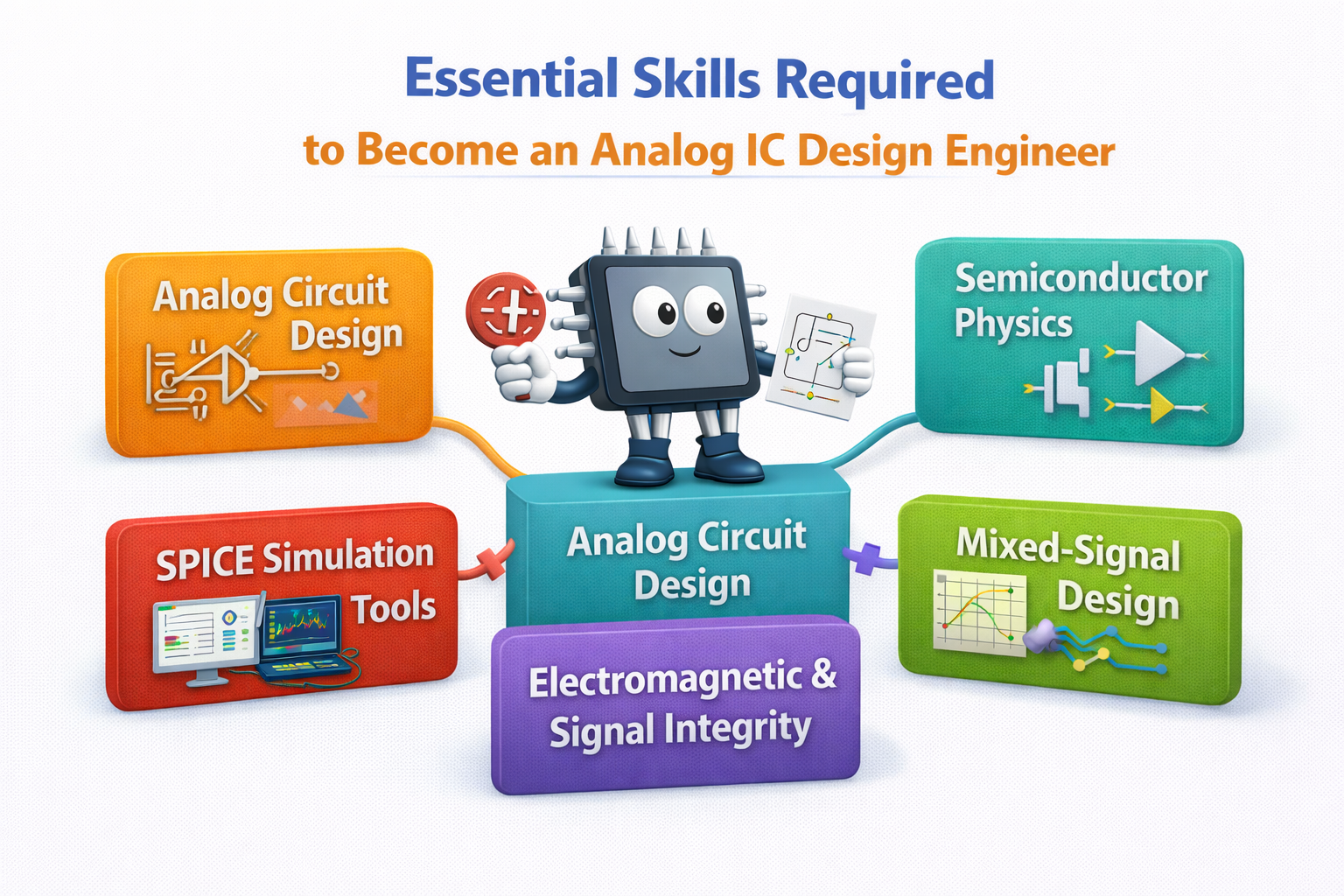
To become a successful Analog IC Design Engineer, strong fundamentals in electronics and semiconductor theory are essential. Engineers must have a deep understanding of analog circuit design concepts such as transistor operation, small-signal analysis, feedback systems, noise analysis, and frequency response. Knowledge of key analog building blocks like operational amplifiers, current mirrors, bandgap references, and data converters is also important. In addition, a solid grasp of semiconductor physics, MOSFET behavior, and device modeling helps engineers design efficient and reliable circuits at the transistor level. These core technical skills allow analog designers to solve complex design challenges and optimize circuit performance in integrated circuits.
Apart from theoretical knowledge, Analog IC engineers must be proficient in industry-standard Electronic Design Automation (EDA) tools and simulation environments. Tools such as Cadence Virtuoso, SPICE simulators, and layout verification tools are widely used to design, simulate, and validate analog circuits before fabrication. Engineers also need strong problem-solving skills, attention to detail, and the ability to analyze parameters like gain, noise, power consumption, and stability. Effective collaboration with layout engineers, verification teams, and system designers is another important skill in the semiconductor design process. By combining strong technical expertise with practical design experience, engineers can build a successful career in analog IC design within the semiconductor industry.
Career Path of an Analog IC Design Engineer (Entry-Level to Senior Roles)
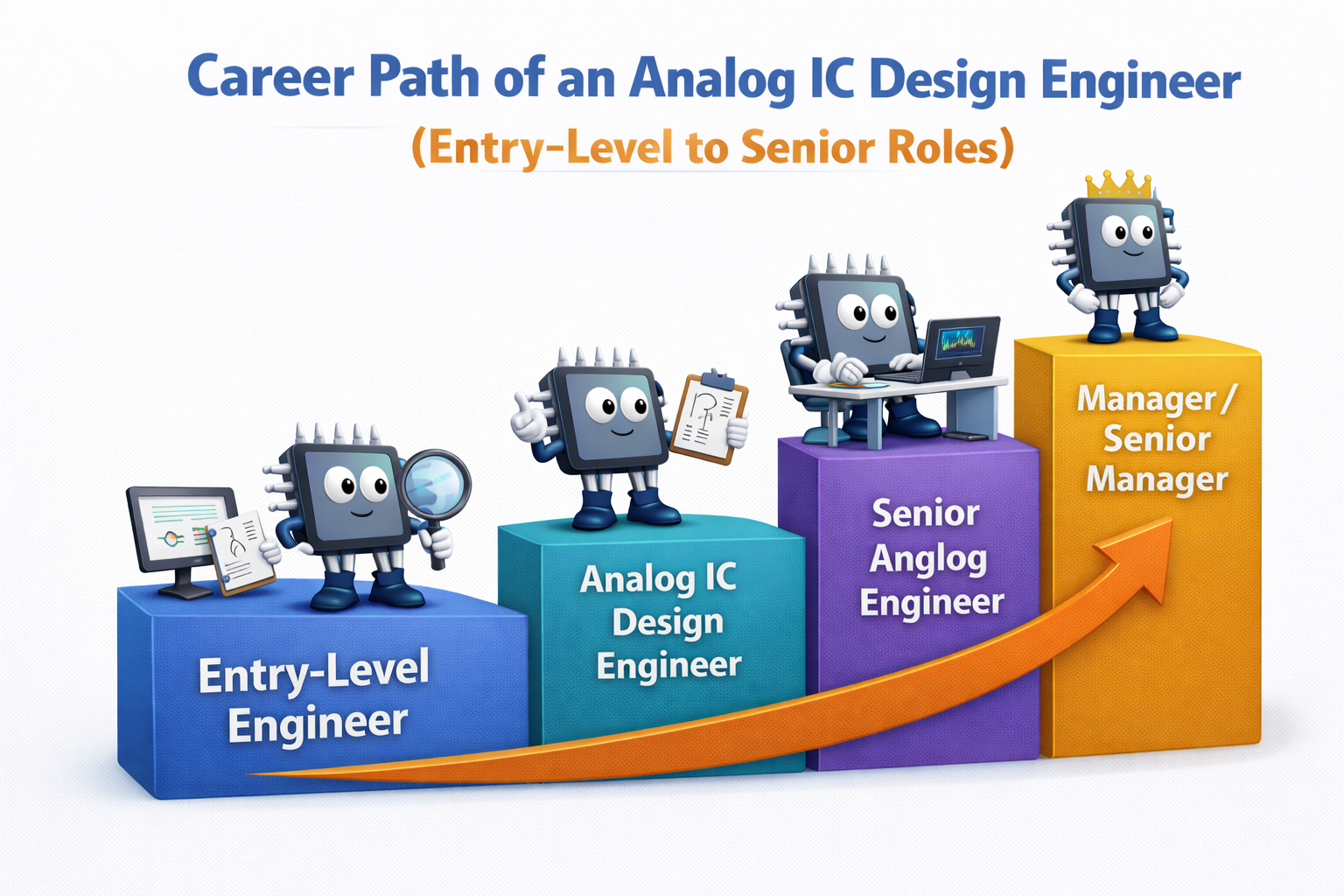
The career path of an Analog IC Design Engineer typically begins with entry-level positions where engineers build strong foundations in analog circuit design and semiconductor fundamentals. Fresh graduates usually start as Junior Analog Design Engineers, Analog Design Engineers, or Analog Circuit Engineers, working under the guidance of senior engineers. In these roles, they assist in schematic design, circuit simulations, and performance analysis using EDA tools such as Cadence Virtuoso and SPICE. Entry-level engineers focus on understanding analog building blocks like amplifiers, current mirrors, voltage references, and data converters while learning how to optimize circuits for parameters such as gain, power consumption, and noise.
After gaining several years of experience, engineers progress to mid-level roles such as Senior Analog IC Design Engineer or Lead Analog Engineer. At this stage, professionals take greater responsibility for designing complex analog blocks used in integrated circuits, including PLLs, ADCs, DACs, and power management circuits. They work closely with layout engineers to ensure that physical layouts meet design requirements while minimizing parasitic effects. Mid-level engineers are also involved in design reviews, debugging silicon issues, and improving circuit performance across different operating conditions and semiconductor process technologies.
With extensive industry experience, engineers can advance to senior leadership roles such as Principal Analog IC Designer, Analog Architect, or Technical Director. In these positions, they define high-level circuit architectures for complex semiconductor chips and guide teams of engineers through the entire analog design process. Senior experts play a key role in innovation, technology development, and strategic decision-making within semiconductor companies. Many experienced analog IC engineers also move into specialized domains such as RF design, mixed-signal system architecture, or technical management, contributing to the development of next-generation semiconductor technologies.
Industries Hiring Analog IC Design Engineers

Analog IC Design Engineers are in high demand across multiple industries that rely on advanced semiconductor technology. The semiconductor manufacturing industry is the primary employer, with companies designing chips for various electronic applications such as consumer electronics, communication systems, and computing devices. Major semiconductor firms develop analog and mixed-signal integrated circuits used in smartphones, laptops, wearable devices, and networking hardware. These engineers work on designing critical circuit blocks such as amplifiers, power management ICs, and data converters that ensure reliable performance in modern electronic products.
Apart from semiconductor companies, Analog IC Design Engineers are also employed in industries such as automotive electronics, telecommunications, healthcare technology, and industrial automation. In the automotive sector, analog ICs are essential for electric vehicles, battery management systems, sensor interfaces, and advanced driver-assistance systems (ADAS). Telecommunications companies rely on analog and RF circuits for wireless communication technologies such as 5G and satellite systems. Additionally, medical device manufacturers use analog circuits in imaging equipment, diagnostic devices, and wearable health monitors. As technology continues to advance with IoT, AI hardware, and smart systems, the demand for skilled analog IC design engineers is expected to grow across many high-tech industries.
Challenges Faced by Analog IC Designers in Modern Semiconductor Technology
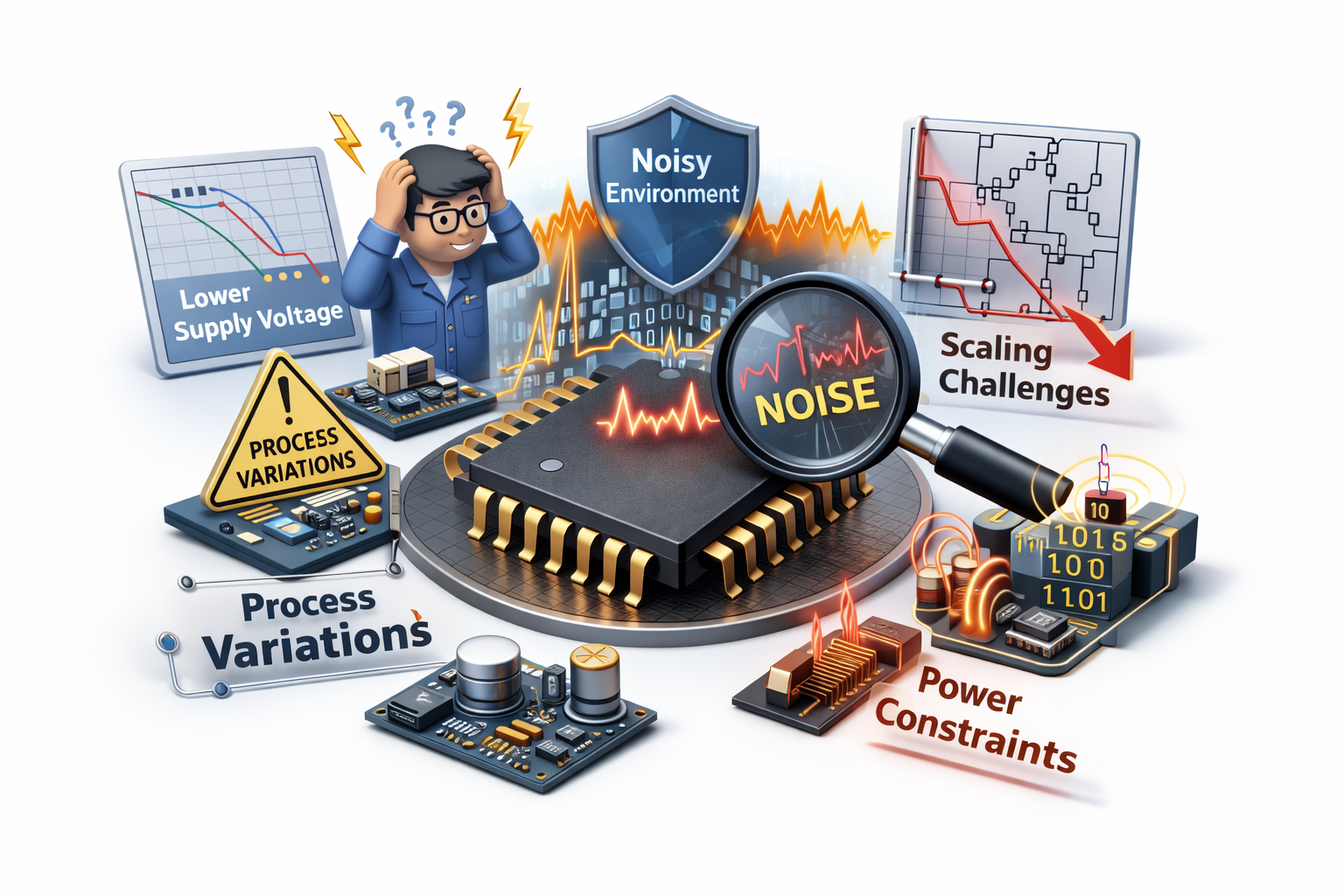
Analog IC designers face several technical challenges in modern semiconductor technology as devices continue to scale to smaller process nodes. One of the major challenges is device scaling and reduced supply voltages, which significantly impact analog circuit performance. As transistor sizes shrink, maintaining parameters such as gain, linearity, and signal swing becomes more difficult. Lower supply voltages limit the headroom available for analog circuits, making it challenging to design high-performance amplifiers and voltage regulators while maintaining stability and efficiency.
Another major challenge is noise, signal integrity, and process variations in advanced semiconductor processes. Analog circuits are highly sensitive to noise and interference, especially in mixed-signal systems where analog and digital circuits coexist on the same chip. Designers must carefully manage sources of noise such as thermal noise, flicker noise, and coupling effects from nearby digital blocks. Additionally, variations in semiconductor manufacturing processes can cause changes in transistor characteristics, which can affect circuit behavior. Engineers must perform extensive simulations and design techniques such as calibration, trimming, and robust biasing to ensure reliable performance across different operating conditions.
Power consumption and design complexity also present significant challenges for modern analog IC designers. With the growing demand for energy-efficient devices such as smartphones, wearable electronics, and IoT sensors, designers must create circuits that operate with extremely low power while maintaining high performance. At the same time, integrated circuits are becoming more complex, combining analog, digital, RF, and power management blocks within a single chip. This increases design complexity and requires engineers to collaborate closely with layout, verification, and system teams. Overcoming these challenges requires strong expertise in circuit design, semiconductor physics, and advanced simulation techniques.
Future Scope of Analog IC Design in the Semiconductor Industry

The future scope of Analog IC design in the semiconductor industry remains very strong as modern electronic systems continue to rely on analog circuits to interact with real-world signals. Even with the rapid growth of digital technologies, analog circuits are essential for functions such as signal amplification, power management, sensor interfaces, and data conversion. Emerging technologies like Internet of Things (IoT), artificial intelligence hardware, electric vehicles, and 5G/6G communication systems require highly efficient analog and mixed-signal circuits to handle real-time signals and energy management. As semiconductor devices become more advanced and integrated, analog IC designers will play a critical role in ensuring reliable and high-performance chip operation.
The demand for skilled analog IC engineers is expected to grow as industries continue to adopt advanced semiconductor solutions. Areas such as automotive electronics, renewable energy systems, biomedical devices, and high-speed communication technologies are creating new opportunities for analog circuit innovation. Additionally, modern System-on-Chip (SoC) designs integrate analog, digital, and RF blocks on the same chip, increasing the need for engineers who can design complex analog circuits that meet strict performance and power requirements. With continuous advancements in semiconductor technology and global investments in chip manufacturing, analog IC design remains one of the most valuable and future-proof career paths in the semiconductor industry.
Conclusion
In conclusion, the role of an Analog IC Design Engineer is one of the most critical and specialized positions in the semiconductor industry. Analog circuits form the foundation that allows electronic systems to interact with real-world signals such as sound, temperature, and radio frequencies. From designing amplifiers and data converters to developing power management and communication circuits, analog engineers play a key role in building reliable and high-performance semiconductor devices. With the rapid advancement of technologies like IoT, electric vehicles, artificial intelligence hardware, and wireless communication, the demand for skilled analog IC designers continues to grow across global technology companies.
For students and professionals interested in semiconductor careers, analog IC design offers a challenging yet highly rewarding path. By developing strong fundamentals in electronics, mastering industry-standard design tools, and gaining hands-on experience with circuit design and simulation, aspiring engineers can build a successful career in this field. As the semiconductor industry continues to expand and innovate, analog IC designers will remain essential in shaping the next generation of electronic systems and integrated circuits used across modern technology.