


Analog vs Digital VLSI Jobs: Which Career Path Should You Choose?
Navigate through this article using the table of contents below
Table of Contents
No headings found in this article.
The semiconductor industry is evolving rapidly, and VLSI (Very Large Scale Integration) careers are becoming one of the most sought-after paths for electronics engineers. Among the many career options in this field, Analog VLSI and Digital VLSI jobs stand out as two major domains that drive modern chip design. From smartphones and AI processors to automotive electronics and IoT devices, both analog and digital circuits play critical roles in semiconductor technology. However, many aspiring engineers often struggle with one important question: Should they choose Analog VLSI or Digital VLSI as their career path?
Understanding the difference between Analog vs Digital VLSI jobs is essential for making the right career decision in the semiconductor industry. Analog VLSI focuses on designing circuits that process continuous signals, such as amplifiers, power management ICs, and RF systems, while Digital VLSI deals with logic-based systems used in processors, memory, and complex digital chips. Each domain requires different skill sets, tools, and design methodologies. In this article, we will explore the key differences, required skills, career opportunities, and future scope of both Analog and Digital VLSI careers, helping you determine which path aligns best with your interests and professional goals.
Introduction to VLSI Careers in the Semiconductor Industry
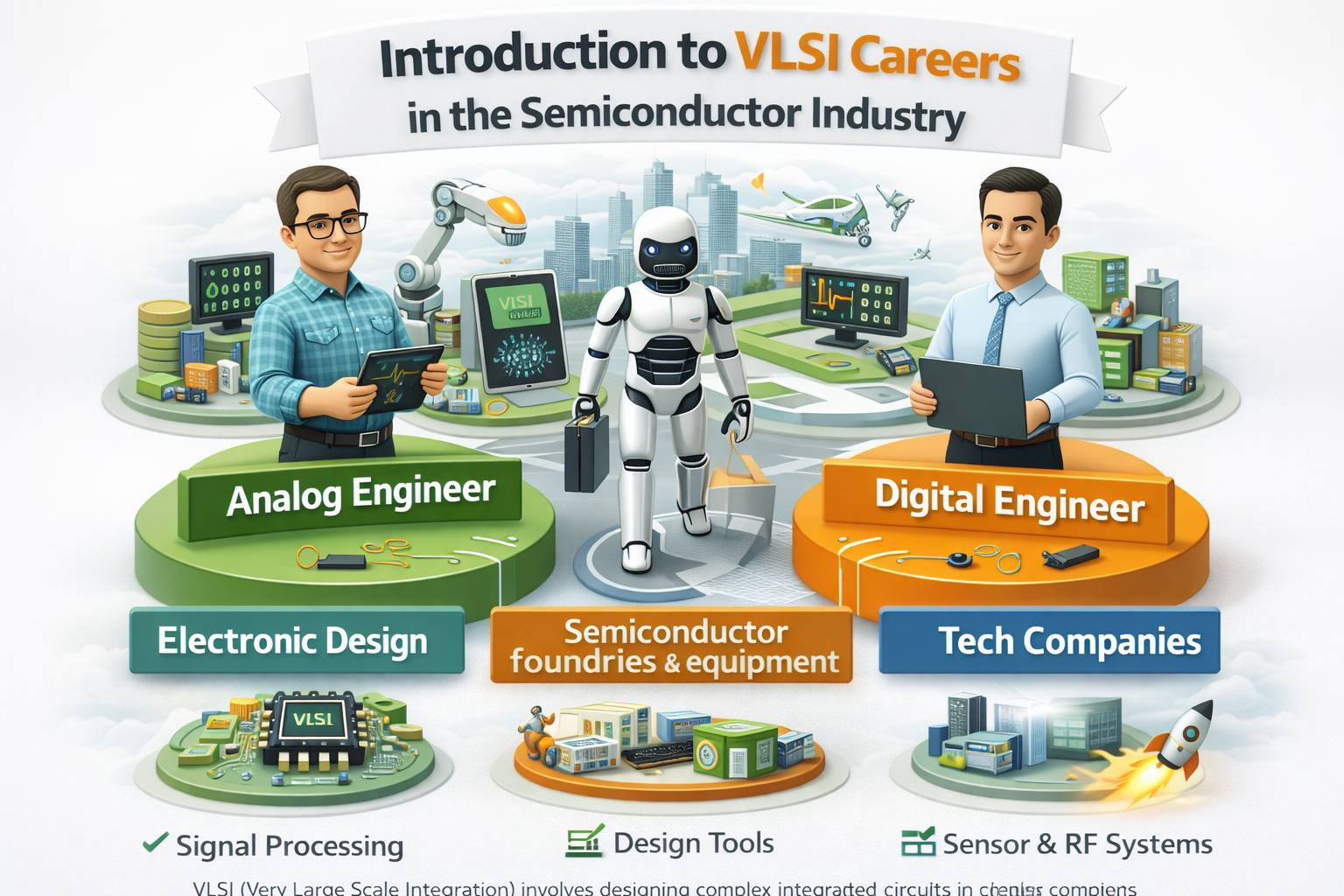
The VLSI (Very Large Scale Integration) industry is a fundamental pillar of the modern semiconductor ecosystem, enabling the design and manufacturing of complex integrated circuits that power today’s electronic devices. From smartphones, laptops, and AI accelerators to automotive electronics and IoT systems, VLSI technology is responsible for integrating millions or even billions of transistors onto a single chip. As global demand for advanced electronics continues to grow, the semiconductor industry is expanding rapidly, creating a wide range of career opportunities for engineers specializing in chip design, verification, testing, and fabrication.
A career in VLSI design offers diverse roles across both front-end and back-end domains of semiconductor development. Front-end roles typically include RTL design, digital verification, and analog circuit design, where engineers focus on defining and validating the logical functionality of a chip. Back-end roles, such as physical design, layout engineering, and timing analysis, ensure that the chip design can be successfully manufactured while meeting performance, power, and area constraints. With the increasing complexity of modern System-on-Chip (SoC) architectures, companies are constantly seeking skilled VLSI engineers who can work with advanced EDA tools and design methodologies.
The rapid evolution of technologies like artificial intelligence, 5G communication, autonomous vehicles, and high-performance computing has further increased the demand for skilled semiconductor professionals. Governments and technology companies around the world are investing heavily in semiconductor manufacturing and chip design innovation, making VLSI one of the most promising career paths for electronics and electrical engineering graduates. For aspiring engineers, building strong fundamentals in digital logic, semiconductor devices, and circuit design can open the door to rewarding and high-growth opportunities in the global semiconductor industry.
What is Analog VLSI? Understanding Analog Circuit Design

Analog VLSI refers to the design and development of integrated circuits that process continuous electrical signals rather than discrete digital values. In analog circuit design, engineers work with parameters such as voltage, current, frequency, and noise to create circuits that can accurately handle real-world signals. These circuits are essential in many semiconductor applications, including amplifiers, voltage regulators, oscillators, phase-locked loops (PLLs), analog-to-digital converters (ADC), and digital-to-analog converters (DAC). Since most real-world signals—such as sound, temperature, and radio waves—are analog in nature, analog VLSI plays a crucial role in bridging the gap between the physical world and digital processing systems.
Analog VLSI design requires a deep understanding of semiconductor physics, transistor-level circuit design, and signal integrity. Engineers must carefully optimize circuits for performance factors such as gain, bandwidth, power consumption, linearity, and noise reduction. Unlike digital design, where logic states are either 0 or 1, analog circuits operate across a continuous range of values, making the design process more sensitive to variations in manufacturing and environmental conditions. As a result, analog VLSI engineers rely heavily on advanced simulation tools and precise layout techniques to ensure that the circuit functions reliably when fabricated in silicon.
What is Digital VLSI? Understanding Digital Chip Design
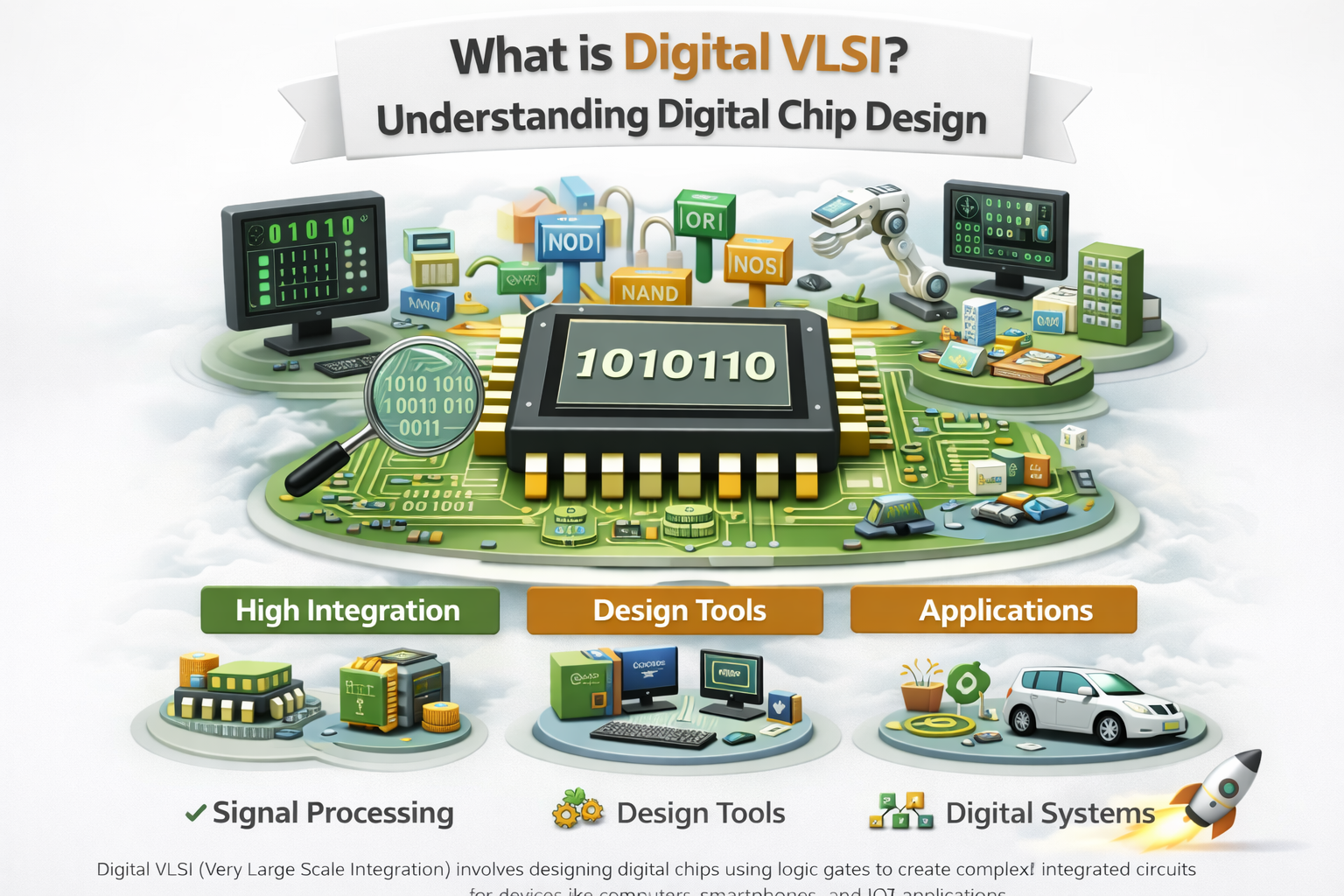
Digital VLSI refers to the design and development of integrated circuits that process discrete digital signals, typically represented as binary values (0 and 1). In digital chip design, engineers create complex electronic systems using logic gates, flip-flops, registers, and other digital components to perform computation and data processing. Digital VLSI is the foundation behind modern processors, memory chips, graphics processing units (GPUs), and System-on-Chip (SoC) architectures used in smartphones, computers, networking devices, and AI hardware. The design process usually begins with Register Transfer Level (RTL) design, where hardware functionality is described using hardware description languages such as Verilog or VHDL.
The digital VLSI design flow involves several stages, including RTL coding, functional verification, synthesis, timing analysis, and physical design, to ensure that the chip operates correctly and efficiently when manufactured. Engineers use advanced Electronic Design Automation (EDA) tools to simulate and validate the design before it is fabricated in silicon. Compared to analog design, digital VLSI focuses more on logical operations and system architecture rather than continuous signal behavior. With the rapid growth of technologies such as artificial intelligence, cloud computing, and high-performance processors, digital VLSI engineers are in high demand across the semiconductor industry.
Key Differences Between Analog and Digital VLSI Design
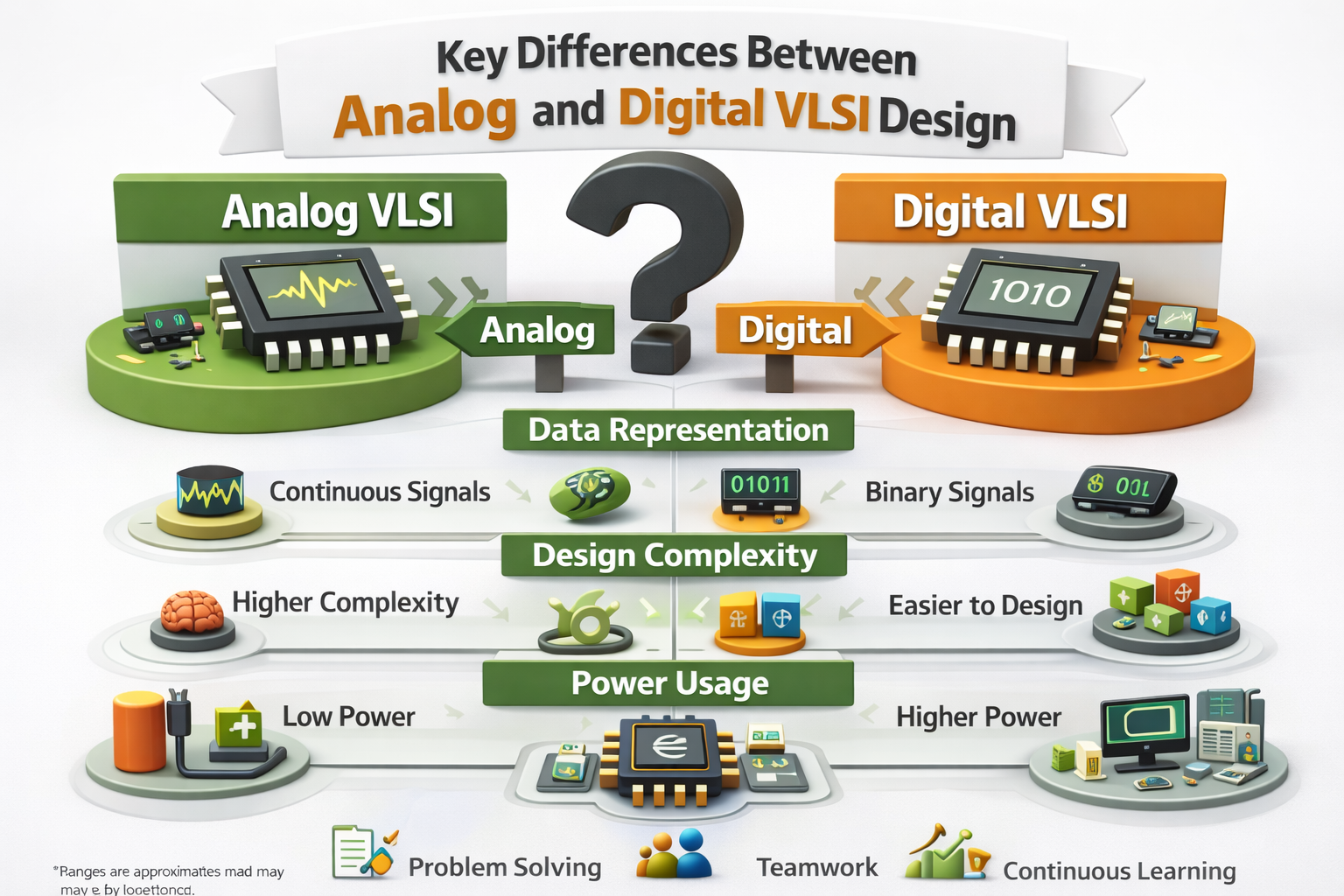
Understanding the key differences between Analog and Digital VLSI design is essential for engineers planning a career in semiconductor chip development. The primary distinction lies in the type of signals each domain handles. Analog VLSI design deals with continuous signals that can vary smoothly over a range of voltages or currents, which are common in real-world phenomena such as sound, temperature, and radio signals. In contrast, Digital VLSI design processes discrete binary signals represented by logic levels, typically 0 and 1. Because of this fundamental difference, analog circuits focus on signal accuracy and linearity, while digital circuits emphasize logical operations, data processing, and computational efficiency.
Another major difference lies in the design methodology and complexity of analysis. Analog VLSI engineers typically work at the transistor level, carefully designing circuits such as amplifiers, oscillators, and power management blocks. These circuits must be optimized for parameters like gain, noise, power consumption, and signal integrity, making the design process highly sensitive to manufacturing variations and environmental factors. On the other hand, digital VLSI engineers usually design systems using hardware description languages (HDLs) such as Verilog or VHDL at the RTL level. Their designs are then synthesized into gate-level circuits and further optimized during the physical design stage using automated EDA tools.
The tools, skills, and applications in both domains also differ significantly. Analog VLSI designers often use tools like Cadence Virtuoso and Spectre for circuit simulation and layout verification, requiring strong knowledge of semiconductor devices and analog signal behavior. Digital VLSI engineers rely on tools such as Synopsys Design Compiler, Cadence Genus, and simulation platforms for RTL verification and synthesis. In terms of applications, analog circuits are widely used in RF communication systems, power management ICs, and sensor interfaces, while digital circuits dominate in microprocessors, memory chips, AI accelerators, and digital signal processing systems. Together, both analog and digital VLSI domains work collaboratively to build complete semiconductor systems.
Skills Required for Analog VLSI Engineers
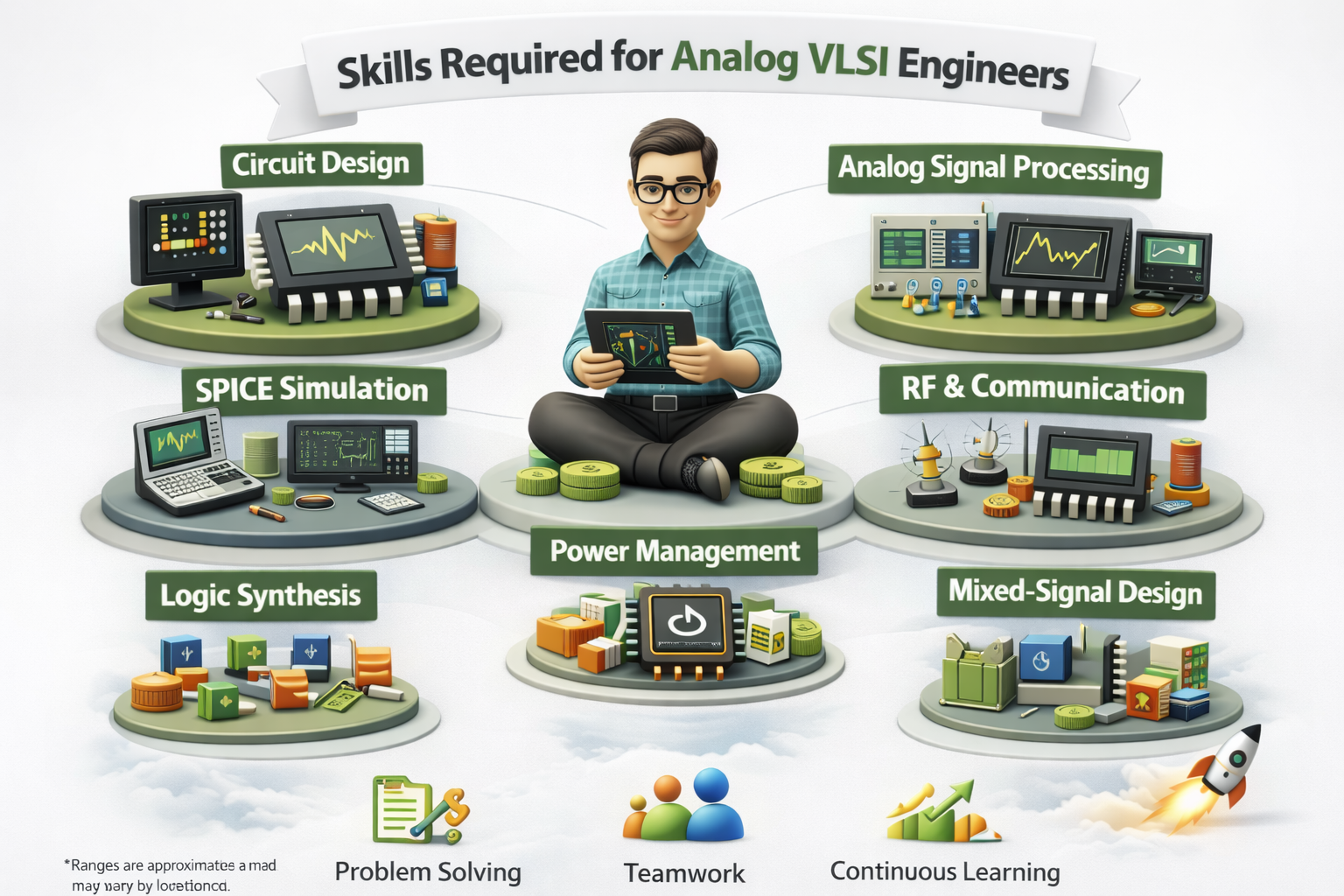
To build a successful career in Analog VLSI design, engineers must develop strong fundamentals in semiconductor devices, electronic circuits, and analog signal processing. Analog VLSI engineers work primarily at the transistor level, designing circuits such as amplifiers, voltage regulators, phase-locked loops (PLLs), and data converters like ADCs and DACs. A solid understanding of concepts such as gain, bandwidth, noise, stability, linearity, and power consumption is essential for creating high-performance analog circuits. Engineers must also be proficient in analyzing circuit behavior under different operating conditions to ensure reliable performance when the chip is fabricated.
In addition to theoretical knowledge, practical skills and tool expertise are equally important in analog VLSI design. Engineers commonly use industry-standard EDA tools such as Cadence Virtuoso, Spectre, and SPICE simulators to design, simulate, and validate analog circuits before manufacturing. Knowledge of analog layout techniques, parasitic effects, and device matching is also critical to ensure that the circuit performs correctly on silicon. Strong problem-solving ability, attention to detail, and a deep understanding of circuit behavior are key qualities that help analog VLSI engineers develop efficient and robust semiconductor designs.
Skills Required for Digital VLSI Engineers
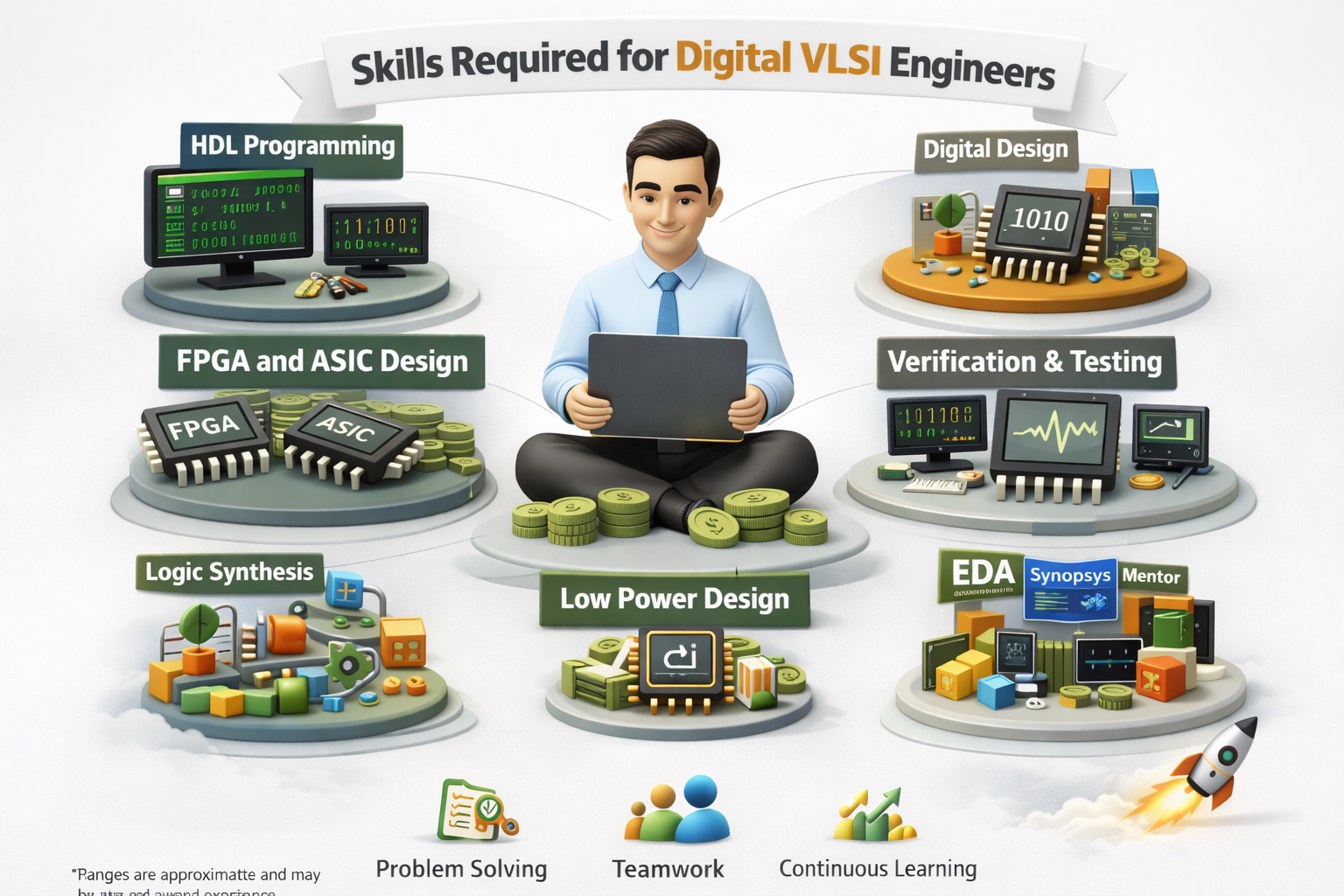
To build a successful career in Digital VLSI design, engineers must have a strong foundation in digital electronics, computer architecture, and logic design. Digital VLSI engineers work with binary logic systems to design complex integrated circuits such as microprocessors, memory units, and System-on-Chip (SoC) architectures. A deep understanding of logic gates, finite state machines (FSMs), combinational and sequential circuits, and timing concepts is essential for creating reliable digital hardware. In addition, engineers must be proficient in hardware description languages (HDLs) such as Verilog, SystemVerilog, or VHDL, which are used to describe and implement digital circuits at the Register Transfer Level (RTL).
Beyond theoretical knowledge, digital VLSI engineers must also be skilled in using Electronic Design Automation (EDA) tools and verification methodologies that ensure a chip functions correctly before fabrication. Tools such as Synopsys Design Compiler, Cadence Genus, ModelSim, and VCS are widely used for synthesis, simulation, and functional verification. Knowledge of timing analysis, scripting languages like Python or TCL, and debugging techniques is also valuable in modern digital design environments. With the increasing complexity of semiconductor chips, strong analytical thinking, coding proficiency, and the ability to work with advanced design flows are crucial skills for digital VLSI engineers.
Career Opportunities in Analog VLSI Jobs
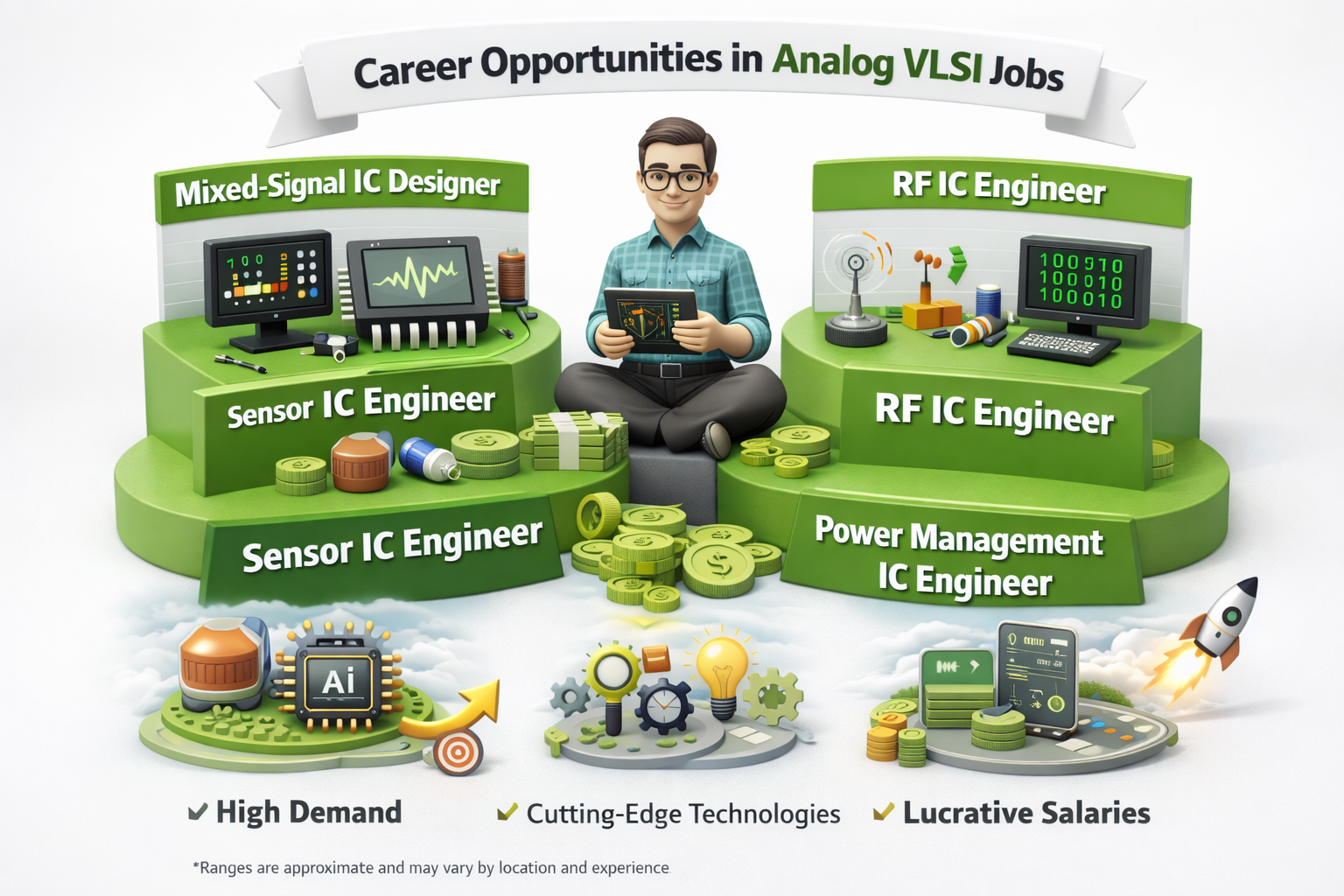
The field of Analog VLSI design offers a wide range of career opportunities within the semiconductor industry, especially as modern electronic systems continue to rely heavily on precise signal processing and power management circuits. Analog VLSI engineers are responsible for designing circuits that handle real-world signals, making them essential for applications such as communication systems, sensors, and power electronics. Common job roles in this domain include Analog Design Engineer, Mixed-Signal Design Engineer, RF IC Designer, and Power Management IC (PMIC) Engineer. These professionals work on developing critical circuit blocks like amplifiers, oscillators, voltage regulators, phase-locked loops (PLLs), and analog-to-digital converters (ADCs).
Many leading semiconductor companies actively hire analog VLSI professionals to develop high-performance chips used in smartphones, automotive electronics, medical devices, and wireless communication systems. Engineers in this field often collaborate closely with digital designers and system architects to create mixed-signal integrated circuits, where both analog and digital components operate together on a single chip. Due to the complexity of analog circuit design and the limited number of specialized engineers in this domain, analog VLSI professionals are often considered highly valuable in the semiconductor job market.
As technologies like 5G communication, electric vehicles, IoT devices, and advanced sensor systems continue to grow, the demand for skilled analog VLSI engineers is expected to increase significantly. Career growth in this field can progress from entry-level roles such as Analog Circuit Design Engineer or Layout Engineer to senior positions like Senior Analog Designer, Analog Architect, or Technical Lead. With strong expertise in transistor-level design, circuit simulation, and analog layout optimization, engineers can build rewarding and long-term careers in the rapidly evolving semiconductor industry.
Career Opportunities in Digital VLSI Jobs
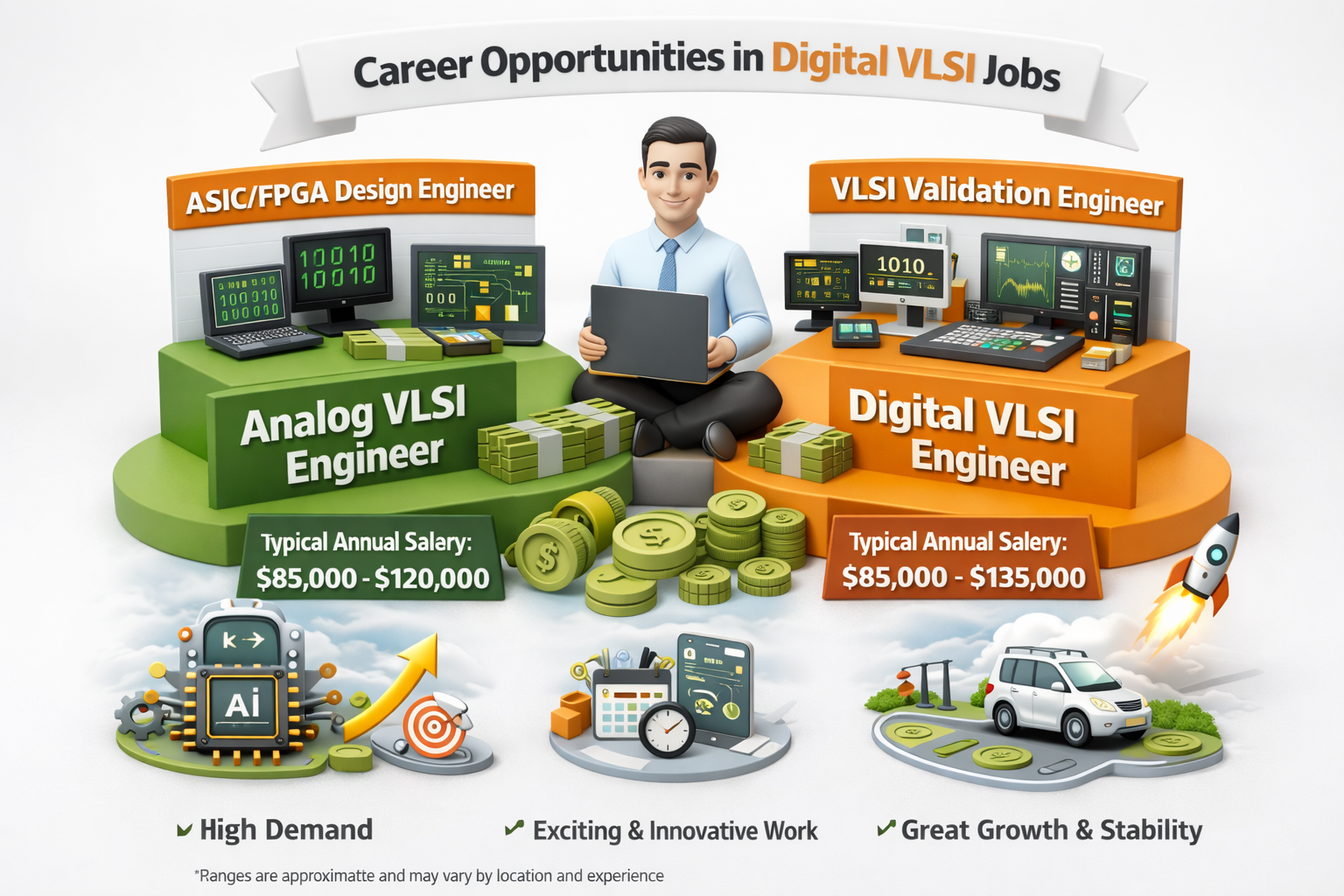
The field of Digital VLSI design offers a wide range of career opportunities in the semiconductor industry, as digital integrated circuits form the backbone of modern computing and electronic systems. Digital VLSI engineers are responsible for designing complex chips that perform data processing, control operations, and system-level functions. Common job roles in this domain include RTL Design Engineer, Verification Engineer, FPGA Design Engineer, and Physical Design Engineer. These professionals work on developing digital components such as processors, memory controllers, communication interfaces, and System-on-Chip (SoC) architectures used in smartphones, computers, networking equipment, and embedded systems.
Many global semiconductor companies and technology firms actively recruit digital VLSI engineers to design high-performance chips for applications like artificial intelligence, cloud computing, and high-speed networking. Engineers in this field typically work with hardware description languages such as Verilog, SystemVerilog, or VHDL to develop digital logic at the RTL level. They also use advanced Electronic Design Automation (EDA) tools for simulation, synthesis, timing analysis, and verification to ensure that the chip operates correctly before manufacturing. Due to the increasing complexity of modern processors and SoC designs, digital VLSI engineers are in strong demand across the industry.
Career growth in Digital VLSI jobs can progress from entry-level roles such as Junior RTL Engineer or Verification Engineer to senior positions like Senior Design Engineer, SoC Architect, or Technical Lead. With experience, engineers may also specialize in areas such as chip architecture, hardware verification methodologies, or advanced physical design techniques. As emerging technologies such as AI hardware accelerators, autonomous vehicles, 5G networks, and edge computing devices continue to evolve, the demand for skilled digital VLSI professionals is expected to remain strong, making it a promising and rewarding career path in the semiconductor industry.
Salary Comparison: Analog vs Digital VLSI Engineers
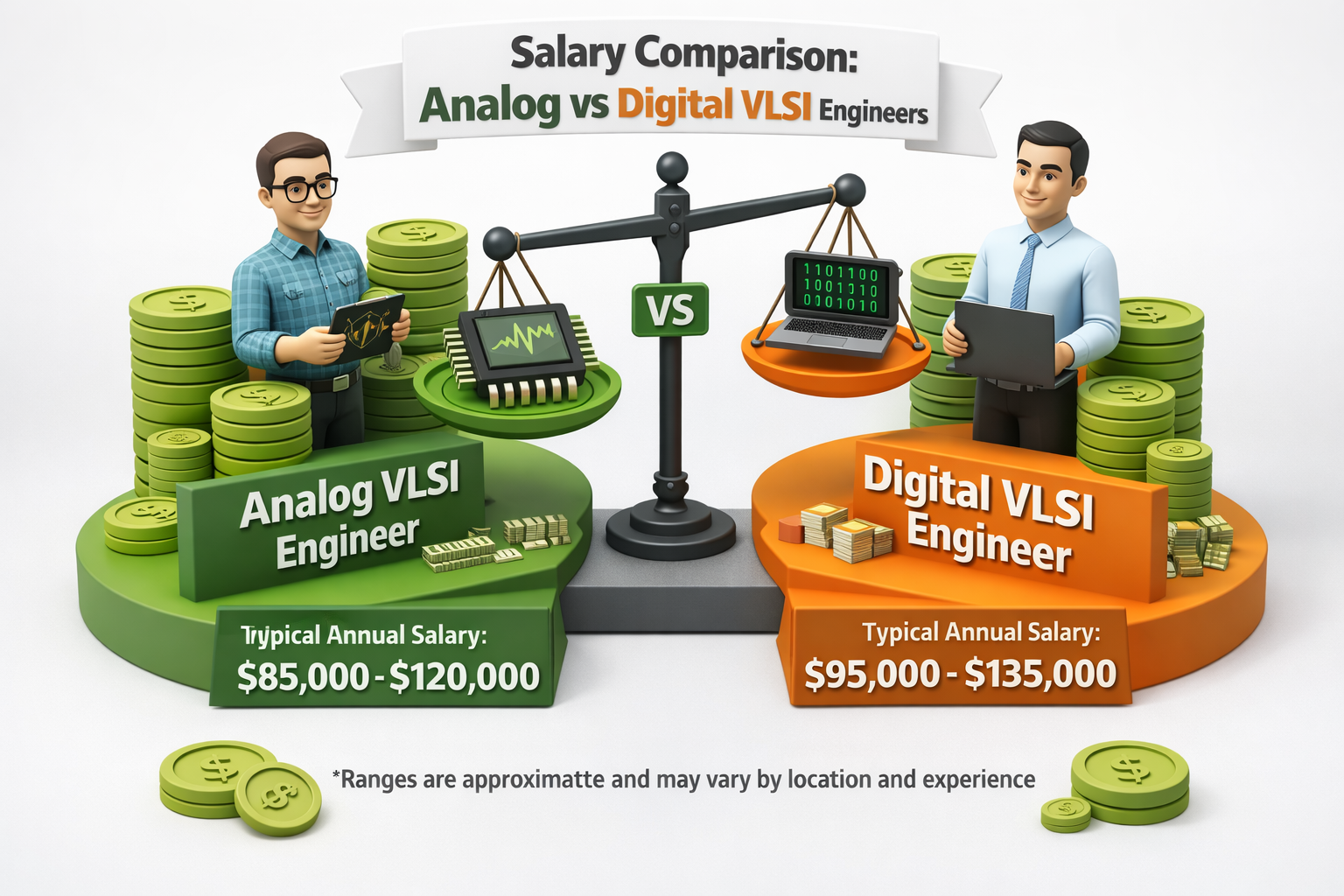
The salary comparison between Analog and Digital VLSI engineers often depends on factors such as experience level, skill specialization, company, and geographic location. In general, both fields offer high-paying career opportunities in the semiconductor industry due to the growing demand for skilled chip designers. Entry-level Digital VLSI engineers in India typically earn competitive salaries because of the large number of roles available in areas such as RTL design, verification, and physical design. On the other hand, Analog VLSI engineers often command slightly higher salaries at mid to senior levels because analog circuit design requires deep expertise in transistor-level design and fewer engineers specialize in this domain.
Globally, both Analog and Digital VLSI professionals enjoy strong earning potential as semiconductor companies invest heavily in advanced chip development for AI, automotive electronics, and high-performance computing. In India, experienced VLSI engineers can earn significantly higher salaries as they progress into roles such as Senior Design Engineer, SoC Architect, or Analog Architect. While digital VLSI offers a broader range of job opportunities due to the scale of digital chip development, analog VLSI roles often provide higher specialization value, which can translate into strong long-term career growth and competitive compensation packages in the semiconductor industry.
Future Scope of Analog and Digital VLSI Careers in 2026 and Beyond
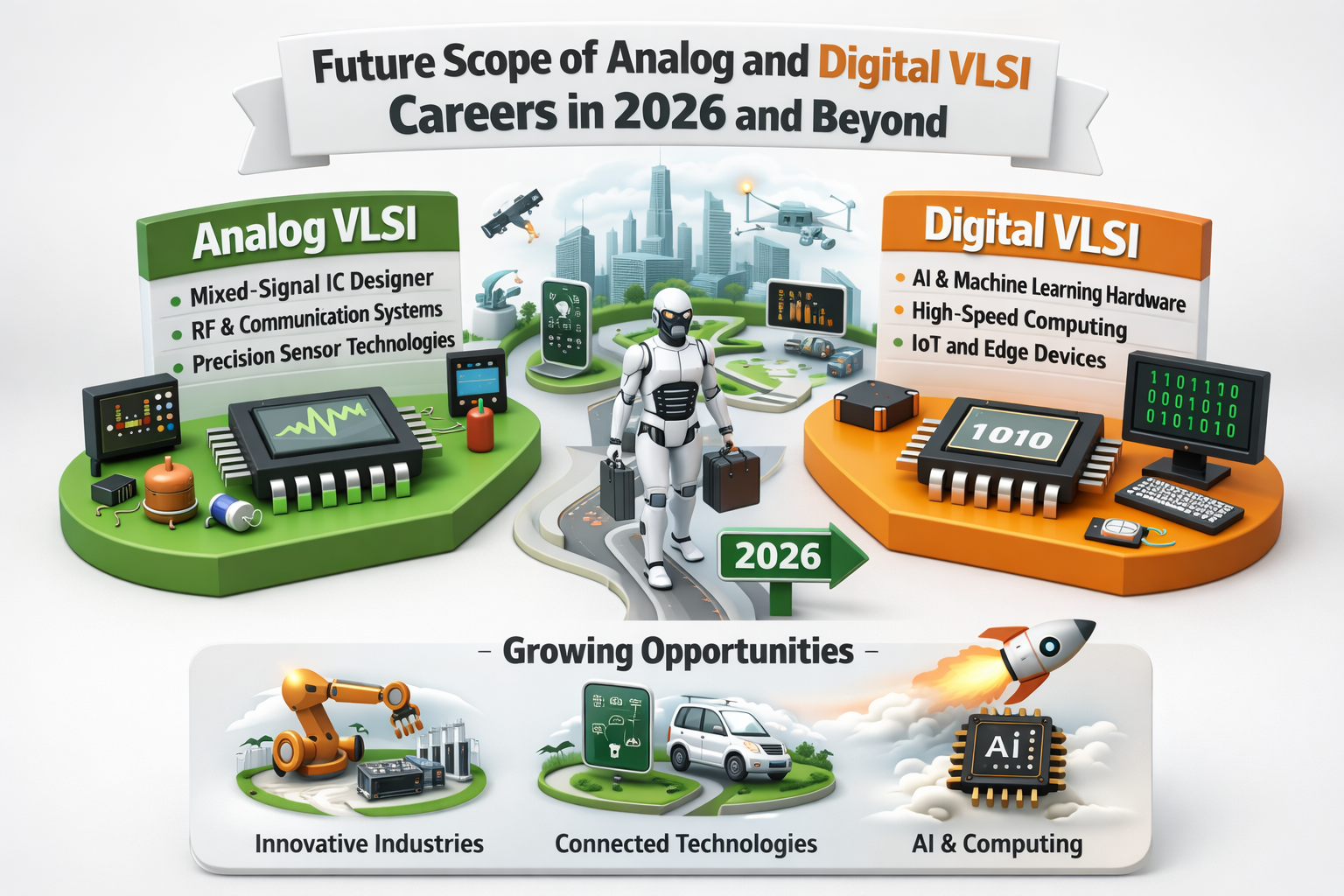
The future scope of Analog and Digital VLSI careers looks extremely promising as the global semiconductor industry continues to expand rapidly. With the increasing demand for advanced electronic devices such as smartphones, smart wearables, electric vehicles, and high-performance computing systems, integrated circuit design has become a critical area of innovation. Both analog and digital VLSI engineers play essential roles in developing next-generation chips that power modern technologies. Governments and major technology companies are investing billions of dollars into semiconductor research, chip manufacturing, and design infrastructure, creating long-term career opportunities for skilled VLSI professionals.
In the coming years, emerging technologies such as artificial intelligence (AI), 5G communication, Internet of Things (IoT), and autonomous vehicles will significantly increase the need for advanced semiconductor solutions. Digital VLSI engineers will be crucial for designing powerful processors, AI accelerators, and System-on-Chip (SoC) architectures that can handle massive computational workloads. At the same time, analog VLSI engineers will be needed to design efficient power management circuits, RF communication blocks, sensor interfaces, and mixed-signal systems that enable real-world signal processing. The combination of analog and digital technologies in modern chips means that both domains will remain highly relevant.
Looking toward 2026 and beyond, the demand for skilled VLSI engineers is expected to grow as semiconductor technology moves toward smaller process nodes, higher chip complexity, and more integrated systems. Companies working in sectors such as automotive electronics, AI hardware, consumer electronics, and telecommunications will require talented engineers who can design innovative and energy-efficient chips. For students and professionals interested in semiconductor engineering, building expertise in VLSI design tools, circuit fundamentals, and modern chip architectures can open the door to exciting career opportunities in one of the most dynamic and high-impact industries in the world.
Tips for Students to Choose Between Analog and Digital VLSI
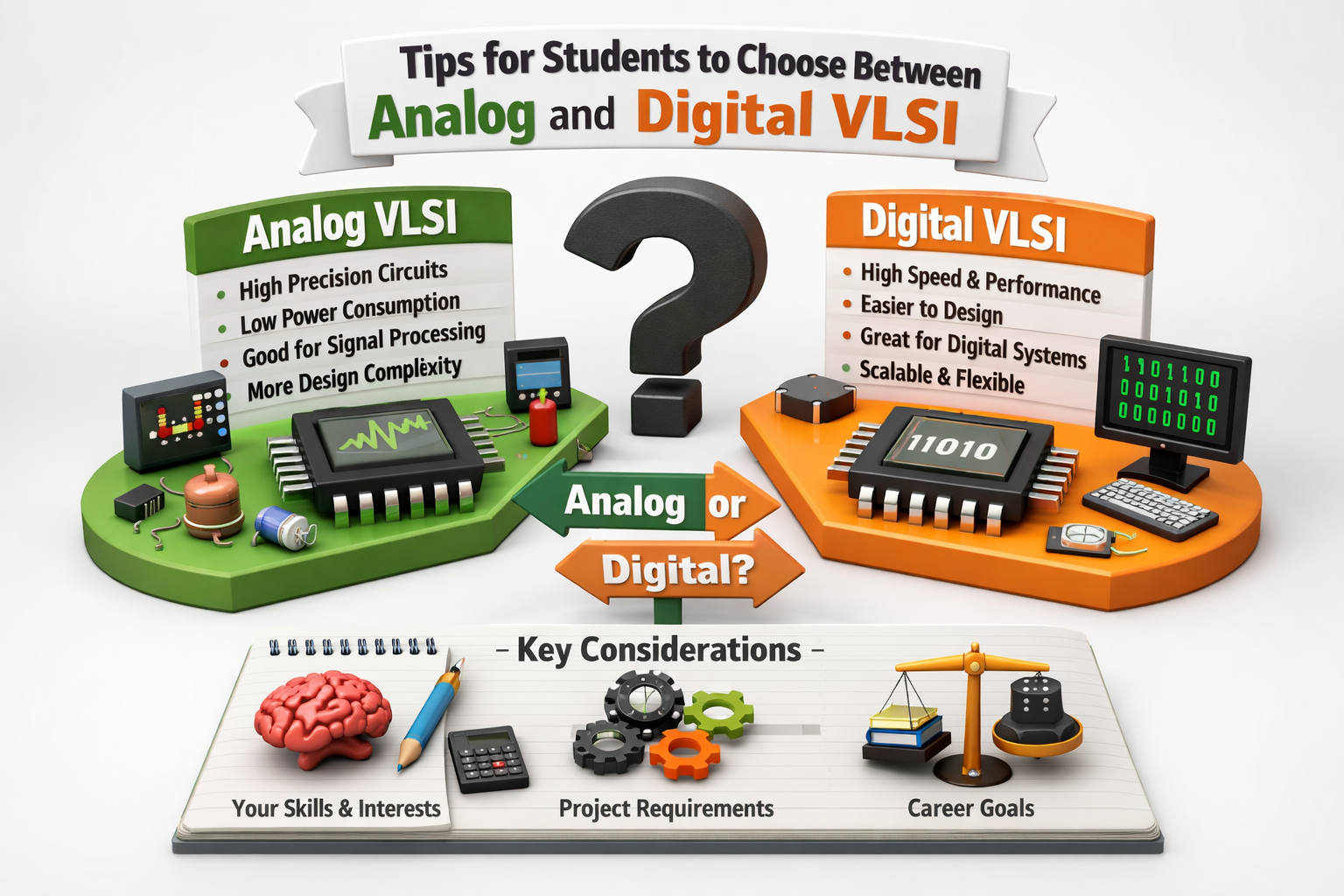
Choosing between Analog and Digital VLSI can be challenging for students who are beginning their journey in semiconductor engineering. The first step is to evaluate your core interests and strengths in electronics concepts. If you enjoy working with circuit analysis, continuous signals, transistor-level design, and understanding how voltages and currents behave in real-world systems, Analog VLSI may be a suitable path. On the other hand, if you are more interested in logic design, coding hardware using languages like Verilog or VHDL, and building complex digital systems such as processors and memory architectures, then Digital VLSI could be the better choice for your career.
Students should also consider the learning curve and required skill sets in both domains. Analog VLSI often requires a deeper understanding of semiconductor physics, device behavior, and circuit theory, making it more mathematically and conceptually intensive. Digital VLSI, however, involves more work with hardware description languages, verification methodologies, and automated design tools, which can be easier for students who enjoy programming and system-level thinking. Exploring coursework, online training programs, and small design projects in both areas can help students identify which field aligns best with their abilities.
Another important factor is industry demand and career opportunities. Digital VLSI generally offers a larger number of job openings in roles such as RTL design, verification, and physical design, as most modern chips are heavily digital. However, analog VLSI specialists are fewer in number, which means skilled analog engineers are often highly valued in the semiconductor industry. Students should focus on building strong fundamentals, learning industry-standard EDA tools, and gaining hands-on experience through projects or internships to make an informed decision between these two exciting VLSI career paths.
Conclusion
Choosing between Analog and Digital VLSI jobs ultimately depends on your interests, strengths, and long-term career goals within the semiconductor industry. Both domains play a crucial role in modern chip design, working together to create powerful and efficient electronic systems. While Analog VLSI focuses on continuous signal processing and transistor-level circuit design, Digital VLSI deals with logic-based systems used in processors, memory, and complex SoC architectures. Understanding the differences in design methodologies, required skills, and career opportunities can help aspiring engineers make a well-informed decision about which specialization suits them best.
As the semiconductor industry continues to grow with advancements in AI, 5G, IoT, automotive electronics, and high-performance computing, the demand for skilled VLSI engineers will remain strong in both analog and digital domains. Students and professionals who build solid fundamentals in electronics, gain hands-on experience with industry tools, and continuously update their technical knowledge will have excellent career prospects in this field. Whether you choose Analog VLSI or Digital VLSI, both paths offer rewarding opportunities to contribute to cutting-edge technologies that shape the future of modern electronics.