

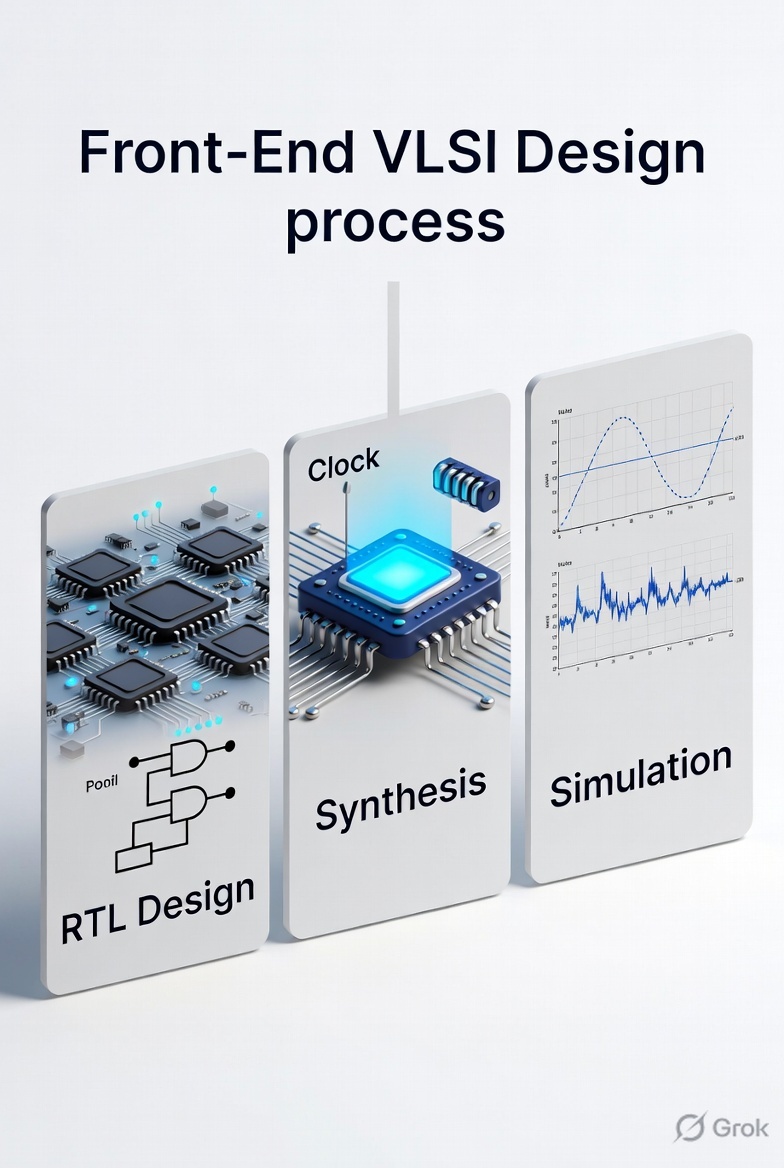
Front-End VLSI Roles Explained: RTL Design, Synthesis, and Simulation.
Navigate through this article using the table of contents below
Table of Contents
No headings found in this article.
The world of semiconductor design begins with Front-End VLSI engineering, where ideas are transformed into functional digital circuits before they move to physical chip manufacturing. From writing hardware logic to validating functionality, front-end roles play a critical part in modern chip development. Key positions such as RTL Design Engineers, Synthesis Engineers, and Simulation or Verification Engineers ensure that a digital design is accurate, optimized, and ready for implementation. As demand for advanced processors, AI hardware, and smart devices continues to grow, understanding these front-end VLSI roles has become essential for aspiring engineers and professionals entering the semiconductor industry.
In the VLSI design flow, the front-end stage focuses on describing and validating circuit functionality using hardware description languages like Verilog and VHDL. RTL design defines the behavior of digital systems, synthesis converts that design into gate-level logic, and simulation verifies that the design performs correctly under different scenarios. Each of these roles contributes to building reliable and high-performance chips used in smartphones, automotive electronics, data centers, and IoT devices. This article explains the responsibilities, tools, and importance of RTL design, synthesis, and simulation engineers, helping readers clearly understand how front-end VLSI teams bring complex semiconductor designs to life.
Introduction to Front-End VLSI Design and Its Importance
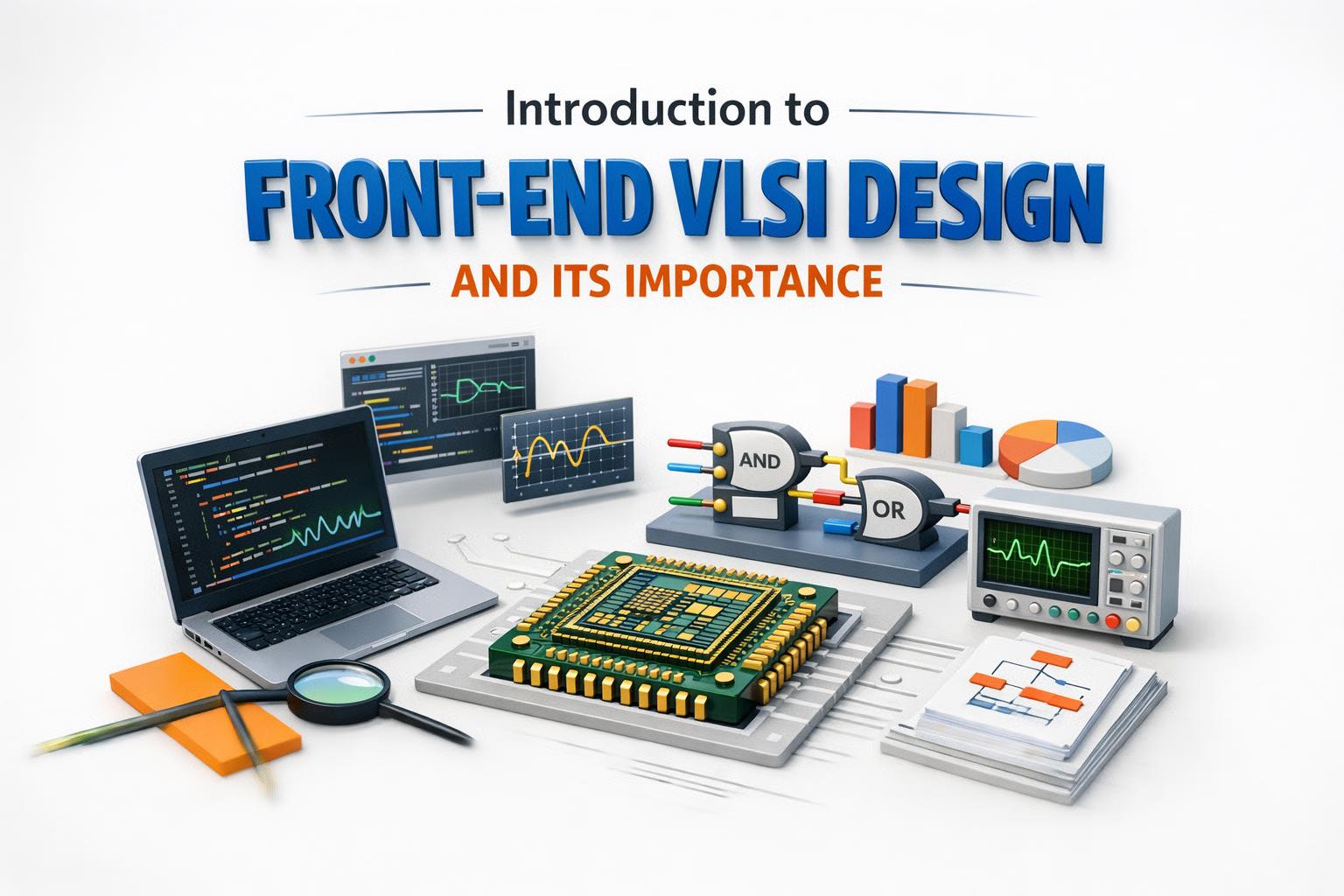
Front-End VLSI design is the initial and one of the most critical stages in the semiconductor development process, where engineers define how a digital chip should function before it is physically built. At this stage, designers create and describe the behavior of electronic circuits using hardware description languages such as Verilog or VHDL. This process mainly focuses on building the logical architecture of integrated circuits, ensuring that the design performs the required operations efficiently. Front-end VLSI design typically includes key steps such as RTL design, logic synthesis, and simulation, which together form the foundation for developing modern processors, communication chips, and embedded systems used in smartphones, automotive electronics, and IoT devices.
The importance of Front-End VLSI design lies in its ability to identify functional issues and optimize the architecture early in the chip development cycle. By verifying and refining the design at this stage, engineers can significantly reduce costly errors that might appear during later stages of physical implementation or manufacturing. This phase also ensures that the digital logic meets performance, power, and functionality requirements before moving to the back-end design process. As semiconductor technologies continue to advance and chips become more complex, the role of front-end VLSI engineers has become increasingly essential in delivering reliable, high-performance, and energy-efficient electronic systems.
Overview of the VLSI Design Flow: From RTL to Silicon
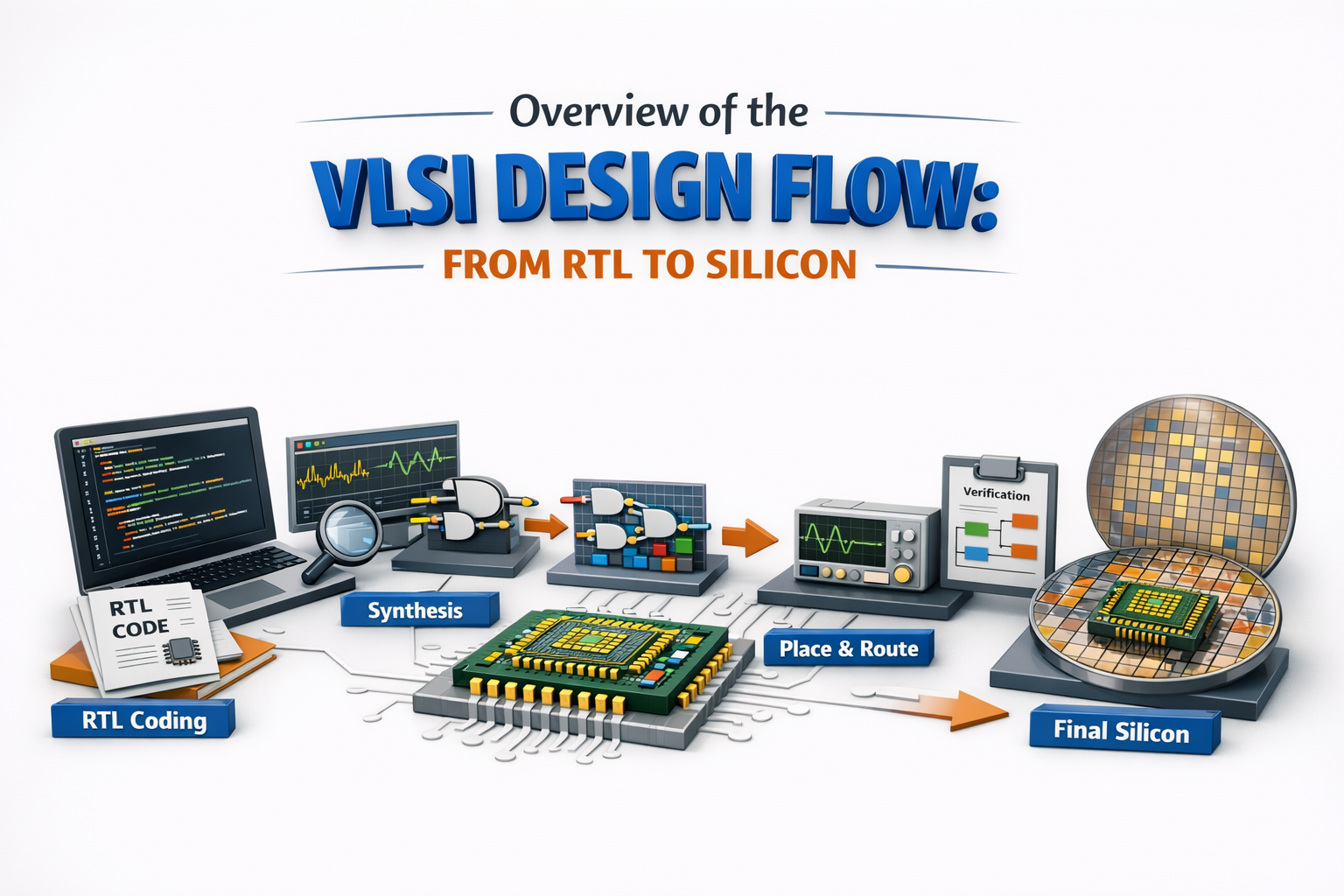
The VLSI design flow is a structured process that transforms a digital system concept into a fully functional semiconductor chip. It begins with system-level planning, where engineers define the architecture, functionality, and performance requirements of the chip. Once the specifications are clear, designers move to the Register Transfer Level (RTL) stage, where the behavior of the digital circuit is described using hardware description languages such as Verilog or VHDL. RTL design focuses on defining how data moves between registers and how logic operations are performed, forming the foundation for the entire chip design process.
After the RTL code is developed, the next step in the VLSI design flow is logic synthesis. During this stage, synthesis tools convert the RTL description into a gate-level netlist composed of standard logic cells such as AND, OR, and flip-flops. Engineers also perform various checks and optimizations to ensure the design meets timing, power, and area constraints. Following synthesis, functional and timing simulations are carried out to verify that the design behaves correctly under different operating conditions. These verification steps help identify potential design errors early in the development cycle, reducing the risk of costly mistakes later.
Once the front-end verification is completed, the design moves to the back-end or physical design stage, where the logical circuit is translated into a physical layout on silicon. This stage includes processes such as floorplanning, placement, routing, and timing optimization. After the layout is finalized and validated through design rule checks and other verification processes, the design is sent for chip fabrication in a semiconductor foundry. The final result is a silicon chip that can be integrated into electronic products, demonstrating how the VLSI design flow systematically transforms RTL-level descriptions into real-world semiconductor devices.
What Does an RTL Design Engineer Do? Roles and Responsibilities
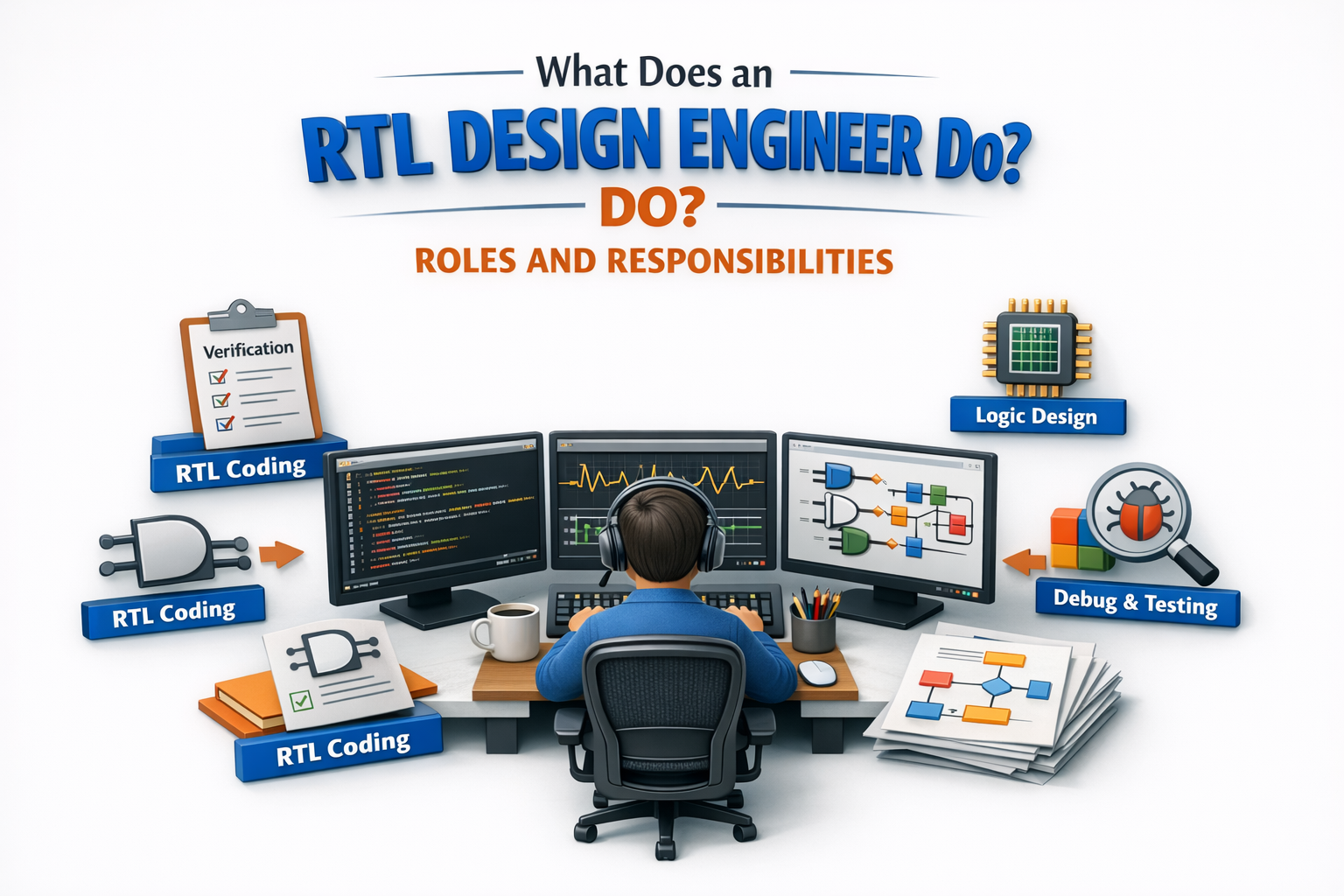
An RTL (Register Transfer Level) Design Engineer is responsible for designing and implementing the digital logic that defines how a semiconductor chip functions. At this stage of the VLSI design flow, engineers write hardware description code using languages such as Verilog or VHDL to describe how data moves between registers and how logical operations are executed within the circuit. RTL designers translate system-level specifications into structured digital architectures, ensuring that the design meets functional requirements and performance goals. Their work forms the foundation of chip development, as the RTL code later becomes the basis for synthesis, simulation, and physical implementation.
In addition to writing RTL code, RTL Design Engineers perform functional verification, debugging, and design optimization to ensure the circuit operates correctly under various conditions. They collaborate closely with verification engineers, synthesis engineers, and system architects to refine the design and resolve issues early in the development process. RTL engineers also focus on optimizing the design for factors such as power efficiency, timing performance, and hardware resource utilization. By ensuring that the digital logic is robust, scalable, and ready for further stages of the VLSI design flow, RTL Design Engineers play a critical role in the successful development of modern semiconductor chips used in computing, communication, and embedded systems.
Key Skills and Tools Required for RTL Design Engineers
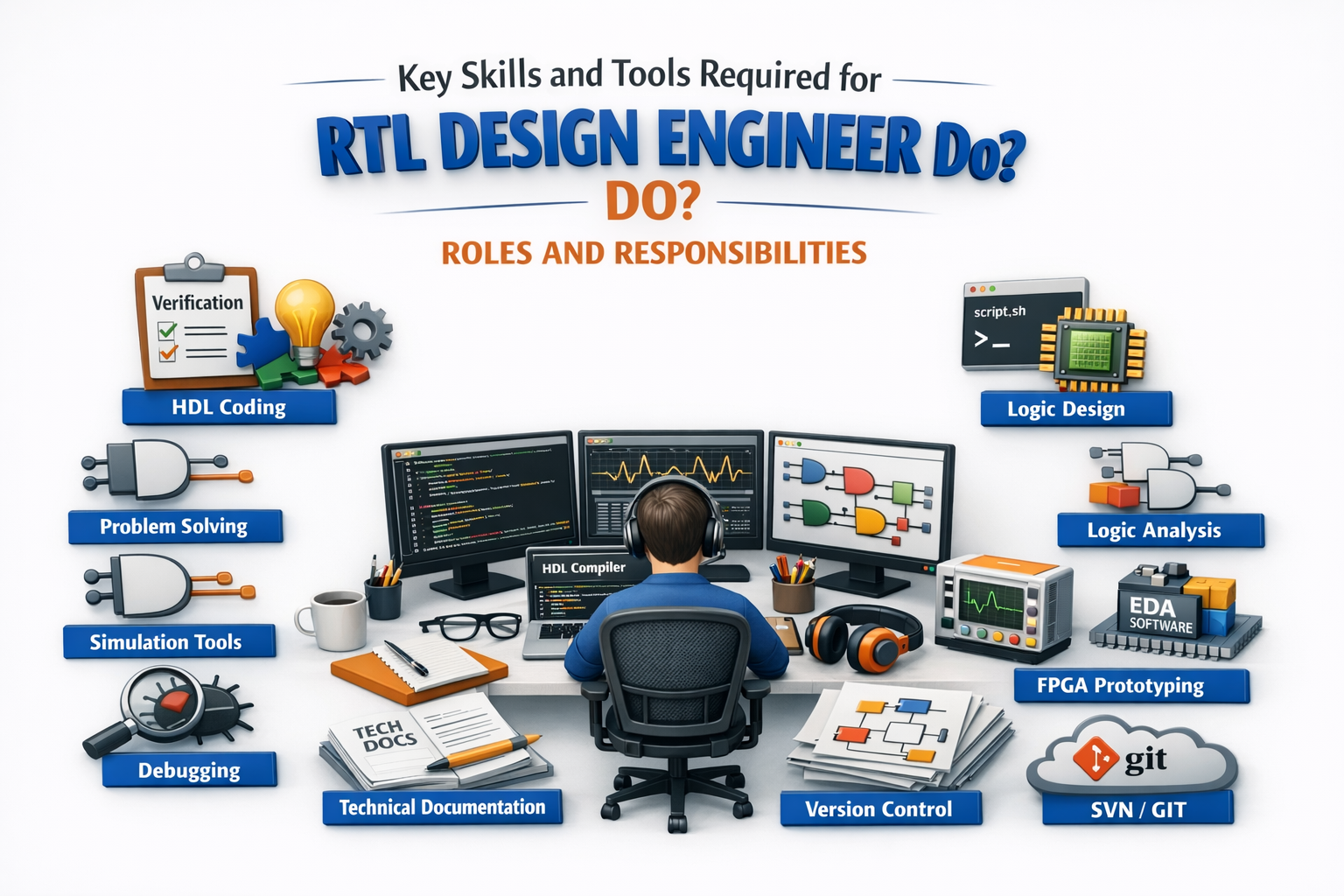
To succeed as an RTL (Register Transfer Level) Design Engineer, a strong foundation in digital electronics and computer architecture is essential. Engineers must understand concepts such as combinational and sequential logic, finite state machines, pipelining, timing analysis, and clock domain crossing. Knowledge of hardware description languages like Verilog or VHDL is a core requirement, as these languages are used to describe the behavior and structure of digital circuits at the RTL level. In addition, RTL designers must be capable of translating high-level system specifications into efficient hardware logic while ensuring the design meets performance, power, and area constraints.
Along with technical knowledge, RTL engineers must develop strong design and debugging skills. Writing clean, synthesizable, and scalable RTL code is critical for ensuring that the design works correctly during synthesis and simulation. Engineers also need experience with functional verification methods, waveform debugging, and testbench creation to validate the behavior of the design. Understanding timing constraints, reset strategies, and design-for-testability practices further helps ensure that the digital circuit functions reliably when integrated into larger semiconductor systems.
RTL Design Engineers also rely on a variety of industry-standard tools to develop and validate their designs. Simulation tools such as ModelSim and VCS are commonly used to verify RTL functionality, while synthesis tools like Synopsys Design Compiler help convert RTL code into gate-level netlists. Additionally, engineers often use waveform viewers, linting tools, and version control systems to manage and debug complex designs. Familiarity with these tools, along with strong problem-solving abilities and collaboration skills, enables RTL engineers to efficiently design and optimize digital circuits for modern semiconductor applications.
Role of a Synthesis Engineer in Front-End VLSI
A Synthesis Engineer plays a crucial role in the front-end VLSI design flow by transforming RTL code written by designers into a gate-level netlist that can be implemented in hardware. Using synthesis tools, the engineer converts hardware description language code into a network of logic gates and standard cells from a technology library. During this process, the synthesis engineer ensures that the design meets key constraints such as timing, power consumption, and silicon area. They carefully analyze design reports, apply timing constraints, and optimize the logic structure to achieve the required performance targets before the design moves to the physical design stage.
In addition to converting RTL to gate-level logic, synthesis engineers are responsible for identifying and resolving design issues that may affect chip performance or manufacturability. They perform tasks such as timing analysis, constraint management, and logic optimization to ensure the design is efficient and ready for back-end implementation. Synthesis engineers also collaborate closely with RTL designers and physical design teams to refine the architecture and address timing violations or design inefficiencies. Their work ensures that the digital logic is accurately translated into a form that can be physically implemented on silicon, making them a vital part of the front-end VLSI development process. Synthesis is a key step in transforming design into real hardware, and it is covered in depth in System-on-Chip (SoC) Design training.
Importance of Simulation in VLSI Design Verification
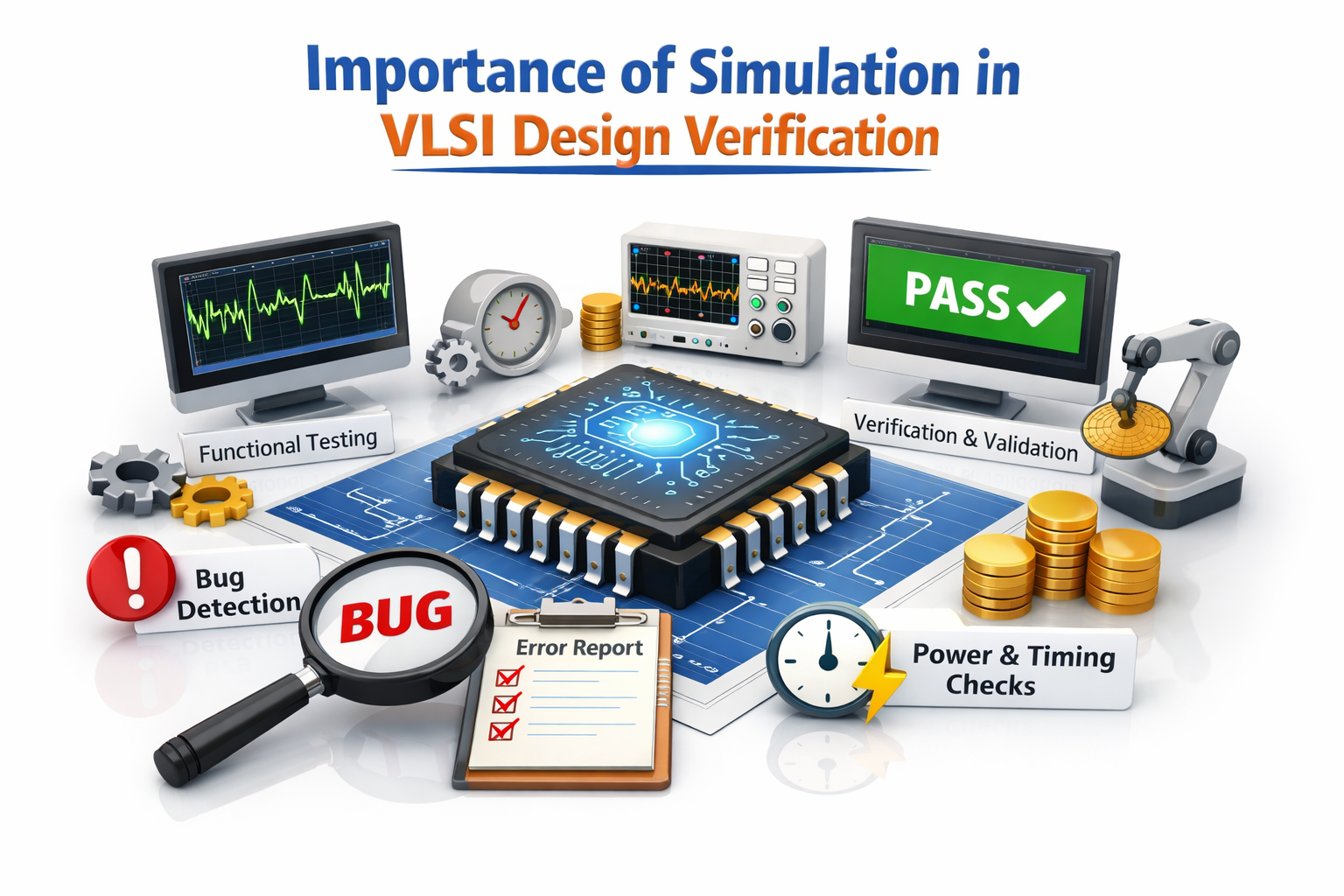
Simulation plays a critical role in VLSI design verification by ensuring that a digital circuit behaves exactly as intended before it moves to the manufacturing stage. In semiconductor design, even a small logical error can lead to costly chip failures after fabrication. Simulation allows engineers to test the functionality of RTL designs in a virtual environment, verifying that the circuit performs the correct operations under various input conditions. By running different test cases and analyzing the outputs, designers can detect design flaws early and ensure the system meets the required functional specifications.
Another important aspect of simulation is its ability to validate the interaction between different modules within a complex chip design. Modern integrated circuits often contain millions or even billions of transistors, making manual verification impossible. Through simulation, engineers can observe signal transitions, timing behavior, and data flow across multiple blocks of the design. Tools such as waveform viewers help designers analyze signal activity and identify issues such as logic mismatches, incorrect state transitions, or unexpected outputs, which can then be corrected before the design progresses further in the VLSI workflow.
Simulation also improves the overall reliability and efficiency of the chip development process. By thoroughly verifying the design through functional and timing simulations, engineers can significantly reduce the risk of errors that might appear during synthesis or physical implementation. This process ultimately saves time, development costs, and manufacturing resources. As semiconductor designs continue to grow in complexity, simulation remains a fundamental part of VLSI verification, ensuring that digital circuits are robust, accurate, and ready for successful silicon implementation.
Differences Between RTL Design, Synthesis, and Simulation Roles
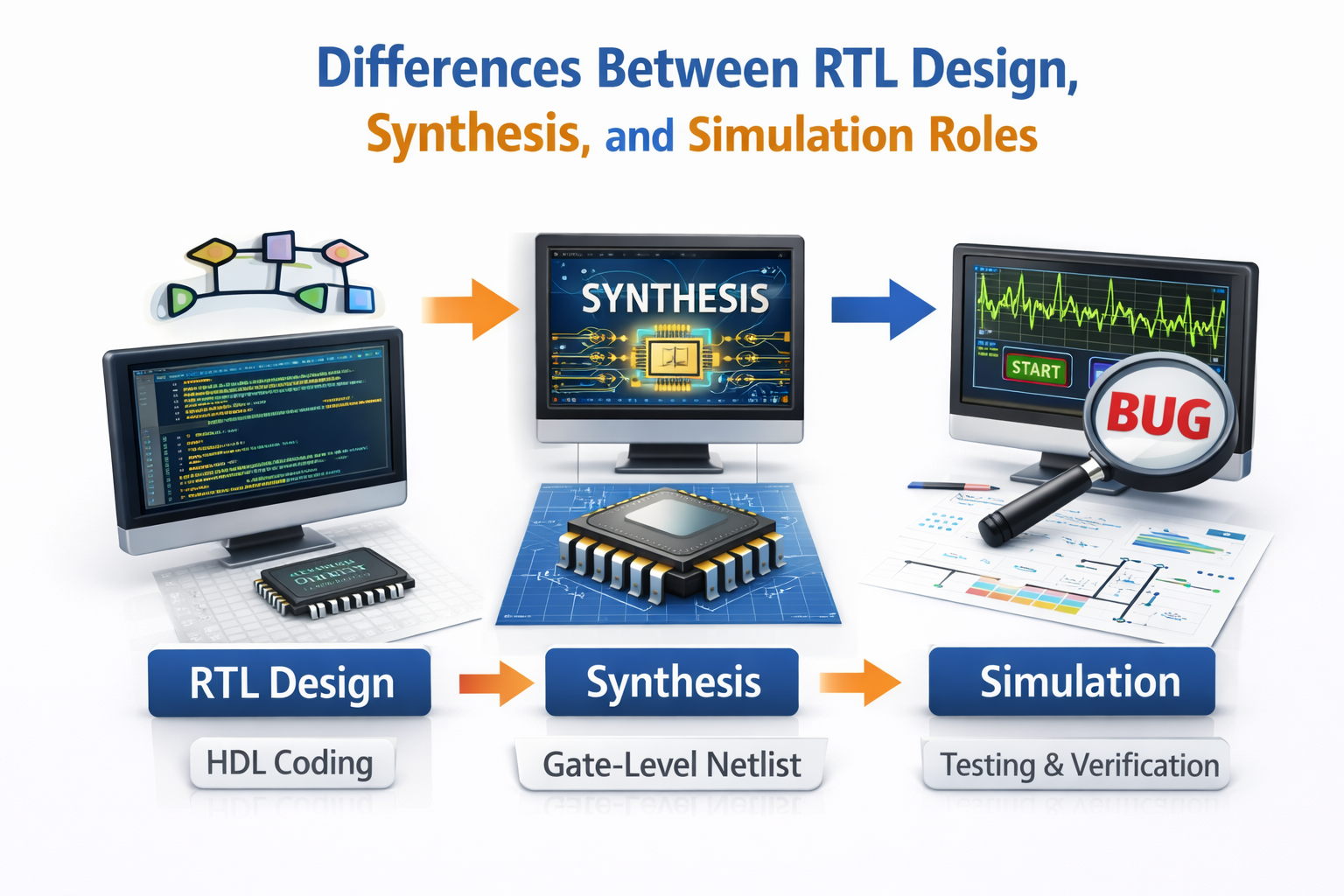
In the front-end VLSI design flow, RTL design, synthesis, and simulation are three closely related roles, but each focuses on a different stage of developing and validating a digital circuit. An RTL Design Engineer is responsible for creating the functional architecture of the chip using hardware description languages such as Verilog or VHDL. At this stage, the engineer defines how data moves between registers and how logic operations are executed within the system. The primary goal of RTL design is to translate system-level specifications into structured and synthesizable digital logic that forms the foundation of the semiconductor design.
A Synthesis Engineer works on the next stage of the design flow by converting the RTL code into a gate-level netlist using synthesis tools and technology libraries. This process maps the RTL logic into standard cells such as logic gates, flip-flops, and multiplexers that can be physically implemented on silicon. During synthesis, engineers also focus on optimizing the design for timing, power consumption, and chip area while applying design constraints. Their work ensures that the RTL design can be efficiently implemented during the physical design stage without performance issues or resource inefficiencies.
Simulation Engineers, often part of the verification team, focus on validating the functionality of the RTL design before and after synthesis. They create testbenches, apply various input scenarios, and analyze outputs to ensure the circuit behaves correctly under different operating conditions. Simulation helps detect logical errors, design bugs, and unexpected behaviors early in the development process. While RTL designers build the logic and synthesis engineers prepare it for implementation, simulation engineers ensure that the design functions correctly, making all three roles essential for successful front-end VLSI development.
Career Opportunities in Front-End VLSI Engineering
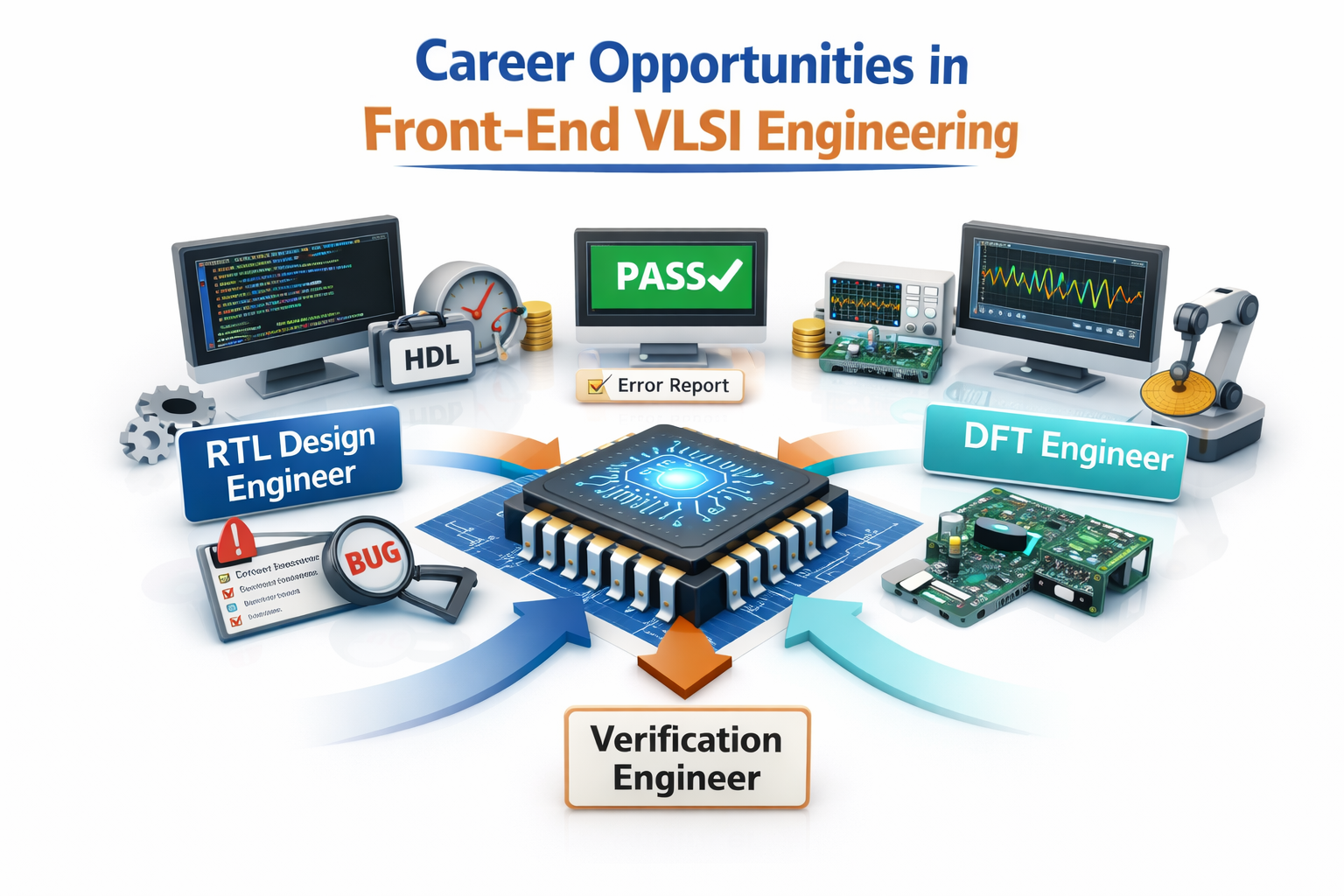
Front-End VLSI engineering offers a wide range of career opportunities for professionals interested in semiconductor design and digital hardware development. Engineers in this field typically start their careers as RTL Design Engineers, Verification Engineers, or Synthesis Engineers, where they work on designing, validating, and optimizing digital circuits for integrated chips. As they gain experience, professionals can move into advanced roles such as Senior Design Engineer, Verification Lead, or System Architect, where they handle complex chip architectures and large-scale semiconductor projects. These roles are highly valued in industries such as consumer electronics, telecommunications, automotive systems, artificial intelligence hardware, and data center processors.
The demand for front-end VLSI engineers continues to grow as semiconductor technology advances and the need for high-performance chips increases worldwide. Major semiconductor companies, chip design firms, and technology organizations actively hire professionals skilled in RTL design, simulation, and logic synthesis. With the rapid expansion of technologies such as 5G, IoT devices, autonomous vehicles, and AI accelerators, skilled VLSI engineers are becoming increasingly important in the global technology ecosystem. As a result, front-end VLSI engineering provides strong career stability, competitive salaries, and opportunities to work on cutting-edge semiconductor innovations.
Future Scope of Front-End VLSI Roles in the Semiconductor Industry

The future scope of front-end VLSI roles in the semiconductor industry is extremely promising as the demand for advanced electronic devices continues to grow worldwide. Technologies such as artificial intelligence, 5G communication, high-performance computing, and the Internet of Things (IoT) require powerful and efficient semiconductor chips. Front-end VLSI engineers play a critical role in designing and verifying the digital logic that powers these technologies. As chip architectures become more complex and performance requirements increase, the need for skilled RTL designers, synthesis engineers, and verification specialists is expected to rise significantly across global semiconductor companies.
Another major factor driving the growth of front-end VLSI roles is the continuous advancement in semiconductor manufacturing technologies. Modern chips are now being developed using smaller process nodes, advanced packaging methods, and specialized architectures such as AI accelerators and system-on-chip (SoC) designs. These innovations require highly optimized and carefully verified digital logic at the front-end design stage. Engineers must develop efficient architectures, ensure design scalability, and maintain strict power and performance targets. As a result, companies are investing heavily in front-end design teams to create reliable and high-performance chip solutions for next-generation electronics.
In the coming years, the semiconductor industry is expected to expand rapidly due to increasing global demand for computing power and smart devices. Countries around the world are also investing in semiconductor research and manufacturing to strengthen their technology ecosystems. This growth will create numerous opportunities for front-end VLSI professionals in areas such as chip design, verification, and system architecture. For engineers with strong digital design skills and knowledge of modern design tools, front-end VLSI roles will continue to offer long-term career growth, global job opportunities, and the chance to contribute to the development of future semiconductor technologies.
Tips for Beginners to Start a Career in Front-End VLSI Design
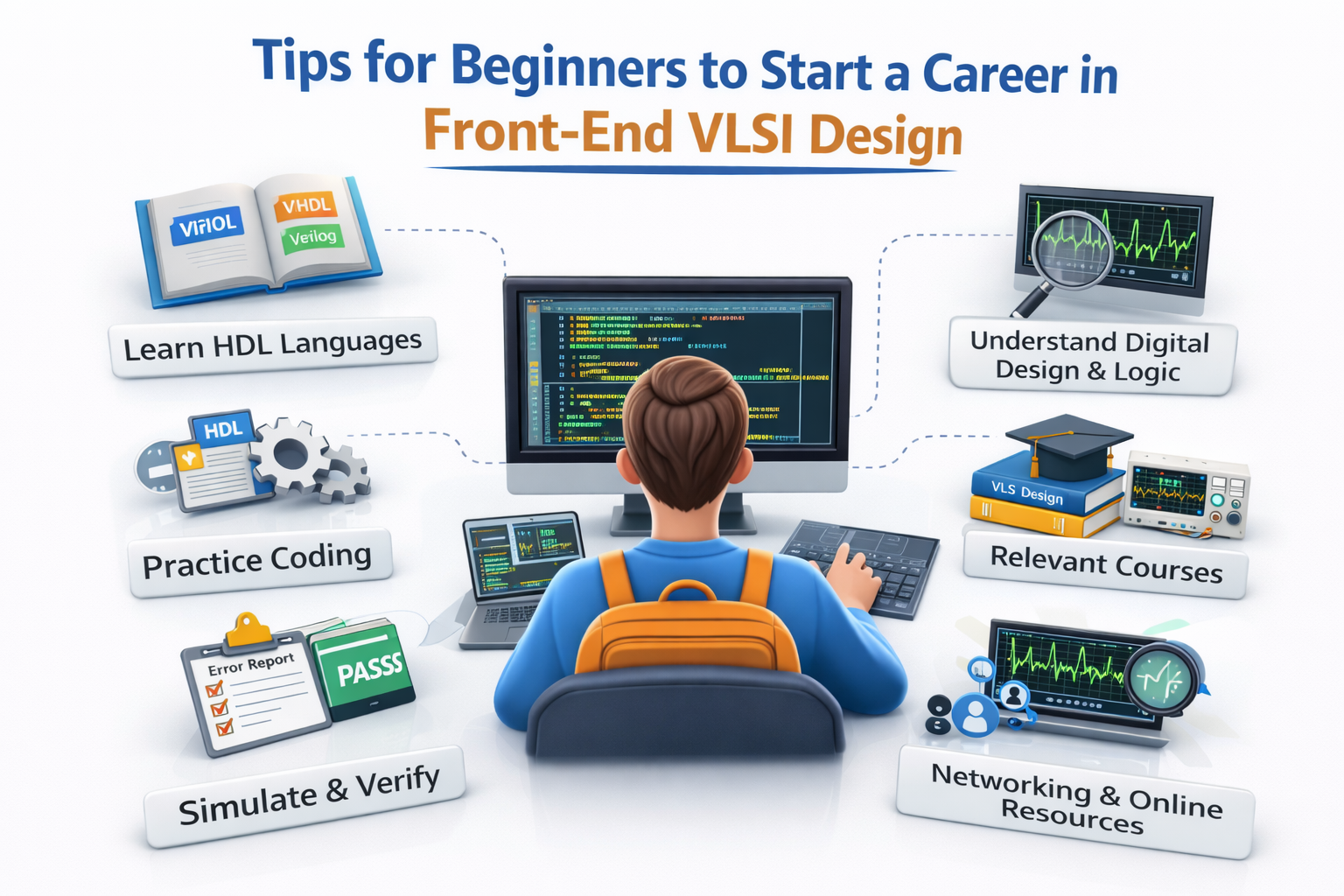
Starting a career in front-end VLSI design requires a strong foundation in digital electronics and hardware design concepts. Beginners should first focus on understanding fundamental topics such as combinational and sequential logic, finite state machines, timing analysis, and computer architecture. Learning hardware description languages like Verilog or VHDL is essential, as these languages are used to design and describe digital circuits at the RTL level. Along with theoretical knowledge, beginners should practice writing synthesizable RTL code and performing basic simulations to understand how digital logic behaves under different conditions. Building a clear understanding of the VLSI design flow—from RTL design to synthesis and verification—also helps aspiring engineers prepare for real-world semiconductor development.
In addition to technical learning, gaining hands-on experience is very important for beginners entering the VLSI industry. Working on small projects such as designing simple processors, counters, or communication modules can help strengthen practical design skills and improve problem-solving abilities. Beginners should also become familiar with commonly used industry tools for simulation and synthesis, as practical exposure to these tools is highly valued by employers. Following online courses, participating in technical communities, and studying real chip design examples can further enhance learning. By combining strong fundamentals, practical project experience, and continuous learning, beginners can build a solid pathway toward a successful career in front-end VLSI design.
Conclusion
Front-End VLSI roles such as RTL design, synthesis, and simulation form the foundation of the semiconductor design process. These roles work together to transform a high-level system idea into a verified digital design that can eventually be implemented on silicon. RTL engineers create the functional architecture of the chip, synthesis engineers convert that design into optimized gate-level logic, and simulation or verification engineers ensure the design works correctly under different conditions. Each role contributes to building reliable, efficient, and high-performance integrated circuits that power modern technologies such as smartphones, data centers, automotive electronics, and smart devices.
As the semiconductor industry continues to expand with innovations in artificial intelligence, 5G, IoT, and advanced computing systems, the demand for skilled front-end VLSI engineers is expected to grow significantly. For students and professionals interested in chip design, developing strong knowledge in digital electronics, hardware description languages, and design tools can open many career opportunities in this field. By understanding the responsibilities and importance of RTL design, synthesis, and simulation roles, aspiring engineers can better prepare themselves to contribute to the next generation of semiconductor technologies.