


VLSI Verification Engineer: Career Path, Skills, and Salary Insights
Navigate through this article using the table of contents below
Table of Contents
No headings found in this article.
The semiconductor industry is evolving rapidly, and one of the most critical roles behind reliable chip development is the VLSI Verification Engineer. Before any integrated circuit reaches production, it must go through rigorous verification to ensure the design functions exactly as intended. This is where VLSI verification engineers play a vital role. They use advanced simulation techniques, verification methodologies, and programming skills to detect design bugs early in the development cycle. As semiconductor devices power technologies like smartphones, AI systems, automotive electronics, and IoT devices, the demand for skilled verification engineers continues to grow globally. To start a career in this domain, building strong practical skills through an industry-oriented RTL Design Engineer Training program is highly beneficial.
A career as a VLSI Verification Engineer offers exciting opportunities for engineers interested in digital design validation, hardware simulation, and system-level testing. Professionals in this field typically work with languages such as SystemVerilog, Verilog, and methodologies like UVM to create test environments that validate complex chip architectures. With semiconductor companies investing heavily in advanced chip design, this role has become one of the most sought-after positions in the VLSI domain. In this blog, we will explore the career path of a VLSI Verification Engineer, essential skills required to succeed, and salary insights to help aspiring engineers understand how to enter and grow in this high-demand semiconductor career.
What is a VLSI Verification Engineer? Role and Responsibilities
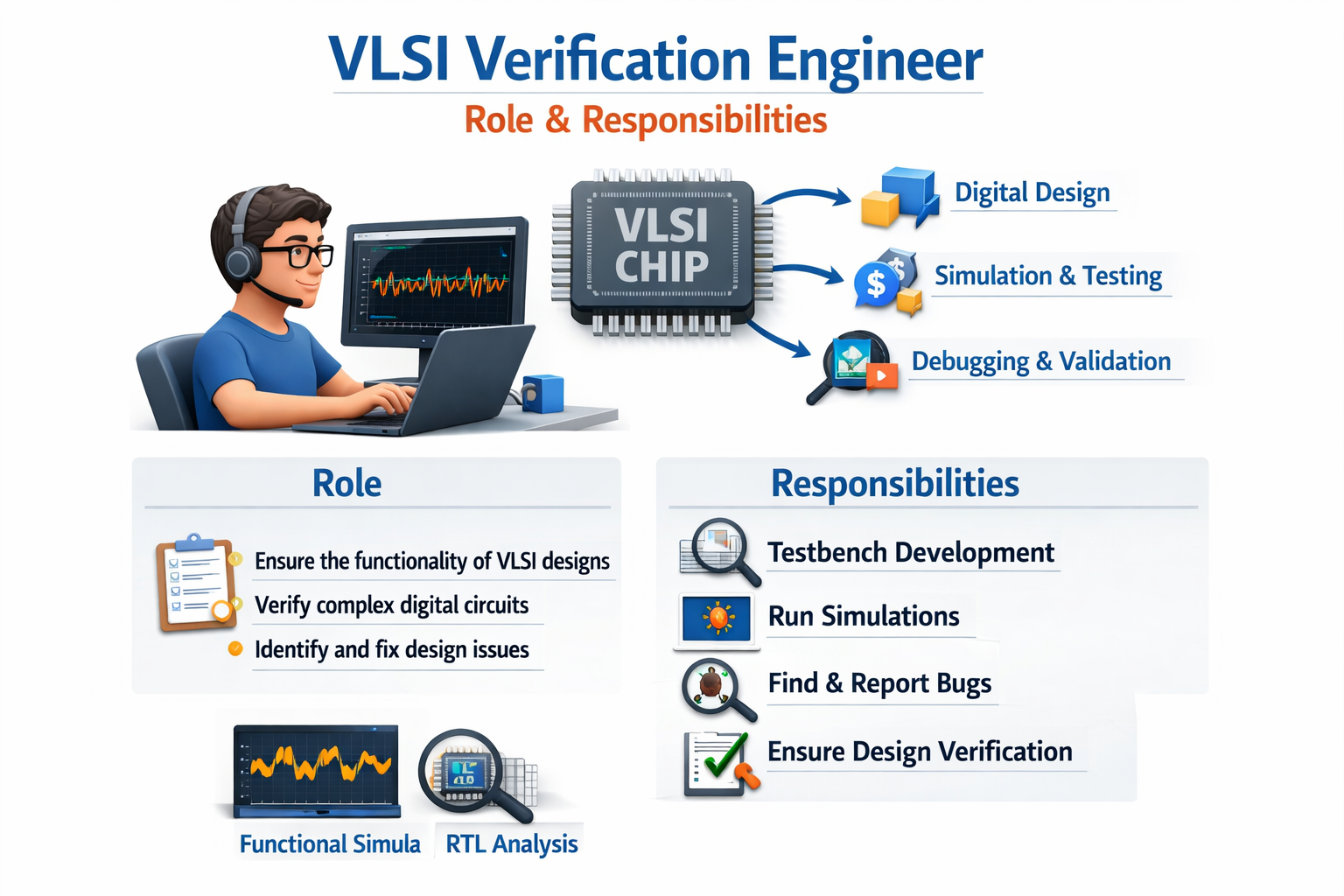
A VLSI Verification Engineer is responsible for ensuring that a digital chip design functions correctly before it is manufactured. In the VLSI (Very Large Scale Integration) design flow, verification plays a critical role in identifying functional errors and design flaws at an early stage. Verification engineers test the Register Transfer Level (RTL) design created by VLSI design engineers using simulation and advanced verification methodologies. By creating test environments, writing test cases, and analyzing simulation results, they ensure that the integrated circuit behaves according to its specifications under different scenarios. This process is essential because even a small design bug can lead to costly failures once the chip is fabricated. A solid understanding of circuits and logic design is essential, which you can develop through an Analog & Digital Electronics course.
The responsibilities of a VLSI Verification Engineer include developing verification plans, building testbenches using languages like SystemVerilog or Verilog, and implementing methodologies such as Universal Verification Methodology (UVM). They also perform functional verification, debug design issues, analyze waveform outputs, and collaborate closely with RTL design teams to fix identified bugs. In addition, verification engineers work with Electronic Design Automation (EDA) tools like simulators and debuggers to validate complex semiconductor designs efficiently. Their role is crucial in ensuring the reliability, performance, and quality of modern electronic devices such as processors, smartphones, automotive systems, and AI hardware.
Importance of Verification in the VLSI Design Flow

Verification is one of the most critical stages in the VLSI design flow because it ensures that a chip design functions exactly as intended before it moves to fabrication. In modern semiconductor development, integrated circuits contain millions or even billions of transistors, making design complexity extremely high. Even a small functional error in the design can lead to major failures once the chip is manufactured. Since chip fabrication is very expensive and time-consuming, verification helps detect and fix design bugs early in the development cycle, preventing costly redesigns and production delays.
In the VLSI design process, verification is performed after the Register Transfer Level (RTL) design is created. Verification engineers develop detailed testbenches and test scenarios to validate different functionalities of the design. Using hardware description languages such as Verilog and SystemVerilog, along with advanced verification methodologies like UVM (Universal Verification Methodology), engineers simulate the design under multiple operating conditions. This process ensures that the logic behaves correctly, meets performance requirements, and complies with the original design specifications before it proceeds to synthesis and physical design stages.
Verification also plays a major role in improving the reliability and quality of semiconductor products used in real-world applications. Modern technologies such as smartphones, automotive electronics, artificial intelligence processors, and IoT devices depend on highly reliable chips. Through techniques like functional verification, code coverage analysis, and debugging, verification engineers ensure that every part of the design is thoroughly tested. As chip complexity continues to grow, verification has become a dominant part of the VLSI development cycle, often accounting for nearly 60–70% of the overall design effort in many semiconductor projects.
Key Skills Required to Become a VLSI Verification Engineer
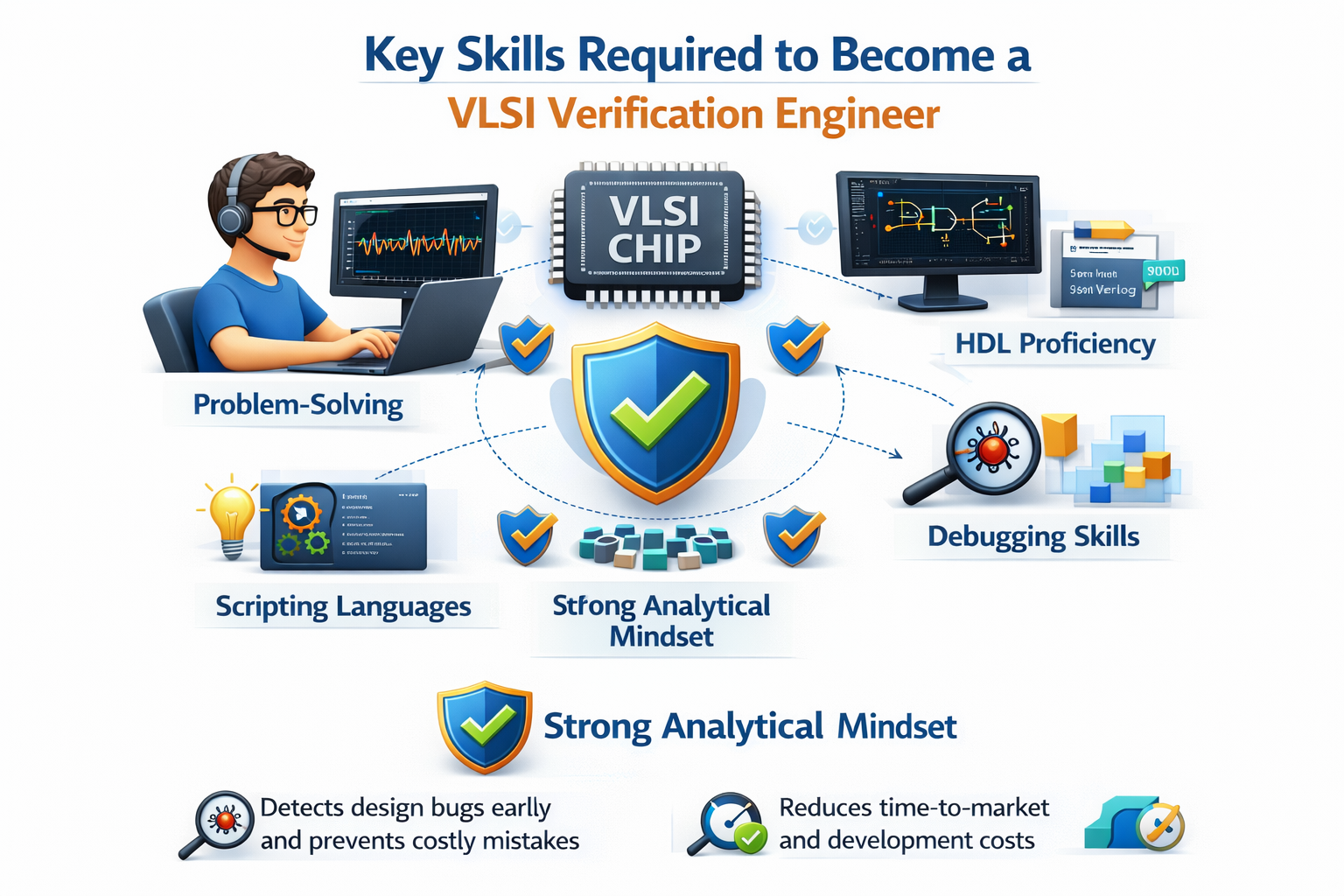
To become a successful VLSI Verification Engineer, a strong foundation in digital electronics and computer architecture is essential. Engineers must understand concepts such as logic gates, flip-flops, finite state machines, timing analysis, and RTL (Register Transfer Level) design. Knowledge of hardware description languages like Verilog and SystemVerilog is also crucial, as these languages are used to develop testbenches and verify digital circuits. In addition, familiarity with verification methodologies such as UVM (Universal Verification Methodology) helps engineers build reusable and scalable verification environments for complex chip designs. These technical skills allow verification engineers to simulate, test, and validate semiconductor designs effectively.
Apart from core technical knowledge, a VLSI Verification Engineer must develop strong debugging, analytical, and scripting skills. Debugging simulation results, analyzing waveforms, and identifying design bugs are key parts of the verification process. Engineers often use scripting languages such as Python, Perl, or TCL to automate verification tasks and improve testing efficiency. Experience with Electronic Design Automation (EDA) tools like simulators and debuggers is also highly valuable in real-world semiconductor projects. By combining programming knowledge, hardware design understanding, and strong problem-solving abilities, aspiring engineers can build a successful career in VLSI verification and contribute to the development of reliable semiconductor devices.
Educational Background and Qualifications Needed
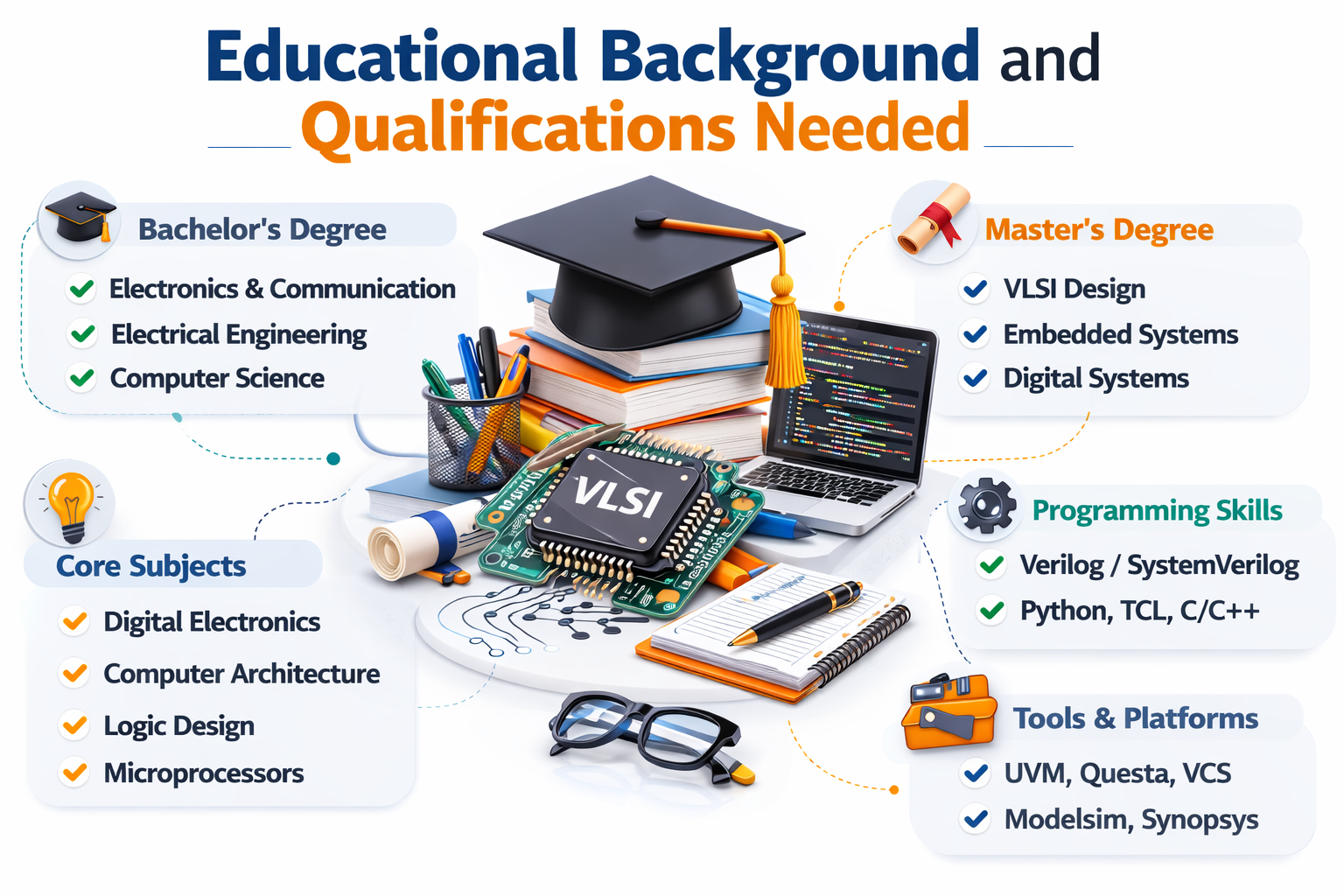
To pursue a career as a VLSI Verification Engineer, a strong educational background in electronics and semiconductor-related fields is essential. Most professionals in this domain hold a Bachelor’s degree in Electronics and Communication Engineering (ECE), Electrical Engineering, or Electronics and Instrumentation Engineering. During their undergraduate studies, students typically learn fundamental subjects such as digital electronics, microprocessors, computer architecture, signals and systems, and semiconductor devices. These subjects provide the core knowledge required to understand digital circuit design and verification processes. A solid understanding of programming and hardware description languages is also beneficial for students who want to enter the VLSI verification field.
In addition to a bachelor’s degree, many aspiring engineers enhance their expertise by pursuing a Master’s degree in VLSI Design, Microelectronics, or Embedded Systems, which offers deeper knowledge of semiconductor design and verification methodologies. Specialized training programs, certification courses, and industry-oriented VLSI training institutes can also help candidates gain practical experience with tools like SystemVerilog, UVM, and simulation environments. Hands-on projects, internships, and exposure to real-world verification workflows significantly improve job readiness. With the rapid growth of the semiconductor industry, engineers with strong academic foundations and practical verification skills are highly valued by leading chip design companies.
VLSI Verification Engineer Career Path (Entry-Level to Senior Roles)
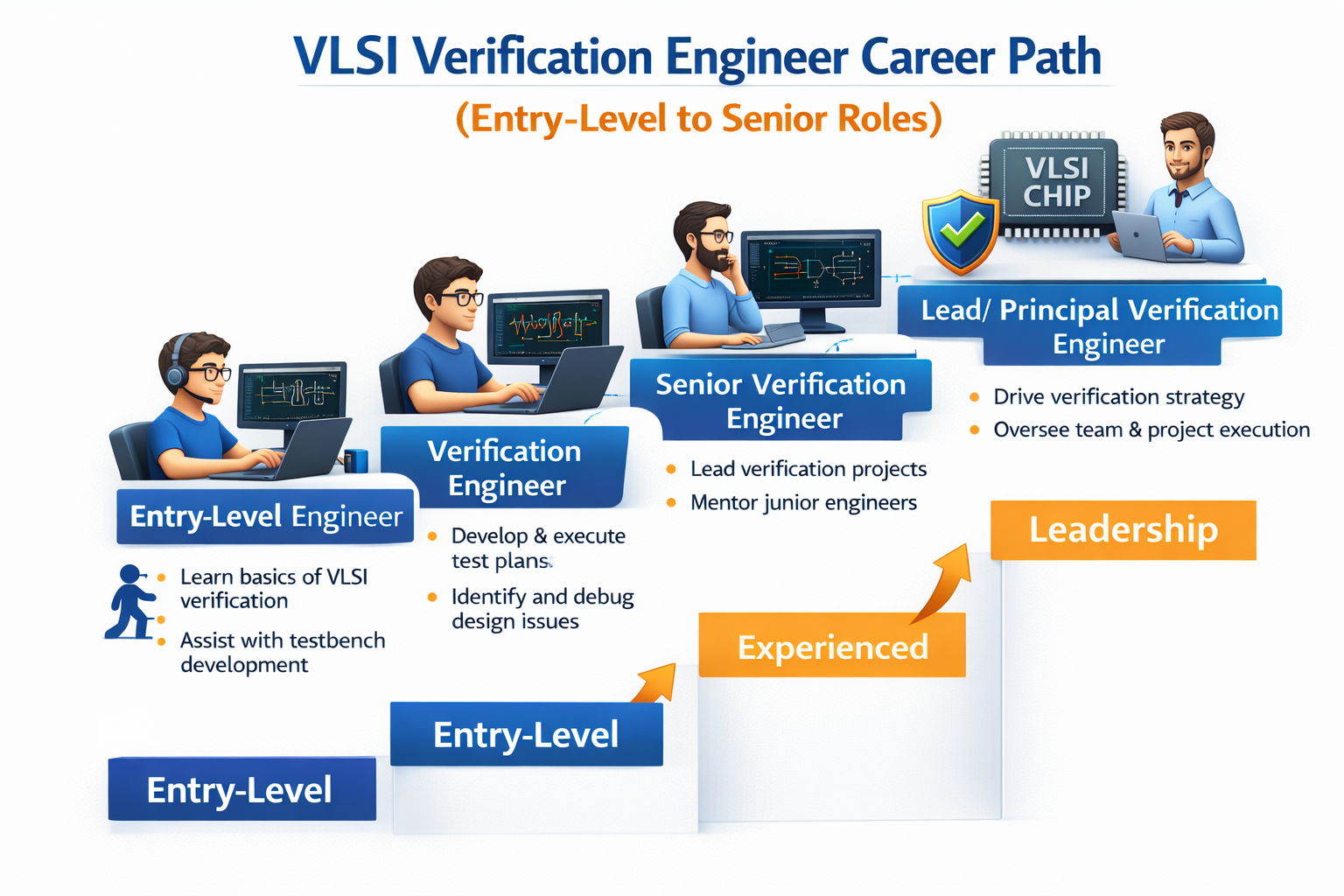
The career path of a VLSI Verification Engineer typically begins with an entry-level role such as Junior Verification Engineer or Graduate Trainee Engineer in a semiconductor company. At this stage, engineers focus on learning the fundamentals of the verification process, including writing basic test cases, running simulations, and understanding RTL designs created by the design team. They work with hardware description languages like Verilog or SystemVerilog and gain hands-on experience with simulation and debugging tools. Entry-level engineers also learn industry verification methodologies and gradually develop the ability to analyze waveform outputs and identify functional bugs in digital circuits.
With a few years of experience, professionals advance to the role of Verification Engineer or Senior Verification Engineer. In these positions, engineers handle more complex verification tasks such as building advanced testbenches, implementing verification environments using methodologies like UVM, and developing reusable verification components. They also collaborate closely with RTL design teams to resolve design issues and ensure that the chip meets its functional and performance requirements. At this stage, engineers are expected to have strong debugging skills, a deep understanding of digital design concepts, and the ability to manage verification tasks for specific modules within a larger semiconductor project.
As professionals gain extensive industry experience, they can move into leadership roles such as Verification Lead, Verification Architect, or Verification Manager. In these senior-level positions, engineers are responsible for defining verification strategies, managing verification teams, and ensuring complete functional coverage of complex chip designs. They oversee project timelines, coordinate with design and physical implementation teams, and guide junior engineers throughout the verification process. This career progression offers significant growth opportunities, allowing experienced verification engineers to take on strategic roles in semiconductor product development while also benefiting from competitive salaries and global career prospects.
VLSI Verification Engineer Salary in India and Globally

The salary of a VLSI Verification Engineer is considered highly competitive due to the growing demand for semiconductor professionals worldwide. In India, the average salary for a VLSI verification engineer typically ranges from ₹3 lakh to ₹16 lakh per year, depending on factors such as experience, company, and location. Fresh graduates or entry-level engineers generally start with salaries between ₹3 LPA and ₹6 LPA, while professionals with 2–5 years of experience can earn between ₹6 LPA and ₹15 LPA. Cities with strong semiconductor ecosystems—such as Bengaluru, Hyderabad, Pune, and Chennai—often offer higher salaries because many global chip design companies operate there. (AmbitionBox)
Globally, VLSI verification engineers earn significantly higher salaries, especially in countries with large semiconductor industries such as the United States, Germany, and Taiwan. In the United States, experienced design verification engineers working in major semiconductor companies can earn over $100,000 per year, with higher compensation packages that may include bonuses and stock options. As engineers gain more expertise in advanced verification methodologies like SystemVerilog, UVM, and SoC verification, their earning potential increases further. With the rapid growth of technologies such as artificial intelligence, automotive electronics, and high-performance computing, the demand for skilled VLSI verification engineers continues to rise, making it one of the most rewarding and stable career options in the semiconductor industry.
Difference Between VLSI Design Engineer and Verification Engineer
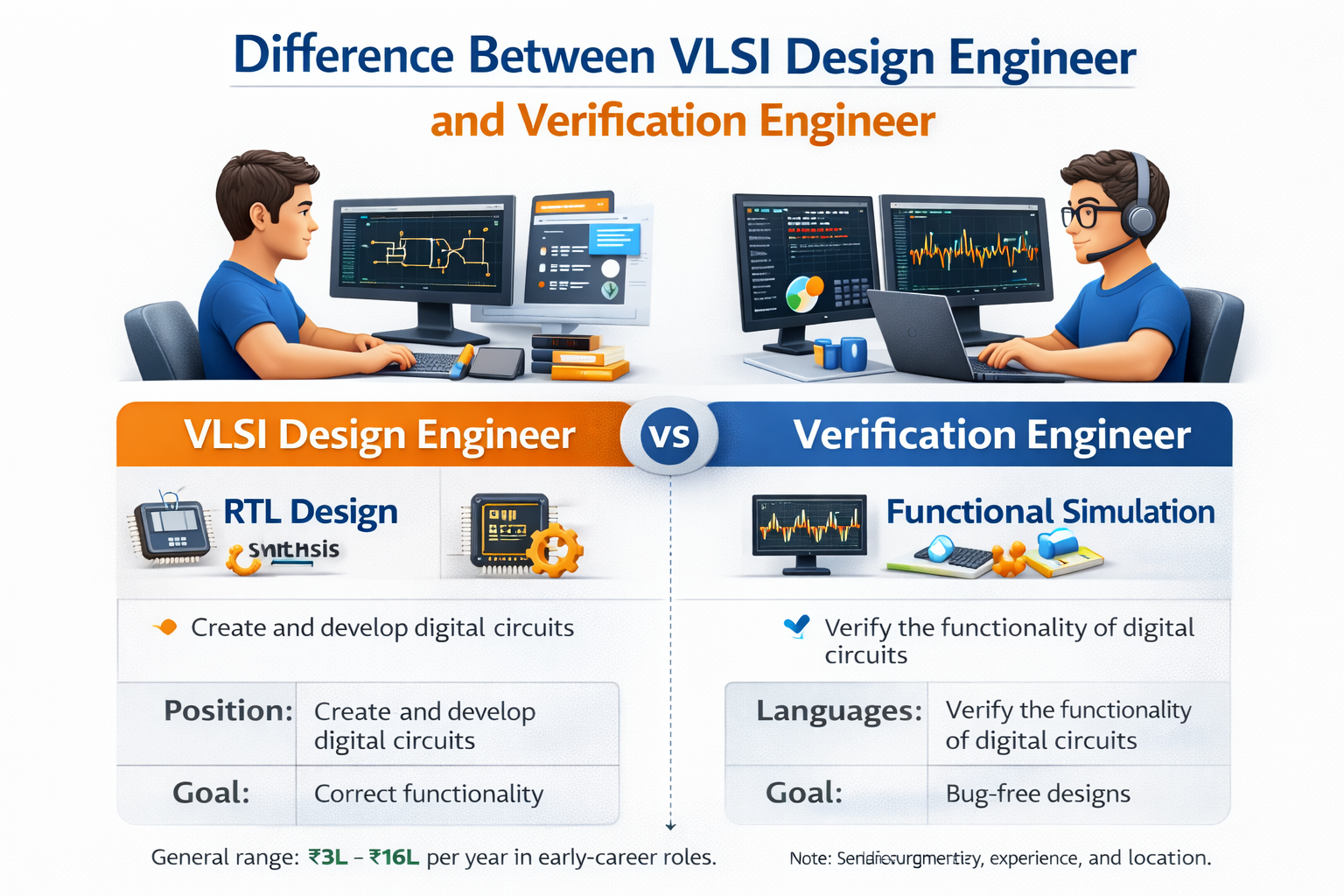
The roles of a VLSI Design Engineer and a VLSI Verification Engineer are closely related but focus on different stages of the semiconductor design process. A VLSI Design Engineer is responsible for creating the digital logic and architecture of integrated circuits using hardware description languages such as Verilog or VHDL. Their primary task is to develop the Register Transfer Level (RTL) design that defines how a chip performs specific functions. On the other hand, a VLSI Verification Engineer ensures that the design created by the design team works correctly under all possible conditions. Verification engineers test the functionality of the RTL design through simulation and validation techniques before the chip moves to manufacturing.
Another key difference lies in the tools, methodologies, and workflows used by both roles. VLSI Design Engineers focus mainly on designing and optimizing digital circuits, writing RTL code, and working with synthesis and timing analysis tools. In contrast, Verification Engineers develop testbenches and verification environments to validate the design. They typically use advanced verification languages like SystemVerilog and methodologies such as UVM (Universal Verification Methodology) to simulate complex scenarios and identify potential design bugs. Their work involves extensive debugging, waveform analysis, and coverage-driven verification to ensure that every part of the design functions according to specifications.
Despite their differences, both roles are highly collaborative and essential for successful semiconductor development. Design engineers and verification engineers work closely throughout the design cycle to detect and fix errors early in the process. While design engineers focus on building the functionality of the chip, verification engineers concentrate on ensuring its reliability and correctness. Together, they help deliver high-quality semiconductor products used in modern technologies such as smartphones, automotive systems, artificial intelligence processors, and IoT devices.
Best Projects for VLSI Verification Engineer Resume
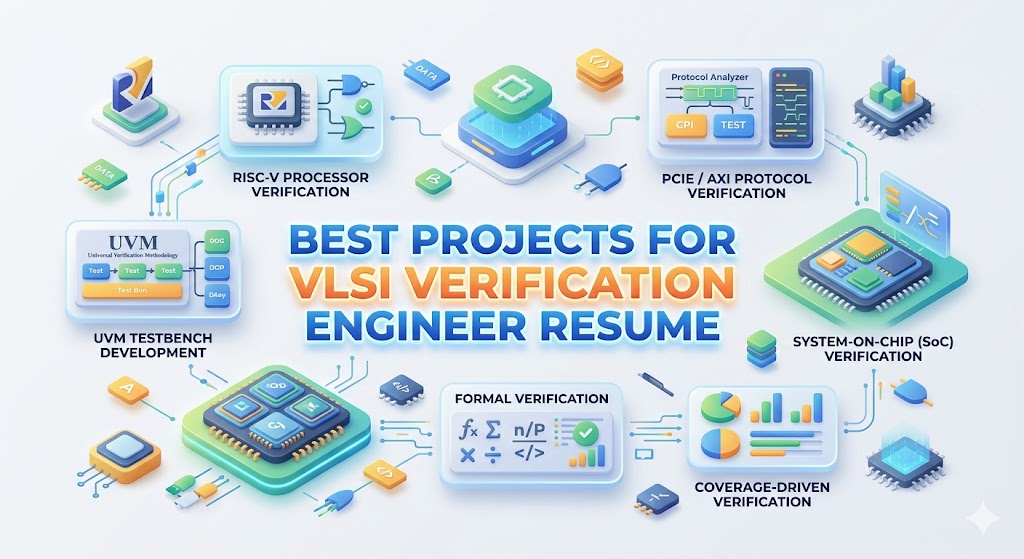
Working on practical verification projects is one of the best ways to strengthen a VLSI Verification Engineer resume and demonstrate real-world skills to semiconductor employers. Projects help candidates showcase their understanding of RTL design, testbench development, and debugging techniques. Some of the most valuable beginner-to-intermediate projects include UART verification, FIFO verification, ALU verification, and memory controller verification. In these projects, engineers create verification environments using languages like Verilog or SystemVerilog and develop test cases to validate different functional scenarios. Implementing verification concepts such as stimulus generation, assertions, and functional coverage helps candidates gain hands-on experience in identifying and debugging design errors.
For more advanced projects, aspiring verification engineers can work on protocol verification projects such as AXI, SPI, I2C, or PCIe verification using SystemVerilog and UVM methodology. These projects simulate real industry workflows where engineers build reusable testbench architectures, create constrained random test cases, and analyze simulation results using waveform debugging tools. Including such projects in a resume demonstrates strong knowledge of verification methodologies and the ability to handle complex digital designs. By completing well-documented projects with clear verification strategies, engineers can significantly improve their chances of securing roles in semiconductor companies and VLSI design firms.
Tips to Build a Successful Career in VLSI Verification
Building a successful career in VLSI verification starts with developing a strong foundation in digital electronics, computer architecture, and hardware design concepts. Understanding topics such as logic design, finite state machines, timing analysis, and RTL architecture is essential for verifying complex semiconductor designs. Aspiring engineers should also focus on learning hardware description and verification languages like Verilog and SystemVerilog, as these are widely used in the industry. In addition, gaining practical experience through projects and simulations helps improve problem-solving skills and provides a deeper understanding of how verification works in real chip development.
Another important step is mastering industry-standard verification methodologies and tools. Learning frameworks such as UVM (Universal Verification Methodology) can significantly enhance an engineer’s ability to create scalable and reusable verification environments. Engineers should also develop strong debugging and scripting skills using languages like Python, Perl, or TCL, which are often used to automate verification tasks. Hands-on experience with Electronic Design Automation (EDA) tools and waveform analysis is crucial for identifying and fixing functional issues in digital circuits efficiently.
Continuous learning and staying updated with the latest trends in the semiconductor industry are key factors for long-term success in VLSI verification. Engineers should actively participate in technical communities, attend semiconductor webinars or conferences, and follow emerging technologies such as AI accelerators, automotive electronics, and advanced SoC design. Networking with industry professionals and gaining internship or project experience can also open doors to better career opportunities. By combining strong technical skills, practical experience, and continuous learning, aspiring engineers can build a rewarding and stable career in the VLSI verification field.
Conclusion
A career as a VLSI Verification Engineer plays a crucial role in the semiconductor industry, ensuring that complex chip designs function correctly before they are manufactured. As modern electronic devices become more advanced, the demand for skilled verification engineers continues to grow across global semiconductor companies. By understanding the VLSI design flow, mastering verification methodologies, and developing strong debugging and analytical skills, aspiring engineers can build a solid foundation in this highly specialized field. With the right educational background and hands-on project experience, entering the VLSI verification domain can open doors to exciting opportunities in cutting-edge technology development.
In addition to strong technical knowledge, continuous learning and practical exposure are essential for long-term success in this career path. Engineers who stay updated with emerging verification tools, methodologies like SystemVerilog and UVM, and evolving semiconductor technologies can significantly enhance their professional growth. With competitive salaries, clear career progression, and increasing demand in areas such as AI hardware, automotive electronics, and advanced SoC design, VLSI verification offers a promising and rewarding career for electronics and semiconductor engineers worldwide.