

Ai Chip design and hardware acceleration: Why and How it is most demanding course in 2026
Navigate through this article using the table of contents below
Table of Contents
No headings found in this article.
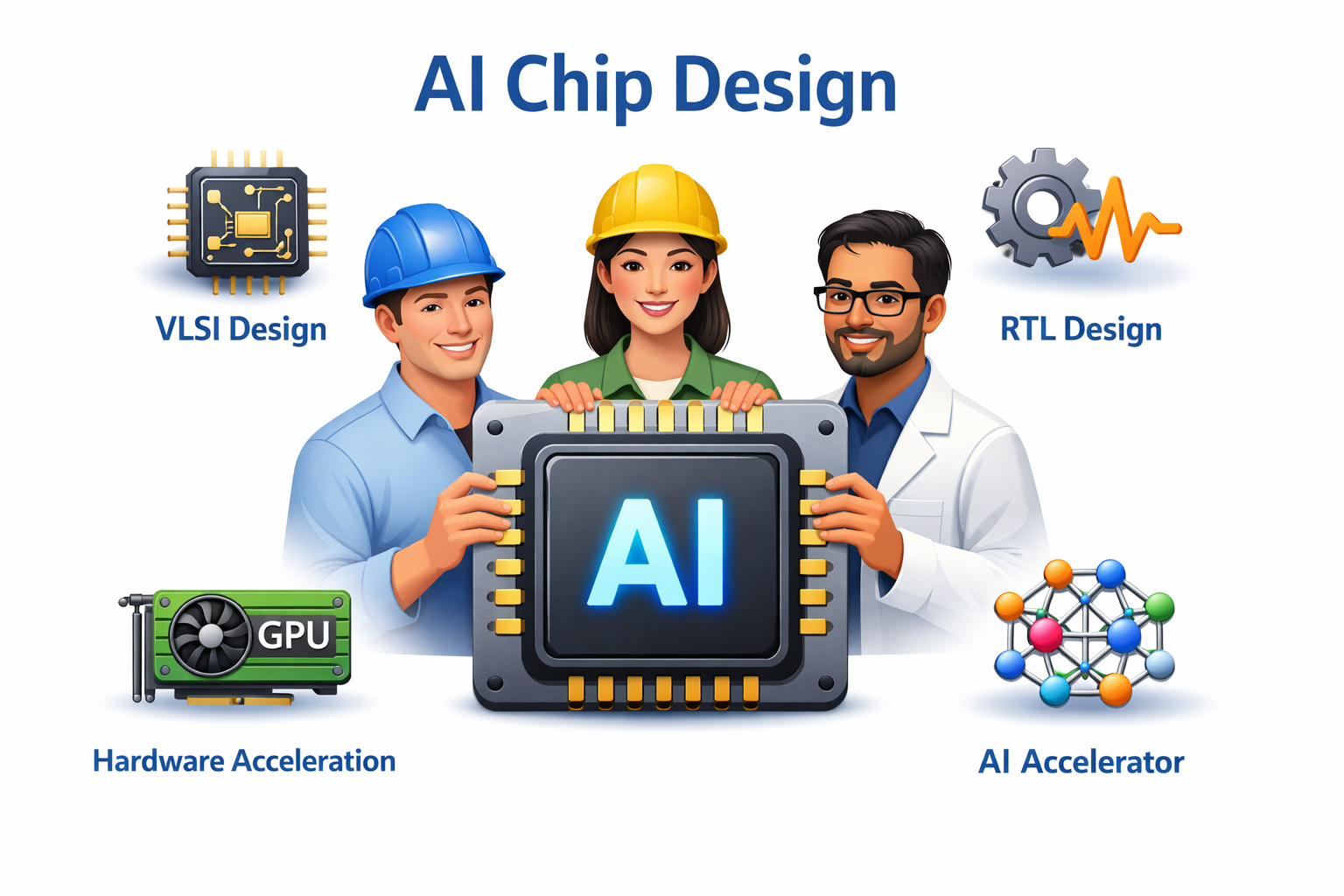
Artificial Intelligence is transforming every industry—from autonomous vehicles and smart healthcare systems to cloud computing and robotics. But behind every powerful AI model lies a critical piece of technology: AI chips and hardware acceleration. Traditional processors like CPUs are no longer sufficient to handle the massive data processing and parallel computations required by modern AI algorithms. This is where AI chip design and hardware acceleration come into play. Specialized processors such as GPUs, TPUs, and AI accelerators are designed to perform complex machine learning tasks faster and more efficiently. As AI adoption continues to grow globally, companies are investing heavily in AI semiconductor technologies, creating a massive demand for engineers skilled in designing these high-performance chips.
Because of this rapid technological shift, AI chip design and hardware acceleration courses are becoming one of the most in-demand learning paths in 2026. Universities, tech institutes, and semiconductor training programs are now focusing on teaching skills like VLSI design, RTL design, FPGA development, and AI hardware architecture. Professionals who understand both AI algorithms and hardware optimization are becoming extremely valuable in the semiconductor industry. With major companies building advanced AI processors for data centers, edge devices, and autonomous systems, students and engineers who learn AI hardware design today can unlock exciting career opportunities in the rapidly growing AI and semiconductor ecosystem.
What AI chip design means ?
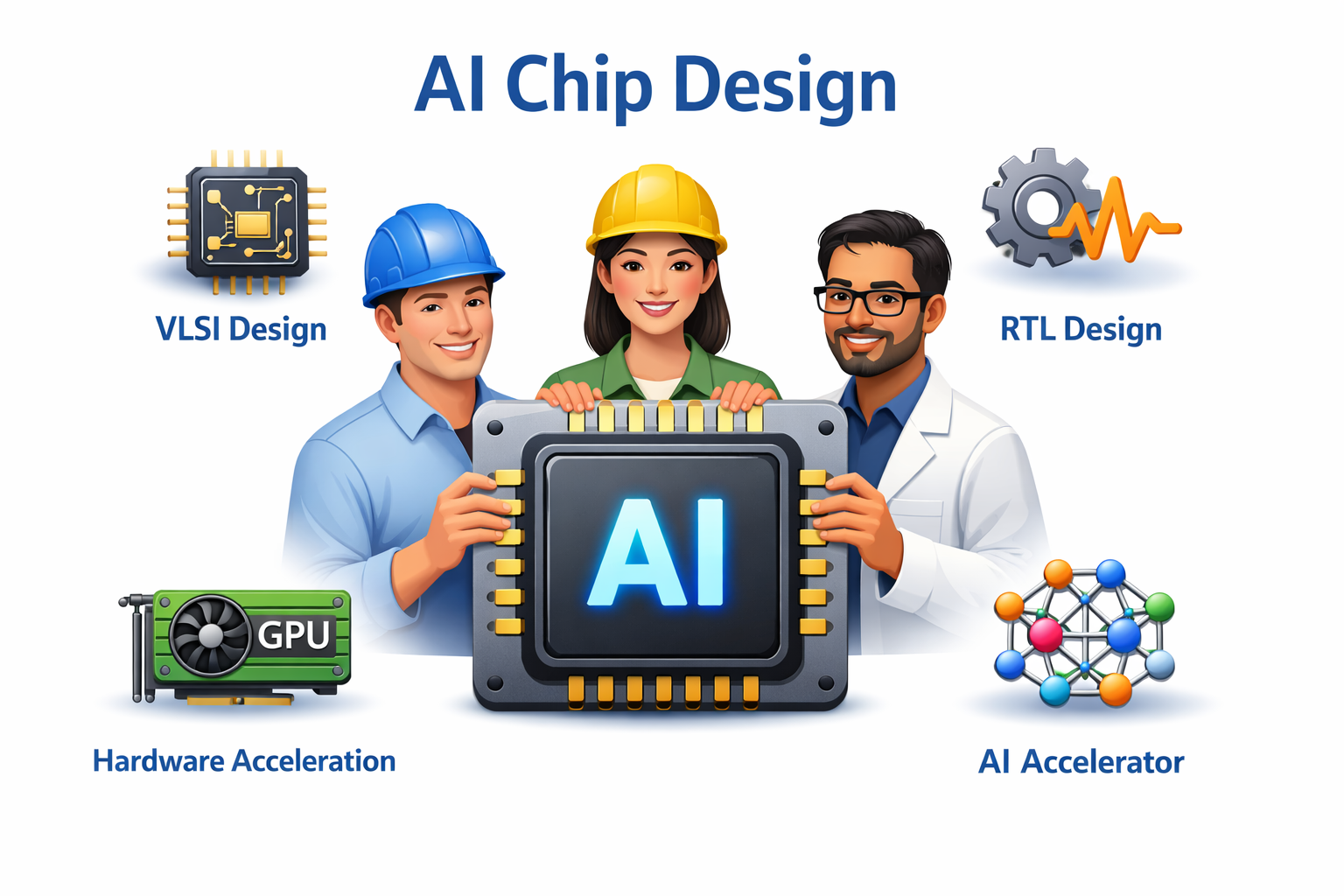
AI chip design refers to the process of creating specialized semiconductor chips that are optimized to run artificial intelligence and machine learning workloads efficiently. Unlike traditional processors such as CPUs, which are designed for general-purpose computing, AI chips are built to handle the massive parallel computations required by deep learning algorithms, neural networks, and data processing tasks. These chips are engineered to accelerate operations like matrix multiplication, data inference, and training models, allowing AI systems to process large datasets faster while consuming less power.
AI chip design involves several advanced technologies, including VLSI design, digital circuit design, RTL coding, ASIC development, and hardware acceleration architectures. Engineers design and optimize these chips so they can deliver high performance for AI applications used in areas such as autonomous vehicles, smart devices, robotics, healthcare diagnostics, and cloud computing. As artificial intelligence continues to expand across industries, the demand for efficient AI processors has increased significantly, making AI chip design one of the most important and rapidly growing fields in the semiconductor industry
Differences Between Traditional Processors and AI Chips
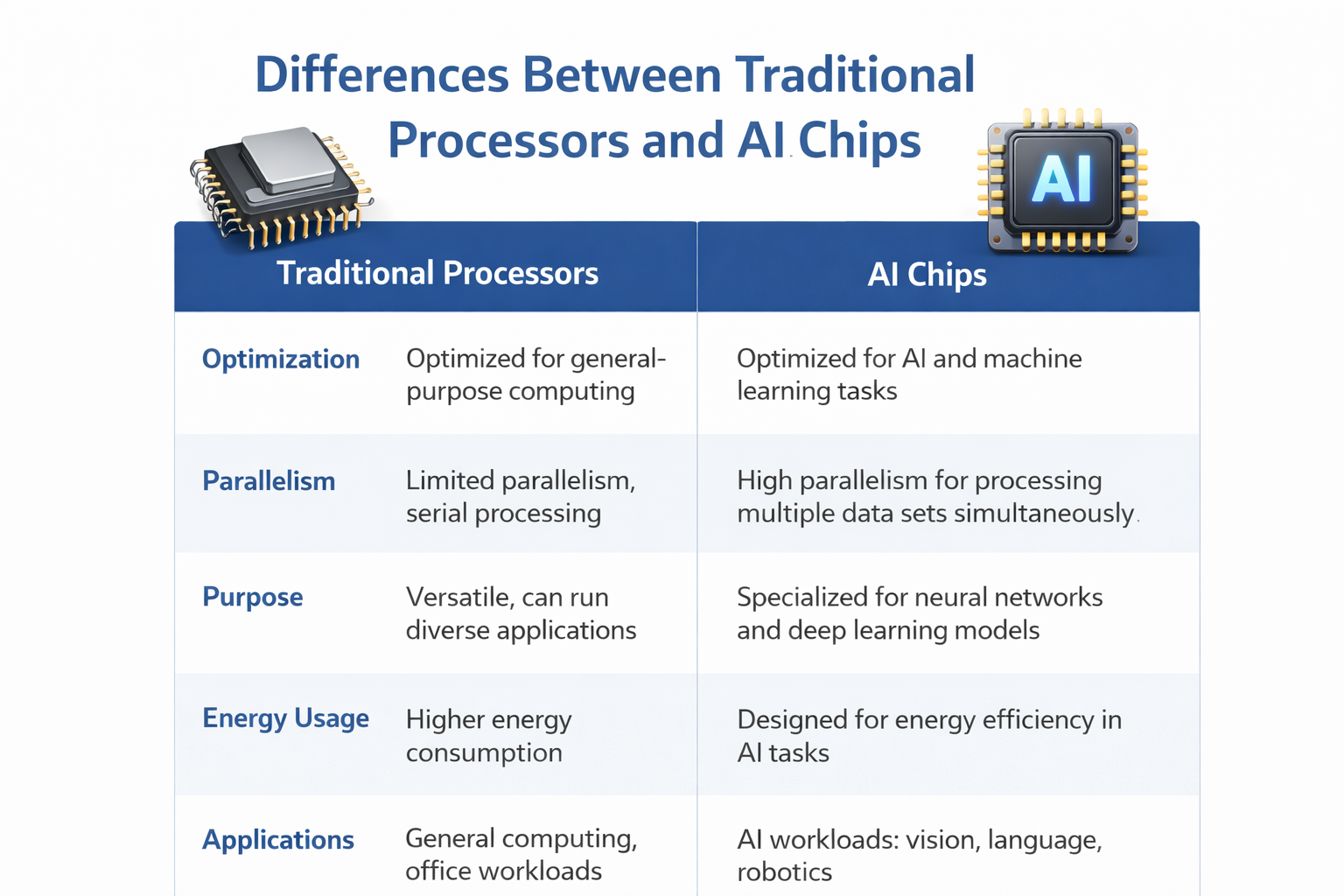
Traditional processors, such as CPUs (Central Processing Units), are designed for general-purpose computing tasks. They are optimized to handle a wide range of operations including running operating systems, executing software applications, and managing system processes. CPUs usually contain a limited number of powerful cores that process instructions sequentially or with limited parallelism. This architecture works well for everyday tasks like web browsing, office applications, and basic computing operations, but it becomes inefficient when dealing with the massive parallel calculations required by modern artificial intelligence and deep learning models.
In contrast, AI chips are specialized processors designed specifically to accelerate artificial intelligence workloads. These chips are optimized for performing large numbers of mathematical operations simultaneously, which is essential for training and running neural networks. AI chips such as GPUs, TPUs, and NPUs are built with thousands of smaller processing units that enable high levels of parallel processing. This architecture allows AI hardware to process large datasets quickly, reduce latency, and improve energy efficiency, making them ideal for applications like image recognition, natural language processing, autonomous driving, and real-time AI analytics.
Purpose
CPUs: Designed for general-purpose computing.
AI Chips: Built specifically for AI and machine learning workloads.
Processing Style
CPUs: Mostly sequential processing.
AI Chips: Highly parallel processing.
Core Architecture
CPUs: Few powerful cores.
AI Chips: Thousands of smaller cores optimized for AI tasks.
Performance for AI Tasks
CPUs: Slower for deep learning and neural network operations.
AI Chips: Much faster and optimized for AI computations.
Energy Efficiency
CPUs: Consume more power when running heavy AI workloads.
AI Chips: Designed to be more power-efficient for AI processing.
Typical Applications
CPUs: Operating systems, applications, and general computing.
AI Chips: Machine learning, computer vision, robotics, and autonomous
systems.
What is Hardware Acceleration?
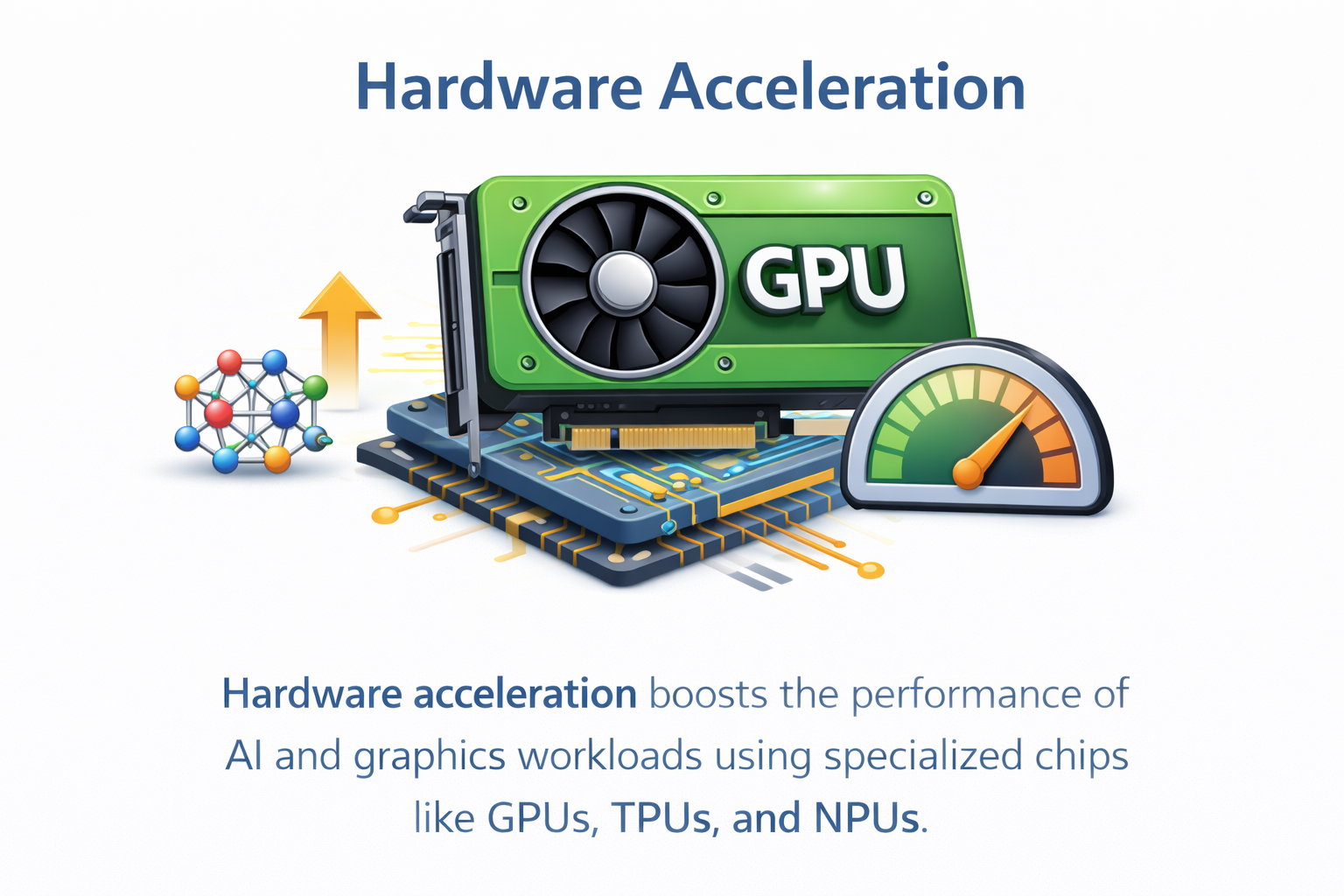
Hardware acceleration refers to the use of specialized hardware components to perform certain computing tasks faster and more efficiently than general-purpose processors. Instead of relying only on a CPU to handle every operation, hardware acceleration offloads specific workloads—such as graphics rendering, video processing, or artificial intelligence computations—to dedicated processors designed for those tasks. These specialized units are optimized to execute complex calculations quickly, reducing processing time and improving overall system performance.
In the context of artificial intelligence and modern computing, hardware acceleration plays a crucial role in handling large-scale data processing and parallel computations required by machine learning models. Technologies like GPUs, TPUs, FPGAs, and AI accelerators are commonly used to accelerate tasks such as neural network training, image recognition, and real-time data analysis. By using hardware acceleration, systems can process massive datasets more efficiently, lower power consumption, and achieve significantly higher performance, making it an essential technology for AI, cloud computing, autonomous vehicles, and advanced data center operations.
Why AI Chip Design is the Most In-Demand Skill in 2026
Artificial Intelligence is rapidly transforming industries such as healthcare, automotive, finance, robotics, and cloud computing. As AI applications become more advanced, the need for powerful and efficient hardware to run these complex algorithms has increased significantly. Traditional processors like CPUs cannot handle the massive parallel computations required by deep learning and neural networks. This has created a strong demand for AI chip design, where engineers develop specialized processors capable of accelerating AI workloads. As companies continue to build smarter technologies, professionals with expertise in AI hardware and semiconductor design are becoming extremely valuable.
Another major reason why AI chip design is one of the most in-demand skills in 2026 is the explosive growth of data and AI-driven services. Modern applications such as autonomous vehicles, smart assistants, recommendation systems, and edge AI devices require real-time data processing with low latency. To achieve this, companies are developing advanced hardware accelerators like GPUs, TPUs, and Neural Processing Units (NPUs). Engineers who understand VLSI design, hardware acceleration, and AI processor architecture are therefore in high demand because they help build the infrastructure that powers modern AI technologies.
Additionally, the global semiconductor industry is heavily investing in AI-focused hardware solutions. Leading technology companies are designing custom AI chips for data centers, mobile devices, and high-performance computing systems. This shift toward specialized AI hardware has opened a wide range of career opportunities for students and professionals interested in chip design and hardware engineering. As AI adoption continues to grow worldwide, learning AI chip design and hardware acceleration is becoming a future-proof skill that can lead to exciting roles in the rapidly expanding semiconductor and artificial intelligence ecosystem.
Industries Driving the Demand for AI Hardware Engineers

The demand for AI hardware engineers is growing rapidly as more industries adopt artificial intelligence to improve efficiency, automation, and decision-making. Sectors such as automotive, healthcare, robotics, finance, and cloud computing are heavily investing in AI-powered technologies that require specialized hardware to process large volumes of data quickly. Applications like autonomous driving, intelligent surveillance systems, medical image analysis, and smart assistants rely on advanced AI processors capable of handling complex machine learning algorithms. As a result, companies are developing custom AI chips and hardware accelerators, creating strong demand for engineers skilled in AI chip design and semiconductor technologies.
Another major driver of demand is the expansion of data centers and edge computing. Cloud service providers and technology companies are building powerful AI infrastructure to support services like recommendation systems, natural language processing, and large-scale data analytics. At the same time, edge devices such as smartphones, smart cameras, drones, and IoT systems require efficient AI hardware that can process data locally with low latency. To meet these growing technological needs, industries are increasingly hiring AI hardware engineers who can design, optimize, and develop specialized processors, making this field one of the fastest-growing career opportunities in the semiconductor and artificial intelligence sectors.
Key Technologies Used in AI Chip Design
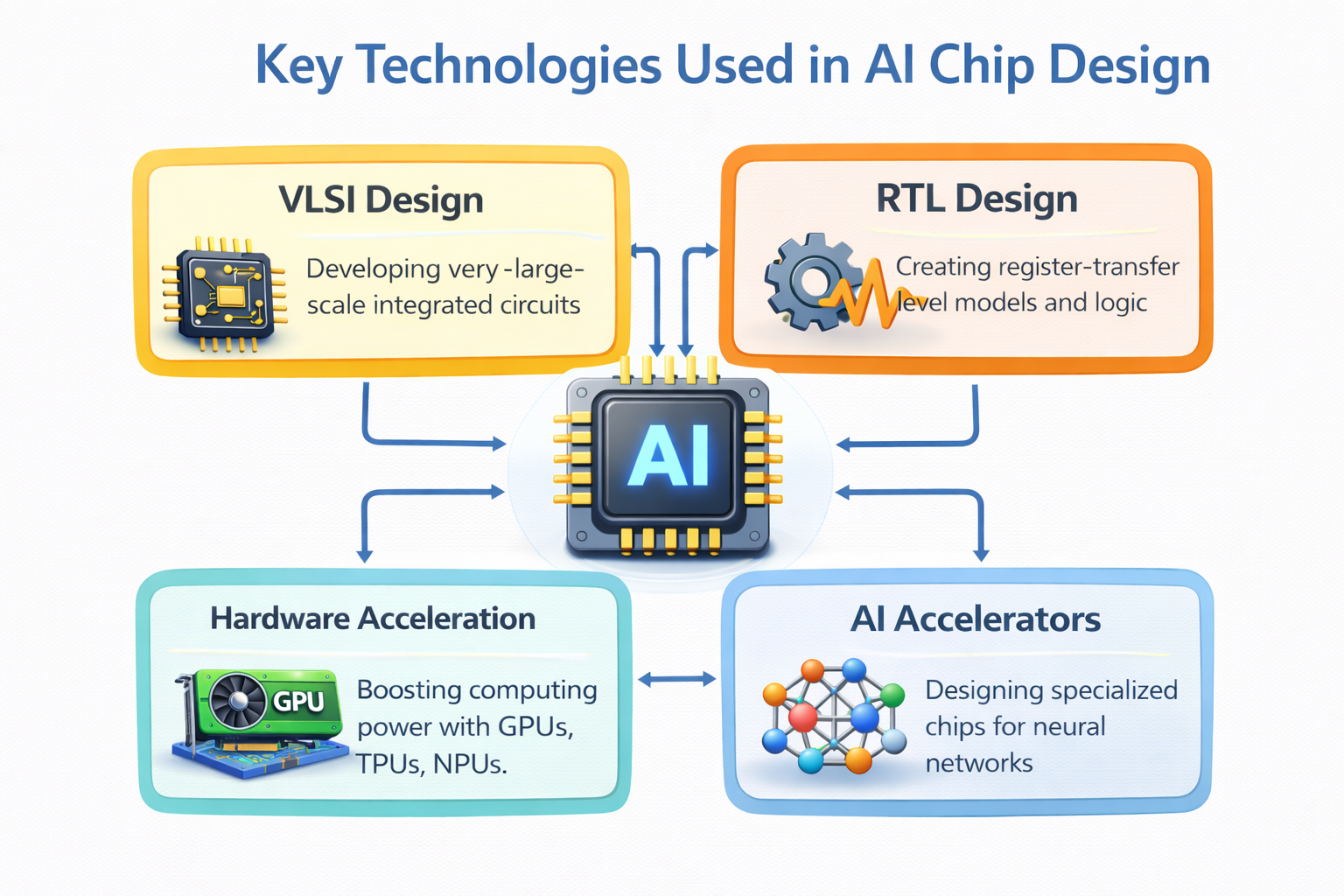
AI chip design relies on several advanced semiconductor technologies that enable processors to handle complex artificial intelligence and machine learning workloads efficiently. One of the most important technologies is VLSI (Very Large Scale Integration) design, which allows engineers to integrate millions or even billions of transistors onto a single chip. VLSI design helps create powerful processors capable of performing large-scale computations required for neural networks, deep learning models, and real-time data processing. This technology forms the foundation of modern AI processors used in data centers, edge devices, and high-performance computing systems.
Another key technology used in AI chip development is RTL (Register Transfer Level) design, typically implemented using hardware description languages such as Verilog or SystemVerilog. RTL design focuses on describing how data moves between registers and how different hardware components interact within a chip. Engineers use this level of design to build and optimize digital circuits that perform the mathematical operations required for AI algorithms. In addition to RTL design, technologies like ASIC (Application-Specific Integrated Circuit) design and FPGA prototyping play an important role in developing customized AI accelerators that deliver high performance and energy efficiency.
Furthermore, hardware–software co-design and parallel computing architectures are essential for building modern AI chips. AI workloads require massive parallel processing, which is why architectures used in GPUs, TPUs, and neural processing units are optimized for performing thousands of computations simultaneously. Engineers must carefully design the hardware so it works efficiently with AI frameworks and software libraries. By combining semiconductor design techniques, advanced chip architectures, and optimized hardware acceleration, these technologies enable the development of powerful AI processors that drive innovations in artificial intelligence applications across multiple industries.
Popular AI Chip Architectures
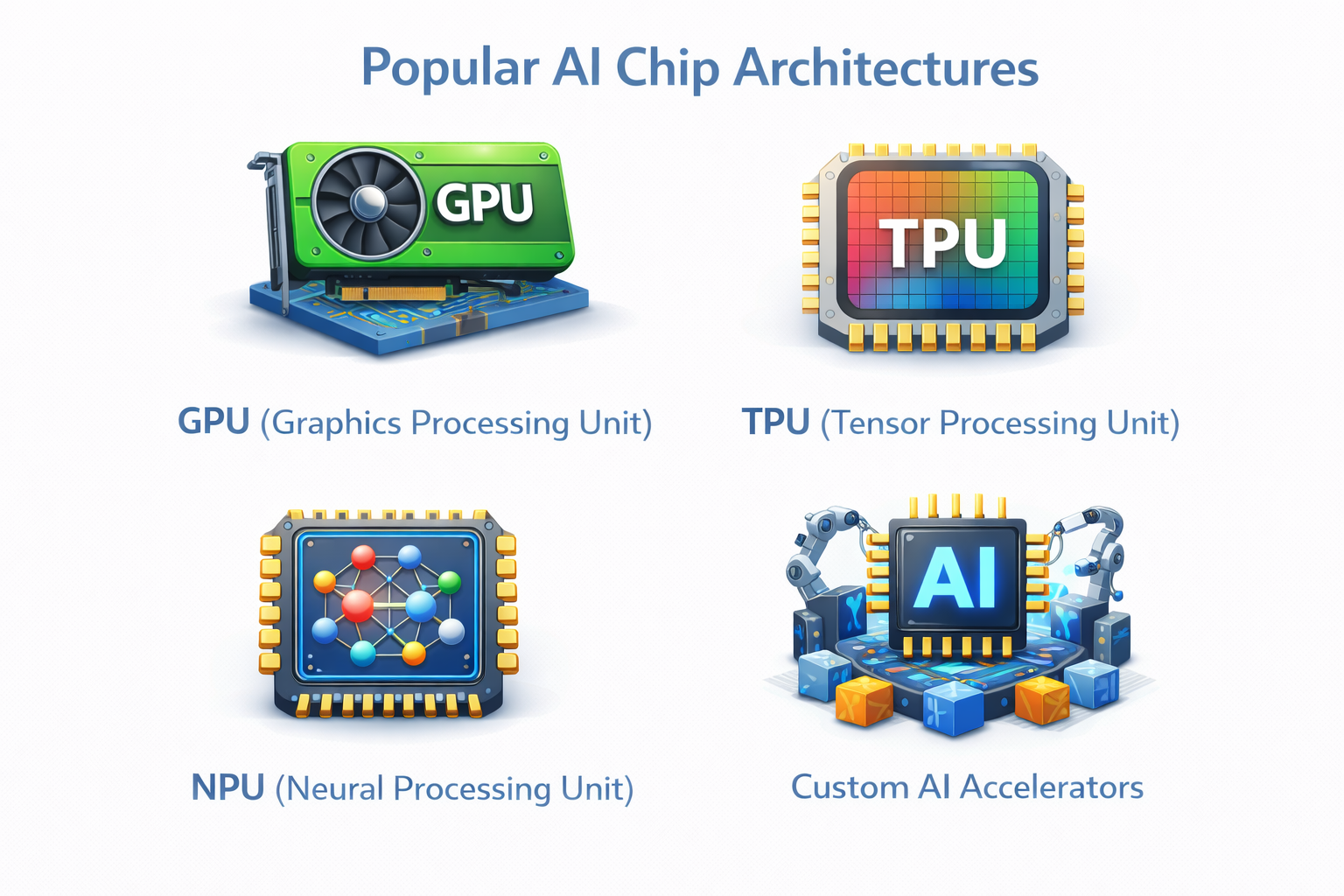
AI chip architectures are specialized processor designs created to efficiently execute artificial intelligence and machine learning workloads. Unlike traditional CPU architectures, AI chip architectures are optimized for performing large numbers of parallel mathematical operations such as matrix multiplications and vector calculations, which are fundamental to neural networks and deep learning models. These architectures are designed to handle massive datasets, reduce processing latency, and improve energy efficiency, enabling faster training and inference for AI applications used in areas like computer vision, natural language processing, and robotics.
Some of the most widely used AI chip architectures include Graphics Processing Units (GPUs), Tensor Processing Units (TPUs), and Neural Processing Units (NPUs). GPUs were originally designed for graphics rendering but are highly effective for AI because they can perform thousands of operations simultaneously. TPUs are specialized processors built specifically for accelerating machine learning tasks, especially deep learning models used in cloud computing and data centers. NPUs are designed for efficient AI processing in edge devices such as smartphones, cameras, and IoT systems. These architectures play a crucial role in powering modern AI technologies and continue to evolve as the demand for faster and more efficient AI hardware grows.
Top Semiconductor Companies Working on AI Chips
Many leading semiconductor companies are actively developing advanced AI chips to support the growing demand for artificial intelligence applications. Companies like NVIDIA, Intel, and AMD are at the forefront of designing high-performance processors used in AI training and inference. NVIDIA’s GPUs are widely used in data centers and AI research because of their powerful parallel computing capabilities. Intel and AMD are also investing heavily in AI accelerators and specialized processors that improve performance for machine learning workloads. These companies play a major role in advancing AI hardware technologies used in cloud computing, robotics, autonomous vehicles, and scientific research.
In addition to traditional semiconductor giants, several technology companies are also designing their own custom AI chips. For example, Google developed Tensor Processing Units (TPUs) to accelerate machine learning tasks in its data centers, while Apple integrates Neural Processing Units into its mobile processors to power on-device AI features. Similarly, Qualcomm is developing AI processors for smartphones and edge devices. The continuous innovation by these companies is driving the growth of the AI semiconductor ecosystem, creating strong demand for engineers skilled in AI chip design, hardware acceleration, and advanced semiconductor technologies.
Salary of AI Chip Design Engineers in 2026
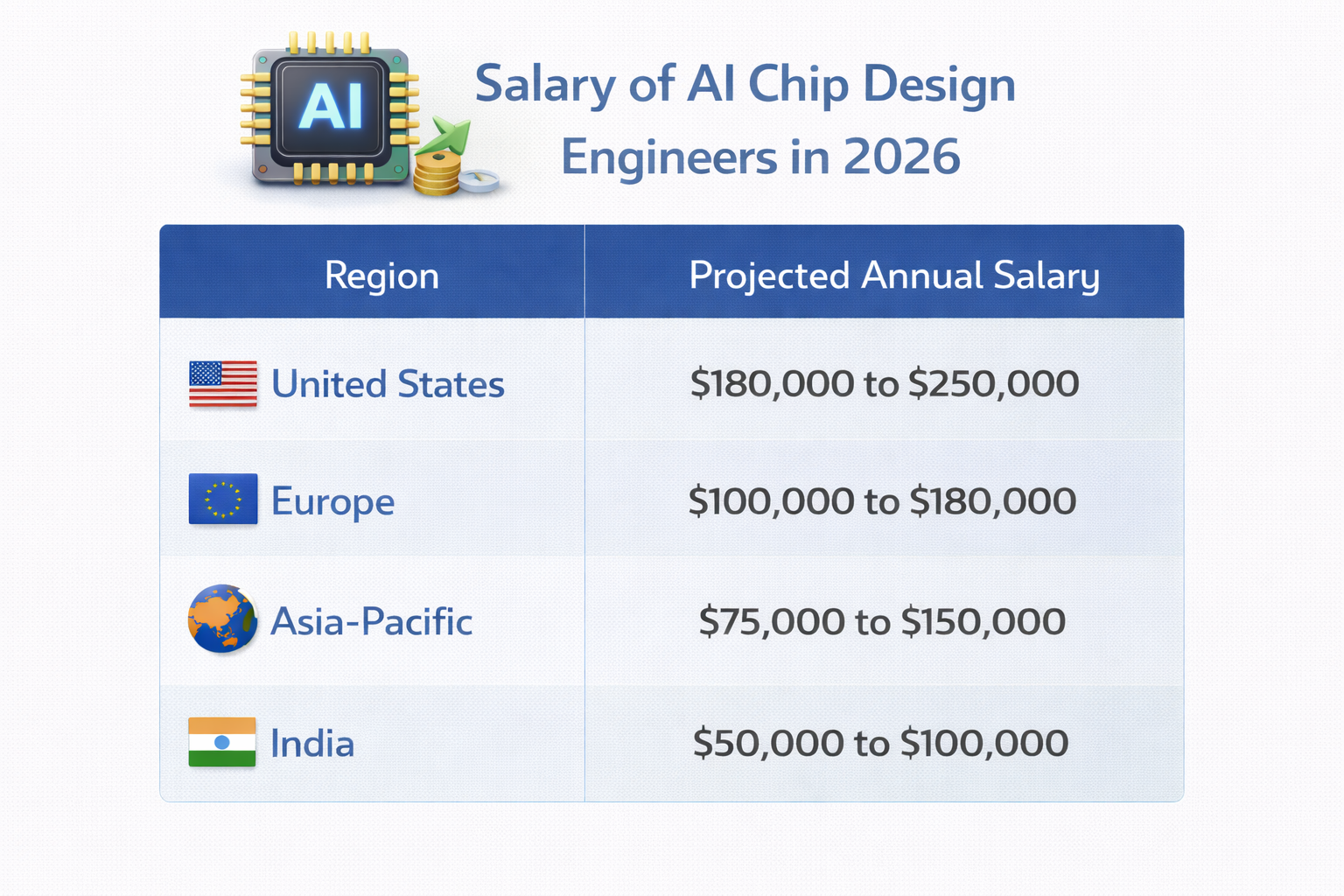
The salary of AI chip design engineers in 2026 is expected to be very competitive because of the rapid growth of artificial intelligence and the semiconductor industry. Companies developing AI processors for data centers, autonomous vehicles, robotics, and edge devices require highly skilled engineers who understand AI hardware architecture, VLSI design, RTL design, and hardware acceleration. Since the number of professionals with these specialized skills is still limited, companies are offering attractive salary packages to hire and retain top talent in this field.
As more organizations invest in AI infrastructure and custom semiconductor solutions, the demand for AI chip designers continues to increase worldwide. Engineers who specialize in designing AI accelerators, neural processing units, and high-performance computing chips can expect strong career growth and higher earning potential. With experience and expertise in advanced chip design technologies, professionals in this field can secure high-paying roles in leading semiconductor companies, making AI chip design one of the most promising and rewarding careers in the technology sector.
Entry-Level Engineers (0–2 years experience)
India: ₹6 LPA – ₹12 LPA
Mid-Level Engineers (3–7 years experience)
India: ₹15 LPA – ₹25 LPA
Senior Engineers (8+ years experience)
India: ₹30 LPA – ₹50 LPA or more
AI Chip Architects / Experts
₹50 LPA – ₹1 Crore+ in top semiconductor companies
Global Opportunities
International salaries can range from $100,000 to $200,000+ per year depending on experience and company.
Career Opportunities in AI Chip Design
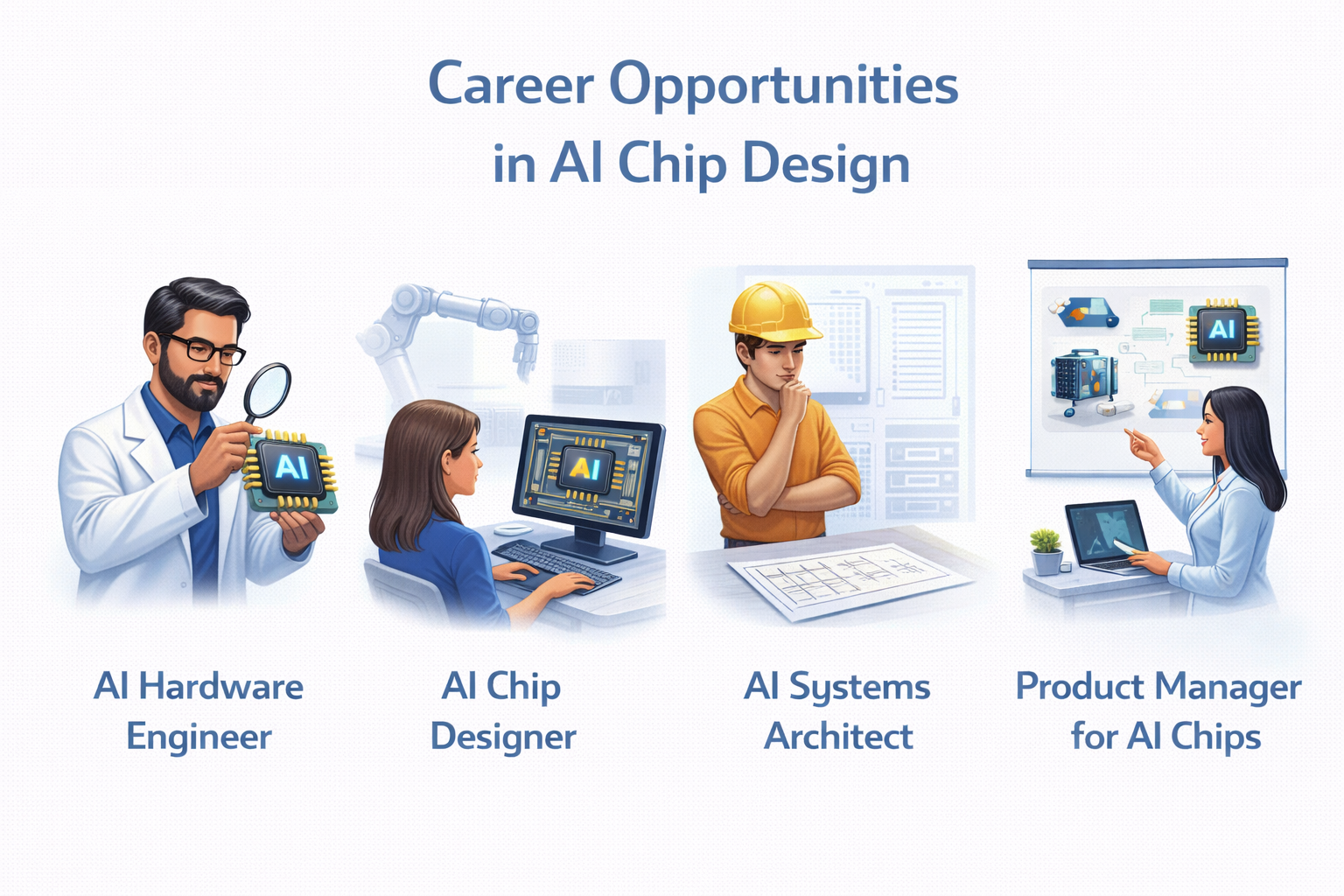
Career opportunities in AI chip design are expanding rapidly as artificial intelligence becomes a core part of modern technology. Companies developing AI-powered systems require specialized hardware that can process large amounts of data efficiently. This has created a strong demand for engineers who can design and optimize processors used in machine learning and deep learning applications. Professionals with skills in VLSI design, RTL design, computer architecture, and hardware acceleration can find opportunities in roles such as AI hardware engineer, ASIC design engineer, FPGA engineer, and RTL design engineer. These roles focus on building high-performance chips that power AI applications used in industries like autonomous vehicles, cloud computing, robotics, and smart devices.
In addition to technical roles, AI chip design also opens opportunities in research, architecture design, and semiconductor product development. Engineers can work on developing AI accelerators, neural processing units, and next-generation semiconductor technologies that improve the speed and efficiency of artificial intelligence systems. With the growing demand for AI infrastructure across the world, professionals in this field can work with leading semiconductor companies, technology firms, and research organizations. As AI continues to evolve, careers in AI chip design offer long-term growth, competitive salaries, and the chance to contribute to groundbreaking innovations in the global technology ecosystem. As AI continues to transform semiconductor design, advanced programs like the Master's in AI Chip Architecture & Agentic EDA Orchestration are opening next-generation career opportunities.
conclusion
AI chip design and hardware acceleration are becoming essential technologies that power the next generation of artificial intelligence applications. As industries increasingly rely on AI for automation, data analysis, and intelligent decision-making, the demand for specialized processors capable of handling complex computations continues to grow. Technologies such as VLSI design, RTL design, and AI accelerator architectures are enabling engineers to build powerful chips that improve performance, reduce power consumption, and support advanced AI workloads across data centers, edge devices, and smart systems.
Because of this rapid technological advancement, learning AI chip design and hardware acceleration is emerging as one of the most valuable career paths in 2026. Students and professionals who develop skills in semiconductor design and AI hardware technologies can access exciting opportunities in leading technology and semiconductor companies. As the AI ecosystem continues to expand worldwide, expertise in AI chip design will play a crucial role in shaping the future of computing, making it a future-proof and highly rewarding field for aspiring engineers.