

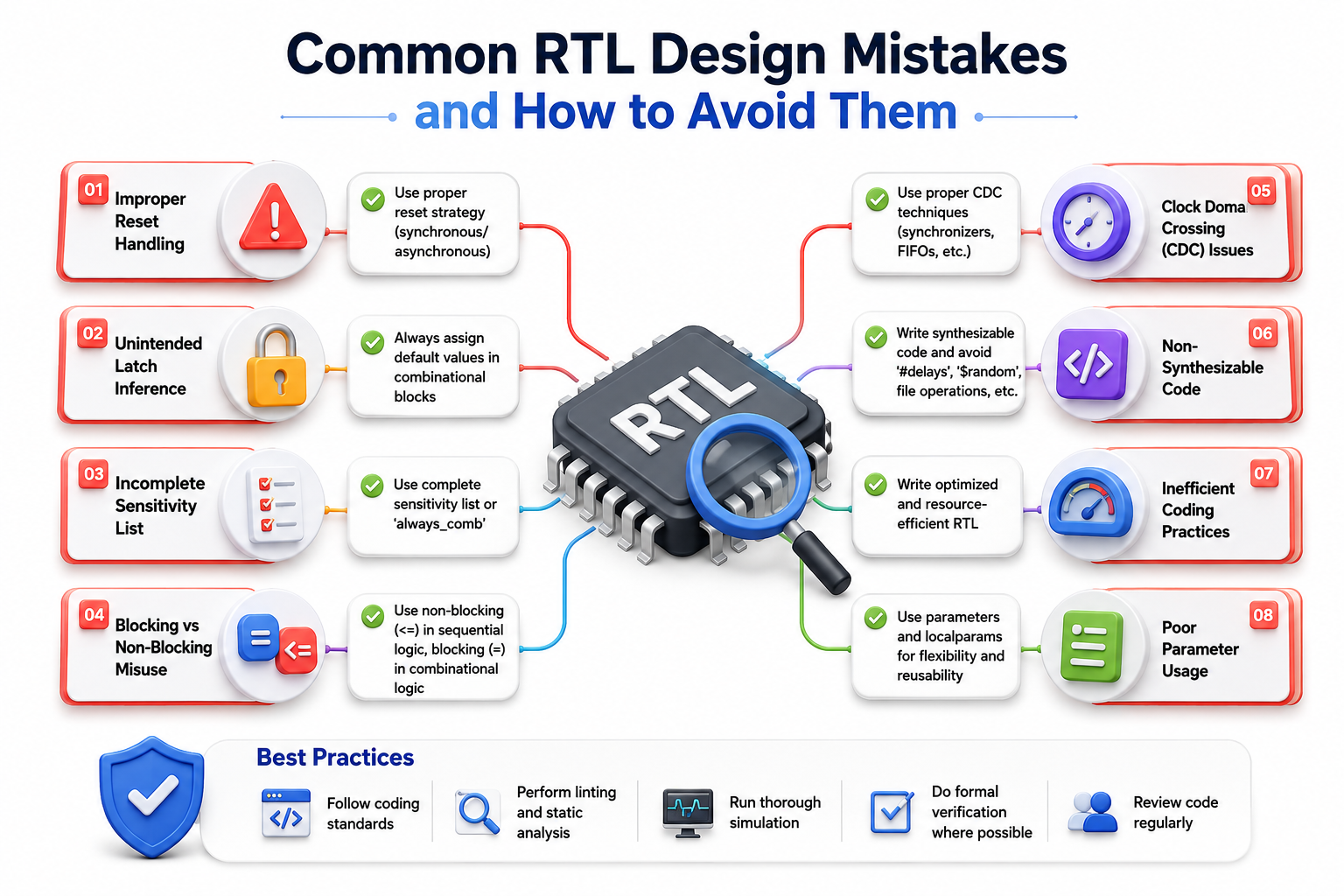
Common RTL Design Mistakes and How to Avoid Them
Navigate through this article using the table of contents below
Table of Contents
No headings found in this article.
What if a single RTL coding mistake could delay your chip design project by weeks or even lead to costly silicon re-spins? In the highly competitive semiconductor industry, RTL (Register Transfer Level) design serves as the foundation of every digital integrated circuit. Even experienced RTL engineers can encounter design errors that affect functionality, timing, power consumption, and overall chip performance. Identifying and preventing these mistakes early in the design cycle is essential for creating reliable and efficient hardware systems.
As the demand for skilled chip designers continues to grow, professionals often enhance their expertise through specialized RTL Design and Verification Training in India, where they learn industry-standard design methodologies, coding best practices, and advanced verification techniques. Understanding common RTL design mistakes and how to avoid them can significantly improve design quality, reduce verification effort, and accelerate time-to-market. From improper reset handling and unintended latch inference to clock domain crossing issues and inefficient coding practices, these errors can create major challenges during synthesis and verification. In this article, we explore the most common RTL design pitfalls, their impact on ASIC and FPGA development, and practical strategies to help RTL designers build robust, synthesizable, and high-performance digital designs.
What Is RTL Design and Why Is It Important in VLSI Development?
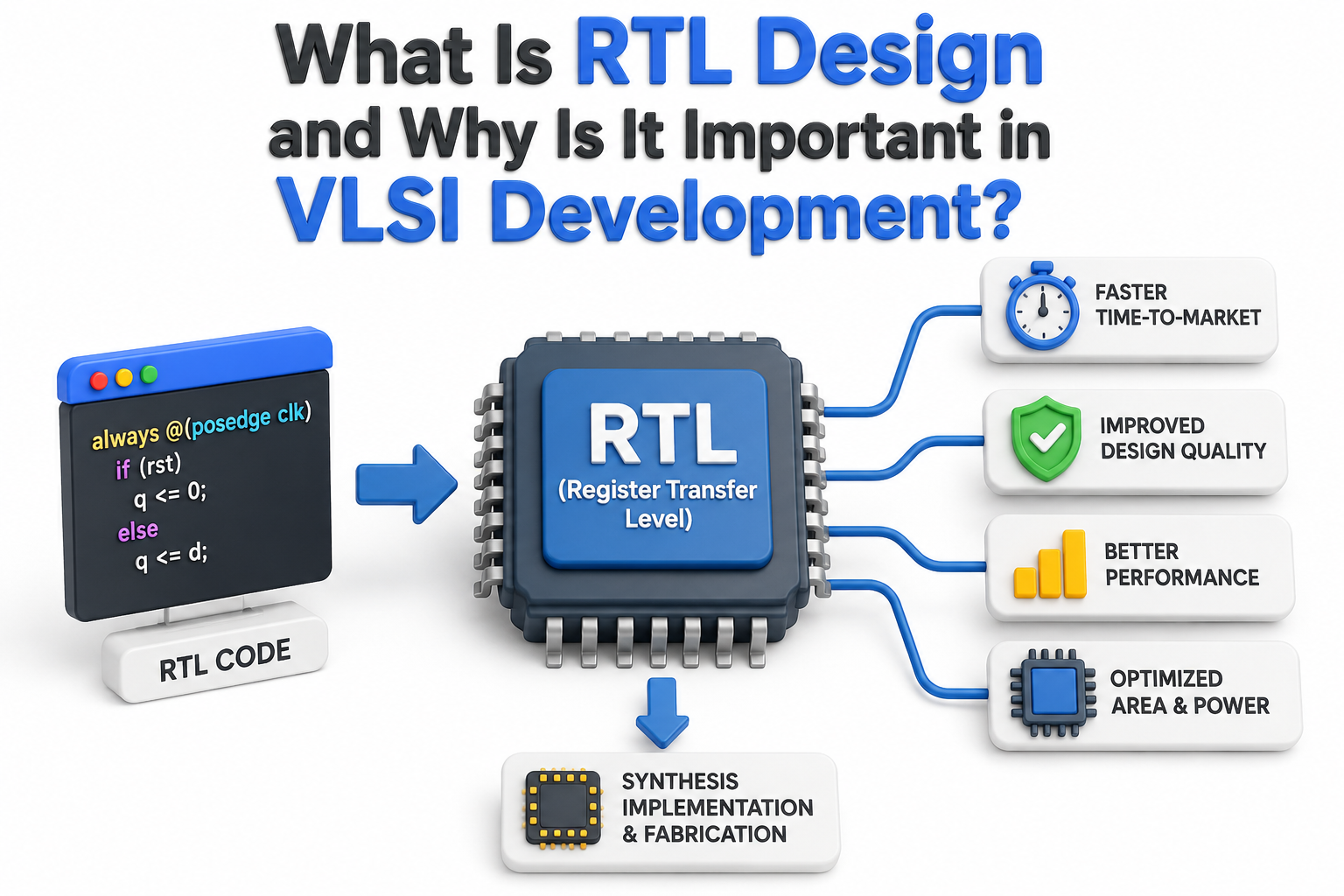
RTL (Register Transfer Level) Design is a hardware design abstraction used to describe how data moves between registers and how logical operations are performed within a digital circuit. Written primarily in Hardware Description Languages (HDLs) such as Verilog and VHDL, RTL design serves as the foundation of modern ASIC and FPGA development. It allows engineers to define the behavior, functionality, and architecture of digital systems before they are physically implemented in silicon. By creating an accurate RTL model, designers can simulate, verify, and optimize circuit behavior early in the development cycle, reducing the risk of costly design errors later in the process.
RTL design plays a critical role in VLSI (Very Large Scale Integration) development because it bridges the gap between system-level specifications and gate-level implementation. A well-written RTL design directly impacts chip performance, power consumption, area utilization, and overall reliability. During the VLSI design flow, RTL code undergoes synthesis, verification, timing analysis, and physical design before becoming a manufacturable semiconductor device. As semiconductor technologies continue to advance, high-quality RTL design has become essential for developing complex processors, communication systems, AI accelerators, automotive electronics, and other high-performance integrated circuits efficiently and accurately.
Read more about :- RTL Design and Verification Training in Hyderabad
Common RTL Design Mistakes That Impact Chip Performance
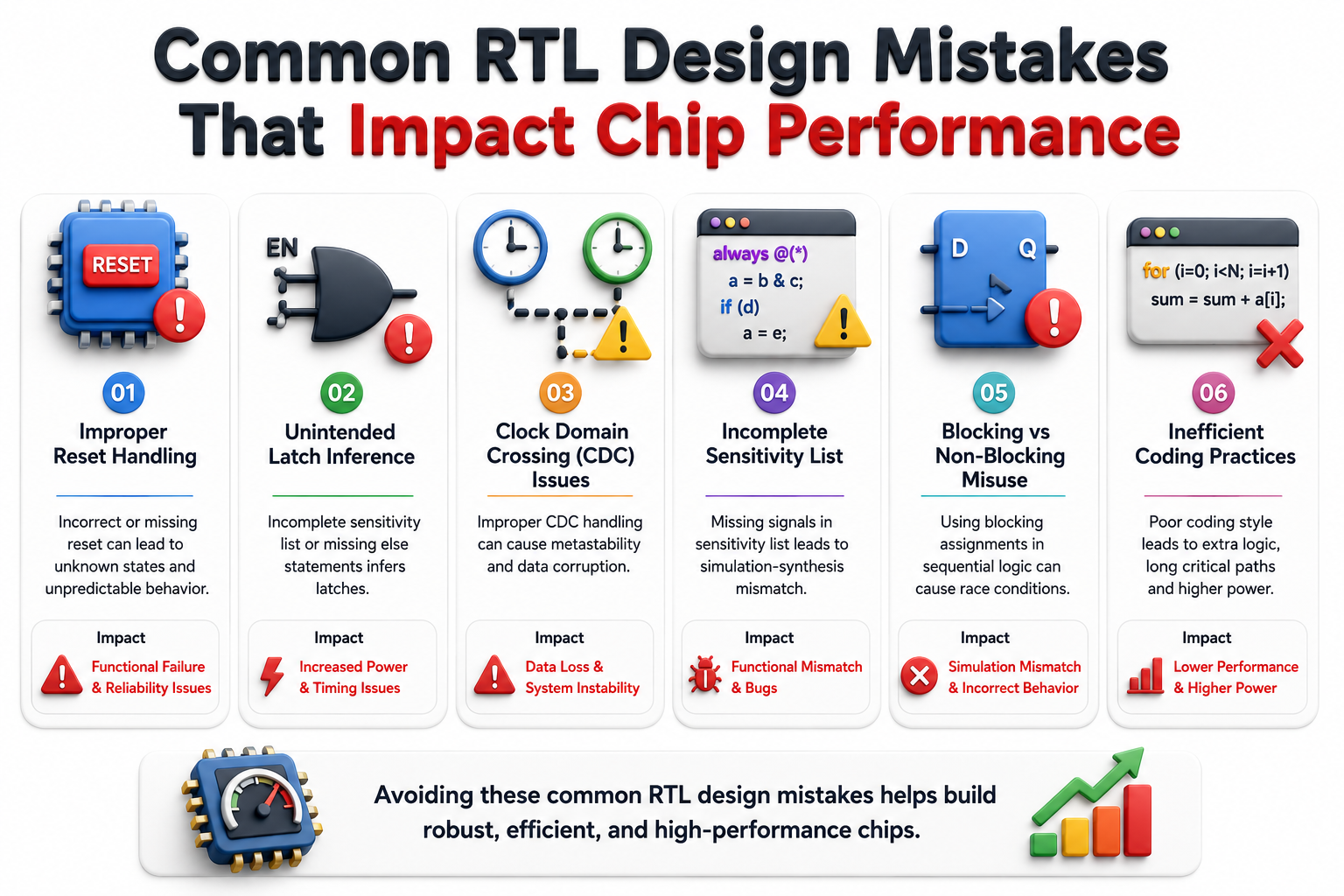
RTL design mistakes can significantly impact chip performance, functionality, and reliability, making early detection and correction essential in any VLSI project. Since RTL (Register Transfer Level) code serves as the blueprint for digital hardware implementation, even small coding errors can propagate through synthesis and physical design stages, resulting in timing violations, increased power consumption, or incorrect circuit behavior. Common issues such as unintended latch inference, improper reset implementation, and incorrect assignment usage can create challenges that are difficult and costly to fix later in the semiconductor design cycle.
One of the most frequent RTL design mistakes is failing to account for timing and synchronization requirements. Problems such as clock domain crossing (CDC) errors, race conditions, and incomplete sensitivity lists can lead to simulation and synthesis mismatches, causing unpredictable hardware behavior. Similarly, data width mismatches, overflow conditions, and poor finite state machine (FSM) design practices can introduce functional bugs that affect the accuracy and stability of digital systems. These issues often become more critical as chip complexity increases, especially in modern ASIC and FPGA designs.
Poor coding practices can also reduce design scalability, maintainability, and verification efficiency. Hardcoded values, lack of parameterization, insufficient code reviews, and inadequate verification planning can make RTL designs difficult to modify and debug. By following established RTL coding guidelines, performing thorough functional verification, and using linting and CDC analysis tools, engineers can minimize design risks and improve overall chip quality. Understanding these common RTL design mistakes is the first step toward building robust, synthesizable, and high-performance digital circuits that meet industry standards and project requirements.
Unintended Latch Inference in RTL Design
Unintended latch inference is one of the most common RTL design mistakes encountered in ASIC and FPGA development. A latch is typically inferred when a combinational logic block does not assign values to an output signal under all possible input conditions. As a result, the synthesis tool creates storage elements to retain the previous value of the signal, even when the designer did not intend to implement memory behavior. Unwanted latches can introduce timing issues, increase power consumption, complicate timing closure, and create simulation-to-silicon mismatches that negatively affect overall chip performance and reliability.
To avoid unintended latch inference in RTL design, engineers should ensure that all output signals in combinational logic are assigned values in every possible execution path. This can be achieved by providing default assignments at the beginning of combinational blocks and including complete if-else or case statements with appropriate default conditions. Using coding guidelines, RTL linting tools, and thorough code reviews can help identify latch-related issues early in the design cycle. By following these best practices, RTL designers can create fully combinational logic, improve synthesizability, and reduce the risk of functional and timing problems in VLSI designs.
Improper Reset Design and Reset Handling Issues
Improper reset design is a critical RTL design mistake that can lead to unpredictable circuit behavior, startup failures, and difficult-to-debug functional issues in ASIC and FPGA designs. Resets are responsible for initializing registers, state machines, and control logic to known states when a system powers up or recovers from an error condition. Problems often arise when reset signals are inconsistently applied, incorrectly synchronized, or unnecessarily connected to every register in the design. Poor reset implementation can result in metastability, increased routing complexity, higher power consumption, and timing closure challenges, ultimately affecting the reliability and performance of the chip.
To avoid reset handling issues, designers should establish a clear reset strategy early in the RTL design process and consistently follow it throughout the project. Choosing the appropriate reset type—synchronous or asynchronous—based on system requirements is essential. For asynchronous resets, proper synchronization should be implemented when releasing the reset signal to prevent metastability issues. Engineers should also reset only the registers that require initialization, rather than applying resets indiscriminately across the entire design. Regular RTL reviews, linting checks, and verification of reset scenarios during simulation help ensure that all components initialize correctly and operate reliably under different startup and recovery conditions.
Clock Domain Crossing (CDC) Errors
Clock Domain Crossing (CDC) errors occur when signals are transferred between different clock domains that operate at separate frequencies or phases. Since there is no fixed timing relationship between these clock domains, signals can become unstable during transfer, leading to metastability, data corruption, missed events, or unpredictable circuit behavior. CDC issues are among the most critical challenges in modern ASIC and FPGA design because complex System-on-Chip (SoC) architectures often contain multiple clock domains for performance and power optimization. If CDC errors are not properly addressed, they can cause intermittent failures that are difficult to detect during simulation but may appear in silicon after fabrication.
To avoid CDC errors, designers should use proper synchronization techniques when transferring signals between clock domains. Single-bit control signals should pass through multi-stage synchronizers, while multi-bit data transfers should use mechanisms such as asynchronous FIFOs, handshake protocols, or Gray-coded counters. CDC analysis tools should be integrated into the verification flow to automatically identify unsafe crossings and synchronization issues. Additionally, following established CDC design guidelines, performing thorough verification, and conducting regular design reviews can significantly reduce the risk of metastability and ensure reliable communication across clock domains in RTL designs.
Blocking vs Non-Blocking Assignment Mistakes
Blocking and non-blocking assignment mistakes are among the most common RTL coding errors in Verilog-based ASIC and FPGA design. Blocking assignments (=) execute sequentially within a procedural block, meaning each statement completes before the next one begins. Non-blocking assignments (<=), on the other hand, schedule updates to occur simultaneously at the end of the current simulation time step. Problems arise when designers use blocking assignments in sequential logic or mix both assignment types incorrectly within the same process. Such mistakes can create simulation inconsistencies, race conditions, and behavior that does not accurately represent the intended hardware, potentially leading to functional bugs and verification challenges.
To avoid blocking vs non-blocking assignment errors, designers should follow a clear coding guideline: use non-blocking assignments (<=) for clocked sequential logic and blocking assignments (=) for combinational logic. Consistently separating combinational and sequential processes improves code readability and reduces the risk of simulation-synthesis mismatches. RTL linting tools, code reviews, and functional verification should also be used to identify assignment-related issues early in the design cycle. By applying these best practices, engineers can create predictable, synthesizable RTL code that accurately reflects the intended hardware behavior and improves overall design reliability.
Race Conditions and Timing Issues in RTL Code
Race conditions and timing issues in RTL code occur when the behavior of a digital circuit depends on the order or timing of signal updates rather than the intended design logic. These problems often arise from improper use of blocking and non-blocking assignments, unsynchronized signal transfers, multiple drivers for the same signal, or poorly structured sequential logic. Race conditions can cause simulation results to differ from actual hardware behavior, making bugs difficult to identify and debug. In complex ASIC and FPGA designs, timing issues such as setup and hold time violations can further impact performance, leading to unreliable operation and functional failures after synthesis or silicon implementation.
To avoid race conditions and timing-related problems, designers should follow established RTL coding guidelines and maintain a clear separation between combinational and sequential logic. Non-blocking assignments (<=) should be used in clocked processes, while blocking assignments (=) should be reserved for combinational logic. Proper clock domain crossing (CDC) synchronization techniques, timing constraint definition, and static timing analysis are also essential for ensuring reliable signal transfers and meeting timing requirements. Additionally, thorough simulation, RTL linting, code reviews, and verification testing can help detect race conditions early, allowing engineers to create stable, predictable, and high-performance digital designs.
Overusing Hardcoded Values in RTL Design
Overusing hardcoded values in RTL design is a common coding practice that can reduce design flexibility, scalability, and maintainability. Hardcoded values are fixed numerical constants directly embedded in the RTL code, such as bus widths, memory sizes, counter limits, or timing parameters. While this approach may seem convenient during initial development, it becomes problematic when design requirements change. Engineers often need to modify multiple sections of code manually, increasing the risk of errors and making the design difficult to reuse across different ASIC or FPGA projects. In large VLSI designs, excessive hardcoding can also complicate verification and prolong development cycles.
To avoid this mistake, designers should use parameters, local parameters, and configurable constants instead of fixed values wherever possible. Parameterized RTL code allows key design attributes such as data widths, buffer depths, and address ranges to be modified from a single location without changing the core logic. This approach improves code reusability, simplifies design updates, and makes verification more efficient. Additionally, adopting coding standards, performing regular code reviews, and focusing on modular design practices can help ensure that RTL designs remain scalable, maintainable, and adaptable to future project requirements.
Simulation and Synthesis Mismatch Issues
Simulation and synthesis mismatch issues occur when RTL code behaves differently during simulation than it does after synthesis and hardware implementation. These discrepancies can lead to functional failures that are not detected during the verification phase but appear later in FPGA prototypes or fabricated ASICs. Common causes include incomplete sensitivity lists, unintended latch inference, improper initialization, misuse of simulation-only constructs, and incorrect assignment styles. Since simulation models are used to validate design functionality before synthesis, any mismatch between simulated behavior and synthesized hardware can result in costly debugging efforts and project delays.
To avoid simulation and synthesis mismatches, designers should write fully synthesizable RTL code and follow established coding guidelines throughout the design process. Using complete combinational logic descriptions, avoiding unsupported simulation constructs, properly handling resets, and adhering to recommended blocking and non-blocking assignment practices can significantly reduce mismatch risks. Additionally, RTL linting tools, synthesis checks, formal verification, and gate-level simulations should be incorporated into the verification flow to identify inconsistencies early. By maintaining coding discipline and validating designs across multiple verification stages, engineers can ensure that the synthesized hardware accurately reflects the intended RTL functionality.
Tools Used to Detect RTL Design Errors
Detecting RTL design errors early is essential for developing reliable and high-performance ASIC and FPGA designs. To achieve this, engineers use a variety of specialized tools that analyze RTL code for functional, structural, and timing-related issues before the design reaches synthesis or silicon implementation. RTL linting tools help identify coding violations, unintended latch inference, unused signals, and synthesis-related problems. Clock Domain Crossing (CDC) analysis tools detect unsafe signal transfers between different clock domains, while static analysis and formal verification tools help uncover logic inconsistencies and corner-case bugs that may not be found through simulation alone. These tools significantly improve design quality by identifying potential issues early in the VLSI development cycle.
To avoid RTL design mistakes, engineers should integrate these verification and analysis tools into their standard design flow rather than relying solely on manual code reviews. Regular linting, CDC checks, functional simulation, formal verification, and static timing analysis can help detect problems before they become costly hardware issues. Additionally, establishing coding standards, conducting peer reviews, and continuously validating RTL code throughout development can further reduce design risks. By combining automated verification tools with best coding practices, RTL designers can create robust, synthesizable, and error-free digital circuits while improving overall productivity and reducing time-to-market.
Conclusion: Building Robust RTL Designs Through Best Practices
Building robust RTL designs requires more than simply writing functional code—it demands adherence to proven coding standards, thorough verification, and a deep understanding of potential design pitfalls. Common RTL design mistakes such as unintended latch inference, improper reset handling, clock domain crossing errors, race conditions, and simulation-synthesis mismatches can significantly impact chip performance, reliability, and development timelines. By recognizing these challenges early and implementing industry-recommended RTL coding practices, engineers can create designs that are easier to verify, synthesize, and maintain throughout the VLSI development process.
Following best practices in RTL design not only improves design quality but also reduces debugging effort, verification complexity, and the risk of costly silicon re-spins. Leveraging tools such as RTL linting, CDC analysis, formal verification, and static timing analysis helps identify issues before they reach later stages of development. Combined with parameterized coding, structured design methodologies, and comprehensive testing, these practices enable engineers to build scalable, efficient, and high-performance ASIC and FPGA solutions. Ultimately, a disciplined approach to RTL design is essential for delivering reliable semiconductor products that meet modern industry requirements and accelerate time-to-market.