

Pre-Silicon vs Post-Silicon Validation: Key Differences
Navigate through this article using the table of contents below
Table of Contents
No headings found in this article.
Have you ever wondered how semiconductor companies ensure that a chip works flawlessly before and after it is manufactured? In the VLSI industry, validation is a critical process that helps identify design flaws, performance issues, and functional errors before products reach the market. Two major stages of this process are Pre-Silicon Validation and Post-Silicon Validation, both of which play a vital role in delivering reliable and high-performance semiconductor devices. Understanding the differences between these validation phases is essential for engineers, students, and professionals looking to build a career in chip design and verification.
When comparing Pre-Silicon vs Post-Silicon Validation, the key distinction lies in the stage at which testing is performed. Pre-Silicon Validation focuses on verifying the design using simulations, emulation platforms, and formal verification techniques before the chip is fabricated. In contrast, Post-Silicon Validation takes place after manufacturing, where engineers test the actual silicon hardware under real-world conditions to identify functional, performance, and reliability issues. This article explores the key differences between Pre-Silicon and Post-Silicon Validation, including their objectives, methodologies, tools, challenges, and career opportunities in the semiconductor industry.
What is Pre-Silicon Validation?
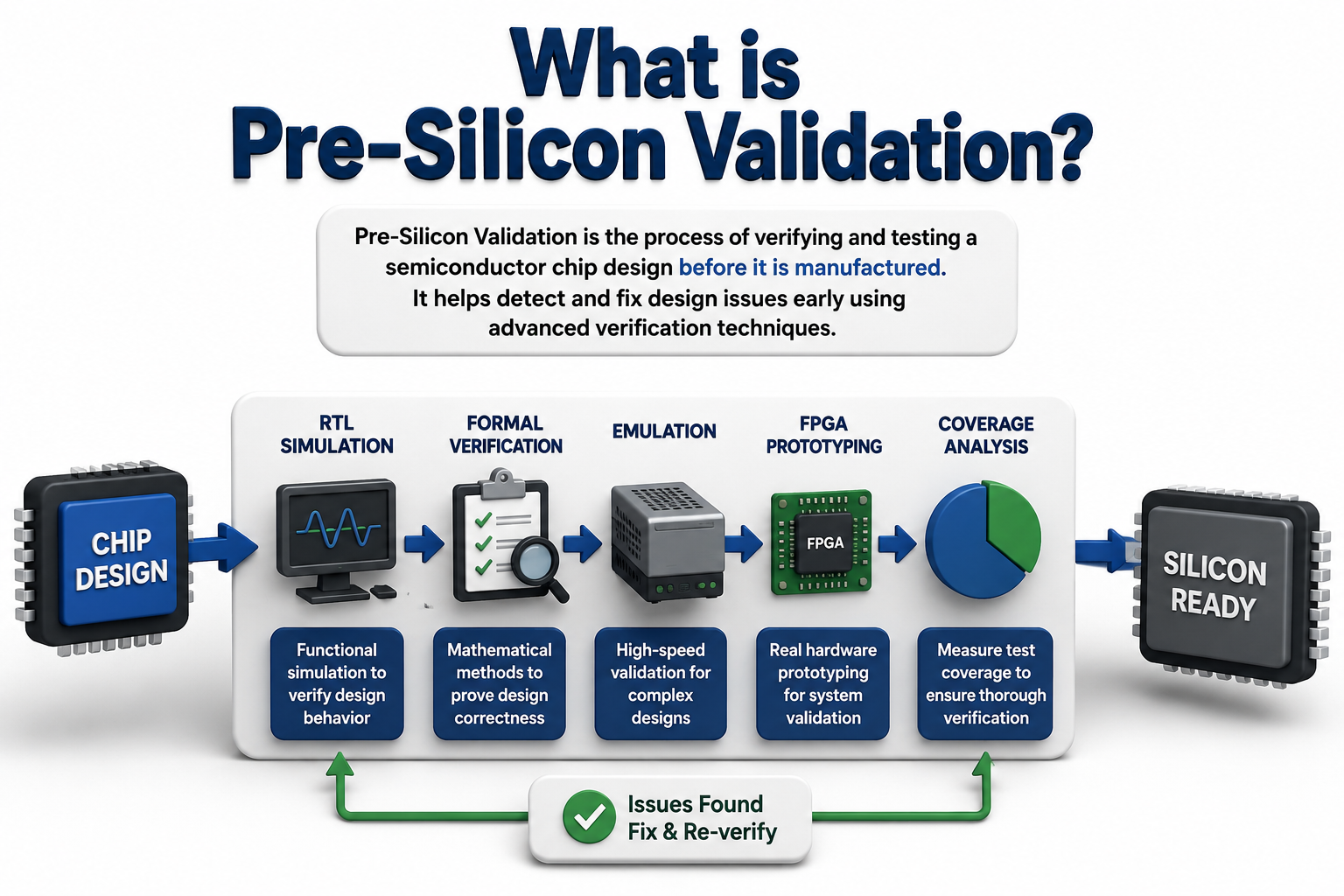
Pre-Silicon Validation is the process of verifying and testing a semiconductor chip design before it is physically manufactured. It is a crucial stage in the VLSI design flow that helps engineers identify functional bugs, logic errors, performance issues, and design inconsistencies at an early stage. During pre-silicon validation, engineers use simulation, formal verification, emulation, and FPGA prototyping techniques to ensure that the design behaves according to the intended specifications. Detecting issues before fabrication significantly reduces development costs and minimizes the risk of expensive silicon re-spins.
The primary objective of Pre-Silicon Validation is to confirm the correctness, reliability, and performance of the design before it reaches the manufacturing phase. Verification engineers create comprehensive test environments and test cases to validate different design scenarios and achieve maximum coverage. This process is especially important for complex System-on-Chip (SoC) and ASIC designs, where even minor errors can lead to major product failures. By ensuring design quality early in the development cycle, Pre-Silicon Validation helps accelerate time-to-market, improve product reliability, and increase the overall success rate of semiconductor products.
visit at :- Best VLSI Training Institute in India
What is Post-Silicon Validation?
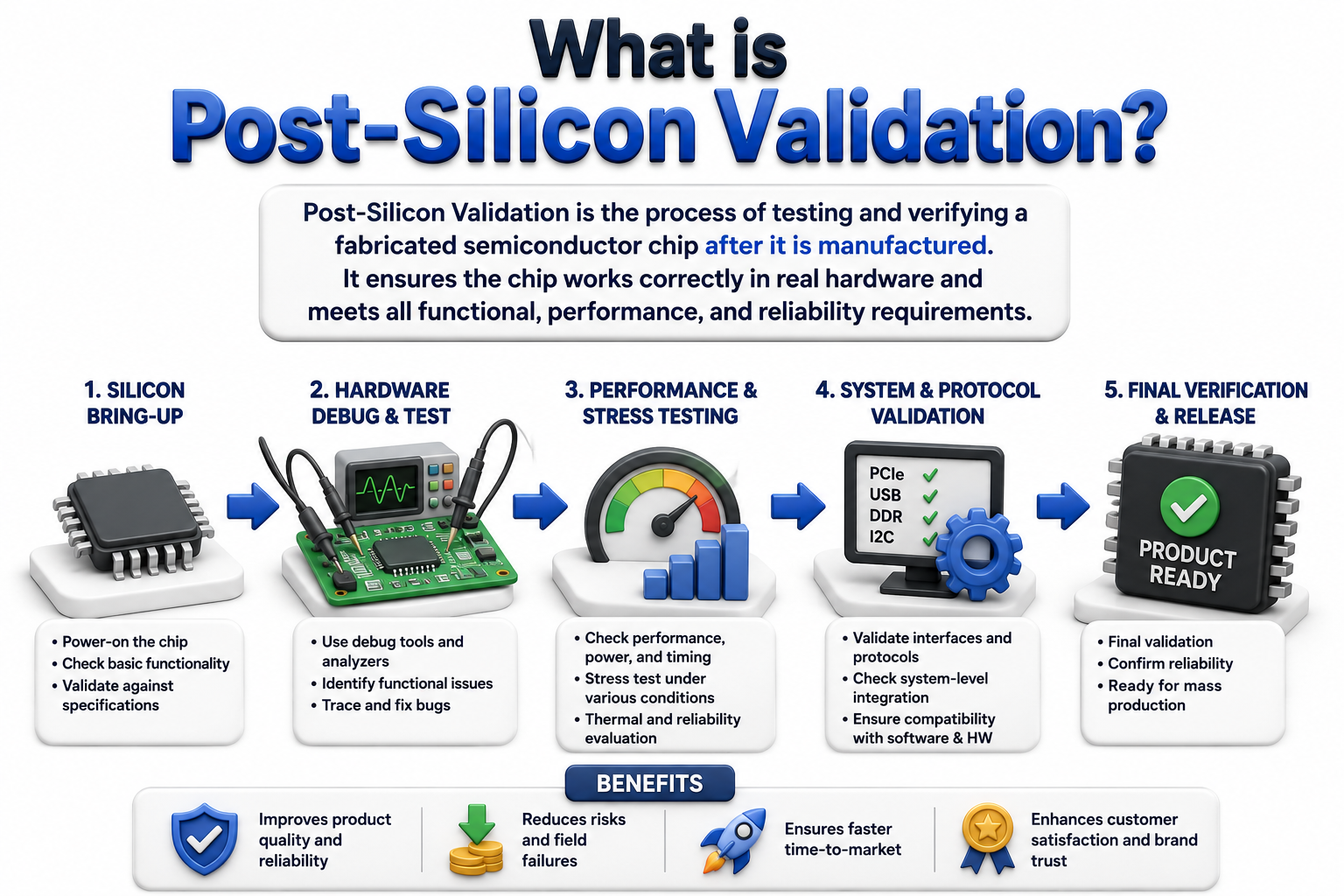
Post-Silicon Validation is the process of testing and verifying a semiconductor chip after it has been fabricated and manufactured. Unlike Pre-Silicon Validation, which relies on simulations and virtual models, Post-Silicon Validation is performed on the actual silicon hardware. The primary goal is to ensure that the chip functions correctly under real-world operating conditions and meets all performance, power, reliability, and functionality requirements. Engineers use specialized hardware testing platforms, debugging tools, and validation frameworks to identify issues that may not have been detected during the pre-silicon stage.
Post-Silicon Validation plays a critical role in the semiconductor product development lifecycle because it confirms that the manufactured chip behaves as expected when integrated into a complete system. This phase includes activities such as silicon bring-up, hardware debugging, protocol validation, performance benchmarking, and stress testing. Since real hardware interactions can reveal hidden defects, timing issues, or interoperability challenges, post-silicon validation helps improve product quality and reliability before commercial release. By thoroughly testing the physical chip, companies can reduce product failures, enhance customer satisfaction, and ensure a successful product launch in competitive markets.
Pre-Silicon Validation Process Explained
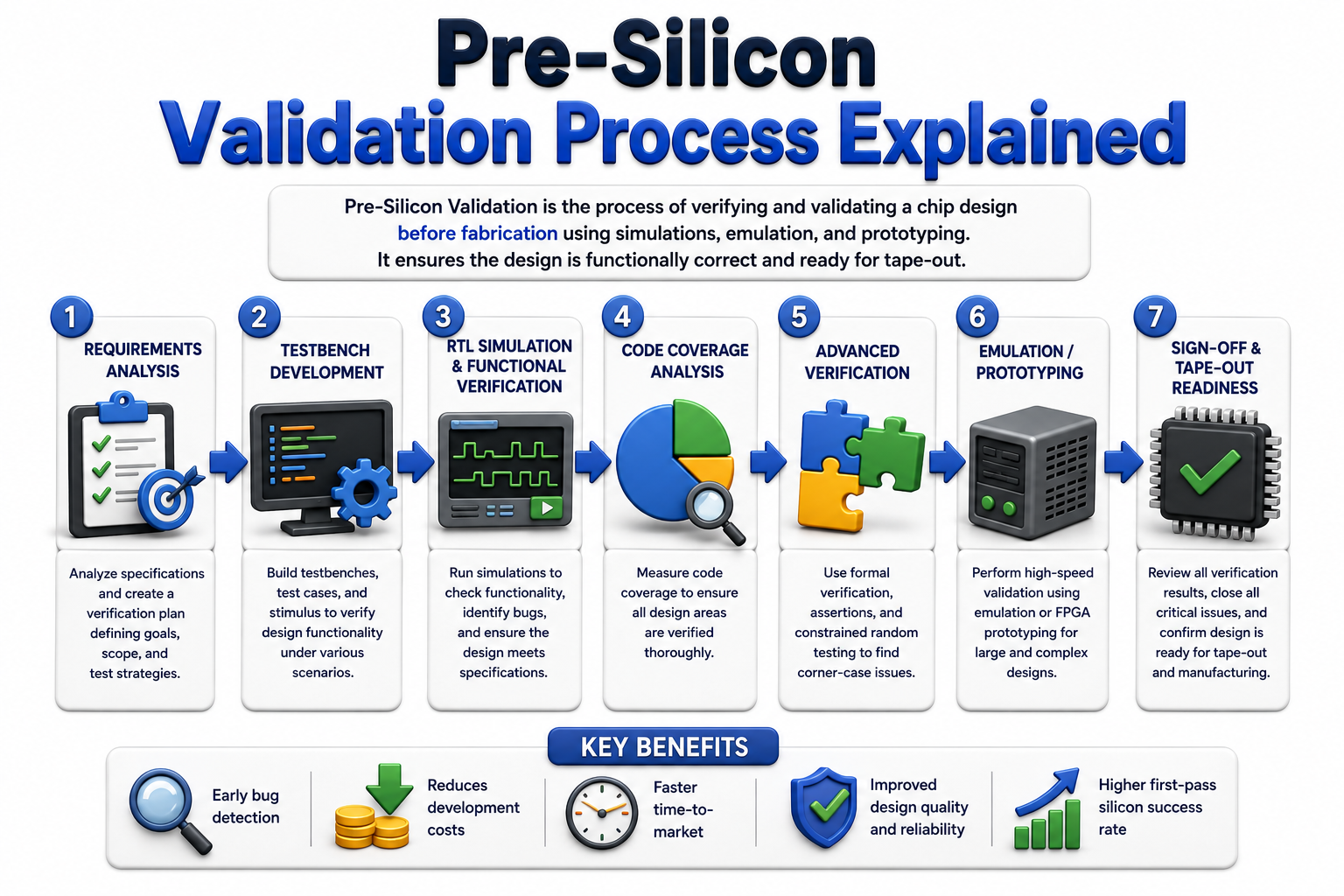
The Pre-Silicon Validation process begins during the design phase of a semiconductor chip, where engineers verify the functionality and correctness of the design before fabrication. The process starts with creating verification plans based on design specifications and developing testbenches to simulate different operating scenarios. Verification engineers use techniques such as RTL simulation, functional verification, formal verification, and code coverage analysis to detect bugs and ensure that the design behaves as intended. These methods help identify logic errors, protocol violations, and performance issues early in the development cycle, reducing the risk of costly modifications after manufacturing. Understanding these concepts is highly beneficial for learners pursuing Post Silicon Validation Training in India, as strong pre-silicon knowledge forms the foundation for effective silicon validation and debugging activities.
As chip designs become increasingly complex, the Pre-Silicon Validation process also incorporates advanced technologies such as emulation and FPGA prototyping to validate System-on-Chip (SoC) and ASIC designs more efficiently. Engineers run extensive test cases, monitor coverage metrics, and perform regression testing to verify all critical design functions. The ultimate goal is to achieve comprehensive verification coverage and ensure that the design meets functional, timing, and performance requirements before tape-out. By thoroughly validating the design at this stage, semiconductor companies can improve product quality, shorten development timelines, and reduce the chances of silicon failures after fabrication. This practical understanding is also valuable for professionals enrolling in Post Silicon Validation Training in Bangalore, where they learn how pre-silicon verification results support successful post-silicon testing, debugging, and product validation..
Post-Silicon Validation Process Explained
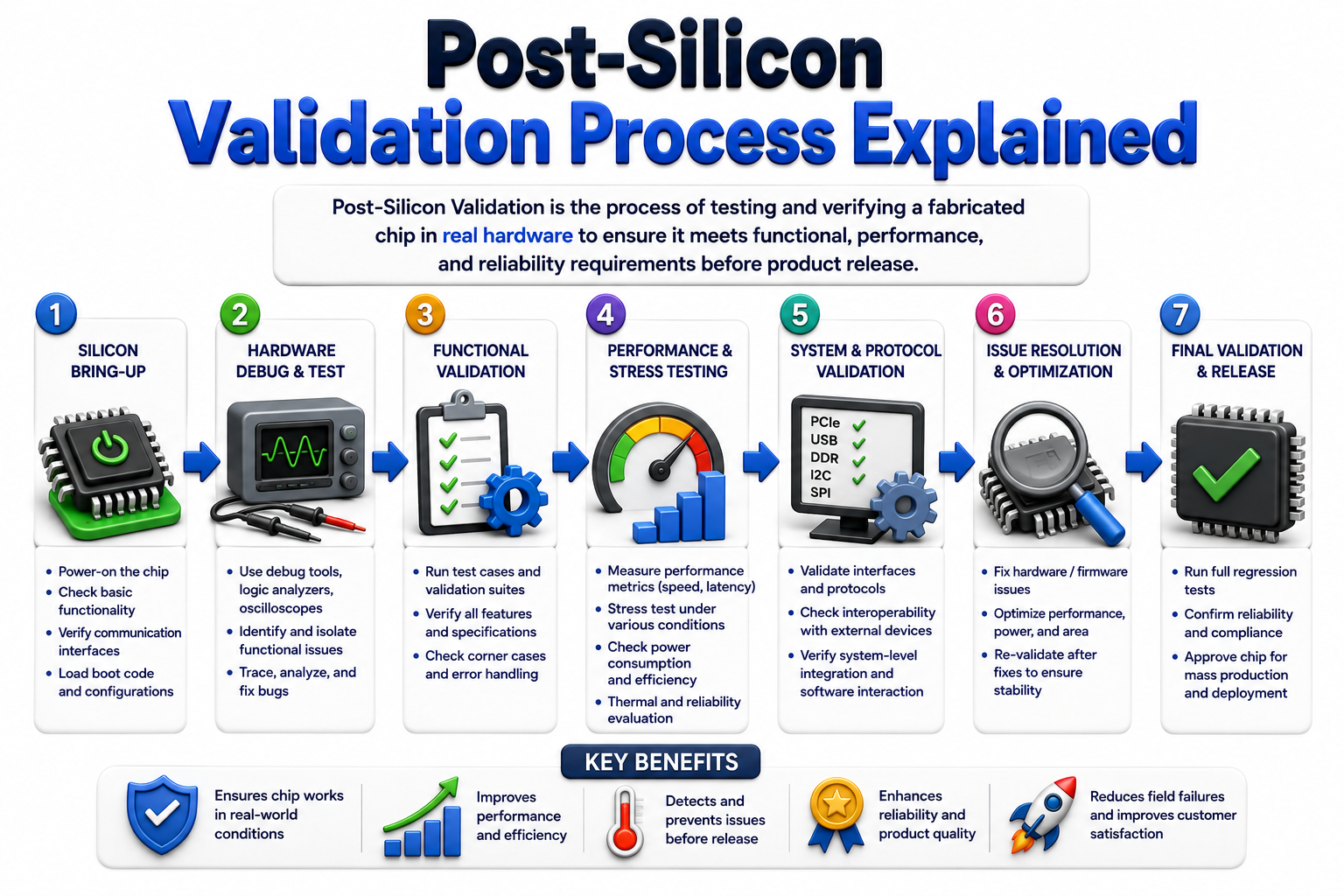
The Post-Silicon Validation process begins once a semiconductor chip has been fabricated and is available as physical silicon hardware. The first step is silicon bring-up, where engineers power on the chip and verify its basic functionality against the original design specifications. During this phase, hardware validation teams use debugging tools, logic analyzers, oscilloscopes, and protocol analyzers to monitor chip behavior and identify any functional issues. The objective is to ensure that the manufactured silicon operates correctly and that all major subsystems, interfaces, and communication protocols perform as expected in real hardware environments.
After initial bring-up, engineers conduct extensive testing to evaluate the chip's performance, power consumption, reliability, and compatibility under various operating conditions. This includes stress testing, performance benchmarking, thermal analysis, and system-level validation to uncover defects that may not have been detected during pre-silicon verification. Post-Silicon Validation also involves debugging complex hardware and software interactions, optimizing system performance, and verifying compliance with industry standards. By thoroughly testing the physical chip before commercial deployment, semiconductor companies can improve product quality, minimize field failures, and ensure a reliable user experience.
Benefits of Pre-Silicon Validation
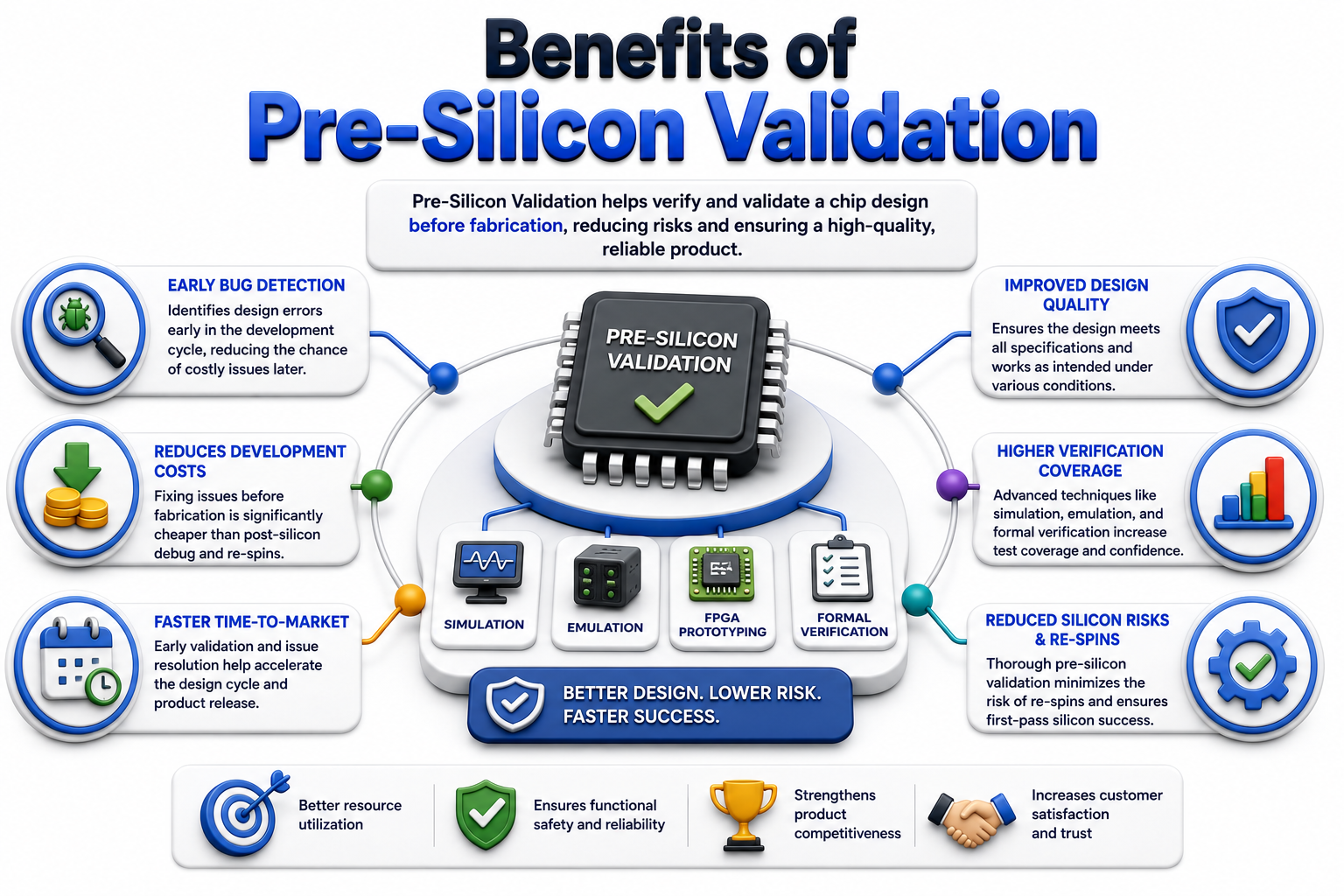
Pre-Silicon Validation offers numerous benefits by enabling engineers to identify and resolve design issues before a chip enters the manufacturing stage. One of its biggest advantages is early bug detection, which helps prevent costly errors from reaching the fabrication phase. Using simulation, formal verification, emulation, and FPGA prototyping, engineers can thoroughly test design functionality and verify compliance with specifications. This proactive approach reduces the likelihood of silicon re-spins, lowers development costs, and improves overall design accuracy, making the product development process more efficient and reliable.
Another major benefit of Pre-Silicon Validation is its contribution to faster time-to-market and higher product quality. By validating the design extensively before fabrication, semiconductor companies can minimize delays caused by post-manufacturing issues and accelerate product launches. The process also improves verification coverage, ensuring that critical design scenarios are tested under various conditions. As a result, companies can deliver more robust, high-performance, and reliable semiconductor products while maintaining a competitive advantage in the rapidly evolving VLSI and semiconductor industry.
Benefits of Post-Silicon Validation
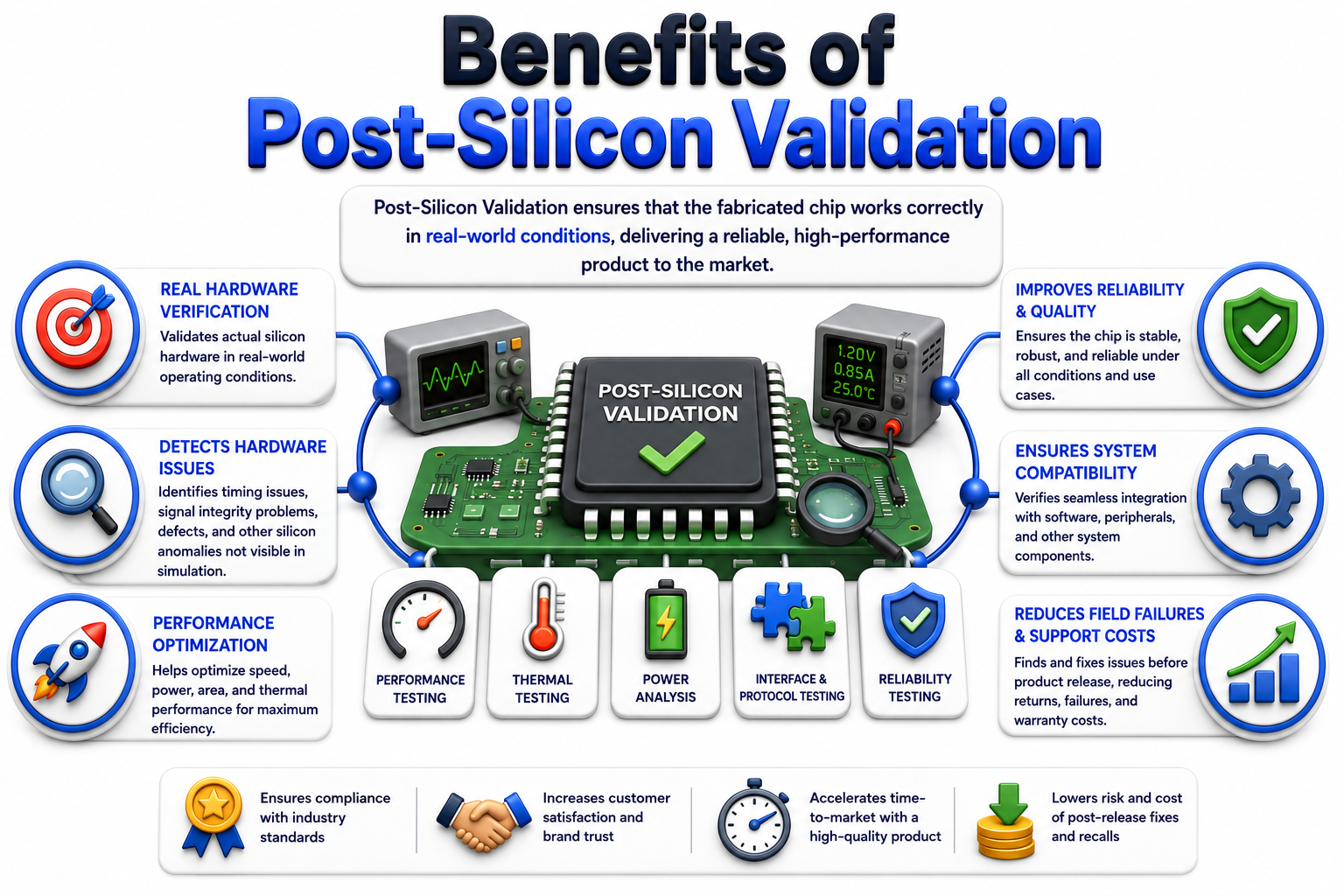
Post-Silicon Validation provides critical benefits by ensuring that a fabricated semiconductor chip performs correctly in real-world operating environments. Unlike simulations used during the pre-silicon stage, post-silicon validation tests the actual hardware, allowing engineers to verify functionality, performance, power consumption, and reliability under realistic conditions. This process helps uncover hardware defects, timing issues, and system-level problems that may not be visible during simulation-based verification. Identifying and resolving these issues before product release significantly reduces the risk of failures in the field and enhances overall product quality.
Another key benefit of Post-Silicon Validation is its role in performance optimization and product readiness. Engineers can analyze how the chip interacts with software, peripherals, and other hardware components to ensure seamless system integration. Through stress testing, benchmarking, and reliability assessments, validation teams can fine-tune the chip for maximum efficiency and stability. This comprehensive testing process improves customer satisfaction, strengthens product reliability, and helps semiconductor companies deliver high-quality, market-ready solutions while maintaining compliance with industry standards and performance expectations.
Pre-Silicon vs Post-Silicon Validation: Key Differences
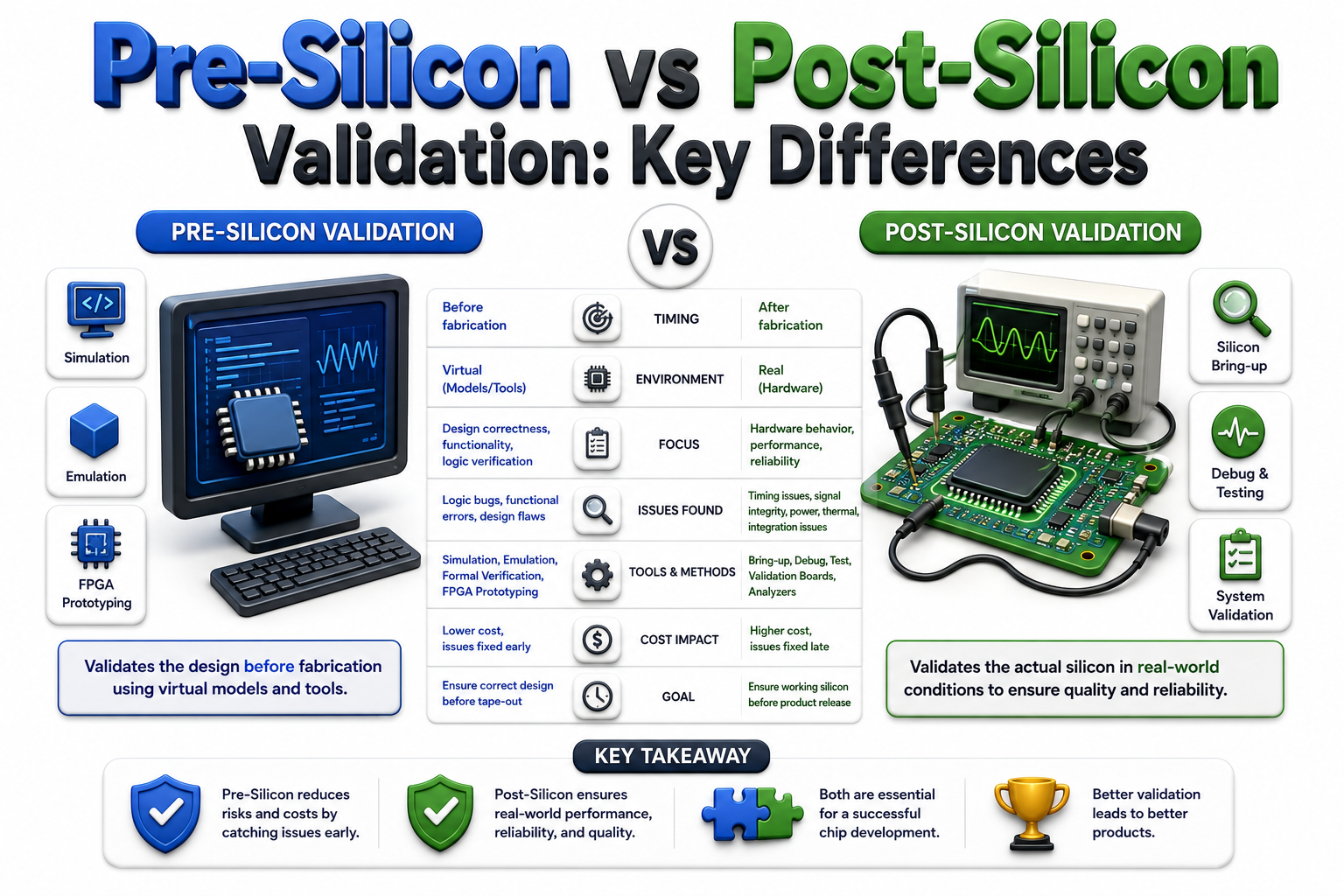
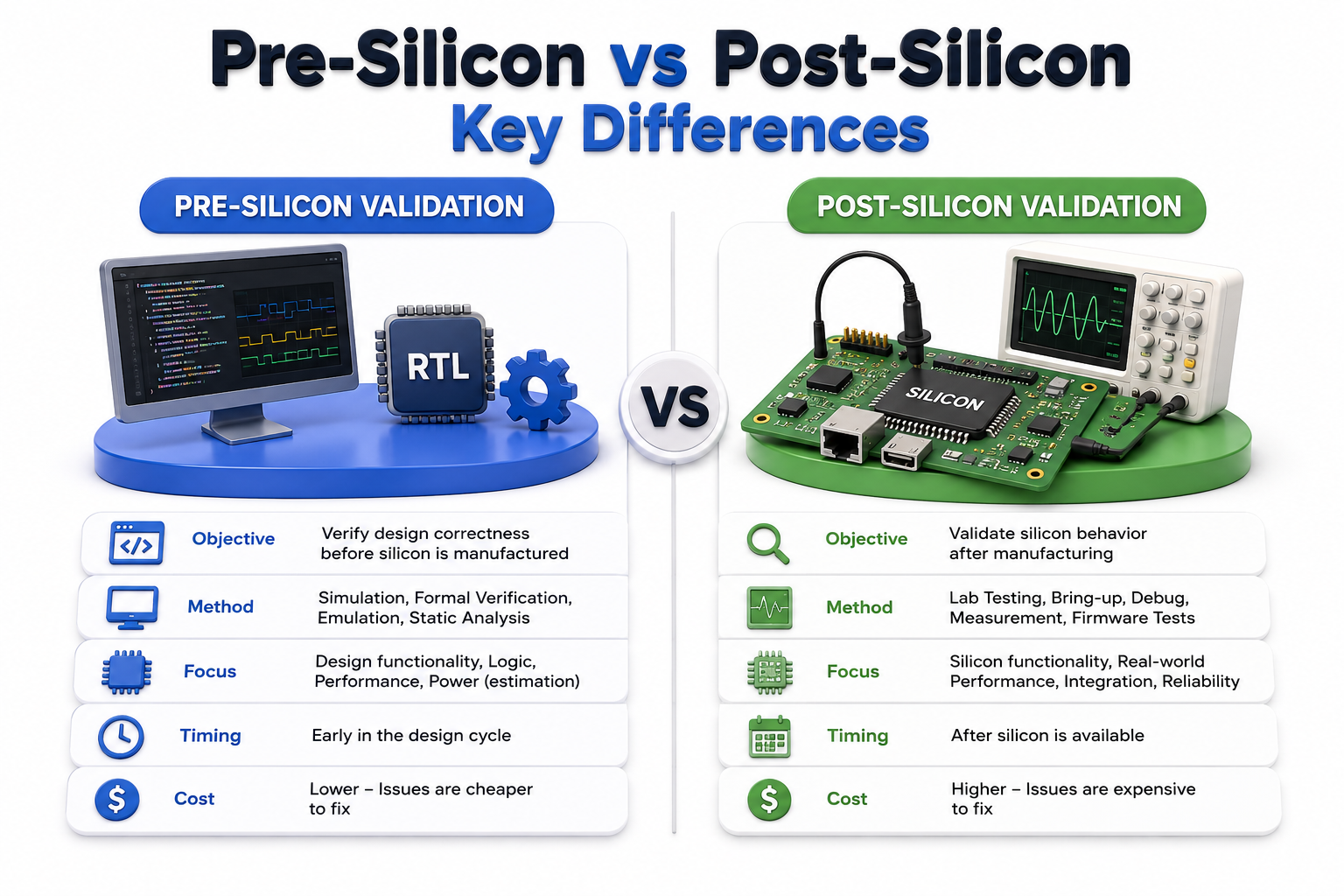
Pre-Silicon Validation and Post-Silicon Validation are two essential stages in the semiconductor product development lifecycle, each serving a unique purpose in ensuring chip quality and reliability. Pre-Silicon Validation is performed before chip fabrication and focuses on verifying the design using simulations, formal verification, emulation, and FPGA prototyping. In contrast, Post-Silicon Validation takes place after manufacturing and involves testing the physical silicon hardware to ensure it operates correctly under real-world conditions. Together, these validation stages help reduce design risks and improve the success rate of semiconductor products.
One of the primary differences between Pre-Silicon and Post-Silicon Validation lies in the testing environment. Pre-Silicon Validation is conducted in a virtual environment where engineers analyze the design through software-based tools and verification methodologies. This approach enables teams to detect and fix bugs early, significantly reducing development costs. Post-Silicon Validation, however, is performed on the actual fabricated chip, allowing engineers to evaluate real hardware behavior, system interactions, power efficiency, and performance characteristics that cannot always be accurately predicted through simulation.
Another key distinction is the type of issues identified during each phase. Pre-Silicon Validation primarily focuses on finding functional errors, design flaws, and logic bugs before the chip reaches production. The goal is to achieve comprehensive verification coverage and ensure that the design meets all specifications. Post-Silicon Validation, on the other hand, concentrates on uncovering hardware-related issues such as signal integrity problems, timing violations, thermal concerns, interoperability challenges, and performance bottlenecks. These issues often become apparent only when the chip is tested in a real operating environment.
From a business and engineering perspective, both validation stages are equally important but offer different benefits. Pre-Silicon Validation helps lower manufacturing risks, reduce development expenses, and accelerate time-to-market by preventing costly silicon re-spins. Post-Silicon Validation ensures that the final product meets quality, reliability, and performance standards before commercial deployment. Understanding the differences between Pre-Silicon vs Post-Silicon Validation is crucial for VLSI professionals, as both fields offer valuable career opportunities and play a significant role in the success of modern semiconductor and System-on-Chip (SoC) designs.
Conclusion
In conclusion, both Pre-Silicon Validation and Post-Silicon Validation are indispensable stages in the semiconductor development process, ensuring that chips meet functional, performance, and reliability requirements before reaching end users. Pre-Silicon Validation helps engineers identify and fix design flaws early through simulations, formal verification, and prototyping, significantly reducing development costs and minimizing manufacturing risks. By validating the design before fabrication, companies can accelerate product development and improve overall design quality.
Post-Silicon Validation complements this process by testing the actual manufactured chip under real-world operating conditions. It helps uncover hardware-related issues, optimize performance, and verify system-level functionality before commercial release. While Pre-Silicon Validation focuses on design correctness, Post-Silicon Validation ensures product readiness and long-term reliability. Understanding the key differences between these validation phases is essential for VLSI professionals, students, and semiconductor engineers looking to build expertise in one of the most critical areas of modern chip development.