

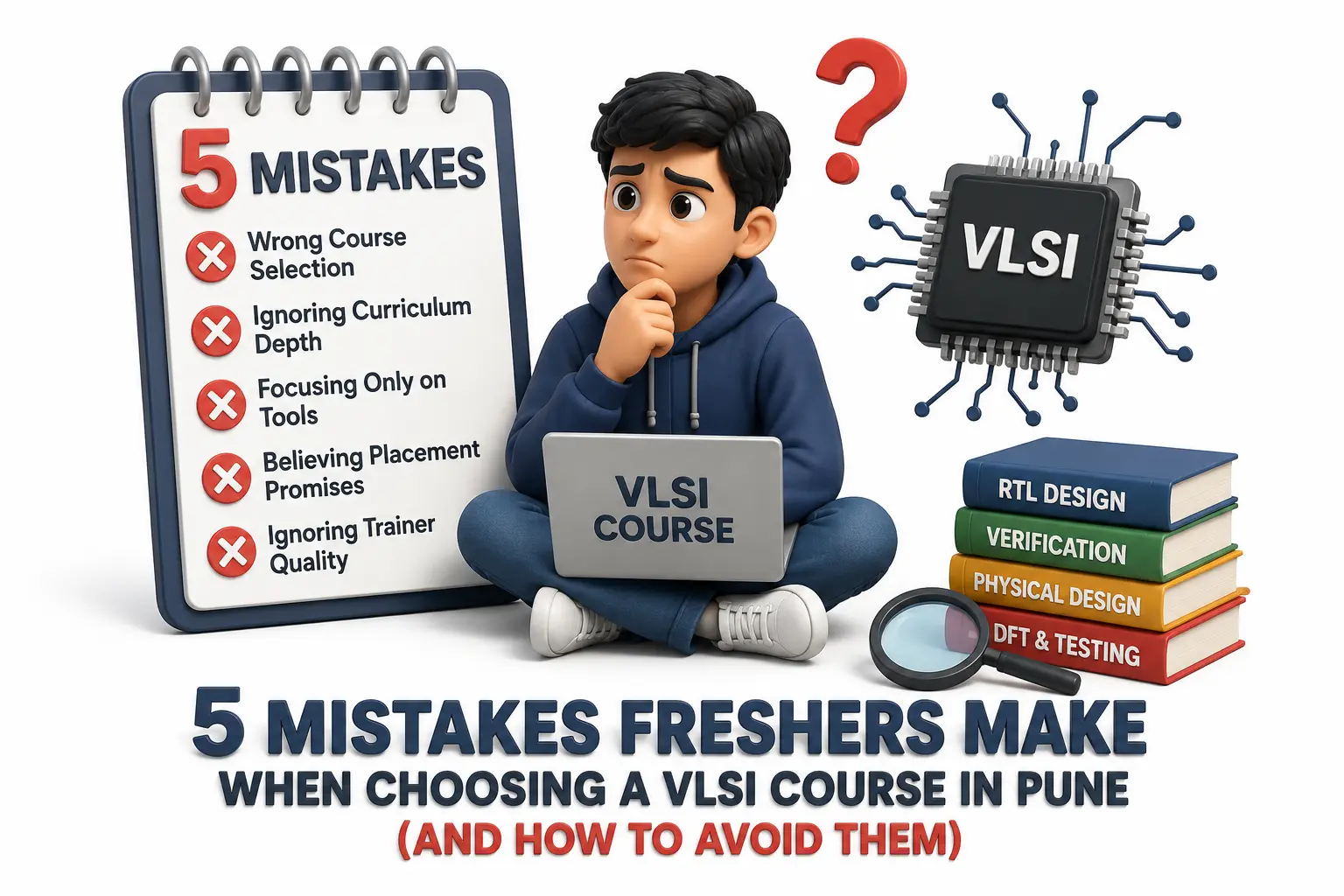
5 Mistakes Freshers Make When Choosing a VLSI Course in Pune (And How to Avoid Them)
Navigate through this article using the table of contents below
Table of Contents
No headings found in this article.
Choosing a VLSI course can look simple until every institute starts promising industry-ready training, advanced tools, practical projects and placement assistance. For a fresher, the real challenge is not finding a course in Pune—it is separating meaningful technical training from impressive marketing.
A wrong choice can cost months of learning and still leave you unprepared for technical interviews. Before paying fees, you need to know exactly what to investigate. These five common mistakes—and one practical selection strategy—can help you choose training based on career value rather than promises.
Choosing a Course Before Choosing Your VLSI Career Direction

One of the biggest mistakes freshers make is searching for a course before understanding the VLSI domain they actually want to enter. VLSI is not one job. RTL design, design verification, physical design, DFT, FPGA development and analog design require different technical abilities.
For example, someone interested in RTL design needs strong digital electronics, Verilog/SystemVerilog, FSM design, synthesizable coding, timing fundamentals and synthesis knowledge. A verification candidate may require SystemVerilog, UVM, assertions, functional coverage, protocols and debugging. Physical design follows a different path involving floorplanning, placement, CTS, routing, STA and timing closure.
Before enrolling, ask yourself:
Which entry-level role am I preparing for?
What skills appear repeatedly in jobs for that role?
Does the syllabus develop those skills deeply?
Are projects aligned with my target role?
Will I be able to explain and demonstrate those projects during an interview?
A course covering ten domains superficially is not automatically better than one providing meaningful depth in a carefully selected specialization.
Mistaking a Long Syllabus for an Industry-Relevant Curriculum
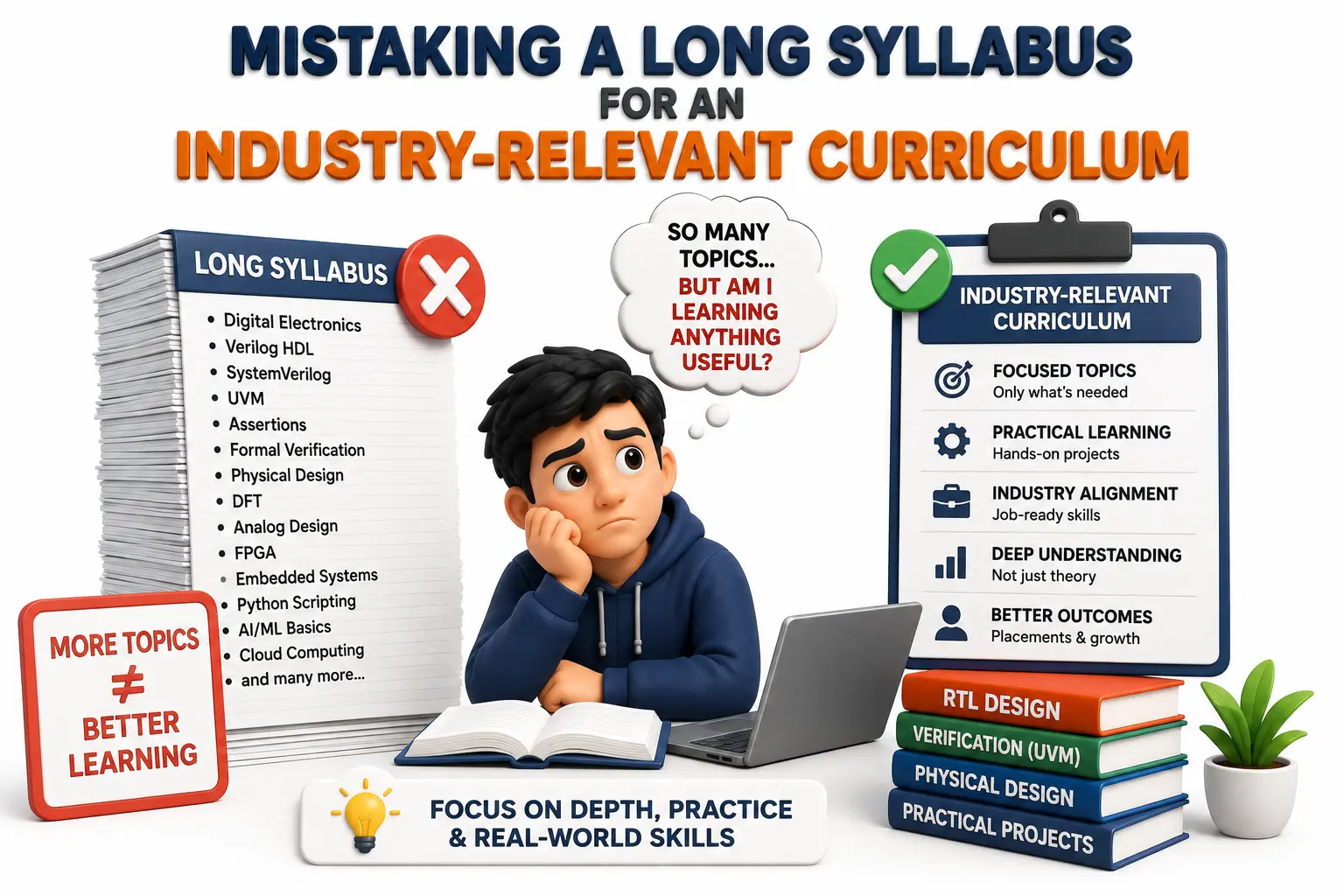
A 30-page syllabus can look impressive. It can also hide an important problem: topics may be listed without enough time for students to actually master them.
Freshers should evaluate depth, sequence and application, not the number of technologies printed in a brochure. Digital fundamentals should logically lead into HDL coding, design concepts, verification or implementation, depending on the specialization. Advanced topics should not appear simply because they make the syllabus look modern.
When evaluating a vlsi training institute in pune, examine whether students actually write RTL, create testbenches, analyze waveforms, debug failures, run tools and complete progressively difficult assignments. Ask how many hours are dedicated to practical work and whether exercises are evaluated individually.
A useful curriculum should answer three questions: What will you understand? What will you build? What will you be capable of debugging independently? If an institute can answer only the first question, the program may remain too theoretical for serious interview preparation.
Believing Tool Access Automatically Means Hands-On Experience

“Training on industry-standard EDA tools” appears frequently in course promotions, but simply having access to software does not create engineering ability.
Watching an instructor run simulations is different from writing your own design, encountering errors, reading logs, analyzing waveforms and correcting the problem yourself. Practical VLSI learning should make students uncomfortable enough to solve real technical problems instead of reproducing prepared demonstrations.
Look for training that includes activities such as:
RTL coding and simulation
Testbench development
Waveform analysis and debugging
Synthesis or implementation exercises relevant to the track
Protocol-based assignments
Verification planning and coverage for verification students
Timing analysis for implementation-oriented students
Individual or team projects with measurable deliverables
JastTech can be evaluated using the same standard as any other training provider: ask to see the actual learning process, project expectations, tool environment and student deliverables before deciding.
Your goal is not to put an EDA-tool name on your resume. It is to confidently explain what you did with that tool when an interviewer asks technical follow-up questions.
Trusting Placement Claims Without Checking the Evidence

Placement support matters, but freshers sometimes allow one attractive number or phrase to decide the entire course purchase. Statements such as “placement assistance,” “job guarantee” or “multiple hiring partners” need context.
Before enrollment, ask what placement support actually includes. Does it mean resume preparation and job alerts, or does it include technical mock interviews, aptitude preparation, company-specific interview practice and genuine recruitment opportunities?
Request information about:
Recent VLSI-specific placements
Job roles students received
Graduation years and eligibility conditions
Companies recruiting for core semiconductor roles
Typical interview preparation process
Number and format of mock interviews
Placement eligibility requirements
Whether support continues after course completion
Do not judge quality only by logos displayed on a website. A student placed as an RTL, verification, DFT or physical-design engineer provides more relevant evidence for a VLSI aspirant than a large placement figure containing unrelated technology roles.
Placement should be the result of technical readiness—not a substitute for it.
Ignoring Trainer Quality, Mentoring and Debugging Support
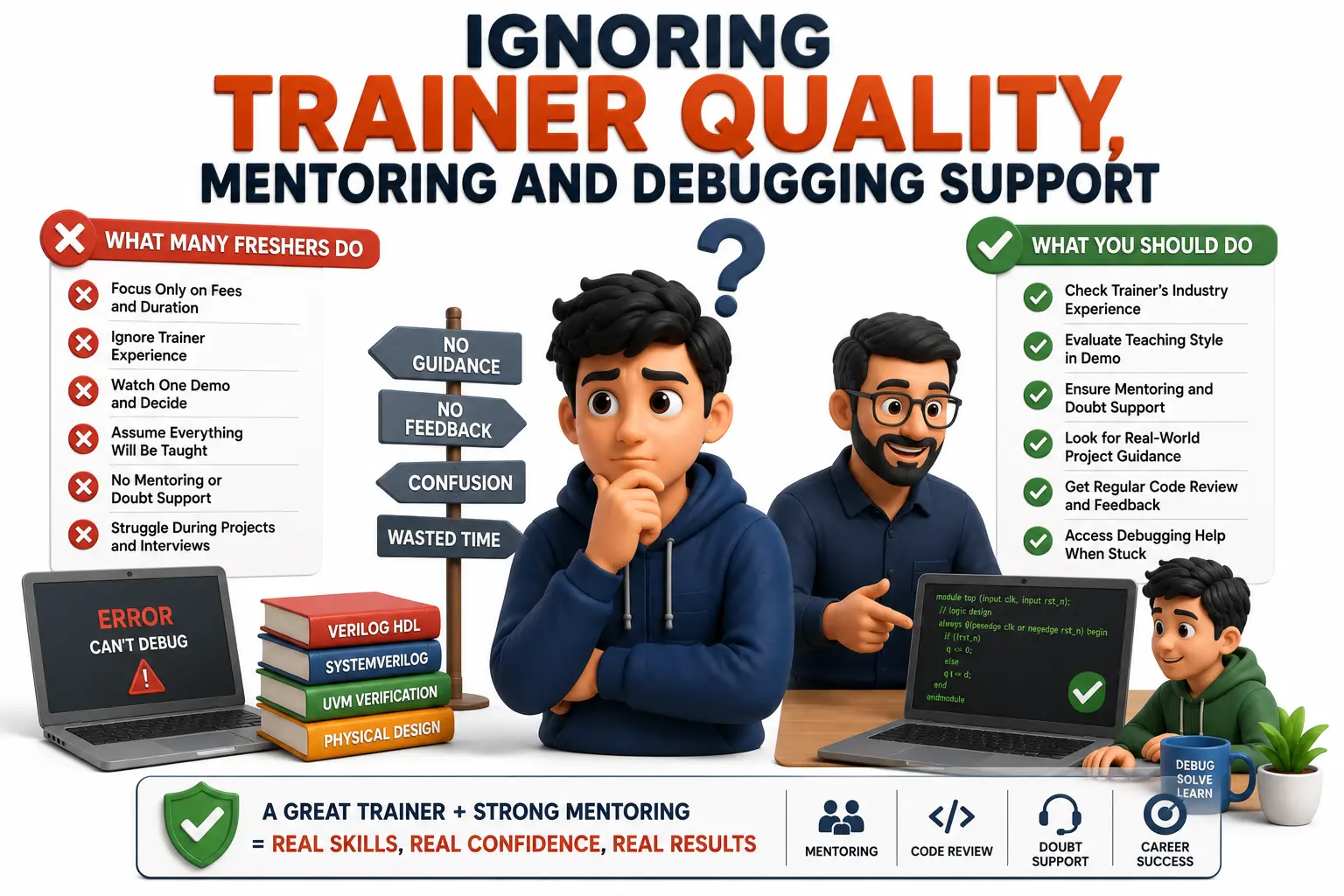
A strong curriculum becomes far less valuable when students cannot get meaningful technical guidance.
Freshers frequently compare fees, duration and placement claims while forgetting to investigate who actually teaches the course. An experienced trainer should be able to explain not only syntax and theory but also design decisions, common mistakes, debugging approaches, tool behavior and interview expectations.
Attend a demo session wherever possible. Instead of judging only presentation skills, observe whether the trainer explains why something happens. Ask a technical question and see whether the answer connects theory with engineering practice.
Also investigate what happens after class. VLSI learning involves coding errors, failed simulations, confusing waveforms and concepts that may require repeated explanation. Check whether students receive:
Assignment reviews
Doubt-solving sessions
Code feedback
Project mentoring
Technical assessments
Interview feedback
Consistent feedback can be more valuable than simply increasing classroom hours because engineering competence develops through correction and repetition.
Build a Selection Checklist Before Paying Your Course Fees

The best way to avoid all five mistakes is to compare courses using evidence instead of emotion. Do not enroll immediately because a counselor offers a discount, tells you seats are limited or promises a fast route into the semiconductor industry.
Shortlist two or three programs and compare their syllabus, specialization, trainer background, practical assignments, project depth, tool usage, batch size, mentoring process and placement evidence. Speak with recent alumni when possible and ask specific questions about what they actually built and how the course helped during interviews.
Your final decision should satisfy four conditions: the course matches your target role, provides enough practical work to develop independent skills, gives access to competent technical mentoring, and offers transparent career support.
The semiconductor industry rewards engineers who can understand a specification, solve problems, write or analyze technical work, debug failures and explain their reasoning. Choose the course that develops those abilities rather than the one with the longest list of features.
Conclusion
Freshers do not need the course with the biggest syllabus, most software names or strongest marketing promise. They need training aligned with a specific VLSI career path and enough structured practice to convert concepts into skills. Curriculum depth, projects, trainer access, debugging practice and verifiable placement support deserve far more attention than certificates alone.
Before enrolling in Pune, spend a few days investigating what happens inside the training rather than focusing only on what appears in the brochure. Ask difficult questions, attend a demo, inspect projects and understand your target role. The right decision can turn your course from another qualification into the foundation of a genuine semiconductor career.