

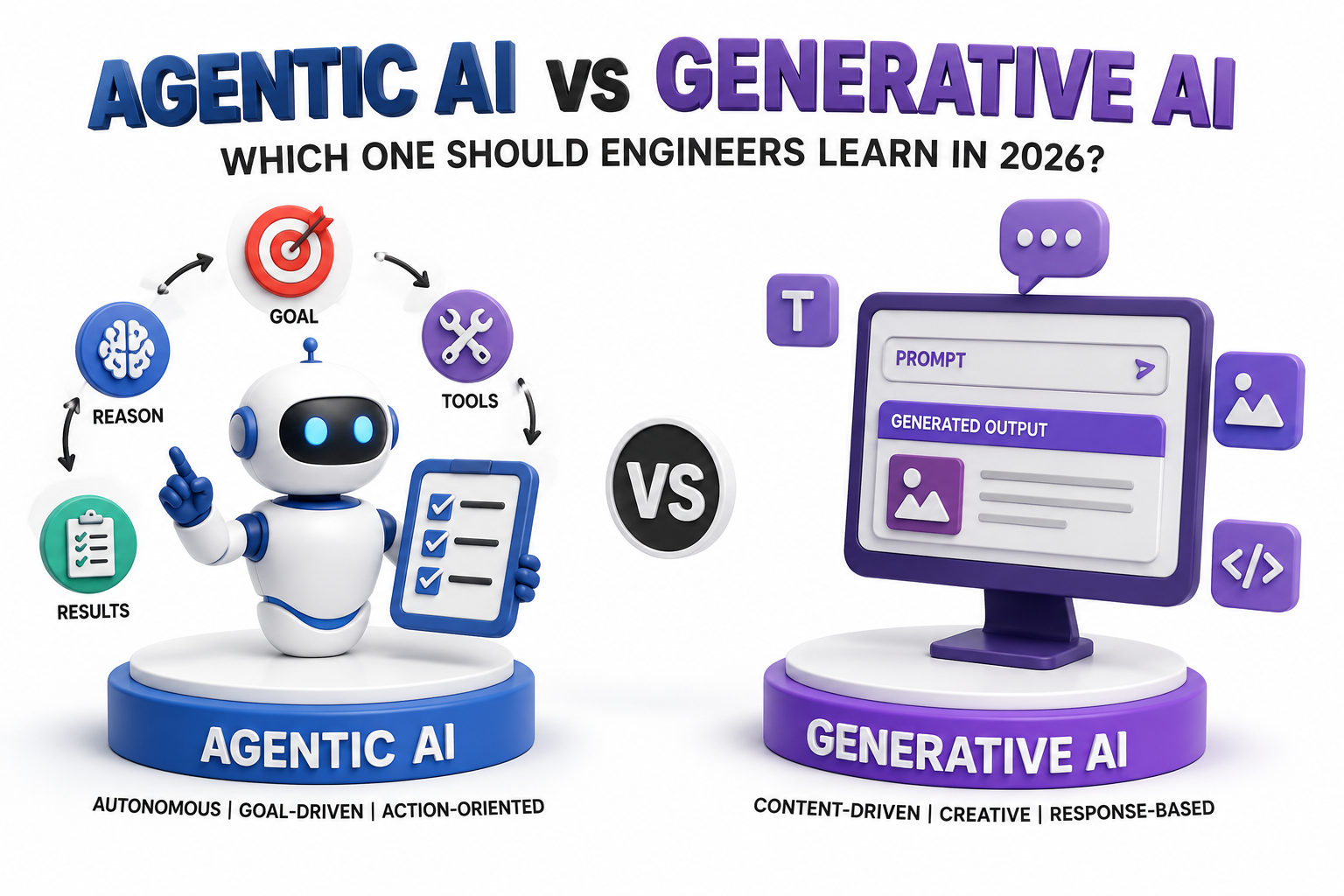
Agentic AI vs Generative AI: Which One Should Engineers Learn in 2026?
Navigate through this article using the table of contents below
Table of Contents
No headings found in this article.
Artificial intelligence is no longer limited to generating text, images, or code. In 2026, organizations are rapidly adopting systems capable of planning, reasoning, using tools, and executing complete workflows with minimal human intervention. This evolution is changing what companies expect from software engineers.
For students, developers, and IT professionals, the biggest question is no longer whether to learn AI—but which AI skills will deliver long-term career growth. Understanding the difference between Generative AI and Agentic AI is now essential for building future-ready engineering expertise.
Understanding the Core Difference Between Generative AI and Agentic AI
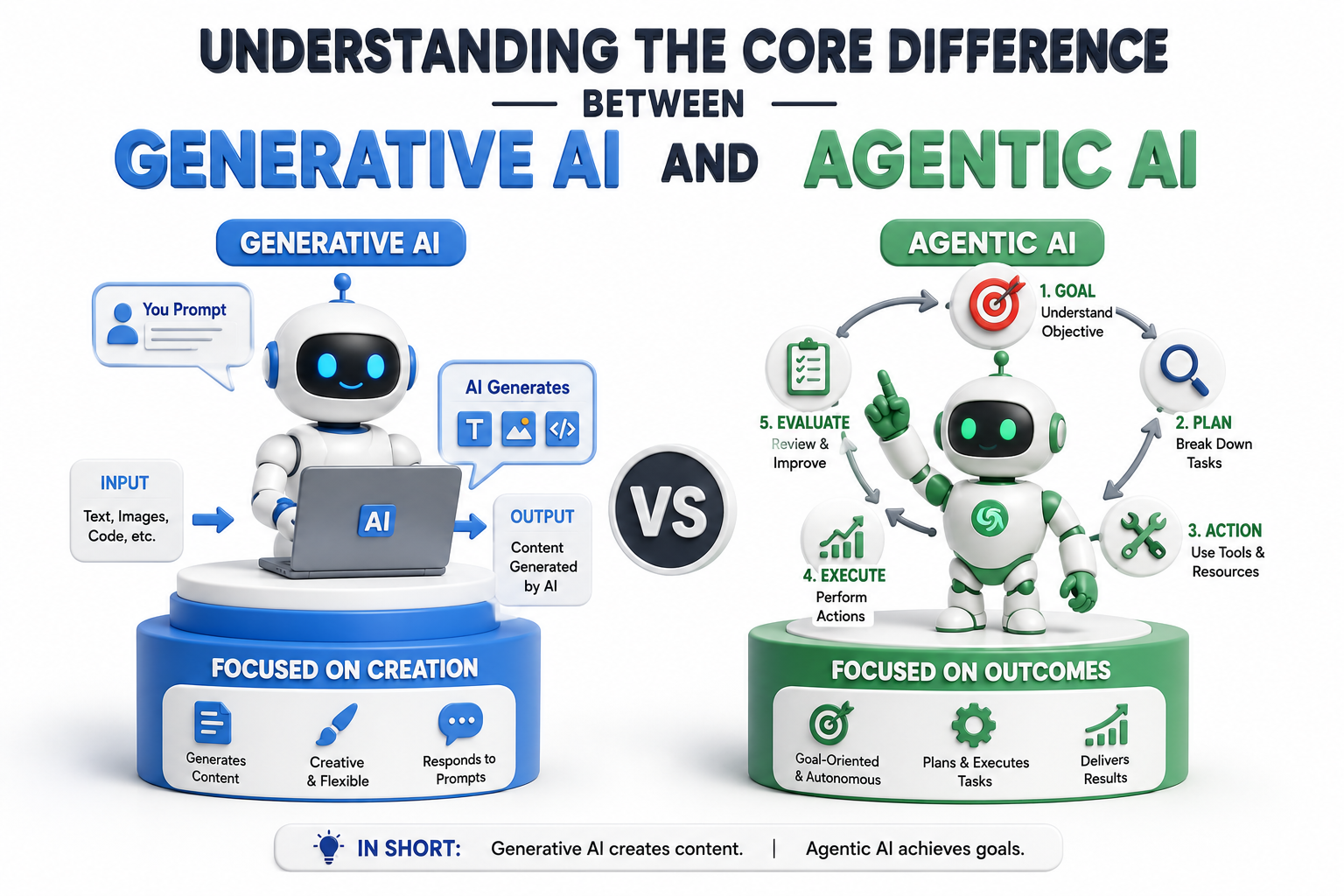
Generative AI focuses on creating content from user prompts. It predicts the next token to generate text, images, videos, code, summaries, or documentation. Popular tools include ChatGPT, Claude, Gemini, and GitHub Copilot.
Agentic AI builds upon these models by introducing planning, reasoning, memory, and tool usage. Rather than simply generating an answer, an AI agent can complete an objective across multiple steps.
Key differences include:
Generative AI responds to prompts.
Agentic AI works toward goals.
Generative AI creates outputs.
Agentic AI performs actions.
Generative AI depends on continuous human input.
Agentic AI operates with greater autonomy.
Instead of replacing Generative AI, Agentic AI extends its capabilities by combining language models with orchestration, APIs, external tools, and decision-making systems.
Why 2026 Marks the Shift Toward Agentic AI
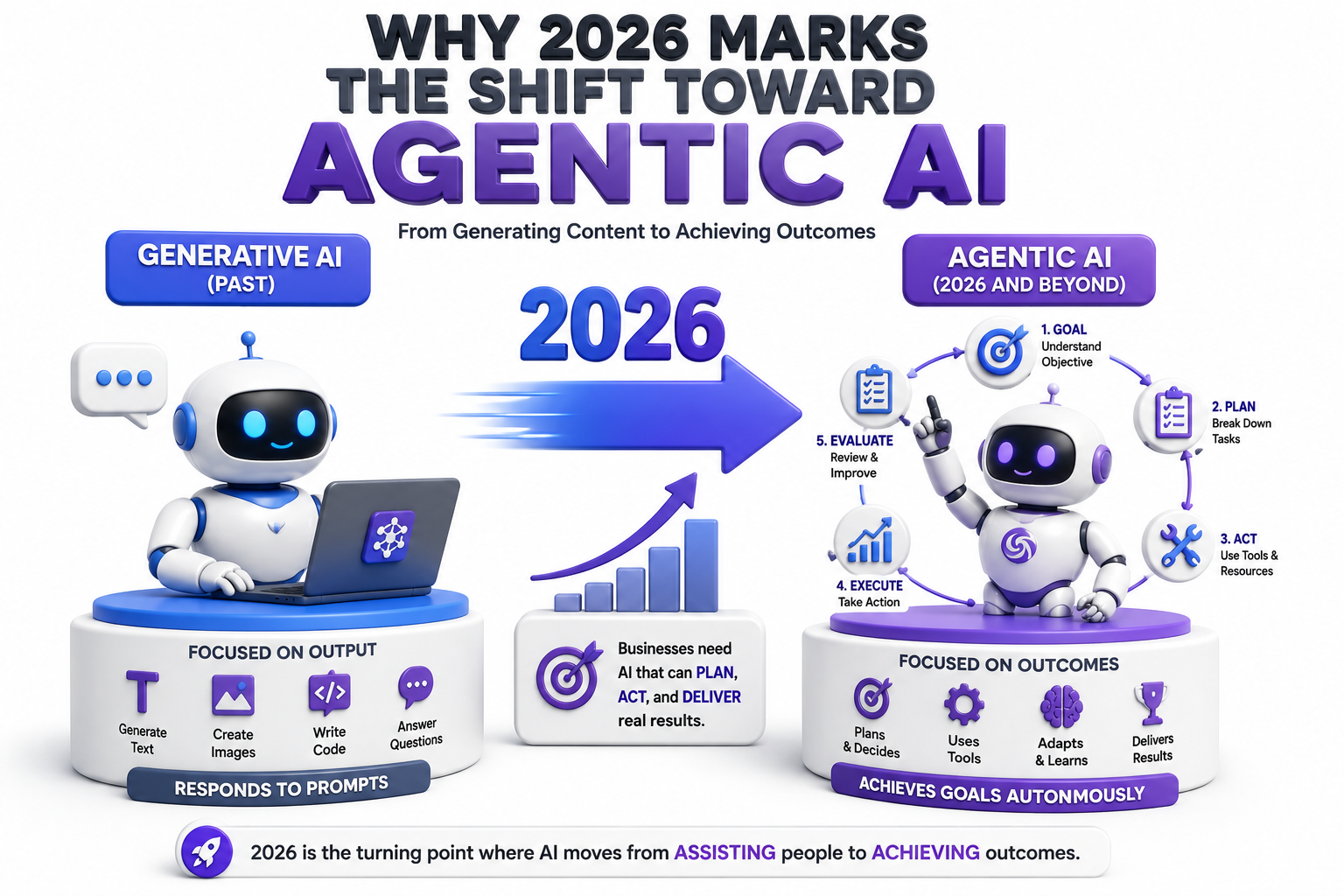
The AI landscape has evolved from content generation to workflow automation. Enterprises are now investing in AI systems capable of handling customer support, software development, business operations, cybersecurity monitoring, and data analysis with minimal supervision.
Several industry developments highlight this transition:
AI agents are increasingly embedded into engineering workflows.
Software engineers are spending more time designing AI systems than writing repetitive code.
Autonomous AI assistants are becoming standard across enterprises.
For engineers, this means learning only prompt engineering is no longer sufficient. Modern AI development requires understanding how autonomous systems coordinate multiple tools while maintaining reliability, governance, and human oversight.
Skills Engineers Should Learn Beyond Prompt Engineering
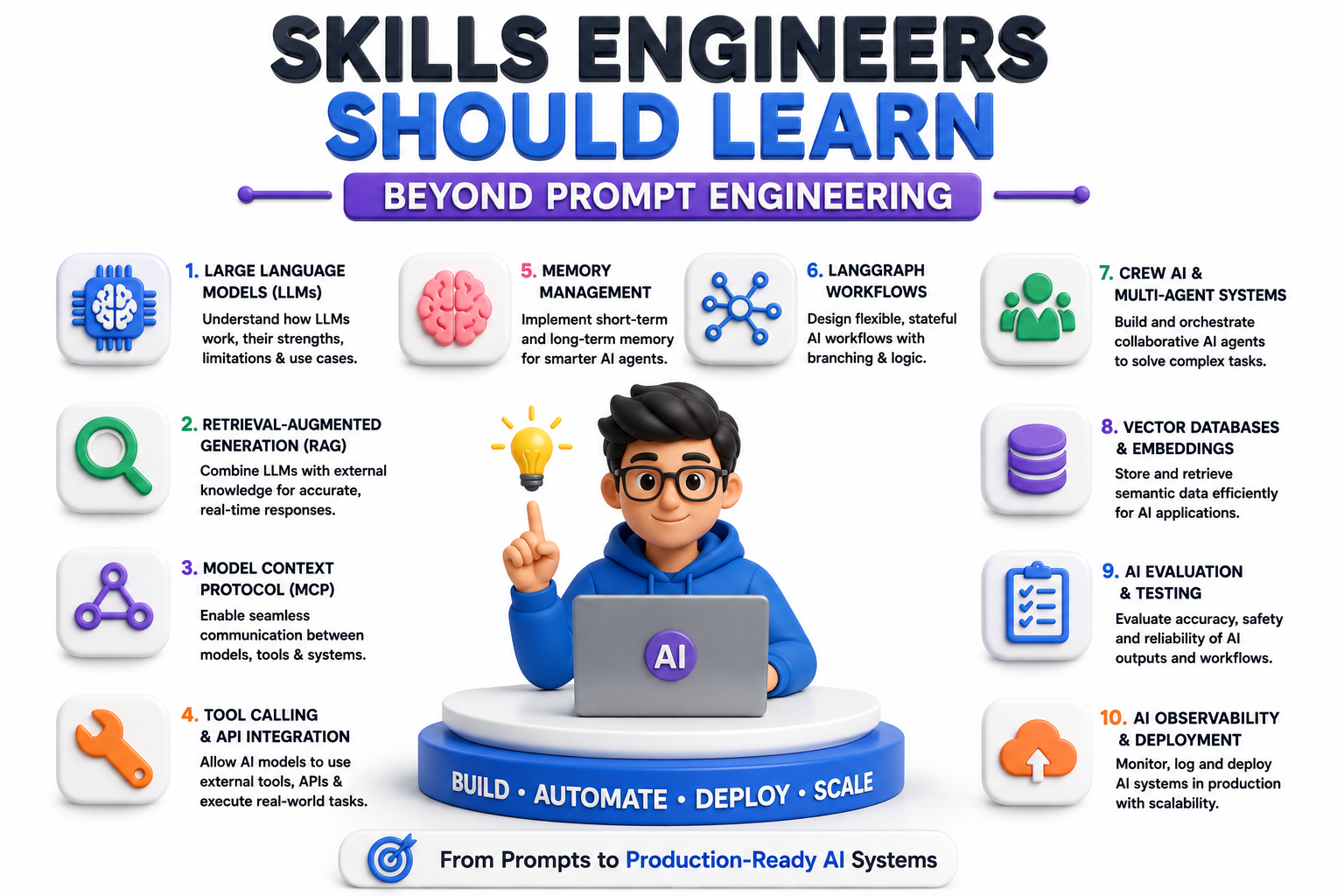
Many beginners assume mastering prompts is enough for an AI career. In reality, companies are hiring engineers who can build production-ready AI applications.
Essential technical skills include:
Large Language Models (LLMs)
Retrieval-Augmented Generation (RAG)
Model Context Protocol (MCP)
Tool Calling
AI Memory Management
LangGraph
CrewAI
Multi-agent orchestration
API integration
Vector databases
AI evaluation and testing
AI observability
Cloud deployment
Equally important are software engineering fundamentals, including Python, REST APIs, Docker, Git, databases, cloud platforms, and distributed systems.
Agentic AI combines traditional software engineering with modern AI capabilities, making multidisciplinary skills increasingly valuable.
Agentic AI vs Generative AI: Which One Offers Better Career Opportunities?
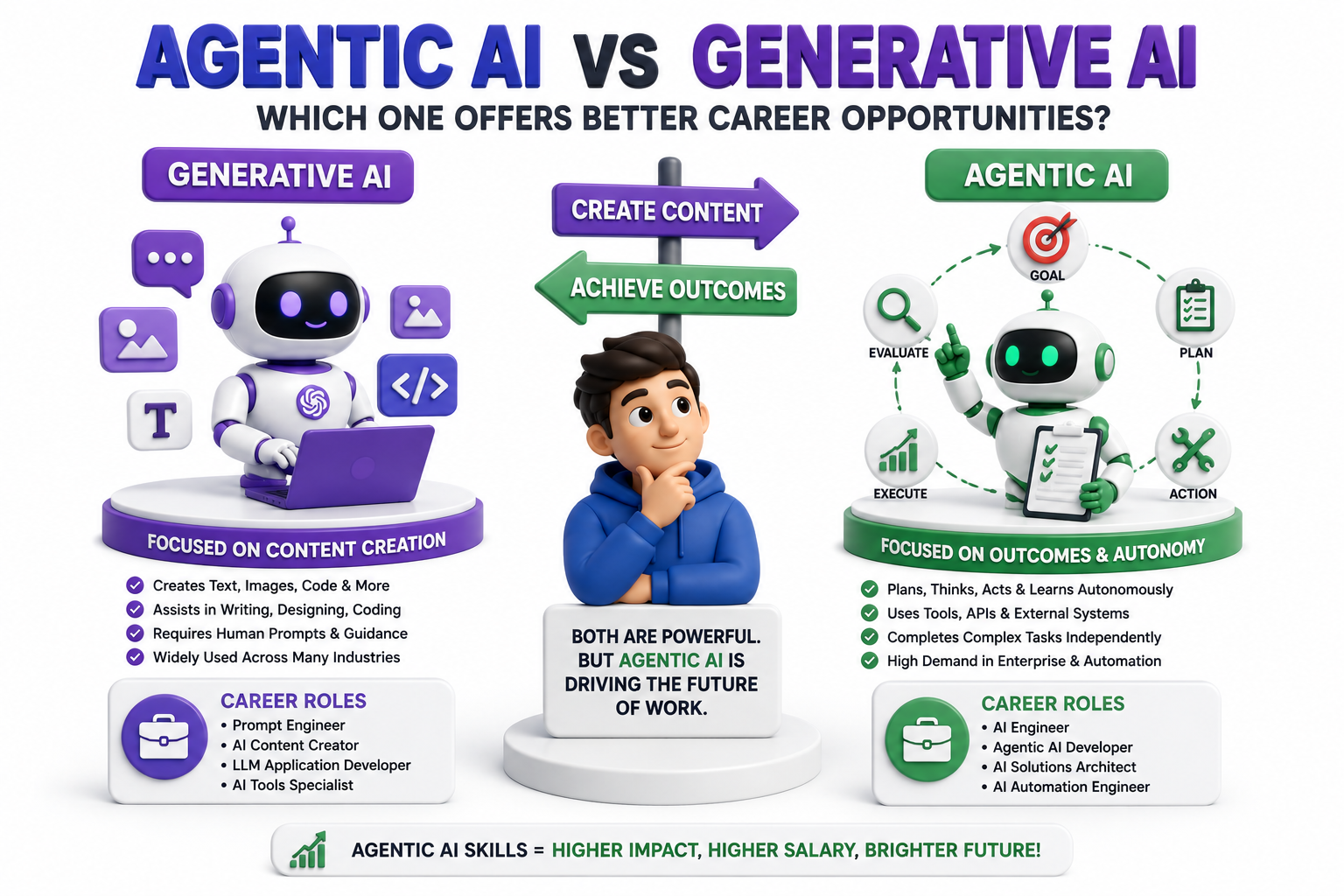
Generative AI skills remain valuable because organizations continue building chatbots, copilots, content generation platforms, and AI search systems.
However, hiring trends indicate growing demand for engineers capable of designing complete AI workflows instead of isolated AI features. Emerging roles include:
AI Engineer
Agentic AI Developer
AI Solutions Architect
LLM Engineer
AI Automation Engineer
AI Platform Engineer
AI Product Engineer
These roles require engineers to combine language models with business logic, external systems, APIs, and automation pipelines.
Rather than choosing one technology over the other, employers increasingly value professionals who understand both content generation and autonomous execution.
A Practical Learning Roadmap for Engineers in 2026
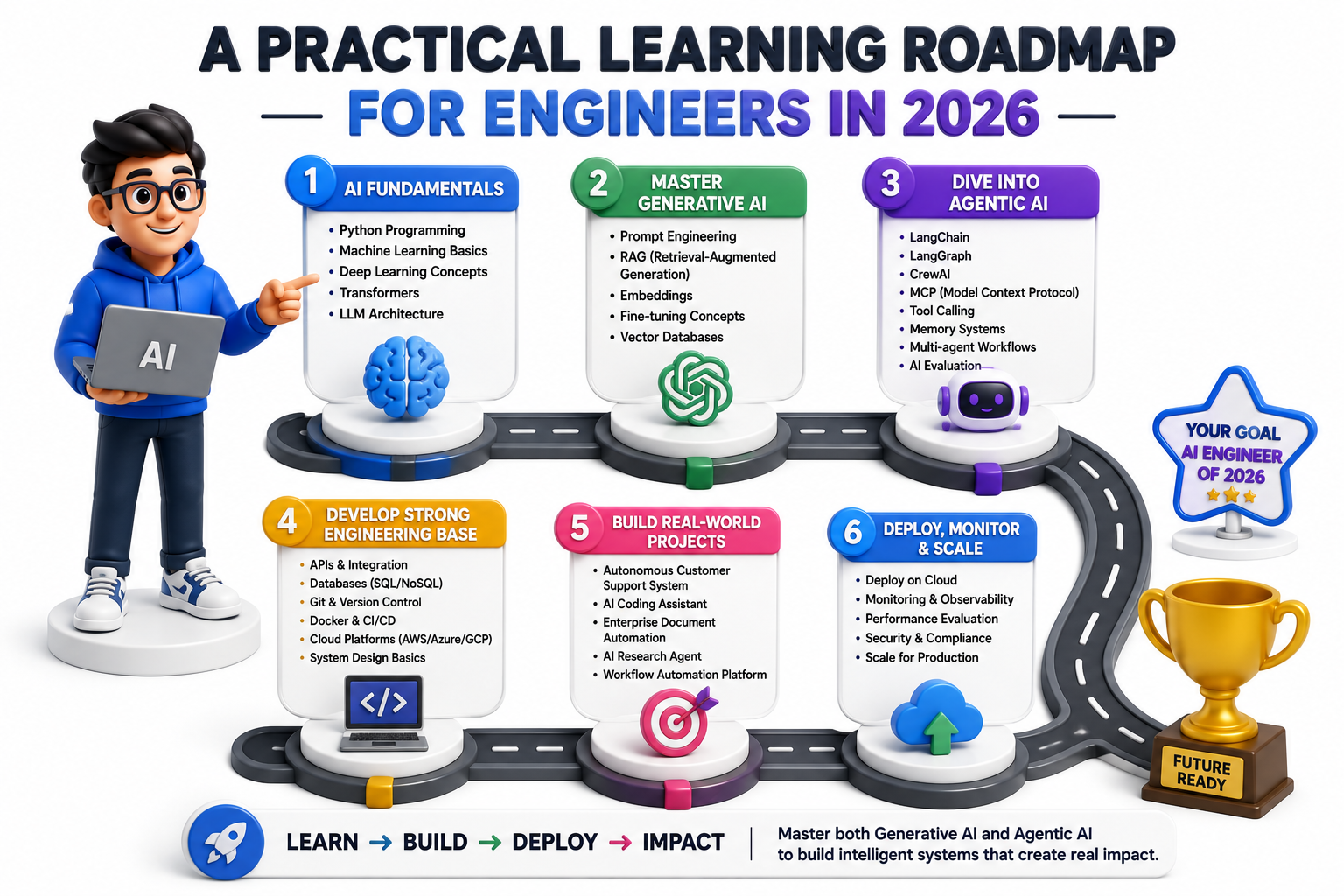
A structured roadmap helps avoid learning disconnected tools.
Begin with AI fundamentals:
Python programming
Machine Learning basics
Deep Learning concepts
Transformers
LLM architecture
Next, master Generative AI:
Prompt Engineering
RAG
Embeddings
Fine-tuning concepts
Vector databases
Then move into Agentic AI:
LangChain
LangGraph
CrewAI
MCP
Tool Calling
Memory systems
Multi-agent workflows
AI evaluation
Finally, build real-world projects such as:
Autonomous customer support systems
AI coding assistants
Enterprise document automation
AI research agents
Workflow automation platforms
Hands-on projects remain the strongest indicator of practical AI engineering ability.
Why Learning Both Technologies Is the Smartest Career Decision
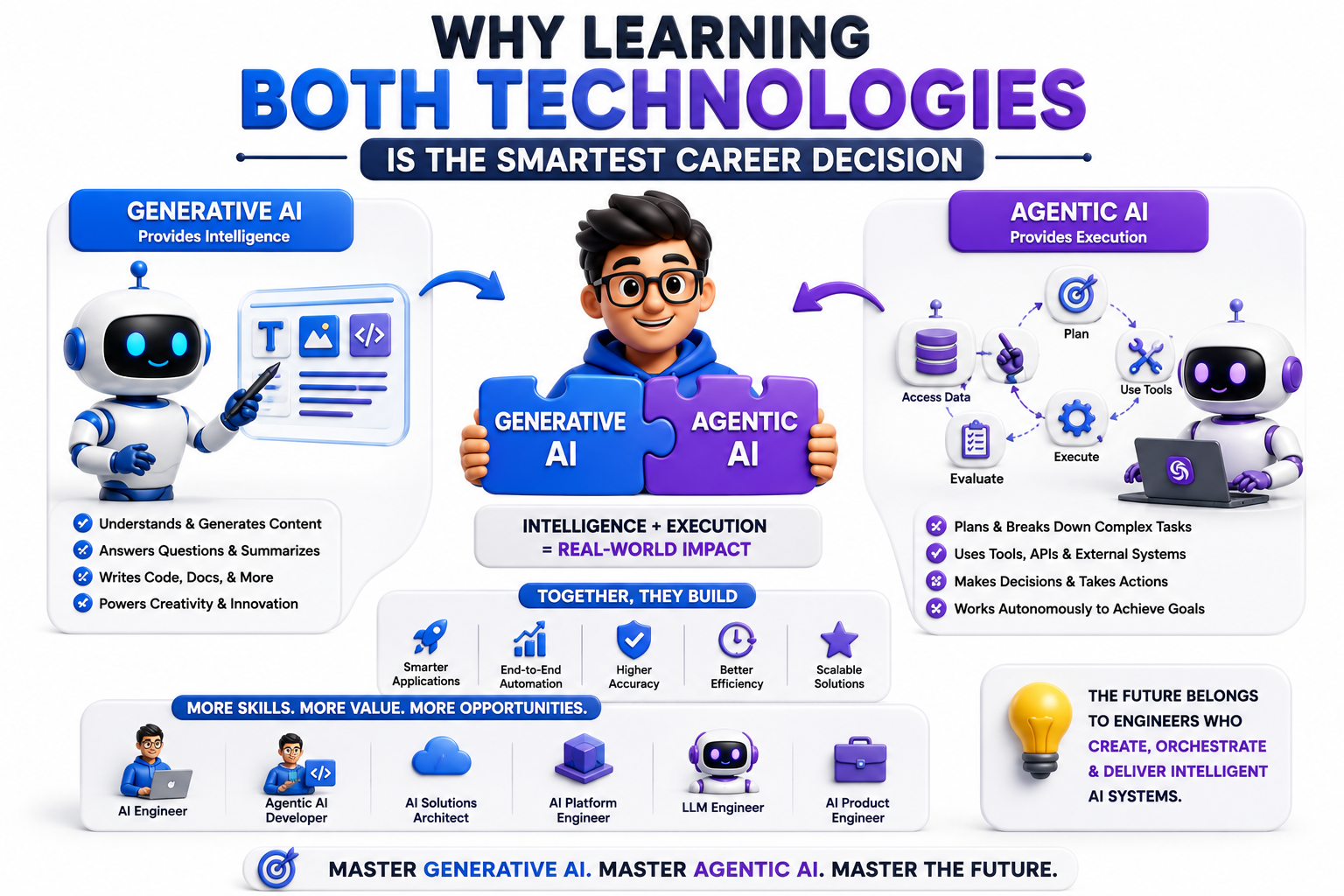
The biggest misconception is viewing Agentic AI and Generative AI as competing technologies.
In reality:
Generative AI provides intelligence.
Agentic AI provides execution.
Most enterprise AI applications combine both. An AI agent typically uses an LLM to reason, generate responses, call tools, retrieve information, and make decisions before completing a task.
For aspiring engineers, this means career success depends on mastering the entire AI application lifecycle rather than specializing too narrowly.
Training platforms like JastTech help bridge this gap by combining theoretical concepts with practical projects covering Generative AI, Agentic AI frameworks, cloud deployment, workflow automation, and real-world engineering use cases. Building production-grade applications prepares learners for the rapidly evolving AI job market.
Conclusion
The AI industry in 2026 is shifting from systems that simply generate information to systems capable of making decisions, coordinating tools, and completing complex objectives. While Generative AI remains the foundation of modern intelligent applications, Agentic AI represents the next stage of software engineering by transforming static models into autonomous problem solvers. Engineers who understand both technologies will be better equipped to build scalable, enterprise-ready AI solutions.
Rather than asking whether Agentic AI will replace Generative AI, the better question is how they work together. Employers are increasingly looking for professionals who can combine LLMs, orchestration frameworks, APIs, memory, and automation into complete AI systems. By developing expertise across both domains through continuous learning and practical experience with platforms like JastTech, engineers can position themselves for some of the most in-demand and future-proof technology careers of 2026 and beyond.