

ASIC Design Career Roadmap for Freshers
Navigate through this article using the table of contents below
Table of Contents
No headings found in this article.
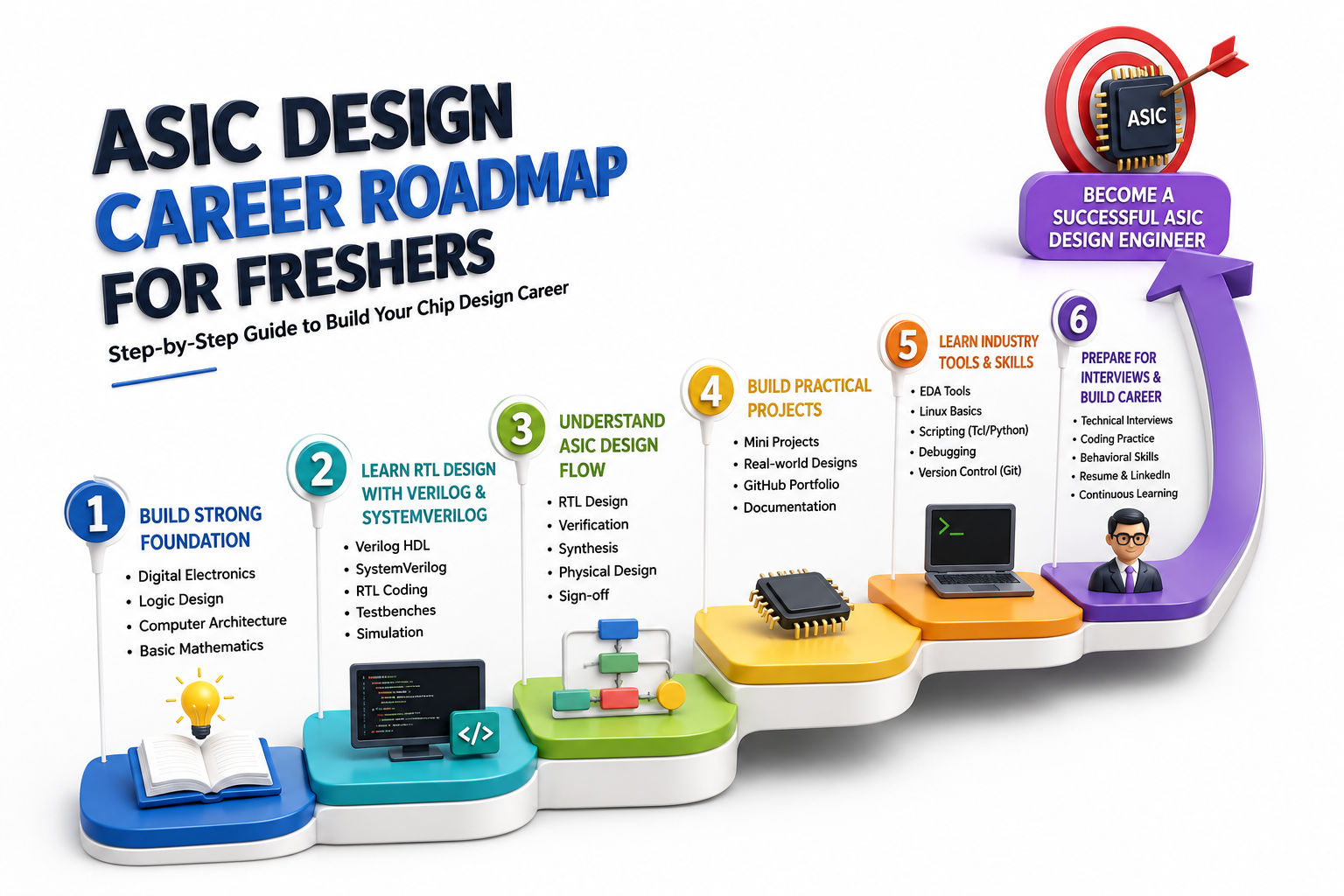
The semiconductor industry is expanding rapidly, creating exciting opportunities for engineering graduates interested in chip design. Yet many freshers struggle to understand where to begin, which skills matter most, and how to build a profile that attracts recruiters. A clear roadmap can eliminate confusion and help you focus on the right learning path.
ASIC Design is one of the most rewarding careers in VLSI, but success requires more than learning Verilog or completing a course. Employers look for engineers who understand the complete digital design flow, possess strong problem-solving skills, and can demonstrate practical experience through projects. This guide explains the exact roadmap freshers should follow to become job-ready ASIC Design Engineers.
Build a Strong Foundation in Digital Electronics and Computer Architecture
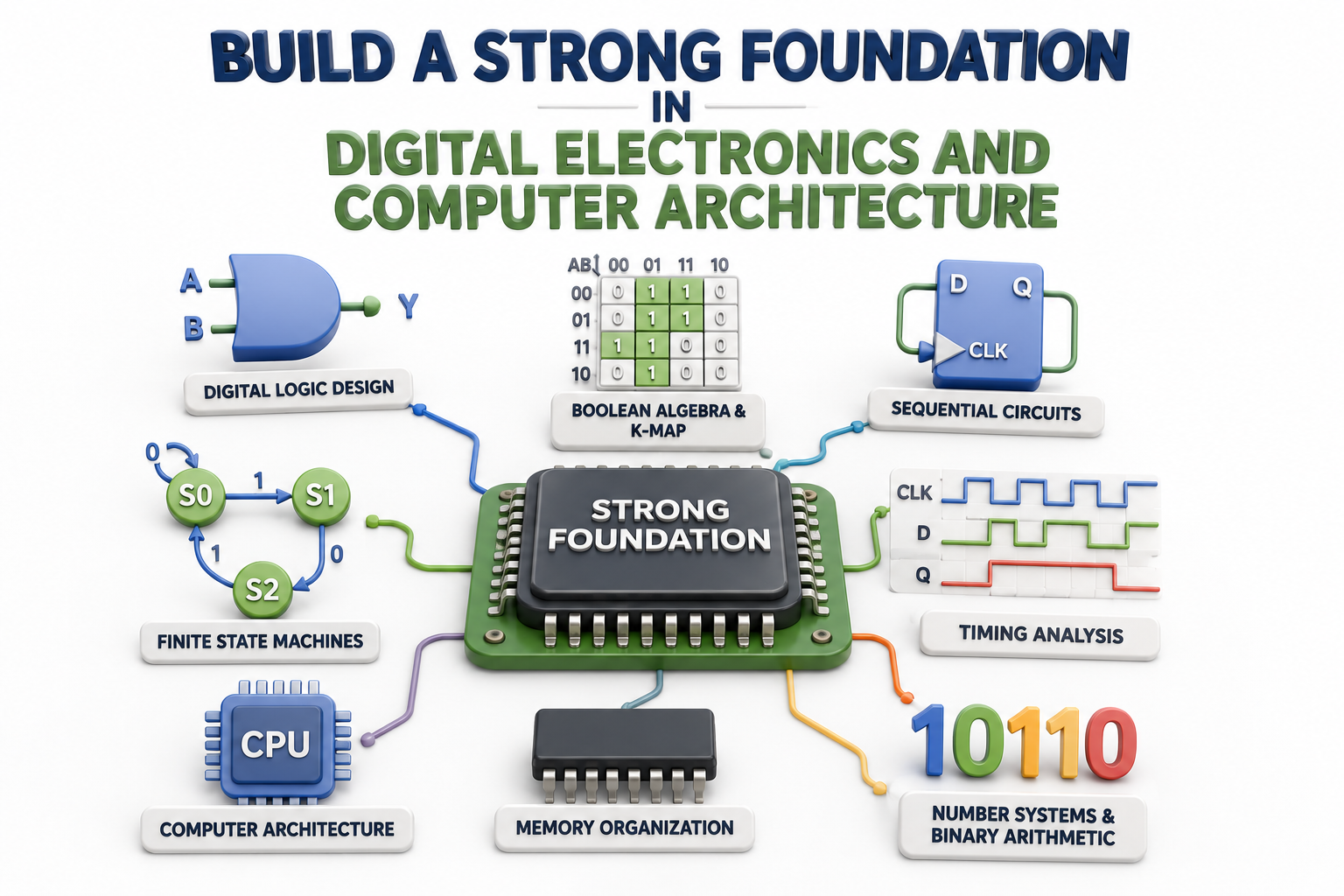
Every successful ASIC Design Engineer begins with a solid understanding of digital electronics. Before writing RTL code, you should understand how digital circuits function, how logic is optimized, and how processors execute instructions. These concepts form the backbone of modern chip design and are frequently tested during technical interviews.
Focus on mastering topics that directly influence digital circuit design. Rather than memorizing formulas, aim to understand how each concept applies to real semiconductor products. A strong conceptual foundation makes advanced design topics significantly easier to learn and helps you troubleshoot design issues more effectively.
Key concepts include:
Digital Logic Design
Boolean Algebra and Karnaugh Maps
Finite State Machines
Combinational and Sequential Circuits
Timing Analysis Fundamentals
Computer Architecture Basics
Memory Organization
Number Systems and Binary Arithmetic
Building confidence in these fundamentals will make the transition to RTL design much smoother and prepare you for more complex ASIC development tasks.
Learn RTL Design Using Verilog and SystemVerilog
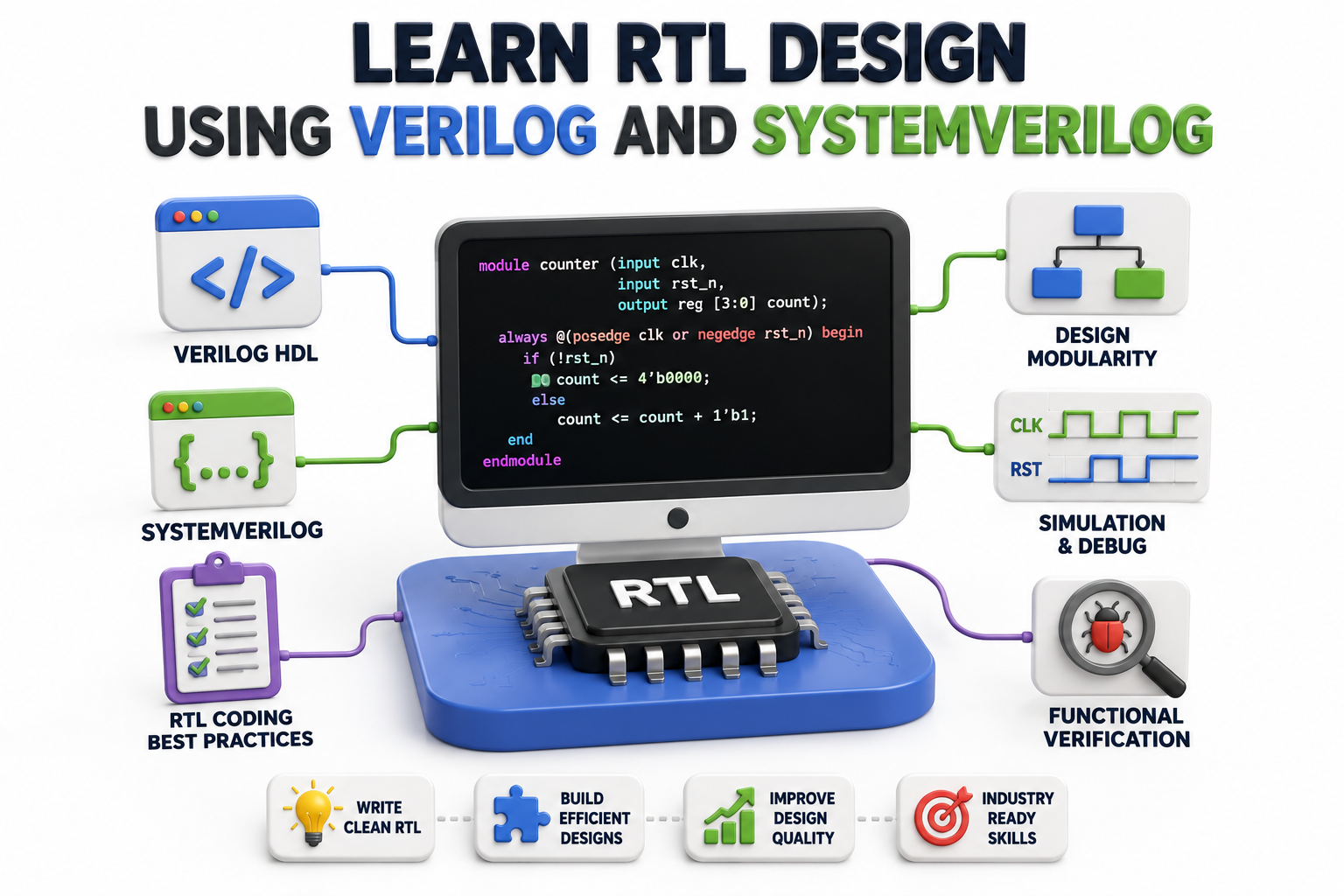
RTL (Register Transfer Level) design is the heart of ASIC development. It defines how digital hardware behaves before it is physically implemented on silicon. Learning Verilog and SystemVerilog allows you to convert design specifications into synthesizable hardware descriptions that can later be verified and manufactured.
Instead of focusing only on language syntax, learn how to write clean, modular, and synthesizable RTL. Recruiters often value coding quality, readability, and understanding of hardware behavior more than the number of completed tutorials. Regular coding practice improves debugging skills and builds confidence for technical interviews.
Important RTL topics to learn include:
Verilog HDL Syntax
SystemVerilog Fundamentals
Combinational and Sequential Coding
Parameterized Modules
FSM Design
Arithmetic Logic Units
Counters and Shift Registers
FIFO and Memory Controllers
Clock Domain Crossing Basics
Consistent RTL practice is essential because strong coding skills form the foundation for every ASIC Design role.
Understand the Complete ASIC Design Flow
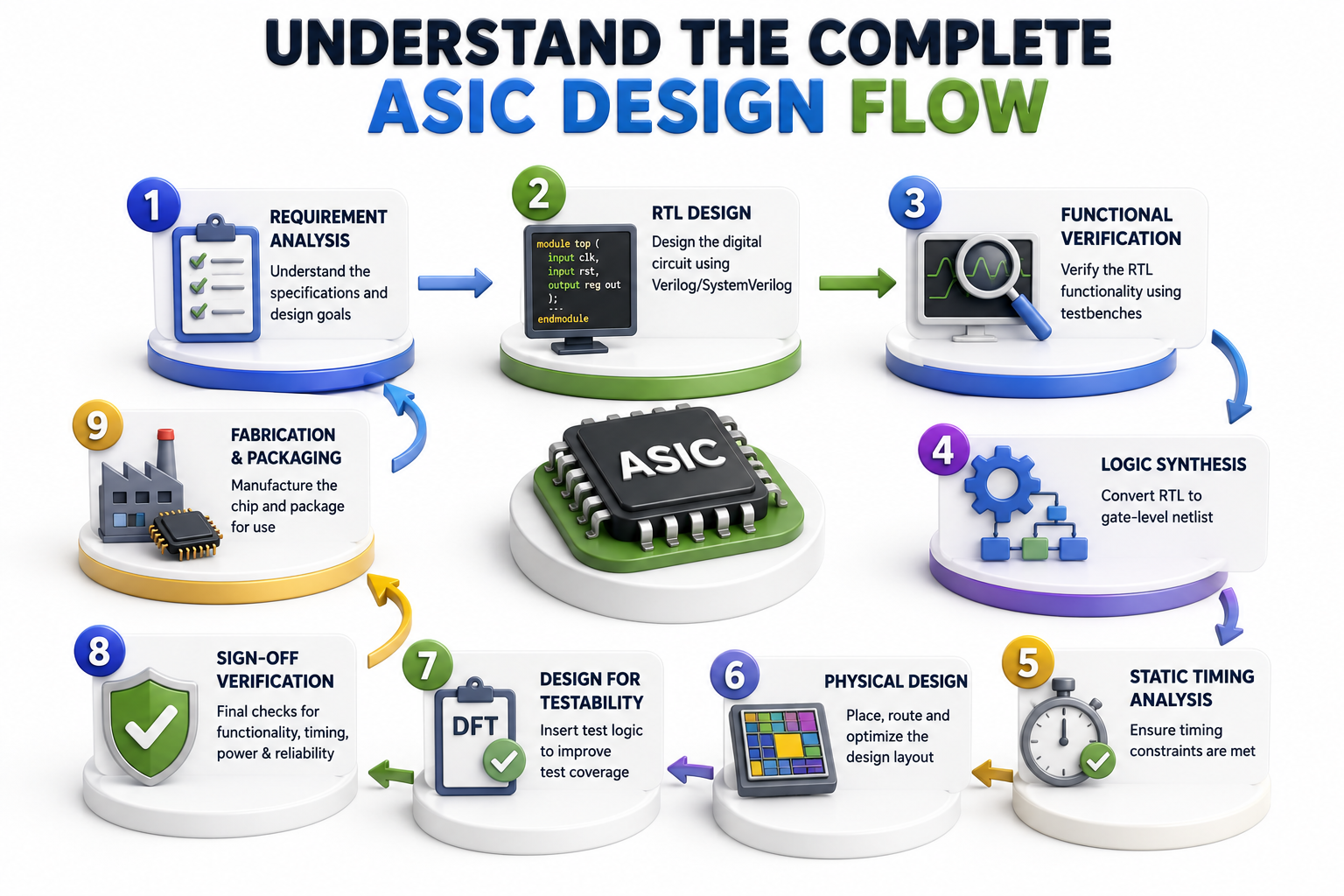
Many freshers know how to write RTL but have limited knowledge of what happens afterward. Understanding the complete ASIC design flow helps you see how every stage contributes to producing a functional semiconductor chip. This broader perspective also improves communication with verification, physical design, and DFT teams in professional environments.
The ASIC design flow begins with system specifications and progresses through RTL design, functional verification, synthesis, timing analysis, physical implementation, and finally chip fabrication and testing. Even if your role focuses on RTL, understanding downstream processes enables you to write designs that are easier to verify and implement.
Major stages include:
Requirement Analysis
RTL Design
Functional Verification
Logic Synthesis
Static Timing Analysis
Physical Design
Design for Testability
Sign-off Verification
Fabrication and Packaging
A clear understanding of the complete flow demonstrates industry awareness and differentiates freshers during interviews.
Develop Practical Projects That Strengthen Your Resume
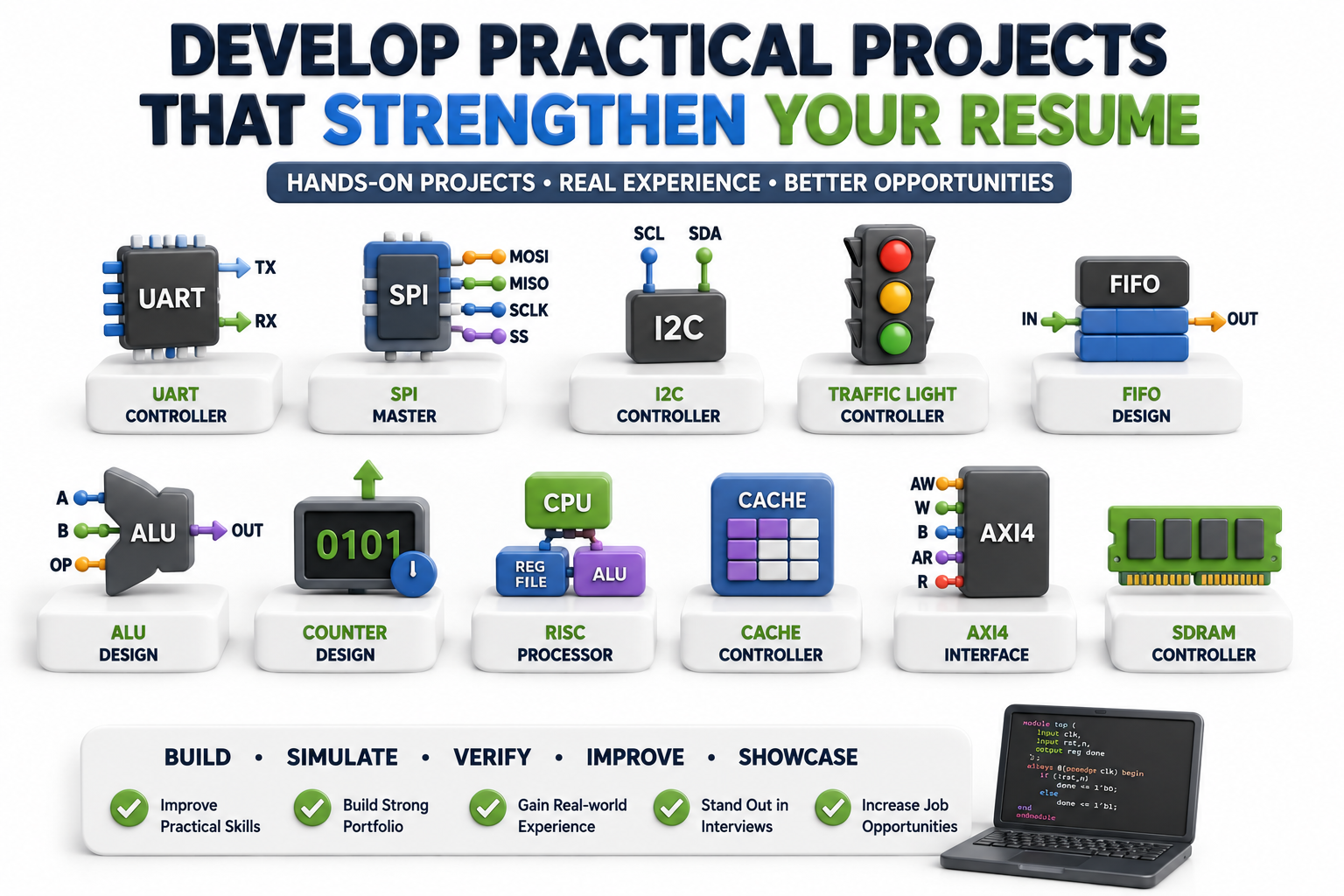
Projects are one of the strongest indicators of practical skills. Recruiters often spend more time discussing projects than academic grades because projects demonstrate your ability to solve engineering problems. Well-documented projects also provide excellent opportunities to explain design decisions during interviews.
Choose projects that gradually increase in complexity instead of attempting extremely advanced designs too early. Focus on writing clean RTL, validating functionality through simulation, and documenting your work clearly. Hosting projects on GitHub further strengthens your professional profile and showcases your development process.
Recommended ASIC Design projects include:
UART Controller
SPI Master
I2C Controller
Traffic Light Controller
FIFO Design
ALU Design
RISC Processor
Cache Controller
AXI4 Interface
SDRAM Controller
Completing several high-quality projects provides stronger evidence of your capabilities than listing numerous theoretical topics on a resume.
Learn Industry Tools, Scripting, and Debugging Techniques
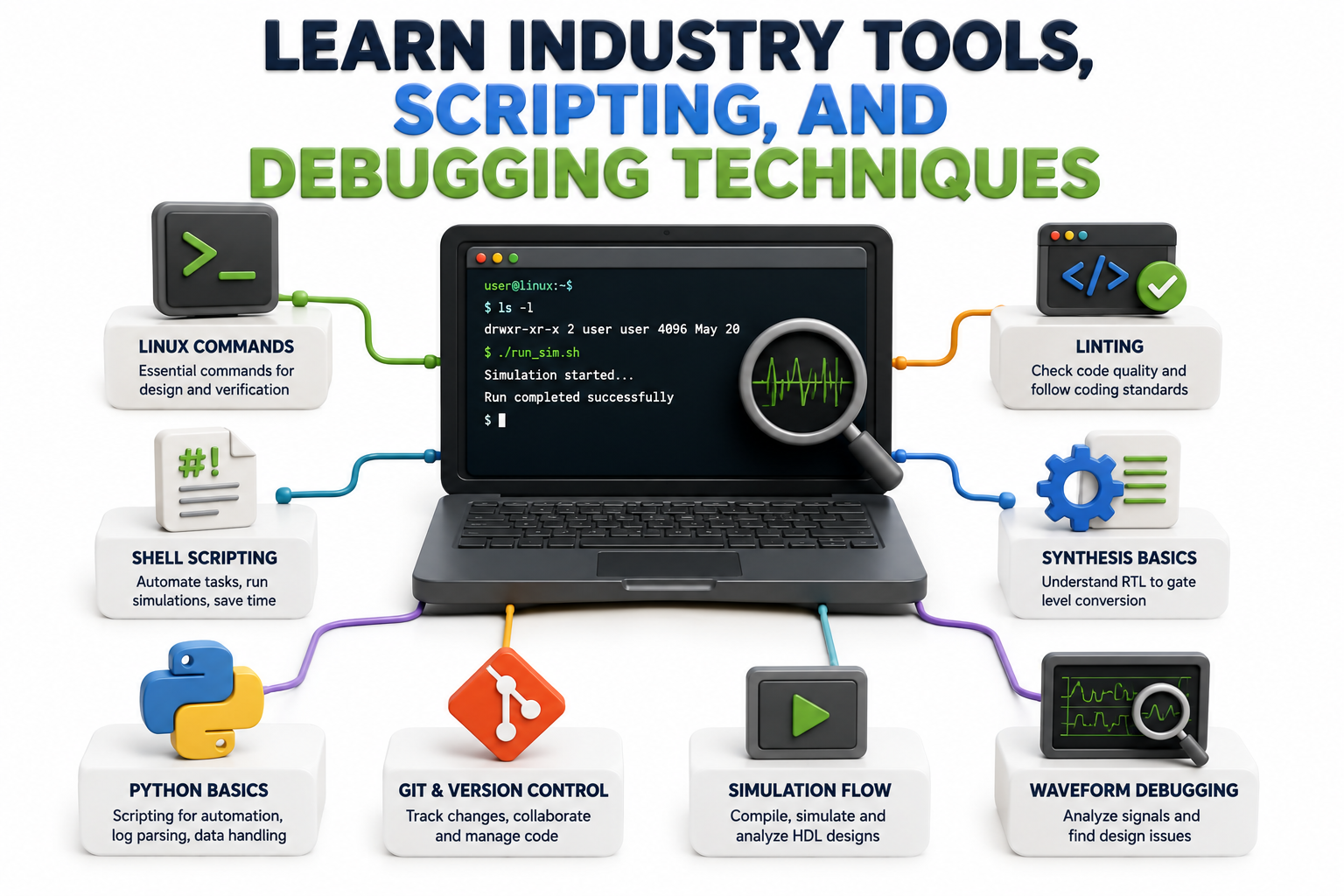
Modern ASIC development relies heavily on professional EDA tools, Linux environments, and scripting languages. Freshers who understand these tools adapt more quickly to industry workflows and often require less training after joining a company.
You do not need expertise in every commercial tool before applying for jobs, but familiarity with the overall workflow significantly improves employability. Learning Linux commands, shell scripting, and basic Python automation can save engineering time and simplify repetitive verification and debugging tasks.
Useful technical skills include:
Linux Commands
Shell Scripting
Python Basics
Git Version Control
Simulation Workflow
Waveform Debugging
Linting Concepts
Synthesis Basics
These supporting skills complement your RTL knowledge and demonstrate that you understand real engineering environments rather than only classroom concepts.
Prepare for ASIC Design Interviews and Build a Professional Career Path
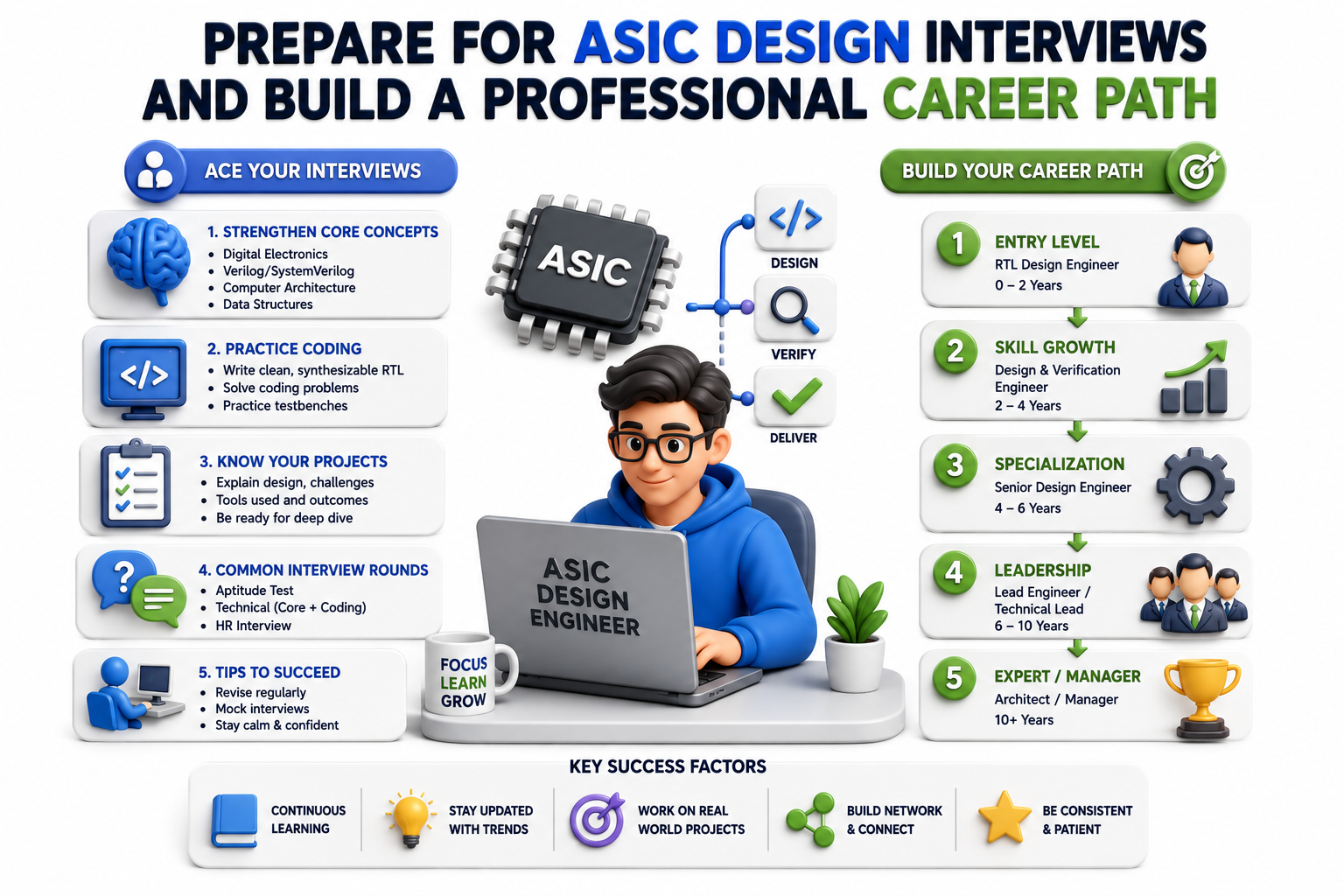
Technical interviews evaluate both conceptual understanding and problem-solving ability. Candidates should be prepared to explain digital electronics fundamentals, write RTL code, debug simple circuits, and discuss project implementation in detail. Interviewers often ask follow-up questions to assess whether projects were genuinely completed by the candidate.
A structured preparation strategy helps improve confidence and increases the likelihood of securing interviews. In addition to technical preparation, maintaining a professional resume, GitHub portfolio, and LinkedIn profile creates a stronger first impression with recruiters.
To maximize your job readiness:
Revise digital electronics regularly.
Practice RTL coding every week.
Solve timing and FSM questions.
Prepare detailed project explanations.
Build a professional GitHub portfolio.
Improve communication and presentation skills.
Stay updated with semiconductor industry trends.
Enroll in structured industry-oriented training, such as programs offered by JASTTech, to gain hands-on experience and guidance from industry professionals.
A combination of technical expertise, practical projects, and effective interview preparation creates a strong foundation for launching an ASIC Design career.
Conclusion
Building a successful ASIC Design career requires a structured learning approach rather than attempting to master every VLSI domain simultaneously. By strengthening your digital electronics fundamentals, developing RTL coding expertise, understanding the complete ASIC design flow, and completing practical projects, you can create a profile that aligns with industry expectations. Supporting these skills with Linux, scripting, and debugging knowledge further enhances your readiness for professional engineering roles.
The semiconductor industry continues to create new opportunities for skilled ASIC Design Engineers, making this an excellent time for fresh graduates to enter the field. Focus on continuous learning, maintain a portfolio that showcases your abilities, and prepare thoroughly for technical interviews. With consistent effort, practical experience, and guidance from quality training platforms such as JASTTech, you can confidently begin your journey toward a rewarding career in ASIC Design.