

Can ECE Students Get Jobs in VLSI Without GATE?
Navigate through this article using the table of contents below
Table of Contents
No headings found in this article.
Does getting a VLSI job require cracking GATE and completing an M.Tech? Many ECE students believe that a GATE qualification is the only way to enter the semiconductor industry. However, the reality is different. Private semiconductor companies also recruit skilled B.Tech graduates with the right technical knowledge.
If you have completed Electronics and Communication Engineering and want to build a career in chip design, verification or physical design, there are several opportunities available without GATE. Understanding the required skills and hiring process can help you start preparing in the right direction.
Is GATE Compulsory for Getting a VLSI Job?
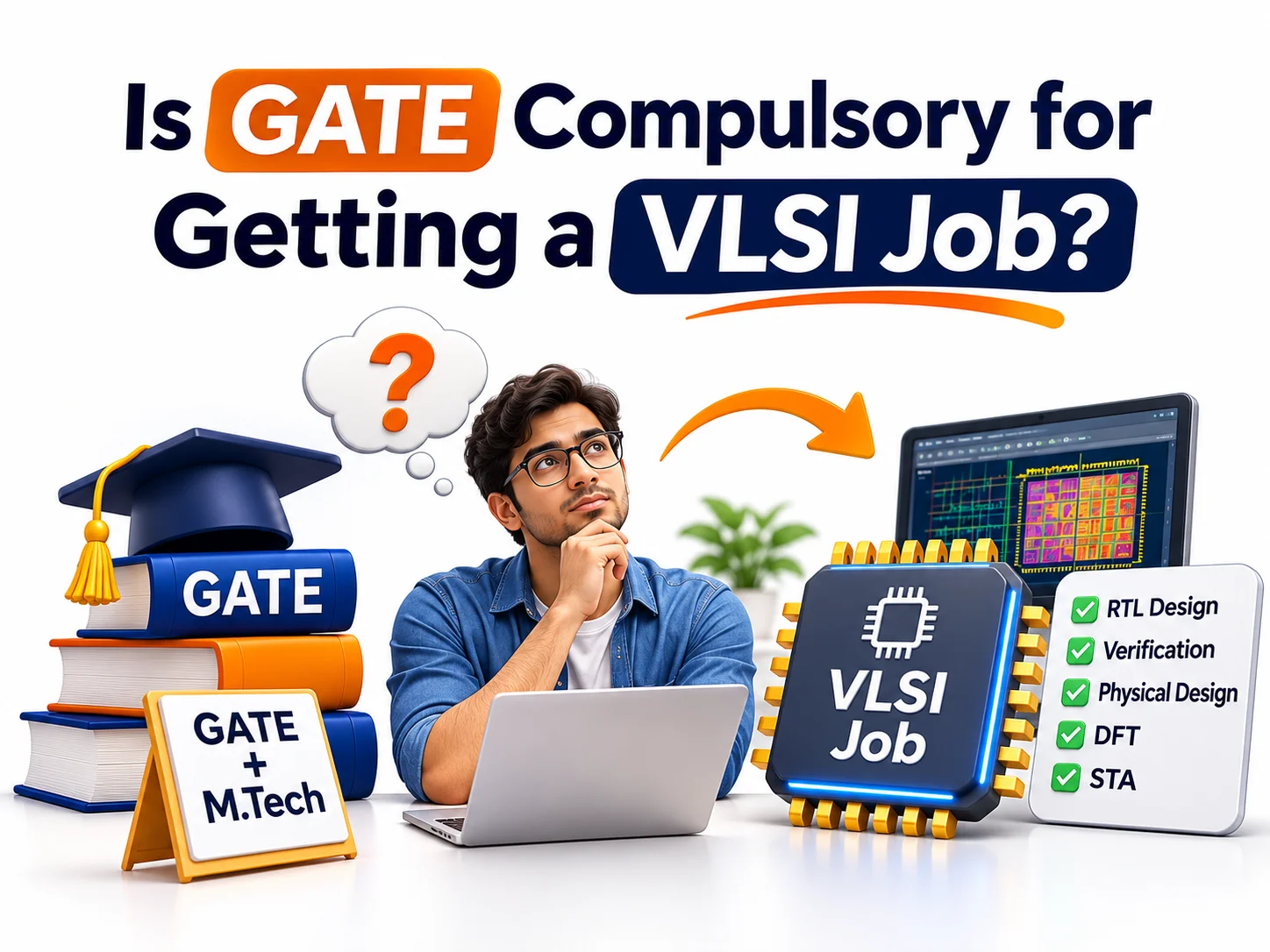
No, GATE is not compulsory for every VLSI job in India. It is primarily an entrance examination used for postgraduate admissions and certain recruitment opportunities in public-sector organizations. However, private semiconductor companies generally have their own recruitment processes.
Companies evaluate candidates through technical interviews, coding assessments, subject knowledge and practical experience. A B.Tech ECE graduate can apply for suitable entry-level positions if they meet the company's educational and technical requirements.
There are two common career pathways:
With GATE: Students can pursue M.Tech in VLSI, Microelectronics or related specializations at eligible institutions. This provides opportunities for advanced academic learning and research.
Without GATE: Graduates can develop industry-oriented skills, complete practical projects, apply for internships and participate in private-sector recruitment.
The important point is that GATE provides additional opportunities, but it does not determine whether you can become a VLSI engineer.
VLSI Job Opportunities Available for ECE Freshers
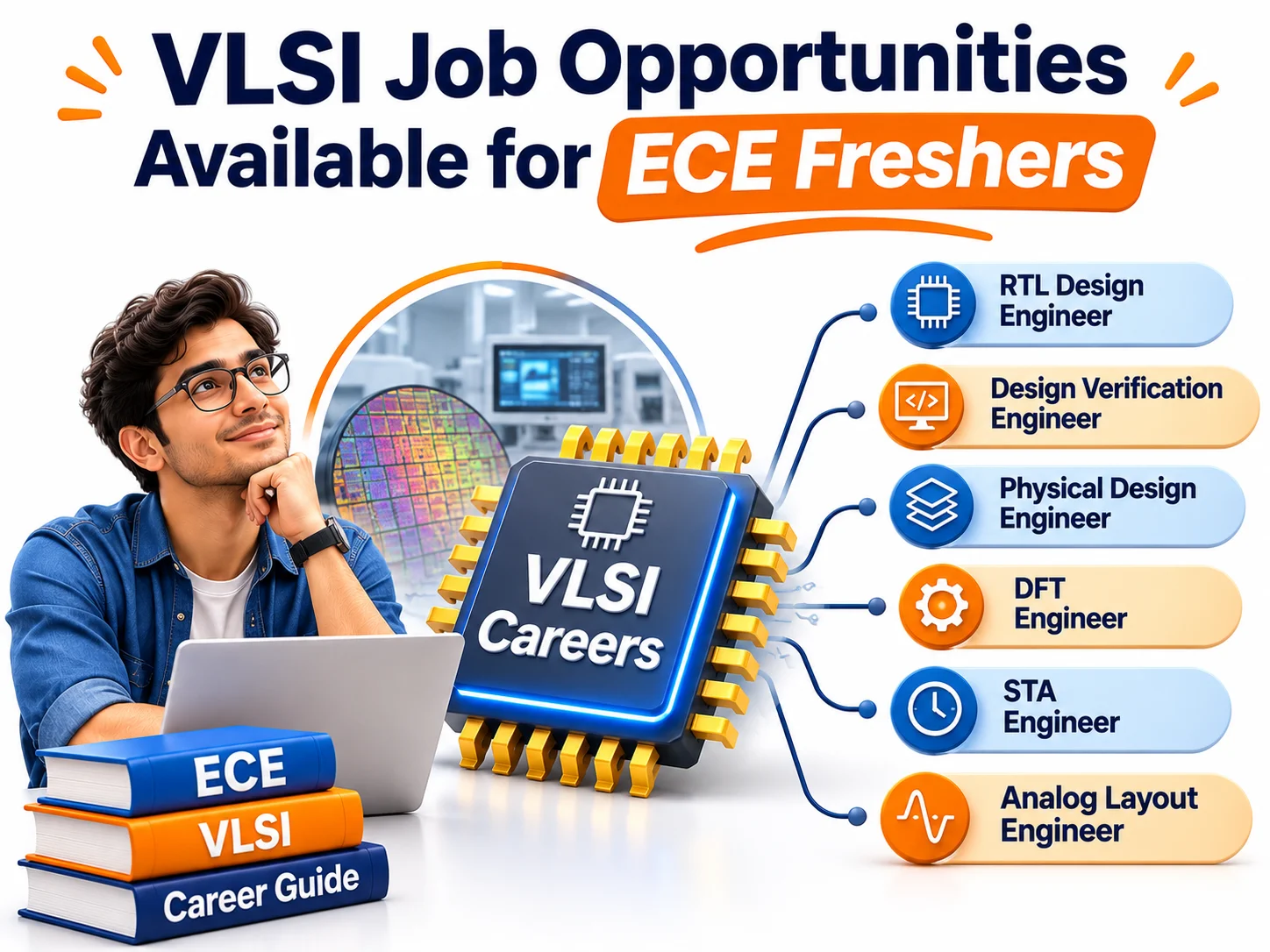
ECE graduates can explore different specializations depending on their interests, technical strengths and practical preparation. Each specialization involves different responsibilities and requires specific knowledge.
Some important entry-level career options include:
RTL Design Engineer: Works on developing digital hardware functionality using Verilog or SystemVerilog. Knowledge of combinational logic, sequential circuits, finite state machines and RTL coding is important.
Design Verification Engineer: Checks whether a digital design behaves according to its specifications. Students should understand SystemVerilog, testbenches, simulation and debugging. UVM knowledge is useful for advanced verification opportunities.
Physical Design Engineer: Works on transforming synthesized netlists into physical chip layouts. Important concepts include floorplanning, placement, clock tree synthesis, routing and timing closure.
DFT Engineer: Focuses on making semiconductor chips testable after manufacturing. Knowledge of scan architecture, scan chains, ATPG, fault models and test coverage is valuable.
STA Engineer: Performs static timing analysis to identify setup and hold violations and evaluate timing paths. Understanding clock relationships, timing constraints and SDC is essential.
Analog Layout Engineer: Works on physical implementation of analog and mixed-signal circuits. Knowledge of MOSFETs, matching, layout techniques and design rules is important.
Freshers should select a specialization based on their interests rather than attempting to learn every VLSI domain simultaneously.
Essential Technical Skills ECE Students Need Without GATE
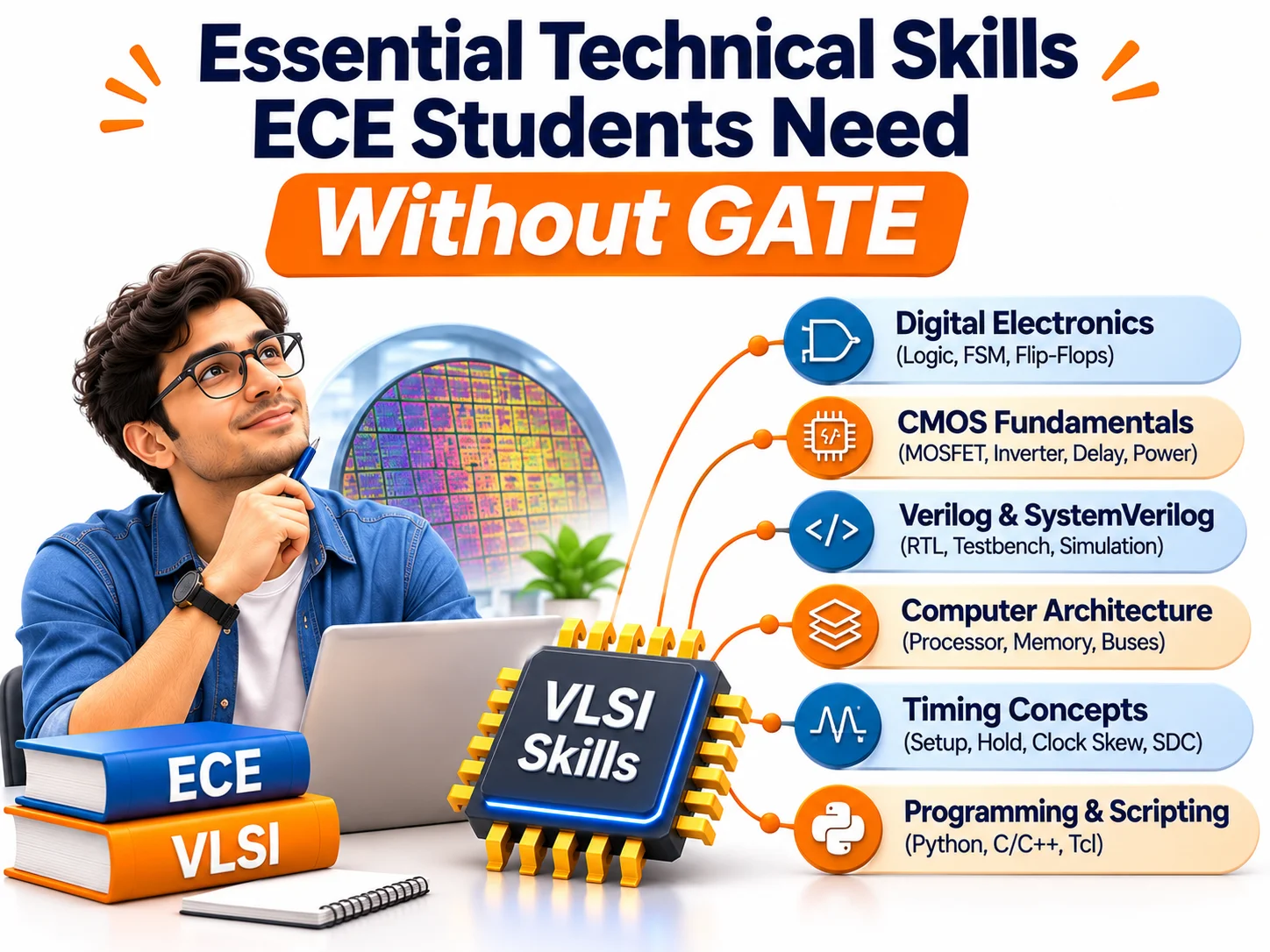
Without a GATE score or postgraduate qualification, demonstrating strong technical knowledge becomes particularly important. Companies need candidates who understand the engineering concepts behind their work rather than simply knowing terminology.
Start by strengthening these fundamentals:
Digital Electronics: Learn Boolean algebra, logic gates, multiplexers, flip-flops, counters and finite state machines.
CMOS Fundamentals: Understand MOSFET operation, CMOS inverter characteristics, propagation delay and power consumption.
Verilog and SystemVerilog: Practise writing synthesizable RTL, developing testbenches and debugging simulation results.
Computer Architecture: Understand processors, registers, memory architecture, buses and basic instruction execution.
Timing Concepts: Study setup time, hold time, clock skew, propagation delay and timing constraints.
Programming and Scripting: Develop basic Python, C/C++ and Tcl knowledge to support automation and technical workflows.
Students interested in structured practical learning can explore JastTech's VLSI Training Hyderabad programs to strengthen their understanding of industry-relevant concepts and tools.
Remember that theoretical knowledge and practical implementation must complement each other. Understanding why a circuit behaves in a particular way is more valuable than memorizing definitions.
How to Build Practical VLSI Experience Before Applying for Jobs
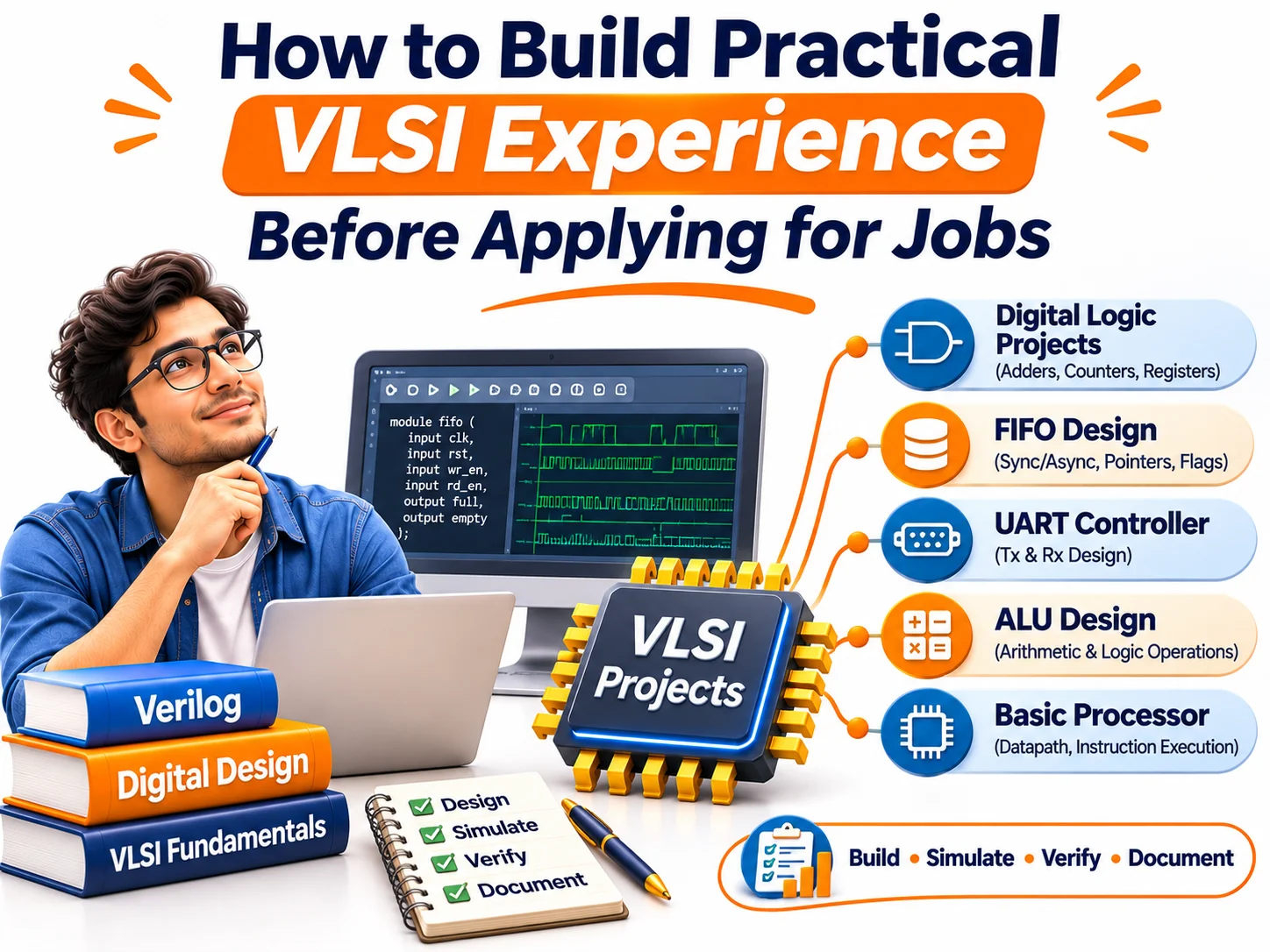
One common challenge for ECE freshers is the lack of industrial experience. However, students can demonstrate their technical abilities through academic projects, simulation exercises and independently developed designs.
A strong project portfolio helps recruiters understand what you can actually implement.
Consider developing these projects:
Digital Logic Projects: Design adders, multiplexers, counters and different types of registers using Verilog.
FIFO Design: Implement a synchronous or asynchronous FIFO and understand pointer management, status flags and overflow conditions.
UART Controller: Develop a basic UART transmitter and receiver with simulation-based verification.
ALU Design: Implement arithmetic and logical operations and verify different input combinations.
Basic Processor Design: Develop a simple processor architecture to understand instruction execution and datapath operations.
Document every project properly. Include the problem statement, design architecture, RTL code, simulation waveforms, verification results and important observations.
Students can also explore open-source tools such as Icarus Verilog, Verilator and GTKWave to practise digital design and simulation without depending entirely on expensive commercial software.
A well-documented project provides meaningful discussion points during technical interviews and demonstrates your ability to solve engineering problems.
How ECE Freshers Can Prepare for VLSI Interviews and Get Hired
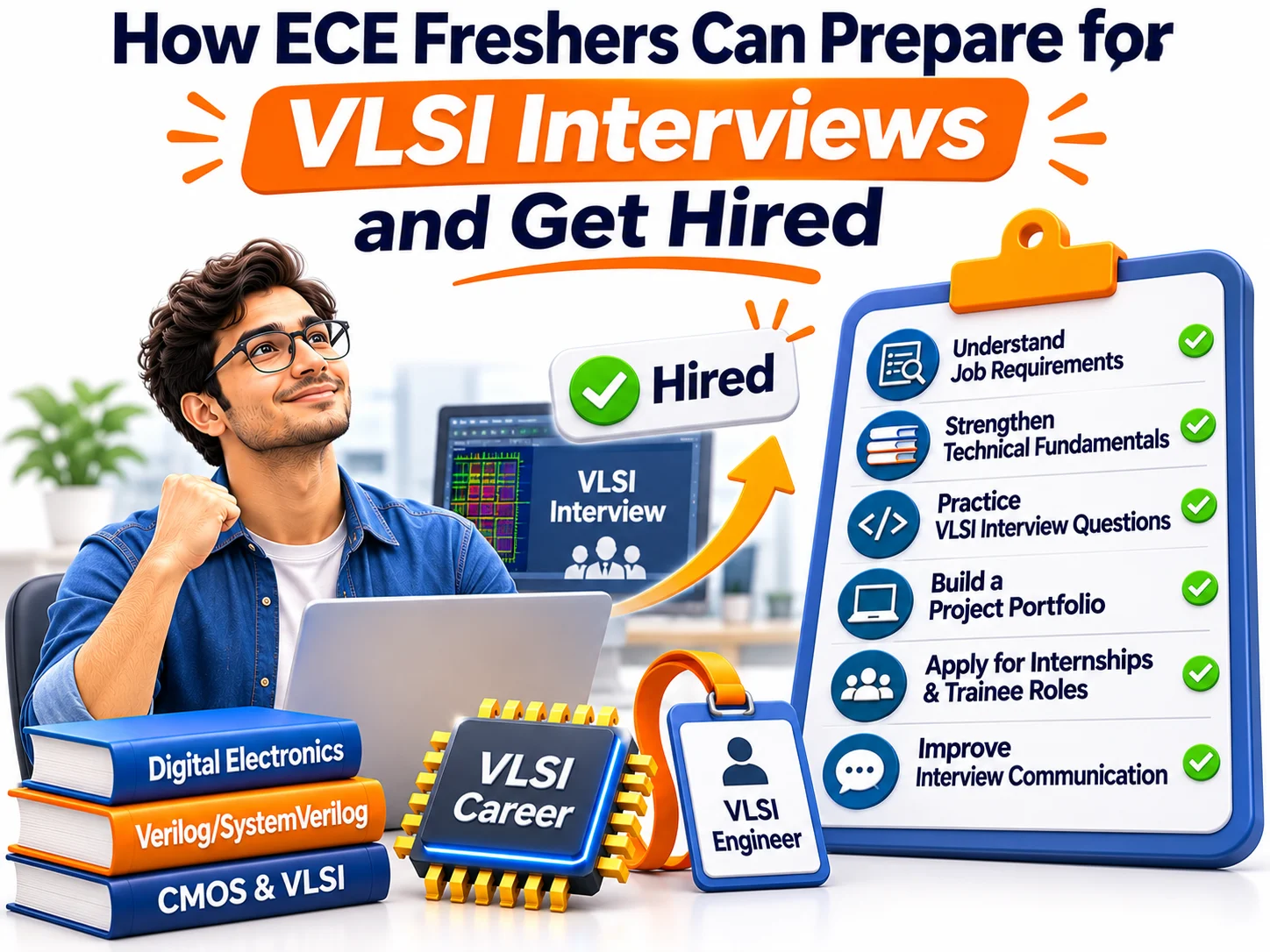
Getting shortlisted without GATE requires a focused job preparation strategy. Instead of applying randomly, identify suitable entry-level roles and prepare according to their technical expectations.
Follow this practical approach:
Understand Job Requirements: Search for RTL design, verification, physical design and DFT trainee positions. Review company eligibility criteria and identify frequently requested skills.
Prepare Technical Fundamentals: Revise digital electronics, CMOS concepts, semiconductor devices, timing fundamentals and computer architecture.
Practise Technical Questions: Solve Verilog coding problems, explain circuit behavior and practise debugging incorrect RTL implementations.
Develop a Project Portfolio: Keep your project documentation, simulation results and code organized. Be prepared to explain your design decisions and challenges.
Apply for Internships and Trainee Positions: Look beyond established semiconductor companies. Design service providers, engineering companies and smaller semiconductor organizations may also offer relevant entry-level opportunities.
Improve Interview Communication: Practise explaining technical concepts clearly. Interviewers often evaluate how candidates approach unfamiliar problems, identify mistakes and communicate solutions.
JastTech encourages practical, industry-oriented learning that helps students connect academic concepts with real VLSI engineering workflows. Students should prioritize demonstrable technical ability instead of collecting certificates without understanding the underlying concepts.
Conclusion
ECE students can absolutely build careers in VLSI without qualifying GATE. Private-sector semiconductor opportunities are available for graduates who develop the necessary technical knowledge, complete meaningful projects and prepare for specialization-specific interviews. GATE remains valuable for M.Tech admissions and certain government opportunities, but it is not a universal requirement for entering the semiconductor industry.
The most important step is to start building industry-relevant capabilities early. Strengthen digital electronics, learn Verilog and SystemVerilog, explore EDA tools and develop practical projects. With structured preparation and consistent effort, B.Tech graduates can work towards opportunities in RTL design, verification, physical design, DFT and other semiconductor domains. JastTech can help aspiring engineers develop the practical foundation needed to move towards their VLSI career goals.