


Common Mistakes Freshers Make While Learning Embedded Systems and How to Avoid Them
Navigate through this article using the table of contents below
Table of Contents
No headings found in this article.
Entering the field of embedded systems engineering offers exciting opportunities to interact directly with hardware, microcontrollers, and real-time processing architectures. However, early-career engineers frequently encounter steep learning curves when transitioning from standard application software development to low-level hardware control. Without proper guidance, engineering graduates often pick up bad programming habits, ignore hardware schematics, and rely heavily on high-level abstractions that hide how microcontrollers truly operate.
Recognizing these systemic mistakes early allows beginners to build sustainable debugging skills, master bare-metal concepts, and excel in industrial technical interviews. Rather than relying on trial-and-error, adopting a structured methodology transforms complex board bring-up tasks into manageable, logical engineering challenges. To fast-track your foundational knowledge before diving into mistakes, explore our complete embedded systems training for beginners skills tools and roadmap.
1. Skipping Electronics Fundamentals and Hardware Schematics
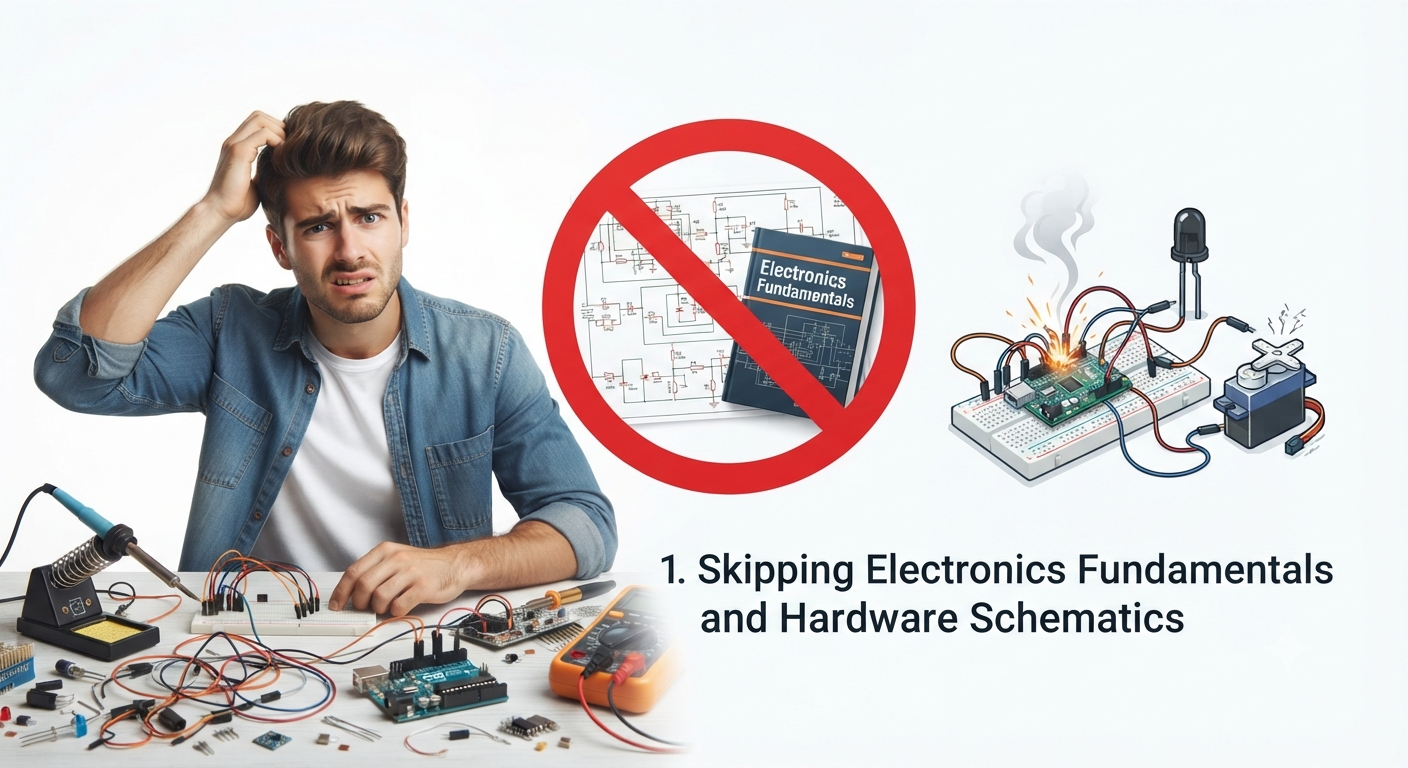
Mistake: Treating Microcontrollers as Pure Software Engines
Many freshers enter embedded systems believing that writing code is 90% of the job. They jump directly into writing C scripts without reading component datasheets, reviewing PCB schematics, or analyzing pinout constraints. When a peripheral fails to respond, they assume the error lies entirely within software logic. This leads to hours wasted modifying functioning code while ignoring floating input pins, wrong pull-up resistors, or improper supply voltages.
How to Avoid It: Master Basic Circuit Analysis and Datasheets
Before writing a single line of firmware, build the habit of reading schematic diagrams and reference manuals. Learn basic electronics principles, including Ohm's law, pull-up/pull-down resistor calculations, decoupling capacitors, and transistor switching. Treat the microcontroller reference manual as your primary guide; understanding register maps, pin multiplexing, and power distribution prevents hardware-induced software failures before they start.
2. Relying Too Heavily on High-Level Arduino Libraries

Mistake: Depending on Abstraction without Understanding Architecture
Arduino and high-level framework wrappers make initial prototyping accessible, but they mask crucial low-level mechanics. Freshers often rely on pre-written functions like analogRead() or delay() without knowing how Analog-to-Digital Converters (ADCs) or hardware timers work under the hood. When asked to configure raw memory registers or write custom drivers during interviews, candidates accustomed to abstractions frequently struggle.
How to Avoid It: Transition to Bare-Metal C and Direct Register Manipulation
Move beyond beginner wrappers by writing bare-metal C code on architectures like ARM Cortex-M or AVR. Practice configuring memory-mapped registers directly using bitwise operations, setting clock trees, and manipulating GPIO directional registers. Following a structured embedded systems training roadmap for beginners ensures you build drivers from scratch, reinforcing your grasp of hardware registers.
3. Ignoring Memory Management and Pointer Safety in Embedded C
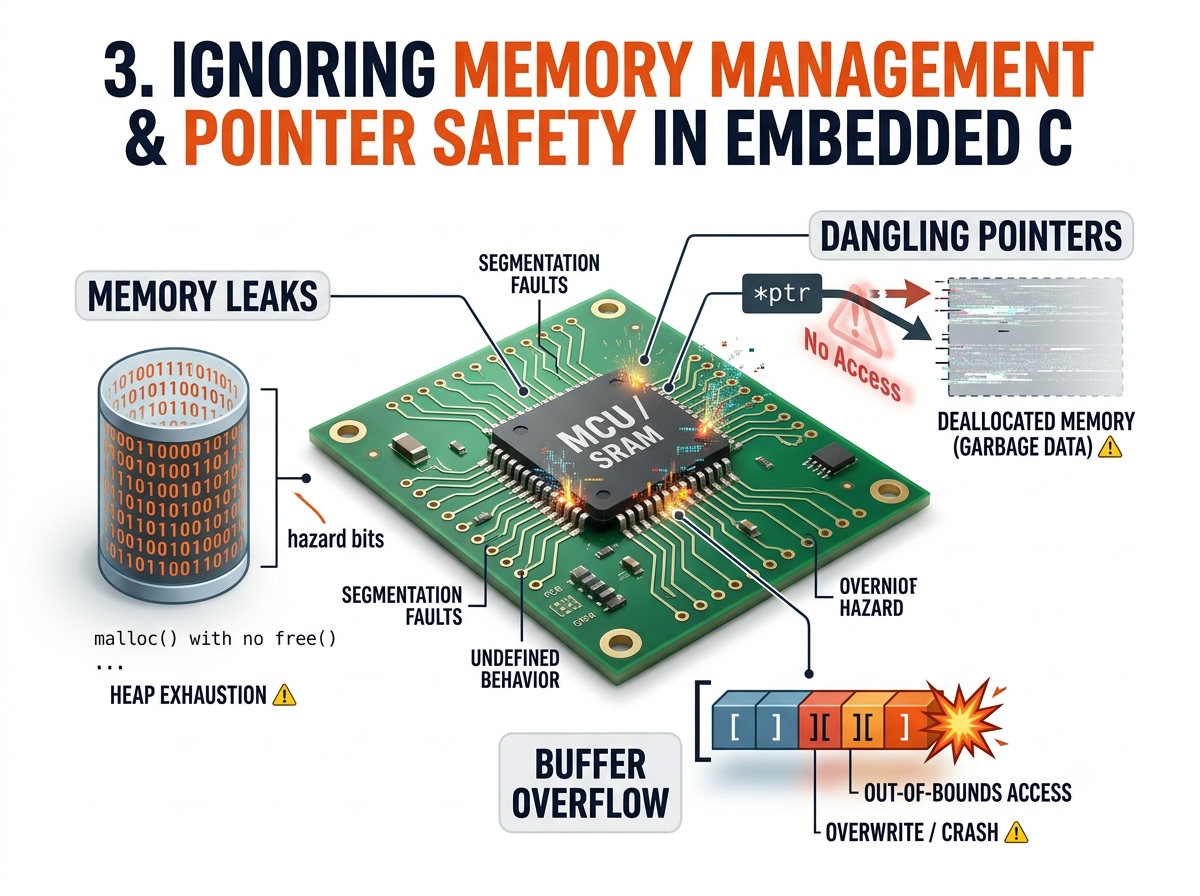
Mistake: Misusing Dynamic Allocation and Unsafe Pointer Arithmetic
In standard computer programming, memory appears almost infinite, but embedded microcontrollers operate under strict RAM and Flash limits. Freshers routinely commit errors by using dynamic memory functions like malloc() or free(), leading to heap fragmentation and system crashes. Additionally, uninitialized pointers, array buffer overflows, and improper typecasting frequently corrupt hardware memory spaces.
How to Avoid It: Enforce Static Allocation and Strict Pointer Rules
Adopt safe Embedded C programming practices by allocating memory statically at compile-time whenever possible. Avoid heap allocation in real-time systems to maintain predictable runtime performance. Always initialize pointers, strictly bound array indices, and use const qualifiers for read-only lookup tables stored in Flash memory to ensure system stability and memory integrity.
4. Overlooking Hardware Int
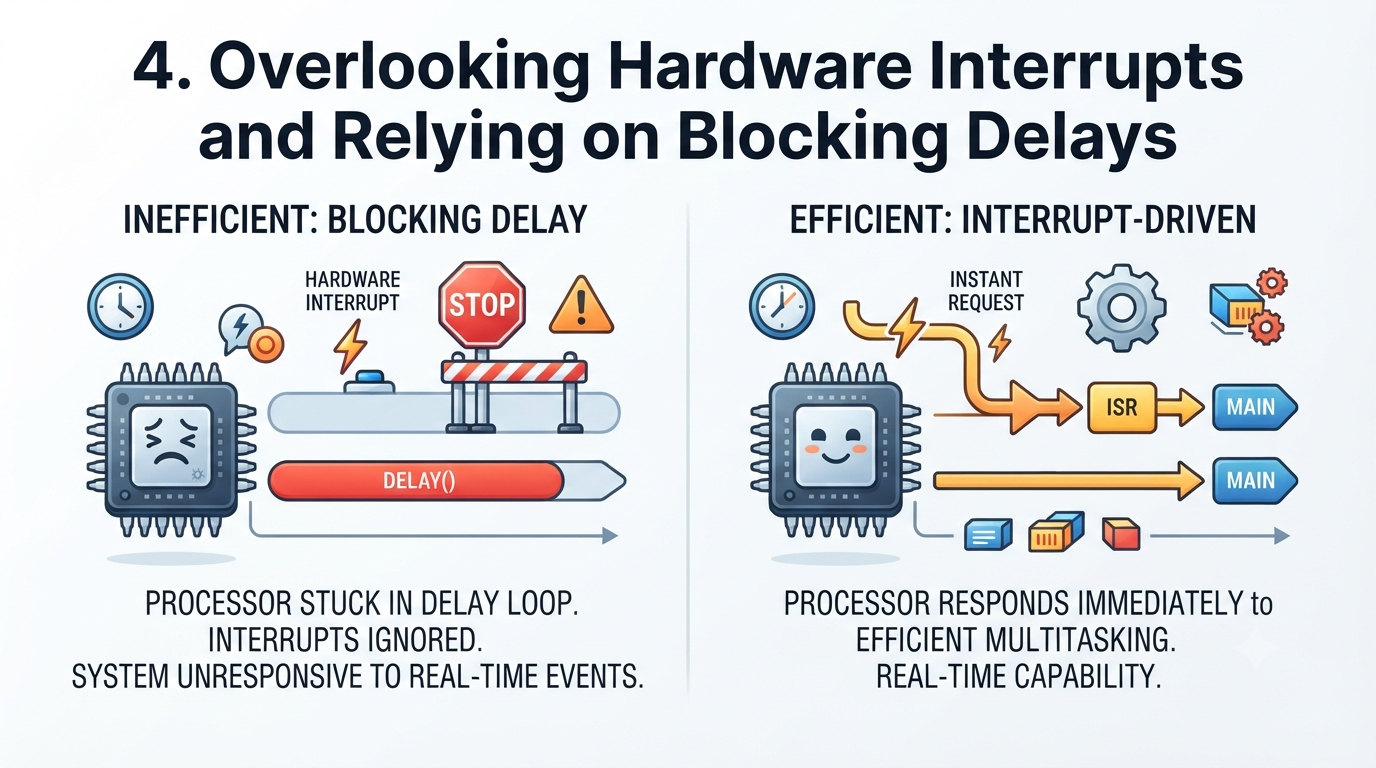
errupts and Relying on Blocking Delays
Mistake: Polling Peripherals and Using Delay Loops in Production Code
A frequent beginner mistake is using software loop delays (like sleep() or delay()) to manage timed events or periodic inputs. Blocking delays stall the CPU, preventing it from processing critical external signals. Similarly, endlessly polling status flags wastes processing power and delays responses to real-time events, degrading system responsiveness.
How to Avoid It: Implement Hardware Timers and Interrupt Service Routines (ISRs)
Architect firmware using hardware-driven interrupts and dedicated timer peripherals. Keep Interrupt Service Routines extremely brief by setting flags or updating thread-safe variables, leaving time-consuming processing tasks for the main execution loop or RTOS tasks. Mastering interrupt priorities, nested vectors, and flag clearing ensures your application responds instantly to real-time events.
5. Neglecting Hardware Debugging Tools and Serial Diagnostics
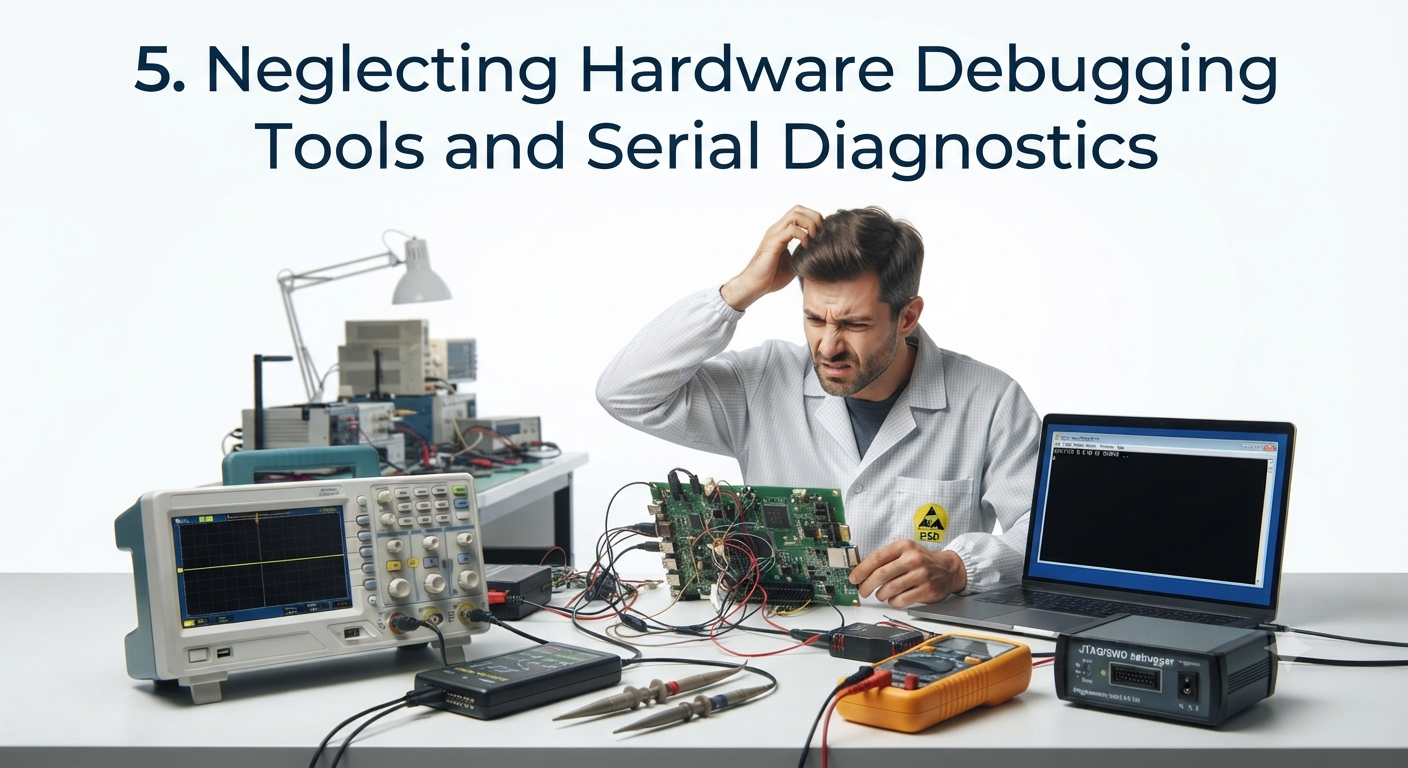
Mistake: Relying Solely on Print Statements for Problem Solving
When code behaves unpredictably, freshers often attempt to debug by adding serial print statements throughout their functions. Print statements alter execution timing, obscure race conditions, consume bandwidth, and are unusable if communication interfaces fail. Attempting to resolve timing or bus conflicts without hardware visibility leads to slow and frustrating troubleshooting.
How to Avoid It: Master In-Circuit Debuggers, Oscilloscopes, and Logic Analyzers
Incorporate hardware debugging tools into your regular workflow early on. Learn to use JTAG/SWD hardware debuggers (such as ST-Link or J-Link) to set breakpoints, inspect registers, and single-step through firmware. Utilize logic analyzers and oscilloscopes to observe actual physical voltage transitions on UART, SPI, and I2C lines to verify clock speeds and signal integrity.
6. Rushing into RTOS and Embedded Linux Without Bare-Metal Mastery

Mistake: Adding OS Complexity Before Understanding Fundamental Hardware
Driven by industry buzzwords, many beginners try learning FreeRTOS or Embedded Linux before mastering bare-metal microcontrollers. Introducing multi-threading, context switching, inter-process communication, and task scheduling without a solid grasp of hardware timers, memory maps, and interrupts causes confusion when complex concurrency bugs surface.
How to Avoid It: Master Super-Loops and State Machines First
Establish a solid foundation in bare-metal development before introducing operating systems. Practice building non-blocking super-loop architectures and Finite State Machines (FSMs) to control peripheral interaction and multi-tasking manually. Once bare-metal concepts are clear, transition to RTOS concepts like mutexes, queues, and semaphores with much greater ease.
7. Failing to Practice Version Control and Modular Firmware Architecture
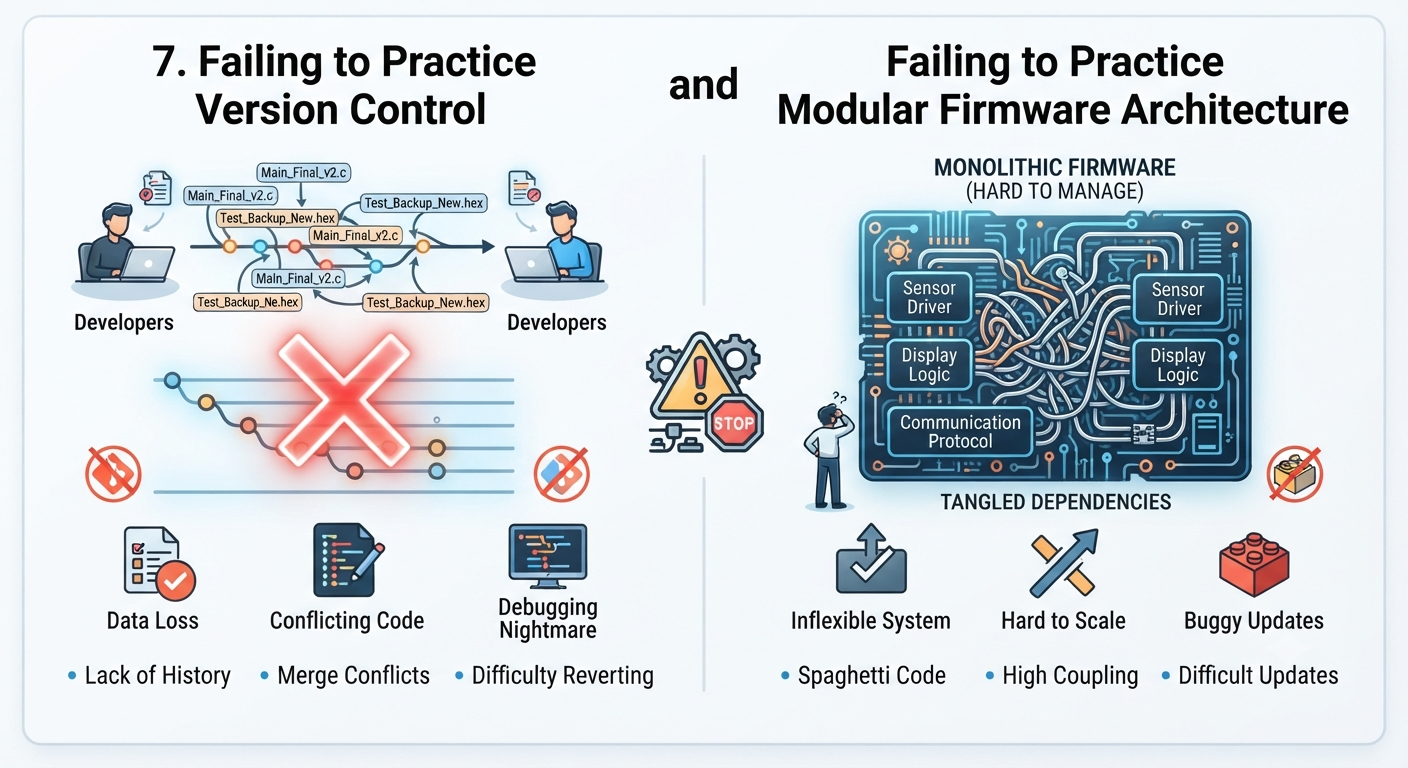
Mistake: Writing Monolithic Code Files and Neglecting Git
Freshers often write entire firmware projects within a single main.c file. Mixing driver configurations, protocol handling, and application logic creates messy codebases that are difficult to debug or scale. Additionally, neglecting version control systems like Git leads to lost working code states when making experimental firmware modifications.
How to Avoid It: Build Layered Architecture and Use Git Consistently
Organize firmware cleanly into distinct hardware abstraction layers (HAL), peripheral drivers, and high-level application code. Write modular, reusable .c and .h files with clear interface boundaries. Use Git for version control on every project, maintaining structured commit histories and feature branches to track changes safely and collaborate effectively.