

Complete Mock VLSI Interview Guide for Engineering Students and Freshers
Navigate through this article using the table of contents below
Table of Contents
No headings found in this article.
Landing your first VLSI job is no longer just about memorizing digital electronics concepts. Today's semiconductor companies want candidates who understand design flow, can explain projects confidently, solve problems logically, and communicate effectively during technical interviews.
Whether you're preparing for campus placements or off-campus hiring, a structured mock interview strategy can dramatically improve your confidence. This guide explains exactly how engineering students and freshers should prepare for VLSI interviews in 2026 and how JastTech can help bridge the gap between academic learning and industry expectations.
Understand What Companies Actually Test During VLSI Interviews
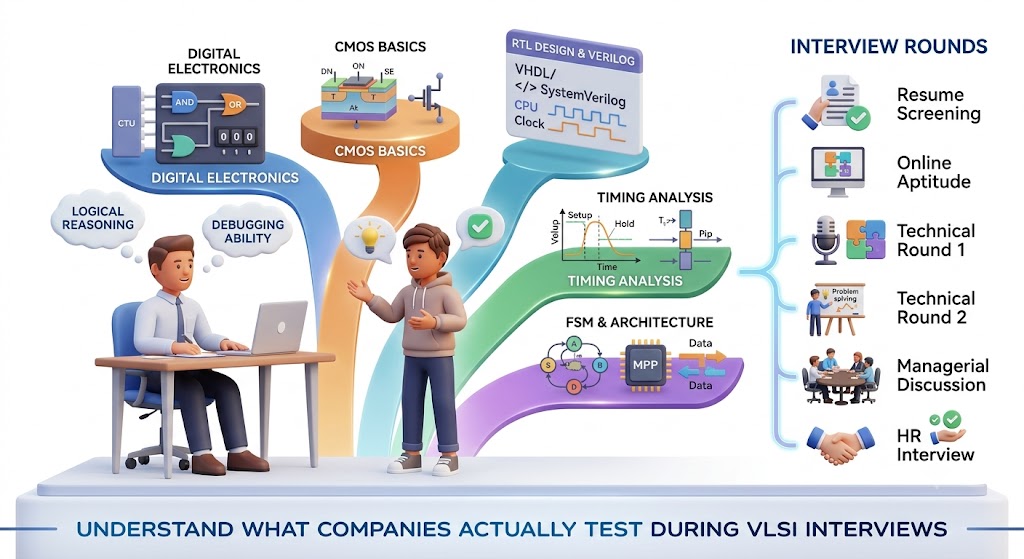
Many students spend months reading textbooks but fail interviews because they prepare the wrong topics. Recruiters assess your ability to apply concepts rather than simply recall definitions.
A typical VLSI interview evaluates multiple skill areas, including:
Digital Electronics fundamentals
CMOS basics
RTL Design concepts
Verilog/SystemVerilog programming
Timing analysis
Finite State Machines (FSM)
Computer Architecture
Basic scripting knowledge
Communication skills
Project understanding
Interview rounds generally include:
Resume screening
Online aptitude assessment
Technical Interview Round 1
Technical Interview Round 2
Managerial discussion
HR interview
Large semiconductor companies expect candidates to think through engineering problems instead of giving memorized answers. Interviewers often ask follow-up questions to evaluate logical reasoning and debugging ability.
Build Strong Fundamentals Before Practicing Interview Questions
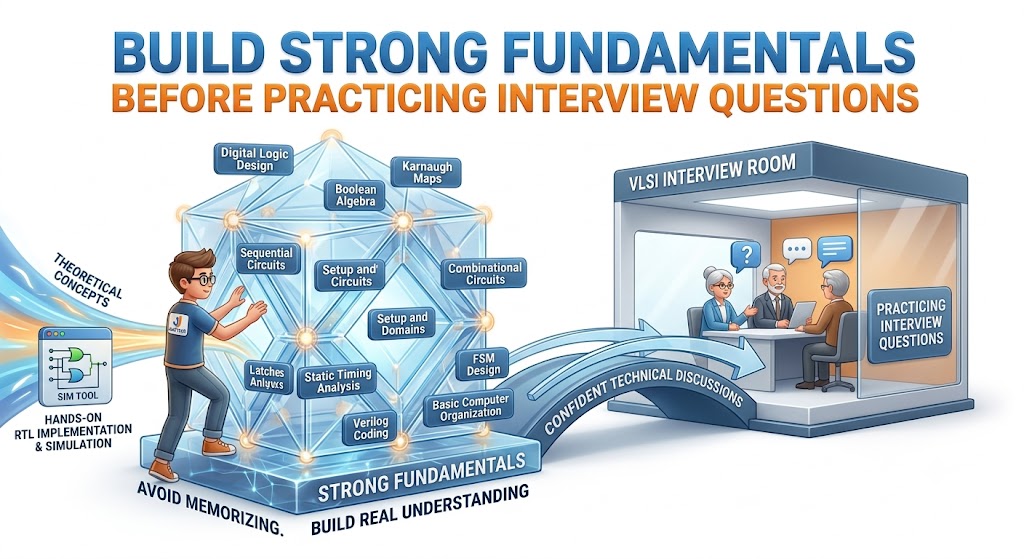
One of the biggest mistakes freshers make is collecting hundreds of interview questions without mastering the fundamentals. Interviewers quickly recognize candidates who have memorized answers without understanding the concepts.
Focus first on building confidence in core subjects:
Digital Logic Design
Boolean Algebra
Karnaugh Maps
Sequential Circuits
Combinational Circuits
Setup and Hold Time
Clock Domains
Flip-Flops
Latches
Static Timing Analysis
FSM Design
Verilog Coding
Basic Computer Organization
Instead of reading definitions, practice explaining every topic in your own words. If you can teach a concept clearly, you are much more likely to answer confidently during interviews.
Students preparing through JastTech are encouraged to combine theoretical concepts with hands-on RTL implementation and simulation exercises, making technical discussions much easier during interviews.
Prepare to Explain Your Projects Like an Engineer
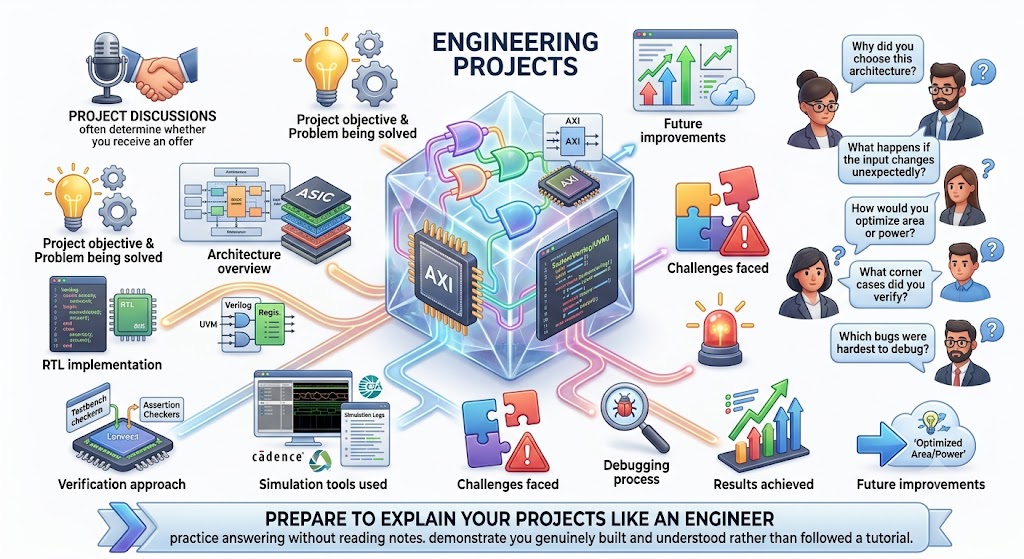
For freshers, project discussions often determine whether they receive an offer. Even a small project can impress interviewers if you explain it with clarity and confidence.
Your explanation should include:
Project objective
Problem being solved
Architecture overview
RTL implementation
Verification approach
Simulation tools used
Challenges faced
Debugging process
Results achieved
Future improvements
Interviewers may ask questions such as:
Why did you choose this architecture?
What happens if the input changes unexpectedly?
How would you optimize area or power?
What corner cases did you verify?
Which bugs were hardest to debug?
Practice answering these questions without reading notes. The goal is to demonstrate that you genuinely built and understood your project rather than simply following a tutorial.
Practice Technical Mock Interviews the Right Way
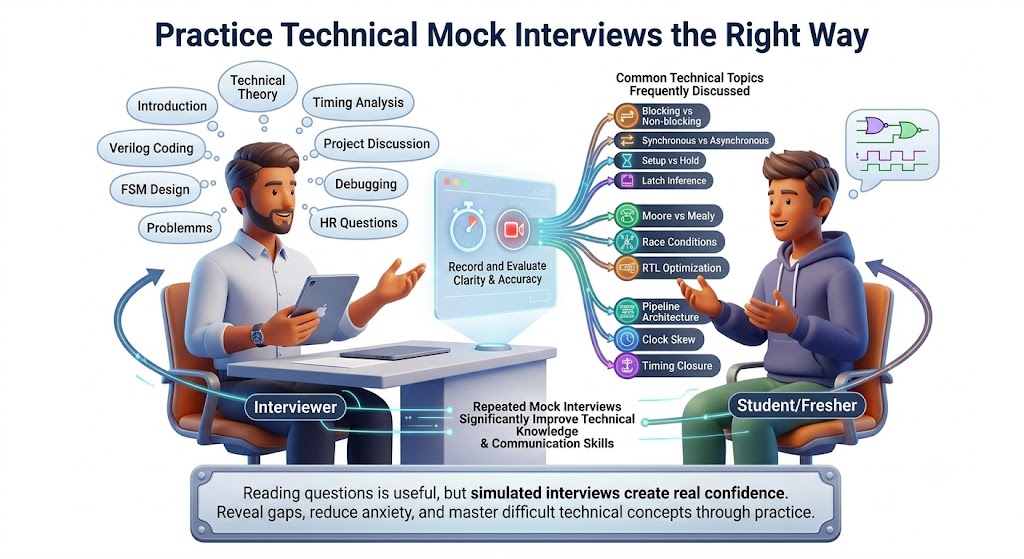
Reading interview questions is useful, but simulated interviews create real confidence. Mock interviews reveal knowledge gaps, improve communication, and reduce interview anxiety.
An effective mock interview should include:
Introduction and self-presentation
Technical theory questions
Verilog coding exercises
FSM design problems
Timing analysis questions
Project discussion
Debugging scenarios
HR questions
Feedback session
During practice, set a timer and answer verbally instead of silently reading answers. Record yourself if possible and evaluate your clarity, technical accuracy, and confidence.
Common technical topics frequently discussed include:
Blocking vs Non-blocking assignments
Setup vs Hold violations
Synchronous vs Asynchronous reset
Moore vs Mealy FSM
Latch inference
Race conditions
Pipeline architecture
Clock skew
Timing closure
RTL optimization
Repeated mock interviews significantly improve both technical knowledge and communication skills.
Prepare for HR and Behavioral Questions
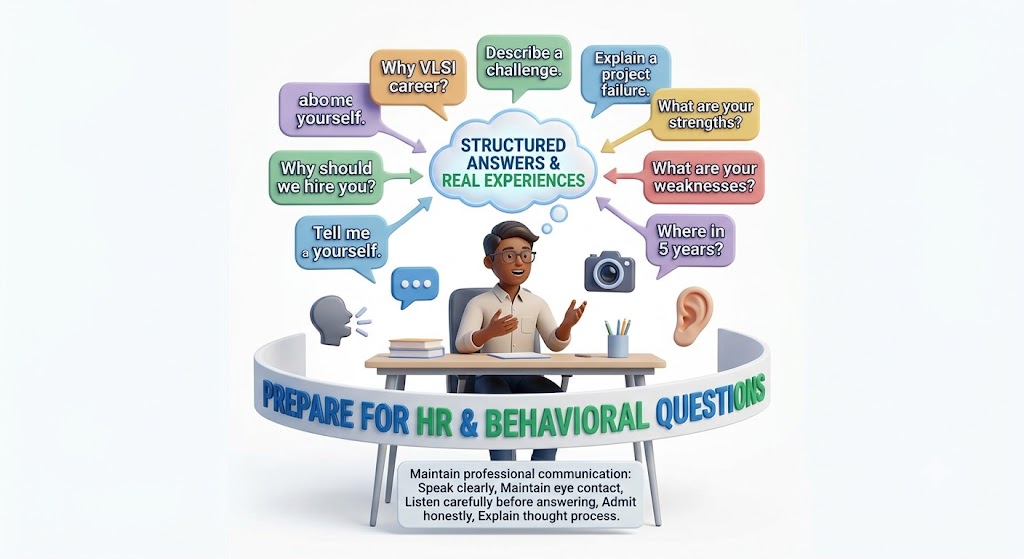
Many students assume HR interviews are easy, but strong technical candidates sometimes lose opportunities because they struggle with behavioral questions.
Prepare structured answers for questions like:
Tell me about yourself.
Why do you want a career in VLSI?
Why should we hire you?
Describe a challenge you faced.
Explain a project failure.
What are your strengths?
What are your weaknesses?
Where do you see yourself in five years?
When answering, use real experiences rather than generic statements. Recruiters appreciate honesty, problem-solving ability, and a willingness to learn.
Maintain professional communication by:
Speaking clearly
Maintaining eye contact
Listening carefully before answering
Admitting honestly when you don't know something
Explaining your thought process instead of guessing
Confidence built through repeated mock interviews often has a greater impact than memorizing perfect responses.
Create a 30-Day Mock Interview Preparation Plan
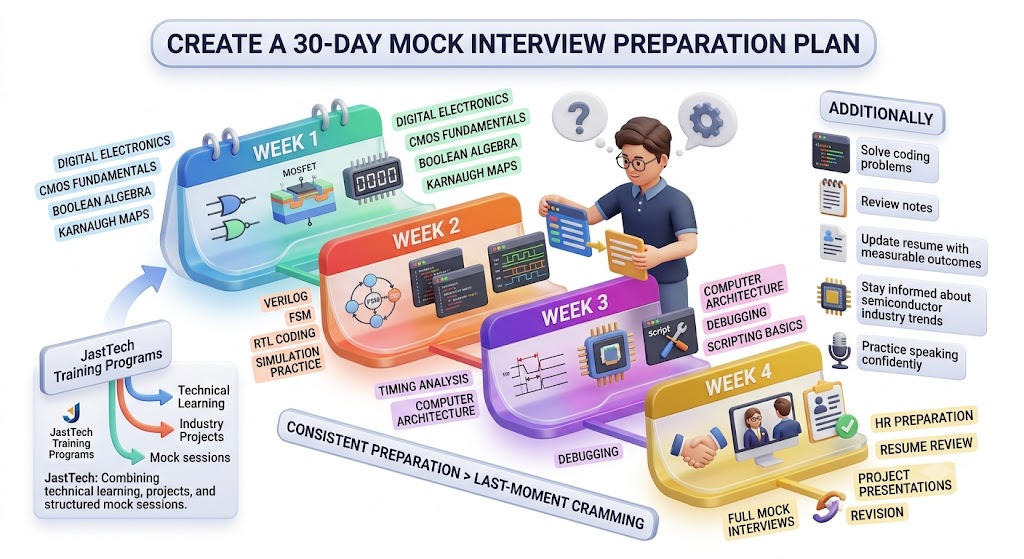
Consistent preparation is far more effective than studying everything at the last moment. A structured schedule helps cover technical concepts while leaving time for revision and practice.
A productive preparation plan should include:
Week 1: Digital Electronics, CMOS fundamentals, Boolean Algebra, Karnaugh Maps
Week 2: Verilog, FSM, RTL coding, simulation practice
Week 3: Timing analysis, Computer Architecture, debugging exercises, scripting basics
Week 4: Full mock interviews, HR preparation, resume review, project presentations, revision
Additionally:
Solve coding problems regularly.
Review your notes after every mock interview.
Update your resume with measurable project outcomes.
Stay informed about current semiconductor industry trends.
Practice speaking confidently without relying on memorized scripts.
Training programs offered by JastTech combine technical learning, industry-oriented projects, and structured mock interview sessions to help engineering students gain practical interview experience before facing actual recruiters.
Conclusion
Success in a VLSI interview depends on much more than technical knowledge. Recruiters evaluate your understanding of core concepts, project ownership, logical thinking, communication skills, and ability to solve engineering problems under pressure. Students who combine conceptual learning with regular mock interviews consistently perform better than those who rely only on interview question lists.
As semiconductor hiring continues to grow in 2026, engineering students and freshers should focus on building practical skills, strengthening RTL and verification fundamentals, and practicing realistic interview scenarios. With disciplined preparation and guidance from industry-focused training platforms like JastTech, candidates can approach interviews with confidence and significantly improve their chances of securing rewarding careers in the semiconductor industry.