

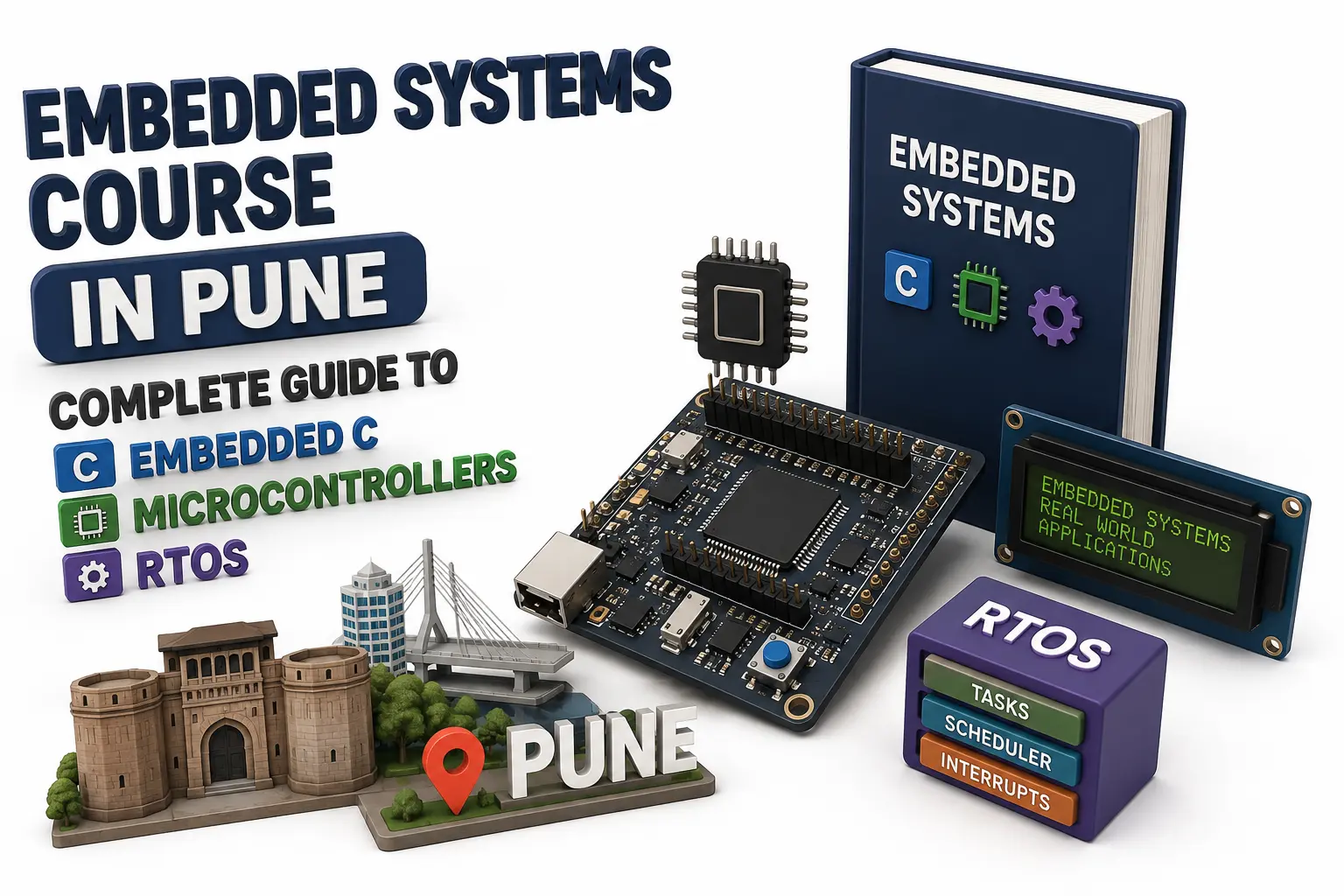
Embedded Systems Course in Pune Complete Guide to Embedded C Microcontrollers and RTOS
Navigate through this article using the table of contents below
Table of Contents
No headings found in this article.
Embedded systems are no longer limited to simple electronic controllers. Modern cars, industrial machines, medical devices, smart appliances and connected products increasingly depend on firmware engineers who can connect software with real hardware.
That makes embedded systems an attractive career for electronics and computer engineering graduates. But learning random technologies is not enough. The right progression from C programming and microcontrollers to RTOS, debugging and real projects can make a major difference.
Why Embedded Systems Is a Strong Career Choice in Pune
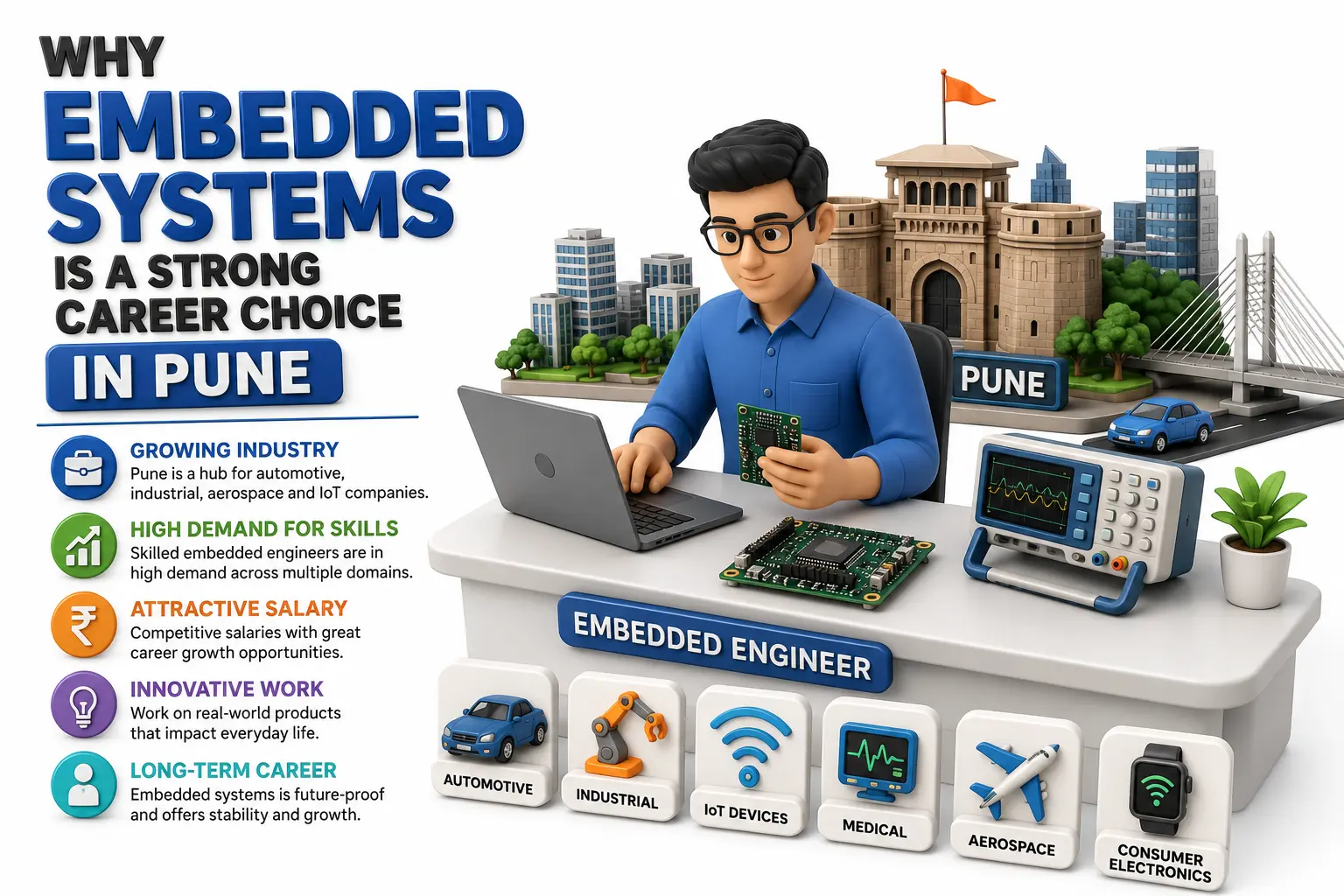
Pune has a significant engineering ecosystem spanning automotive, industrial automation, electronics, manufacturing, mobility and software-enabled hardware products. This creates opportunities for engineers interested in firmware, embedded software, validation and hardware-software integration.
An embedded engineer works much closer to the physical product than a conventional application developer. Code must interact with registers, peripherals, memory, interrupts, sensors and communication interfaces while meeting timing and resource constraints.
Typical entry-level roles include:
Embedded Software Engineer
Firmware Engineer
Embedded C Developer
Microcontroller Programmer
Junior Firmware Engineer
Embedded Test or Validation Engineer
For a fresher, the important point is that employers usually evaluate practical understanding rather than the number of technologies written on a resume. A candidate who can explain an interrupt, configure a UART, debug a memory issue and build a working microcontroller project can demonstrate considerably more value than someone who has only completed theoretical tutorials.
Master Embedded C Before Moving to Advanced Technologies
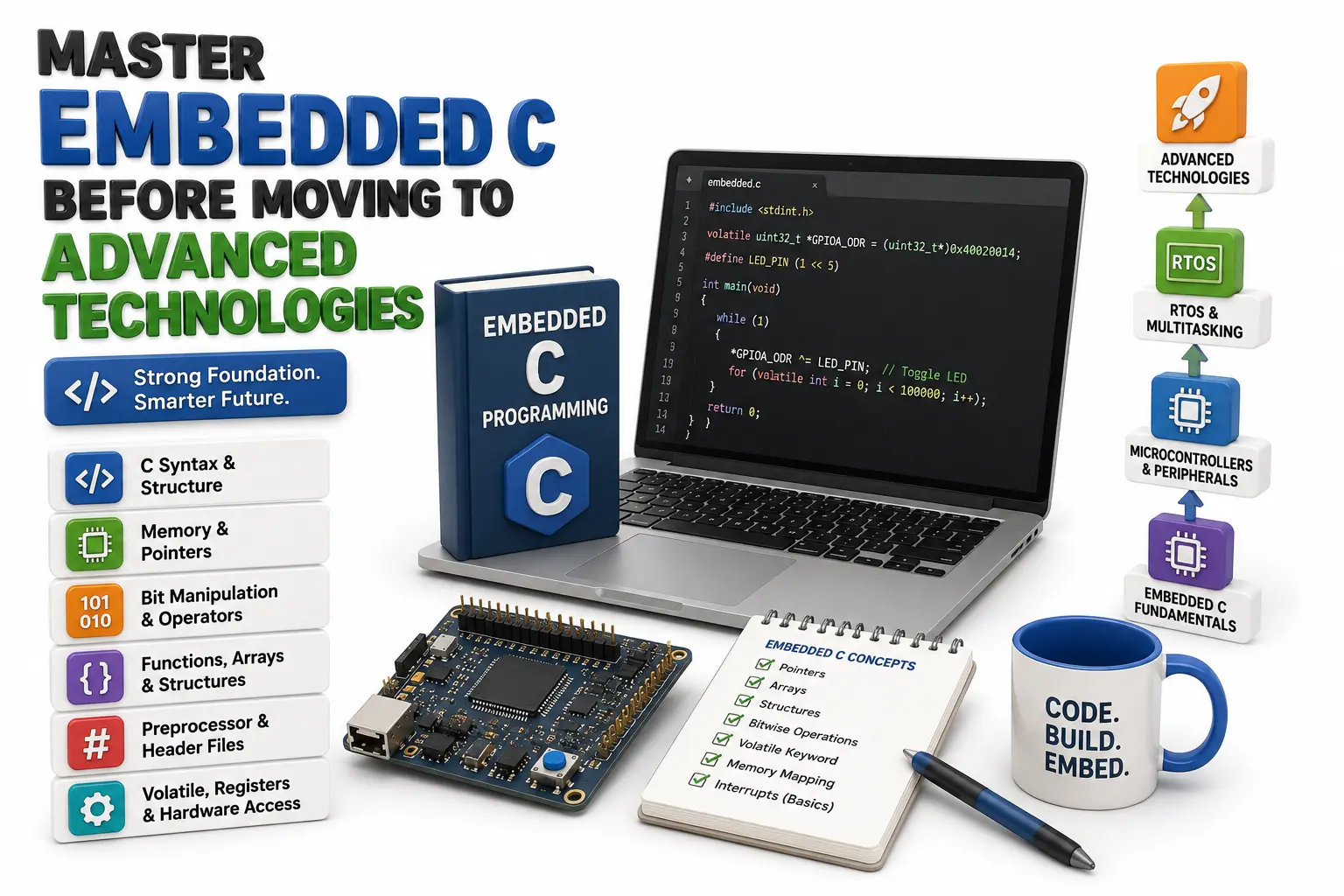
Embedded C is the foundation on which much firmware development is built. Learning ordinary C syntax is only the beginning; embedded development requires understanding how software interacts with limited memory and hardware resources.
A strong learning path should cover:
Pointers and pointer arithmetic
Structures, unions and enumerations
Bitwise operations and masking
Arrays and strings
Function pointers
Static and volatile variables
Memory allocation concepts
Stack and heap behavior
Preprocessor directives
Header files and modular programming
The volatile keyword, for example, becomes particularly important when working with hardware registers or variables modified by interrupts. Similarly, bit manipulation is essential when configuring individual peripheral registers.
JastTech can be positioned within this learning journey as a practical training environment where learners progress from programming fundamentals toward hardware-oriented development. The objective should not simply be completing an Embedded C syllabus but developing the ability to read, write and debug production-style firmware.
Build Practical Skills with Microcontrollers and Peripherals
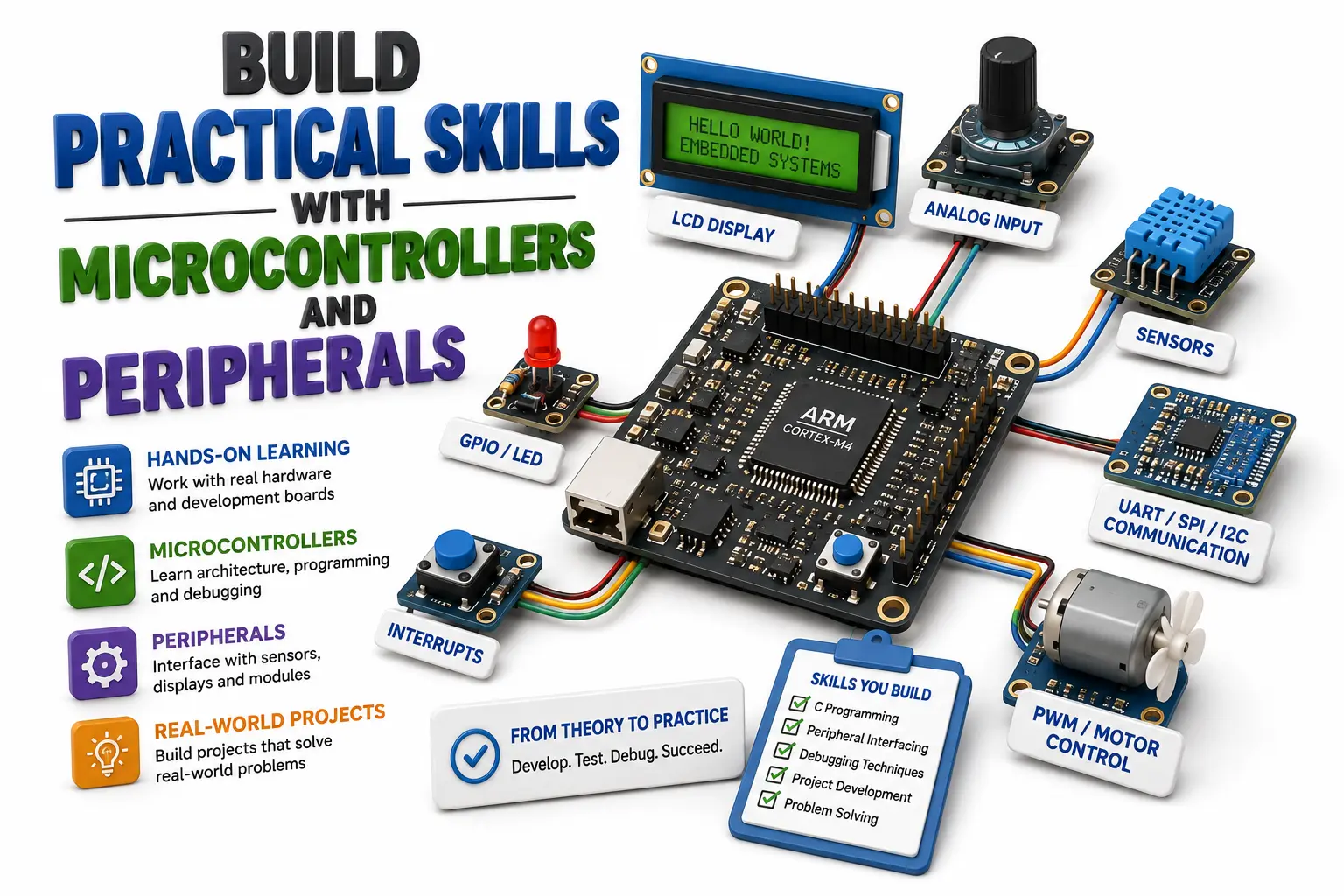
Microcontrollers provide the bridge between programming concepts and physical hardware. Instead of treating every controller as a separate technology, learners should first understand common architectural concepts and then apply them to a modern development platform such as an ARM Cortex-M device.
The most important concepts include:
GPIO configuration
Timers and counters
Interrupts and interrupt service routines
ADC and sensor interfaces
PWM generation
UART, SPI and I2C
Watchdog timers
Flash and RAM organization
Clock configuration
A practical project could begin with GPIO and LED control, progress to button interrupts, then add UART debugging and sensor communication. This sequence teaches how peripherals interact rather than forcing students to memorize register definitions.
When evaluating an embedded training program, ask whether students actually work with development boards and debugging tools. Reading about microcontrollers is fundamentally different from compiling firmware, flashing a target board, observing signals and diagnosing why the system does not behave as expected.
Learn RTOS After Understanding Bare-Metal Firmware
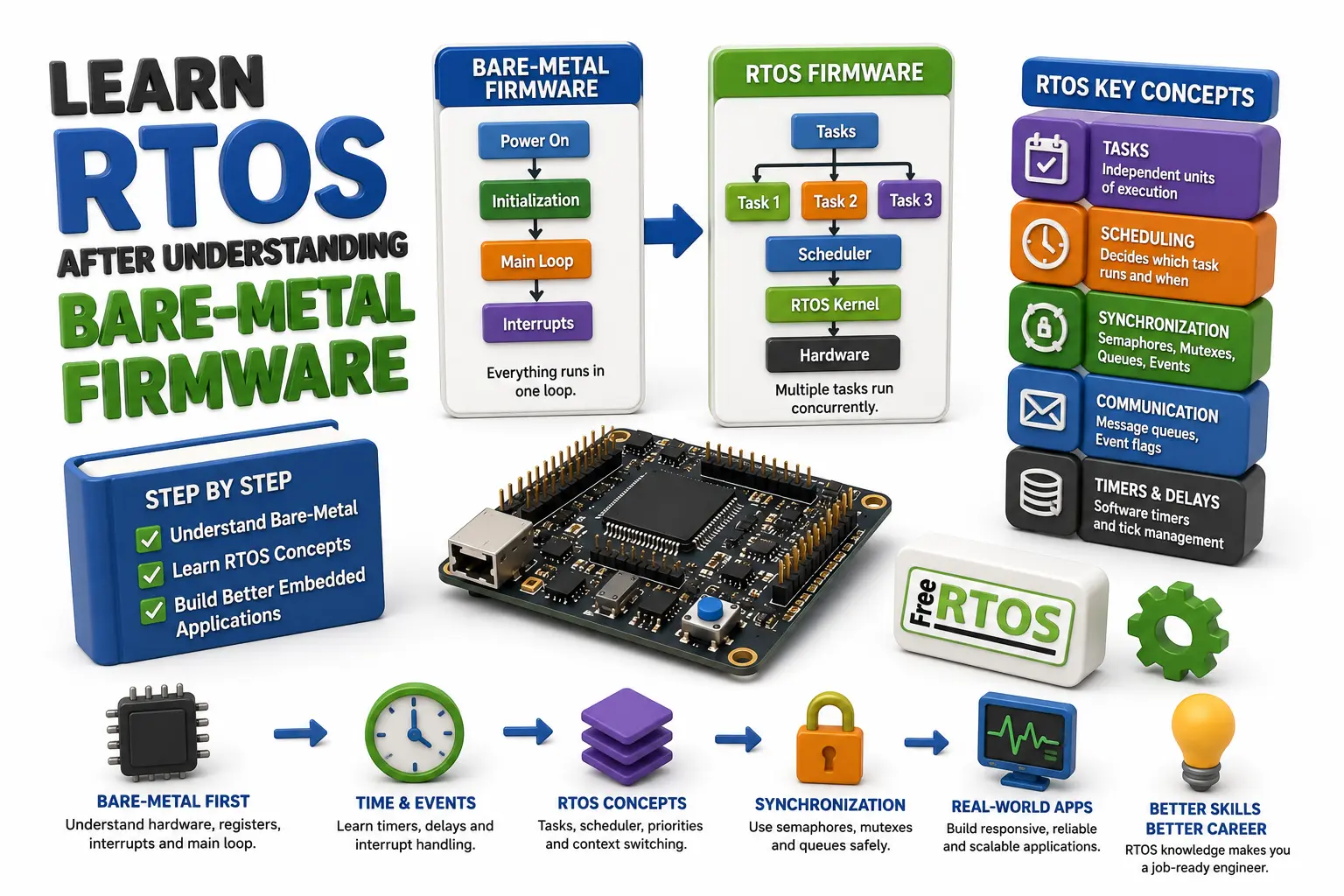
RTOS should come after learners understand how a bare-metal application executes. Without that foundation, concepts such as scheduling, tasks and synchronization can become memorization exercises.
An RTOS introduces a structured approach to applications that need multiple concurrent activities. Instead of putting everything inside one large loop, developers can divide functionality into tasks with different responsibilities and priorities.
Important concepts include:
Tasks and task states
Scheduling and priorities
Context switching
Semaphores
Mutexes
Queues
Event groups
Timers
Interrupt-to-task communication
Stack management
FreeRTOS is particularly useful for learning these principles because it exposes the fundamental mechanisms without hiding them behind an overly complex application framework.
A useful project might contain separate tasks for sensor acquisition, communication and data processing. Learners can then observe what happens when priorities change, shared resources are accessed incorrectly, or synchronization mechanisms are omitted. These experiments provide much deeper understanding than simply completing RTOS API exercises.
Choose Projects That Demonstrate Real Engineering Skills
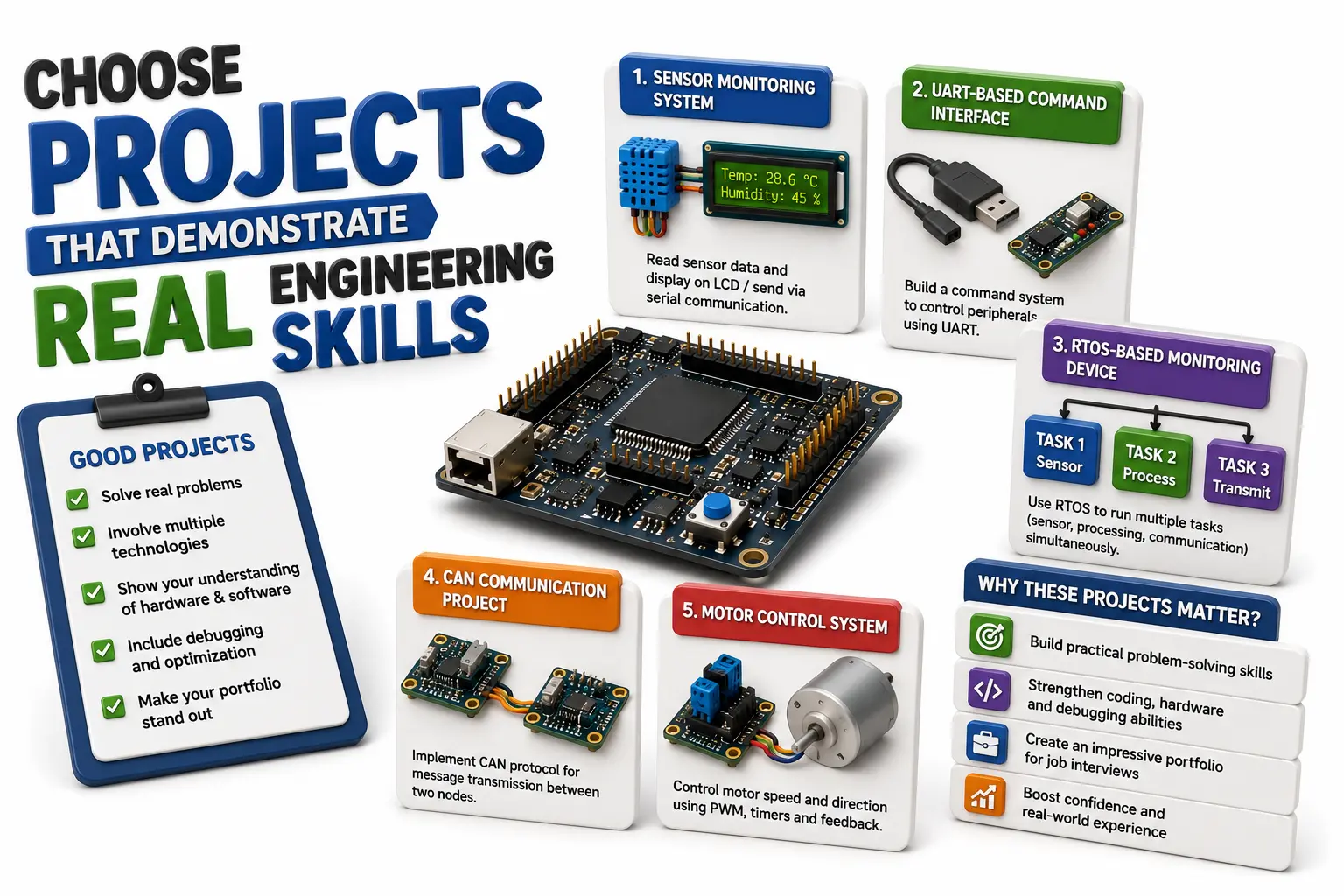
Projects are one of the strongest ways for a fresher to prove embedded knowledge. However, a project should demonstrate engineering decisions rather than simply combine several modules.
Good beginner-to-intermediate projects include:
Sensor Monitoring System: Read temperature or environmental data using ADC or a digital interface and transmit results through UART.
UART-Based Command Interface: Create a firmware command system that accepts commands and controls hardware peripherals.
RTOS-Based Monitoring Device: Separate sensor collection, processing and communication into independent tasks.
CAN Communication Project: Implement message transmission and reception between two microcontroller nodes.
Motor Control System: Use PWM, timers and feedback to control motor speed.
Each project should document the architecture, hardware, software modules, communication protocol and debugging process.
A strong portfolio should also explain problems encountered during development. For example, describing how an interrupt race condition was identified and fixed can demonstrate more technical maturity than simply stating that an RTOS project was completed.
Students researching embedded systems course in Pune for freshers should therefore compare programs based on laboratory access, project depth, debugging exposure and instructor support rather than choosing solely on course duration or certificate claims.
Turn Your Skills into an Embedded Career
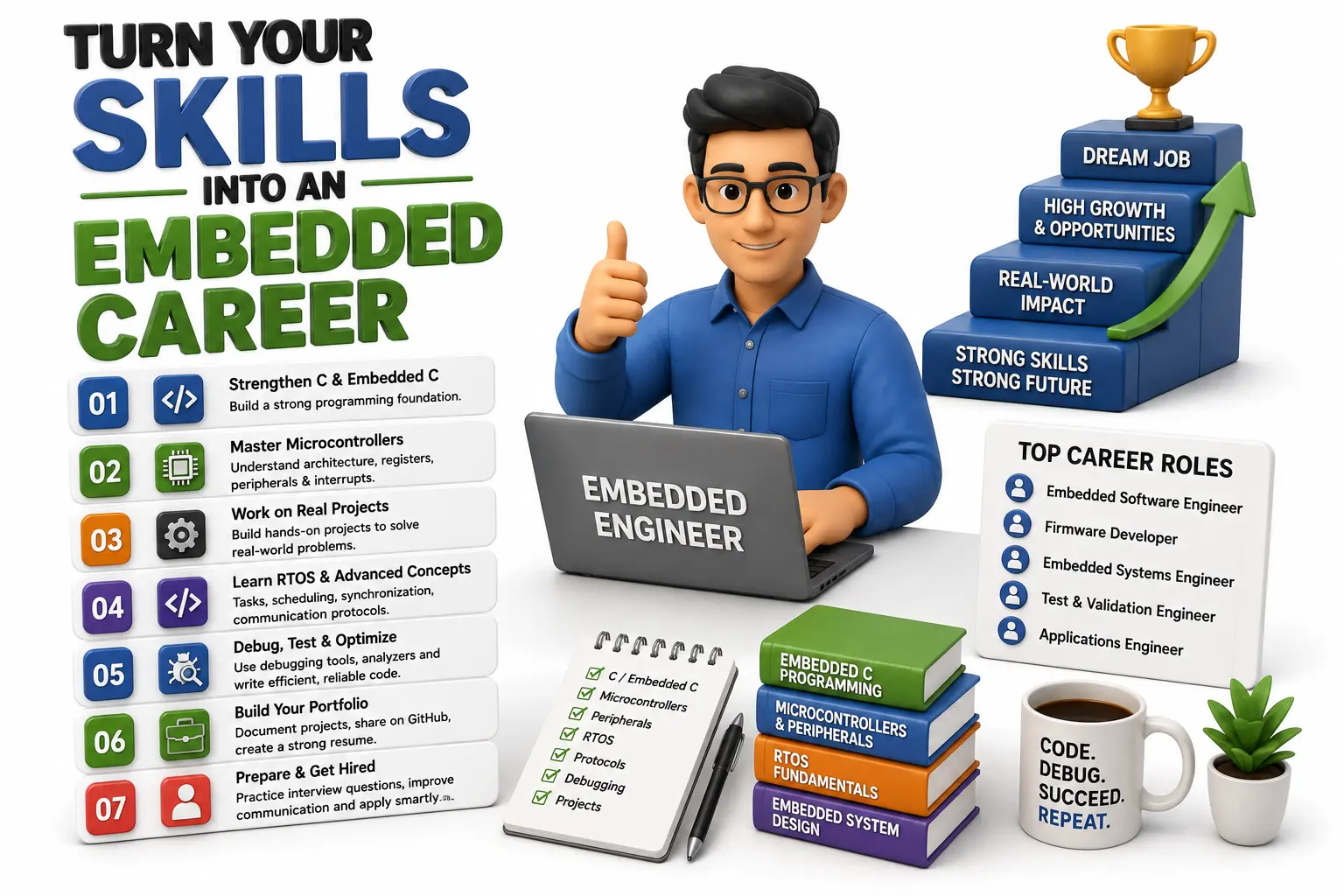
Learning embedded technology becomes valuable when it is converted into demonstrable employability. A fresher should build a progression that combines programming, hardware understanding, debugging and communication skills.
A practical preparation sequence is:
Strengthen C and Embedded C.
Learn one microcontroller architecture thoroughly.
Build peripheral-interfacing projects.
Practice UART, SPI, I2C and CAN fundamentals.
Learn Git and maintain organized project repositories.
Understand RTOS fundamentals.
Practice debugging with breakpoints, watch variables and hardware tools.
Prepare for C, microcontroller and operating-system interview questions.
Create a concise resume focused on measurable technical work.
Understanding Microcontrollers and embedded systems as connected disciplines is especially important. A firmware engineer does not work only with C code; the role requires understanding how software decisions affect memory, timing, peripherals and hardware behavior.
Salary expectations also depend on skills, experience, company, role and technology specialization. Instead of relying on one fixed number, candidates should treat compensation as a progression linked to technical capability. Searches for Embedded systems engineer salary in Pune should therefore be interpreted alongside job descriptions and experience requirements rather than as a guaranteed starting figure.
Conclusion
A successful embedded career is built progressively. Start with C, develop strong Embedded C fundamentals, understand microcontrollers and peripherals, practice hardware debugging, and then move into RTOS and more advanced firmware concepts. This sequence creates technical depth instead of superficial familiarity with many tools.
For anyone deciding how to learn embedded systems in Pune, the best approach is to select training that combines structured instruction with hardware practice, meaningful projects and interview preparation. The goal should be more than completing a course: it should be becoming capable of designing, debugging and explaining real embedded systems.