

From Code to Circuits Exploring Embedded Systems Careers in Pune
Navigate through this article using the table of contents below
Table of Contents
No headings found in this article.
The next big embedded opportunity may not begin with a job application—it may begin with a microcontroller, a few lines of C, and the ability to make hardware respond. Pune's engineering ecosystem is creating opportunities where software knowledge meets real-world electronics.
For students and freshers, the challenge is knowing what employers actually expect beyond classroom theory. The right combination of programming, electronics, debugging, communication protocols, projects, and domain knowledge can turn an ordinary resume into an engineering profile.
Why Pune Is Becoming an Embedded Engineering Destination
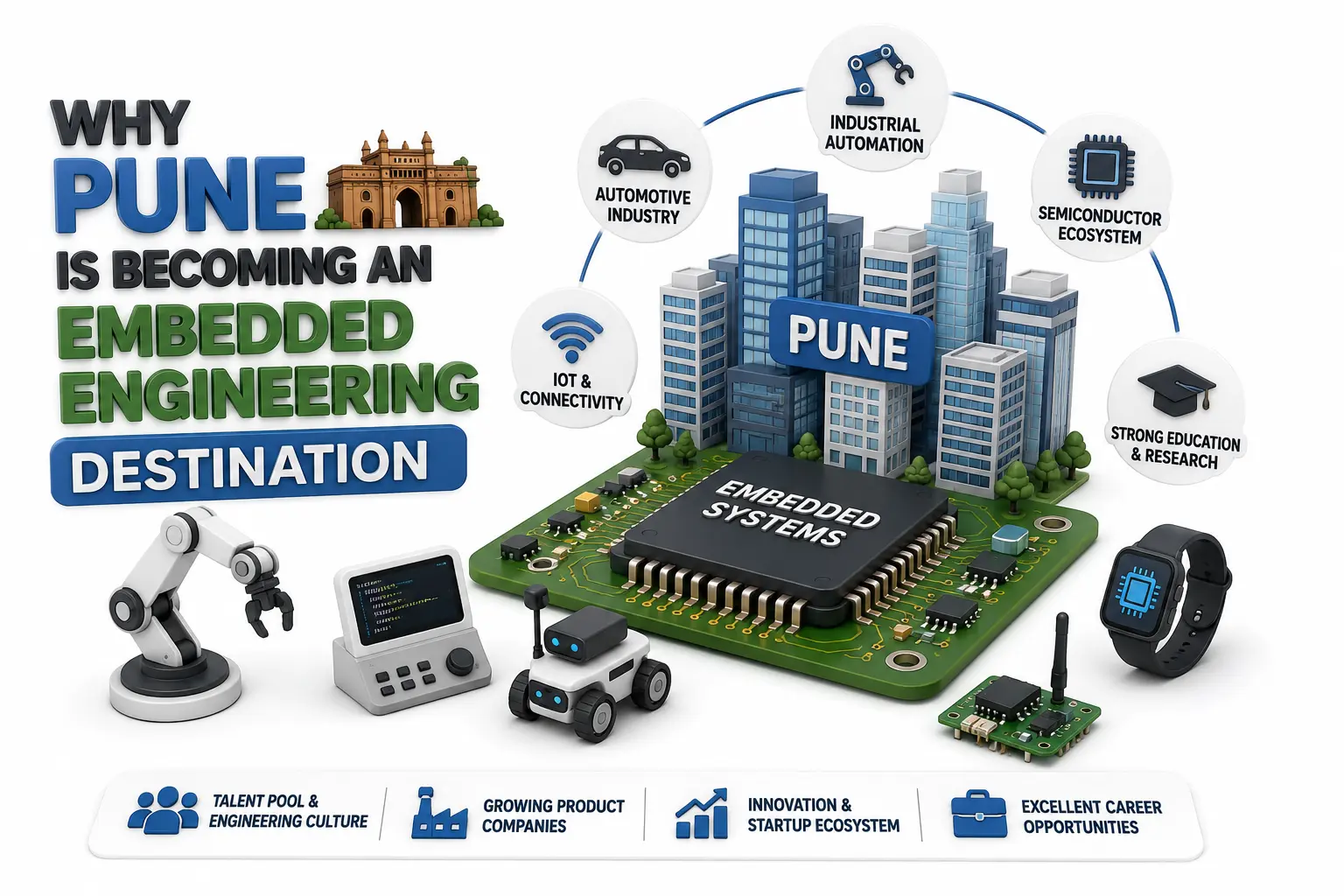
Pune has a distinctive advantage for embedded engineers because its technology ecosystem is closely connected to automotive engineering, industrial automation, manufacturing, mobility, electronics, and research. This creates demand for engineers who can work across the boundary between firmware and physical systems.
The city's automotive heritage is particularly important. Modern vehicles depend on electronic control units, sensors, communication networks, diagnostics, power-management systems, and real-time firmware. At the same time, industrial products increasingly require connected controllers, intelligent instrumentation, robotics, and edge computing.
Current job-market listings reflect this diversity, with embedded opportunities spanning automotive, semiconductor, robotics, hardware, and firmware-related roles.
For an aspiring engineer, that means Pune can support several career directions:
Embedded firmware development
Automotive embedded systems
Embedded Linux development
Hardware-software integration
IoT and connected-device engineering
Industrial automation
Embedded testing and validation
The Embedded Career Paths You Can Build
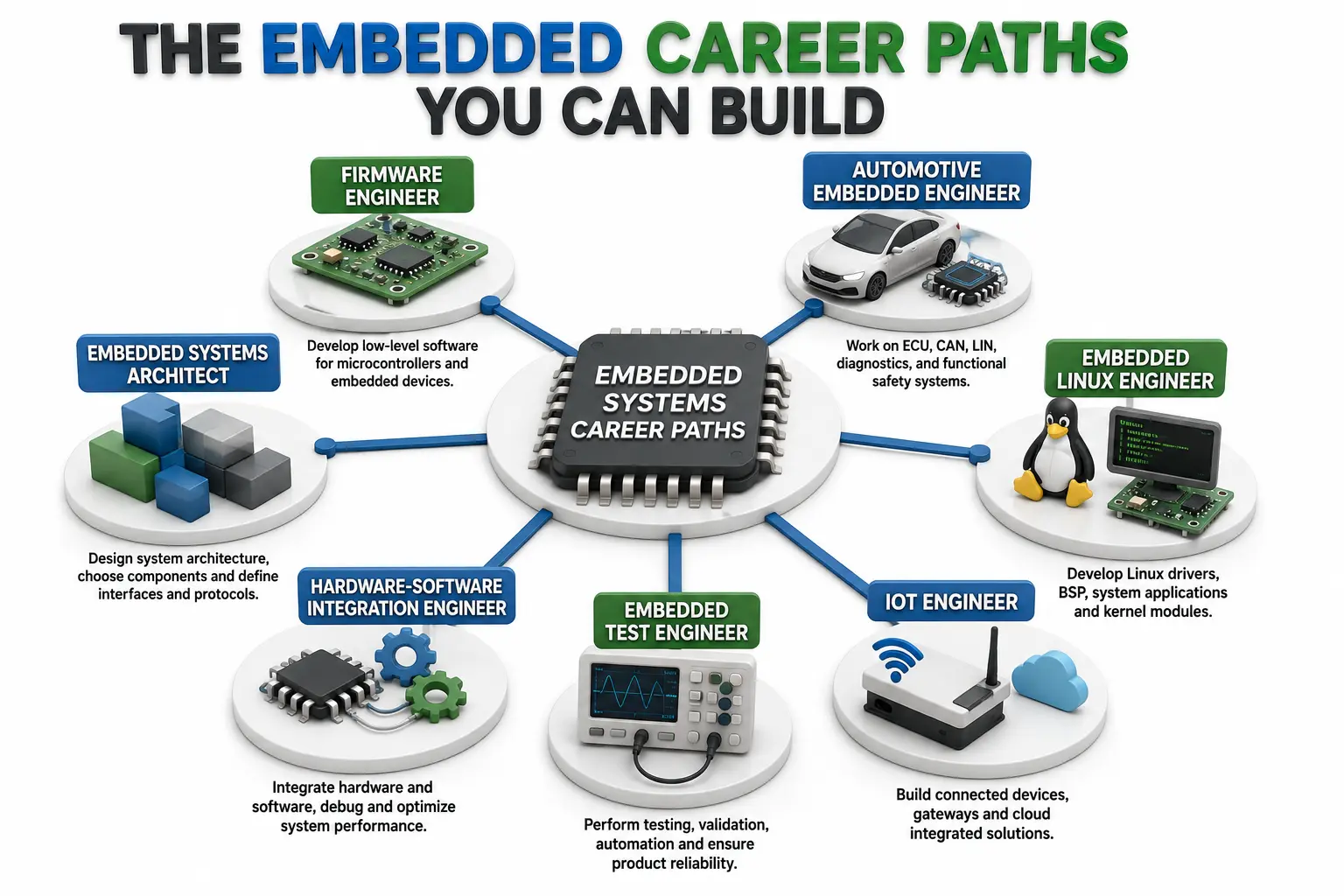
“Embedded engineer” is not a single job description. Two engineers may both work with microcontrollers while having completely different responsibilities.
A firmware engineer typically develops low-level software for microcontrollers, peripherals, sensors, communication interfaces, and control systems. A hardware-oriented embedded engineer may spend more time with schematics, board bring-up, signals, debugging instruments, and hardware integration.
Other paths become relevant as experience increases:
Automotive embedded engineer: ECU firmware, CAN/LIN, diagnostics, AUTOSAR concepts and functional-safety practices.
Embedded Linux engineer: Linux boot process, device drivers, kernel concepts, system programming and board-level integration.
IoT engineer: Sensors, connectivity, gateways, cloud communication and low-power design.
Embedded validation engineer: Test automation, hardware-in-loop testing, debugging and verification.
Embedded systems architect: System-level decisions involving hardware, firmware, interfaces, performance and reliability.
Understanding these differences helps candidates avoid learning technologies randomly. The objective should be to build a coherent skill stack around a target role.
Skills That Turn Coding Knowledge Into Engineering Ability
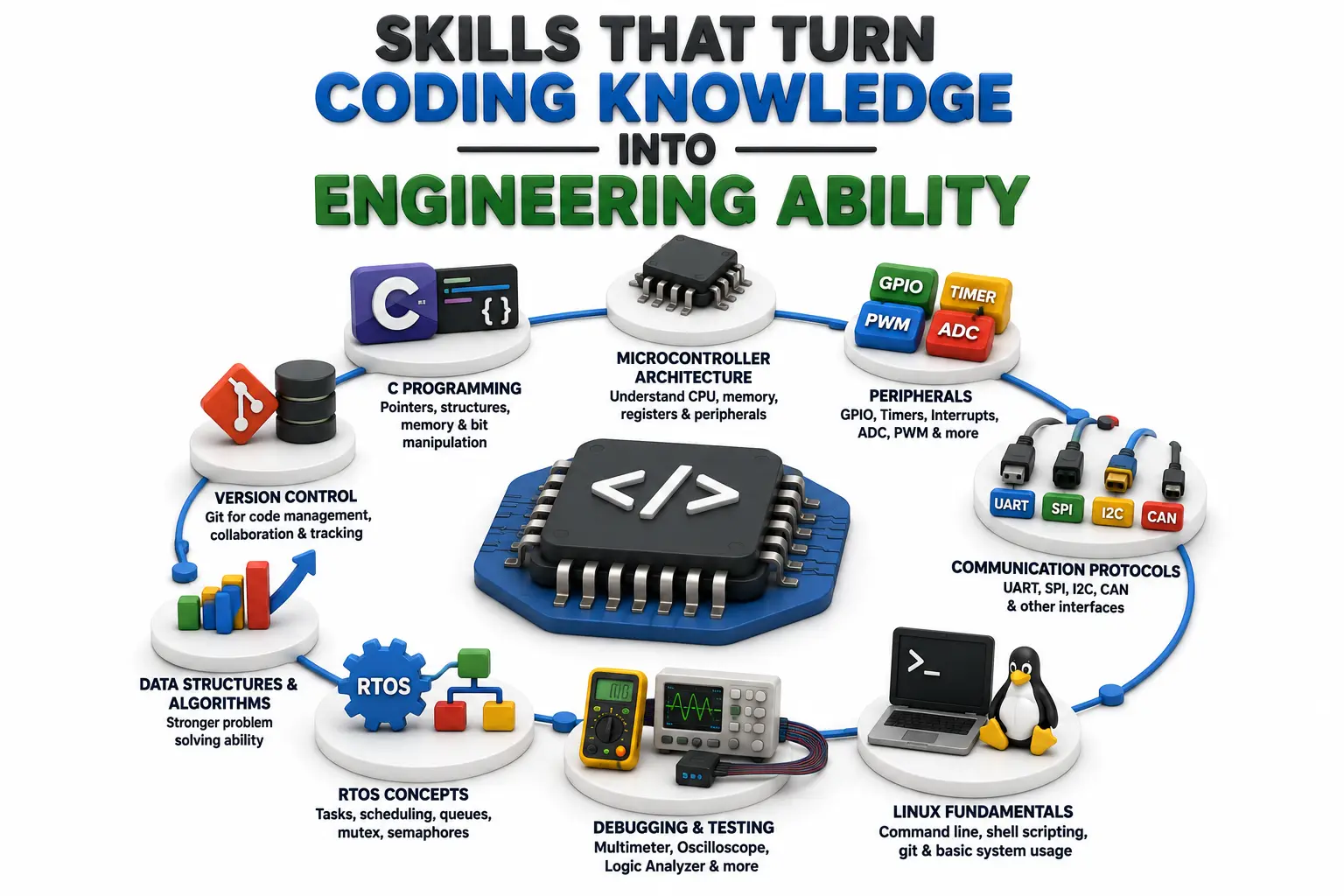
Knowing C syntax is only the starting point. Embedded development requires understanding how software interacts with memory, processors, peripherals and timing-sensitive hardware.
A strong foundation should include:
C programming, pointers, structures, bit manipulation and memory concepts
Data structures and algorithmic problem-solving
Microcontroller architecture and registers
GPIO, timers, interrupts, ADC and PWM
UART, SPI, I2C and CAN
Git and basic Linux command-line usage
Debugging with multimeters, oscilloscopes and logic analyzers
RTOS concepts such as tasks, scheduling, queues, mutexes and semaphores
For Pune candidates, Skills Required for Embedded Systems Jobs increasingly extend beyond programming. Current entry-level listings specifically mention microcontrollers, SBCs, communication protocols, sensors, Embedded C and laboratory debugging equipment.
This is where practical embedded systems training in Pune can become valuable when it provides hardware access, debugging practice and project implementation rather than only recorded theory.
Projects That Can Make a Fresher Job-Ready
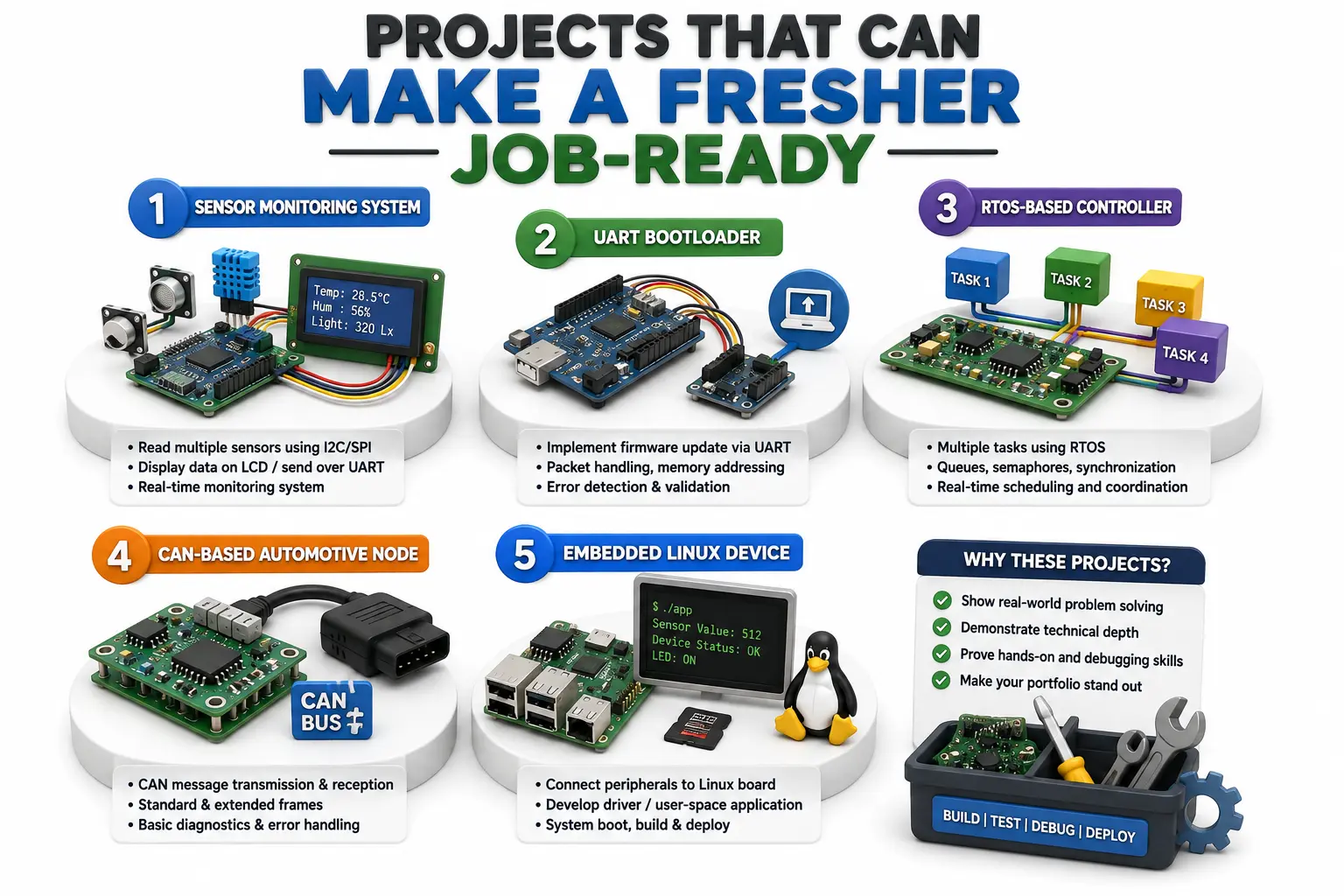
A project should demonstrate engineering decisions, not simply prove that an LED can blink. Recruiters should be able to see what you designed, how you tested it, and what problems you solved.
A progressive portfolio could contain:
Sensor monitoring system: Read multiple sensors through I2C or SPI and display or transmit the measurements.
UART bootloader: Demonstrate firmware updates, packet handling, memory addressing and error detection.
RTOS-based controller: Build multiple concurrent tasks using queues, synchronization and timing mechanisms.
CAN-based automotive node: Implement message transmission, reception and basic diagnostics.
Embedded Linux device: Connect a peripheral to a Linux-based board and develop a simple application or driver-level interface.
Document the architecture, hardware used, communication flow, debugging process and test results. A Git repository with readable code, schematics, photographs, test observations and a concise README can provide much stronger evidence than a resume containing only course certificates.
What the Future Holds for Embedded Engineers in Pune
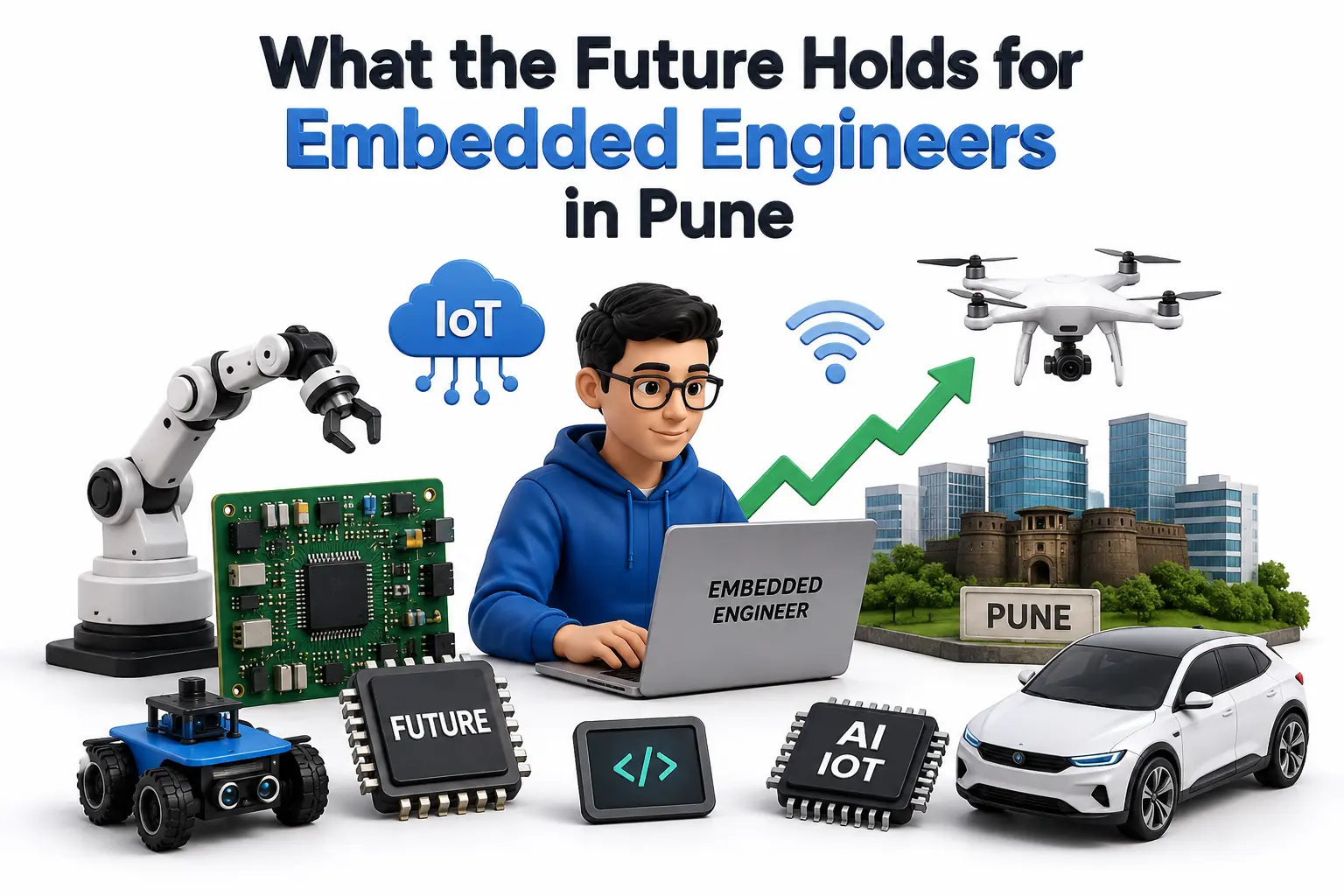
Embedded engineering is moving toward increasingly connected and intelligent products. Vehicles are becoming software-defined, industrial machines are becoming connected, and edge devices increasingly process data locally instead of depending entirely on cloud systems.
This evolution is expanding the technical scope of embedded careers. Engineers may increasingly encounter:
Edge AI and machine-learning inference
Connected and secure IoT devices
Automotive software platforms
Embedded Linux and heterogeneous processors
Wireless communication
Functional safety and cybersecurity
Hardware-in-the-loop testing
Energy-efficient and real-time computing
Pune is also strengthening practical embedded education. For example, an advanced embedded-systems laboratory launched at COEP Technological University emphasizes hardware-software integration and industry collaboration, with KPIT involvement in the initiative.
The implication is important: future engineers will need broader system-level understanding rather than isolated programming knowledge.
A Practical Roadmap From Student to Embedded Engineer
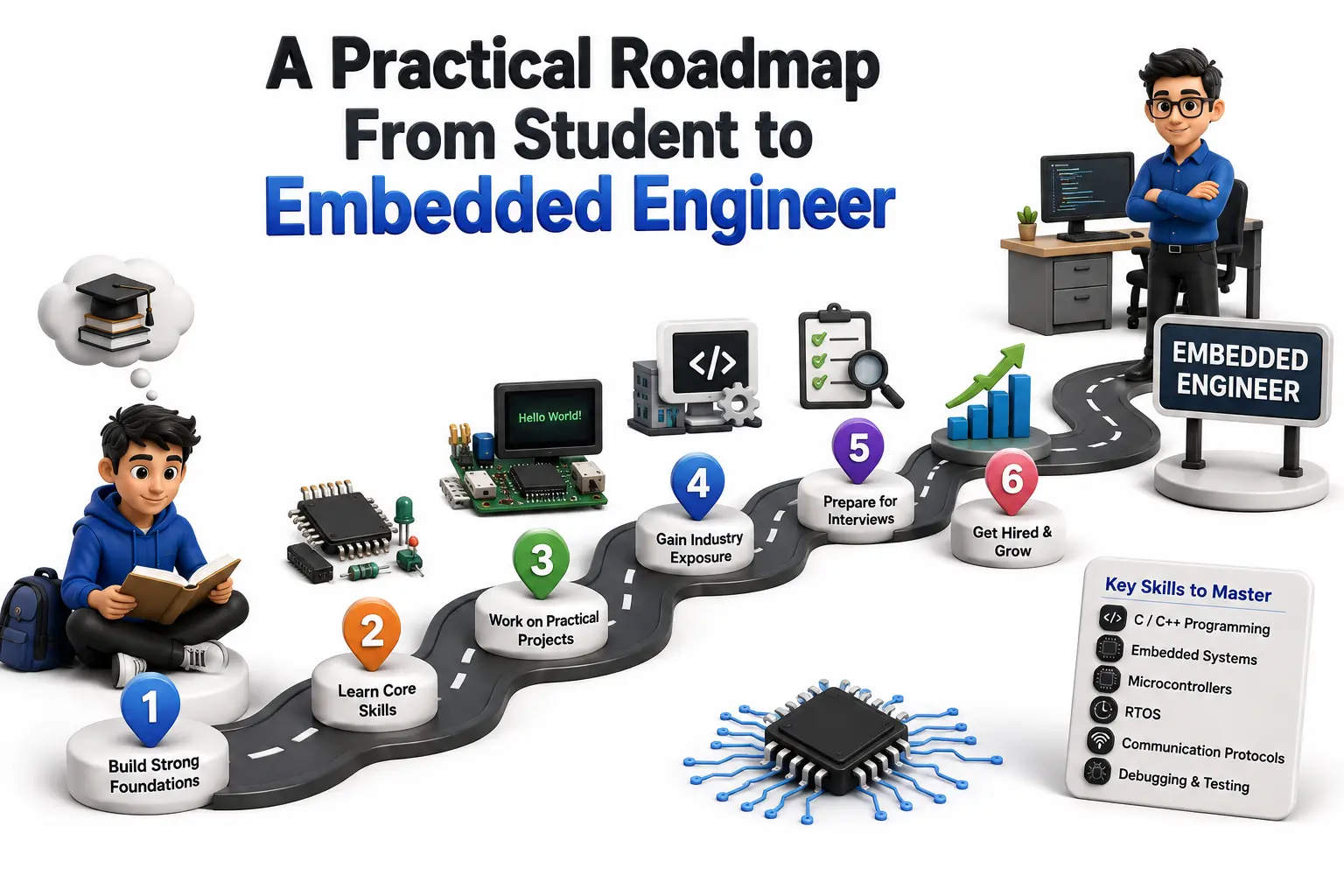
The most effective approach is to build capability in stages rather than trying to master every technology simultaneously.
Stage 1 — Build fundamentals: Strengthen C, digital electronics, microcontrollers, memory, pointers and basic data structures.
Stage 2 — Work with hardware: Learn GPIO, interrupts, timers, ADC, PWM and peripheral communication. Use a development board regularly rather than relying entirely on simulators.
Stage 3 — Learn production concepts: Move into RTOS, Git, debugging, bootloaders, device drivers, Embedded Linux or automotive protocols depending on your target role.
Stage 4 — Build two or three serious projects: Choose projects that demonstrate increasing technical complexity. Measure performance, document bugs and explain design decisions.
Stage 5 — Prepare for interviews: Be ready to explain pointers, volatile, interrupts, memory allocation, race conditions, protocols, RTOS scheduling and debugging scenarios.
Stage 6 — Target Pune's ecosystem strategically: Search across automotive, industrial automation, semiconductor, electronics, robotics and product-development companies instead of restricting yourself to job titles containing only “Embedded Engineer.”
JastTech can complement this journey by helping learners organize technical learning around practical, career-oriented development rather than treating embedded systems as purely academic coursework.
The Embedded systems industry in Pune offers a particularly useful environment for engineers who enjoy seeing their code interact with physical products. But location alone does not create a career; demonstrable engineering ability does.
Conclusion
The strongest embedded engineers are not simply programmers and not simply electronics engineers. They understand the interface between software and hardware—how a line of C code affects a register, how a peripheral communicates, why a signal fails, and how to debug the complete system.
For students and freshers targeting Pune, the winning strategy is therefore practical: build strong fundamentals, choose a career specialization, work with real hardware, create technically credible projects, and learn to explain your engineering decisions clearly. From code to circuits, that combination can turn embedded systems from a subject you studied into a career you can build.