


GCP Data Engineer Training Complete Guide in 2026
Navigate through this article using the table of contents below
Table of Contents
No headings found in this article.
Cloud technology is booming in India, and GCP Data Engineer Training in India is your gateway to a high-paying tech career. Companies across Bengaluru, Hyderabad, and Pune are actively hiring certified GCP professionals in 2026.
This complete guide on GCP Data Engineer Training in India covers top courses, syllabus, fees, salary, and certification tips. Whether you are a fresher or experienced professional, this guide helps you start strong.
What is GCP Data Engineer Training and Why It Matters in India Professional
GCP Data Engineer Training in India teaches professionals how to build, manage, and optimize data pipelines using Google Cloud Platform tools like BigQuery, Dataflow, and Pub/Sub. This training covers real-world data processing, storage, and analytics skills. It is designed for IT professionals, freshers, and developers who want to master cloud-based data engineering and build a strong career in India's fast-growing tech industry.
India is rapidly becoming a global cloud hub, making GCP Data Engineer Training in India more valuable than ever in 2026. Top companies like TCS, Infosys, Google, and hundreds of startups are hiring certified GCP Data Engineers at competitive salaries. With digital transformation accelerating across banking, e-commerce, and healthcare sectors, professionals trained in GCP data engineering enjoy strong job security, faster promotions, and excellent growth opportunities across major Indian cities.
Top Skills You Will Learn in GCP Data Engineer Training
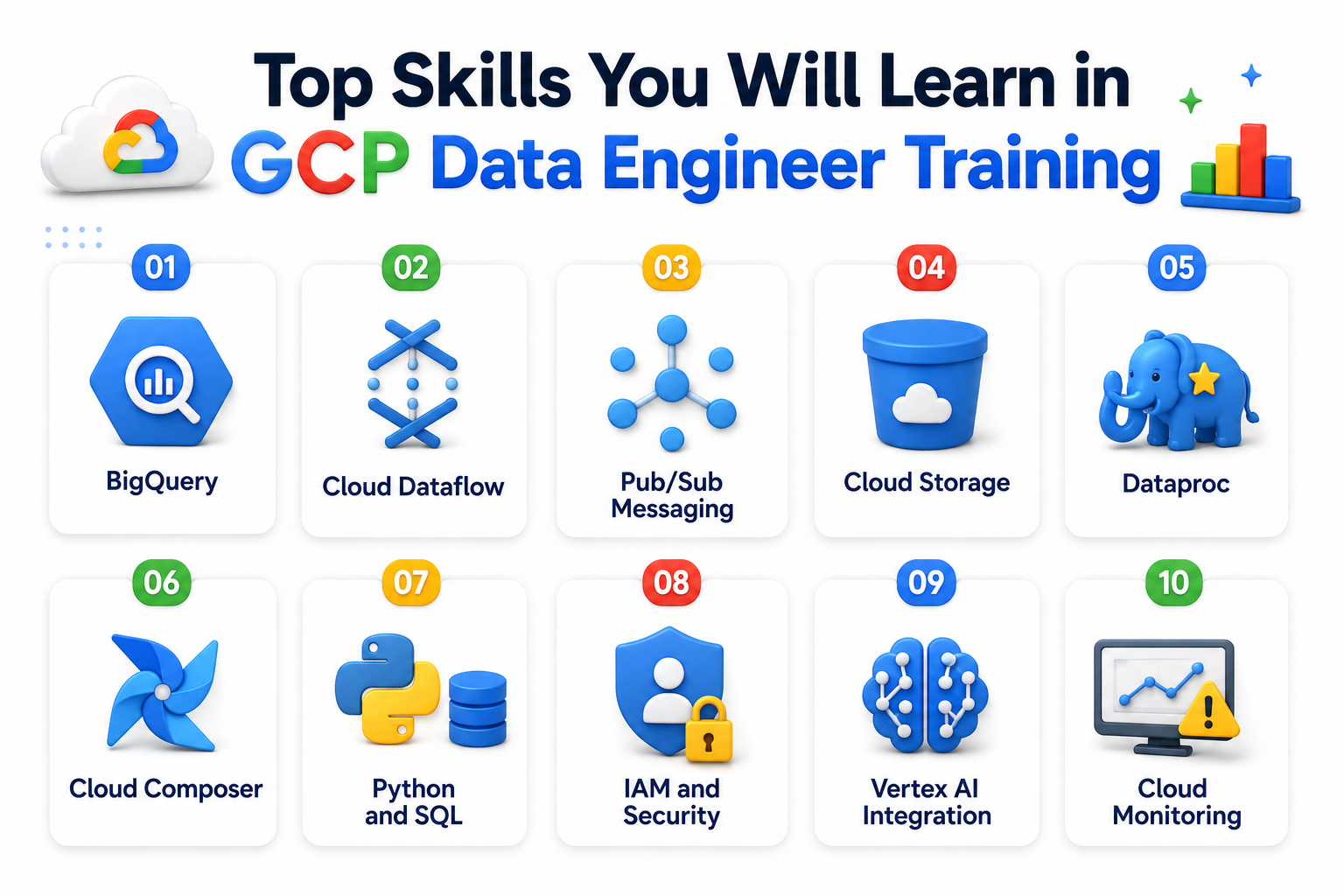
Google Cloud Platform offers a rich ecosystem of tools built specifically for data engineering work. During your training, you will gain hands-on experience with services that power real-world data pipelines used by some of the largest companies globally. The curriculum is designed to take you from understanding cloud fundamentals all the way to building production-grade data solutions confidently.
Here are the key skills you will gain during the training:
BigQuery — Build and query large-scale data warehouses for fast and efficient analytics
Cloud Dataflow — Develop batch and real-time data pipelines using Apache Beam framework
Pub/Sub Messaging — Handle event-driven architecture and real-time data streaming workflows
Cloud Storage — Store and manage structured and unstructured data at scale securely
Dataproc — Run Apache Spark and Hadoop workloads on a fully managed cloud environment
Cloud Composer — Automate and schedule workflows using Apache Airflow on Google Cloud
Python and SQL — Write pipeline logic and run powerful analytical queries on cloud data
IAM and Security — Apply access control, encryption, and compliance policies across GCP services
Vertex AI Integration — Connect data pipelines with machine learning models for intelligent workflows
Cloud Monitoring — Track pipeline performance, set alerts, and optimize resource usage efficiently
Read more :- GCP Data Engineer Training Everything You Need to Know Before You Begin
Best Institutes Offering GCP Data Engineer Training in India 2026
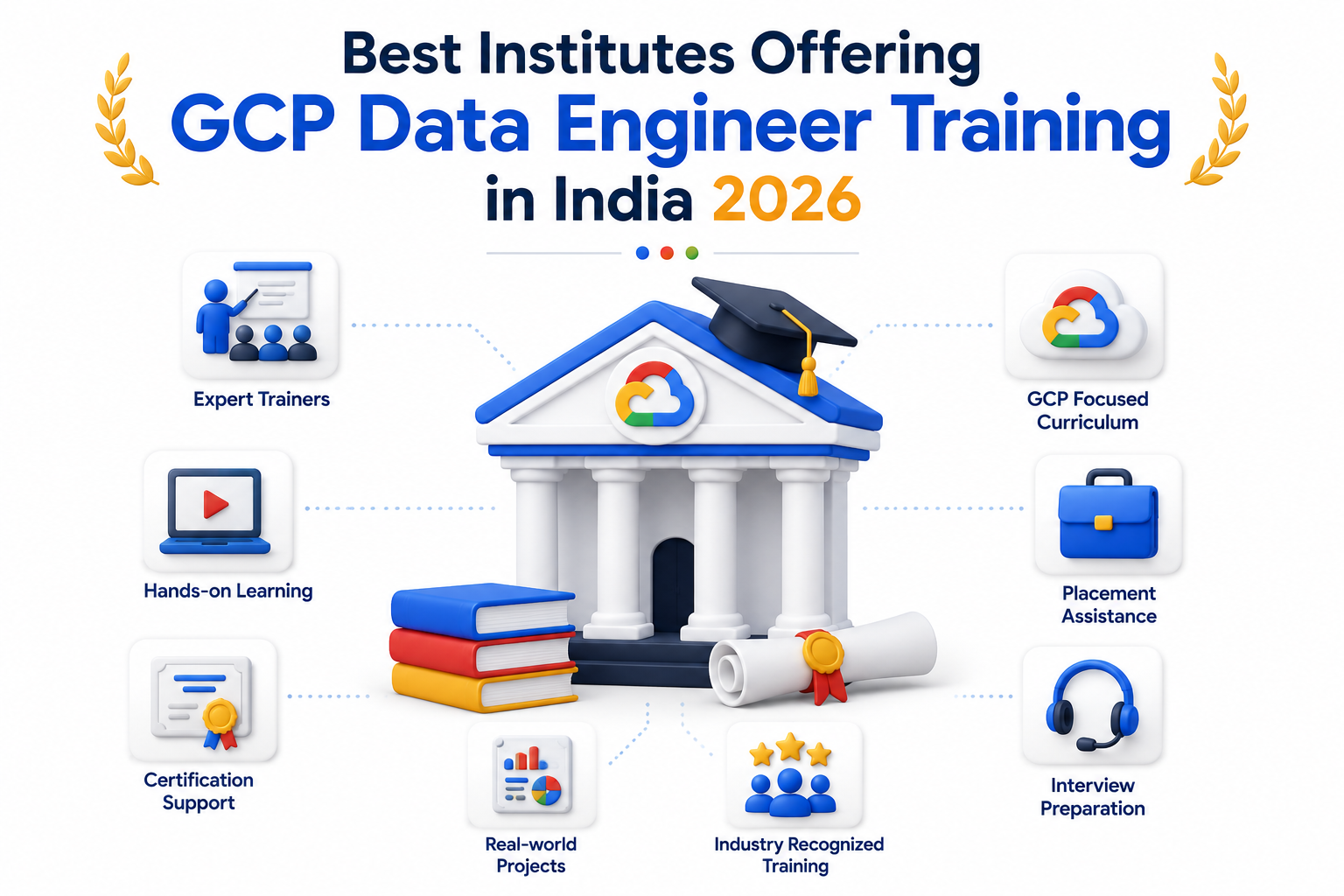
Choosing the right institute for GCP Data Engineer Training is crucial. A good institute offers structured curriculum, expert trainers, hands-on labs, and strong placement support to help you become job-ready and confident.
JastTech is a trusted name for GCP Data Engineer Training in Hyderabad , Bangalore , pune , Chennai and other tech cities of India. With experienced trainers, real project exposure, flexible batch timings, and dedicated placement support, JastTech helps every student achieve their cloud career goals successfully.
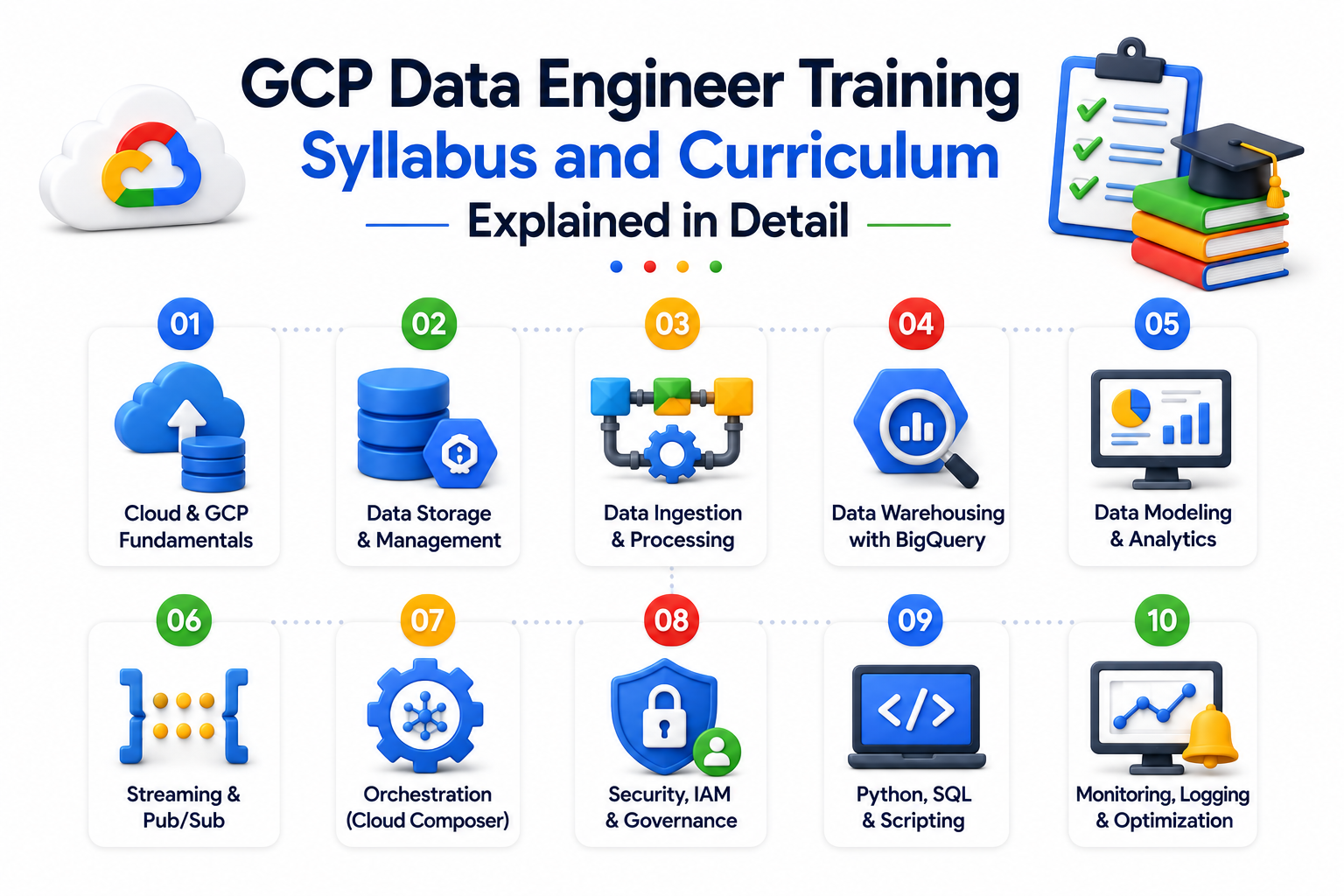
GCP Data Engineer Training Syllabus and Curriculum Explained in Detail
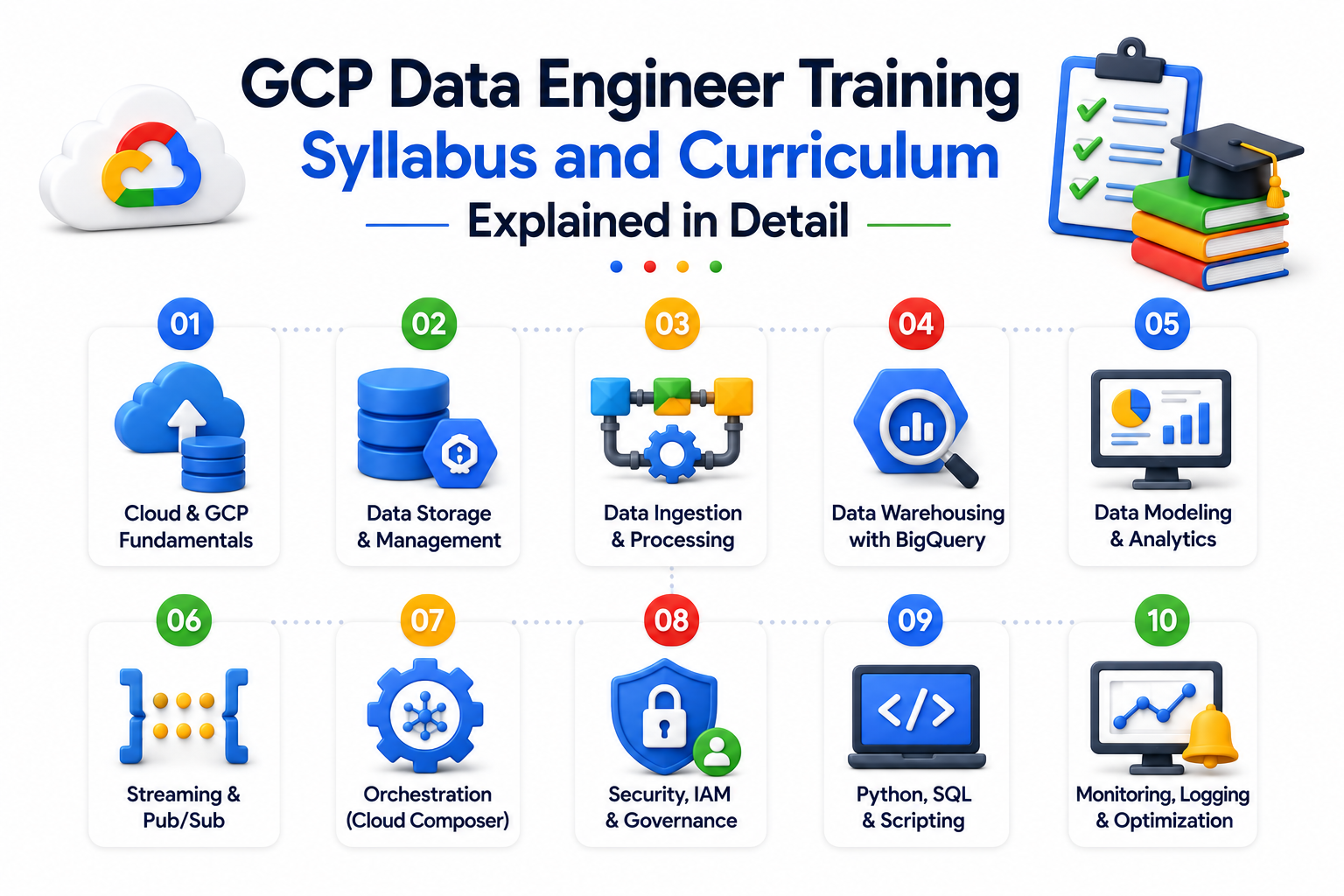
JastTech GCP Data Engineer Training is built on a comprehensive 16-module curriculum that starts from Big Data fundamentals and takes you all the way to certification preparation. Every module is packed with practical sessions, ensuring you do not just understand the concepts but can actually apply them in real working environments.
What makes this curriculum stand out is its strong emphasis on hands-on learning. From writing SQL commands and Linux basics in the early modules to building real-time streaming pipelines and end-to-end data projects in advanced modules, every step is designed to mirror what data engineers actually do on the job.
Here is the complete module breakdown:
Module 1: Introduction to Big Data
Types of Data — Structured, Semi-structured and Unstructured
Distributed Processing concepts
Introduction to Hadoop, its Architecture and Ecosystem
Module 2: Linux and Database Basics
Linux Introduction and Commands (Practical)
RDBMS Basics (Practical)
SQL Commands (Practical)
Module 3: Data Warehouse and Engineering Concepts
OLTP vs OLAP
Data Warehouse fundamentals
SQL vs NoSQL and ETL vs ELT
Hive, Internal and External Tables
File Formats — CSV, JSON, Avro, Parquet, ORC
Table Partitioning, Bucketing and Data Engineering Lifecycle
Module 4: GCP Introduction
Overview of Cloud Computing and Google Cloud Platform
GCP Data Engineering Services
GCP Resource Hierarchy — Org, Folder, Project
IAM Fundamentals
Create GCP Account (Practical)
Module 5: Cloud Storage and Data Lake Design
Cloud Storage Overview — Buckets, Objects, Storage Classes (Practical)
GSUtils Installation and Gcloud Commands (Practical)
Object Lifecycle Management, Versioning and Soft Delete (Practical)
GCS with Data Lake Architecture (Practical)
Module 6: BigQuery — Data Warehouse
BigQuery Architecture, Datasets and Tables (Practical)
Standard SQL and Loading Data into BigQuery (Practical)
Partitioning, Clustering, Query Optimization and Cost Control (Practical)
Metadata and Complex SQLs
Module 7: BigQuery Advanced Features
Views, Materialized Views, Clone Table and Snapshots (Practical)
Time Travel and Public Datasets (Practical)
Nested Complex Data and Sharded vs Partitioned Tables (Practical)
Data Sharing
Module 8: Workflow Orchestration
Workflow Automation Concepts
Apache Airflow Architecture and Cloud Composer
DAGs, Airflow Operators, DAG Dependency and Scheduling
Module 9: Cloud Composer Practicals
Create Composer Environment (Practical)
Build DAGs for Full Load, Delta Load, CDC and Report Exports (Practical)
Module 10: Dataproc and Spark
Spark vs Hadoop and Spark Architecture
RDD, DataFrames, Transformations and Actions
Narrow vs Wide Transformation, Shared Variables, Spark Submit
Module 11: Batch Data Processing
Dataproc Cluster Management and Job Submission
Running Spark Jobs — Read from GCS, Transform and Write to BigQuery (Practical)
Performance Tuning — Repartitioning and Coalesce
Module 12: Cloud Dataflow — Stream Data Processing
Apache Beam and Dataflow fundamentals
Kafka and Pub/Sub Messaging (Practical)
Real-time Data Ingestion, Bigtable and Cloud Functions (Practical)
Streaming Pipelines with Dataflow (Practical)
Module 13: Data Governance and Metadata Management
Data Governance Concepts
Data Catalog, Dataplex
Data Lineage and Quality
Module 14: Monitoring, Logging and Troubleshooting
Cloud Monitoring and Logging
Pipeline Monitoring, Error Analysis and Alerting Mechanism
Module 15: Real-World Use Cases and Projects
End-to-End Data Pipeline Project
Batch and Streaming Architecture
Module 16: Certification Preparation
Google Professional Data Engineer Exam Overview
Sample Questions, Exam Tips and Strategies
GCP Professional Data Engineer Certification
The Google Professional Data Engineer exam is the gold standard for validating your GCP data engineering skills.
Exam Details (2026)
Exam Format: Multiple choice and multiple select
Duration: 2 hours
Registration Fee: ~$200 USD (approximately ₹16,000–₹17,000)
Validity: 2 years (recertification required)
Language: English
Mode: Online proctored or at a test center
Key Exam Topics
Designing data processing systems
Building and operationalizing data pipelines
Ensuring solution quality
Operationalizing machine learning models
Monitoring and optimizing data solutions
GCP Data Engineer Salary in India (2026)
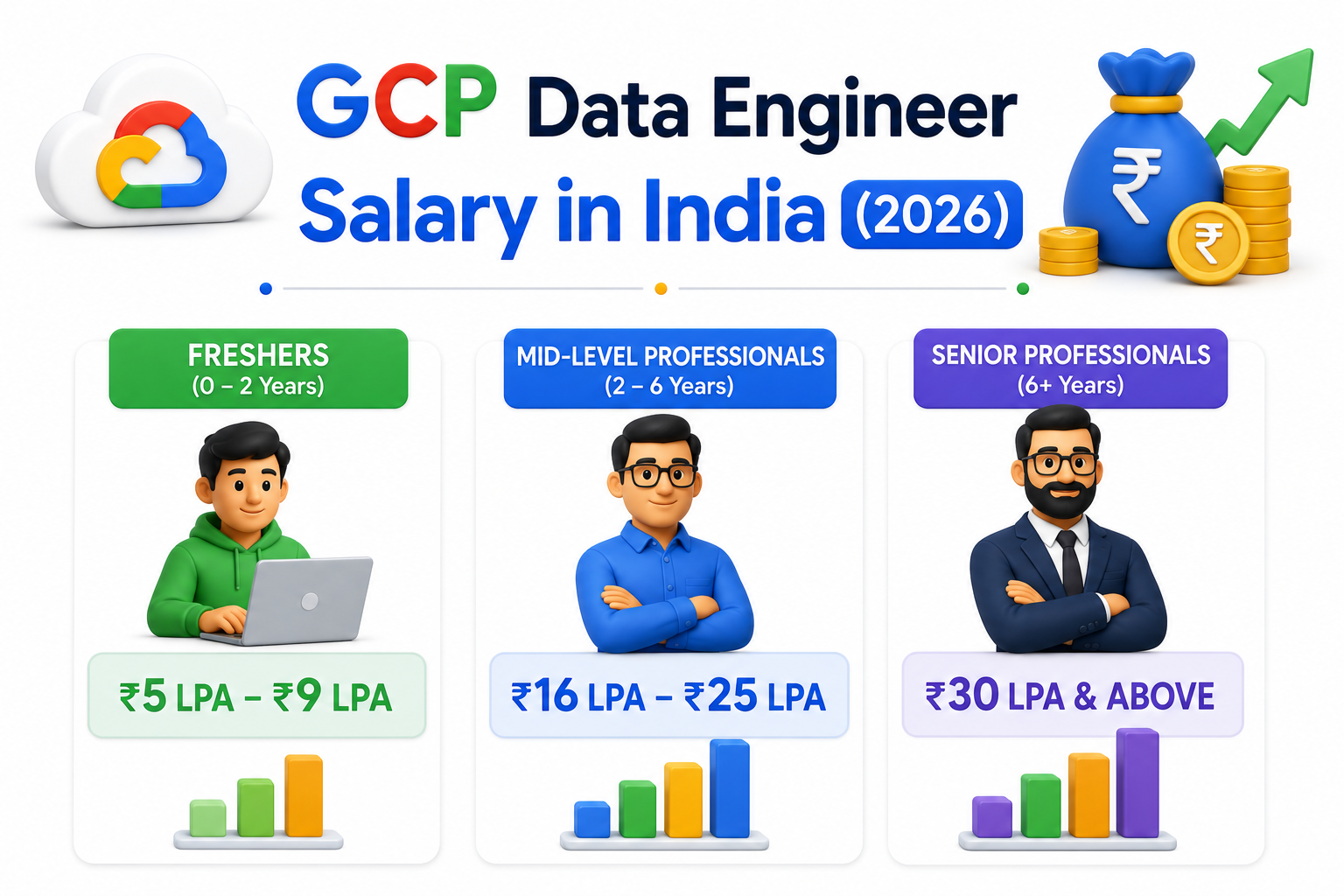
One of the biggest reasons professionals are choosing GCP Data Engineer Training is the exceptional salary potential it offers in India. Certified GCP Data Engineers are among the highest-paid tech professionals, with companies across Bengaluru, Hyderabad, Pune, and Mumbai offering very competitive packages to attract skilled cloud talent.
Freshers with GCP certification can expect starting salaries between ₹5 LPA to ₹9 LPA, while mid-level professionals earn between ₹16 LPA to ₹25 LPA. Senior GCP Data Engineers with six or more years of experience command salaries of ₹30 LPA and above, making it one of the most financially rewarding career paths in India's technology sector.
Conclusion
GCP Data Engineer Training is one of the smartest career decisions in 2026. Cloud adoption is growing rapidly across India, and companies are actively hiring professionals who can build and manage data pipelines on Google Cloud Platform. The demand is strong, salaries are competitive, and growth opportunities are exceptional for certified GCP professionals across India.
If you are serious about a cloud data engineering career, JastTech is the right place to begin. With a 16-module curriculum, hands-on projects, expert mentorship, and strong placement support, JastTech gives you the skills and confidence to step into a GCP Data Engineer role successfully anywhere in India.