

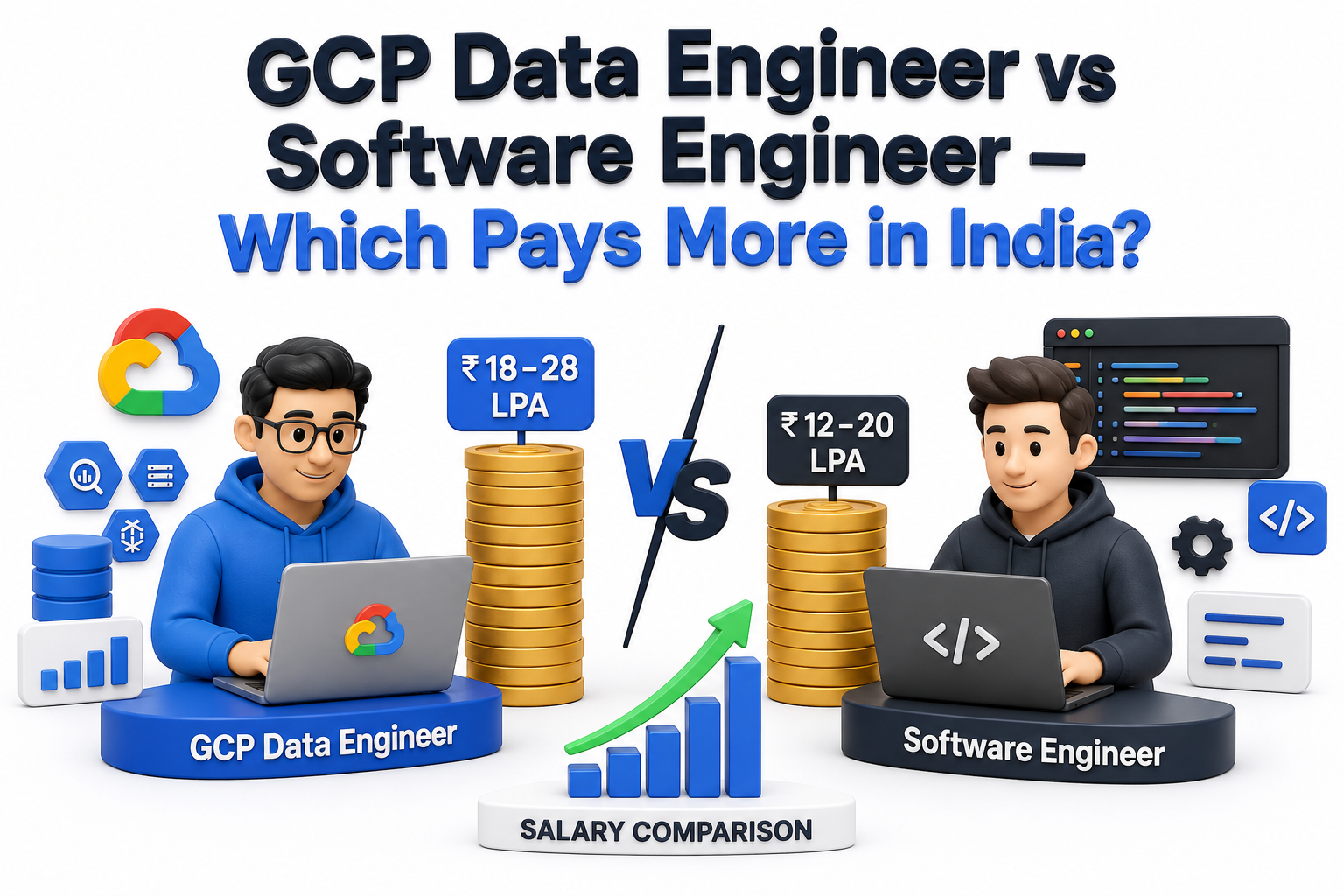
GCP Data Engineer vs Software Engineer — Which Pays More in India?
Navigate through this article using the table of contents below
Table of Contents
No headings found in this article.
What Does a GCP Data Engineer Do?
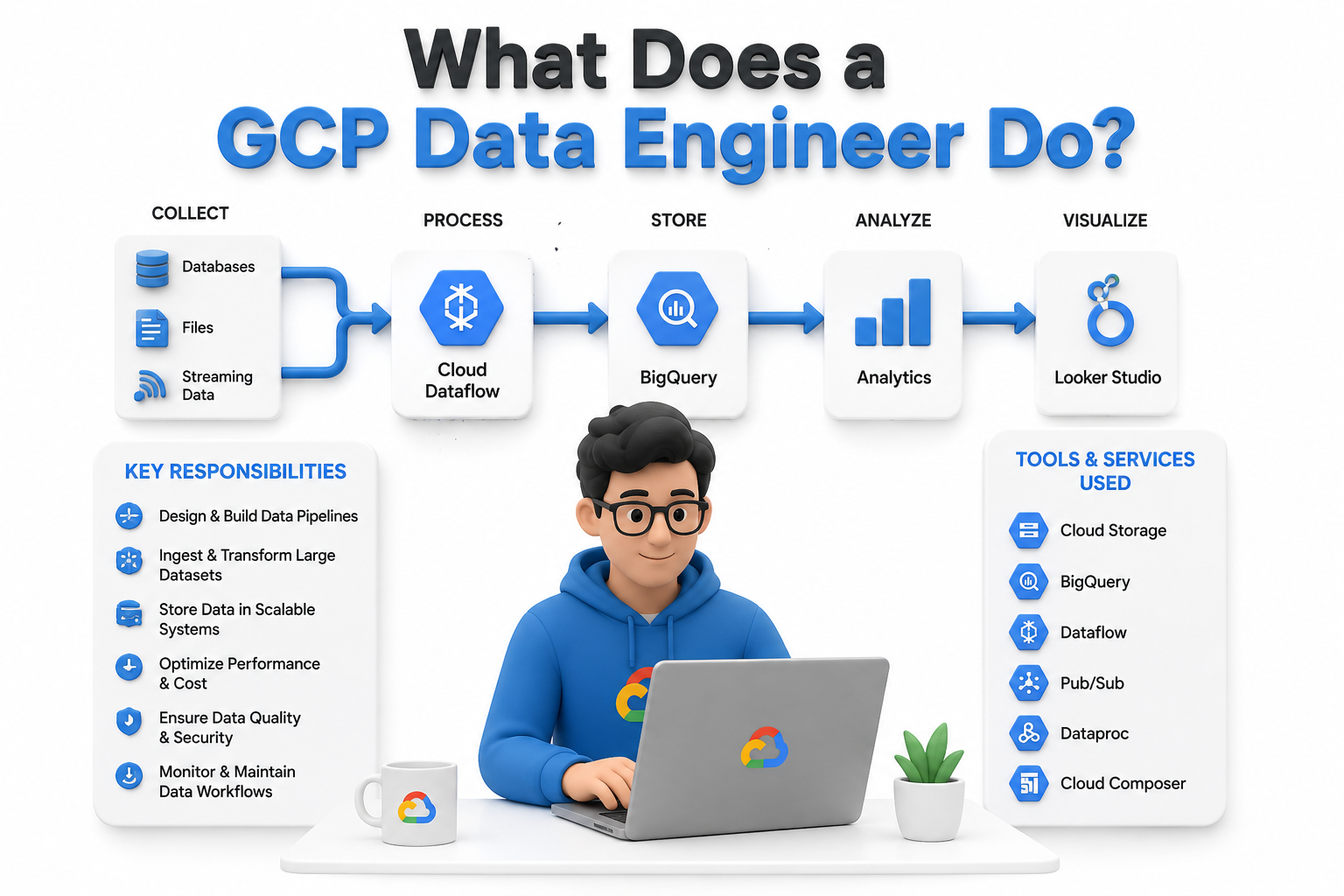
A GCP Data Engineer is a cloud professional responsible for designing, building, and managing large-scale data processing systems on the Google Cloud Platform. Their primary role is to collect raw data from multiple sources, transform it into meaningful information, and store it efficiently for analytics, reporting, and machine learning applications. GCP Data Engineers work with powerful cloud tools such as BigQuery, Dataflow, Cloud Storage, Pub/Sub, and Apache Spark to create secure and scalable data pipelines. In today’s data-driven industries, companies rely heavily on GCP Data Engineers to handle massive amounts of structured and unstructured data while ensuring high performance, reliability, and data security.
In India, the demand for GCP Data Engineers is rapidly increasing across industries like fintech, healthcare, e-commerce, banking, and AI startups because organizations are shifting from traditional servers to cloud-based infrastructure. A GCP Data Engineer not only manages databases and ETL pipelines but also collaborates with data analysts, software developers, and machine learning teams to support business intelligence and AI projects. Strong knowledge of SQL, Python, cloud architecture, and big data technologies is essential for this role. Since businesses are investing heavily in cloud transformation and real-time analytics, GCP Data Engineering has become one of the most promising and high-paying careers in the Indian IT industry.
What Does a Software Engineer Do?
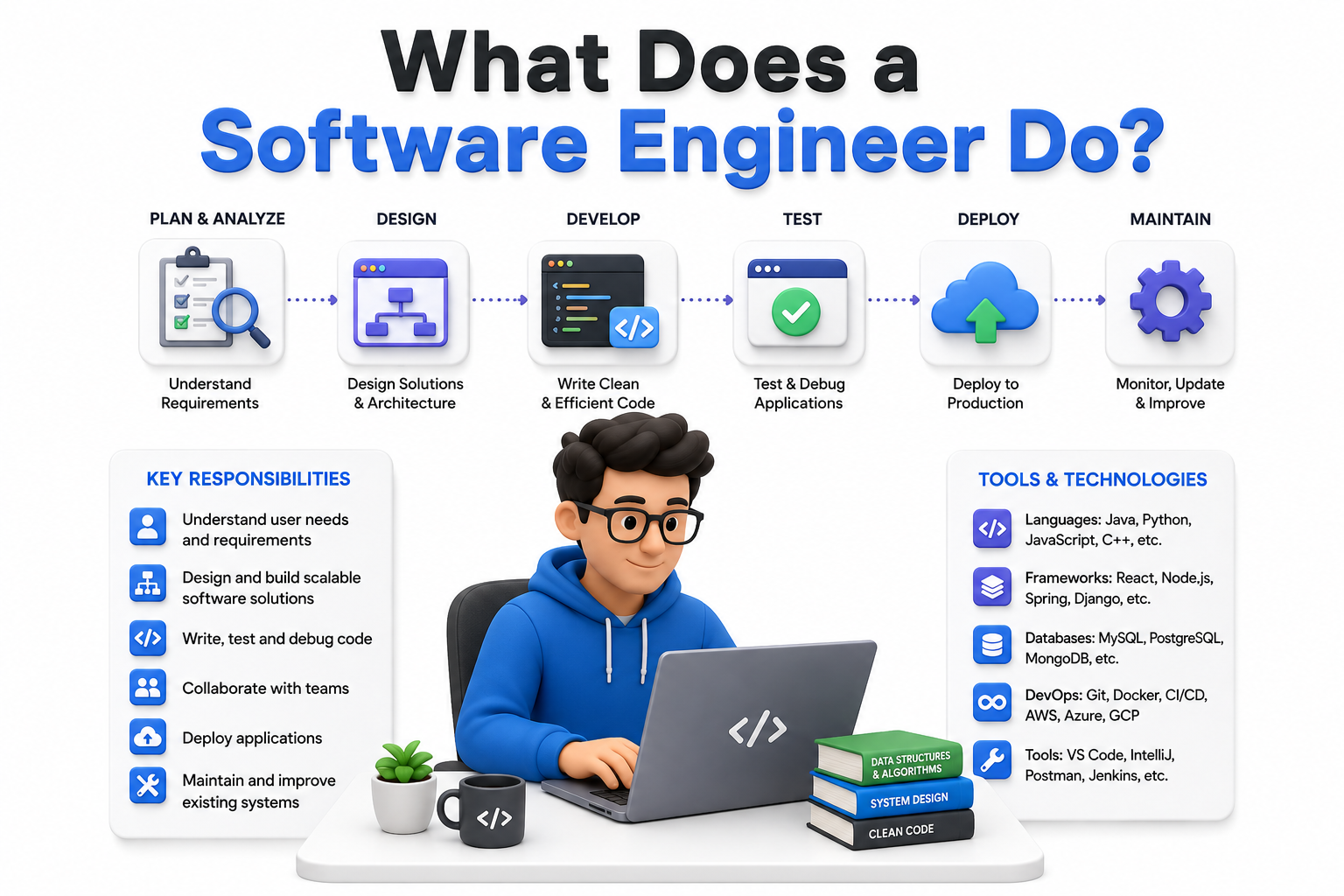
A Software Engineer is a technology professional who designs, develops, tests, and maintains software applications, websites, mobile apps, and enterprise systems used by businesses and consumers worldwide. Software Engineers use programming languages such as Python, Java, C++, JavaScript, and Go to create scalable and efficient software solutions. Their responsibilities include writing clean code, debugging errors, improving application performance, integrating APIs, and collaborating with designers, testers, and product teams. From building e-commerce platforms and banking applications to developing AI-powered systems and cloud-based software, Software Engineers play a crucial role in driving digital transformation across industries.
In India, Software Engineering remains one of the most in-demand and versatile careers in the IT sector due to the rapid growth of startups, SaaS companies, fintech platforms, gaming industries, and multinational technology firms. Software Engineers can specialize in areas like frontend development, backend development, full-stack development, DevOps, cybersecurity, artificial intelligence, or mobile app development based on their interests and career goals. Strong problem-solving skills, knowledge of data structures and algorithms, and expertise in modern development frameworks are highly valued in this profession. As businesses continue investing in automation, cloud computing, and digital products, Software Engineers continue to receive competitive salaries, excellent career growth opportunities, and global job prospects.
GCP Data Engineer vs Software Engineer: Key Differences
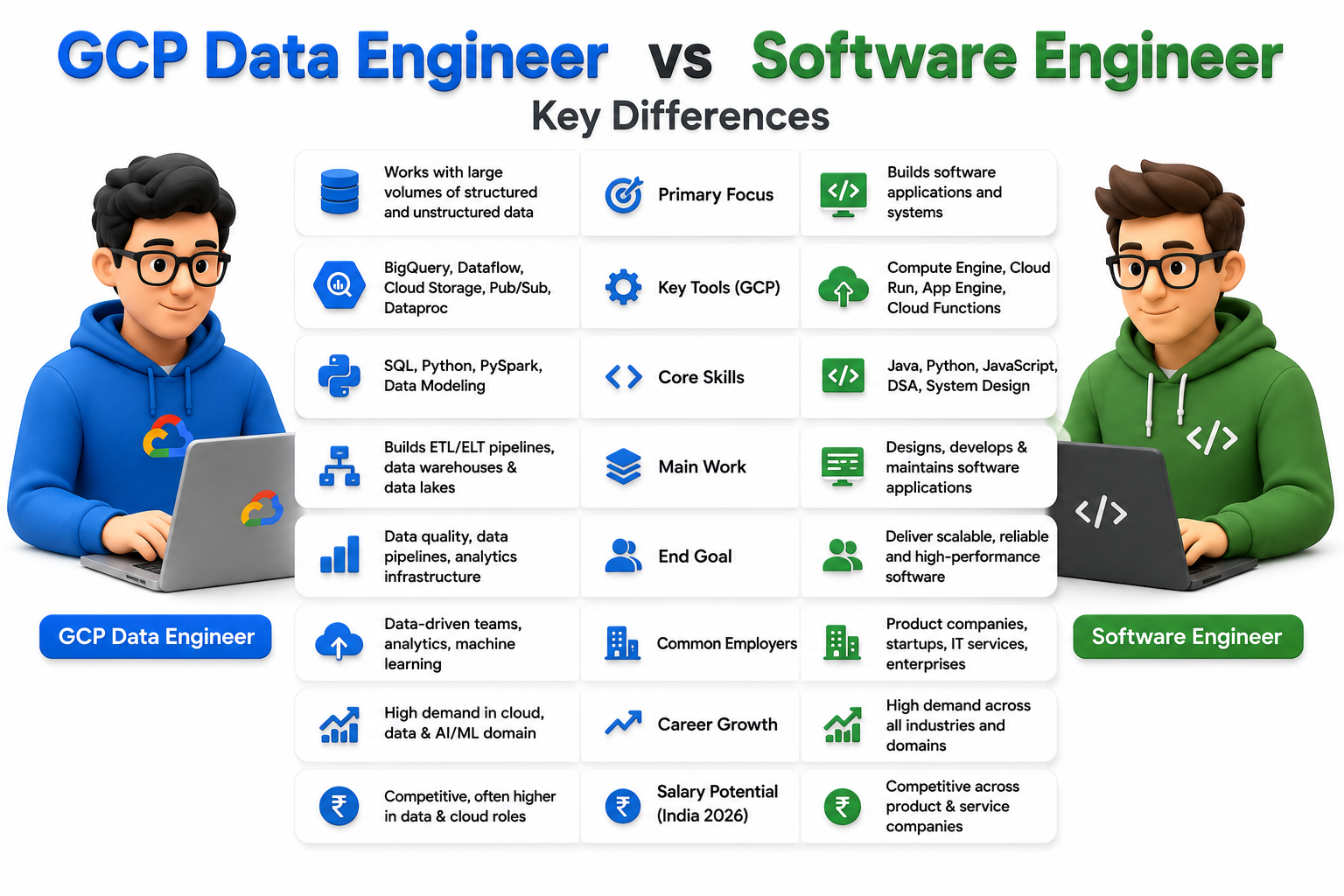
When comparing a GCP Data Engineer vs Software Engineer, the biggest difference lies in their core responsibilities and the technologies they work with. A GCP Data Engineer mainly focuses on handling large-scale data systems, building ETL pipelines, managing cloud databases, and processing big data using tools available on the Google Cloud Platform. They work extensively with technologies like BigQuery, Dataflow, Apache Spark, SQL, and cloud storage services. In contrast, a Software Engineer is primarily responsible for designing and developing software applications, websites, APIs, and backend systems using programming languages such as Java, Python, JavaScript, and C++. While GCP Data Engineers specialize in data infrastructure and analytics, Software Engineers focus more on application development and software architecture.
Another major difference between these two careers is the skill set and learning path required to enter the industry. A GCP Data Engineer must have strong expertise in cloud computing, database management, data warehousing, real-time data processing, and distributed computing systems. Certifications related to Google Cloud and big data technologies can significantly improve career opportunities in this field. On the other hand, Software Engineers typically require deep knowledge of programming concepts, data structures, algorithms, system design, and software development frameworks. Software Engineering offers broader domain flexibility because professionals can move into frontend, backend, mobile app development, DevOps, AI engineering, or cybersecurity depending on their interests and experience.
The salary trends and market demand for both professions in India are also different due to changing industry requirements. GCP Data Engineers are currently experiencing high demand because companies are investing heavily in cloud migration, AI, and data-driven decision-making. This often results in higher salaries for experienced cloud and data professionals, especially in metro cities and product-based companies. Software Engineers, however, continue to dominate the Indian IT industry because every technology company requires software development talent. Although Software Engineering offers more job openings overall, GCP Data Engineering is becoming one of the fastest-growing and highest-paying specializations in the cloud computing market. Choosing between the two careers ultimately depends on whether a person is more interested in cloud data ecosystems or software product development.
Average Salary of GCP Data Engineers in India (2026)
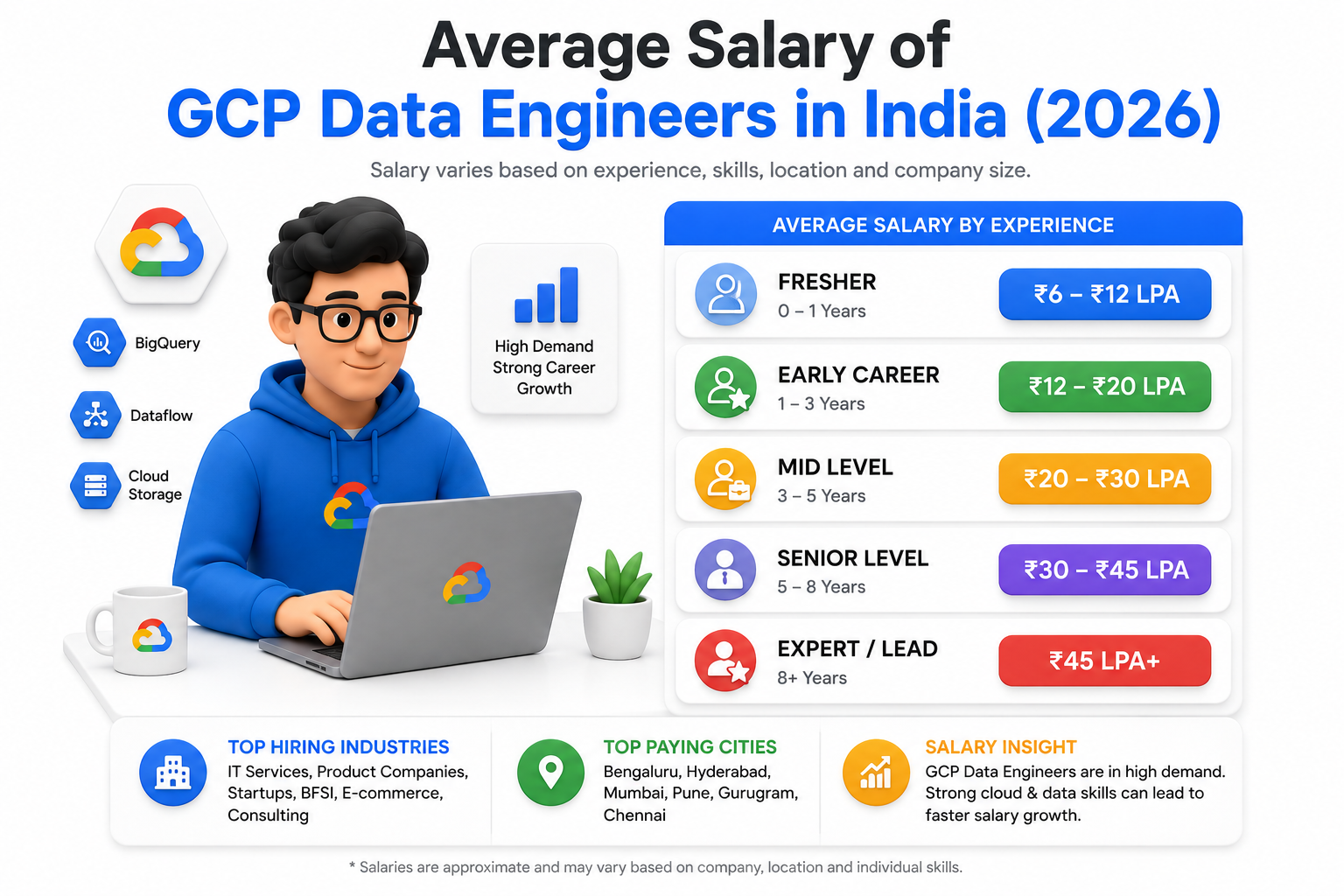
The average salary of a GCP Data Engineer in India in 2026 is significantly higher than many traditional IT roles due to the growing demand for cloud computing and big data expertise. According to recent salary reports, the average annual salary for GCP Data Engineers in India ranges between ₹5 LPA to ₹14 LPA, while experienced professionals working in product-based companies and multinational organizations can earn ₹20 LPA or more. Freshers entering the field with strong skills in SQL, Python, BigQuery, Apache Spark, and Google Cloud services usually start with packages between ₹4 LPA and ₹8 LPA. Professionals with 4–8 years of experience and advanced cloud certifications often receive much higher compensation, especially in cities like Bengaluru, Hyderabad, Pune, and Gurgaon. The salary growth for GCP Data Engineers is accelerating because Indian companies are rapidly adopting cloud-based data infrastructure, AI analytics, and real-time data processing systems. Industries such as fintech, e-commerce, healthcare, banking, and SaaS are actively hiring skilled cloud data professionals to manage massive datasets and scalable data pipelines. In addition to technical expertise, professionals with certifications from Google Cloud Platform and experience in tools like Airflow, Kafka, Snowflake, and Dataflow are commanding premium salaries in the market. Community salary discussions and industry reports also show that experienced Data Engineers working on GCP can reach compensation packages above ₹30–40 LPA after strategic job switches and specialization in cloud architecture and big data technologies.
Average Salary of Software Engineers in India (2026)
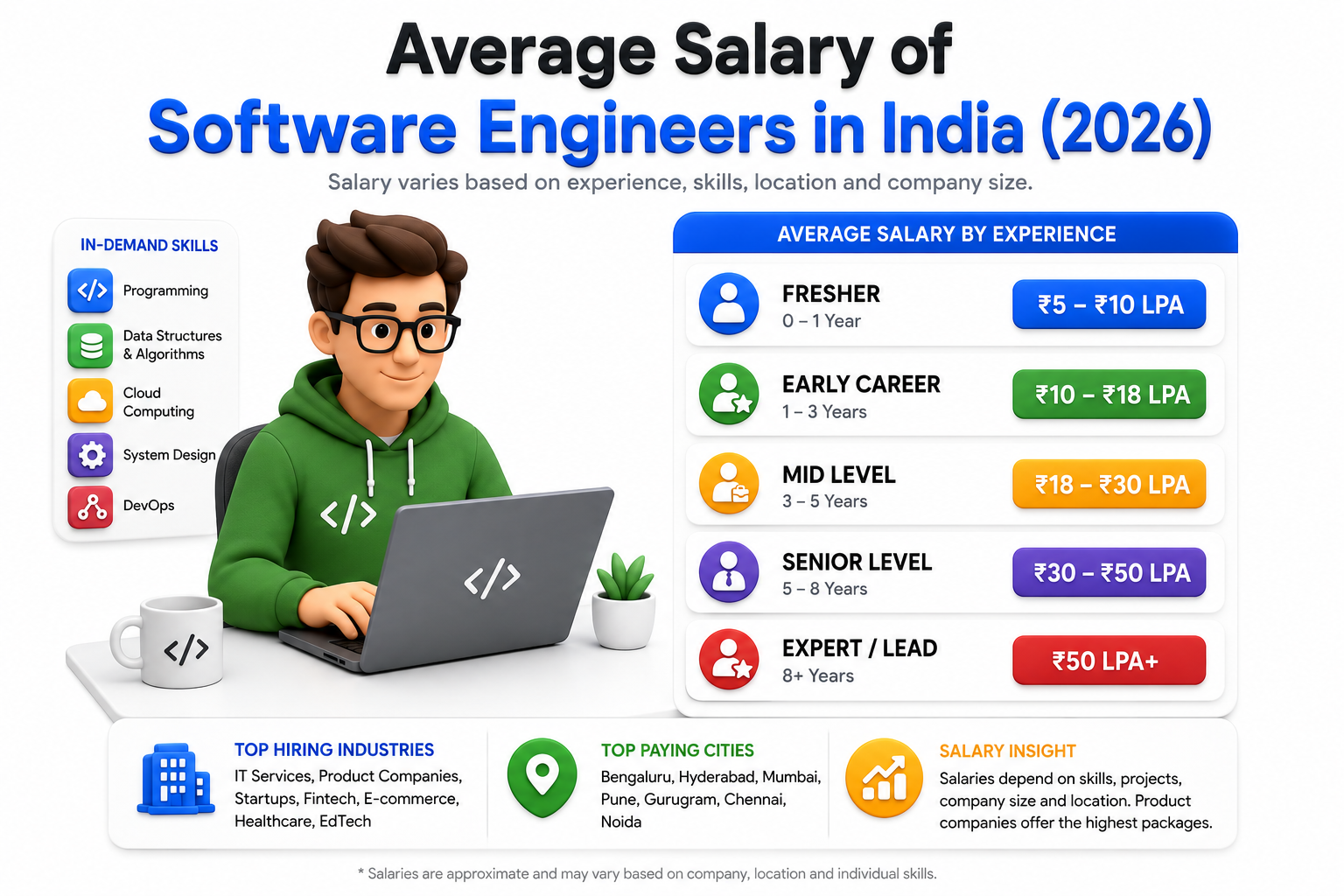
In 2026, the average salary of a software engineer in India typically ranges between ₹4 LPA to ₹15 LPA for most professionals, depending on experience, skills, and company type. Freshers usually start around ₹3.5–6 LPA in IT service companies, while product-based companies and fast-growing startups often offer ₹8–15 LPA or more for entry-level roles. As per current industry trends, mid-level engineers with 3–5 years of experience commonly earn around ₹10–25 LPA, especially if they work in high-demand areas like cloud computing, AI/ML, or full-stack development.
At senior levels, the salary growth becomes significantly higher, with experienced software engineers earning anywhere between ₹25 LPA to ₹60+ LPA, and top-tier roles in global product companies or FAANG firms going even beyond that. Factors such as location (Bangalore, Hyderabad, Pune), tech stack, system design expertise, and switching companies strategically play a major role in determining pay. Overall, the software engineering field in India continues to show strong salary growth in 2026 due to rising demand for digital transformation, AI adoption, and global outsourcing expansion.
Which Career Has Higher Demand in India?
In India, career demand in 2026 is heavily driven by rapid digital transformation, automation, and expansion of service-based industries. Among all fields, technology-related careers consistently rank at the top in demand. Roles such as software developers, data engineers, cloud architects, DevOps engineers, and AI/ML specialists are highly sought after by both Indian IT companies and global product firms. The growth of startups, SaaS companies, and outsourcing hubs continues to keep the IT sector as the strongest employment generator.
Apart from IT, healthcare and life sciences also show strong and stable demand. India’s growing population, increasing lifestyle-related diseases, and expansion of private healthcare systems have increased the need for doctors, nurses, medical technicians, pharmacists, and healthcare data analysts. In addition, biotechnology and pharmaceutical research roles are gaining importance due to rising investment in drug development and medical innovation.
Another fast-growing area is emerging digital and business-focused careers, including cybersecurity, digital marketing, fintech, and business analytics. Cybersecurity professionals are in high demand due to increasing cyber threats, while fintech roles are expanding with the growth of UPI, digital banking, and investment platforms. Overall, careers that combine technology, data, and business problem-solving skills currently have the highest and most sustainable demand in India.
Top Skills Required for GCP Data Engineers
A GCP Data Engineer is expected to have a strong foundation in both data engineering principles and cloud computing concepts, especially within the ecosystem of Google Cloud Platform. Core technical skills include proficiency in SQL and advanced data modeling, as these form the backbone of data extraction, transformation, and analytics. Strong programming ability in Python or Java is also essential for building data pipelines and automation workflows. Additionally, understanding distributed data processing frameworks like Apache Spark and Apache Beam is important for handling large-scale datasets efficiently in cloud environments.
On the cloud-specific side, expertise in BigQuery, Cloud Storage, Dataflow, Dataproc, and Pub/Sub is highly valued for designing scalable data pipelines. Knowledge of ETL/ELT architecture, data warehousing, and real-time streaming systems is also critical. Beyond technical skills, employers increasingly look for familiarity with CI/CD pipelines, Airflow (Cloud Composer), and basic DevOps practices for production-grade data workflows. Strong problem-solving ability, system design understanding, and data security awareness complete the skill set required to succeed as a GCP Data Engineer in today’s competitive job market.
Top Skills Required for Software Engineers
A software engineer is expected to have a strong command over core programming and computer science fundamentals. Proficiency in languages such as Java, Python, C++, or JavaScript is essential, along with a solid understanding of data structures and algorithms (DSA), which form the backbone of efficient problem-solving. Knowledge of object-oriented programming (OOP), database management systems (DBMS), and operating systems is also crucial for building scalable and reliable applications. In addition, familiarity with version control systems like Git is a standard requirement in almost every development environment.
Beyond core programming skills, modern software engineers must also be comfortable with web development frameworks, APIs, and cloud platforms such as Amazon Web Services, Microsoft Azure, or Google Cloud Platform. Skills in system design, microservices architecture, and DevOps practices (CI/CD pipelines, containerization with Docker, Kubernetes) are increasingly important for building production-grade systems. Along with technical expertise, strong problem-solving ability, debugging skills, and effective communication are critical for collaborating in teams and delivering high-quality software in fast-paced development environments.
Best Programming Languages for GCP Data Engineering and Software Development
The choice of programming languages plays a crucial role in both GCP Data Engineering and software development careers. In the data engineering domain on Google Cloud Platform, Python and SQL are the most widely used languages. SQL is fundamental for querying, transforming, and managing structured data in systems like BigQuery, while Python is preferred for building ETL pipelines, automating workflows, and integrating with cloud services. Python’s rich ecosystem of libraries such as Pandas, PySpark, and Apache Beam makes it especially powerful for large-scale data processing.
For more advanced and performance-critical systems, languages like Java and Scala are highly important. These are commonly used in distributed data processing frameworks such as Apache Spark and are preferred in enterprise-level data engineering environments where scalability and performance are key. Java is also widely used in backend development, making it valuable for engineers who work across both software development and data pipelines. Scala, with its functional programming capabilities, is particularly strong in big data ecosystems.
In broader software development, JavaScript and TypeScript dominate web development, especially for frontend frameworks like React and backend environments like Node.js. Meanwhile, languages like Go (Golang) are gaining popularity for cloud-native development due to their speed and efficiency in microservices architecture. In modern tech ecosystems, combining these languages with cloud platforms such as Amazon Web Services and Microsoft Azure gives developers a strong advantage, enabling them to build scalable, high-performance, and production-ready applications.
Which Role Is Better for Freshers in India?
For freshers in India, there is no single “best” role universally, but software development roles are generally considered the most accessible starting point. Entry-level positions such as software engineer, backend developer, or full-stack developer offer structured learning paths, abundant job openings, and faster skill development. Companies across startups, IT services, and product firms consistently hire freshers for these roles, making it easier to enter the tech industry even with moderate experience.
On the other hand, data-focused roles like Data Analyst or Data Engineer (especially on platforms like Google Cloud Platform) are also in high demand but tend to be slightly more specialized. These roles often require stronger fundamentals in SQL, Python, and data modeling, and sometimes cloud tools like BigQuery or Spark. While the learning curve can be steeper, they offer strong long-term career growth and higher salary potential as the industry becomes more data-driven.
Ultimately, the better role depends on a fresher’s interests and skill strengths. If someone enjoys coding, building applications, and problem-solving, software development is a strong starting point. If they are more interested in data, analytics, and cloud systems, data engineering or analytics roles may be more suitable. Both paths are highly promising in India’s 2026 job market, and switching between them later is also common as professionals gain experience and specialization.
GCP Data Engineer vs Software Engineer: Which Career Should You Choose?
Choosing between a GCP Data Engineer and a Software Engineer depends mainly on your interests, skill strengths, and long-term career goals. A Software Engineer focuses on designing and building applications, systems, and user-facing or backend services. This role is broad and includes web development, mobile apps, system design, and scalable software systems. It is ideal for those who enjoy coding regularly, solving algorithmic problems, and working on product development from end to end.
A GCP Data Engineer, on the other hand, specializes in building and maintaining data pipelines, data warehouses, and analytics infrastructure on platforms like Google Cloud Platform. This role is more focused on data movement, processing, and transformation using tools such as BigQuery, Dataflow, Pub/Sub, and Cloud Storage. It is best suited for individuals who enjoy working with large datasets, cloud architecture, ETL workflows, and business intelligence systems. Compared to software engineering, it is more data-centric and less focused on traditional application development.
In terms of career growth, both paths are highly rewarding in India. Software Engineering generally offers a wider range of job opportunities across startups, IT services, and product-based companies, making it more flexible for freshers. GCP Data Engineering, however, is rapidly growing due to the rise of AI, analytics, and cloud adoption, often offering higher specialization and strong salary growth over time. Ultimately, the best choice depends on whether you prefer building software systems (Software Engineer) or building data-driven cloud systems (Data Engineer)—both are in high demand and future-proof in 2026.
Conclusion: Which Pays More in India in 2026?
In India (2026), both Software Engineers and GCP Data Engineers are high-paying careers, but the overall salary distribution shows a slight advantage for Data Engineering roles at the mid-to-senior level. Software Engineers typically earn around ₹5–15 LPA at entry level, with mid-level professionals making ₹15–40 LPA, and senior engineers reaching ₹50 LPA or more in top product companies. This makes software engineering a more widespread and stable high-income path with a larger number of job opportunities across IT services, startups, and product-based companies.
On the other hand, GCP Data Engineers often command higher specialization-based pay, especially as companies increasingly rely on data and AI-driven systems. Entry-level data engineers generally earn around ₹6–12 LPA, mid-level professionals earn ₹12–25 LPA, and senior roles can go up to ₹40 LPA+ or even significantly higher in large enterprises and cloud-focused companies. Because of strong demand for cloud infrastructure, analytics, and AI pipelines, data engineering roles often scale faster in compensation as experience grows.
Overall, Software Engineering tends to offer more job availability and faster entry into the industry, while GCP Data Engineering often provides stronger salary acceleration in the mid-to-senior stages due to specialization in cloud and data platforms like Google Cloud Platform. If the goal is maximum long-term earning potential with niche expertise, data engineering has a slight edge; but if the goal is broader opportunities and easier entry, software engineering remains the safer and more flexible choice.