

Guidewire and Gosu Skills That Matter for Chennai Developers
Navigate through this article using the table of contents below
Table of Contents
No headings found in this article.
A Chennai developer can know Java inside out and still stall in the first week of a Guidewire project. The problem is rarely syntax. Guidewire and Gosu skills involve a data model, a configuration layer, and a way of thinking about insurance that ordinary Java work never asks for.
That gap separates candidates who clear interviews from those who keep applying. Anyone exploring Guidewire training in India will notice how much of a good curriculum goes beyond the language itself.
Why Java Experience Only Gets You Halfway
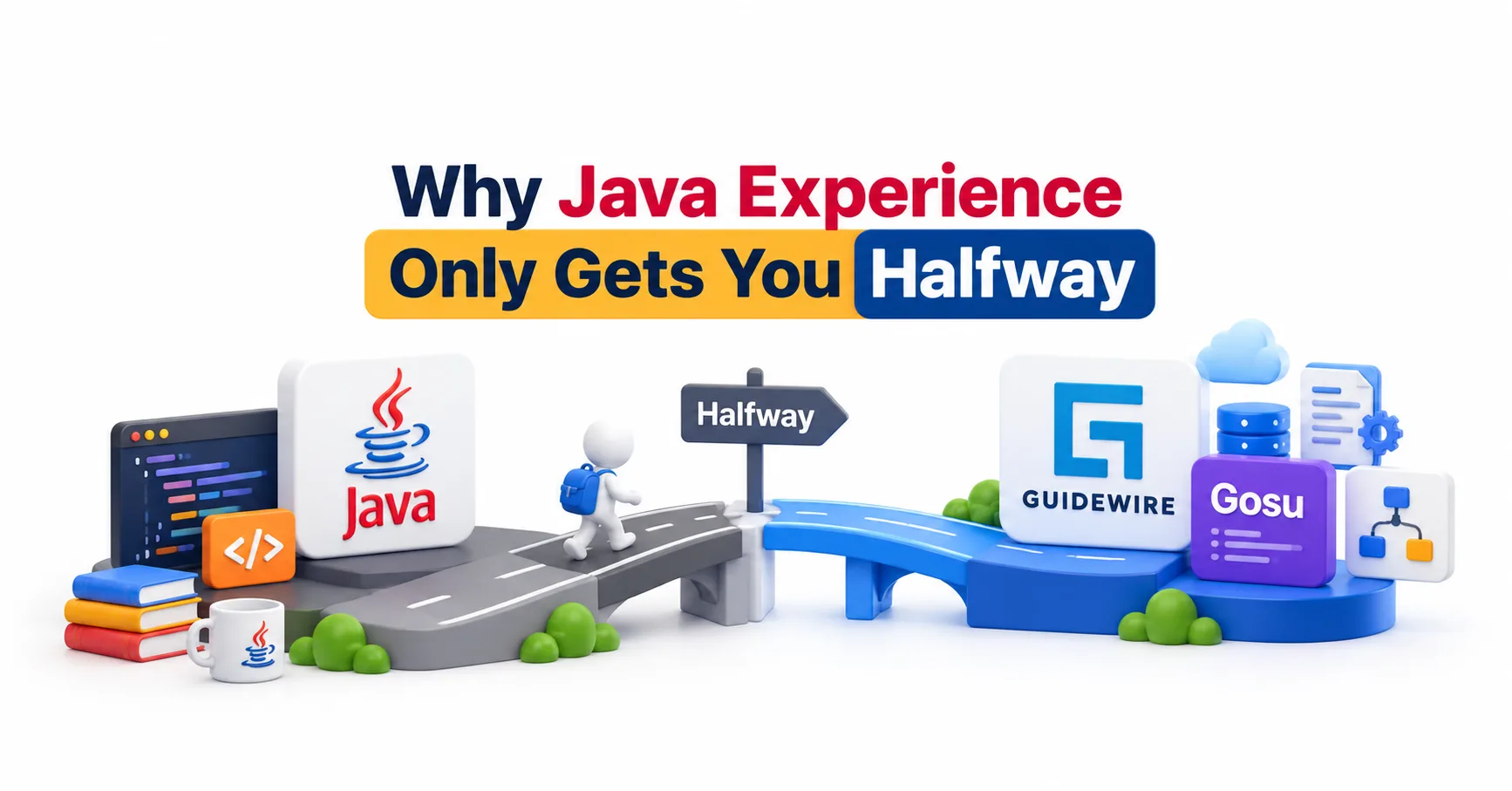
Guidewire InsuranceSuite is a set of core insurance platforms: PolicyCenter for underwriting and policy administration, ClaimCenter for claims, and BillingCenter for billing. Insurers do not build these from scratch. They configure and extend them, and most of that extension work happens in Gosu.
Gosu is a statically typed, object-oriented language that runs on the Java Virtual Machine. Java developers read it quickly, which is both the good news and the trap. The syntax feels familiar, so people assume the job will feel familiar too.
It does not. In a typical Java service you design the domain model yourself. In Guidewire, the domain model already exists, and it is large. A claim has exposures, incidents, contacts, reserves and payments, all connected in ways the product defines. Your first month is spent learning that model, not writing clever code.
Imagine a hypothetical task: a claims manager wants high-value claims flagged for senior review. A Java instinct says to build a new service and a new table. A Guidewire developer asks a different question first. Which existing entity holds the loss amount, which rule or validation hook is the right place to trigger a flag, and what does the product already provide for assignment?
That habit of asking what the platform offers before writing code is the real skill. Everything else in this article builds on it.
Gosu Fundamentals That Show Up in Every Project
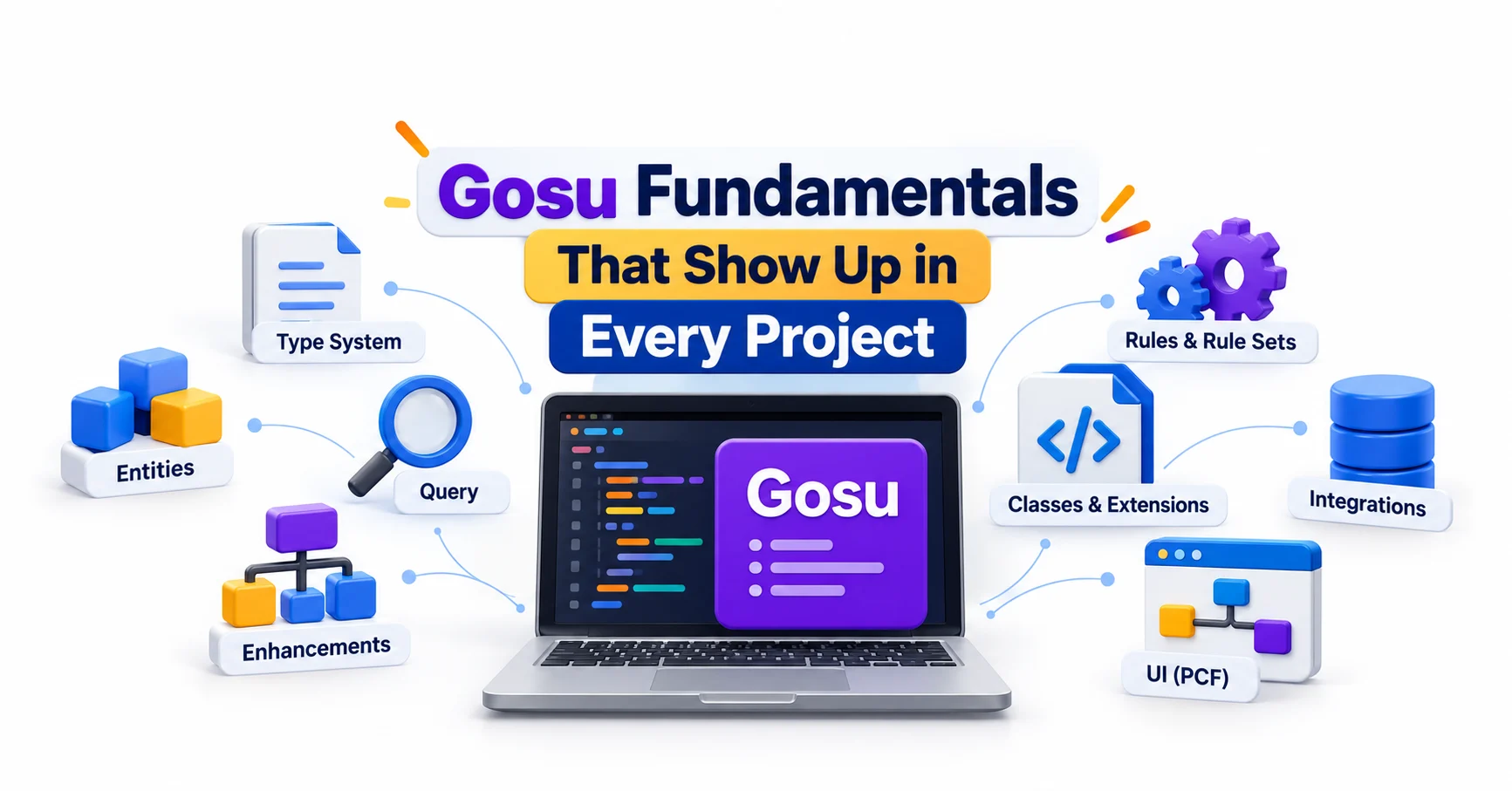
Gosu has a small set of features that appear constantly in real work. Learning these properly is more useful than skimming the whole language.
Type inference lets you write var claim = ... without declaring the type, while the compiler still checks everything. Blocks, Gosu’s version of lambdas, make collection handling short. Methods such as where, map and firstWhere replace the loops you would write in older Java.
Null handling matters more than beginners expect. The null-safe operator ?. and the Elvis-style default ?: keep code from collapsing when an optional field is empty, and optional fields are everywhere in insurance data.
Enhancements are the feature that surprises Java developers most. They let you add methods to an existing type, including types Guidewire ships, without subclassing it. A team might add a helper to a policy or claim entity so that business logic lives in one tidy place instead of being scattered across rules and pages.
Properties, the uses statement for imports, and the typeis and as keywords for type checks and casts round out the daily toolkit. None of it is difficult. It simply has to be second nature before you open a real configuration task.
For a structured walkthrough of these ideas, the Gosu programming course covers the language the way project teams actually use it. Practise writing small enhancements and query snippets yourself rather than only reading examples, because interviews tend to ask you to produce code, not recognise it.
The Guidewire and Gosu Skills Interviewers Test First
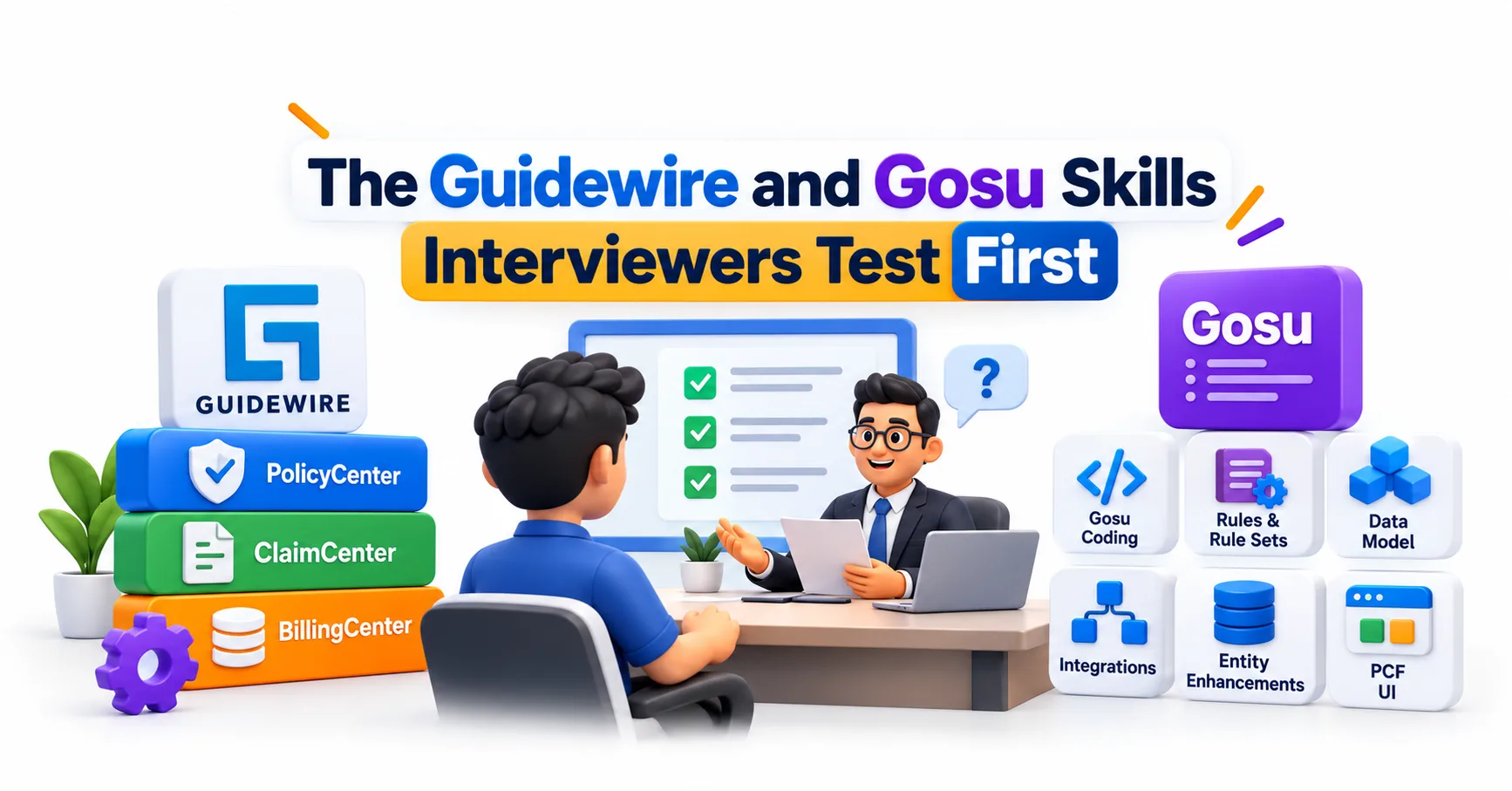
Hiring managers usually probe in a predictable order. They start with Gosu basics, then move quickly to how well you understand the product.
Expect questions on the difference between a rule, a plugin and a delegate. Expect to explain what a bundle is and why changing an entity outside one fails. A bundle is the unit of work that tracks changes to entities and commits them together, so almost every database change in Guidewire passes through one.
Queries come next. Gosu’s query builder API lets you fetch entities with typed conditions, and interviewers often ask how you would find all open claims for a particular adjuster. A candidate who describes loading everything and filtering in memory loses points quickly, because it shows no sense of performance on large datasets.
Then comes the product knowledge. For PolicyCenter, that means policy periods, job types such as submission, renewal and rewrite, and how a change creates a new branch of the policy. For ClaimCenter, it means exposures, coverage verification and assignment.
A common mistake is memorising definitions without connecting them. An interviewer might ask, “A user changes a deductible mid-term. What happens?” A strong answer walks through the policy change job, the new effective date, and what the system recalculates. A weak answer repeats the definition of a policy change.
Practise talking through small scenarios aloud. It exposes gaps that silent reading hides.
Data Model, Typelists, and Entities: The Part Beginners Skip
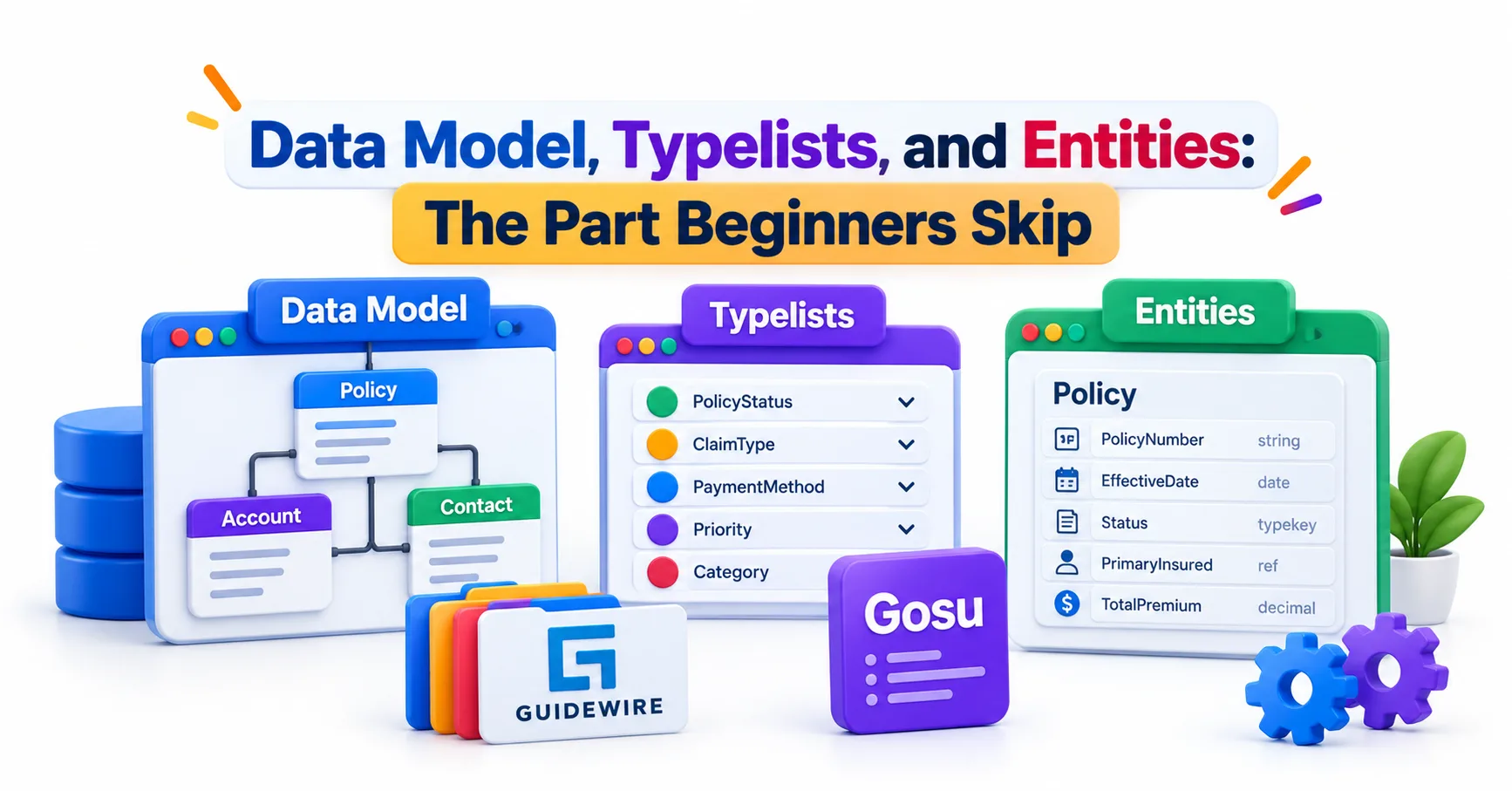
Many learners rush toward coding and neglect the data model, then struggle for months. Guidewire defines its data in metadata files, and developers extend it by adding fields or whole entities to fit a client’s needs.
An entity is a business object, such as a claim or a contact. Extensions add client-specific fields without touching Guidewire’s own files, which keeps upgrades manageable. That upgrade angle is worth understanding early, because careless customisation is one of the most common sources of long-term pain on insurance projects.
Typelists deserve their own attention. A typelist is a controlled list of values, such as loss types or claim states, where each value is a typecode. Typecodes can belong to categories, and categories let you filter which values appear in a given context. Drop-downs across the application are driven this way.
A practical example: a client wants a new loss cause available only for property claims. Adding a typecode and linking it to the right category does the job, with no code. Developers who know typelists solve in an hour what others spend a day coding.
Effective dating is the other concept to learn thoroughly, especially for PolicyCenter. Policy data changes over time, and the system stores versions tied to dates. Reading the right version of a record on the right date is a frequent source of bugs for newcomers.
Our related guide on PolicyCenter effective-dated data explains this with worked examples, and it pays to read it before attempting any policy-related task.
Reading PCF Files and Working Inside Studio
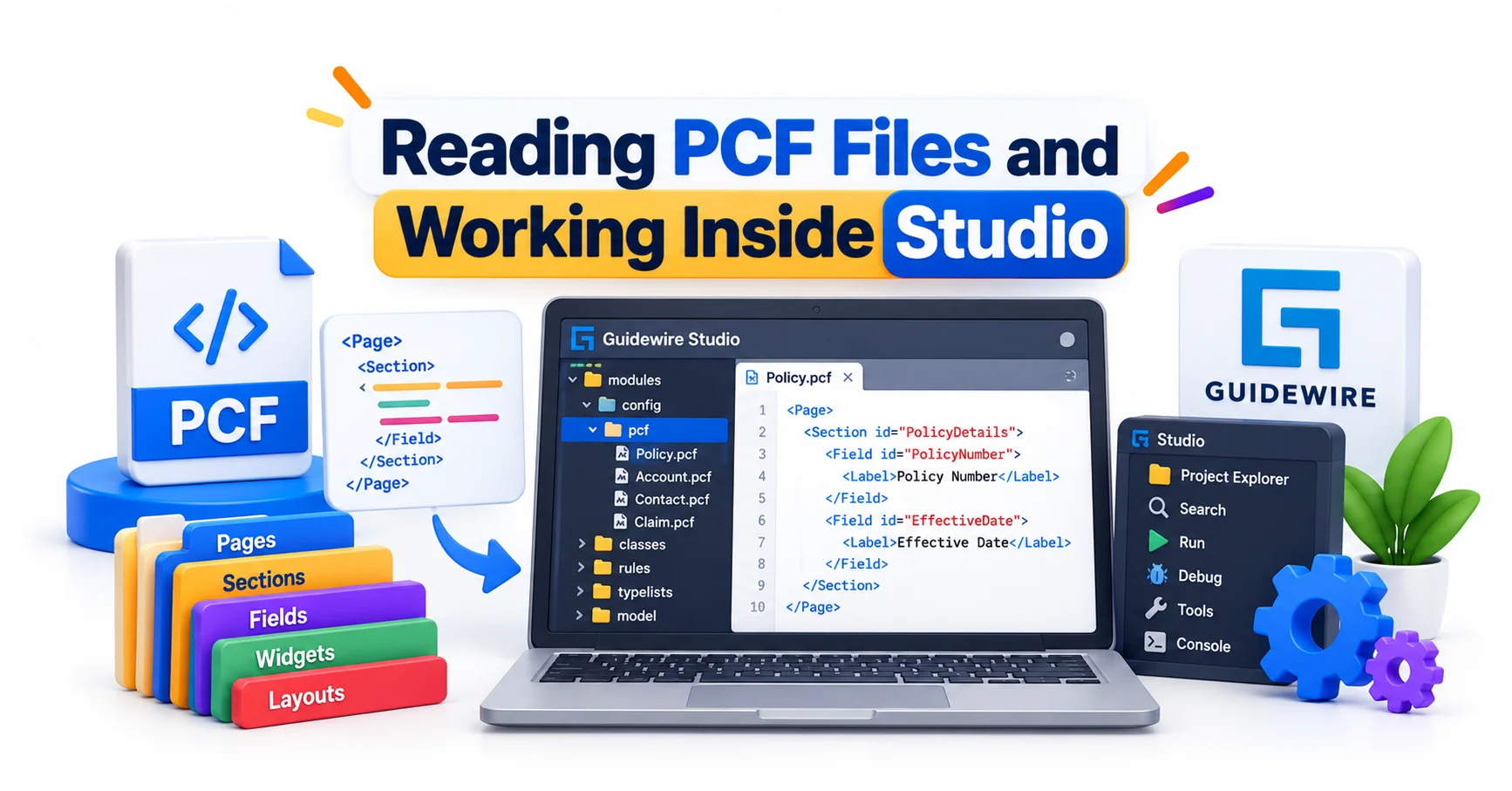
Guidewire’s user interface is configured, not hand-coded in the usual web sense. Screens are defined in PCF files, which describe pages, panels, input fields and the Gosu expressions that fill them.
Developers work in Guidewire Studio, the IDE used to edit PCF files, Gosu classes, rules and data model extensions. Comfort with Studio saves real time. You should know how to find where a field is defined, how to trace which page uses a given widget, and how to run the debugger against a local server.
A beginner’s typical frustration is making a change that seems correct but does not appear. Often the cause is simple: the wrong PCF was edited, a mode or variant of the page applies instead, or the server was not restarted after a data model change. Knowing where to look turns a two-hour mystery into a five-minute fix.
Testing is another area where the gap between trained and untrained developers shows. Guidewire projects use GUnit for unit tests in Gosu, and good teams expect tests alongside configuration changes. Writing even a few tests during practice marks you out in an interview, because many candidates have never done it.
Front-end work is also changing. Guidewire’s Jutro digital framework is JavaScript-based, so developers who understand both the Gosu back end and modern front-end tooling are increasingly useful. You do not need to master it on day one, but knowing it exists and roughly where it fits shows you follow the platform’s direction.
The skill underneath all this is patience with a large configuration surface. Once you can navigate Studio confidently, the rest of the platform becomes far less intimidating.
Integration, Plugins, and Messaging for Chennai Projects
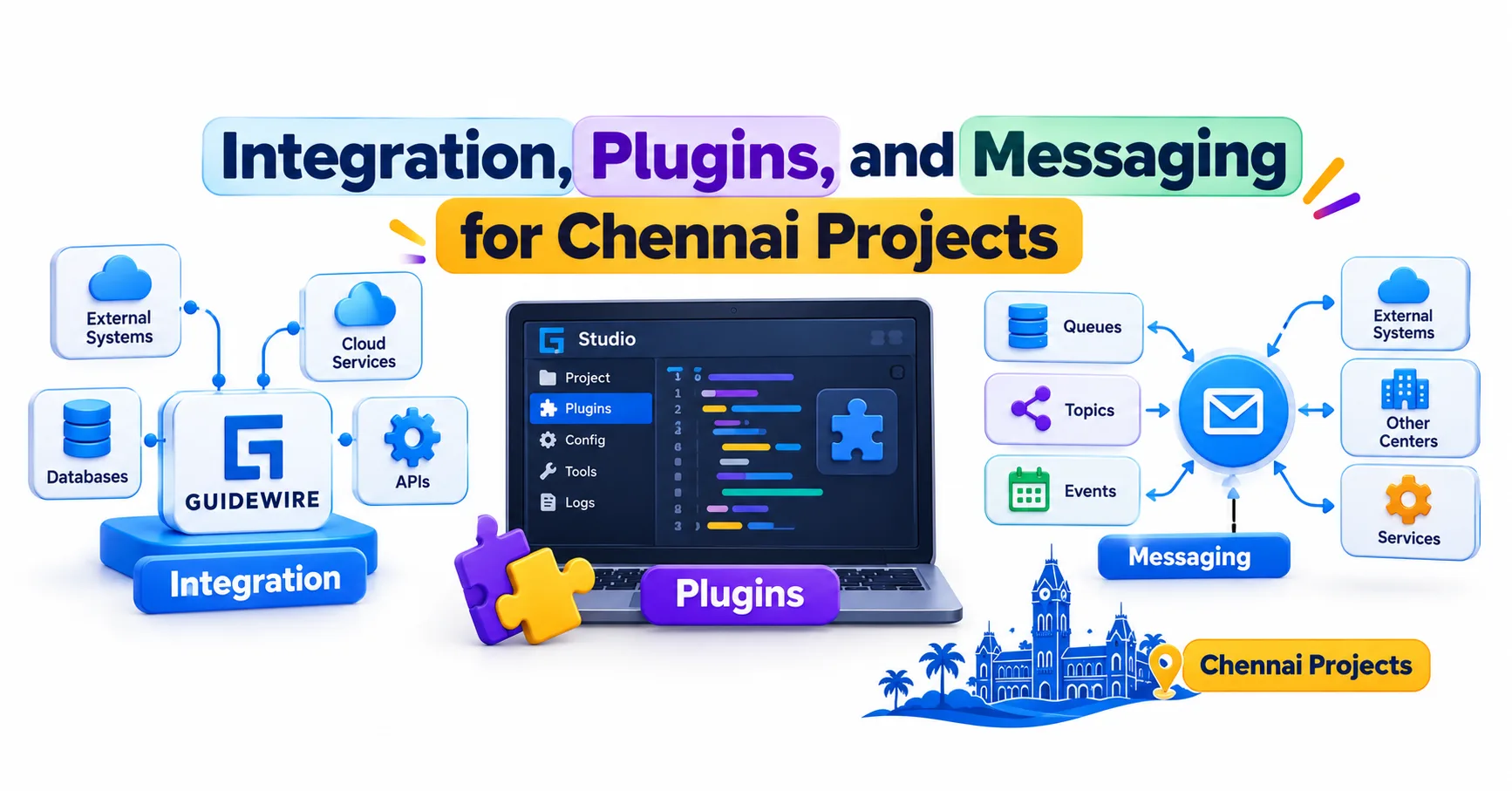
Insurance systems never stand alone. A claim may need to call a payment system, a document service, a fraud scoring tool or a regulator’s reporting feed. This is where many mid-level Guidewire roles earn their value.
Plugins are interfaces that let you replace or extend default behaviour, such as how a number is generated or how a document is produced. Messaging handles outbound events: when something happens in the application, a message is queued and sent to an external system reliably, with retries if the other side is down. Web services expose Guidewire functionality to other applications, using SOAP or REST depending on the integration.
The difference between messaging and a direct web service call confuses many learners. Messaging suits asynchronous, guaranteed delivery where the user should not wait. A web service call suits situations where the user needs an answer right now. Choosing wrongly produces either slow screens or silently lost data, and interviewers like to test exactly this judgement.
Chennai has a large IT services ecosystem, and many developers there work on delivery teams supporting insurers abroad. That often means integration work is where fresh joiners first make contact with production systems, so familiarity with XML, JSON, REST principles and error handling carries real weight.
Cloud delivery has also shifted expectations. As more insurers move to Guidewire’s cloud offerings, understanding how deployments, environments and configuration promotion work is becoming part of the job rather than someone else’s concern.
Spend time building a small integration of your own, even a mock one. Seeing a message fail and retry teaches more than any diagram.
Building a Learning Path That Employers Notice
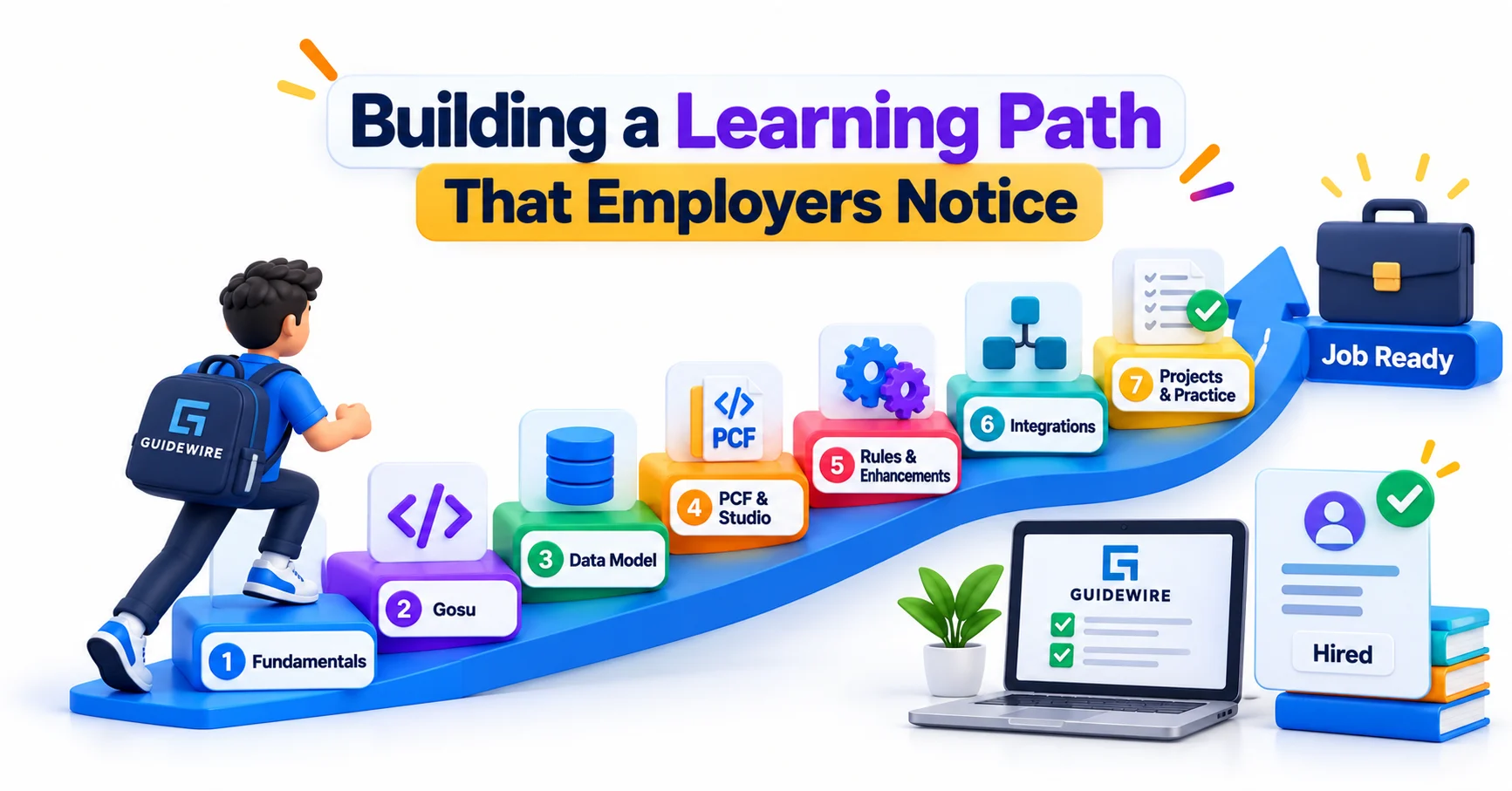
The strongest candidates tend to follow a clear order. First, solid Java and SQL. Second, Gosu fundamentals, practised in small programs. Third, the data model and typelists. Fourth, one product area, such as PolicyCenter or ClaimCenter, studied in enough depth to talk through real scenarios. Only then do integration and advanced topics make full sense.
Trying to learn everything at once is the most common reason people lose momentum. Pick one product line and go deep. Breadth can follow once you are employed.
Insurance domain knowledge is just as valuable as technical depth. Understanding what a deductible, a reserve or an underwriting rule actually means lets you ask better questions and catch requirements that do not quite make sense. Developers who grasp the business are noticed by project managers early.
Hands-on practice matters more than certificates alone. Build a small configuration, extend an entity, write a rule, test it, and keep notes on what went wrong. Those notes become the stories you tell in interviews.
Structured, instructor-led learning can shorten the path considerably, particularly because Guidewire environments are not easy to access on your own. JastTech’s Guidewire training in Chennai is built around that practical approach, pairing platform concepts with project-style exercises that mirror what employers expect.
Finally, be honest about your level. Teams hire juniors who are curious and careful over those who bluff. Saying “I have not used that yet, but here is how I would approach it” lands better than a confident wrong answer.
Conclusion
Strong Guidewire and Gosu skills come from understanding a platform, not just a language. Gosu fluency, data model awareness, Studio confidence and sensible integration judgement together make a developer genuinely useful on an insurance project. For Chennai developers, the opportunity is real, but it rewards depth over shortcuts. Learn the model, practise on scenarios, and the code follows.