

Guidewire Business Analyst Interview Questions and Answers
Navigate through this article using the table of contents below
Table of Contents
No headings found in this article.
Most candidates walk into a Guidewire interview expecting product trivia and get asked how they would handle a vague requirement from an underwriter. That gap catches people off guard. This guide covers the Guidewire business analyst interview questions and answers that actually come up, with the reasoning behind each one. If you are still building your foundation, the Guidewire Business Analyst training course is a structured place to start.
The questions below move from fundamentals to scenarios, so you can see how an interviewer builds a picture of you across the conversation.
What Interviewers Are Really Testing in a Guidewire BA Round
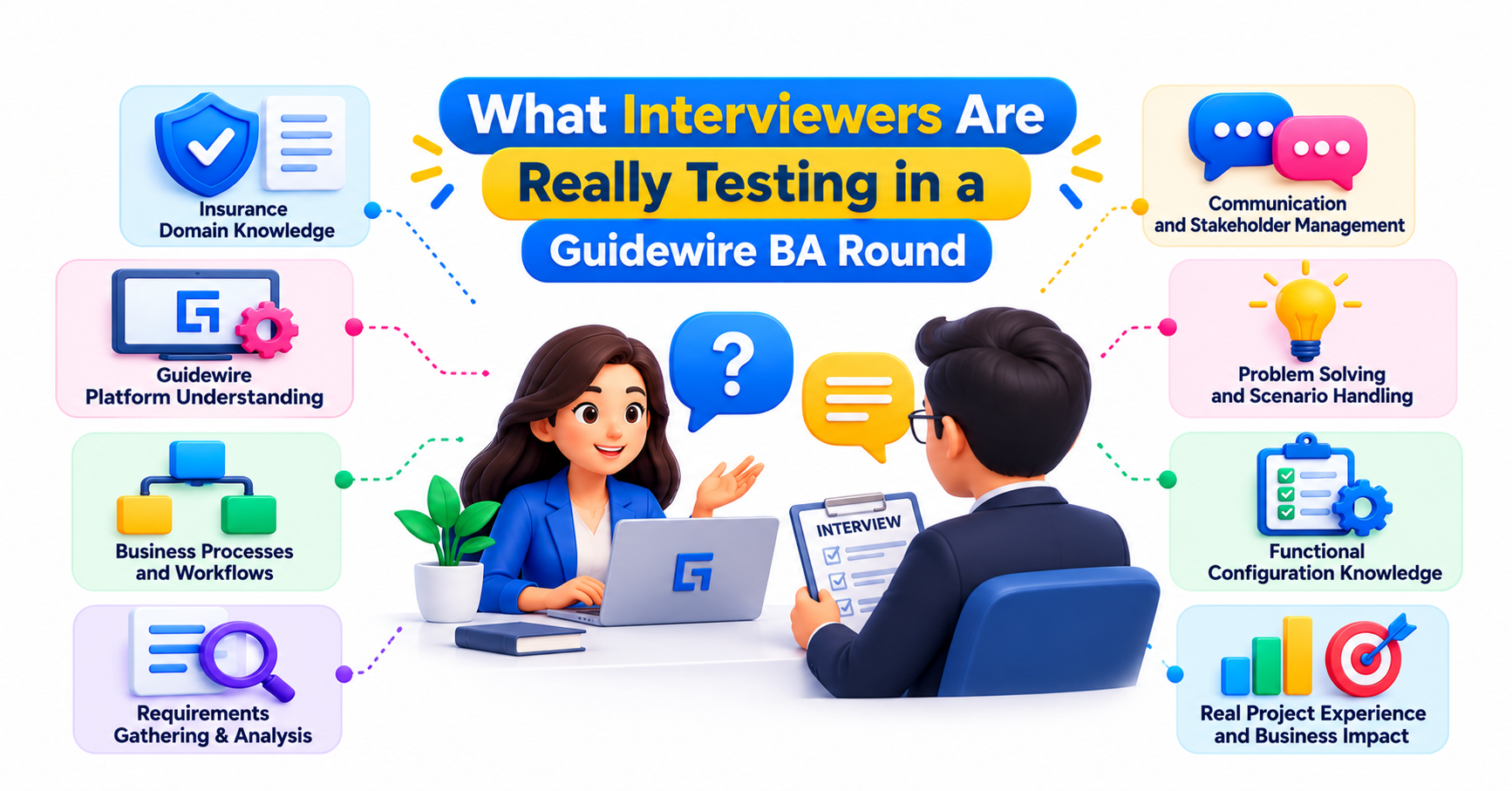
A Guidewire BA interview checks three things at once: whether you understand insurance, whether you understand how Guidewire models it, and whether you can turn messy business needs into something a development team can build. Interviewers rarely care whether you can recite a feature list. They care whether you can explain why a feature exists.
Expect a mix of formats. Early questions are usually definitions (“What is PolicyCenter?”). Middle questions test process knowledge (“Walk me through an endorsement”). Later questions are situational (“A stakeholder wants a field added to the claim screen, and it conflicts with a regulation. What do you do?”).
Preparing for a Guidewire BA role? These 33 questions cover the basics, insurance domain knowledge, requirements work and scenario-based questions. For structured preparation, you can also explore the Guidewire Business Analyst training course.
1. What is Guidewire?
Guidewire is a software platform used by property and casualty (P&C) insurers to run core operations. Its InsuranceSuite covers policy administration, claims and billing, and it is delivered as separate applications that work together.
2. What does a Guidewire Business Analyst do?
A Guidewire BA connects business stakeholders with the technical team. They gather requirements, document how insurance processes should work in the system, write user stories, support testing and help the business accept the final solution.
3. What are the main applications in Guidewire InsuranceSuite?
The three core applications are PolicyCenter, ClaimCenter and BillingCenter. Guidewire also offers related products such as DataHub and InfoCenter for data and analytics, and Digital and Jutro tools for customer-facing experiences.
4. What is PolicyCenter?
PolicyCenter manages the policy lifecycle: quoting, binding, issuance, endorsements, renewals, cancellations and reinstatements. A BA working here often defines product rules, coverages and underwriting requirements.
5. What is ClaimCenter?
ClaimCenter handles the claims lifecycle, from first notice of loss (FNOL) through investigation, reserving, payments and closure. BAs define workflows such as claim assignment, exposure creation and payment approval.
6. What is BillingCenter?
BillingCenter manages invoicing, premium collection, payment plans, commissions and delinquency. It receives policy information from PolicyCenter and bills the customer or agent accordingly.
7. How do the three core applications interact?
PolicyCenter sends policy and premium data to BillingCenter for invoicing. ClaimCenter checks policy details to verify coverage when a loss is reported. Each exchange has requirements a BA must document precisely.
8. What is the difference between a policy, a coverage and an endorsement?
A policy is the insurance contract. A coverage is a specific protection within it, such as collision or liability. An endorsement is a mid-term change to the policy, such as adding a driver or raising a limit.
9. What is FNOL?
First Notice of Loss is the initial report of a loss to the insurer. It captures details such as date, location, parties involved and a description of the incident, and it starts the claims process.
10. What is the difference between an exposure and a reserve in ClaimCenter?
An exposure represents a potential payout on a claim for a particular coverage, such as vehicle damage or bodily injury. A reserve is the amount the insurer sets aside to cover the expected cost of that exposure.
11. What is a Product Model?
The Product Model defines an insurer’s products in Guidewire: lines of business, coverages, terms, options and rules. BAs work with product and underwriting teams to specify what goes into it.
12. What does “effective-dated data” mean in PolicyCenter?
Effective-dated data means that policy information is stored with dates showing when it is valid. This allows the system to show what the policy looked like at any point in time, which matters for mid-term changes and backdated endorsements.
13. What is a policy transaction?
A policy transaction is any action that changes a policy’s state, such as submission, issuance, renewal, endorsement, cancellation or reinstatement. Each transaction creates a new policy period or version.
14. What is the difference between a submission and a policy change?
A submission is a request for new coverage that goes through quoting and binding. A policy change modifies an existing, in-force policy.
15. What is underwriting, and where does it appear in Guidewire?
Underwriting is the assessment of risk to decide whether to offer coverage and at what price. In PolicyCenter, it appears as underwriting rules, referrals, approvals and authority levels.
16. What is Gosu?
Gosu is Guidewire’s programming language, used for business rules, validation and configuration. BAs do not usually write it but should understand where logic lives so they can write clear requirements.
17. What is PCF, and why should a BA know it?
PCF stands for Page Configuration Format. These files define screens and layouts in Guidewire applications. BAs refer to them when specifying changes to fields, buttons, screens or navigation.
18. What are typelists?
Typelists are predefined lists of values, such as loss types or states, used in dropdowns and logic. A BA should confirm which typelist values are needed when requirements involve new categories or codes.
19. What is the difference between configuration and customization?
Configuration uses Guidewire’s supported tools, such as PCF, Gosu, rules and the product model, to adapt the product. Customization usually means deeper changes that can complicate upgrades. BAs should favor configuration where it meets the need.
20. What is Guidewire Studio?
Studio is the development environment used to configure Guidewire applications. A BA does not work in it daily but benefits from knowing what can be changed there.
21. What is Jutro?
Jutro is Guidewire’s digital front-end framework for building customer, agent and employee-facing experiences. BAs may define user journeys and screen requirements for these digital channels.
22. What is Guidewire Cloud?
Guidewire Cloud is the cloud platform on which Guidewire hosts and delivers its products. It affects release cycles, upgrades and how teams plan testing and change management.
23. How do you gather requirements on a Guidewire project?
I start with stakeholder interviews and workshops, review existing processes and documents, and map current and future states. I then confirm requirements with business and technical teams and keep them traceable through to testing.
24. What is a BRD, and how does it differ from an FRD?
A Business Requirements Document describes what the business needs and why. A Functional Requirements Document describes how the system should behave to meet those needs. Many Agile teams replace both with epics and user stories.
25. How do you write a good user story?
Use the format “As a [role], I want [action], so that [benefit],” and add clear acceptance criteria. A good story is small, testable and tied to a business outcome.
26. What is a gap analysis in a Guidewire project?
A gap analysis compares the business’s needs with what the out-of-the-box Guidewire product already supports. Gaps are then handled through configuration, process change or, rarely, custom development.
27. How do you handle changing requirements?
I assess the impact on scope, timeline and dependencies, then discuss it with the product owner and delivery team. Approved changes are documented and prioritized through the project’s change control process.
28. How do you work with developers and testers?
I keep requirements clear and traceable, clarify questions quickly, join backlog refinement and walk through acceptance criteria. During testing, I help triage defects and confirm whether behavior matches the requirement.
29. What is UAT, and what is the BA’s role in it?
User Acceptance Testing is when business users confirm the system meets their needs. The BA helps prepare test scenarios, supports users during testing, logs defects and helps confirm sign-off.
30. What is traceability, and why does it matter?
Traceability links each requirement to its design, test case and outcome. It shows that nothing was missed and helps assess the impact when something changes.
31. A stakeholder asks for a custom screen that duplicates an existing Guidewire feature. What do you do?
I first demonstrate the existing capability and ask what is missing for them. If the gap is small, I suggest configuration. If it is a real need, I document the business justification and the upgrade impact before it goes forward.
32. A policy endorsement is not updating the premium correctly. How would you investigate?
I would reproduce the scenario, check the endorsement’s effective date and the coverage and rating inputs, and compare the result with the expected calculation. Then I would share findings with the developer or rating team with exact steps and data.
33. Why do you want to work as a Guidewire BA?
Guidewire combines insurance domain knowledge with a major enterprise platform used by many insurers. I like the mix of business analysis and technology, and the chance to build deep expertise in a specialized, in-demand skill set.
Conclusion
Guidewire business analyst interview questions and answers reward candidates who connect insurance knowledge, platform understanding, and clear thinking. Learn the lifecycles, practice explaining them with examples, and treat every scenario as a chance to show judgment. Do that, and the interview becomes a conversation between colleagues rather than an exam.