

Guidewire Certification Levels Explained: ACE vs Associate vs Specialist — Which Should You Take First?
Navigate through this article using the table of contents below
Table of Contents
No headings found in this article.
Two developers apply for the same Guidewire role. Same experience, same GitHub commits, same confidence in the interview. One gets the offer. The other doesn't. The difference sitting quietly on one resume? A Guidewire certification the other never bothered to earn.
If you've searched "Guidewire certification" and landed here more confused than when you started, you're not alone. Guidewire's certification path has three distinct tiers, and picking the wrong starting point can cost you months of wasted study time. Let's untangle exactly where each level fits.
What Actually Is Guidewire, and Why Does a Certification Change Anything?
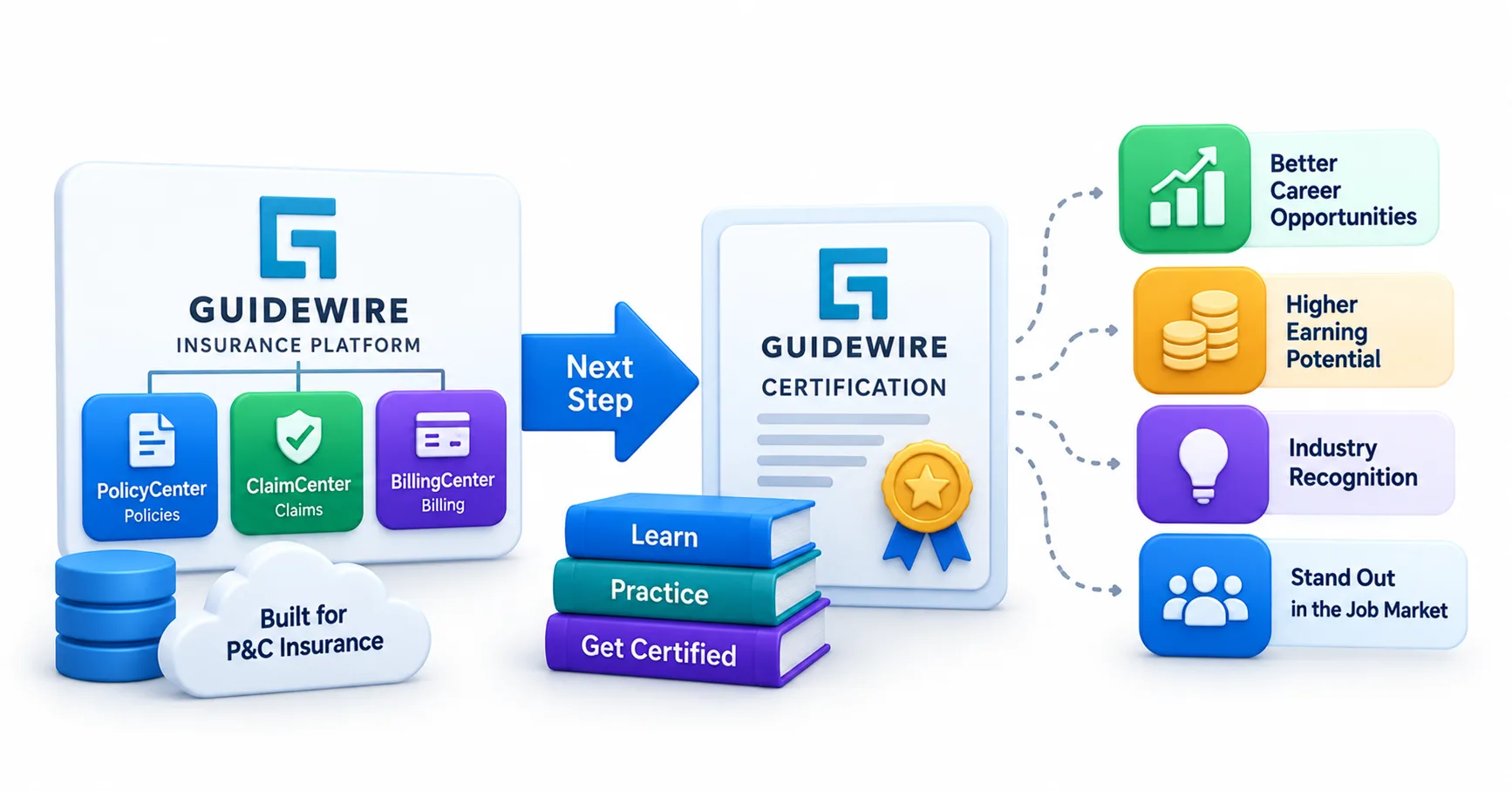
Guidewire builds core insurance software — PolicyCenter, ClaimCenter, and BillingCenter — used by insurers around the globe to manage policies, claims, and billing in one connected system. It's not a niche tool; it's infrastructure that entire insurance companies run on. That makes Guidewire professionals genuinely hard to replace.
Here's the catch: knowing the platform and proving you know it are two different things. A Guidewire certification acts as a shortcut for recruiters and hiring managers who don't have time to test every applicant's skills personally. It's a signal, not a formality.
Think of it like a driving test. You might drive perfectly well without one, but nobody's handing you the keys to a company car until they see proof. Certifications work the same way in enterprise software hiring — especially in insurance tech, where mistakes in configuration can ripple into real financial consequences.
This is exactly why so many professionals now treat Guidewire credentials as a career requirement rather than a bonus line on a resume. The question isn't whether to get certified anymore — it's which certification actually fits where you stand right now.
Associate Certification: Your Honest Starting Line
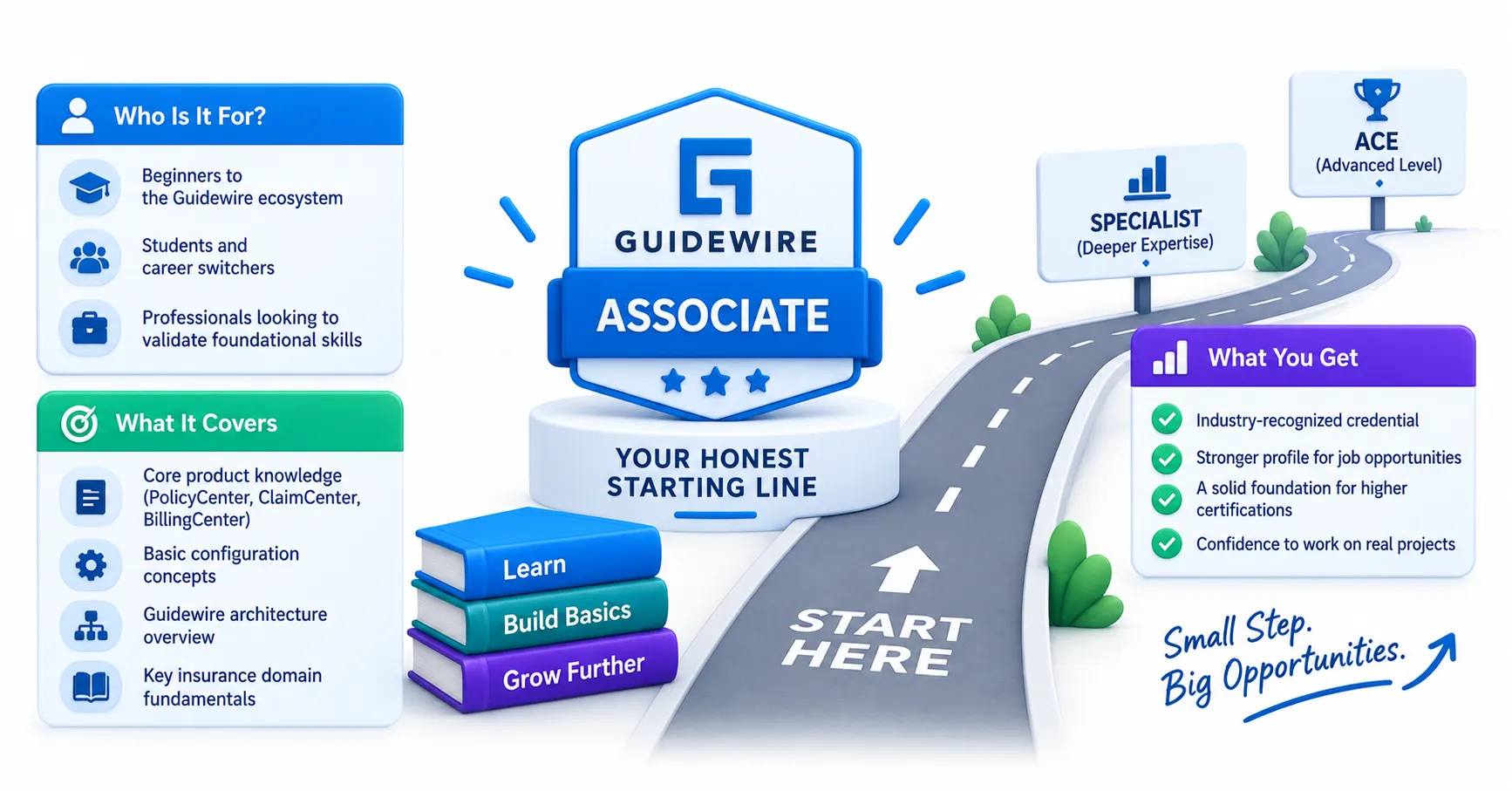
The Associate certification is Guidewire's entry point, and it's built for exactly that purpose. It tests your grasp of core concepts — the data model, basic configuration principles, and how PolicyCenter, ClaimCenter, or BillingCenter are structured under the hood.
You don't need years of hands-on project experience to attempt it. What you do need is genuine familiarity with Guidewire's architecture, gained through structured study rather than skimming documentation the night before.
Here's where people go wrong: they treat Associate-level prep as optional because "it's just the beginner exam." That mindset backfires. Skipping a solid foundation here makes every later certification harder, because Specialist and ACE both assume you've internalized these basics already.
If you're starting from zero, a guided path helps enormously. Programs like the structured Guidewire training in India walk beginners through the platform systematically instead of leaving them to piece it together from scattered forum posts.
Realistically, most successful candidates spend several weeks in focused preparation before sitting this exam. Rushing it rarely pays off — recruiters can tell the difference between someone who understands the platform and someone who memorized flashcards.
Specialist Certification: Where Theory Meets Real Configuration
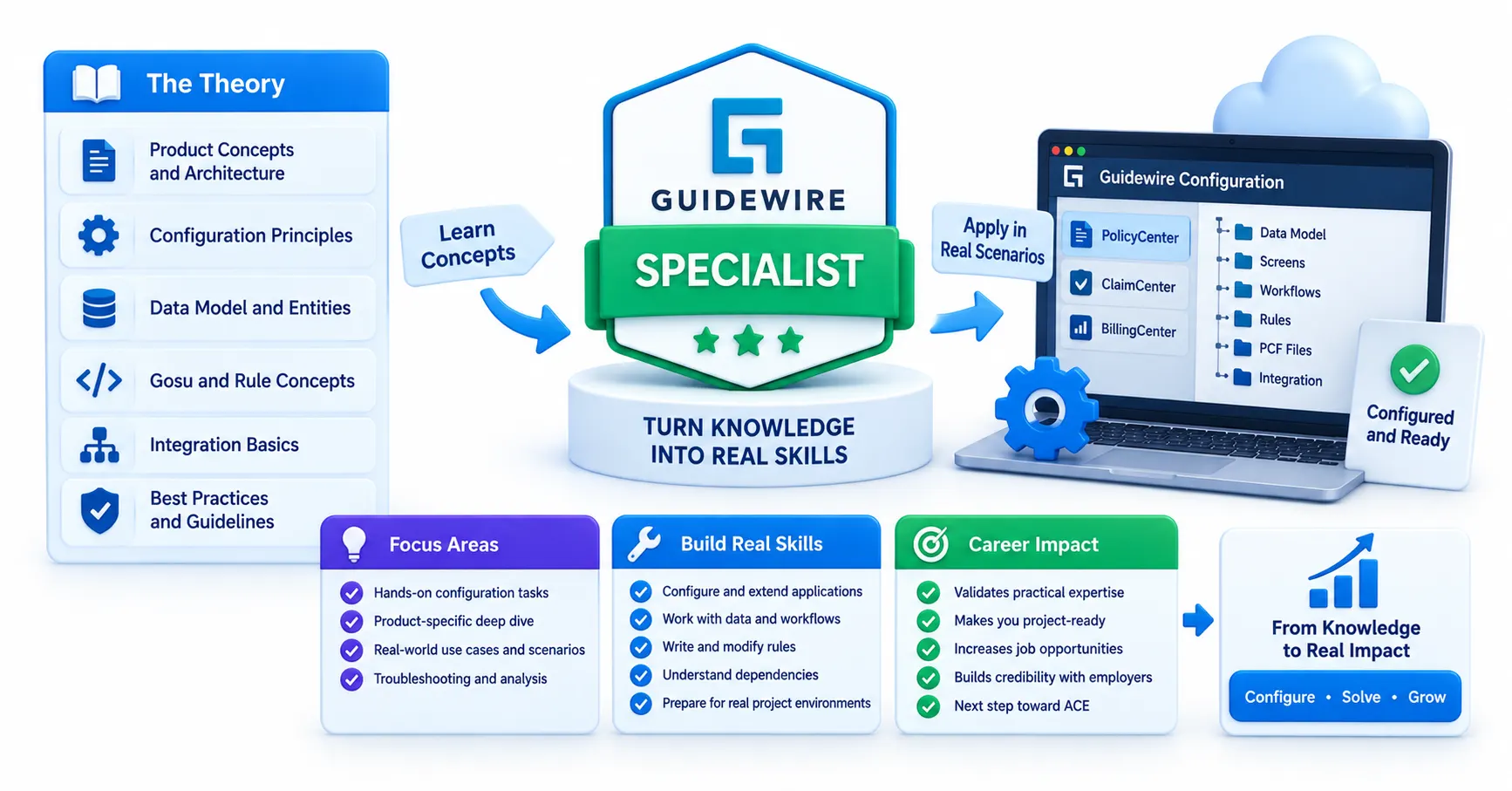
Once you've cleared the Associate level, Specialist certification is where things get genuinely practical. This tier tests whether you can actually configure Guidewire applications — not just describe how configuration works in theory.
Expect scenario-based questions built around real implementation situations: modifying business rules, working with the product model, handling integrations, or troubleshooting configuration issues that mirror actual client projects. A structured Guidewire certification and training in Hyderabad program can help you build this practical foundation while preparing for the certification requirements.
This is the certification that separates people who studied Guidewire from people who've genuinely worked inside it. Employers notice the difference during technical interviews because Specialist-certified candidates tend to speak in specifics rather than generalities.
One practical tip: don't attempt Specialist certification purely from textbooks. Get your hands on a sandbox environment first. Configuration knowledge that only exists on paper collapses the moment someone asks you to actually build something.
Many professionals treat Specialist as the real career turning point — the moment their Guidewire skills stop being theoretical and start becoming practically valuable. If your goal is landing implementation or configuration-focused roles, Specialist certification is arguably the most valuable tier to prioritize, particularly when combined with hands-on practice.
ACE Certification: The Advanced Credential That Opens Senior Doors
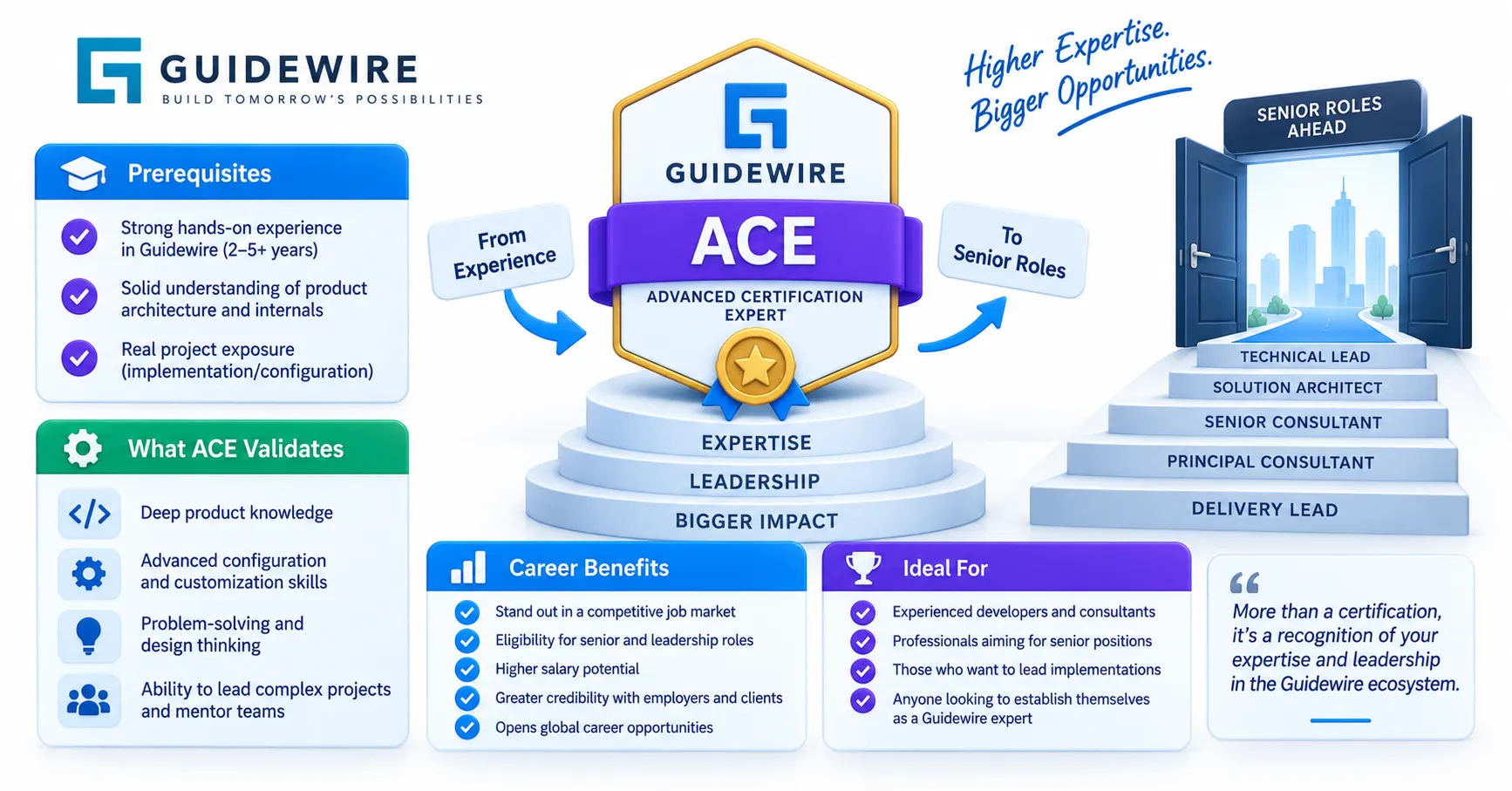
ACE certification — Guidewire's Authorized Certified Engineer credential — sits at the top of the ladder, and it's not designed for beginners dabbling in the platform.
ACE-level exams dig into advanced architecture decisions, complex integration patterns, and platform-wide design choices that affect entire implementations, not just individual modules. This is credential territory for people already working on live Guidewire projects, often in senior developer or technical lead capacities.
Employers view ACE certification differently than the earlier tiers. It's less about "can this person configure a feature" and more about "can this person be trusted to make architectural decisions that affect the whole system." That distinction matters enormously in enterprise insurance software, where a poor architectural call can create problems years down the line.
Naturally, ACE certification demands real project exposure. There's no realistic shortcut here — you generally need substantial implementation experience before this exam becomes worth attempting, let alone passable.
If your career goal involves technical leadership, solution architecture, or consulting roles within the Guidewire ecosystem, ACE is the credential that eventually becomes almost mandatory. It's simply not the one you chase first.
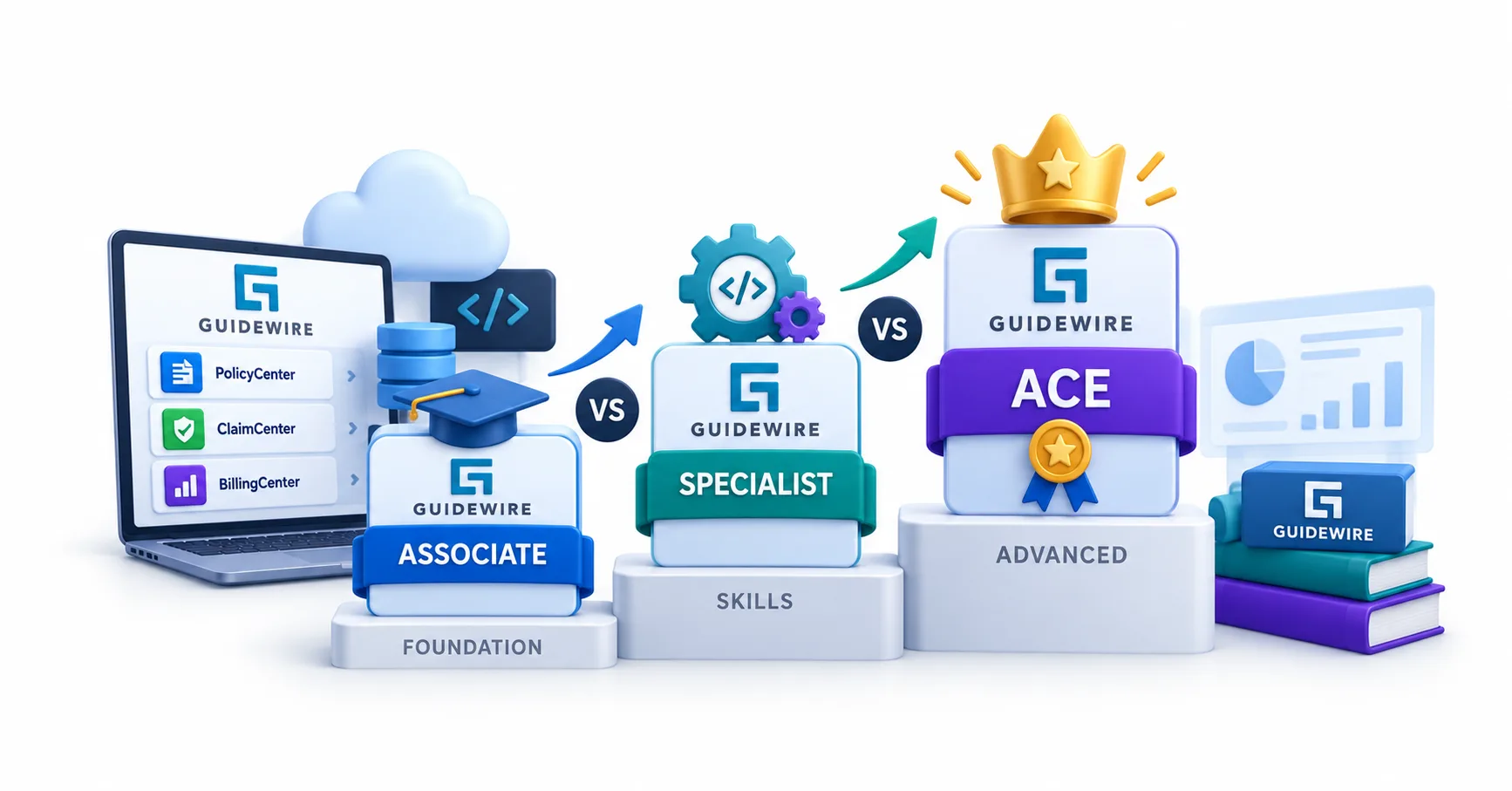
ACE vs Associate vs Specialist: The Real-World Comparison
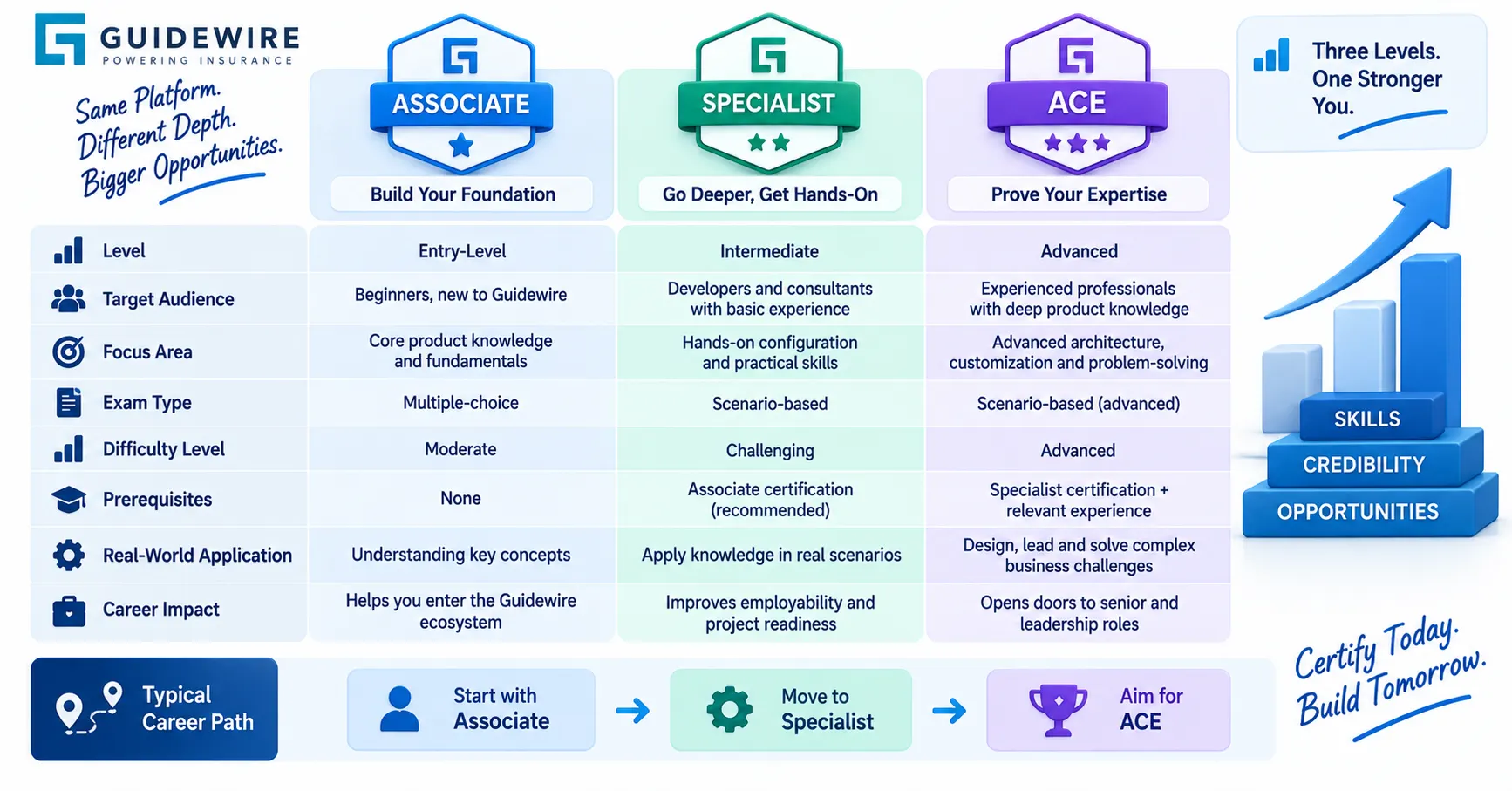
Laid side by side, the differences become obvious once you strip away the marketing language:
Associate — foundational knowledge, ideal for newcomers, tests conceptual understanding.
Specialist — hands-on configuration skill, ideal for active practitioners, tests applied ability.
ACE — advanced architecture and design mastery, ideal for senior professionals, tests strategic judgment.
Notice the progression isn't just difficulty increasing — it's the type of knowledge being tested that shifts entirely. Associate asks "do you understand this?" Specialist asks "can you build this?" ACE asks "can you architect this responsibly?"
This matters because plenty of people mistakenly assume certifications are just harder versions of each other, like exam levels in school. They're not. Each tier evaluates a fundamentally different professional capability, which is exactly why skipping straight to ACE without Specialist-level experience rarely works, regardless of how confident you feel.
Recruiters and hiring managers read these tiers the same way. An Associate badge signals potential. A Specialist badge signals capability. An ACE badge signals trust with high-stakes decisions.
So Which One Should You Actually Take First?
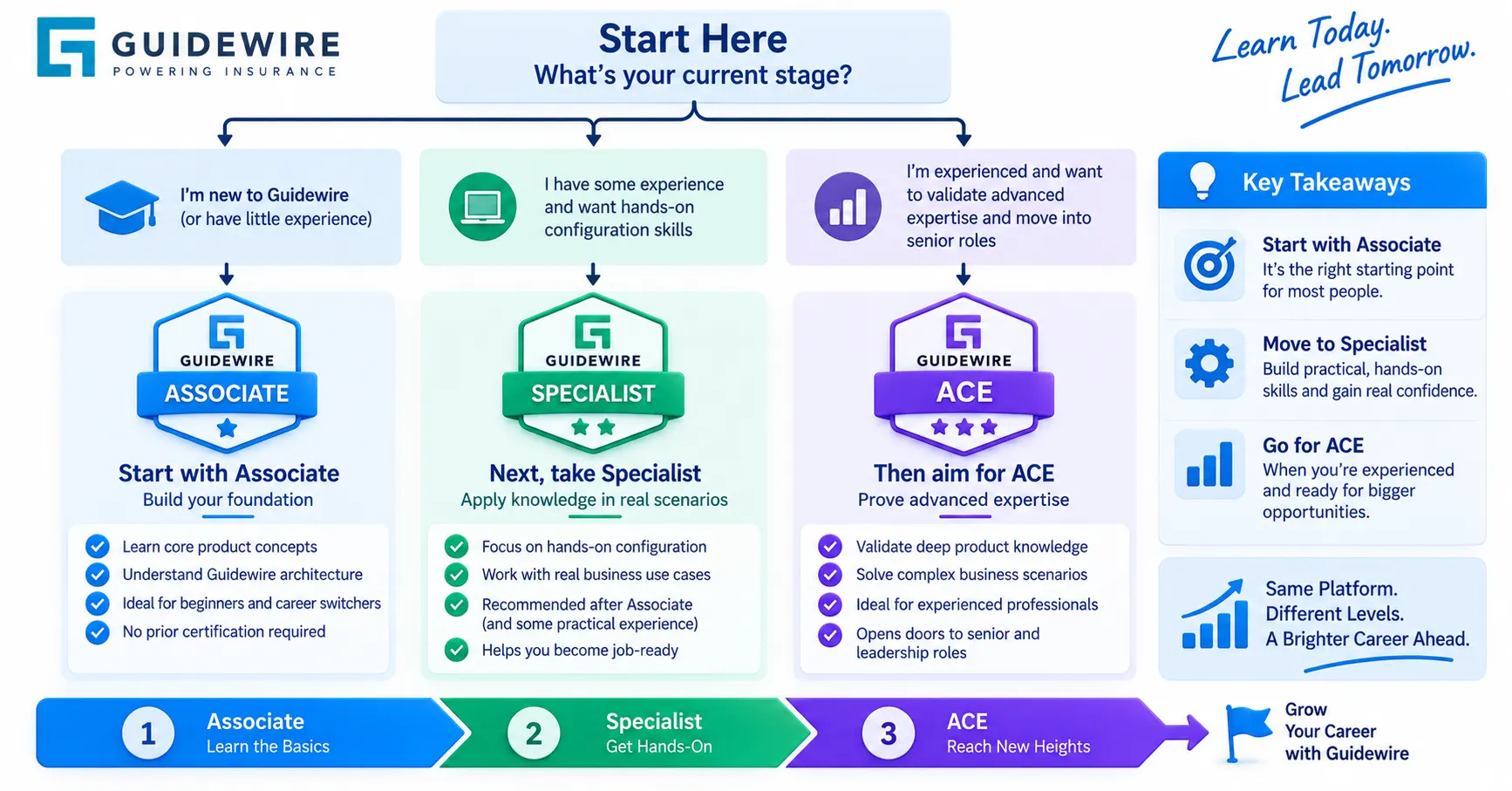
If you're new to Guidewire entirely, the answer is straightforward: Associate certification, no exceptions. Building without a foundation just creates cracks that show up later, usually during your first real project.
If you already have hands-on configuration experience — say, six months to a year working inside PolicyCenter or ClaimCenter — Specialist certification is your logical next move. It matches where your actual skill level already sits.
ACE certification should wait until you're deep into implementation work, ideally with architecture-level responsibilities already on your plate. Attempting it earlier typically means studying concepts you haven't actually applied yet, which rarely sticks.
The honest advice most experienced Guidewire professionals give newcomers: don't chase the most impressive-sounding certification first. Chase the one that matches your current reality, then let your experience catch up to the next tier naturally.
Conclusion
Guidewire certification isn't one exam — it's a career ladder. Start at Associate, earn Specialist through real configuration work, and let ACE arrive once your experience genuinely supports it. Climb it in order, and each credential will actually mean something.