

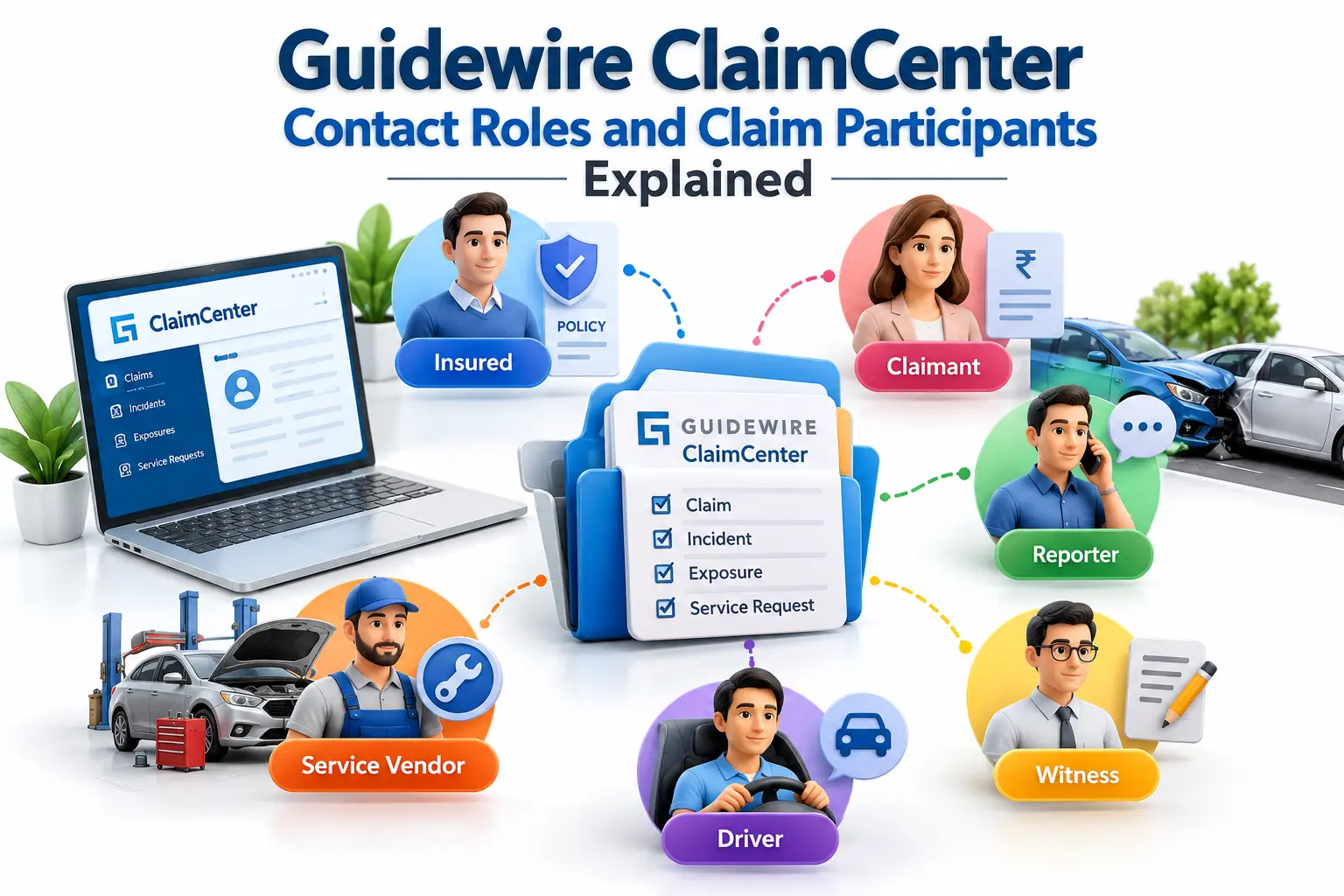
Guidewire ClaimCenter Contact Roles and Claim Participants Explained
Navigate through this article using the table of contents below
Table of Contents
No headings found in this article.
A claim can involve multiple people, organizations, and service providers, but each participant has a different responsibility. Incorrectly assigning a contact role can create confusion during claim handling, affect communication, and complicate payment workflows. Understanding how Guidewire ClaimCenter manages these relationships is essential for building accurate, consistent, and efficient insurance claim processes.
From insured individuals and claimants to witnesses, drivers, and repair vendors, every participant contributes different information to a claim. Learning how contact roles connect to claims, incidents, exposures, and service requests helps developers, testers, and insurance professionals understand the application beyond its basic screens.
Understanding Claim Participants in Guidewire ClaimCenter
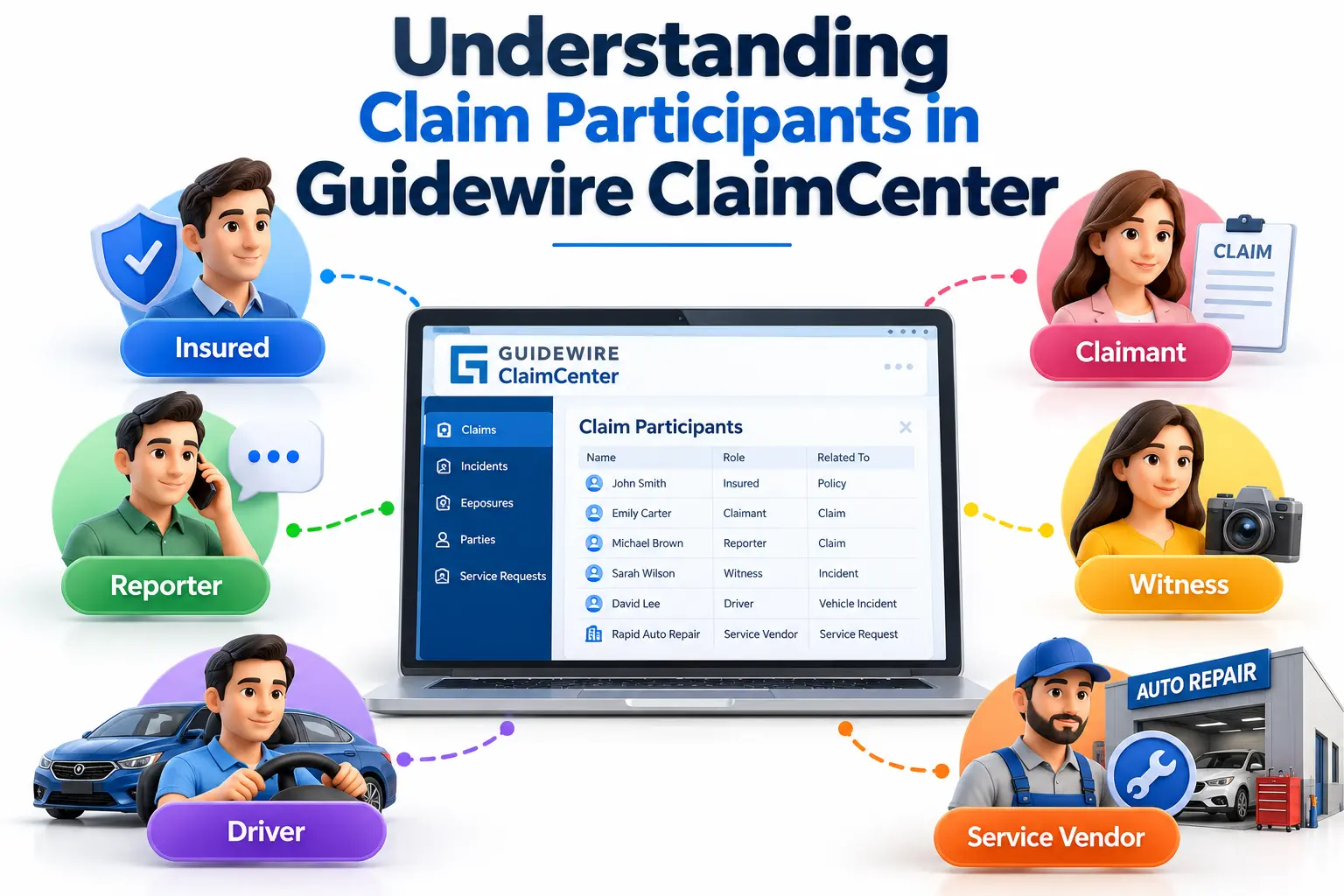
Claim participants are the people or organizations associated with an insurance claim. In Guidewire ClaimCenter, these relationships are represented through claim contacts, commonly referred to as ClaimContact resources in Cloud API. Participants may be involved in reporting an accident, suffering a loss, providing evidence, receiving compensation, or delivering repair services.
Consider an automobile accident involving an insured driver, another vehicle owner, a witness, and an auto repair shop. Each party has a different purpose within the same claim. The insured may report the accident, the other driver may submit a third-party claim, the witness may provide evidence, and the repair shop may complete the vehicle repairs.
Claim participants can include:
Insured: The individual or organization covered by the insurance policy.
Claimant: A person or entity seeking compensation for a loss.
Reporter: The person who initially reports the incident.
Witness: Someone who provides information about the incident.
Driver: A person associated with a specific vehicle incident.
Service vendor: An organization or professional providing services related to the claim.
Understanding these distinctions helps teams configure accurate claim information and avoid treating every participant as having the same relationship with the insurer.
How Contact Roles Work and Why They Matter
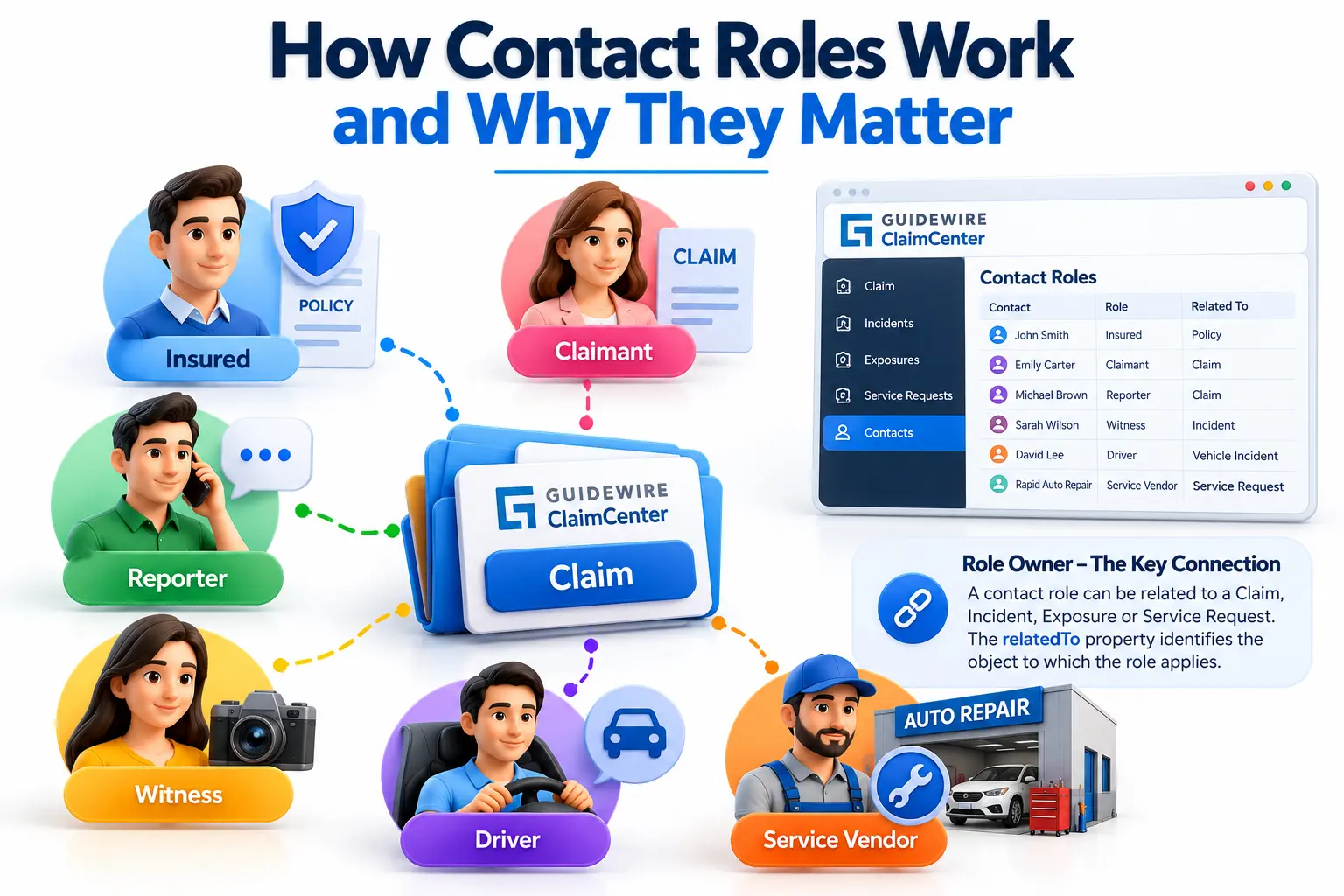
A contact role defines the relationship between a claim contact and a particular object associated with the claim. Importantly, a role is not always limited to the claim itself. It can relate to a policy, vehicle incident, exposure, or service request.
For example, an insured individual may also be the reporter and claimant on the same claim. That individual could additionally hold the driver role for a particular vehicle incident. These relationships serve different business purposes, even though they refer to the same person.
ClaimCenter uses the concept of a role owner to identify the object to which a role applies. In Cloud API, the relatedTo property identifies this associated object.
When reviewing contact roles, consider the following distinctions:
A claim-level role identifies a participant's relationship with the overall claim.
An incident-level role connects someone to a specific event, vehicle, property, or injured person.
An exposure-level role identifies a participant associated with a potential payment.
A service-request role connects a vendor with work requested to address the loss.
Correct role assignment improves claim visibility, supports business rules, and helps downstream processes identify the appropriate person or organization for a particular activity.
Common Contact Roles and Their Business Applications
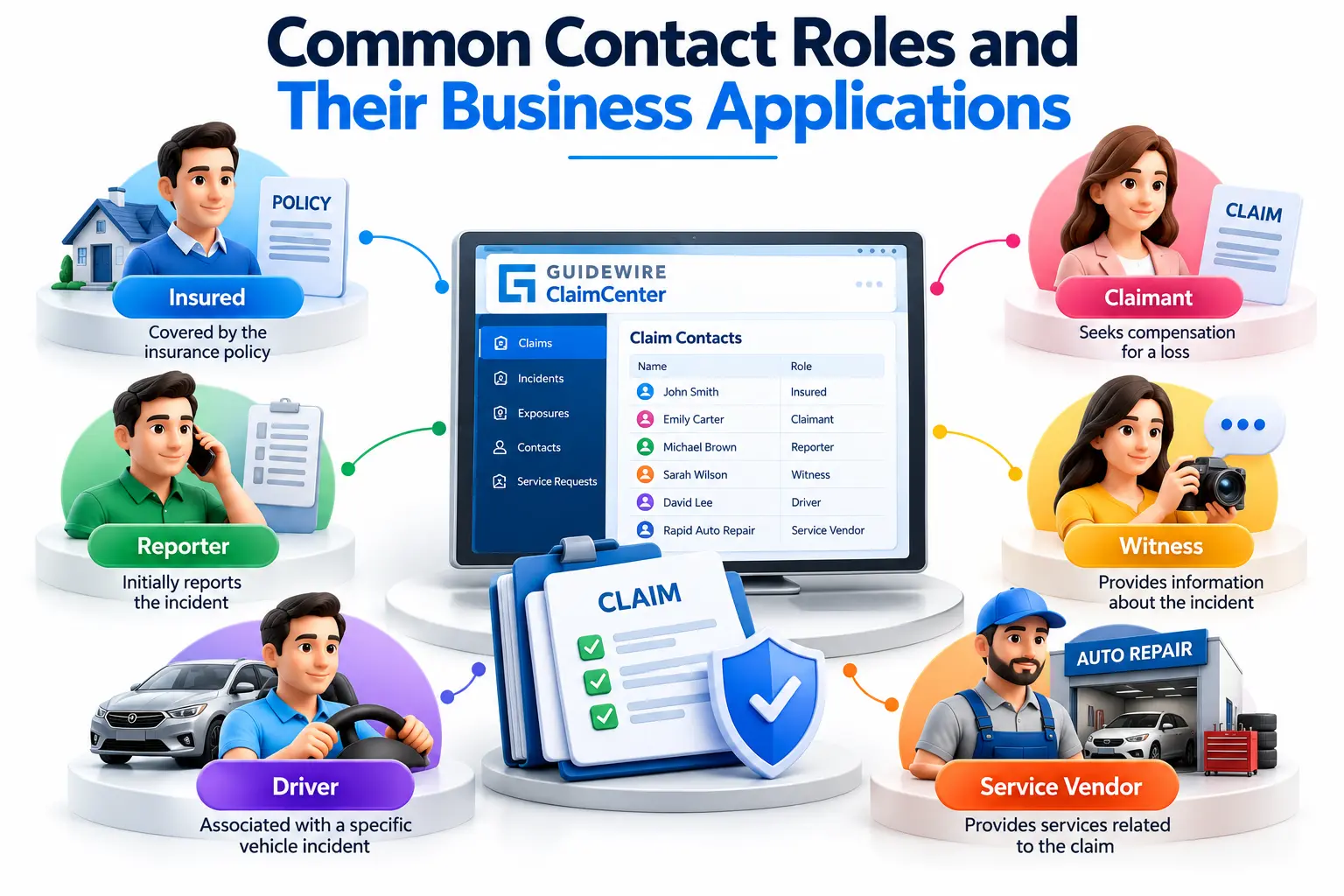
Contact roles help claims professionals understand who is involved, what each participant contributes, and how the claim should progress. Although available roles depend on the implementation and configuration, several common examples illustrate their practical significance.
Insured and claimant: The insured is associated with the policy providing coverage, while the claimant seeks compensation for a loss. These roles can belong to the same person or different parties. A third-party claimant, for instance, may not be insured under the policy responsible for the loss.
Reporter and witness: The reporter communicates the initial incident details. A witness provides information that may help establish what happened. The reporter is not necessarily the insured, and a witness does not automatically become a claimant.
Driver and service vendor: A driver is associated with a particular vehicle incident. A service vendor, such as an auto repair shop or medical provider, supplies services related to the loss.
In practice, teams should verify that each participant has the correct role for the relevant object. Assigning someone as a driver at the claim level instead of associating them with the appropriate vehicle incident can weaken the accuracy of the claim record.
These distinctions are particularly valuable when a single claim contains multiple vehicles, injured individuals, claimants, and potential payments.
Managing Claim Contacts and Role Assignments
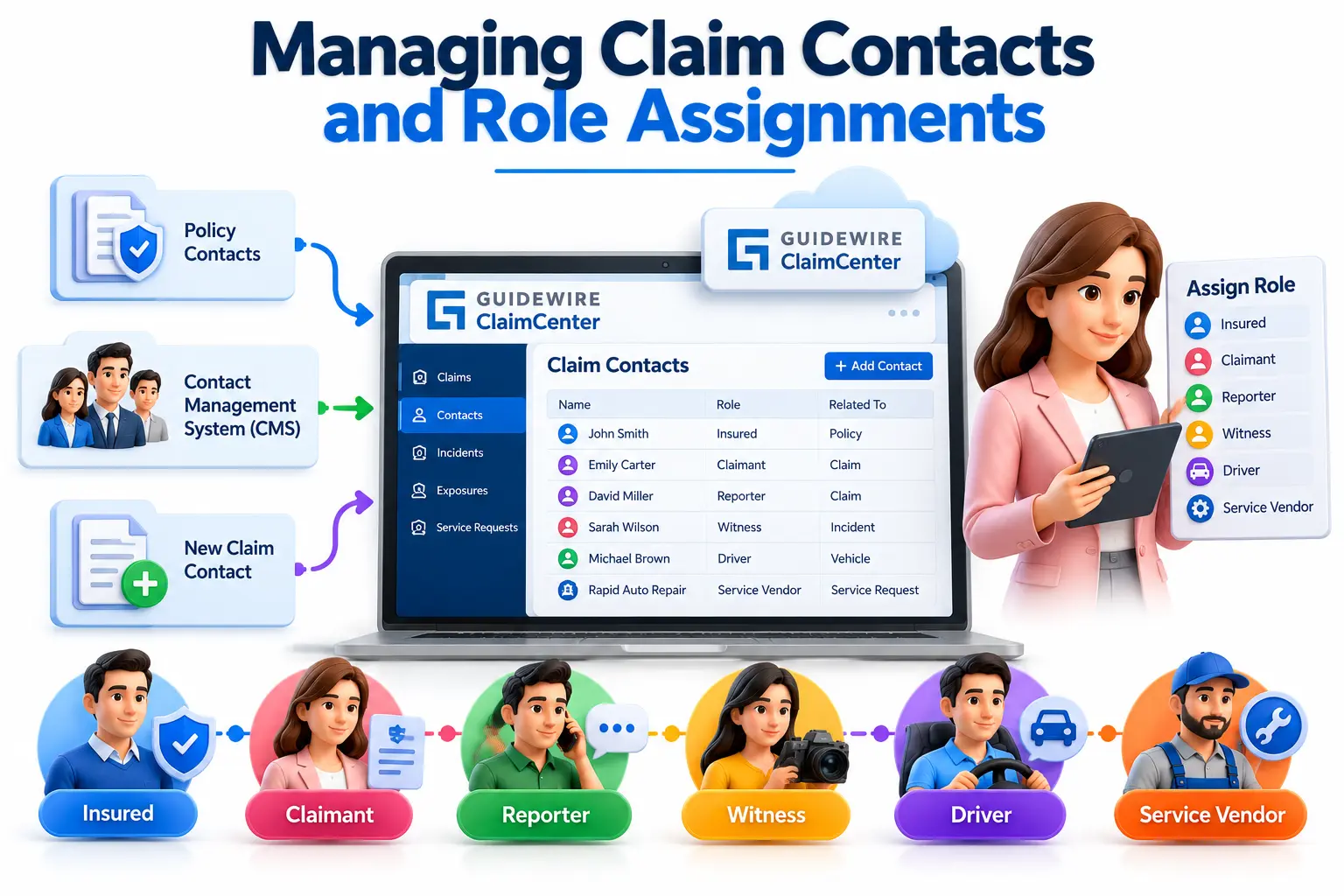
ClaimCenter supports contacts originating from policy information, an integrated contact management system, or information entered specifically for a claim. Policy contacts, such as the insured, may be available when a claim is created. Other participants, including witnesses and third-party claimants, may need to be added separately.
A typical contact management process involves these activities:
Identify whether the person or organization already exists in the available contact records.
Add the existing contact or create a new claim contact when appropriate.
Assign the required role or roles.
Confirm that each role belongs to the correct claim object.
Review the participant's information and relationship before completing the transaction.
In the user interface, claims professionals generally manage these relationships through the claim's Parties Involved area, although navigation and available actions can vary by product version and configuration.
For developers working with Cloud API, the endpoint POST /claim/v1/claims/{claimId}/contacts creates a claim contact. The minimum required information includes a contact subtype, an appropriate name field, and at least one role.
An important technical distinction is that reserved roles cannot be assigned by directly editing the contact's role collection. Instead, they are managed through the relevant field, array, or action on the associated object. Non-reserved roles can be managed through the editable role collection when permitted.
Common Mistakes, Troubleshooting, and Best Practices
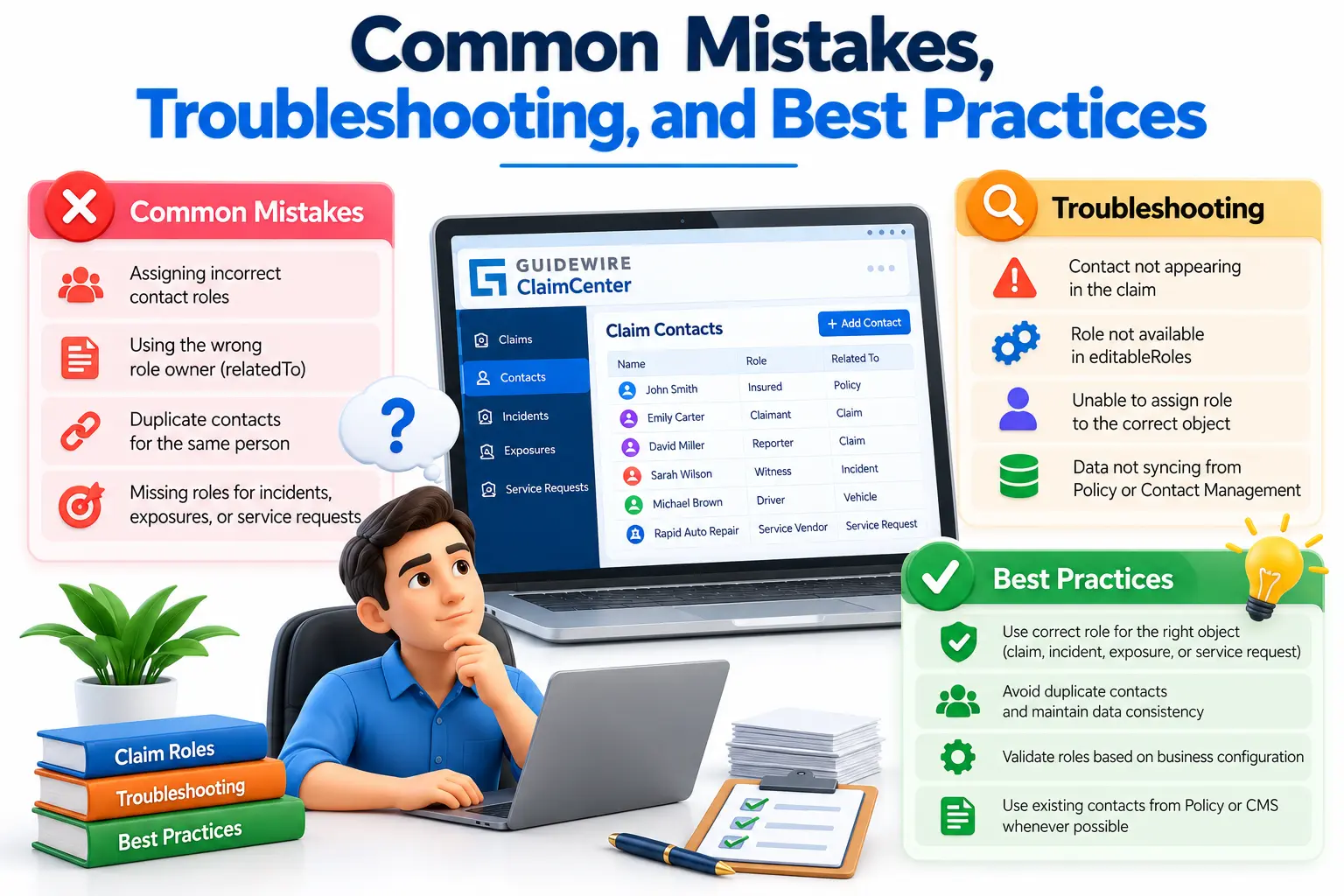
Contact-related problems often arise when users misunderstand role ownership, duplicate existing participants, or assume every role can be edited in the same way. These issues can affect claim data quality and integration behavior.
Common mistakes include:
Incorrect role ownership: Associating a driver with the wrong vehicle incident or a claimant with the wrong exposure.
Duplicate contacts: Creating another record without checking existing policy or contact management information.
Incorrect role assignment: Treating the reporter, insured, and claimant as interchangeable.
Improper API updates: Attempting to modify a reserved role directly through an editable role collection.
Ignoring inactive roles: Overlooking historical relationships when a service provider or other participant has been replaced.
A reliable troubleshooting process starts by identifying the contact, the assigned role, and the object that owns the relationship. Next, verify whether the role is reserved or non-reserved and determine which field, array, or action controls it. Finally, confirm that the resulting claim data reflects the intended business relationship.
For learners developing practical expertise, JastTech can use these scenarios to support hands-on discussions about contact management, claim configuration, and API integration. Professionals exploring Guidewire Training in Chennai can benefit from practicing these concepts alongside claim creation, exposure management, and incident handling.
Practical exercises should include adding a third-party claimant, assigning a witness, associating a driver with a vehicle incident, and reviewing role changes after a vendor replacement. Testing these situations builds stronger troubleshooting skills than memorizing role definitions alone.
Building Practical ClaimCenter Expertise Through Real Scenarios
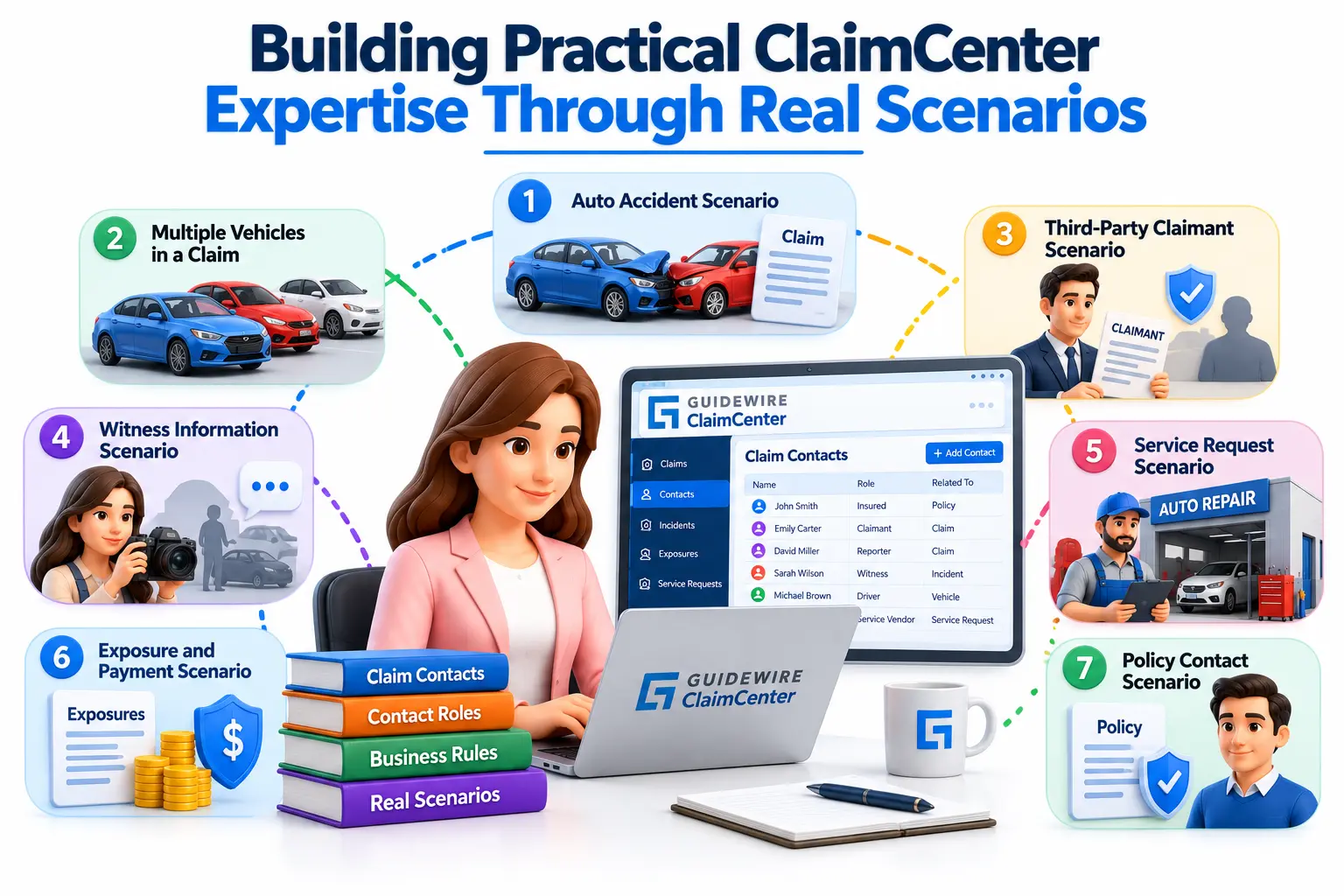
Understanding contact roles becomes more valuable when learners connect the data model to everyday insurance operations. A useful practice scenario is a multi-vehicle accident involving an insured driver, a third-party claimant, two vehicle incidents, a witness, and a repair vendor. Each participant should be associated with the correct object and business responsibility.
During testing, verify that the insured and claimant relationships remain distinct, incident-specific roles reference the correct vehicle, and exposure-level claimant relationships support the intended payment workflow. Also check whether the application permits the expected role assignments and whether integrations preserve contact identifiers.
Developers should become familiar with ClaimContact, ClaimContactRole, and the related contact relationships. In Cloud API implementations, they should additionally understand the difference between the read-only roles array and the editable editableRoles array. These details are important when investigating API validation errors and unexpected role behavior.
Testers can strengthen their approach by preparing scenarios for valid assignments, invalid role combinations, duplicate contacts, inactive relationships, and changes involving multiple claim objects. The exact behavior must always be verified against the project's Guidewire version and configuration.
Conclusion
Guidewire ClaimCenter contact roles establish how people and organizations relate to claims, policies, incidents, exposures, and service requests. Understanding these relationships helps insurance professionals maintain accurate claim records, while developers gain a clearer understanding of the underlying data model and integration requirements. Correct role ownership, appropriate contact management, and careful validation are essential for reliable claim processing.
For aspiring Guidewire professionals, practical exercises involving claim participants provide a strong foundation for understanding real insurance workflows. JastTech can help learners explore these concepts through structured technical learning and scenario-based practice. By combining business knowledge with hands-on configuration and API testing, learners can develop the skills needed to work more confidently with ClaimCenter implementations.