

Guidewire ClaimCenter Subrogation and Recovery Operations Career Guide in Hyderabad
Navigate through this article using the table of contents below
Table of Contents
No headings found in this article.
Insurance claims do not always end when an insurer pays the policyholder. Sometimes, another party is responsible for the loss, creating an opportunity to recover the money. This is where Guidewire ClaimCenter subrogation and recovery operations become essential to modern insurance management.
For aspiring Guidewire professionals in Hyderabad, understanding these processes can open opportunities in insurance technology. From identifying recovery opportunities to managing financial transactions, subrogation combines insurance knowledge, technical configuration, and practical problem-solving skills.
Understanding Subrogation and Recovery Operations in Guidewire ClaimCenter
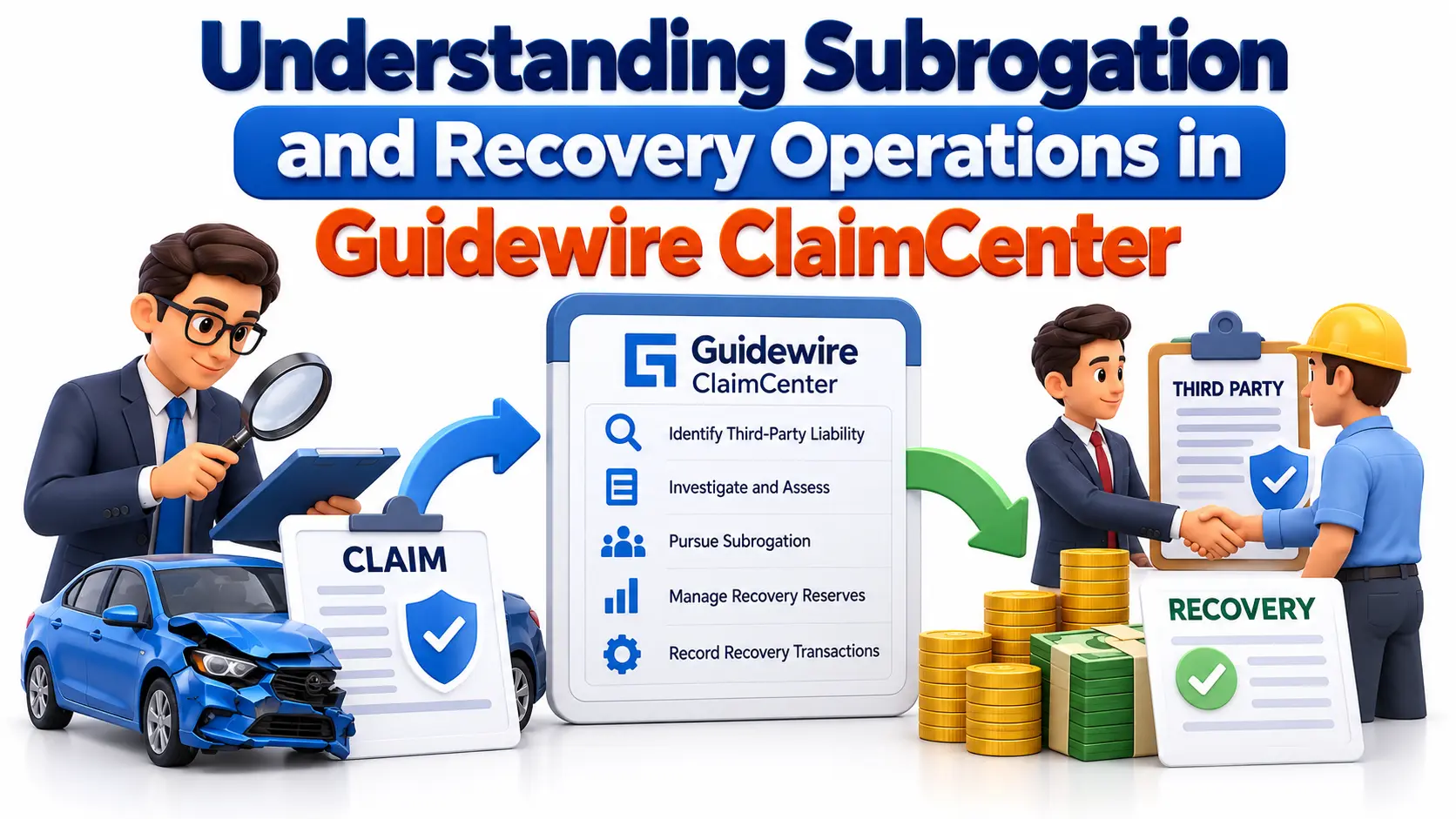
Subrogation is the process through which an insurance company seeks reimbursement from a responsible third party after compensating its policyholder for a covered loss. It helps insurers reduce net claim costs while maintaining accurate financial records and supporting fair claim settlements.
For example, imagine an insured driver suffers vehicle damage caused by another driver. The insurer pays ₹80,000 for repairs. After investigating the accident, the insurer determines that the other driver was responsible and pursues reimbursement from the responsible party or their insurer.
Guidewire ClaimCenter supports the management of these activities through claim information, financial transactions, and recovery-related workflows.
Important concepts include:
Subrogation: Pursuing reimbursement from a legally responsible third party.
Recovery: Money received to offset claim payments or other recoverable amounts.
Recovery Reserve: An estimate of an expected recovery, where applicable.
Recovery Transaction: A financial record representing money recovered.
Claim Exposure: A representation of a specific potential liability within a claim.
Understanding these concepts helps developers connect insurance business requirements with ClaimCenter functionality.
How Guidewire ClaimCenter Manages the Subrogation Lifecycle
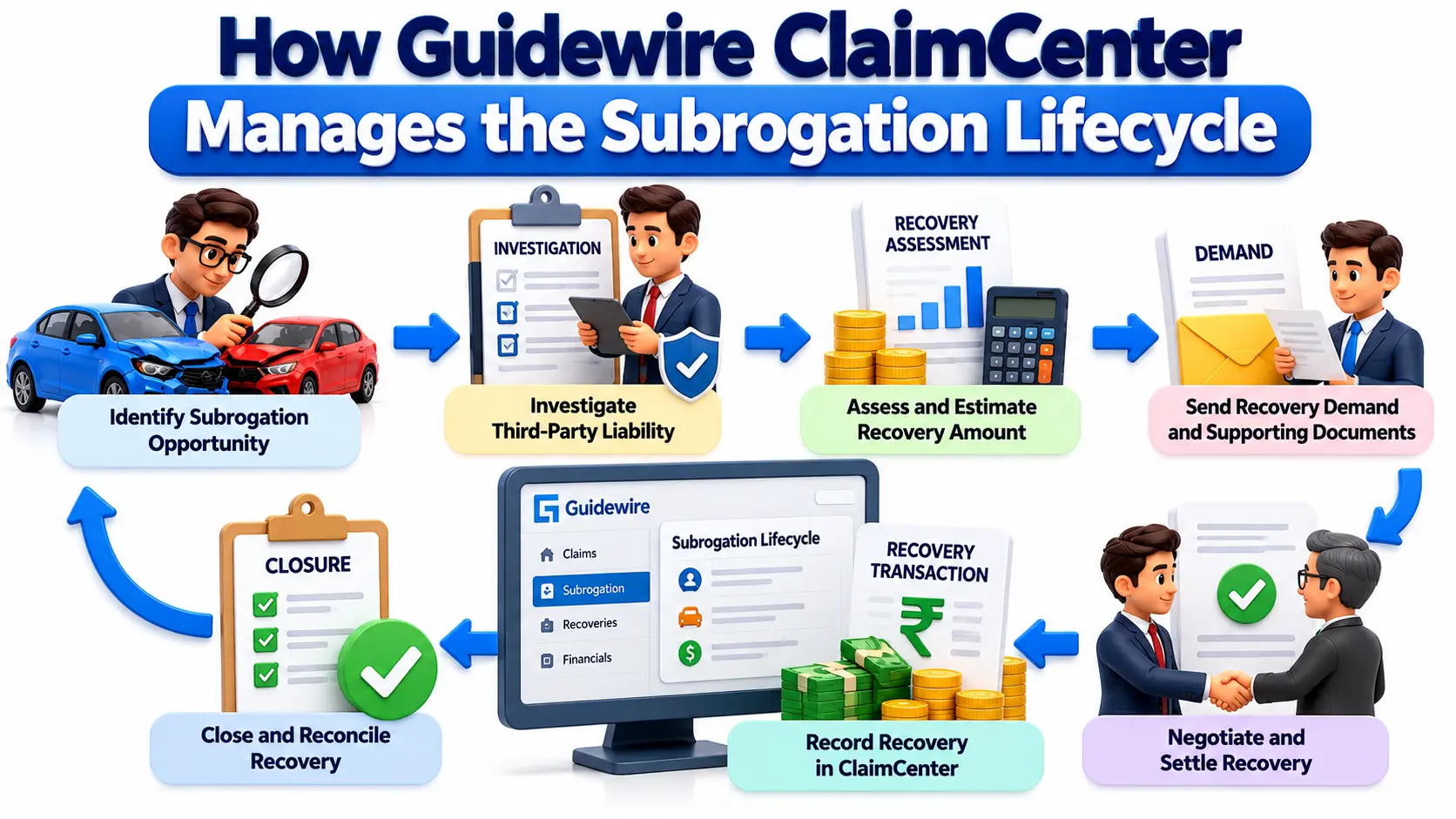
Subrogation involves multiple operational stages, beginning with identifying potential third-party liability and continuing through investigation, negotiation, collection, and financial reconciliation.
ClaimCenter provides claims-management capabilities that support these activities. Depending on the implementation, insurers may also use specialized subrogation solutions or external recovery-management systems.
A typical operational lifecycle includes:
Opportunity Identification: Reviewing claim circumstances to identify potential third-party responsibility.
Liability Investigation: Evaluating accident reports, supporting documents, and available evidence.
Recovery Assessment: Estimating the amount potentially recoverable.
Demand Preparation: Preparing reimbursement requests and supporting documentation.
Negotiation and Settlement: Communicating with responsible parties or their representatives.
Recovery Recording: Recording received funds through appropriate financial transactions.
Closure and Reconciliation: Verifying recovery amounts and completing the relevant operational activities.
Consider a motor insurance claim where the insurer pays ₹1,50,000. Investigation establishes that another party may be responsible for 70% of the loss. The potential recovery could be ₹1,05,000, subject to applicable legal rules, policy provisions, and settlement outcomes.
For Guidewire professionals, the technical challenge is ensuring that recovery information remains consistent with claim financials, permissions, workflows, and reporting requirements.
Understanding Recovery Reserves, Transactions, and Financial Configuration
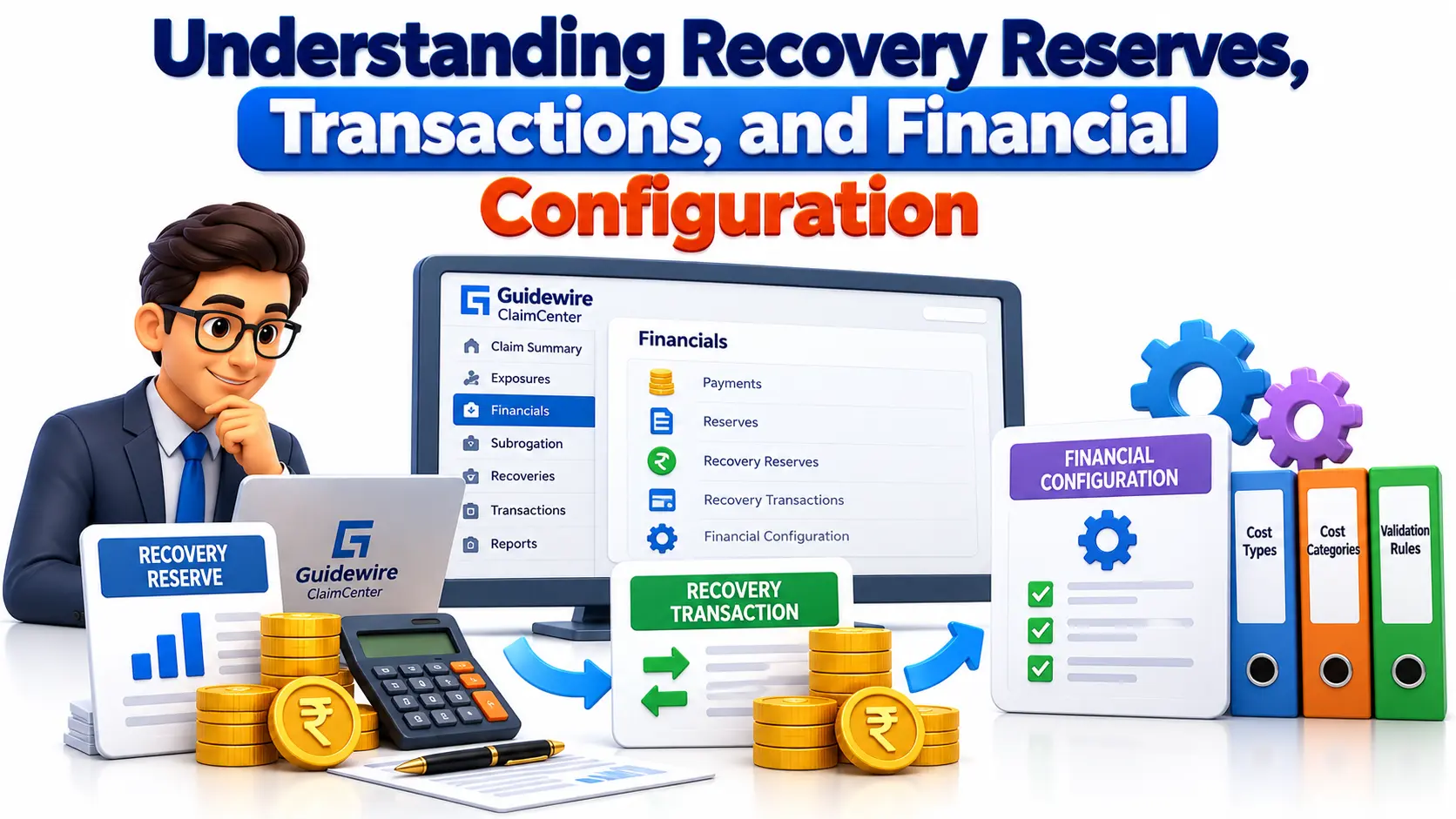
Financial configuration is one of the most important technical areas in Guidewire ClaimCenter. Developers must understand how payments, reserves, recovery reserves, and recoveries interact without confusing their accounting purposes.
A recovery reserve represents an anticipated recovery amount. An actual recovery transaction records funds recovered. These are separate financial concepts, and their handling depends on the insurer's configured business processes.
For example, an insurer might initially expect to recover ₹60,000 from a third party but eventually receive ₹45,000. The application must accurately represent the recovery received and appropriately adjust any remaining recovery reserve.
Important technical areas include:
Cost Types: Categorizing financial activity according to the nature of the claim expense.
Cost Categories: Providing additional classification for financial reporting.
Transaction Status: Tracking financial transactions through their configured lifecycle.
Financial Validation: Preventing invalid amounts and unauthorized financial operations.
Recovery Reporting: Supporting financial reconciliation and management analysis.
Developers should also understand how ClaimCenter financial transactions interact with downstream accounting systems.
For professionals pursuing guidewire training in hyderbad, financial transaction configuration is a valuable practical skill because it connects insurance accounting requirements with enterprise application development.
Configuring Subrogation Workflows and Integrations in ClaimCenter
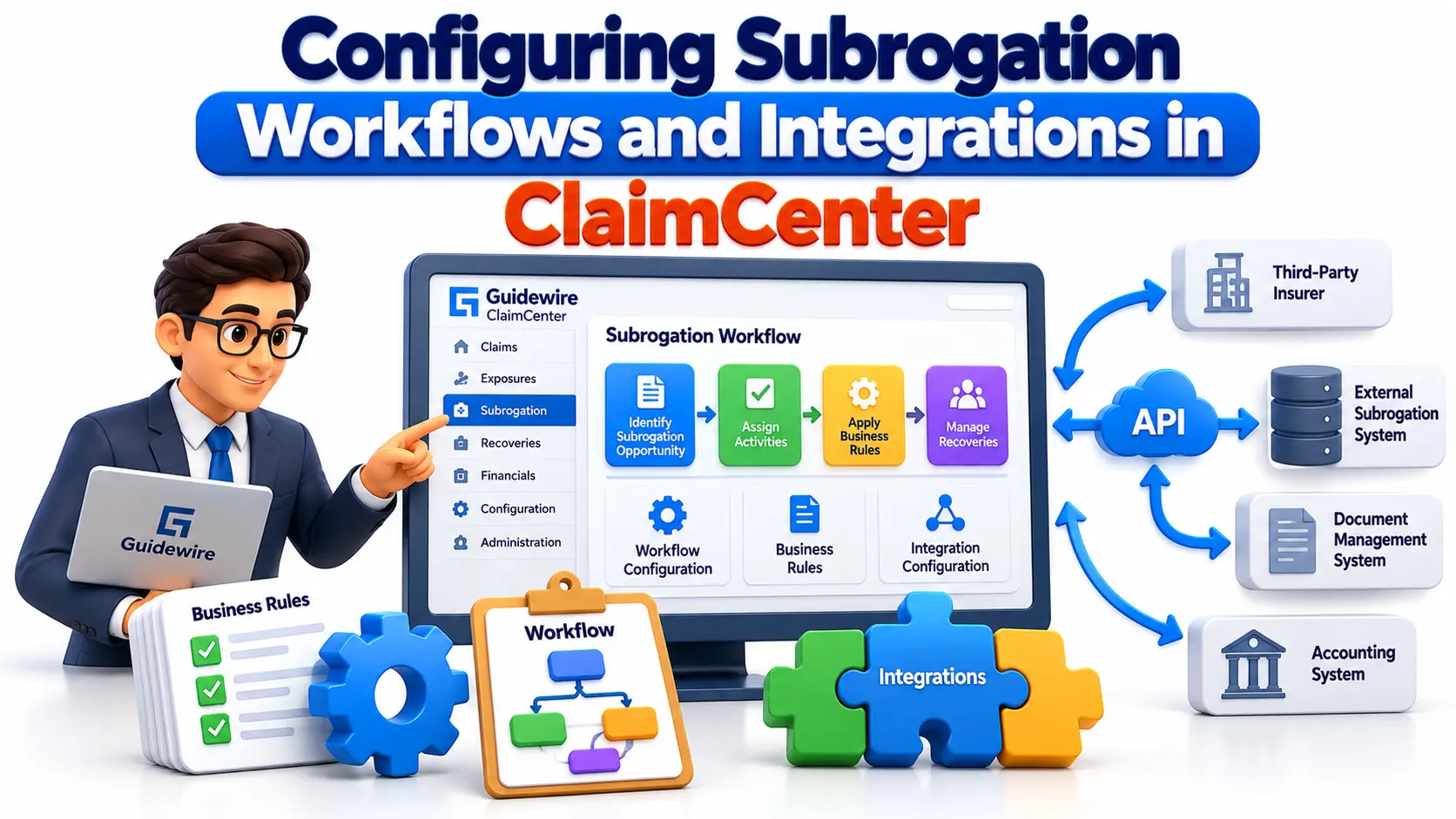
Subrogation processes frequently involve external applications, insurance adjusters, legal teams, and financial departments. Consequently, Guidewire developers must understand both application configuration and integration architecture.
ClaimCenter can support workflow automation through business rules, activities, assignments, and integrations. The exact implementation depends on the ClaimCenter version, deployment architecture, and insurer requirements.
A practical subrogation implementation may involve:
Business Rules: Identifying claims requiring additional recovery investigation.
Activity Configuration: Creating tasks for adjusters to review liability information.
Assignment Rules: Routing recovery-related activities to appropriate users or teams.
Gosu Development: Implementing supported business logic and validation.
Integration APIs: Exchanging relevant claim information with authorized external systems.
Messaging: Supporting asynchronous communication and reliable transaction processing.
For example, when a claim meets configured subrogation criteria, the system could create a review activity and send relevant information to an external recovery platform.
Developers must consider authentication, duplicate messages, failed transactions, and data consistency during integration design.
Professionals exploring guidewire claim center training should prioritize hands-on exercises involving financial configuration, business rules, Gosu, and integration troubleshooting rather than relying exclusively on theoretical platform knowledge.
These capabilities are particularly relevant to insurance technology projects requiring dependable claims processing and financial accuracy.
Testing and Troubleshooting Subrogation and Recovery Operations
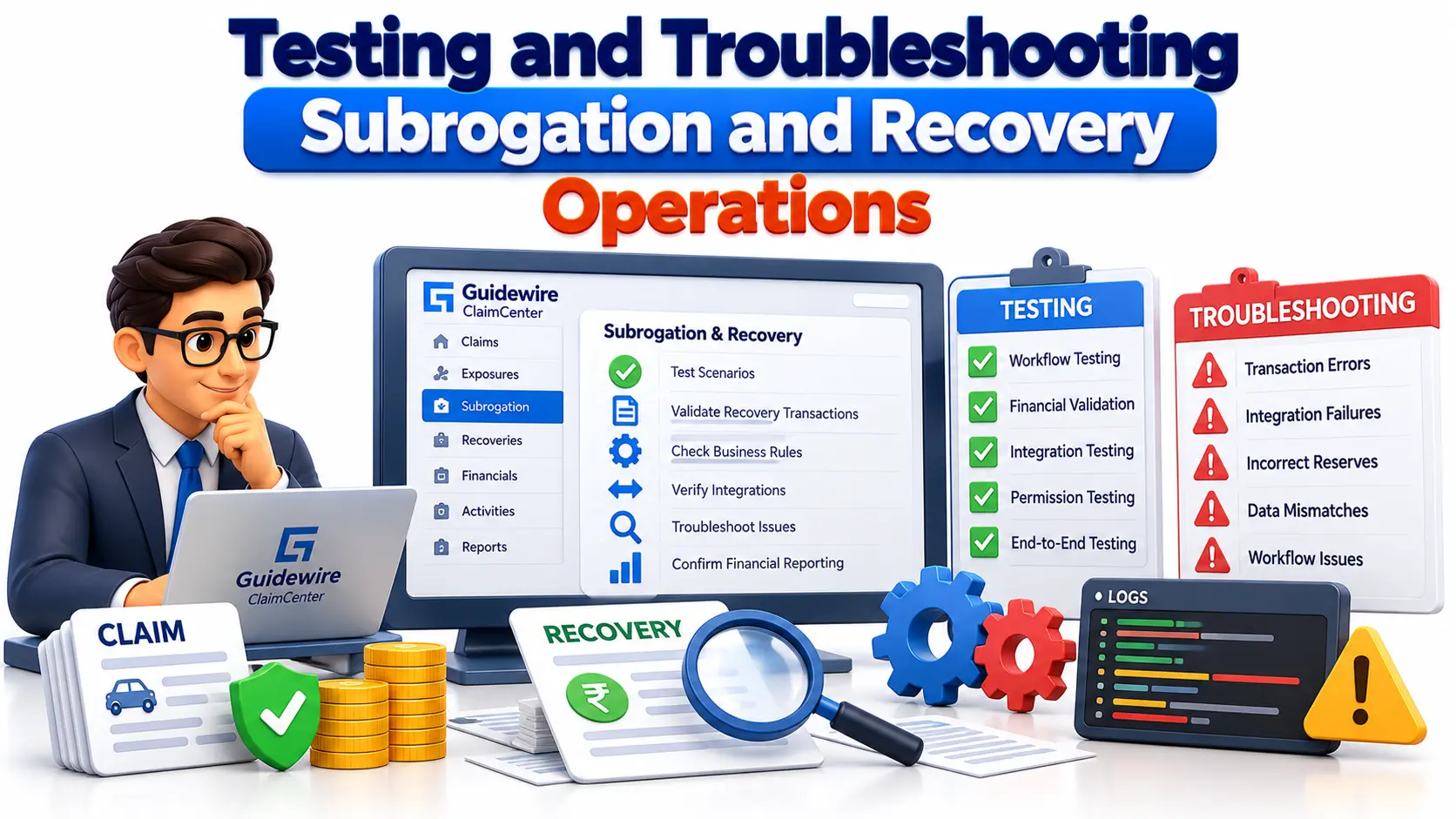
Subrogation configuration requires careful testing because incorrect financial processing can affect claim balances, accounting reconciliation, and operational reporting.
Guidewire developers should validate both business workflows and technical behavior. Testing must confirm that recovery-related transactions follow configured rules and that integrations handle unsuccessful operations safely.
Consider a claim with an expected recovery of ₹90,000. The insurer receives ₹50,000 initially and another ₹40,000 later. The system must accurately record both transactions and reflect the resulting financial position.
Important testing scenarios include:
Recording partial and complete recoveries.
Validating recovery reserve adjustments.
Preventing duplicate financial transactions.
Testing user permissions and approval requirements.
Handling failed external integration requests.
Confirming financial reporting accuracy.
Verifying recovery-related audit information.
Developers should also investigate transaction validation failures, incorrect financial classifications, and integration mapping errors.
A related learning area is Guidewire PolicyCenter Out of Sequence Transactions in Hyderabad, which introduces effective-dated policy changes and transaction sequencing. Although PolicyCenter out-of-sequence processing differs from ClaimCenter recovery operations, understanding both strengthens a developer's ability to reason about complex insurance data and business transactions.
Strong debugging skills help professionals move beyond basic configuration into production support and advanced implementation responsibilities.
Building a Guidewire ClaimCenter Subrogation Career in Hyderabad
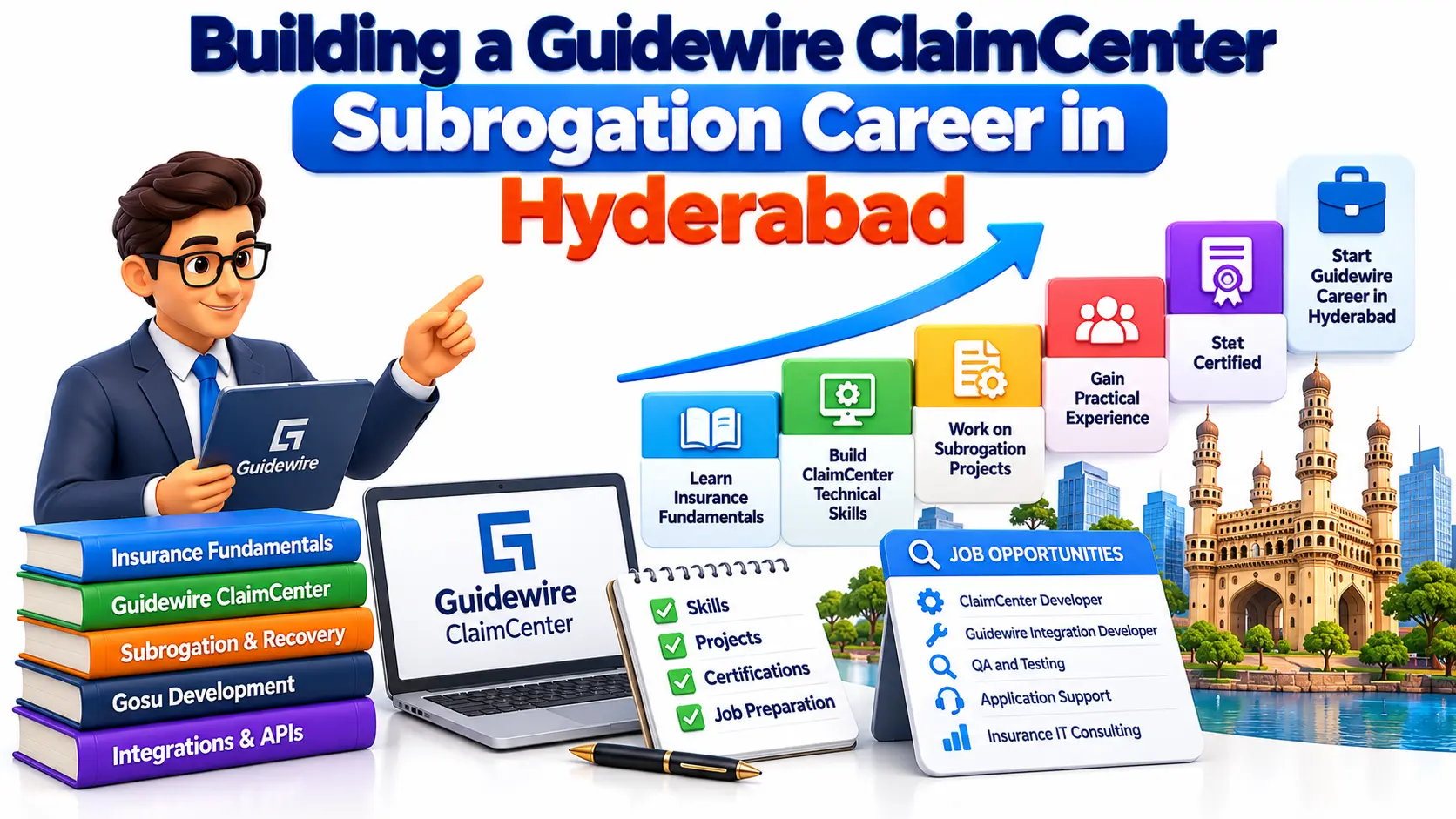
Hyderabad provides career opportunities in insurance technology through IT services, consulting organizations, and enterprise software delivery teams. Guidewire-related roles may involve ClaimCenter implementation, configuration, integrations, testing, and production support.
However, subrogation expertise is generally a specialization within broader ClaimCenter development or insurance operations roles rather than a separate entry-level job category.
Aspiring professionals should build their capabilities through a structured learning roadmap.
Start with insurance fundamentals. Understand claims processing, liability assessment, reserves, payments, recoveries, and subrogation terminology.
Develop ClaimCenter knowledge. Learn claim architecture, exposures, financial transactions, business rules, and application configuration.
Practice technical implementation. Build Gosu skills, understand entity relationships, and explore supported integration approaches.
Create a practical project. Design a simulated recovery workflow involving liability identification, recovery estimation, activity assignment, partial recovery recording, and financial validation.
Prepare for technical interviews. Practice explaining recovery reserves versus actual recoveries, transaction validation, integration failures, and business-rule implementation.
JastTech supports aspiring professionals seeking structured Guidewire learning and practical exposure to insurance application concepts. Training that connects business scenarios with technical exercises can help learners prepare for implementation-oriented interviews.
Candidates should also explore ClaimCenter developer, Guidewire integration developer, QA automation, and application support positions in Hyderabad.
Building demonstrable project experience is particularly valuable because employers often evaluate how candidates translate insurance requirements into reliable technical solutions.
Conclusion
Guidewire ClaimCenter subrogation and recovery operations represent an important intersection of insurance business processes, financial management, and enterprise software development. Understanding recovery lifecycles, financial transactions, configuration, integrations, and testing helps professionals develop specialized skills relevant to modern claims-management projects.
For aspiring Guidewire developers in Hyderabad, the strongest career preparation combines insurance fundamentals with hands-on technical practice. By building realistic projects, strengthening debugging capabilities, and understanding financial workflows, candidates can prepare for ClaimCenter implementation opportunities and develop expertise that supports long-term career growth.