

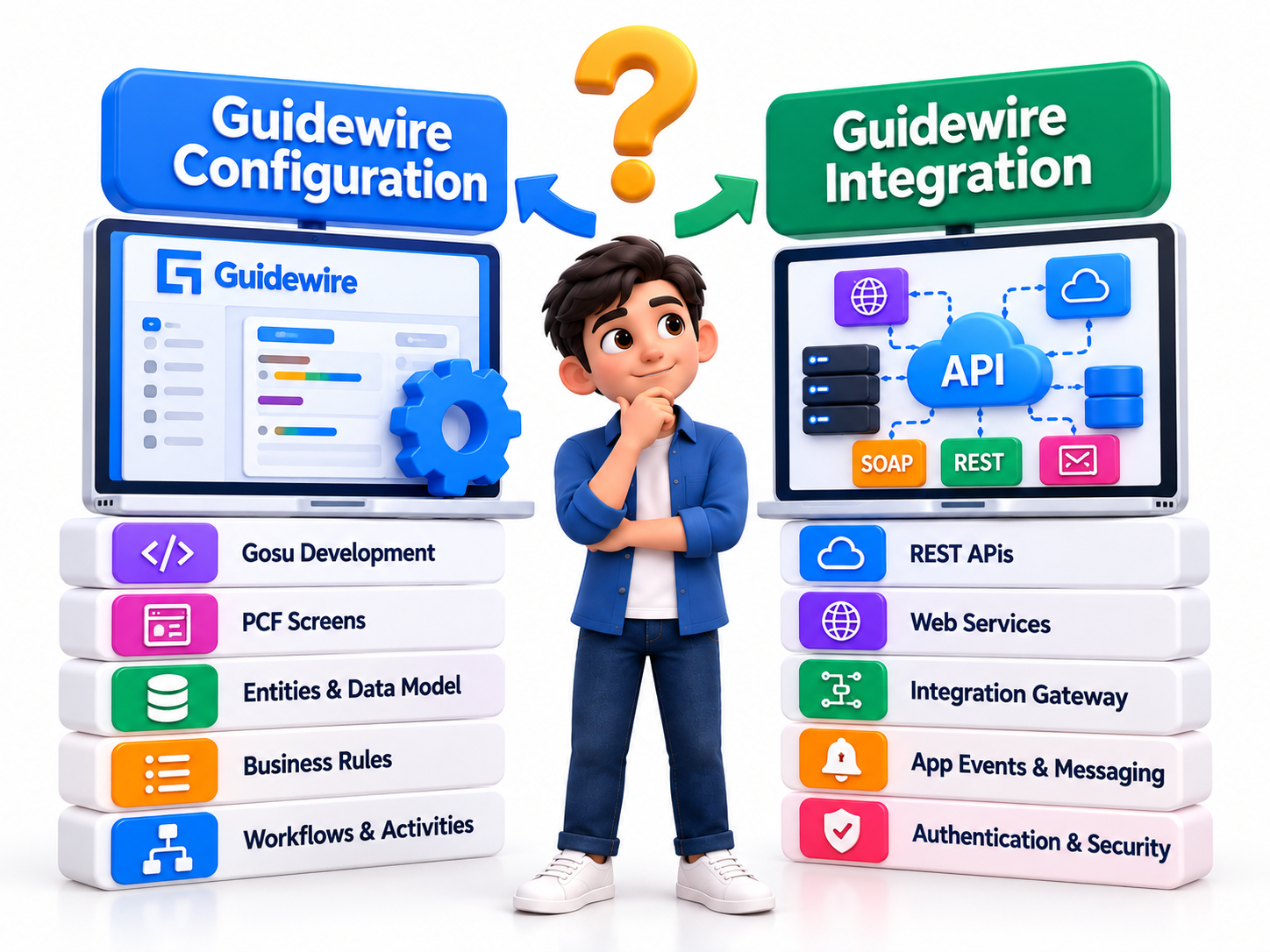
Guidewire Configuration vs Integration: Which Career Path Should Beginners Choose?
Navigate through this article using the table of contents below
Table of Contents
No headings found in this article.
Choosing between Guidewire Configuration and Integration looks simple until you actually start learning the platform. Both paths use Guidewire, both require technical problem-solving, and both can lead to developer roles—but the engineering problems you solve every day can be surprisingly different.
For a beginner, therefore, the better question is not simply, “Which Guidewire career is better?” It is, “Which type of problems do I want to become good at solving?” Understanding that distinction early can save months of unfocused learning and help you build skills that match real implementation work.
Start With What Configuration and Integration Actually Solve
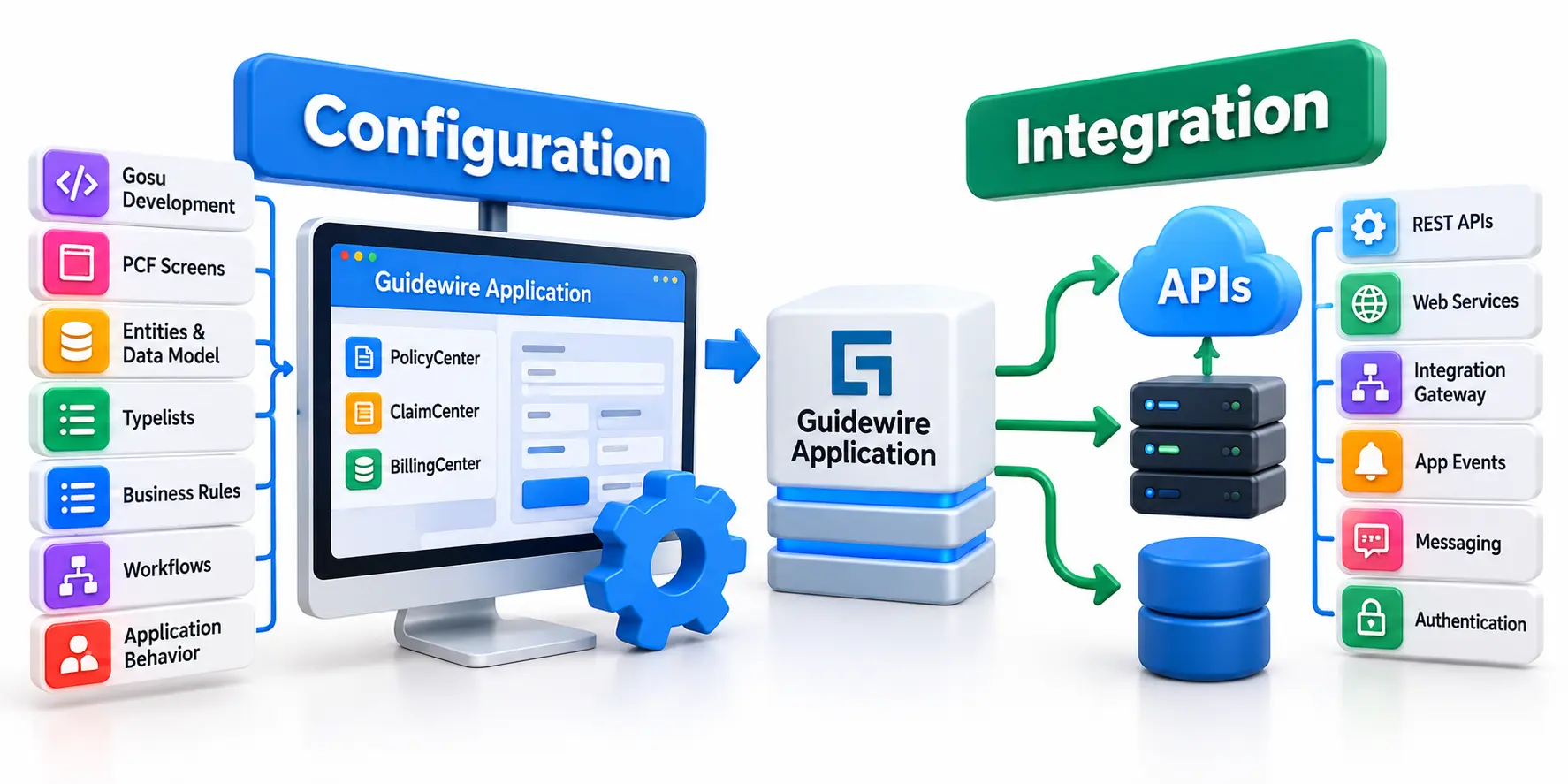
A Guidewire implementation must accomplish two broad technical goals. First, the core application has to behave according to an insurer's business requirements. Second, that application must communicate reliably with the company's wider technology ecosystem.
Configuration primarily addresses the first problem. A configuration developer works inside applications such as PolicyCenter, ClaimCenter, or BillingCenter and adapts their behavior. Depending on the project, that can involve:
Gosu programming
PCF screens and UI behavior
Entities and data-model extensions
Typelists
Business and validation rules
Workflows and activities
Permissions and application behavior
Integration focuses more heavily on the second problem. Insurance applications rarely operate independently. Guidewire may need to exchange information with payment platforms, document systems, customer portals, data platforms, external rating services, or other enterprise applications.
That makes integration developers responsible for designing dependable ways for information to enter, leave, and move between systems. The distinction is useful, but beginners should remember that real Guidewire projects frequently create overlap between the two roles.
Understand What Daily Work Feels Like in Each Career
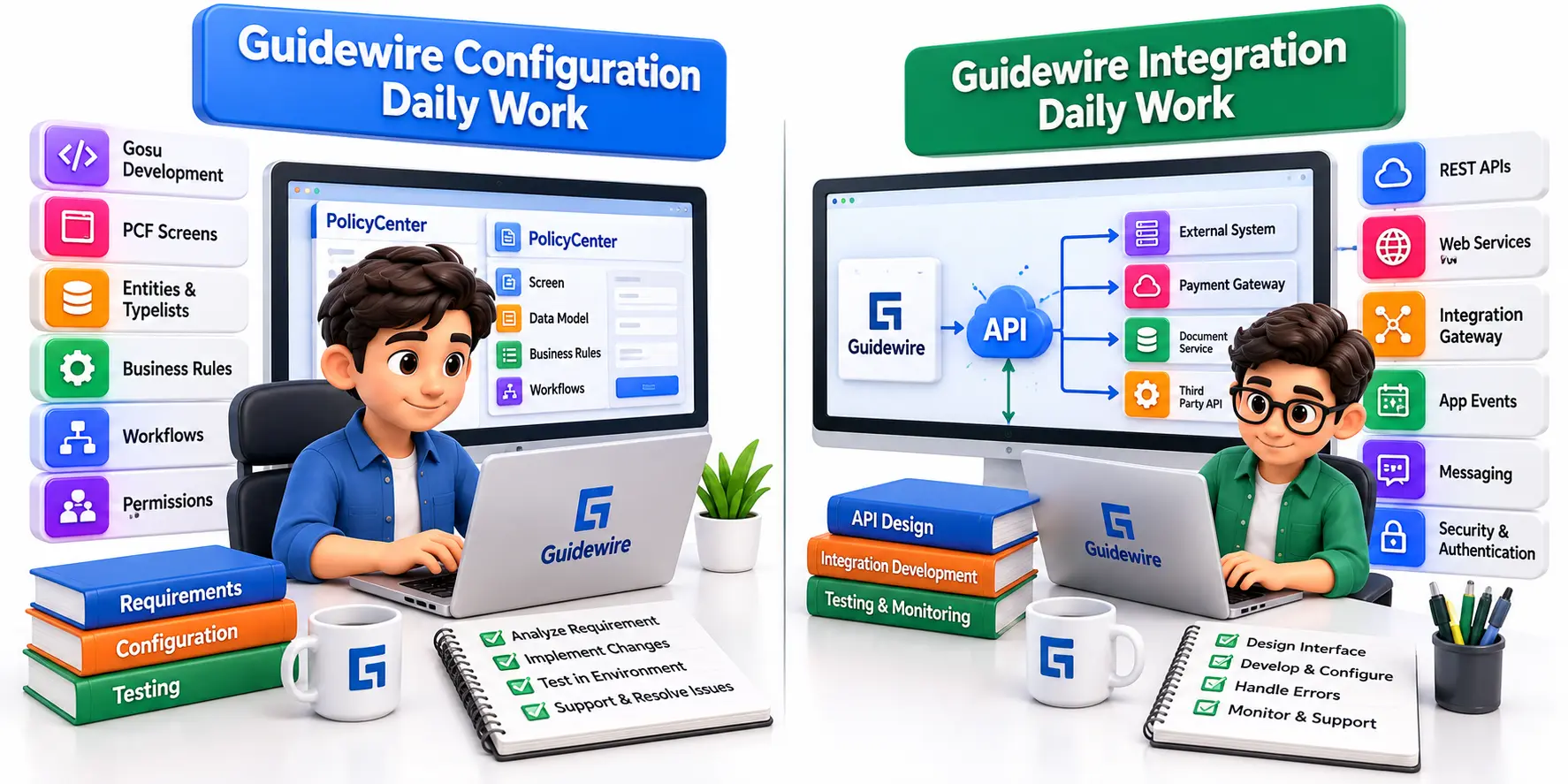
Configuration is closely connected to business requirements. Imagine that an insurer wants a new underwriting condition, an additional policy field, different validation logic, or a modified ClaimCenter screen. A configuration developer translates those requirements into application behavior.
The questions are often application-focused: Where should this information be stored? When should this rule execute? Which users should see this field? What happens when its value changes? You therefore need to understand both technical implementation and the insurance process behind it.
Integration changes the perspective. Suppose ClaimCenter must send claim information to an external service and receive a response. Now you must think about payload formats, APIs, authentication, errors, retries, timeouts, logging, and what happens when another system becomes unavailable.
This path often suits developers who enjoy following data across system boundaries and debugging distributed problems. Instead of asking only what Guidewire should do internally, you repeatedly ask how Guidewire should communicate safely and reliably with everything around it.
Build the Common Foundation Before You Specialize
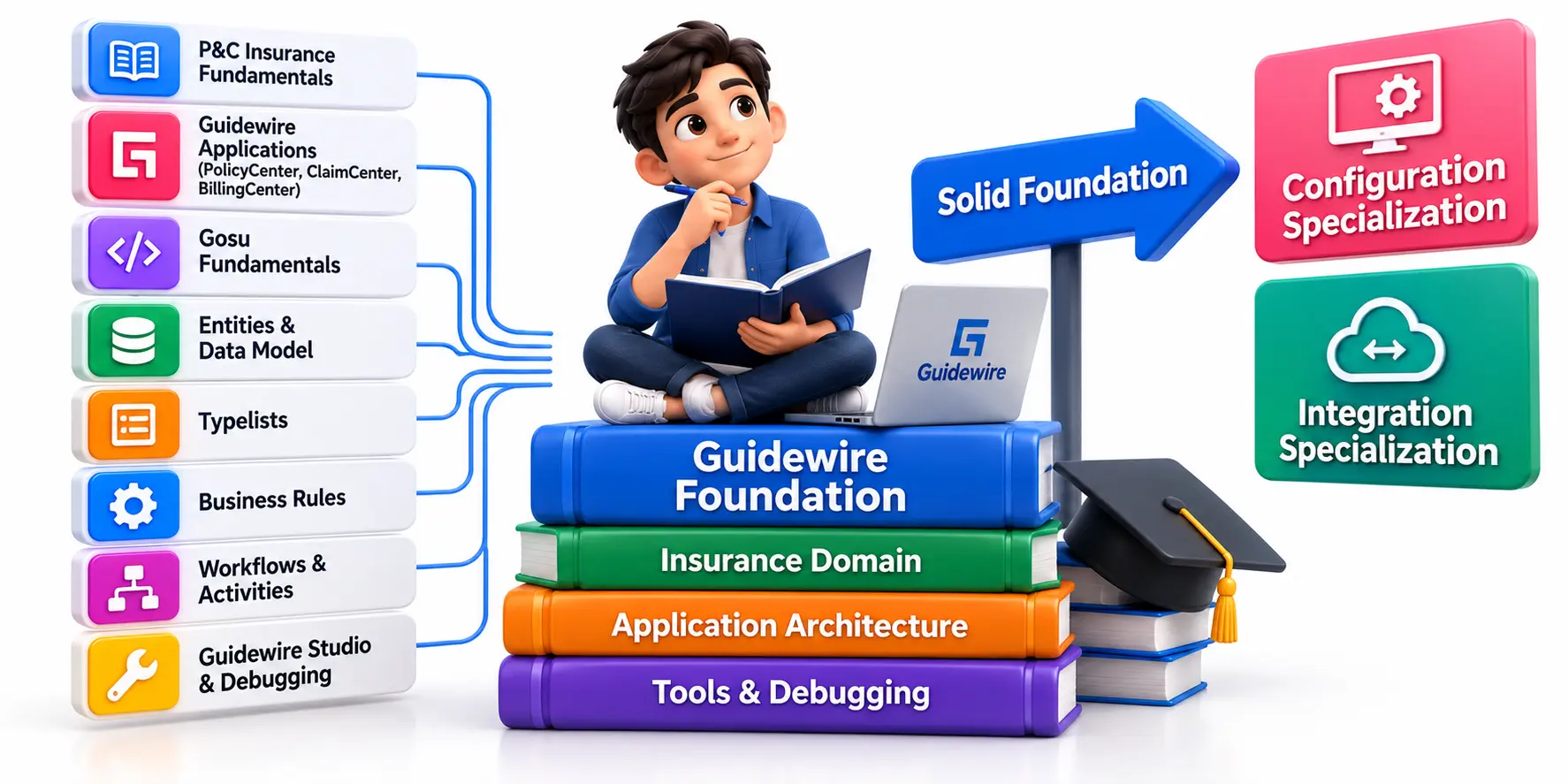
Beginners sometimes start learning advanced integration or PCF customization before understanding Guidewire itself. That creates fragmented knowledge. Both paths become easier when you first build a common foundation around InsuranceSuite architecture and the insurance domain.
Start with PolicyCenter, ClaimCenter, and BillingCenter and understand why each application exists. Then learn core P&C insurance concepts, Guidewire Studio, Gosu fundamentals, entities, typelists, queries, bundles, business rules, and basic debugging.
Someone exploring guidewire training in chennai should therefore evaluate a program by its practical curriculum rather than simply looking for a Configuration or Integration label. The foundation should explain how data and business processes move through Guidewire before specialization begins.
At JastTech, a practical learning roadmap can similarly focus on connecting concepts rather than treating individual Guidewire topics as isolated modules. Beginners should be able to trace a requirement from business logic through data handling and eventually to communication with another system.
Once this foundation is stable, specialization becomes much easier because you understand where your code fits within the complete implementation.
Choose Configuration If Business Logic and Application Behavior Interest You
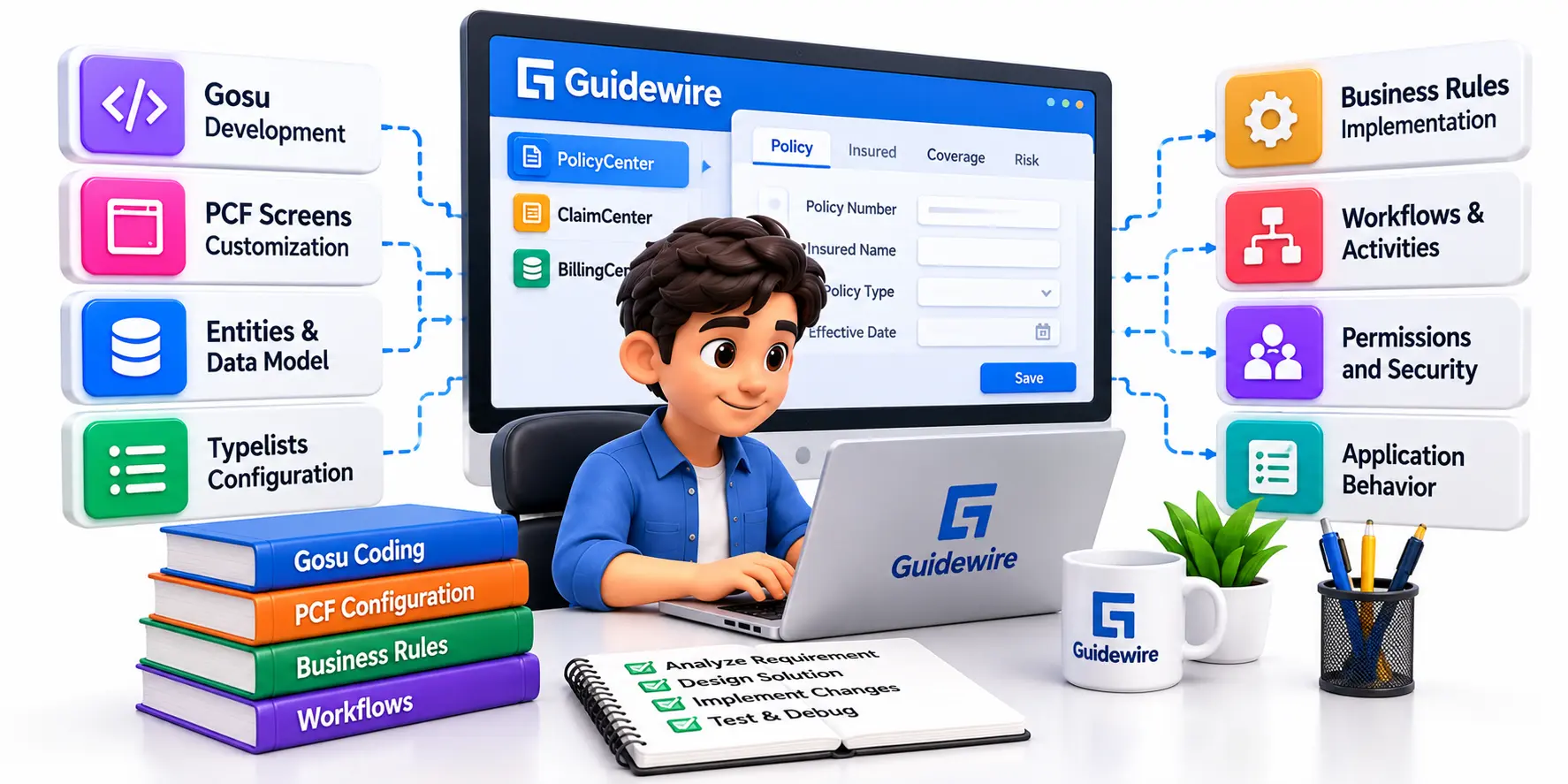
Configuration can be a natural starting point if you enjoy turning requirements into working application features. You are operating close to the core insurance application, so understanding business processes becomes as important as learning syntax.
A useful configuration learning sequence is:
Learn Gosu and object-oriented concepts
Understand Guidewire application architecture
Explore entities, typelists and the data model
Practice PCF configuration
Implement validation and business rules
Understand workflows, activities and permissions
Build small end-to-end configuration scenarios
Practice debugging incorrect application behavior
Projects matter because reading about PCF or typelists does not prove that you can translate a requirement into a working solution. For example, take a simplified insurance requirement and modify its data model, screen, validation logic, and business rule. Then test how the change affects the complete user workflow.
Configuration also provides valuable domain exposure. Because you regularly translate insurance requirements into application behavior, you gradually learn how policies, claims, billing processes, users, and business rules interact.
That combination of domain understanding and technical implementation can later support movement toward senior development, technical leadership, or solution architecture responsibilities.
Choose Integration If APIs, Data Flow and System Communication Excite You
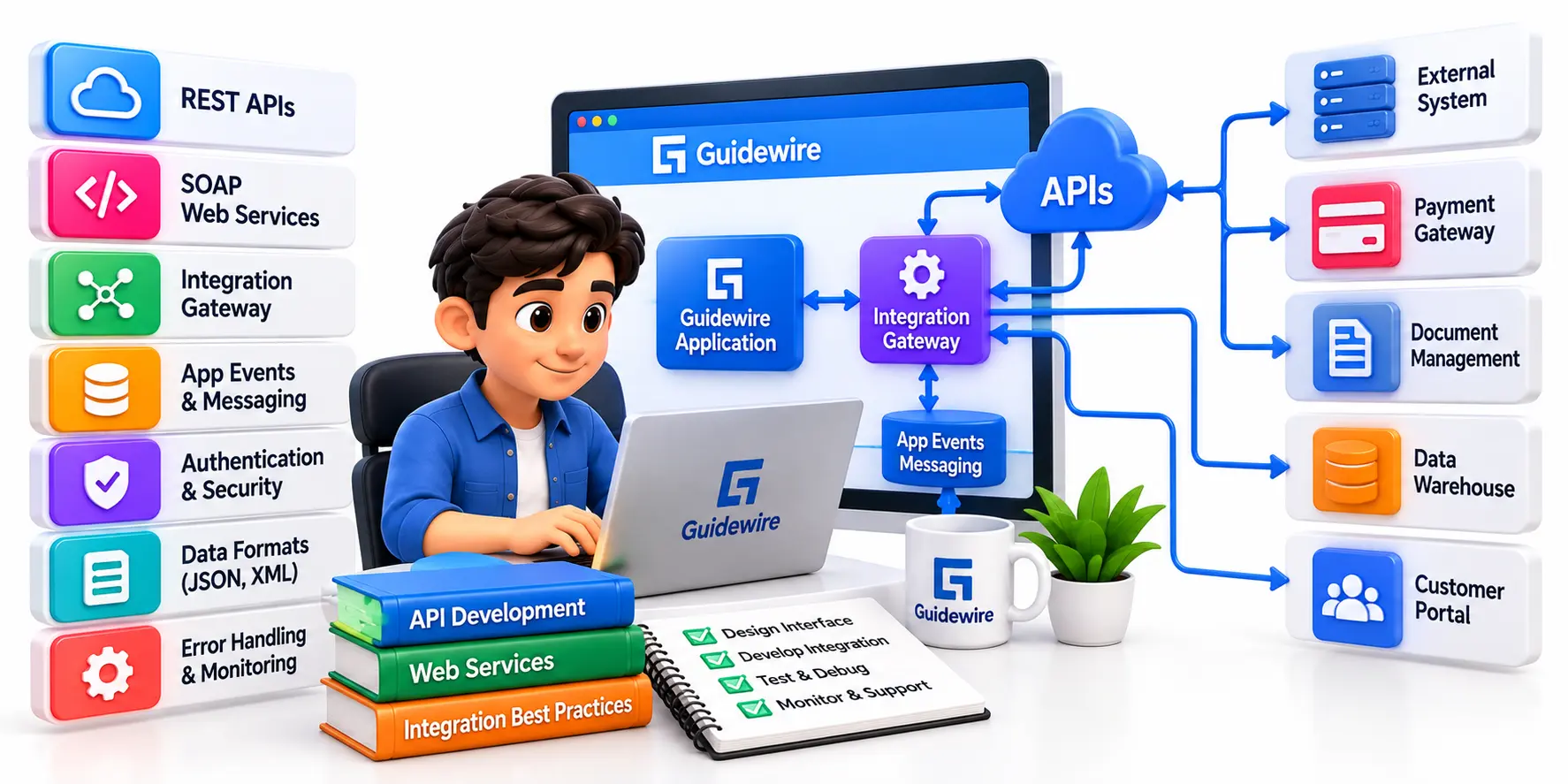
Integration is attractive for developers who enjoy understanding how different applications communicate. The modern path goes significantly beyond memorizing REST and SOAP definitions. You need to understand what makes an interface secure, observable, maintainable, and resilient.
A beginner preparing for Guidewire Integration & Web Services should gradually develop skills in:
REST APIs and HTTP fundamentals
JSON and XML
SOAP and web-service concepts
Authentication and authorization
Guidewire Cloud APIs
Messaging and event-driven communication
Integration Gateway concepts
App Events
Batch and file-based interfaces
Error handling, logging and monitoring
Consider a payment integration. Sending the request is only one part of the problem. What if authentication fails? What if the provider responds slowly? What if the same event is processed twice? What should be logged? How does the support team trace the transaction later?
Those questions illustrate why integration becomes more architecture-oriented as you progress. Modern Guidewire Cloud projects also make cloud integration patterns, API security, asynchronous communication, fault tolerance, and observability increasingly important.
For a beginner with existing Java, API, backend, middleware, or web-services knowledge, this specialization may feel particularly familiar because several concepts transfer directly into Guidewire development.
Build Toward a T-Shaped Guidewire Career Instead of Staying in One Box
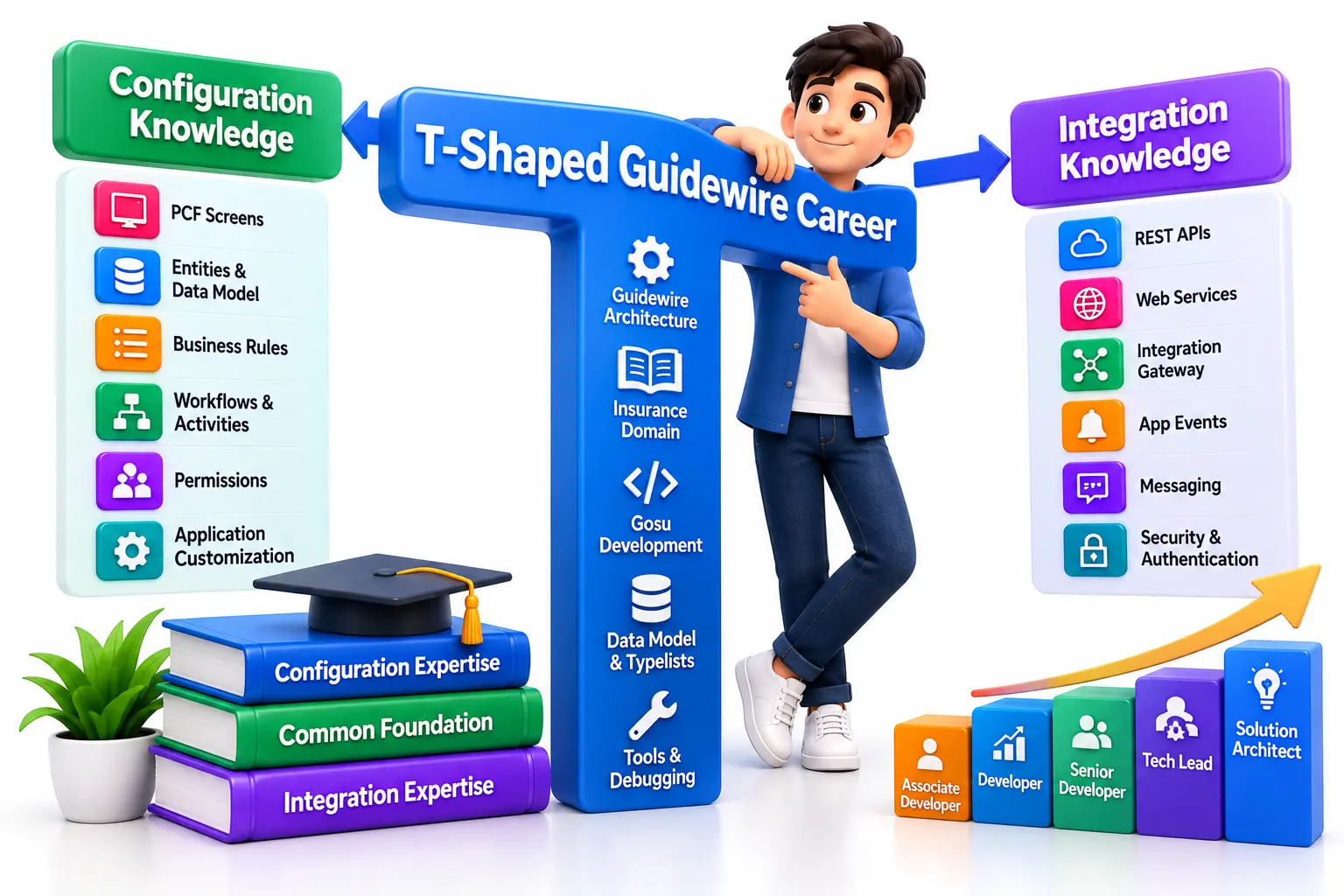
You do not need to treat Configuration versus Integration as a permanent career decision. A stronger strategy is to develop deep expertise in one area while maintaining enough knowledge of the other to understand complete implementation flows.
A configuration specialist benefits from knowing how application changes affect interfaces. An integration specialist benefits from understanding entities, Gosu, bundles, business logic, and the Guidewire data model because integrations ultimately consume or modify application data.
Your first practical project can help reveal your preference. Build a small configuration scenario involving a screen, entity, and rule. Then design an integration scenario in which Guidewire exchanges information with an external service. Pay attention to which problems keep you interested when debugging becomes difficult.
If you enjoy converting business requirements into application behavior, configuration deserves deeper exploration. If APIs, external systems, data exchange, security, and distributed debugging hold your attention, integration deserves deeper exploration.
The strongest long-term profile is often not someone who knows only one isolated collection of features. It is an engineer with one clear specialization who can still understand the broader Guidewire implementation around it.
Conclusion
Guidewire Configuration and Integration are not competing career paths; they solve different parts of the same insurance technology problem. Configuration shapes how the core application behaves, while integration enables that application to exchange information reliably with the surrounding enterprise ecosystem. Your starting path should reflect the engineering work you genuinely want to practice.
Begin with Guidewire architecture, Gosu, data concepts, insurance fundamentals, and debugging before specializing. Then build practical projects instead of collecting disconnected concepts. Whether you eventually become a configuration specialist, integration developer, technical lead, or architect, understanding both sides will make you better prepared for increasingly cloud-oriented Guidewire implementations.