

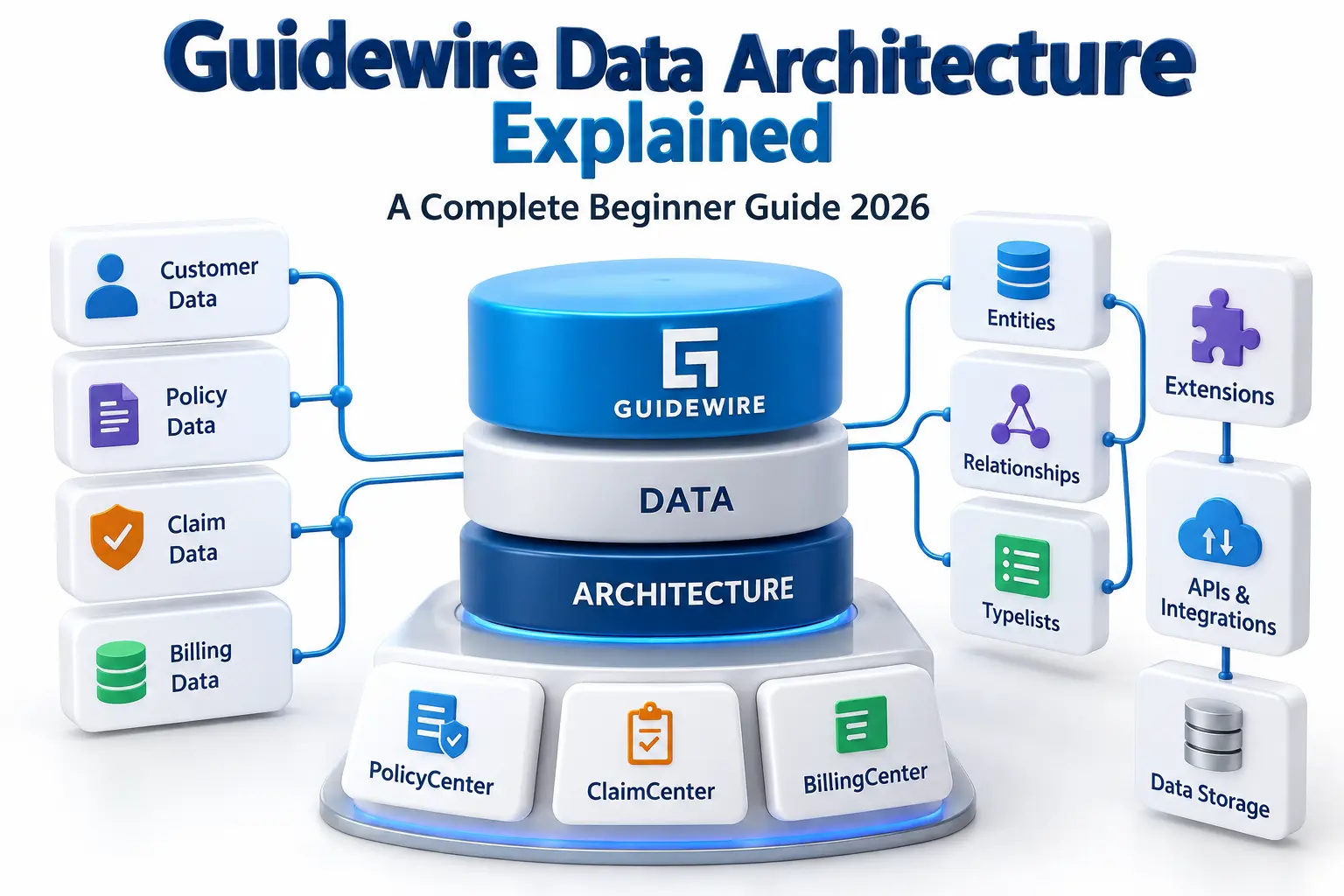
Guidewire Data Architecture Explained A Complete Beginner Guide 2026
Navigate through this article using the table of contents below
Table of Contents
No headings found in this article.
Guidewire can look like a maze of entities, typelists, relationships, configuration files, and insurance terminology when you first enter the ecosystem. But underneath that complexity is a structured data architecture. Once you understand how information is organized, the platform becomes considerably easier to navigate.
For beginners targeting Guidewire development in 2026, learning screens and Gosu alone is not enough. You need to understand what happens to policy, claim, billing, and customer information underneath the application. This guide builds that foundation step by step and connects the concepts to practical project work.
Start With What Guidewire Data Architecture Actually Represents
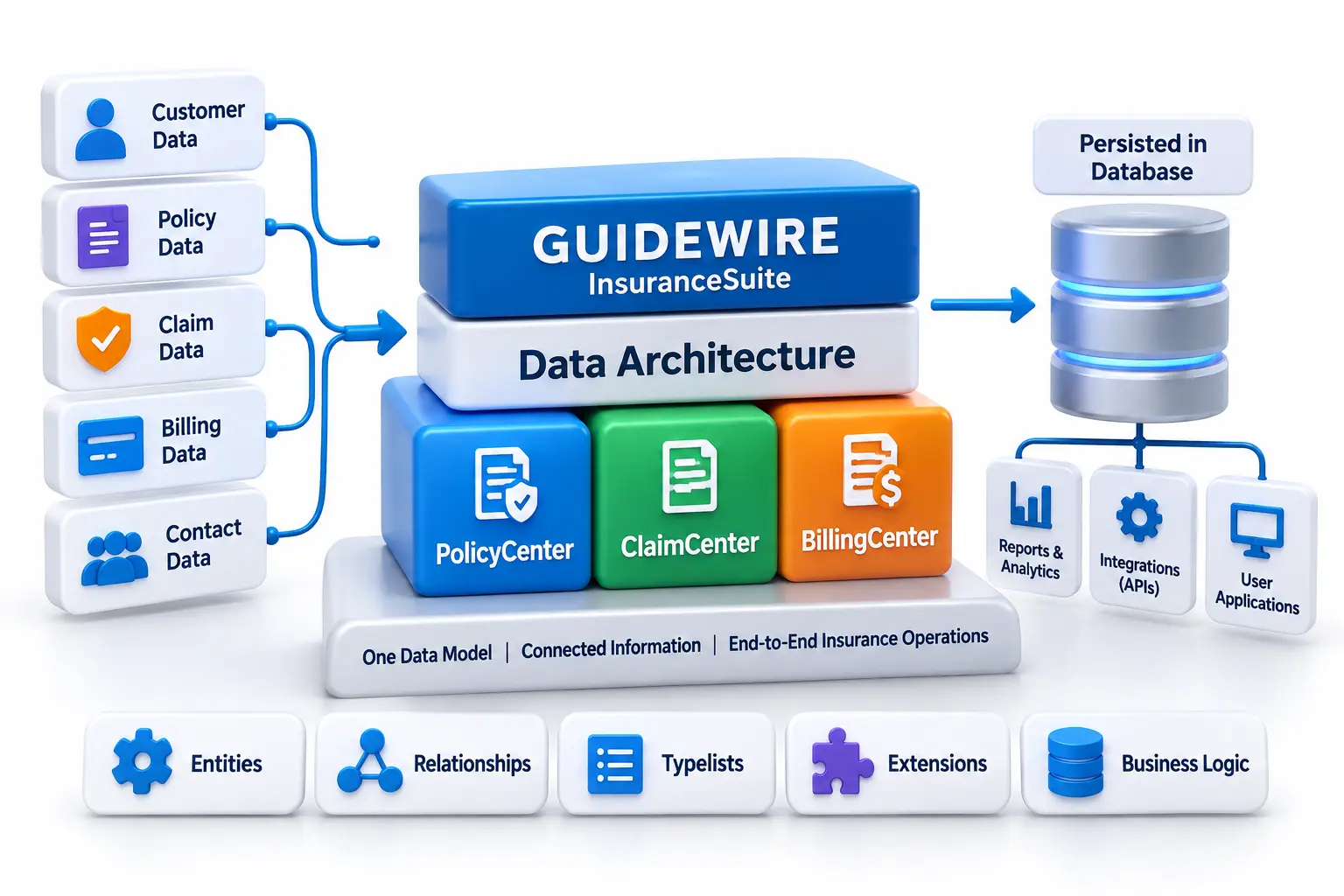
Guidewire InsuranceSuite applications manage different parts of property and casualty insurance operations. PolicyCenter supports the complete policy lifecycle, ClaimCenter manages claims processing, and BillingCenter handles billing, payments, and related financial activities. Although each application serves a different purpose, they all depend on large volumes of connected business data to work efficiently.
Guidewire data architecture defines how this information is structured, stored, connected, accessed, and extended across the platform. Instead of viewing a PolicyCenter screen as a simple set of fields, it is more useful to understand the business objects working behind it. Accounts, policies, contacts, addresses, vehicles, coverages, claims, exposures, invoices, and payments are represented as structured data entities with defined relationships, allowing Guidewire applications to manage complex insurance processes in a consistent and scalable way.
For beginners, it helps to visualize three levels:
Business level: Policy, Claim, Account, Contact and Payment
Application level: entities, fields, relationships, typelists and business logic
Persistence level: information ultimately stored in the underlying database
This perspective is important because changing a data definition can affect application logic, integrations, user interfaces, reporting, and other processes that depend on that information.
Understand Entities Before Trying to Understand the Database
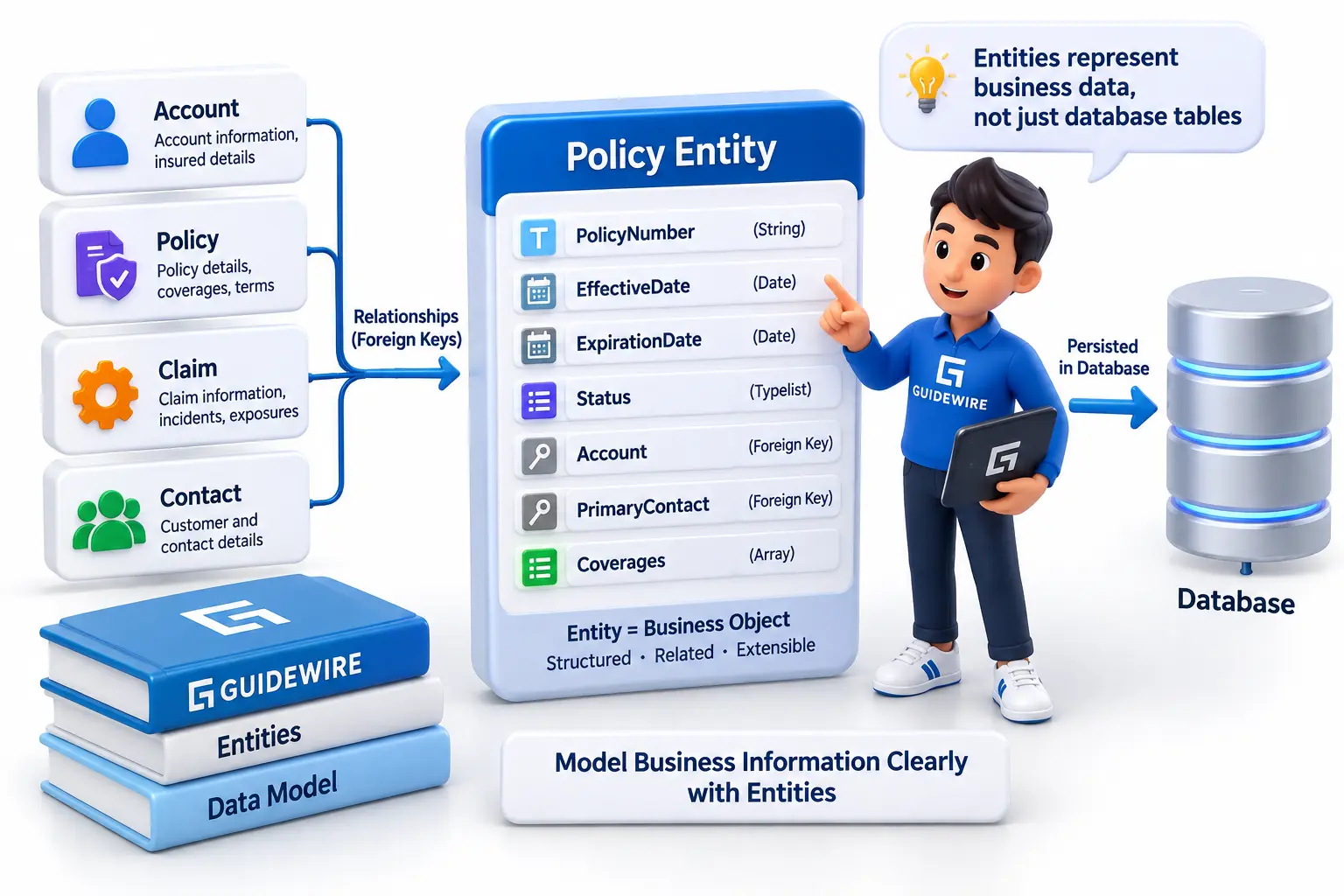
An entity is one of the most important concepts in Guidewire. It represents a structured business object with defined properties. Rather than treating insurance information as unrelated database fields, Guidewire organizes it around meaningful objects developers can work with through the application layer.
Imagine an insurer needs to store a customer address. The system does not need developers to repeatedly define street, city, postal code, and related information wherever an address appears. Structured objects allow information and behavior to be modeled consistently.
Beginners should become familiar with several kinds of entity fields and relationships, including:
Columns for values such as names, dates or identifiers
Typekeys for values selected from controlled classifications
Foreign keys for references to other entities
Arrays for collections of related objects
Entity relationships that represent real insurance associations
This explains why understanding Guidewire is different from simply memorizing database tables. Developers normally reason about business entities and their relationships. When you see a field on a PolicyCenter or ClaimCenter screen, start asking: Which entity owns this information, and how is that entity connected to the surrounding business object?
That question develops genuine Guidewire architecture thinking.
See How Relationships and Typelists Give the Data Meaning
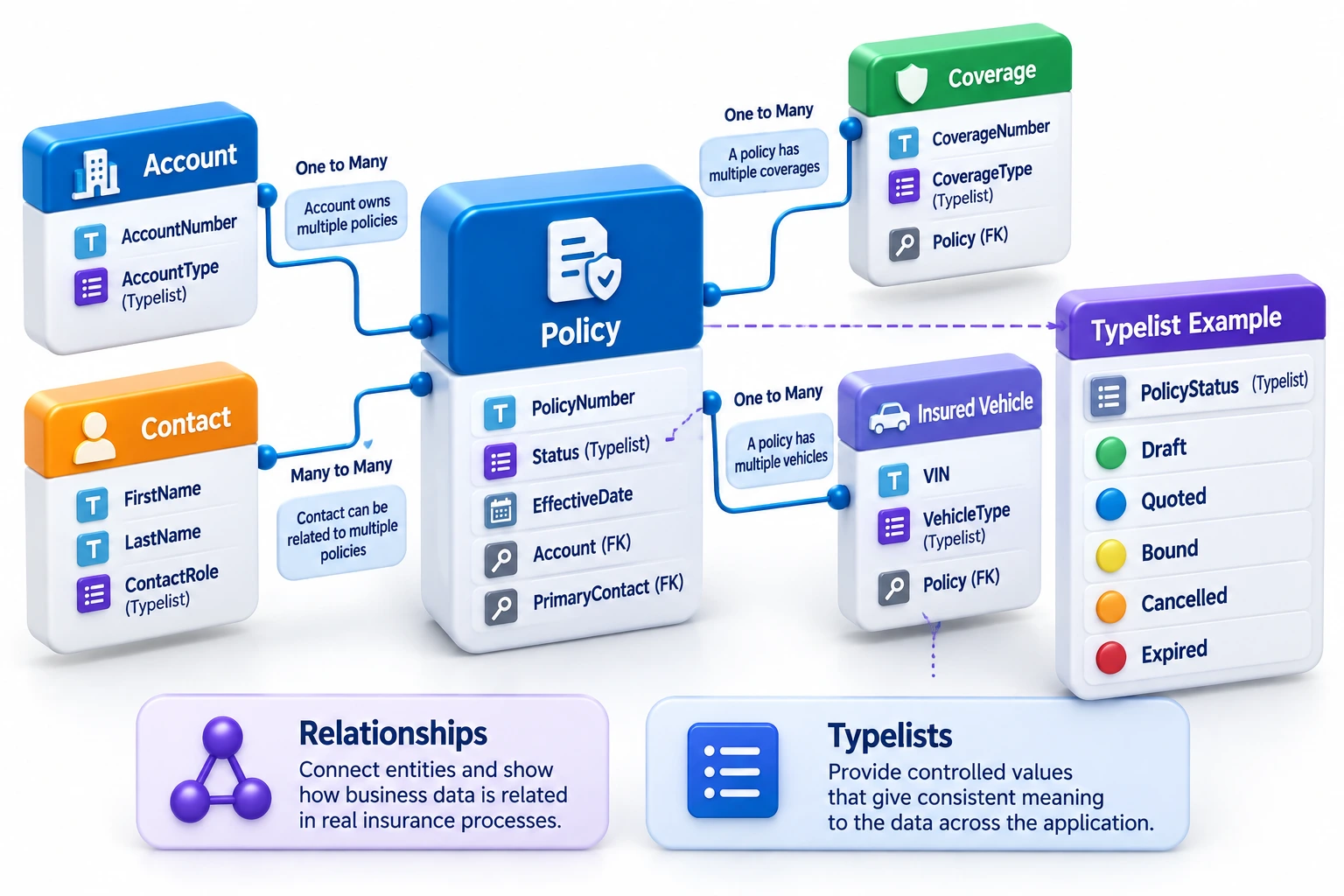
Individual entities are useful, but insurance applications become powerful through relationships. A customer can own policies, a policy can contain insured risks and coverages, and a claim can connect contacts, incidents, exposures, activities, and financial information.
Foreign-key relationships help connect these objects. From a beginner's perspective, think of a foreign key as a structured reference from one object to another. These relationships allow Guidewire applications to represent complex insurance processes without turning every business concept into one enormous record.
Typelists solve another problem: controlled values. Consider values such as statuses, categories, roles, or loss types. Allowing arbitrary text would make business logic unreliable. Typelists provide predefined typecodes that can be used consistently throughout the application.
This is why the Guidewire Data / Architecture Module becomes particularly useful for learners who already understand basic configuration but struggle to see how objects connect underneath the application. Learning relationships and controlled data structures turns isolated Guidewire concepts into one understandable system.
The key distinction is simple: entities describe what information exists, relationships describe how objects connect, and typelists help define which controlled values an object can use.
Learn Extensions Without Breaking the Core Data Model
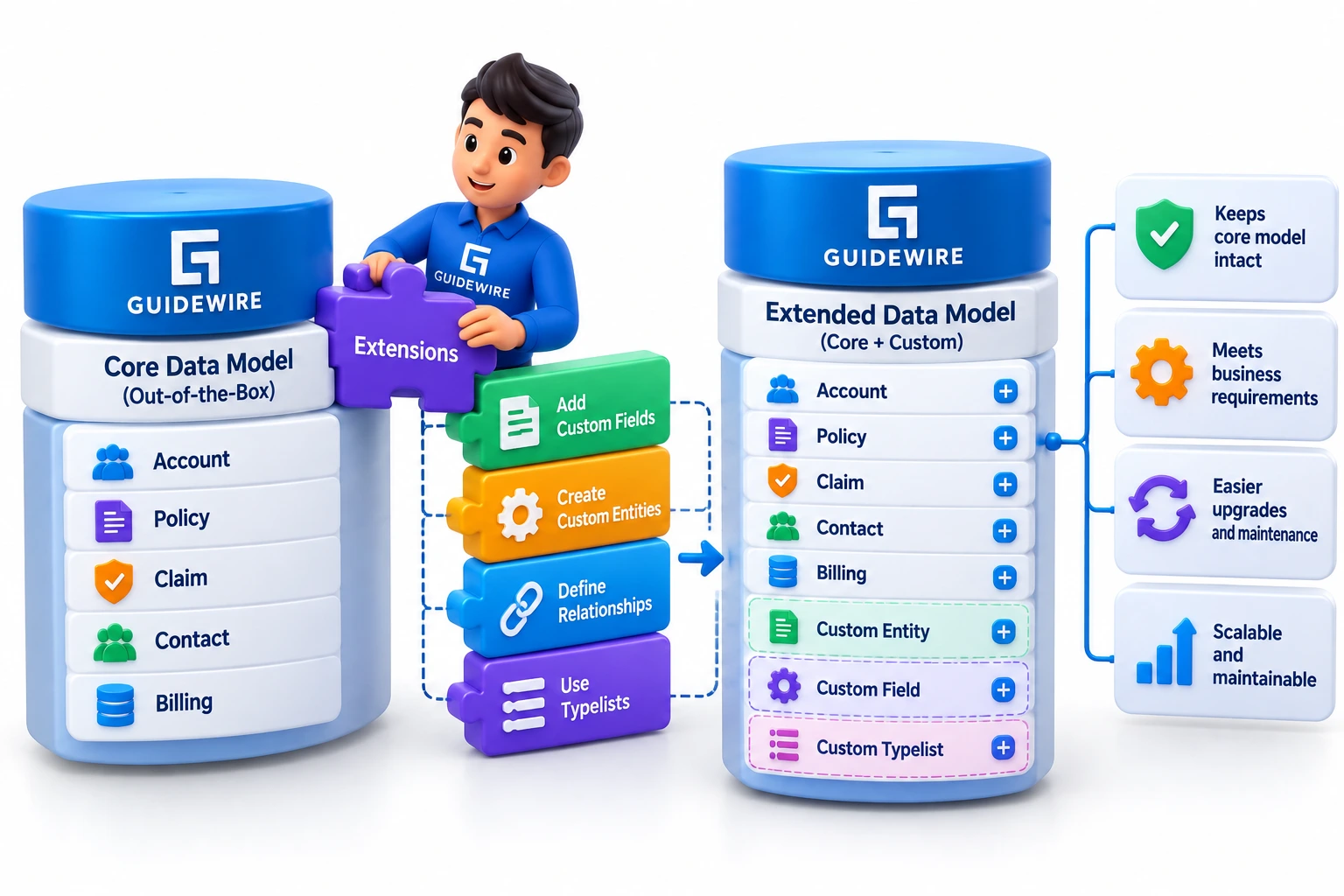
Real insurers rarely use every application exactly as delivered. One carrier may need additional risk information, another may require organization-specific identifiers, and another may introduce business data needed for a particular product or workflow. This is where data-model extensions become important.
Guidewire supports extending the base data model so implementations can introduce additional information without treating the standard model as disposable. Depending on the requirement, developers may add fields to existing business entities or introduce custom entities and relationships.
However, beginners should not assume every requirement needs another database field. Before extending the model, ask:
Does the information already exist somewhere appropriate?
Which business object should own the new information?
Is the field optional or required?
Will integrations need the value?
Could it affect queries or performance?
Does it need a controlled typelist?
How will the design behave during future changes and upgrades?
Good data architecture is therefore not about creating the largest model possible. It is about representing business requirements with the smallest clear, maintainable structure.
This is also where structured Guidewire training can help. JastTech can expose learners to architecture concepts alongside practical configuration scenarios so they understand not only how to make a data-model change, but why a particular design is appropriate.
Connect Persistence, Queries and Transactions to Real Application Work
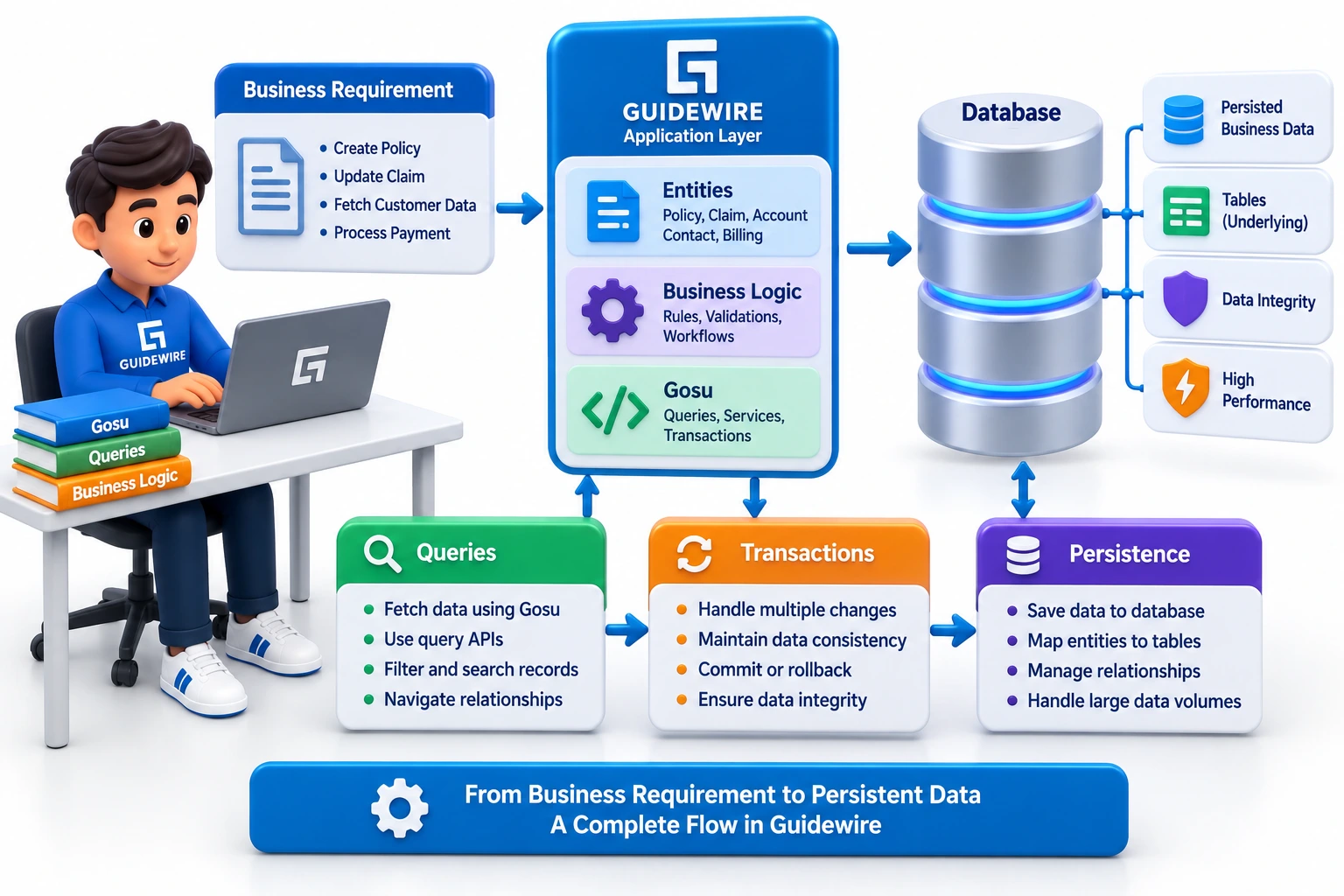
After understanding the model, the next question is simple: how does an application actually work with this information? Guidewire provides an application-level object model so developers can manipulate business entities through platform mechanisms instead of approaching every task as raw database programming.
Gosu and Guidewire query mechanisms are therefore important skills. A developer might need to locate business records based on defined criteria, navigate related entities, update information, or execute logic that depends on stored application data.
A beginner should connect these ideas as a flow:
Business requirement → entity → relationship → query/access → business logic → persistence
Transactions also matter because insurance operations frequently involve multiple related changes. Data integrity becomes critical when financial, policy, or claims information is updated. Developers need to understand the lifecycle of the objects they manipulate instead of assuming that changing an object in code is equivalent to casually editing a database row.
Performance belongs in the same discussion. Poorly designed queries or unnecessary data access can become expensive as production datasets grow. Good Guidewire developers therefore learn to think about query selectivity, relationships, object loading, data volume, and processing patterns alongside functional correctness.
Connect the Data Model to APIs, Cloud Architecture and Integrations
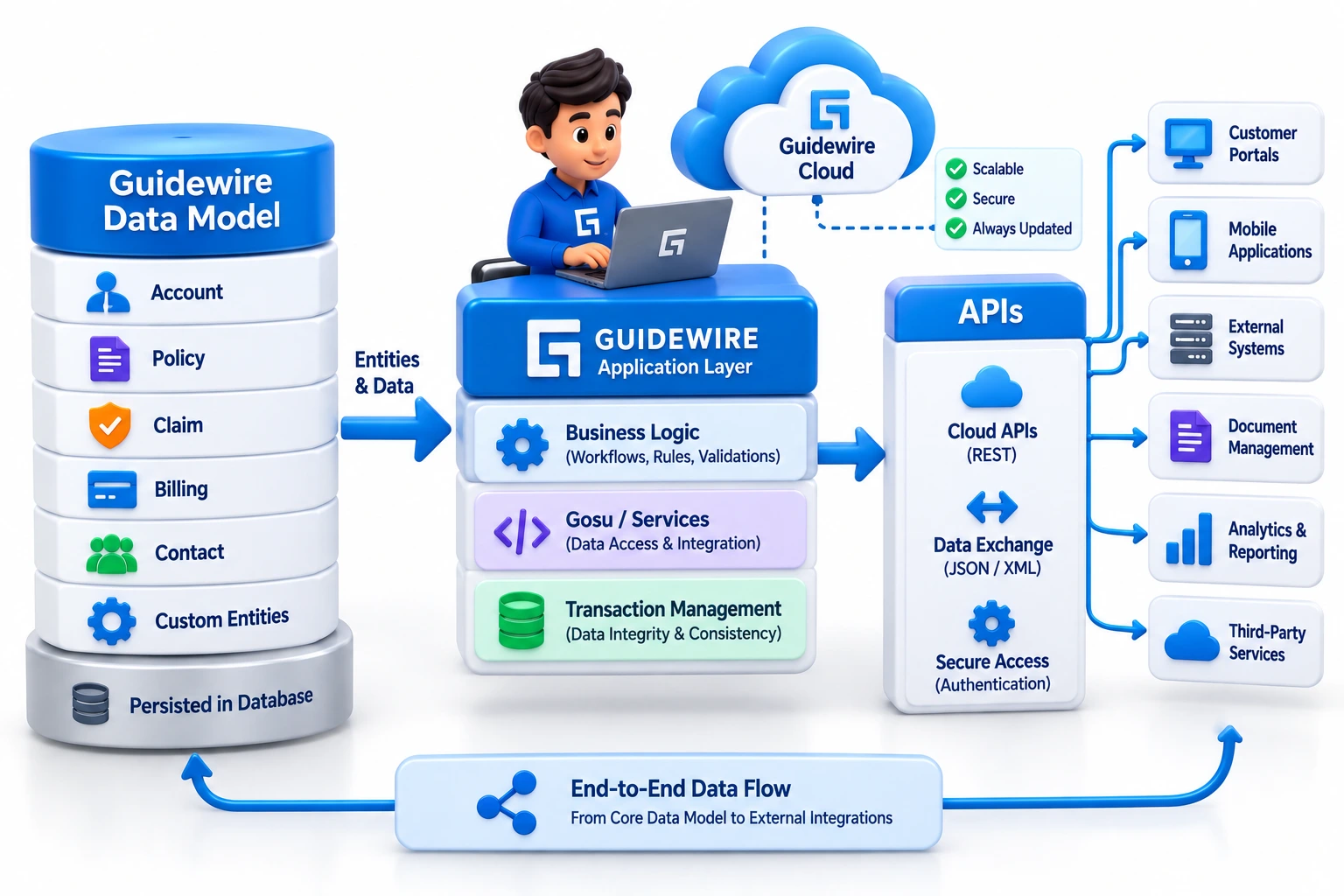
Guidewire development in 2026 cannot be understood only from the database inward. Modern implementations exchange information with portals, mobile experiences, document systems, payment services, analytics platforms, partner applications, and other enterprise services.
Guidewire Cloud APIs expose resources that applications can create, retrieve, update, or query where supported. These API resources relate to the underlying Guidewire data model, but beginners should avoid assuming that every external JSON resource is simply a direct copy of one database table or entity. An API representation can be designed around the business operation being exposed.
That creates an important architectural path:
Database and persistence → Guidewire entity model → business logic → API/resource layer → external systems
Once you understand this path, integration problems become easier to reason about. You can ask where a value originates, which business object owns it, how application logic processes it, what an API exposes, and how an external consumer should use it.
A strong beginner learning path should therefore combine data-model fundamentals with:
Entity and relationship navigation
Typelists and controlled values
Data-model extensions
Gosu data access and queries
Transactions and data integrity
REST and Cloud API fundamentals
Integration and data-mapping concepts
Performance-aware design
That combination prepares learners for real Guidewire projects much better than memorizing isolated configuration steps.
Conclusion
Guidewire data architecture becomes much easier once you stop viewing it as a collection of database tables. The real picture is a connected business-object model in which entities represent insurance information, relationships connect those objects, typelists control defined values, extensions accommodate implementation requirements, and platform mechanisms manage access and persistence.
For beginners in 2026, this foundation creates a bridge between Guidewire configuration, Gosu development, APIs, integrations, and cloud implementations. Learners considering Guidewire Training in Bangalore can benefit from focusing on these architectural fundamentals alongside hands-on practice with entities, data models, Gosu queries, and integration scenarios. This helps connect theoretical concepts with the way Guidewire applications are configured and developed in real projects.
Learn to follow data from a business requirement through its entity relationships and outward to consuming systems. Once you can trace that journey confidently, many advanced Guidewire concepts become far less intimidating, and you will be better prepared to understand complex configuration, integration, and application-development workflows.