

Guidewire Developer Project Ideas for Building Practical Experience
Navigate through this article using the table of contents below
Table of Contents
No headings found in this article.
Learning Guidewire becomes much more valuable when developers move beyond individual configuration exercises and start working with realistic insurance scenarios. Guidewire InsuranceSuite provides applications such as PolicyCenter, ClaimCenter, and BillingCenter, each supporting different areas of P&C insurance operations. A practical project allows developers to connect concepts such as Gosu, product configuration, data models, business rules, PCF configuration, workflows, transactions, and integrations instead of learning each concept separately. Building a project also encourages developers to think about requirements, validation, error handling, testing, and how a Guidewire application behaves throughout an insurance transaction. The goal does not need to be recreating an entire production implementation. A focused project with clearly defined requirements can provide meaningful practice while keeping the scope manageable.
For developers looking for a structured way to strengthen these fundamentals, Guidewire training in India can be considered alongside independent project work. The important point is to use learning as a foundation and then apply the concepts through scenarios that resemble actual Guidewire implementation tasks. A good project can begin with a simple policy transaction and gradually introduce business rules, user-interface configuration, workflows, data extensions, and API interactions. This approach helps developers understand not only how a particular Guidewire feature works, but also why it is used within an insurance process. The following seven project ideas are designed around Guidewire development areas and can be scaled from beginner exercises to more detailed implementation practice.
Personal Auto Policy Lifecycle Project in PolicyCenter
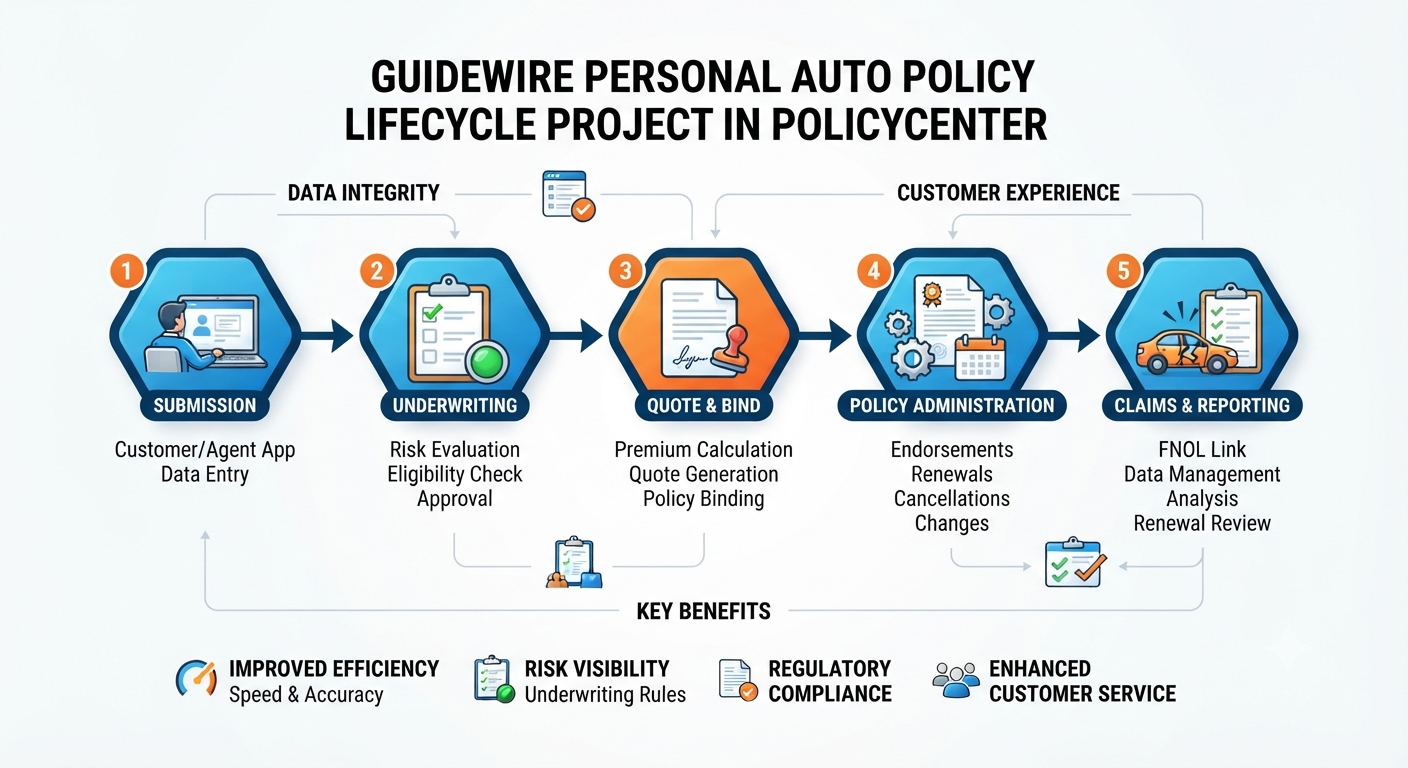
A Personal Auto policy project is a practical starting point for learning how PolicyCenter supports policy administration. The project can model a complete policy journey beginning with account and submission information and continuing through quotation, underwriting evaluation, binding, and policy issuance. Developers can define the information required for drivers, vehicles, coverages, deductibles, and other policy attributes and then configure the relevant product and policy structures. The exercise can also include common policy transactions such as adding a vehicle, adding a driver, changing coverage, cancellation, and renewal. Instead of attempting to implement every possible insurance rule, the project should define a limited set of requirements and implement them consistently. This makes it easier to understand how PolicyCenter processes a transaction and how different configuration elements participate in the policy lifecycle.
The project can then be extended with Guidewire-specific development tasks. Developers can create validation rules for required information, configure underwriting conditions, and implement sample rating logic based on predefined project requirements. PCF configuration can be used where appropriate to practice building or modifying screens used during policy transactions, while Gosu can support business logic and validation scenarios. Testing should cover valid submissions, missing information, invalid combinations, policy changes, and transaction outcomes. The project can also document the relationship between account, policy, job, vehicle, driver, and coverage information. By keeping the scope focused, this exercise gives developers practical exposure to PolicyCenter configuration and development without making unsupported assumptions about how a production insurer would implement its complete rating or underwriting strategy.
FNOL and Claims Processing Project in ClaimCenter
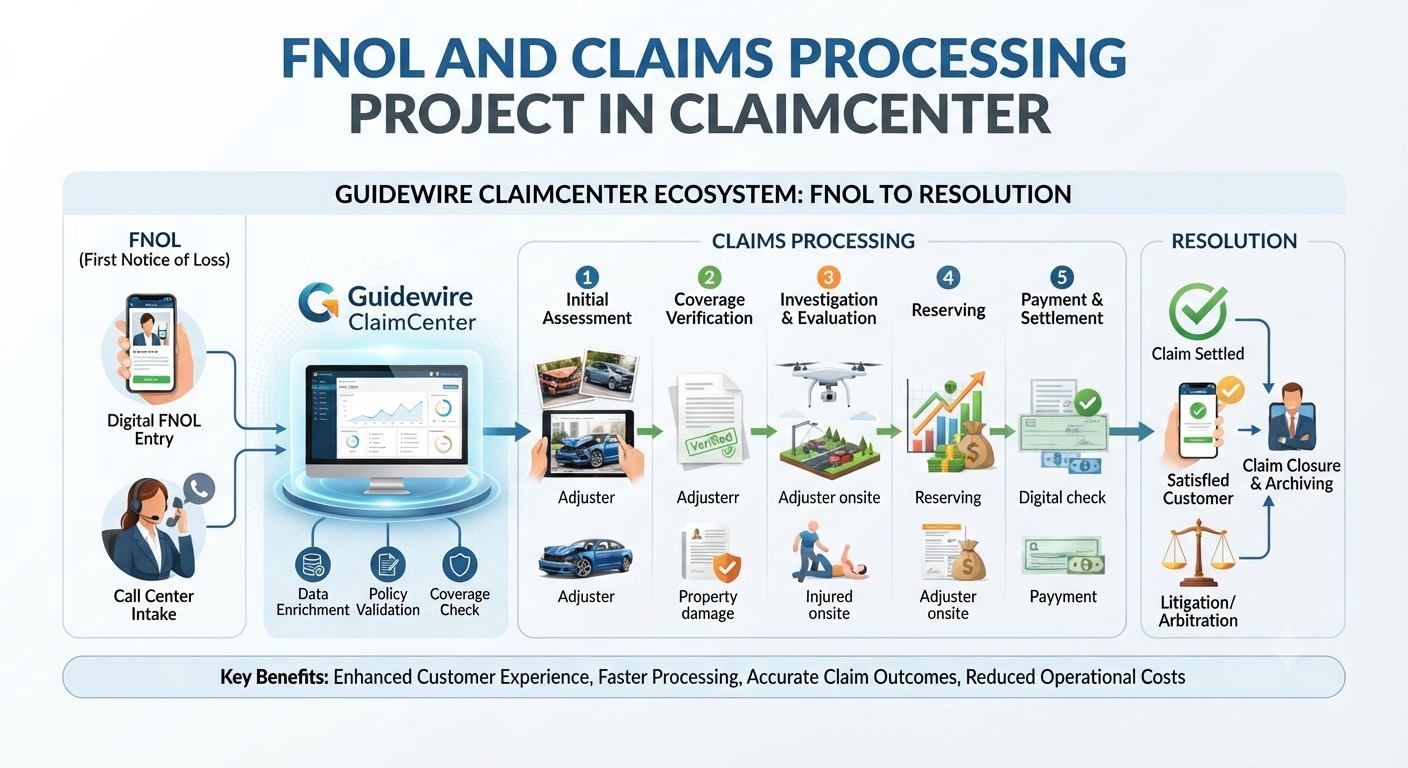
A First Notice of Loss project provides a useful way to practice ClaimCenter development because it brings together claim intake, validation, assignment, activities, financial information, and claim lifecycle processing. The project can begin with a simple automobile accident scenario in which a user provides policy information, loss details, date and location, involved parties, and an initial description of the incident. Developers can configure the claim intake process and define rules that determine whether required information has been supplied. The project can then introduce claim assignment rules based on predefined criteria such as claim type or severity. Activities can be created for follow-up actions, and the project can track the claim as it moves through the selected workflow stages. The objective is to understand how the different ClaimCenter concepts work together rather than creating an oversized claims application.
For developers based in or around Mumbai who want structured exposure to these Guidewire concepts, Guidewire training in Mumbai can be a relevant learning resource alongside project practice. The project itself can be expanded by adding exposures, reserve-related scenarios, payment activities, documents, and configurable claim rules. A developer can also create an integration exercise in which an external application sends structured information to a Guidewire API, with appropriate validation before the information is used by the claim process. Guidewire Cloud API documentation describes RESTful APIs for requesting data and initiating actions within InsuranceSuite applications, including ClaimCenter business flows. Testing should include successful claim creation, incomplete information, invalid identifiers, duplicate requests, and integration failures. This makes the project useful for practicing ClaimCenter concepts while also introducing realistic API and error-handling considerations.
BillingCenter Payment and Installment Management Project
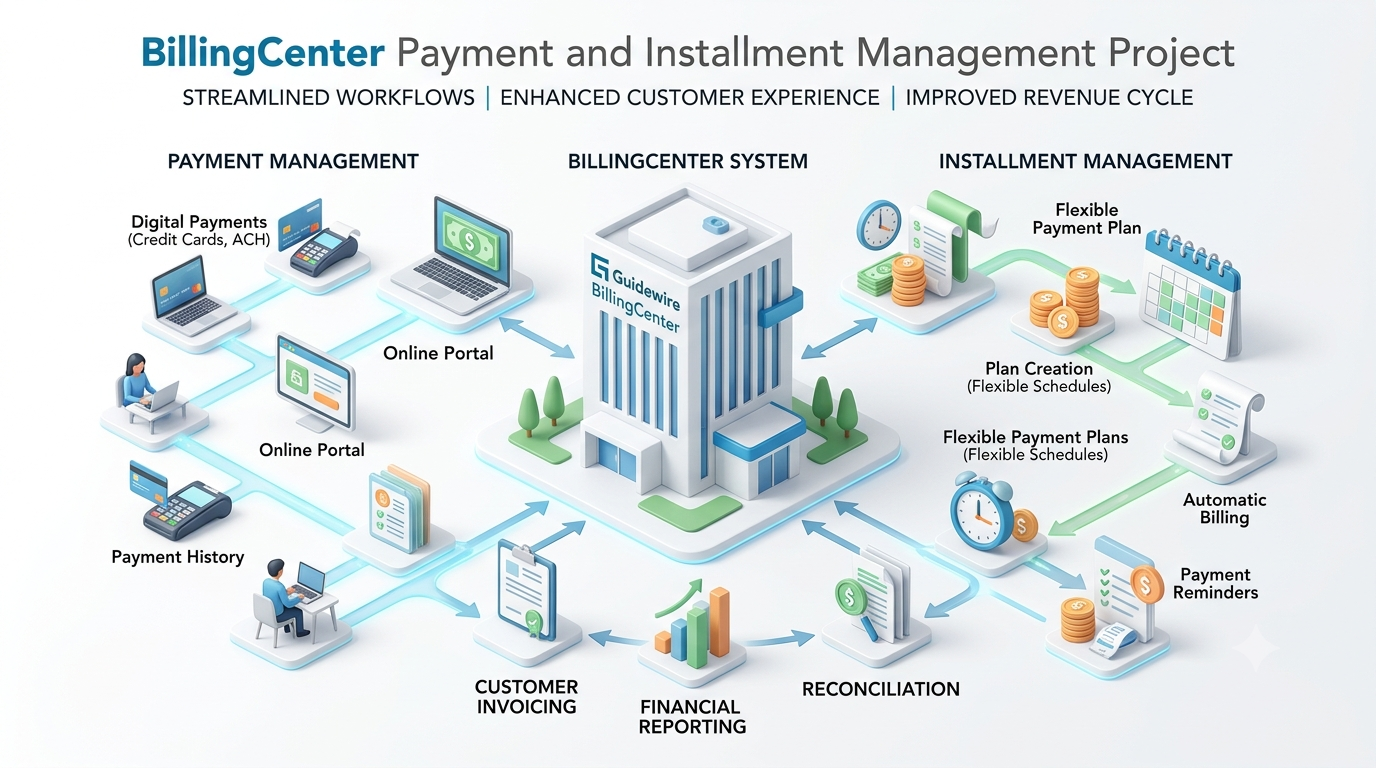
A BillingCenter project can focus on the relationship between policy-related billing information, invoices, payment plans, and payment processing. Developers can define a learning scenario in which an account receives a billing plan and invoices according to predetermined project requirements. The project could support monthly, quarterly, and annual payment schedules, with different test cases for payment dates, outstanding balances, failed payments, and account status changes. Developers can also practice configuring billing-related information and building screens that make important account and invoice details easier to review. The project should clearly distinguish between the requirements being simulated for learning and the capabilities that would require additional configuration or integration in an actual implementation.
The next stage can introduce a mock payment service to demonstrate Guidewire integration concepts. A test payment endpoint can accept a payment request and return a controlled success or failure response. The Guidewire implementation can then process the response, update the appropriate information, and handle expected error scenarios. Cloud API provides RESTful system APIs that can be used by caller applications to request data from or initiate actions within InsuranceSuite, while Guidewire also provides REST API client capabilities for outbound calls to OpenAPI-compliant REST services. These capabilities should be used according to the specific integration design rather than assuming that every external payment scenario uses the same mechanism. The project can therefore cover BillingCenter concepts together with API requests, response handling, validation, logging, and integration testing.
Policy Endorsement and Mid-Term Transaction Project
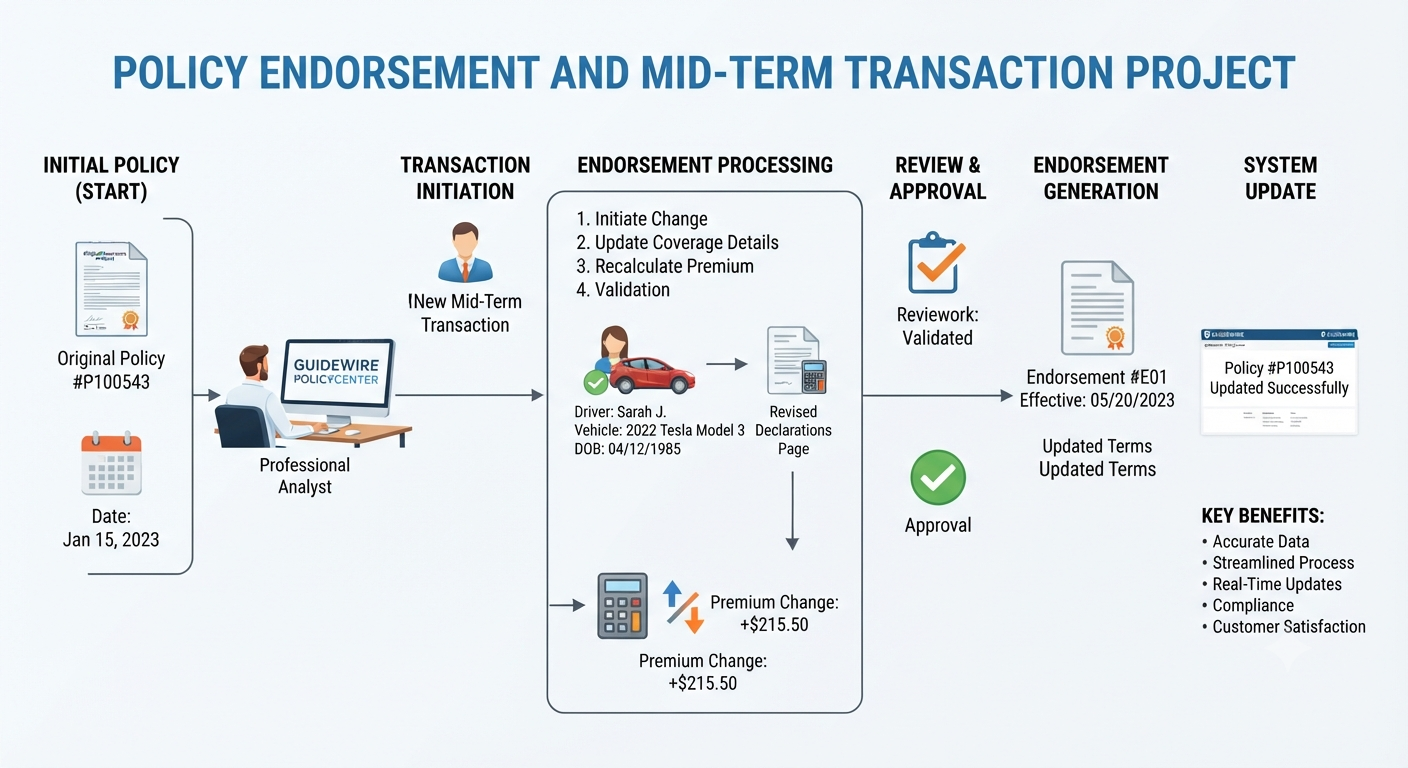
Policy endorsements are an effective project topic because they allow developers to explore how changes are handled after a policy has already been created. The project can focus on a personal auto policy where the policyholder requests a mid-term change, such as adding a vehicle, changing selected coverage, updating an address, or adding a driver. Each transaction should have clearly defined effective dates and validation requirements. Developers can establish rules that determine which information must be supplied before the transaction can proceed. The project can also include scenarios where a requested change requires additional underwriting review. By implementing several controlled transaction types, developers can study how PolicyCenter handles changes to an existing policy rather than focusing only on new-business processing.
A useful extension is to create test scenarios for successful endorsements, invalid changes, incomplete information, and changes that conflict with predefined project rules. Developers can document which entities and attributes are affected by each transaction and how the transaction should be represented after completion. Gosu can be used where appropriate for business rules and validations, while PCF can support relevant user-interface configuration. The project can also explore how documents or downstream processes may be associated with a transaction when required by the defined scenario. The emphasis should remain on understanding Guidewire policy transaction concepts and implementing clearly defined requirements rather than claiming that one project represents every insurer's endorsement process.
Guidewire Business Rules and Underwriting Referral Project
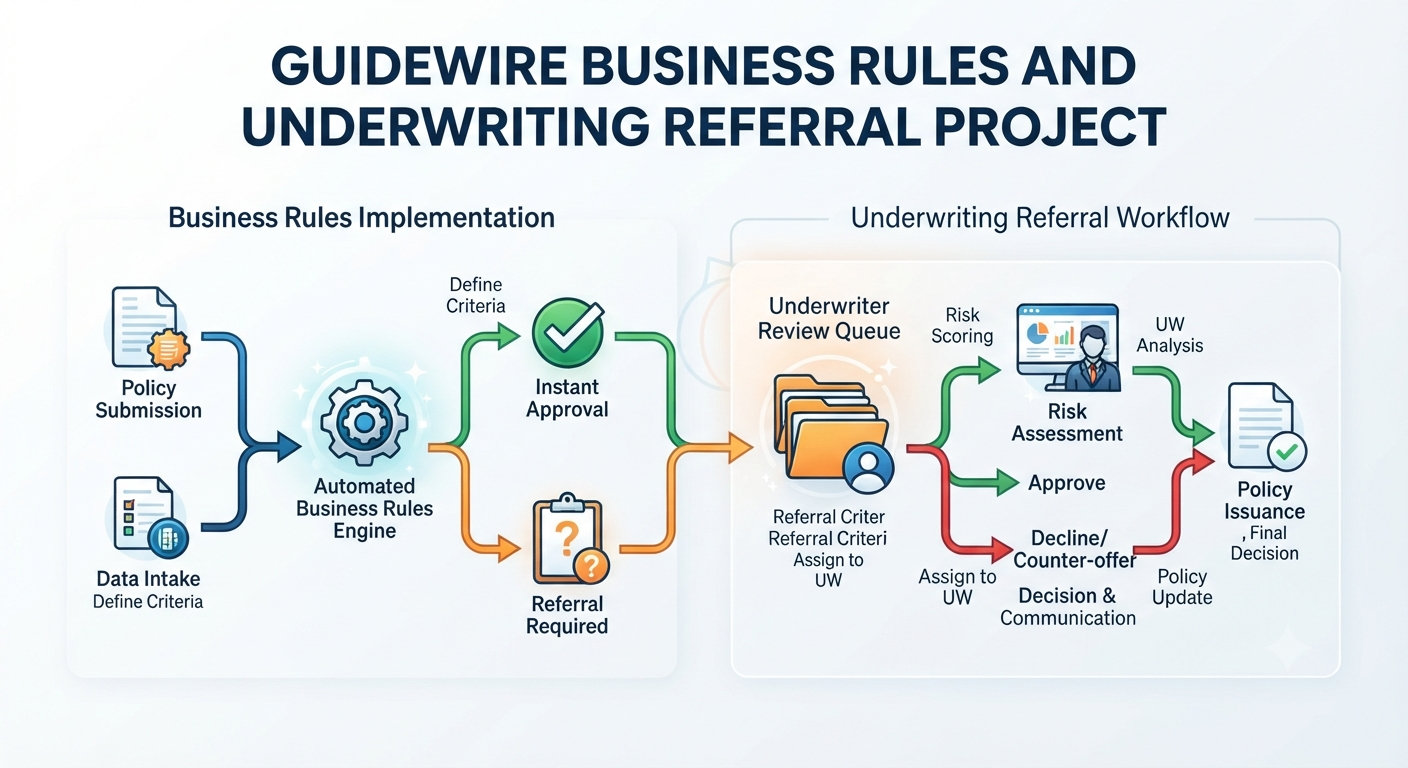
A business-rules project can help developers understand how Guidewire applications apply configurable logic to insurance processes. Instead of building a large application, developers can create a controlled underwriting scenario in which selected policy characteristics determine whether additional review is required. For example, the project can define rules around predefined vehicle characteristics, coverage combinations, property attributes, or other fields relevant to the chosen line of business. When a configured condition is met, the transaction can be routed for review according to the project requirements. The developer can then test both referral and non-referral scenarios and document the conditions that produce each outcome.
The project can become more useful by separating the business requirements from the implementation logic. First, document the rule in plain language. Next, identify the Guidewire data required to evaluate it. Then implement and test the rule using the appropriate configuration or Gosu mechanisms available in the selected application. Testing should include boundary values and combinations of conditions rather than only one successful example. This exercise helps developers understand how business rules participate in Guidewire processes and why maintainable rule design matters. It also provides a practical opportunity to practice debugging, validation, test data preparation, and documentation without presenting a simplified learning rule as a complete production underwriting model.
Guidewire Cloud API and Cross-Application Integration Project
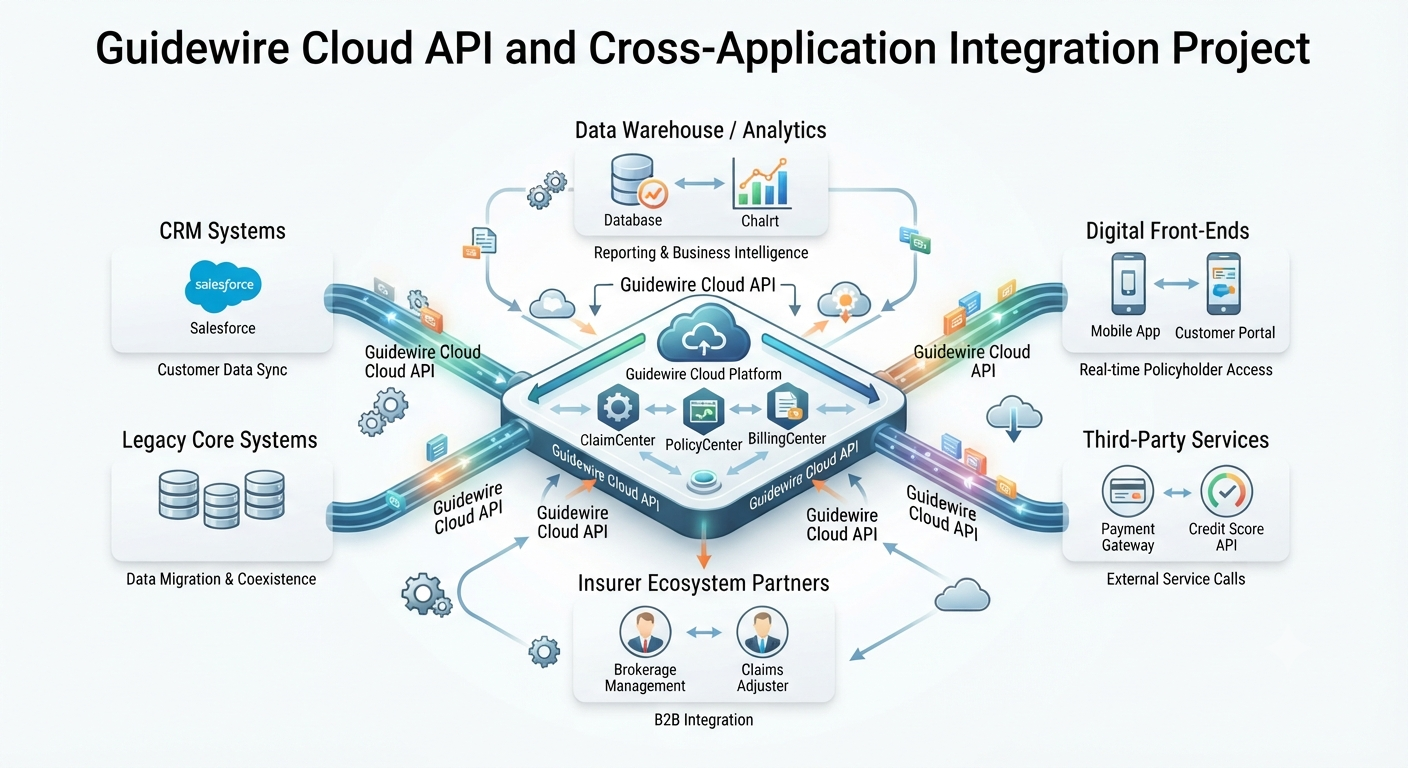
A Guidewire integration project can focus on communication between an InsuranceSuite application and another application. One practical scenario is to create a controlled integration in which an external client retrieves selected policy, claim, or billing information through an appropriate Cloud API endpoint. Guidewire describes Cloud API as a set of RESTful system APIs that caller applications can use to request data from or initiate actions within InsuranceSuite applications. The current documentation also provides API references for PolicyCenter, ClaimCenter, and BillingCenter. This makes API-based development a useful project area for developers who want to understand how Guidewire applications can participate in a wider application environment.
The project should pay particular attention to authentication, authorization, request validation, response handling, and error scenarios. A developer can begin with basic GET or POST operations and then test invalid identifiers, unauthorized requests, incomplete payloads, and failed transactions. Cross-application communication can be included as an advanced exercise, but it should not be presented as automatic behavior. Guidewire documentation states that calls between InsuranceSuite applications require configuration and appropriate authorization. A well-documented project can therefore show the API endpoint, request and response structure, security assumptions, test cases, and failure-handling approach. This demonstrates practical Guidewire integration knowledge without overstating what an API implementation does by default.
Guidewire Document Processing and Cloud Integration Project
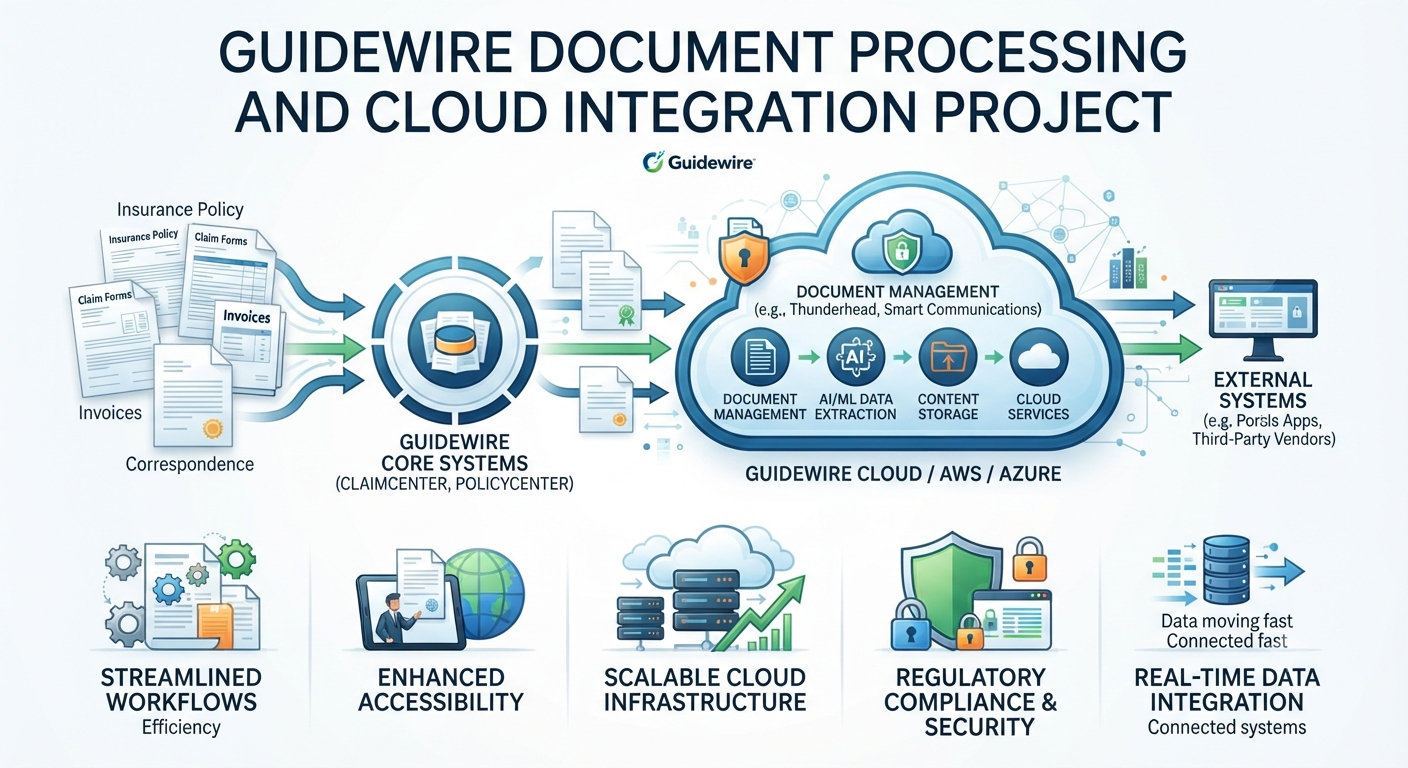
A document-processing project can combine Guidewire application workflows with an external document service while keeping the scenario focused on integration and data handling. For example, a ClaimCenter project could simulate receiving a claim-related document and sending selected information to an external document-processing service. The external service could return structured information, which the integration then validates before determining whether it can be used within the Guidewire process. The project can include document metadata, request and response handling, error conditions, and appropriate status tracking. Guidewire documentation notes that document content is generally managed through a document management system, while InsuranceSuite maintains document-related metadata, so a project should distinguish document metadata from the actual document-content storage process.
For developers preparing to validate their Guidewire knowledge, Guidewire certification preparation can complement hands-on project work by providing a separate study path for certification-related objectives. The project itself should remain technically focused: define the document scenario, specify the integration contract, implement validation, handle failures, and test different responses. Developers can also add asynchronous processing where appropriate, including retry handling and status tracking. The purpose is not to claim that an external AI or document service automatically understands every insurance document. Instead, the project should demonstrate how a Guidewire application can be designed to interact with an external service and how developers can safely handle the resulting data. This makes the project relevant to modern Guidewire integration practice while keeping the technical claims appropriately scoped.
How to Build These Guidewire Projects Effectively
The quality of a Guidewire project depends more on its scope and documentation than on the number of features included. Before starting development, define the insurance scenario, users, transactions, data requirements, business rules, expected outcomes, and integration boundaries. A project should have a clear beginning and end so that every configuration or development task has a reason for existing. For PolicyCenter, this could mean defining one line of business and a limited set of transactions. For ClaimCenter, it could mean concentrating on FNOL, assignment, and selected claim activities. For BillingCenter, the scope could focus on payment plans, invoices, and payment processing. Keeping the requirements controlled makes testing easier and allows developers to understand each Guidewire feature in context.
Documentation should accompany the implementation from the beginning. Record the business requirements, relevant data relationships, configuration decisions, Gosu logic, PCF changes, API contracts, test cases, and known limitations. Include negative testing rather than documenting only successful transactions. For integrations, test invalid requests, authorization failures, unavailable services, malformed responses, and retry scenarios where relevant. For business rules, test both sides of each condition and include boundary cases. This approach turns a basic Guidewire exercise into a structured development project that can demonstrate understanding of configuration, customization, transactions, rules, workflows, and integration concepts.
Conclusion
Guidewire developer projects are most useful when they connect platform concepts with clearly defined P&C insurance scenarios. PolicyCenter projects can provide practice with policy lifecycles, product configuration, endorsements, and underwriting rules. ClaimCenter projects can cover FNOL, claim assignment, activities, financial processes, and claim workflows. BillingCenter projects can introduce billing plans, invoices, payments, and account-related processing. Cloud API projects can then extend the learning into REST-based integration, authentication, request handling, and communication with external or other InsuranceSuite applications.The seven project ideas in this guide can be developed independently or combined into a larger learning portfolio. The important goal is not to make every project production-sized. Instead, each project should have defined requirements, appropriate Guidewire configuration, maintainable business logic, realistic test scenarios, and clear technical documentation. This gives developers a practical way to strengthen their understanding of Guidewire while keeping the learning process focused on actual platform concepts and insurance workflows.
A strong progression is to begin with a focused PolicyCenter or ClaimCenter scenario, add business rules and transactions, move into BillingCenter, and then introduce Cloud API and external integration concepts. With that progression, developers can build practical experience across the major Guidewire areas without relying on exaggerated claims or unnecessary complexity.