

Guidewire Gosu Programming in Bangalore: Language Fundamentals, Business Rules, and Practical Coding Examples
Navigate through this article using the table of contents below
Table of Contents
No headings found in this article.
What separates a Guidewire developer who understands syntax from one who can solve real insurance business problems? The answer lies in mastering Gosu, understanding the InsuranceSuite data model, and translating business requirements into reliable application logic.
Whether you are starting your development journey or strengthening your technical skills, learning Gosu through practical examples can help you understand policy administration, claims processing, billing workflows, and enterprise application customization.
Understanding Gosu and Its Role in Guidewire
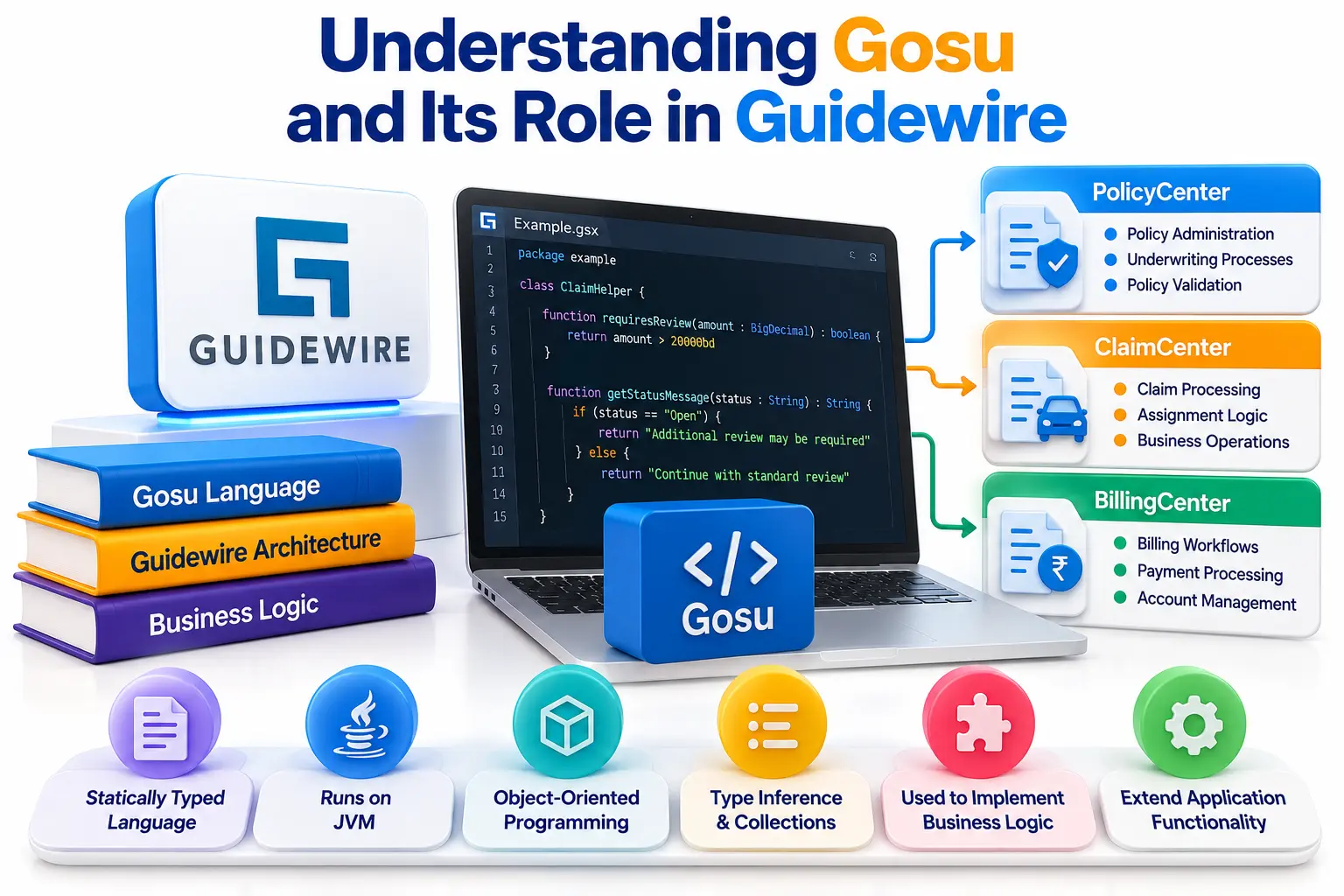
Gosu is a statically typed programming language that runs on the Java Virtual Machine (JVM). It combines object-oriented programming with features such as type inference, collections, and enhancements. Within Guidewire InsuranceSuite, developers use it to implement business logic and extend application functionality.
Gosu is relevant across three major Guidewire applications:
PolicyCenter: Supports policy administration, underwriting processes, and policy transaction validation.
ClaimCenter: Supports claim processing, assignment logic, and claim-related business operations.
BillingCenter: Supports billing workflows, payment processing, and account-related operations.
Understanding Gosu means learning more than its syntax. Developers must also understand application entities, configuration conventions, transaction lifecycles, and the appropriate extension points.
A critical principle is to prefer standard configuration capabilities whenever they meet the requirement. Custom code should address genuine functional needs without introducing unnecessary complexity or upgrade risks.
Mastering Gosu Language Fundamentals
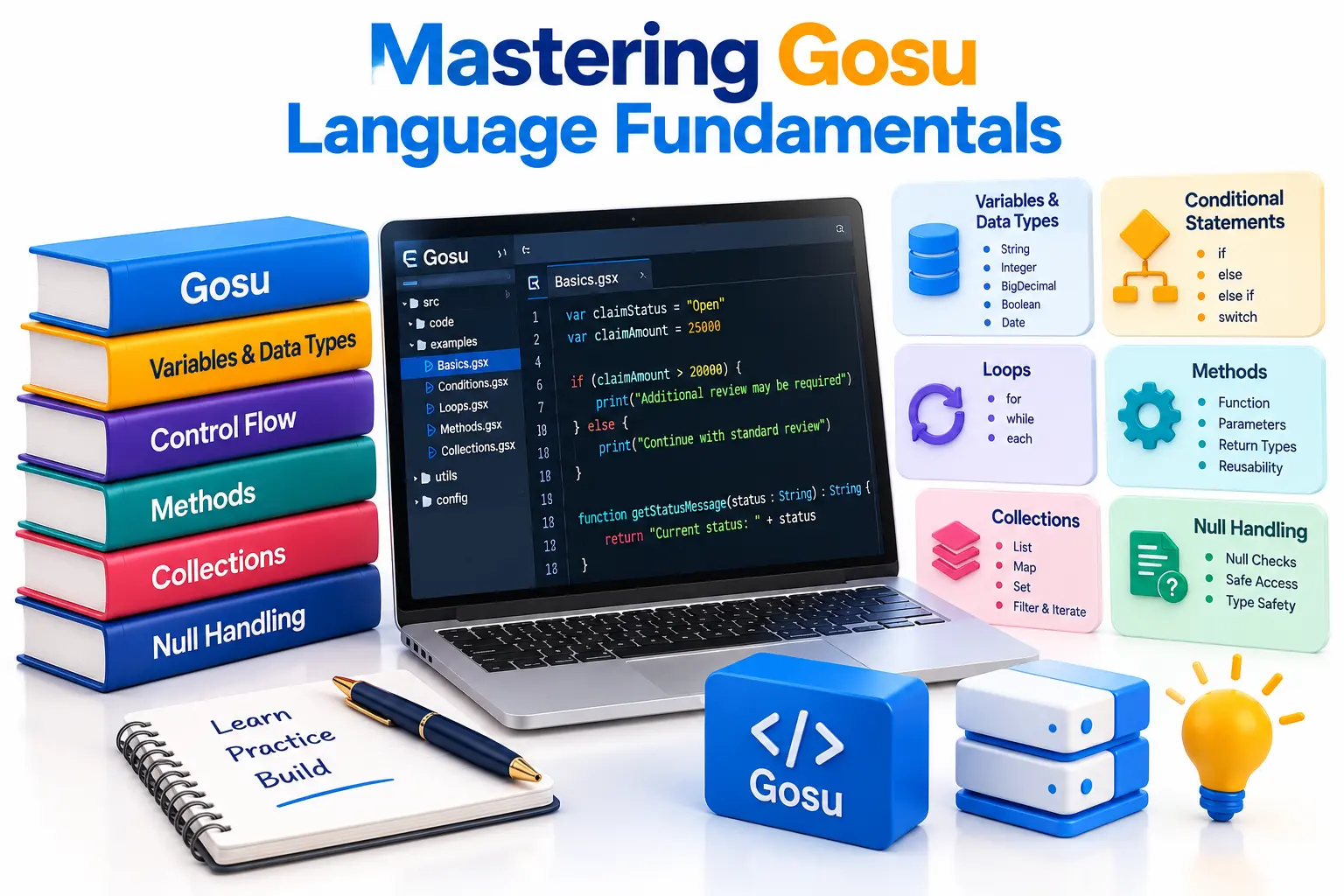
Strong programming fundamentals make Guidewire development easier to understand and maintain. Begin with variables, data types, conditional statements, loops, methods, and collections before progressing to application-specific functionality.
Consider this illustrative Gosu example:
This example demonstrates variable declaration, type inference, comparison, and conditional execution. It is a standalone learning example rather than a complete Guidewire business rule.
Developers should also practise working with lists, maps, strings, dates, and nullable values. These concepts frequently appear when processing business entities and applying conditions to insurance transactions.
Important fundamentals include:
Type safety: Understand how declared and inferred types affect assignments and method calls.
Control flow: Use conditions and loops to express business decisions clearly.
Methods: Separate reusable operations from the code that invokes them.
Collections: Filter and process groups of objects without unnecessary complexity.
Null handling: Check whether an object or property can be absent before accessing it.
Mastering these concepts provides a foundation for understanding more advanced Guidewire development tasks.
Applying Object-Oriented Programming to Insurance Applications
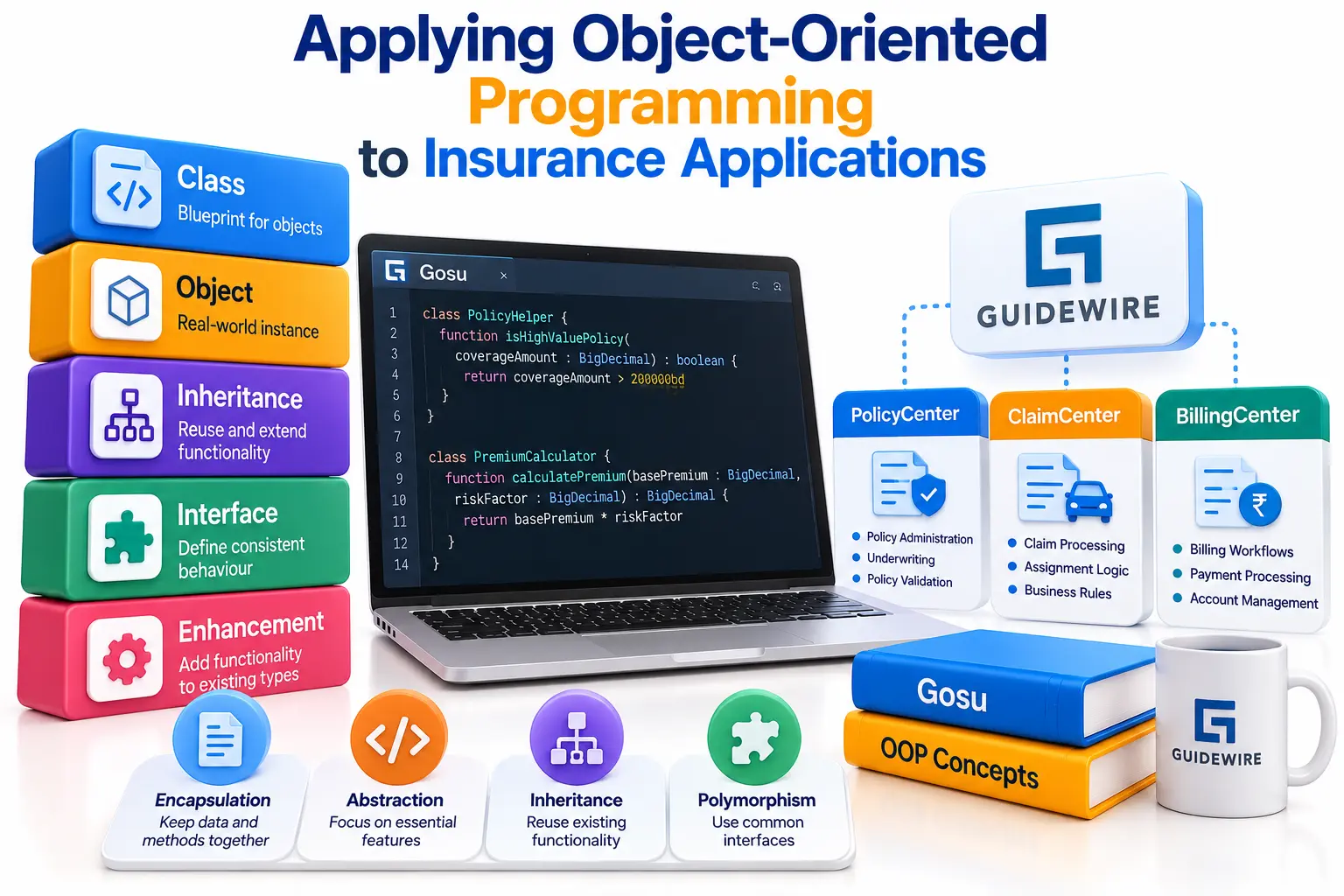
Object-oriented programming organizes software around objects, their properties, and their behaviour. In Gosu, developers work with classes, methods, inheritance, interfaces, and other familiar object-oriented concepts.
Guidewire applications use a domain model containing entities that represent insurance information. For example, PolicyCenter includes policy-related objects, while ClaimCenter contains claim-related entities. Developers must understand the relationships between these objects before implementing business logic.
Consider a simplified conceptual example:
This example illustrates a reusable method that evaluates an amount. It is not a complete Guidewire extension, and the threshold is hypothetical. A production implementation must follow the application's business requirements and coding conventions.
Developers should also understand enhancements, which can add functionality to existing types, and interfaces, which help define consistent behaviour. Their appropriate use depends on the application architecture.
Good object-oriented design encourages readable methods, limited duplication, and clear responsibilities. Avoid placing unrelated operations into one large method simply because they belong to the same workflow.
Designing Business Rules with Gosu
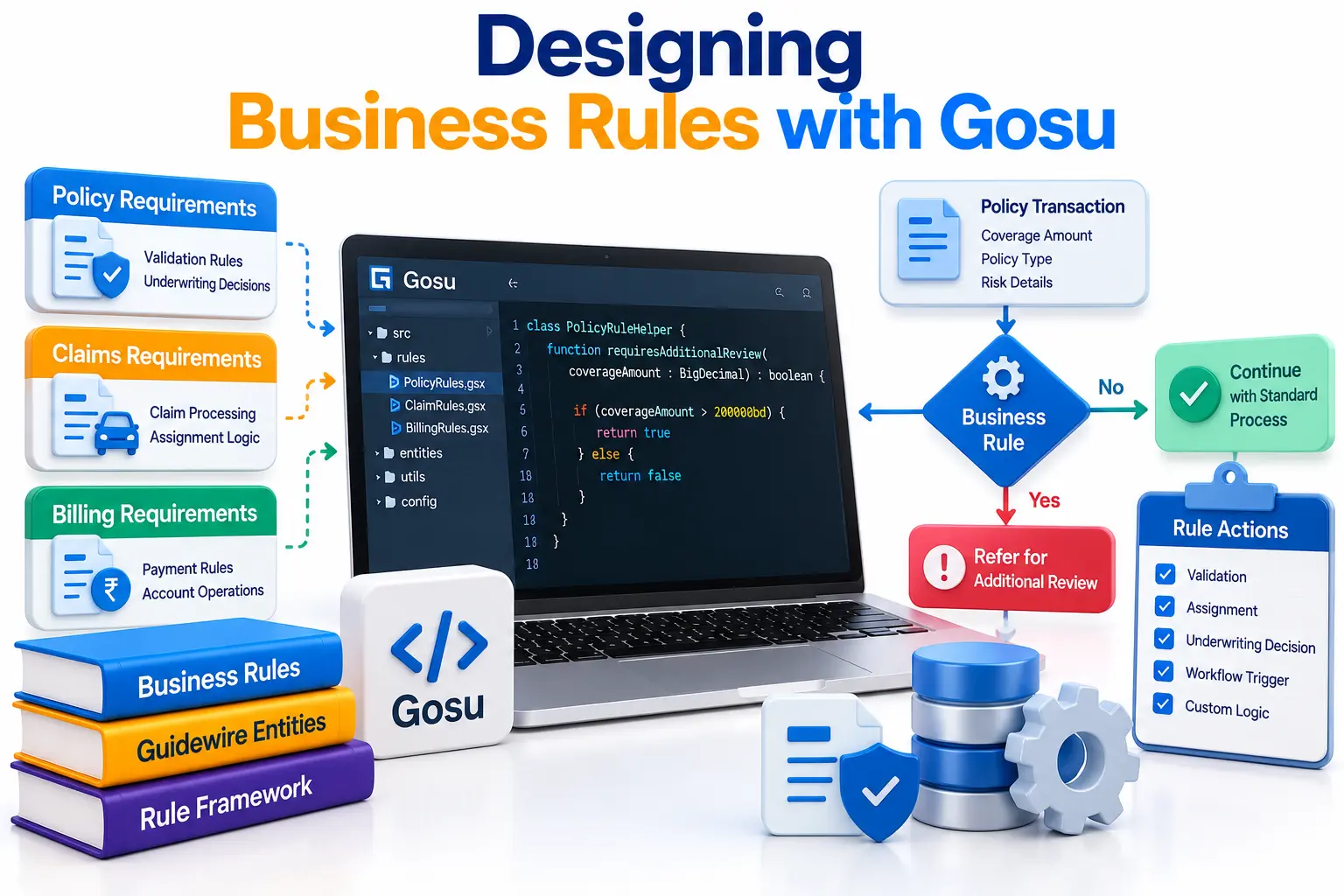
Business rules translate insurance requirements into executable decisions. Depending on the application and requirement, they can support validation, assignment, underwriting decisions, and other workflow activities.
For example, an insurer might require additional review when a policy exceeds a specified coverage threshold. The developer must first clarify the requirement, identify the relevant policy data, determine the correct rule execution point, and define the expected outcome.
A simplified conceptual condition might look like this:
The example demonstrates conditional logic only. Actual underwriting rules must use the correct Guidewire entities, rule framework, and configured business requirements.
Before implementing a rule, developers should establish:
Business purpose: What requirement must the rule enforce?
Input data: Which entities and fields supply the required information?
Execution point: When should the rule run during the transaction lifecycle?
Expected result: Should the application display a validation message, create an issue, or trigger another supported action?
Testing requirements: Which positive, negative, and boundary scenarios must pass?
It is equally important to distinguish configurable business-rule facilities from Gosu rules managed through development tools. Their capabilities, deployment behaviour, and execution requirements can differ.
Practical Coding, Debugging, and Testing Techniques
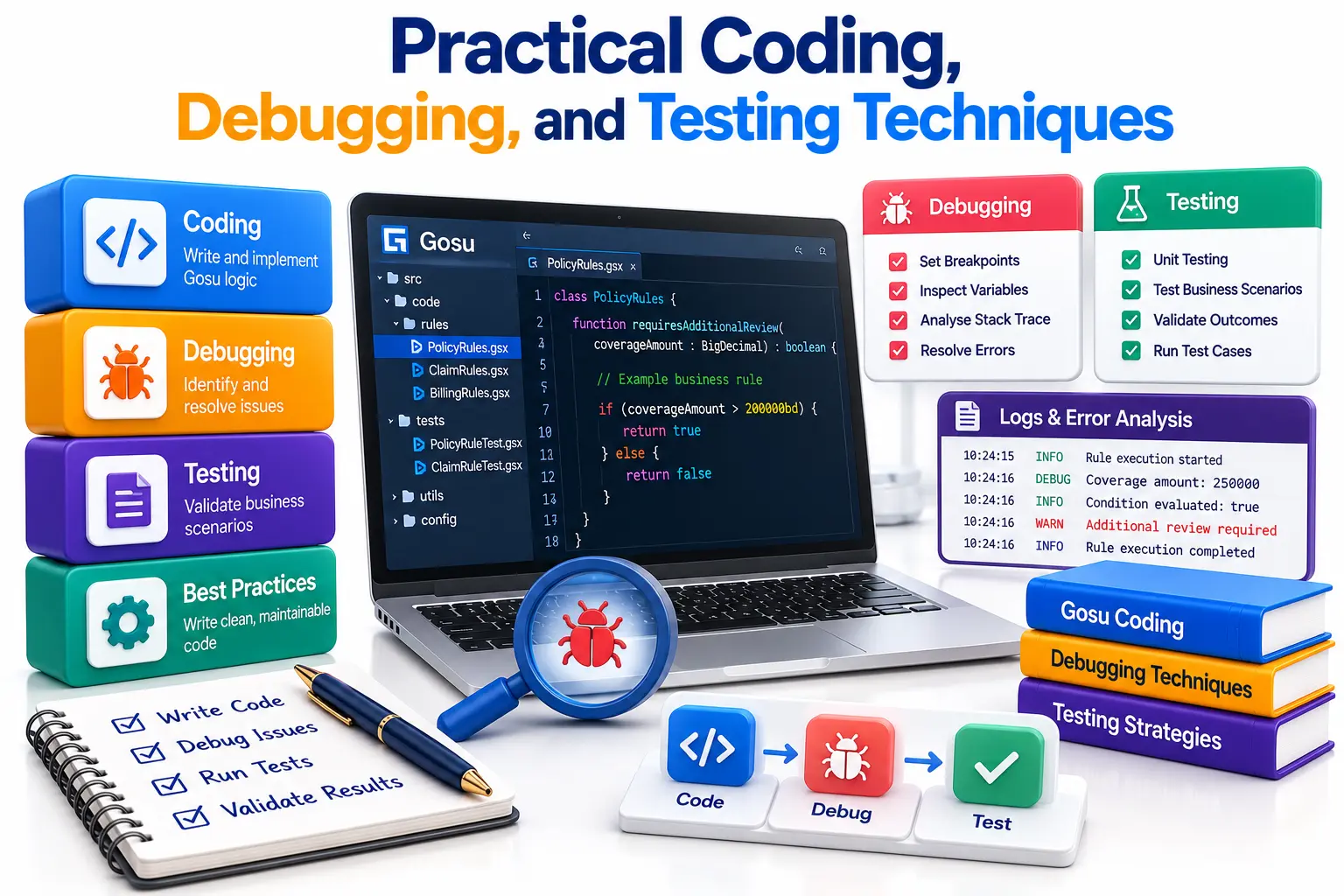
Practical development begins with a clearly defined requirement rather than immediately writing code. A developer working on policy validation, for example, should identify mandatory fields, permitted values, business exceptions, and expected error messages before implementing the solution.
A useful practice exercise is to design a validation scenario that checks whether a required business field has been provided. The implementation should use the correct entity and validation mechanism for the target Guidewire application.
After implementation, test the logic systematically:
Positive scenario: Valid input should produce the expected outcome.
Negative scenario: Invalid or missing input should be handled correctly.
Boundary scenario: Values at and around a business threshold should behave as specified.
Regression scenario: Existing workflows should continue functioning after the change.
Error scenario: Unexpected or incomplete data should not cause avoidable failures.
When debugging, inspect the relevant values, execution path, rule conditions, and application logs. Pay particular attention to null values, incorrect entity references, unexpected transaction states, and assumptions about data availability.
Developers should also consider performance and maintainability. Repeated database queries, unnecessary loops, duplicated conditions, and overly complex rules can make applications harder to support. Where supported, automated tests and code-review practices help identify defects earlier.
JastTech can support learners seeking structured exposure to Gosu concepts and practical Guidewire development exercises. When evaluating a learning programme, look for opportunities to work through realistic requirements, troubleshoot failures, and explain the reasoning behind implementation choices.
Building Job-Ready Guidewire Development Skills in Bangalore

Learning Gosu becomes more valuable when combined with application knowledge and realistic development practice. Employers working with Guidewire environments need developers who can understand requirements, navigate the domain model, implement appropriate customizations, and investigate defects systematically.
For learners exploring Guidewire Gosu Programming through Guidewire Training in Bangalore, a practical roadmap should combine programming foundations with PolicyCenter, ClaimCenter, or BillingCenter concepts. Choose one application initially, then expand your understanding as your skills develop.
A focused learning plan can include:
Foundation: Practise Gosu syntax, types, methods, collections, and object-oriented programming.
Application knowledge: Understand the selected InsuranceSuite application's entities and transaction lifecycle.
Business logic: Implement suitable validation, assignment, or workflow exercises.
Development tools: Learn to navigate Guidewire Studio and interpret compilation errors and logs.
Testing: Document scenarios, test edge cases, and verify that changes do not break existing behaviour.
Project practice: Build a small, demonstrable exercise that explains the requirement, implementation, testing approach, and limitations.
Avoid relying solely on memorized interview answers or copied code snippets. Interviewers may ask why a particular extension point was chosen, how a rule behaves when data is missing, or how a change should be tested.
Cloud development also makes upgrade-aware design increasingly important. Developers should follow the supported customization model, verify version-specific guidance, and minimize unnecessary dependencies on implementation details.
Conclusion
Gosu is an important skill for developers extending Guidewire InsuranceSuite, but language knowledge alone is not enough. Effective development requires understanding the insurance domain, selecting the right configuration or customization approach, writing readable business logic, and testing realistic scenarios. These capabilities help developers move beyond syntax exercises toward solving practical application problems.
For aspiring Guidewire professionals in Bangalore, the strongest next step is to combine structured learning with consistent coding practice. Work through business requirements, investigate errors, document test results, and build projects that demonstrate your reasoning. With a solid foundation and hands-on experience, you can prepare more effectively for Guidewire development responsibilities and technical interviews.