

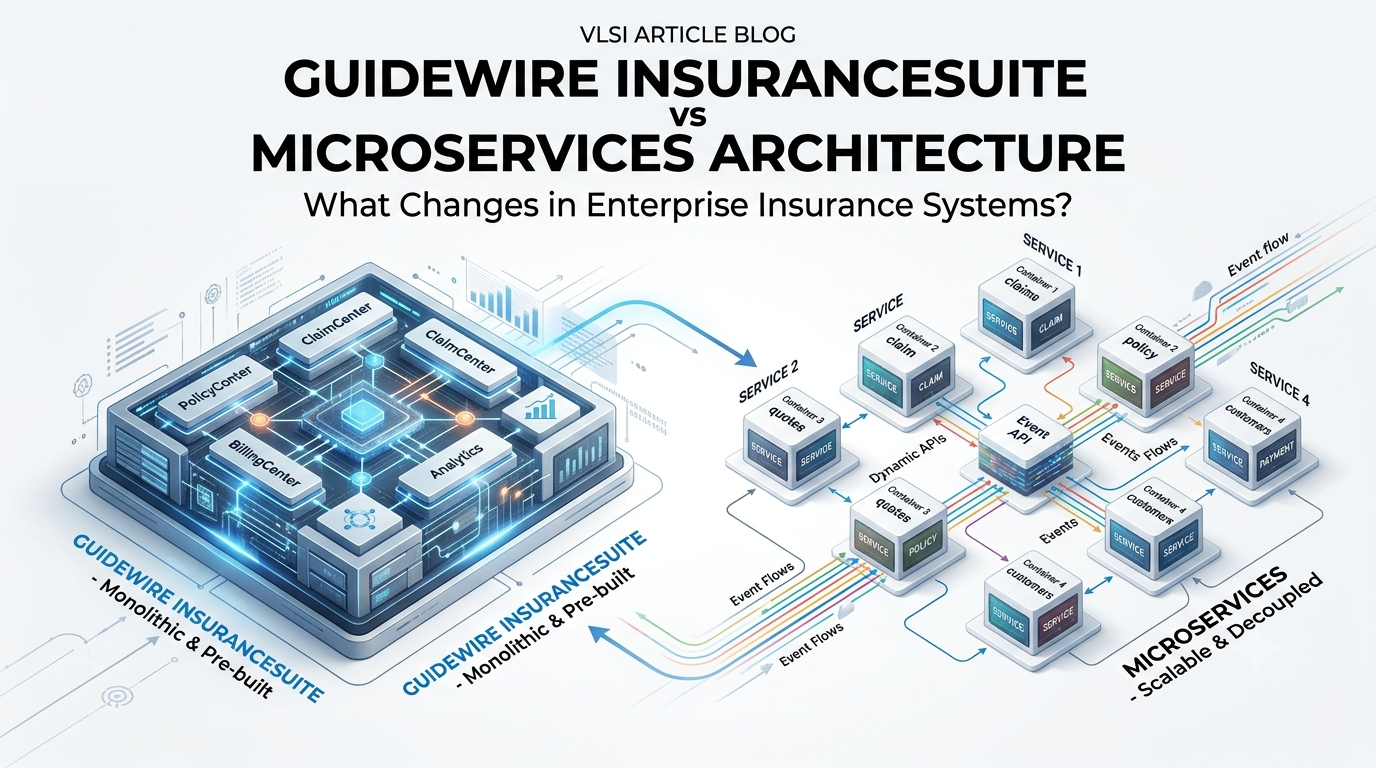
Guidewire InsuranceSuite vs Microservices Architecture: What Changes in Enterprise Insurance Systems?
Navigate through this article using the table of contents below
Table of Contents
No headings found in this article.
The digital transformation of the property and casualty (P&C) insurance sector is accelerating as insurers modernize legacy systems and respond to growing demands for digital customer experiences, faster product delivery, and more connected operations. Two architectural approaches frequently considered in this transformation are adopting an industry-specific platform such as Guidewire InsuranceSuite or designing a custom ecosystem around microservices. These approaches differ in how they provide insurance capabilities, organize business logic, manage data, support integrations, and handle ongoing development.
Guidewire InsuranceSuite provides applications specifically designed around core P&C insurance processes, while a microservices approach provides an architectural pattern for decomposing an application into independently developed and deployed services. The distinction is therefore not simply between a “monolithic” and a “microservices” system. Instead, it is about the balance between pre-built insurance functionality, platform-managed capabilities, architectural flexibility, and the engineering responsibility required to build and operate a distributed system.For professionals entering the enterprise insurance technology space, understanding these differences is important. Specialized Guidewire training can provide practical exposure to PolicyCenter, ClaimCenter, BillingCenter, Gosu, data models, configuration, and integration concepts. At the same time, knowledge of APIs, distributed systems, cloud infrastructure, and microservices remains valuable when working with modern insurance ecosystems.
Core Architectural Paradigms: Domain-Specific Platform vs. Distributed Services
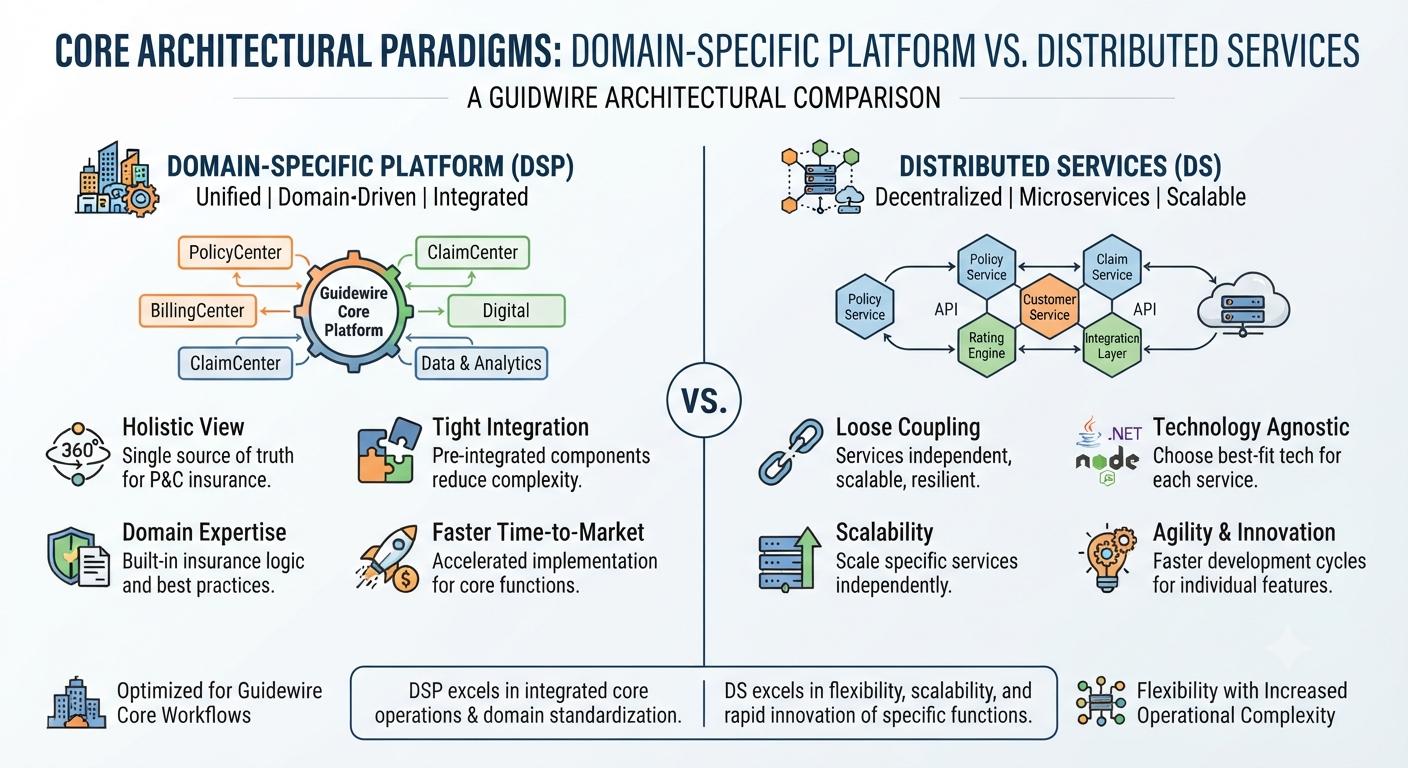
Guidewire InsuranceSuite is an industry-focused platform designed specifically for P&C insurance operations. Its core applications include PolicyCenter, BillingCenter, and ClaimCenter, each addressing a major area of insurance operations. These applications provide pre-built domain capabilities, business rules, workflows, data structures, and integration mechanisms that insurers can configure and extend according to their requirements.Rather than requiring an insurer to construct fundamental insurance capabilities independently, the platform provides an established foundation for common P&C processes. This can reduce the amount of domain functionality that an organization needs to design and maintain itself. However, implementation still involves configuration, extensions, integrations, testing, data migration, and operational governance.
A microservices architecture approaches the problem differently. Business capabilities can be divided into independently deployable services—for example, rating, policy issuance, customer management, claims intake, payments, or document processing. These services can communicate through APIs, messaging systems, or event streams.This flexibility can allow teams to select different technologies and deployment strategies for individual services. However, it also introduces distributed-system concerns such as service discovery, observability, API management, failure handling, security, and coordination between services.Importantly, microservices do not inherently require every service to use a completely separate physical database. The appropriate data ownership and storage strategy depends on the system's architecture, consistency requirements, and operational constraints.
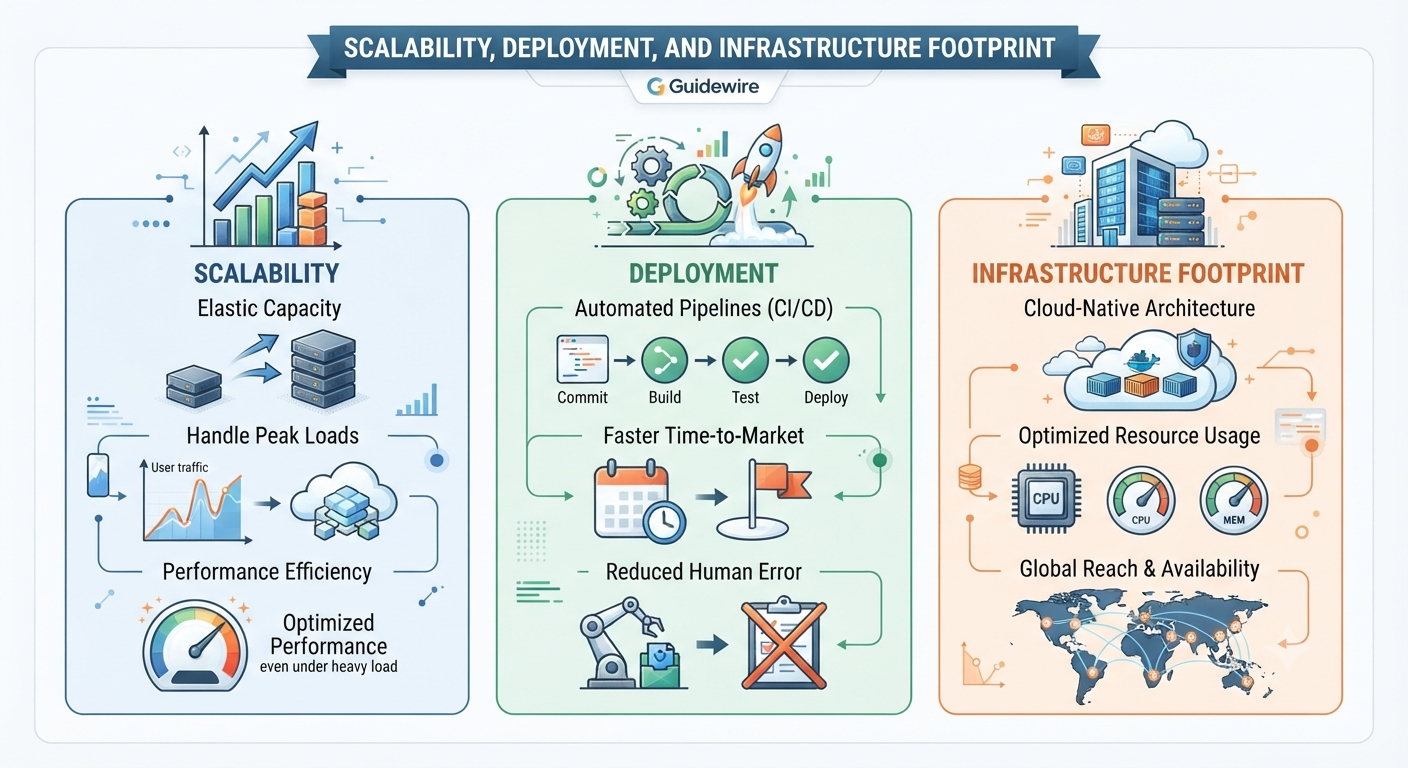
Guidewire InsuranceSuite has evolved with cloud deployment models, including Guidewire Cloud. Cloud-based deployment can provide access to elastic infrastructure and managed platform capabilities, while the exact scaling model depends on the application, workload, deployment architecture, and service configuration.For example, an insurer experiencing increased transaction volumes during a policy-renewal period may need additional application capacity. The practical scaling approach depends on the specific Guidewire application and the environment in which it operates rather than assuming that every component scales in exactly the same way.
Microservices can provide more granular scaling because individual services can be scaled according to their workloads. If claims intake experiences a sudden increase in traffic after a major weather event, the relevant service can potentially receive additional computing resources without scaling unrelated services to the same degree.However, this flexibility comes with operational responsibilities. Organizations may need container orchestration, CI/CD pipelines, centralized logging, distributed tracing, monitoring, security controls, and service-management practices. Therefore, microservices can provide fine-grained scalability, but realizing that benefit requires a mature engineering and operations model.
Data Integrity, Consistency, and State Management
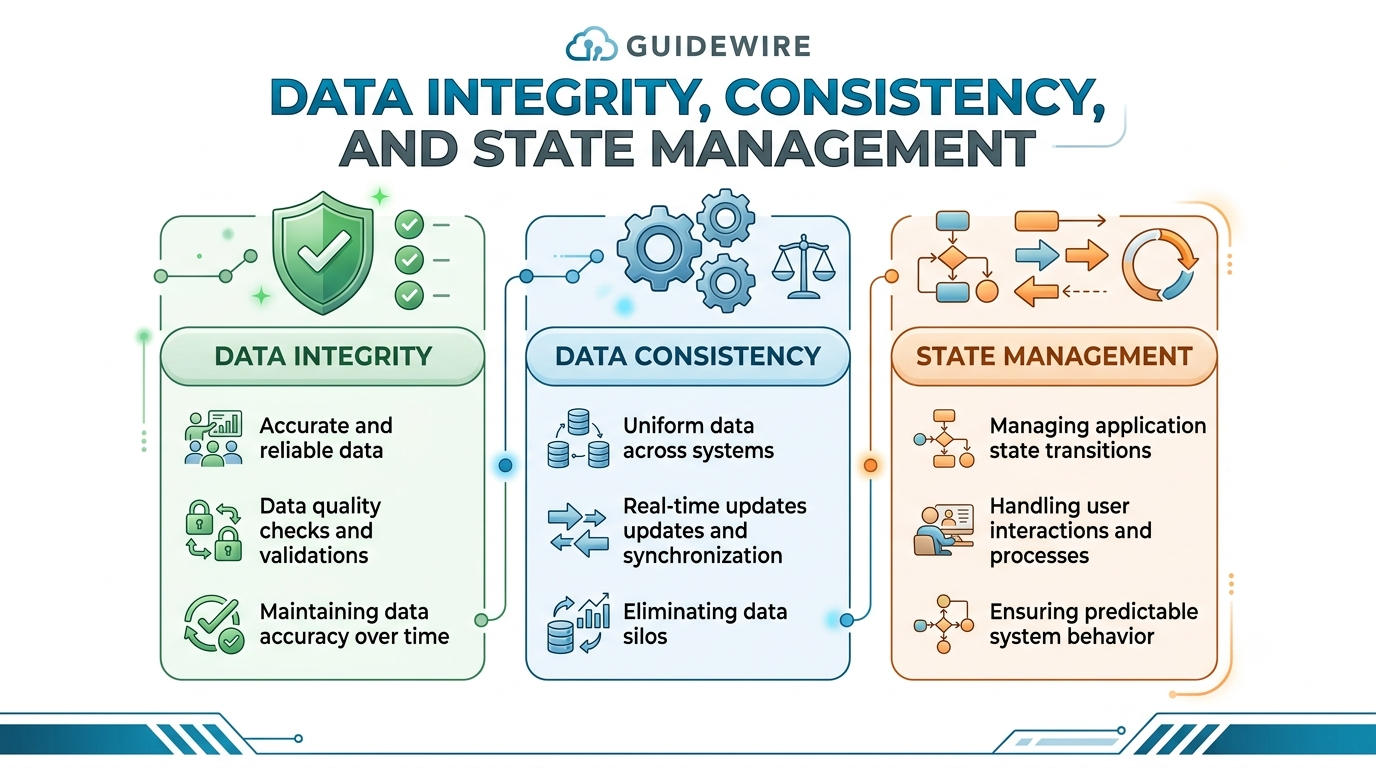
Data management is an important architectural consideration when comparing an industry platform with a distributed microservices ecosystem.Guidewire applications provide structured insurance data models and transaction-processing capabilities designed around P&C business processes. Policy, billing, claims, and related entities are managed according to the application's domain model and transaction mechanisms.This can simplify many business operations because the platform provides established mechanisms for handling insurance-related state and business transactions. However, when multiple Guidewire applications or external systems participate in a business process, integration boundaries still need to be designed carefully. Data synchronization, interfaces, error handling, and reconciliation can remain important implementation concerns.
Microservices generally encourage clear ownership of business data by individual services. A service may maintain its own data store or data boundary, but a separate physical database for every service is not an absolute requirement.When multiple services participate in one business process, maintaining consistency can require patterns such as events, retries, idempotency, orchestration, choreography, or Saga-style compensation. This means that developers must explicitly design how systems behave when one part of a distributed transaction succeeds while another fails.The result is a trade-off: centralized or platform-provided domain capabilities can simplify certain transactional workflows, while distributed services provide greater independence but require more deliberate coordination across system boundaries.
Time-to-Market, Customization, and Product Configuration
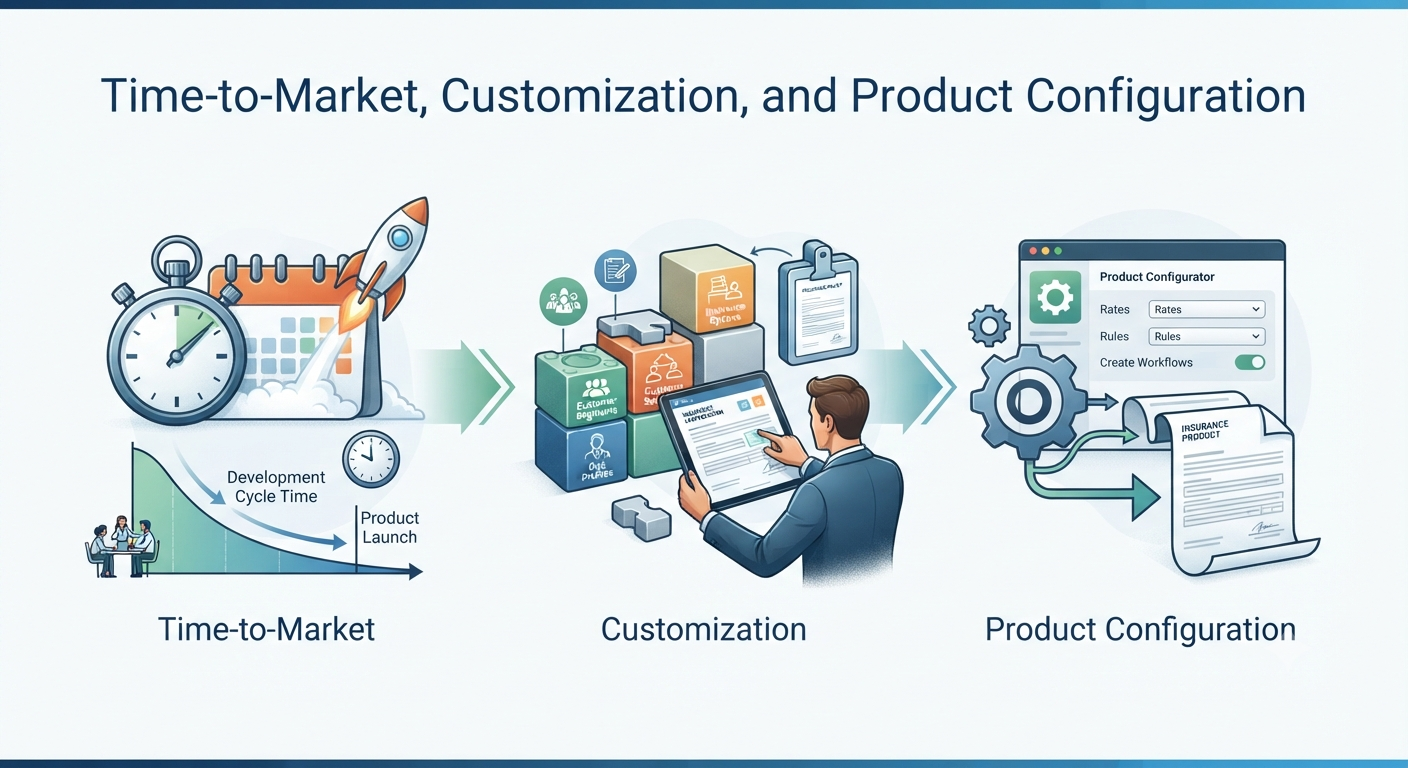
One of the major characteristics of Guidewire InsuranceSuite is its insurance-specific functionality. The platform provides capabilities for areas such as product modeling, policy administration, billing, claims, rating, workflows, and other P&C processes.Instead of implementing these capabilities from the ground up, insurers can configure existing functionality and use supported extension mechanisms to adapt the platform to their business requirements. This can reduce the amount of foundational insurance functionality that an implementation team needs to develop independently.
Microservices provide a different type of flexibility. Organizations can design individual services around their own business requirements, technology choices, data models, and deployment strategies.However, this flexibility also means that the organization may need to design and implement more of the underlying insurance functionality itself. Depending on the scope of the project, this can include product rules, rating logic, policy lifecycle processes, validation, APIs, data structures, user interfaces, and service-to-service workflows.Therefore, the comparison is not simply “configuration versus building everything from scratch.” The actual balance depends on how much insurance functionality already exists within the chosen technology ecosystem and how much the organization intends to develop internally.
Integration Ecosystems and API Abstraction
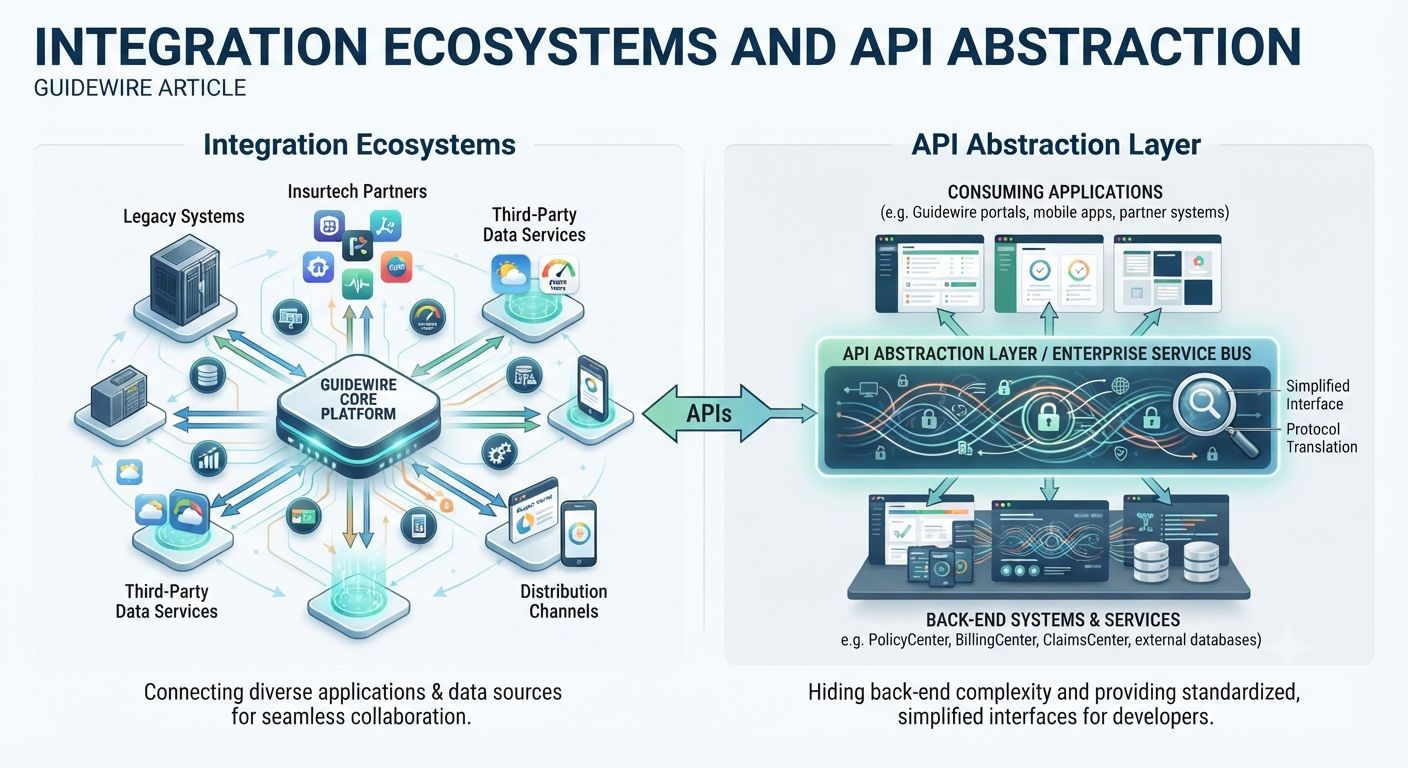
Modern insurance platforms rarely operate in isolation. Core systems commonly interact with payment providers, rating services, document systems, customer platforms, fraud solutions, telematics platforms, data providers, and other enterprise applications.Guidewire provides integration capabilities through its API framework, messaging mechanisms, and cloud-oriented integration approaches. Guidewire Cloud APIs can provide standardized ways for external applications to interact with Guidewire functionality, reducing the need to create completely custom interfaces for every integration scenario.
This can be particularly useful when organizations need to connect core insurance applications with surrounding digital systems.Microservices typically treat APIs and asynchronous communication as fundamental architectural components. API gateways, event streams, message brokers, and publish/subscribe mechanisms can support communication between internal services and external applications.This approach provides considerable flexibility, particularly when an organization operates a broad cloud-native ecosystem. At the same time, the organization becomes responsible for API governance, authentication, authorization, versioning, backward compatibility, observability, and lifecycle management across its services.
Total Cost of Ownership (TCO) and Maintenance Dynamics
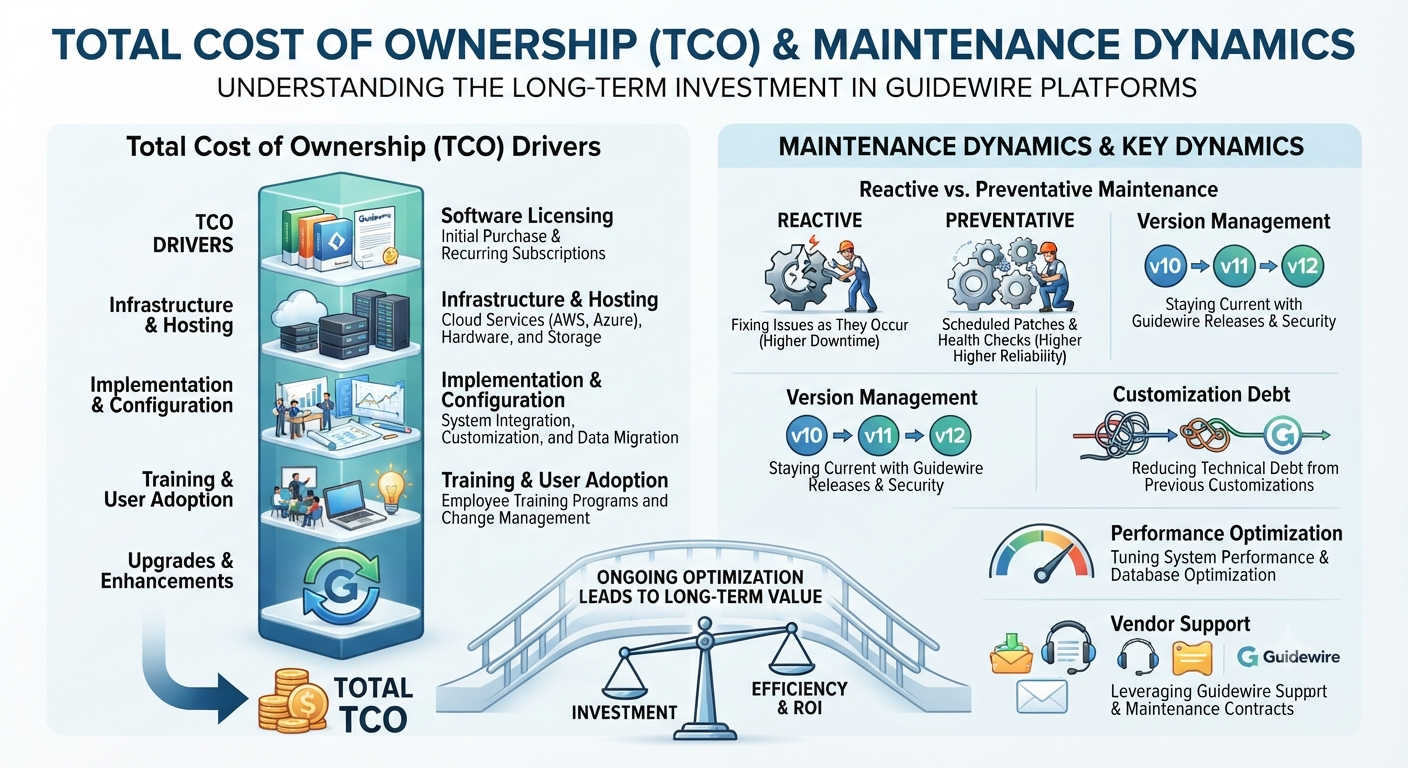
Total Cost of Ownership should be evaluated across more than software licensing. Relevant factors include platform or subscription costs, cloud infrastructure, development resources, testing, operations, security, upgrades, integrations, and long-term maintenance.Guidewire InsuranceSuite involves commercial licensing and/or subscription costs depending on the deployment and commercial model. One potential advantage is that a substantial amount of insurance-specific functionality is provided as part of the platform. This can reduce the amount of core insurance functionality that an organization has to build and maintain independently.However, implementation, customization, integration, testing, data migration, and ongoing operational activities still require significant investment.
Microservices can be built using open-source frameworks and commercially available cloud services, potentially reducing dependence on a single packaged application license. However, microservices do not automatically eliminate licensing or infrastructure costs. Organizations may still pay for cloud platforms, databases, monitoring systems, API gateways, messaging infrastructure, commercial developer tools, and other services.In addition, the engineering effort required to develop, secure, test, deploy, monitor, and maintain a large distributed system can become a substantial component of TCO.Consequently, neither architectural approach should be assumed to be universally cheaper. TCO depends on the insurer's existing technology landscape, internal engineering capabilities, implementation scope, licensing arrangements, infrastructure choices, and long-term operating model.
Developer Experience, Talent Acquisition, and Career Considerations
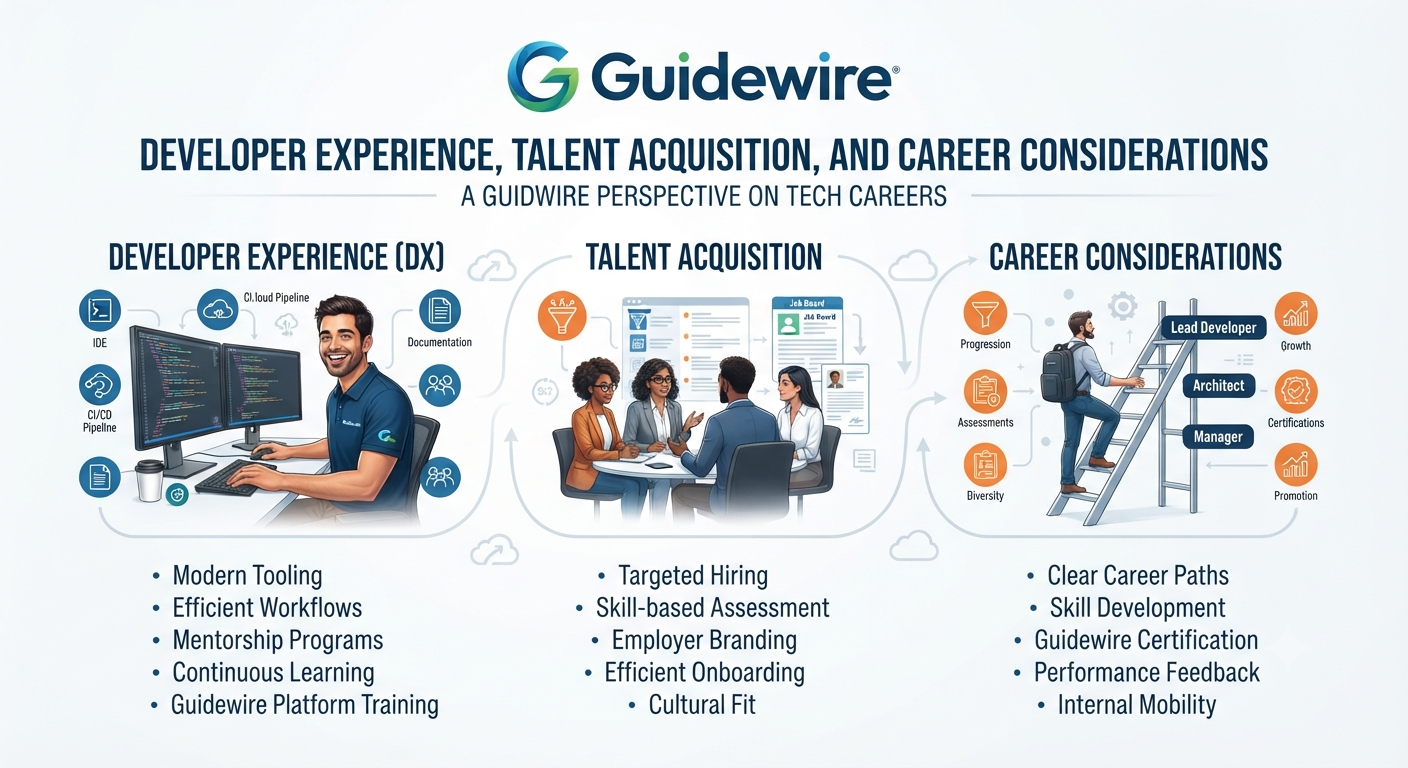
The architectural choice also affects the skills required within an engineering organization.Working with Guidewire InsuranceSuite generally requires knowledge of the Guidewire platform, its application architecture, configuration and extension mechanisms, Gosu, data models, integration frameworks, and P&C insurance processes. Developers and technical professionals may also need to understand how Guidewire applications interact with surrounding enterprise systems.Microservices environments typically require broader software engineering and cloud-native skills. Depending on the implementation, developers may work with technologies such as Java and Spring Boot, Node.js, Go, Python, Docker, Kubernetes, cloud platforms, APIs, messaging systems, and observability tools.
The two paths therefore create different learning requirements. Guidewire expertise combines software development with specialized insurance-domain knowledge, while microservices expertise is more broadly applicable across industries but still requires developers working in insurance to understand the relevant business domain.For professionals planning a career in enterprise insurance technology, understanding both sides can be valuable. Knowledge of a domain-specific platform can complement broader skills in APIs, cloud architecture, integration, distributed systems, and software engineering.
Conclusion
Guidewire InsuranceSuite and microservices represent different architectural approaches to solving enterprise insurance technology problems.Guidewire provides an industry-specific foundation with established P&C capabilities, structured data models, configurable business functionality, and integration mechanisms. This can reduce the need to develop fundamental insurance capabilities independently.Microservices provide a flexible architectural model in which business capabilities can be separated into independently managed services. This can support technology diversity, independent deployment, and granular scaling, but it also introduces additional responsibilities around distributed data, observability, communication, security, and operational management.
The practical decision therefore depends on the insurer's business requirements, existing systems, engineering capabilities, integration landscape, desired level of customization, operating model, and long-term technology strategy.Rather than viewing Guidewire and microservices as mutually exclusive choices, organizations can also evaluate how domain-specific platforms and independently developed services can coexist within a broader enterprise architecture.