

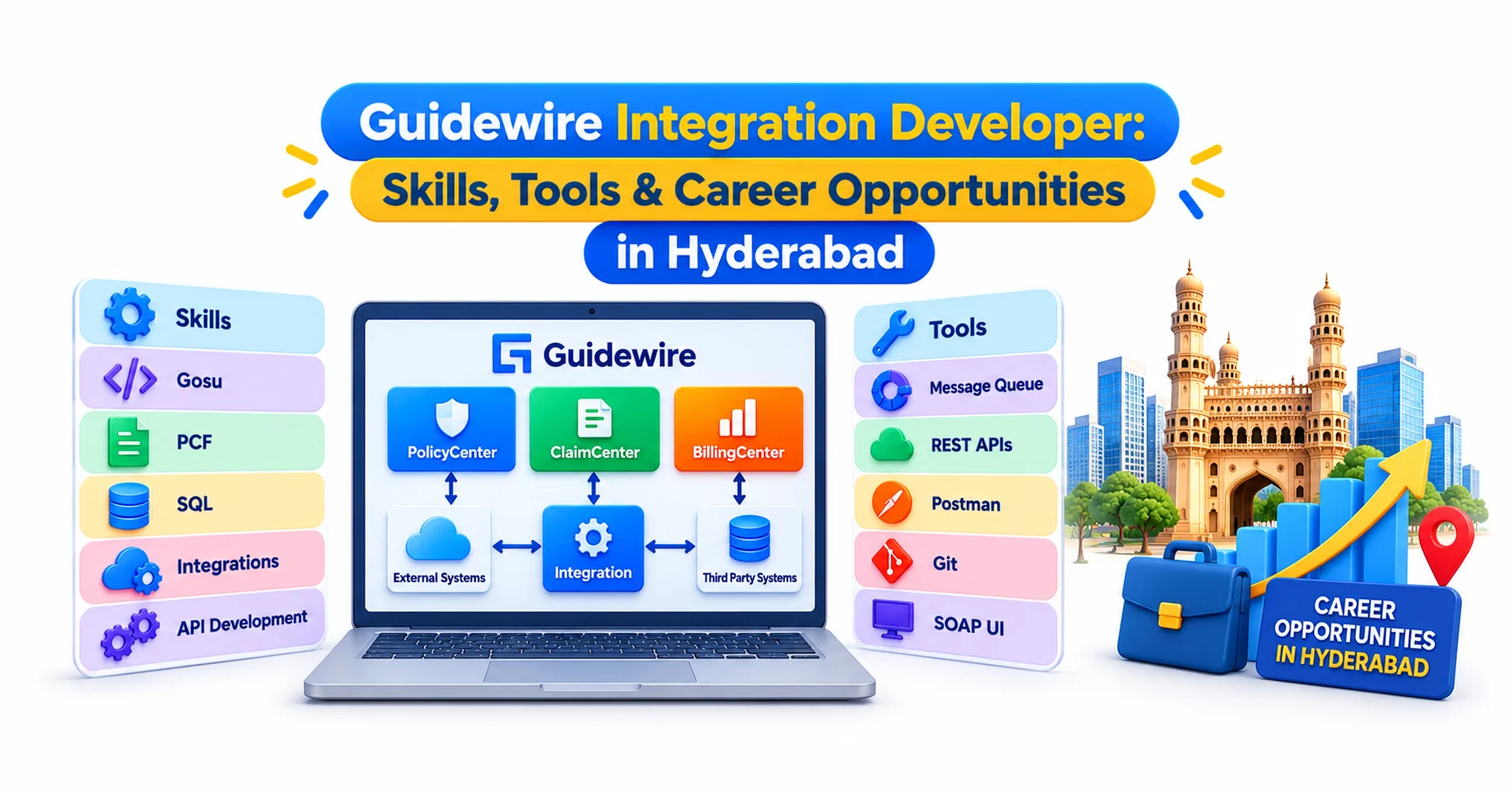
Guidewire Integration Developer: Skills, Tools & Career Opportunities in Hyderabad
Navigate through this article using the table of contents below
Table of Contents
No headings found in this article.
A policy gets bound in PolicyCenter, and a few seconds later a billing account has to exist, a document has to be generated, and a downstream data warehouse has to know about it. None of that happens by accident. Behind every one of those handoffs sits a Guidewire integration developer, and the demand for that role in Hyderabad keeps showing up in job listings across the city. If you want to enter this field, Guidewire training in Hyderabad is a practical place to start building the right foundation.
What a Guidewire Integration Developer Actually Does All Day
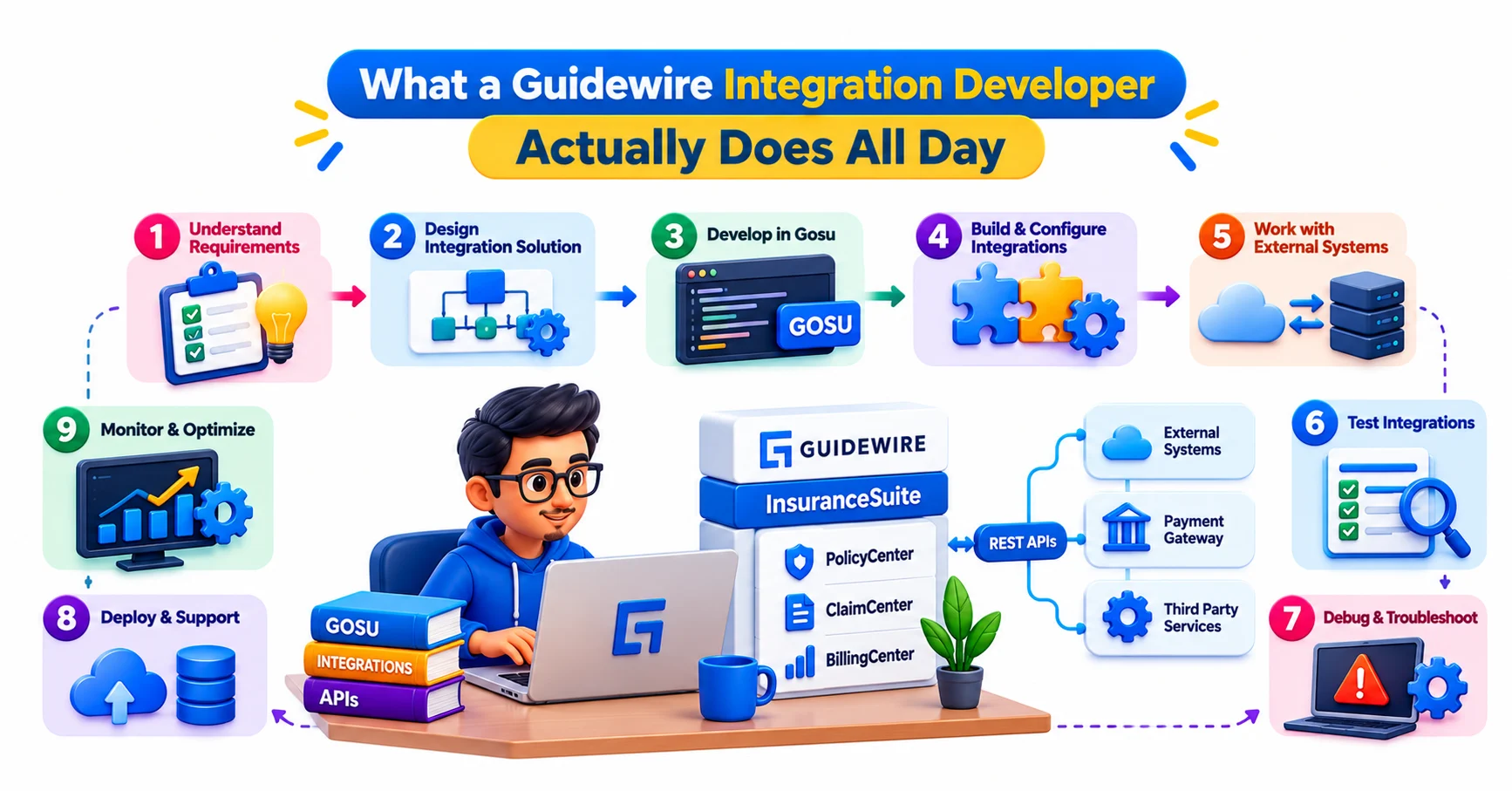
A Guidewire integration developer connects InsuranceSuite applications (PolicyCenter, ClaimCenter and BillingCenter) with the other systems an insurer depends on. That includes payment gateways, document platforms, CRM tools, third-party data providers, legacy mainframes and reporting systems.
The work splits into two directions. Inbound integrations bring data into Guidewire, such as a vehicle lookup service returning details for a quote. Outbound integrations push data out, such as a claim payment instruction going to a finance system. Most real projects contain both, often in the same business flow.
Here is a hypothetical but realistic day. A ClaimCenter team needs first notice of loss records to flow into a fraud-scoring service. The integration developer studies the data the service expects, decides whether the call should be synchronous or event-driven, writes and tests the connection, and then plans for the unhappy paths: the service times out, returns malformed data, or goes down for maintenance. That last part, planning for failure, is where most of the real engineering lives.
This is also what separates the role from a general configuration developer. A configuration developer shapes screens, rules and product behavior inside Guidewire. An integration developer is responsible for how Guidewire behaves as part of a larger system, which means thinking about reliability, security and data contracts as much as business logic.
The Technical Skills Hyderabad Employers Keep Asking For
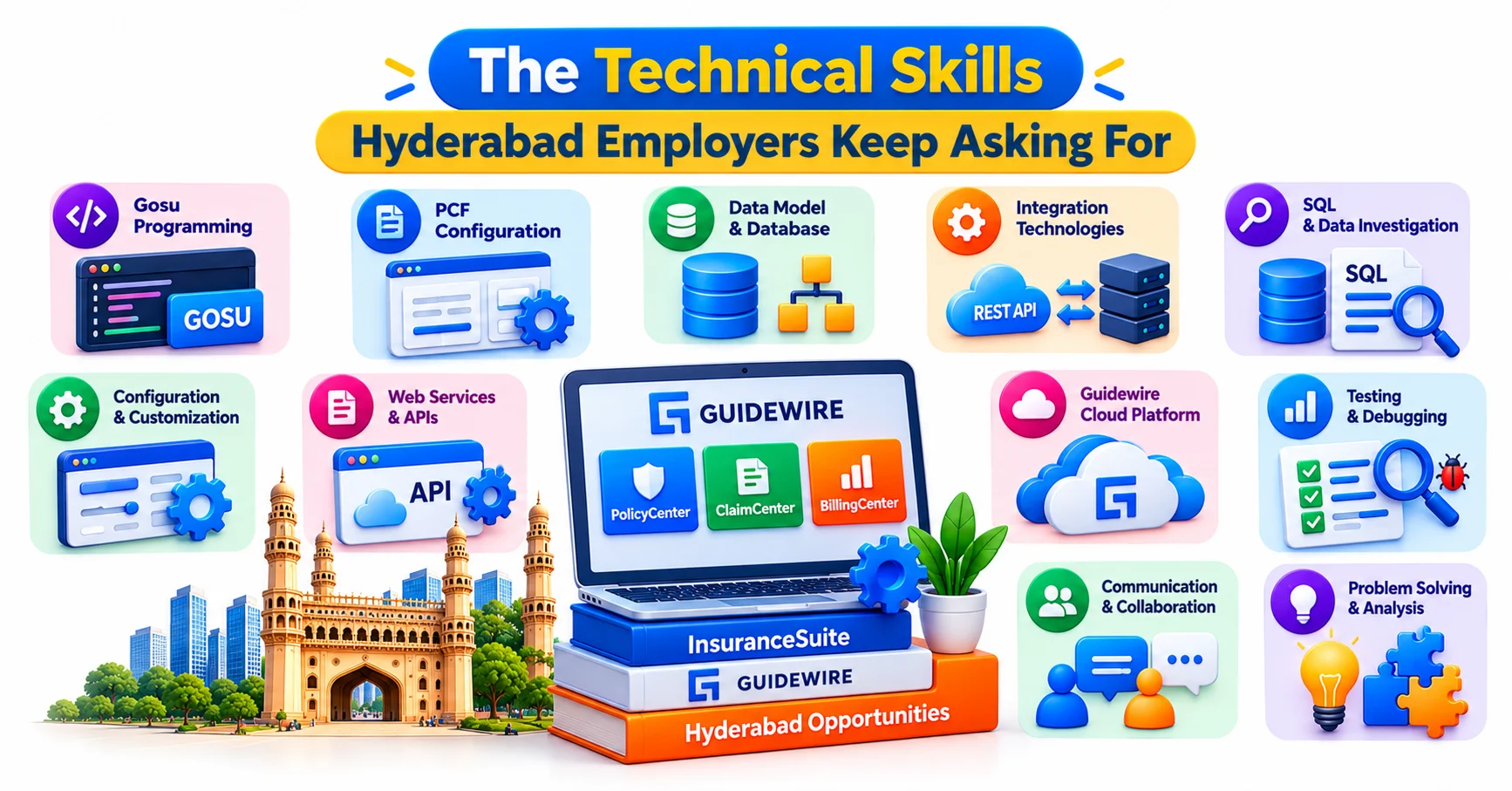
Reading through current Hyderabad openings, a clear pattern emerges. The same group of skills appears again and again, regardless of whether the employer is a large services firm or a product-focused team.
Gosu and Java come first. Gosu is the language of Guidewire’s own configuration layer, and Java matters for anything running outside the application, including middleware and custom services. Most listings expect comfort with both, with the exact balance depending on the project.
Next comes web services, both SOAP and REST. Employers also expect solid knowledge of XML, JSON, XSD and WSDL, because these are the formats and contracts that define how systems talk. If you have ever debugged a request that failed because one element was named differently, you already understand why this matters.
Then there are the Guidewire-specific mechanisms. Messaging and message destinations handle reliable asynchronous communication. Plugins and integration points let you extend platform behavior at defined hooks. Batch processes and work queues deal with large volumes of scheduled work, such as nightly policy renewals or bulk billing runs. GX models, which control how Guidewire entities are shaped into XML or JSON for exchange, appear regularly in job descriptions as well.
SQL is the quiet requirement that many learners underestimate. When an integration misbehaves in production, you will often need to inspect data directly to understand what was sent, what was received and where the two disagree.
A common beginner mistake is to treat these as a checklist to memorize. Employers mostly test whether you can reason about them together. Can you explain why a payment confirmation should use messaging instead of a direct web service call? Can you describe what happens to a queued message when the destination system is offline? Those answers matter more than naming every tool.
Building Your Foundation in Guidewire Integration Web Services
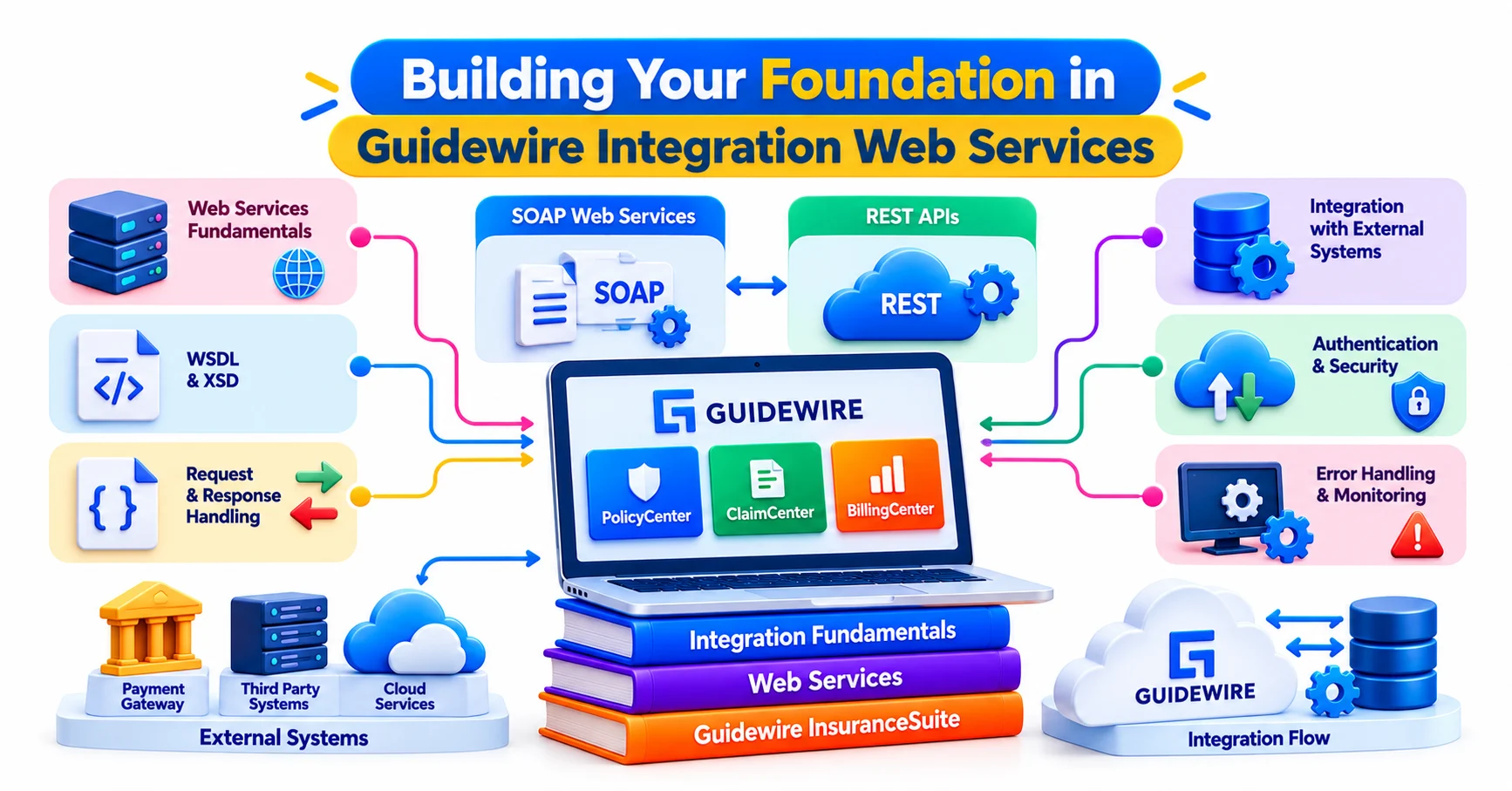
If you are choosing where to invest learning time first, web services deserve priority. They are the most common integration style in the suite, and almost every other concept builds on understanding how requests, responses and contracts work.
Guidewire applications can both expose and consume web services. Exposing a service means other systems can call into Guidewire, for example to retrieve a policy summary. Consuming a service means Guidewire calls out, for example to validate an address. Learners often practice only one direction and then get surprised when interviews cover both.
Good practice looks like this: start with a simple REST endpoint that returns a small JSON payload, then add authentication, then add error handling, and only then move to complex entity structures. Doing it in that order teaches you what each layer is for. SOAP deserves the same treatment, since many established insurance systems still rely on WSDL-based contracts and will not be replaced soon.
Structured practice helps here, because integration concepts are hard to absorb from reading alone. A dedicated course on Guidewire integration web services can walk through exposing and consuming services in a project-style setting, which is closer to what an employer will ask you to do than isolated exercises.
One more habit worth building early: always think about the contract before the code. Agree on field names, data types, optional versus required values and error formats first. Teams that skip this step lose days to avoidable mismatches later.
Messaging, Events and the Move Toward Guidewire Cloud
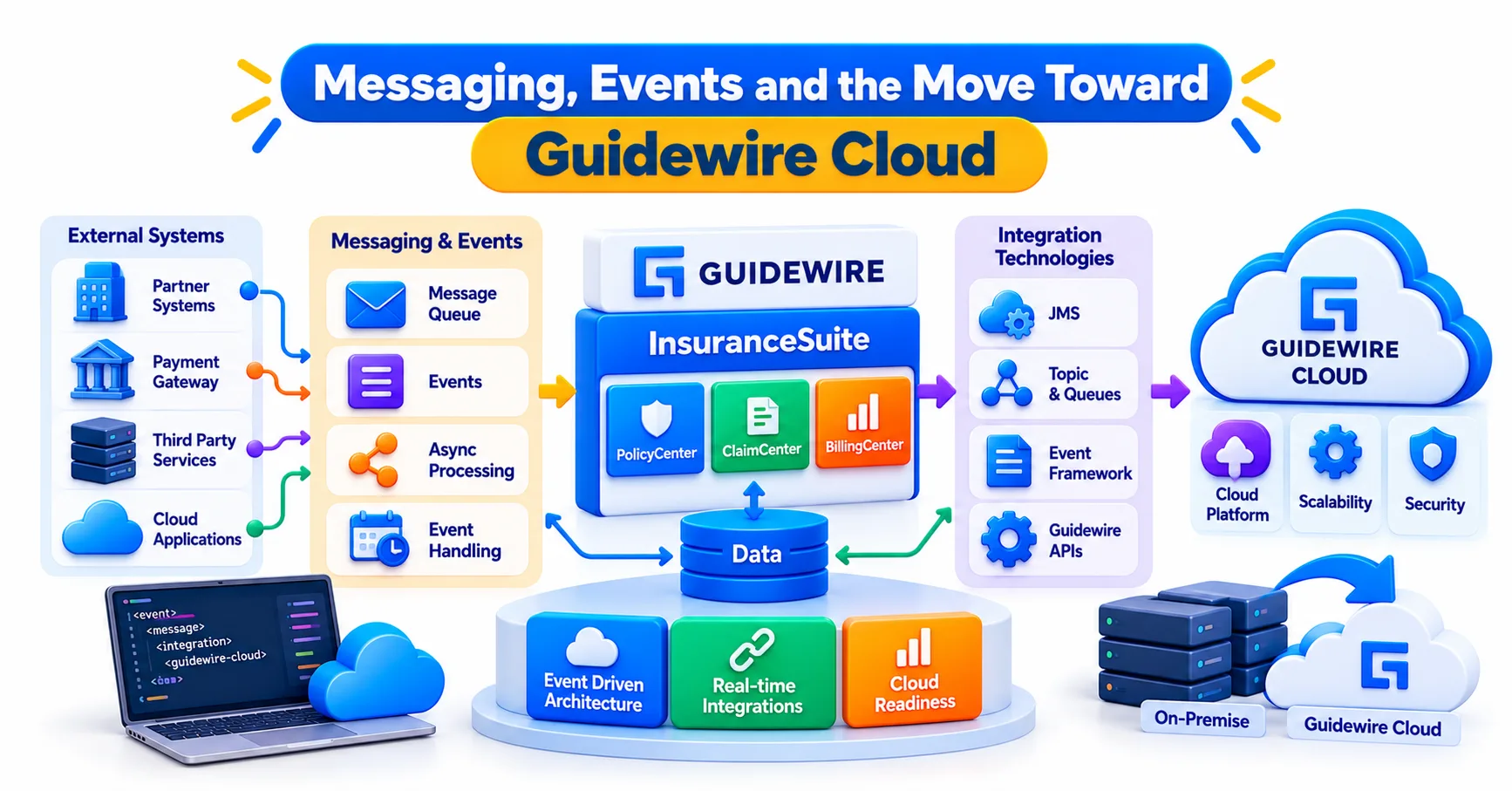
Web services handle conversations where one side waits for an answer. Many insurance processes do not work that way. When a claim is paid, the finance system does not need to hold up the adjuster’s screen. It just needs to receive the event reliably, even if it is busy or briefly offline. That is the job of messaging.
Guidewire’s messaging framework queues outbound messages and delivers them to configured destinations, retrying when something fails. Understanding how messages are created, how they are ordered, what happens when a destination is suspended, and how to handle errors is a core skill, and it comes up often in interviews.
The platform itself is changing too. Many current Hyderabad job descriptions mention Guidewire Cloud, Integration Gateway, Cloud APIs and App Events. In plain terms, Cloud APIs give standardized REST access to application data, App Events let applications publish business events for other systems to react to, and Integration Gateway supports building integrations that run alongside the cloud applications. Some listings also mention Apache Camel, which is a general-purpose integration framework.
What does this mean for a learner? Do not abandon the fundamentals, because on-premises and older implementations still need support and upgrade work. But do build familiarity with cloud-era concepts, including event-driven design, API security with standards such as OAuth 2.0, and the idea that integrations should be observable, meaning you can see what went wrong without guesswork.
Cloud projects also bring DevOps habits into the picture. Listings frequently mention Git, Jenkins, Maven and CI/CD pipelines, and some name AWS or Azure. You do not need to be a DevOps engineer, but you should be comfortable working in a version-controlled, automated delivery environment.
Tools, Testing and the Habits That Make Integrations Reliable
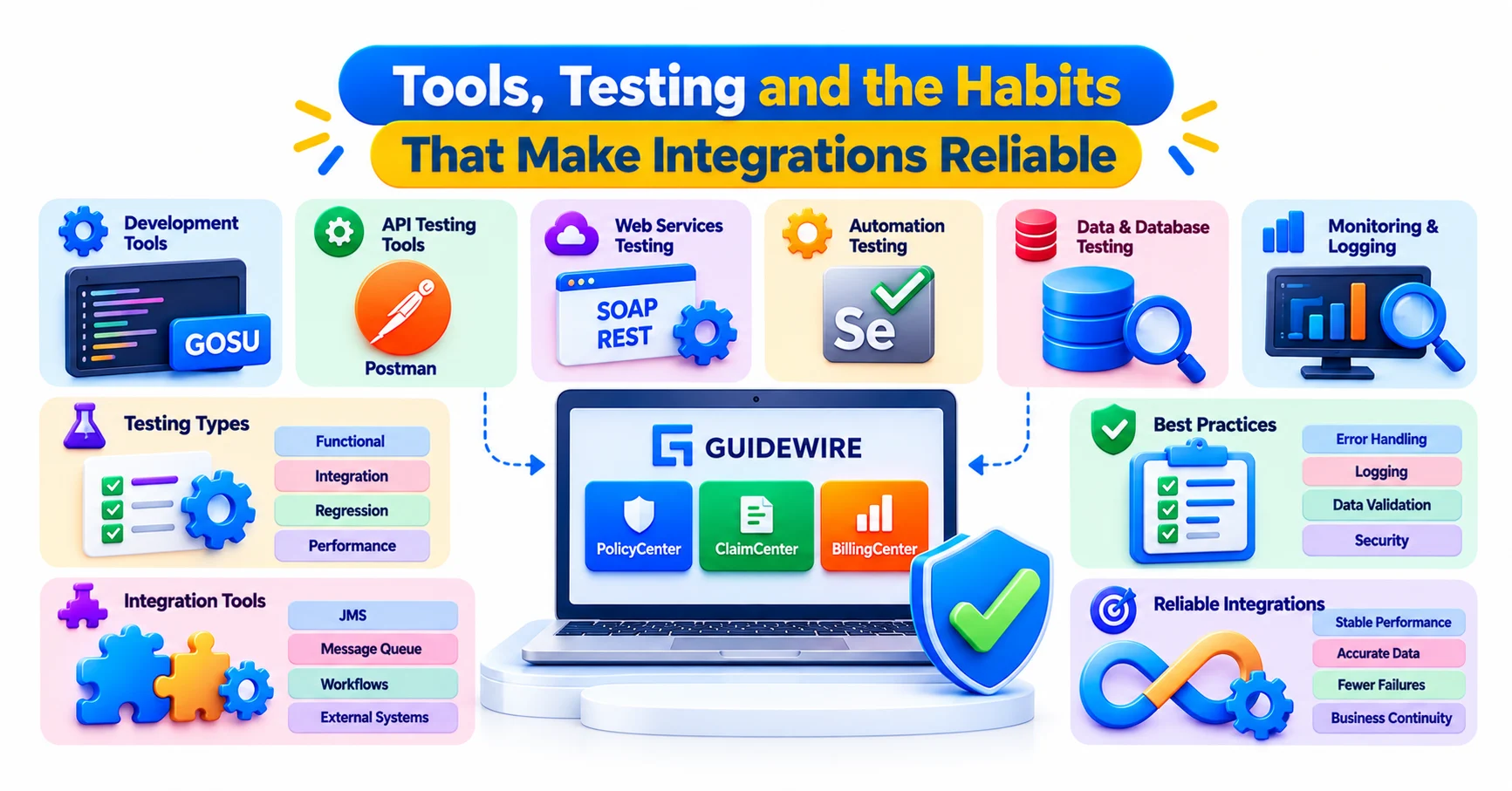
Writing an integration is only half the job. Proving it works under realistic conditions is the other half, and this is where experienced developers stand out.
For API testing, tools such as Postman and SoapUI are standard. They let you send requests, inspect responses and build repeatable test collections. Some teams add automated API testing with frameworks like Rest Assured, particularly where regression testing runs inside a pipeline. Understanding the broader testing picture helps too, since API-level checks and user-interface checks catch different kinds of defects.
For troubleshooting, logging discipline matters more than most learners expect. A good integration logs enough to reconstruct what happened (correlation identifiers, timestamps, request and response summaries) without exposing sensitive customer data. Insurance data includes personal and financial details, so careful handling is not optional.
A few habits separate dependable integrations from fragile ones:
Design for retries, and make operations safe to repeat so a retry does not create a duplicate payment or policy.
Set sensible timeouts rather than letting a slow external system freeze a user’s screen.
Validate incoming data instead of trusting it, even from systems you consider reliable.
Document each interface, including field meanings, error codes and ownership, so the next developer is not guessing.
Practice with a realistic mini project. For example, build a small service that receives a policy-issued event, transforms the data into the format an external system expects, handles a deliberate failure, and logs the outcome. Even a modest exercise like this teaches more than reading about the topic for weeks, and it gives you something concrete to discuss in an interview.
Career Paths, Hiring Patterns and How to Prepare in Hyderabad
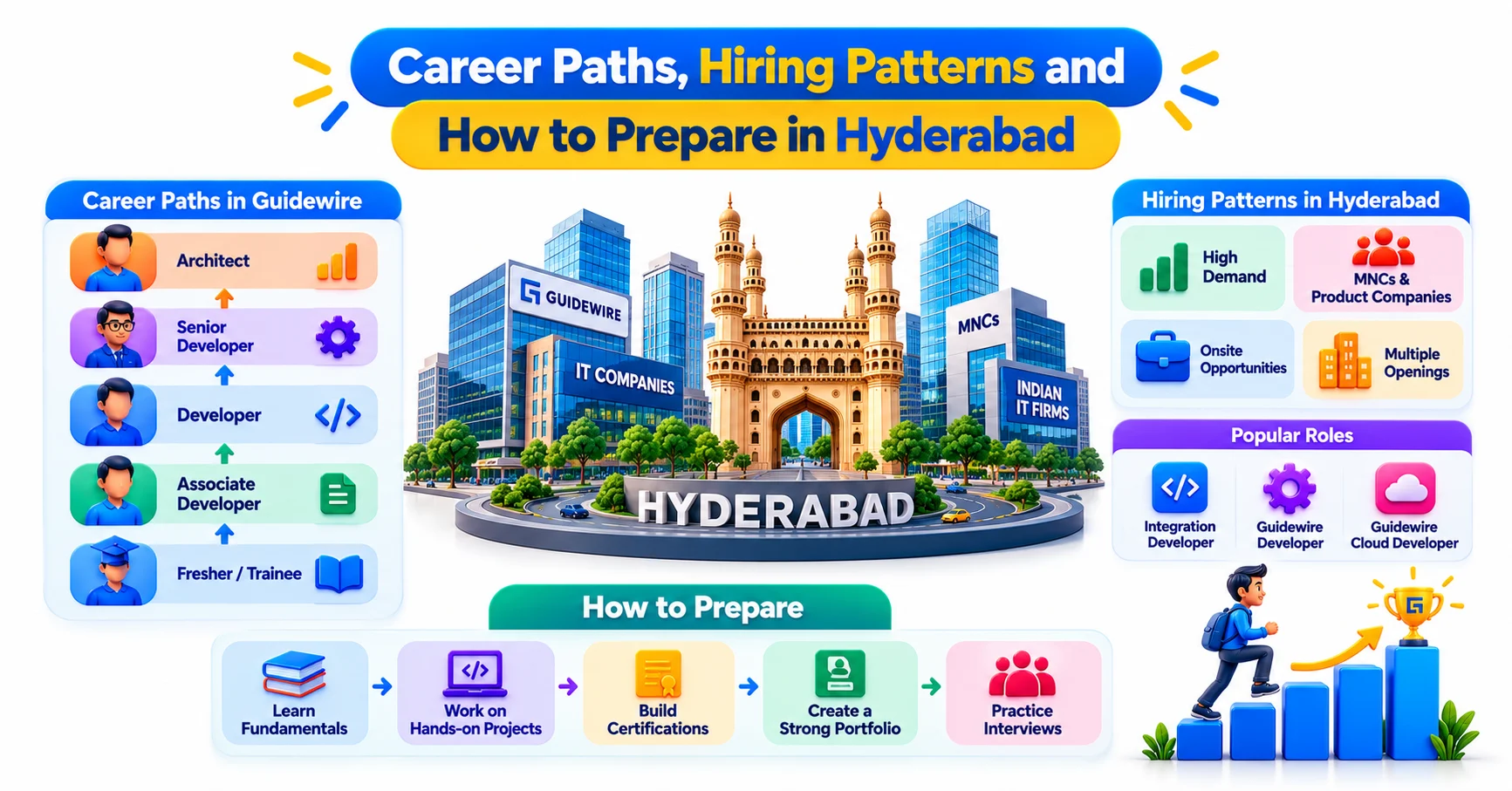
Hyderabad is one of the main Indian hubs for insurance technology work. Current openings for integration developers span global services companies, consulting firms and specialist technology providers, and many are hybrid roles. Listings typically target mid-level candidates, with experience requirements commonly ranging from around two years to eight or more, though the range varies by employer and project. Treat any single number you see online with caution, since each posting reflects one team’s needs.
Freshers should be realistic. Direct entry into a pure integration role is less common than starting in a broader Guidewire developer or configuration position and moving toward integration as you gain experience. That is not a disadvantage. Seeing how the core applications behave makes you a much better integrator later.
A sensible progression looks like this. Early on, you learn the data model, Gosu and basic configuration. Next comes hands-on work with web services, plugins and messaging. After that, you take on full interface ownership, from design through production support. Later paths include integration architect, technical lead, or specialization in cloud and API-led architecture. Domain knowledge helps at every stage, and listings often prefer property and casualty insurance exposure.
Certification can support your profile, and some employers list Guidewire certification as a good-to-have, but it rarely replaces demonstrable skill. Hiring managers tend to probe with scenario questions: how would you handle a failed message, how would you version an API, how would you debug a mismatched payload? Prepare by building small projects and explaining your decisions out loud.
Soft skills carry real weight here. Integration work means negotiating contracts between teams that do not share the same priorities. Clear written documentation and calm communication when something breaks in production are valued as highly as technical depth. Training providers such as JastTech can help by combining technical practice with interview preparation, but the commitment to build and break things yourself is what ultimately shows in your work.
Conclusion
Insurance runs on systems that must agree with each other, and the person who makes them agree is rarely visible until something fails. A Guidewire integration developer in Hyderabad needs strong web services knowledge, a working grasp of messaging and cloud-era events, disciplined testing habits and the patience to design for failure. Build those in order, practice on small realistic projects, and the role stops looking like a list of tools and starts looking like a craft worth growing into.