

Guidewire Plugins Explained: Types, Architecture and Real-World Use Cases
Navigate through this article using the table of contents below
Table of Contents
No headings found in this article.
A payment is approved in ClaimCenter, but the money must be processed by another system. A document is requested, but the file lives outside Guidewire. How does InsuranceSuite hand these responsibilities to custom or external functionality without rewriting its core application?
One important answer is Guidewire plugins. They provide controlled extension points through which PolicyCenter, ClaimCenter, and BillingCenter can execute specialized functionality. But understanding plugins requires more than memorizing names—you need to understand their architecture, execution model, and appropriate use cases.
Understand What a Guidewire Plugin Actually Does
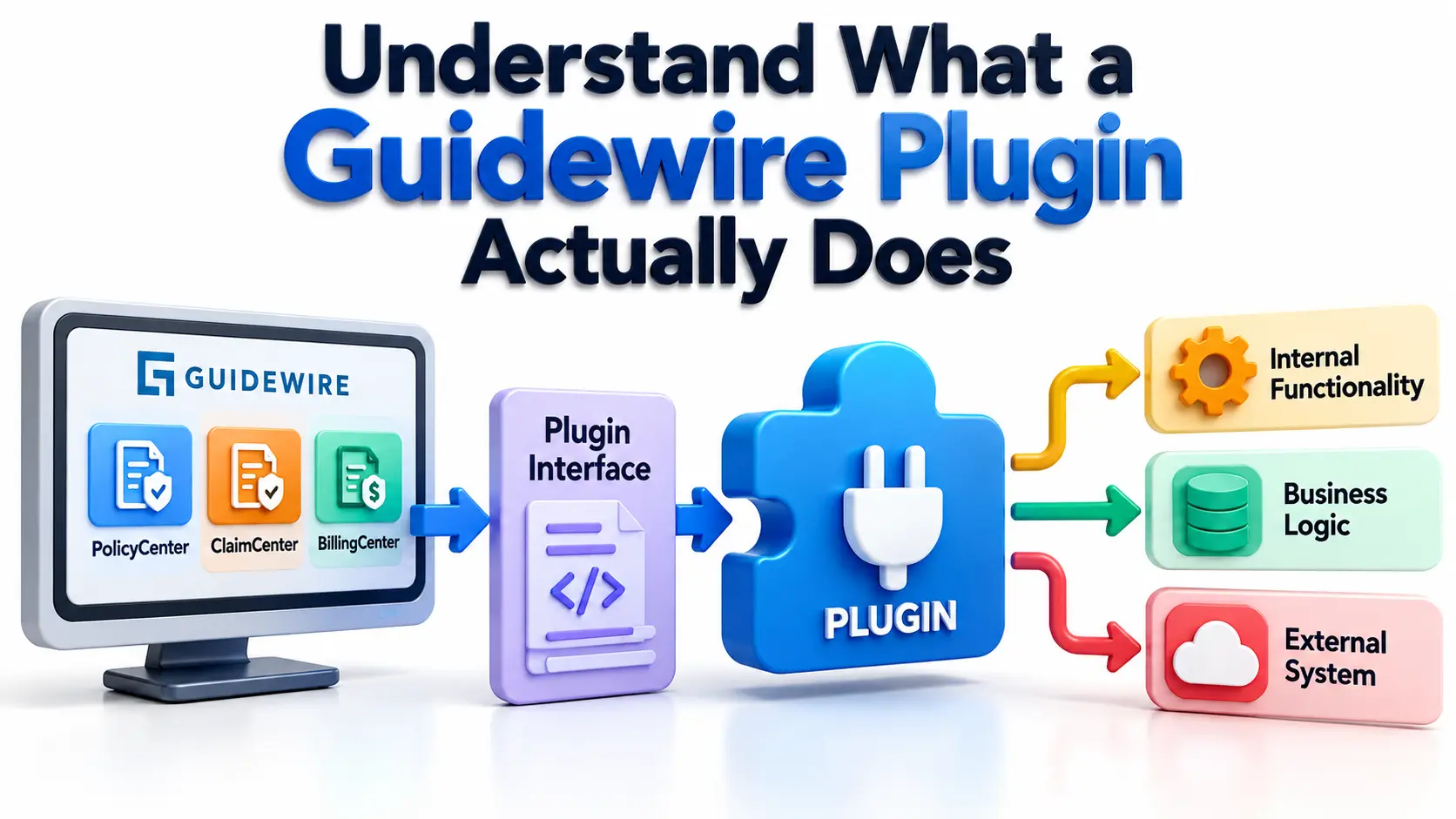
A Guidewire plugin is an implementation of a defined plugin interface that InsuranceSuite can invoke when it needs a particular operation performed. Instead of hard-coding every implementation into the application's business logic, Guidewire defines contracts that implementations can satisfy.
Think of the interface as a promise. It specifies the methods that an implementation must provide. The implementation then determines how the required operation happens.
A simplified conceptual flow looks like this:
InsuranceSuite functionality → Plugin interface → Registered implementation → Processing → Result
Depending on the requirement, processing may remain inside the application or communicate with another system. Typical responsibilities can include:
Generating identifiers
Working with documents
Supporting authentication behavior
Sending integration messages
Connecting specialized external functionality
Retrieving information needed by an InsuranceSuite process
This separation matters because the application knows the contract without needing every implementation detail embedded directly into the calling logic.
For developers, this changes the way a requirement should be analyzed. The first question should not be, “Where should I write a Gosu method?” Instead ask whether Guidewire already provides an extension point designed for that responsibility.
See the Architecture Behind Interface, Implementation and Registry
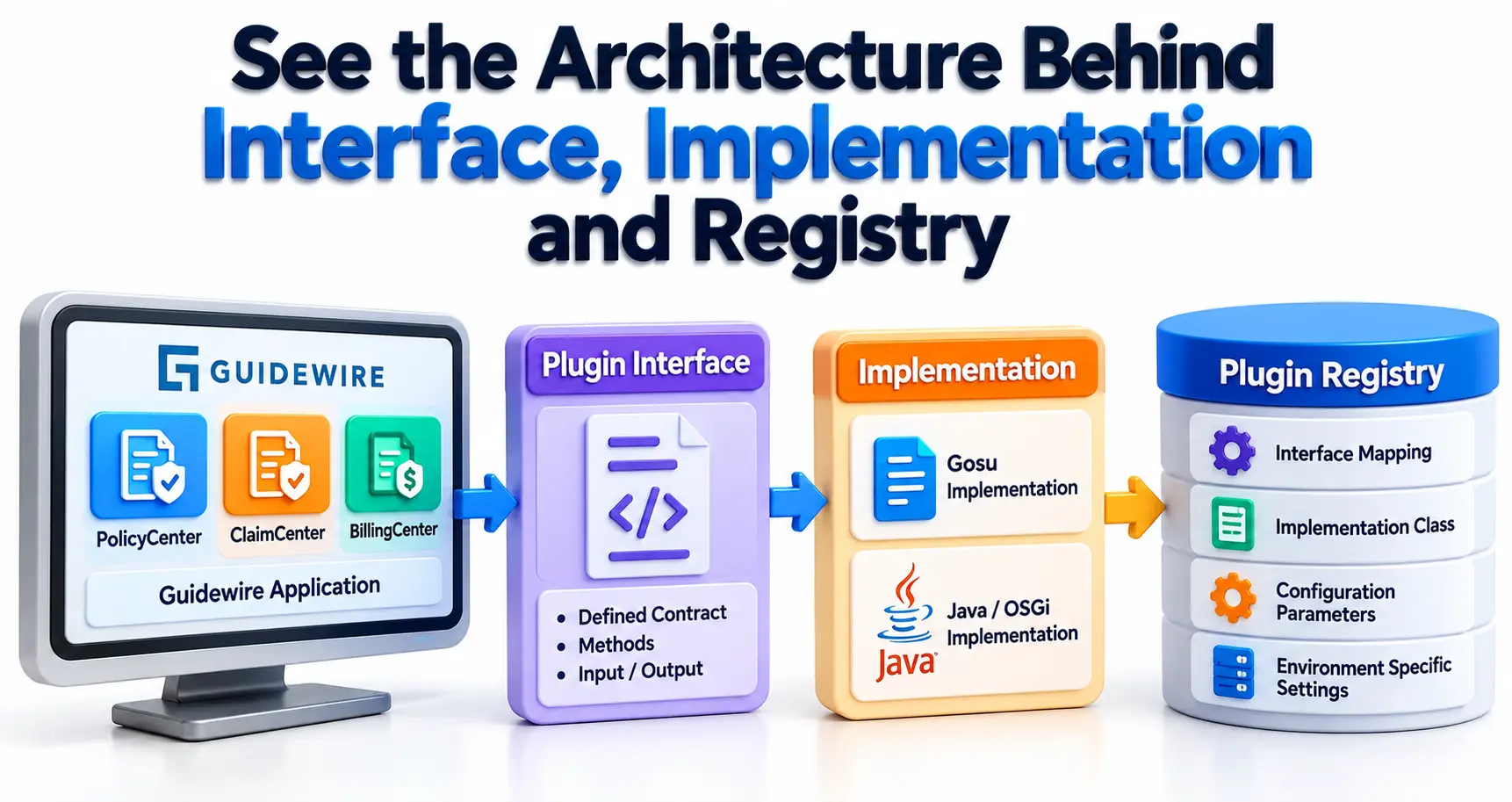
The plugin architecture becomes easier when you divide it into three important parts: the plugin interface, implementation class, and plugin registration.
The interface defines the contract. If Guidewire expects a particular method and return type, the implementation has to satisfy that contract. The implementation contains the actual behavior and can be written using supported implementation approaches such as Gosu or Java. Java implementations can also be encapsulated using OSGi where appropriate.
Registration connects these two pieces. Guidewire Studio's plugin registry identifies which implementation should be used for a particular plugin interface.
Conceptually:
Guidewire Process
↓
Plugin Interface
↓
Plugin Registry
↓
Gosu / Java Implementation
↓
Internal operation or external service
Parameters can also make implementations environment-aware. A development environment may require different configuration from production, for example. Parameters therefore help separate deployable behavior from values that vary between environments.
This architecture is important for students taking a guidewire course in chennai because simply learning Gosu syntax does not explain how enterprise Guidewire code is connected to platform extension points. Developers need to understand where the implementation belongs and how InsuranceSuite discovers it.
Separate Predefined, Messaging and Startable Plugins
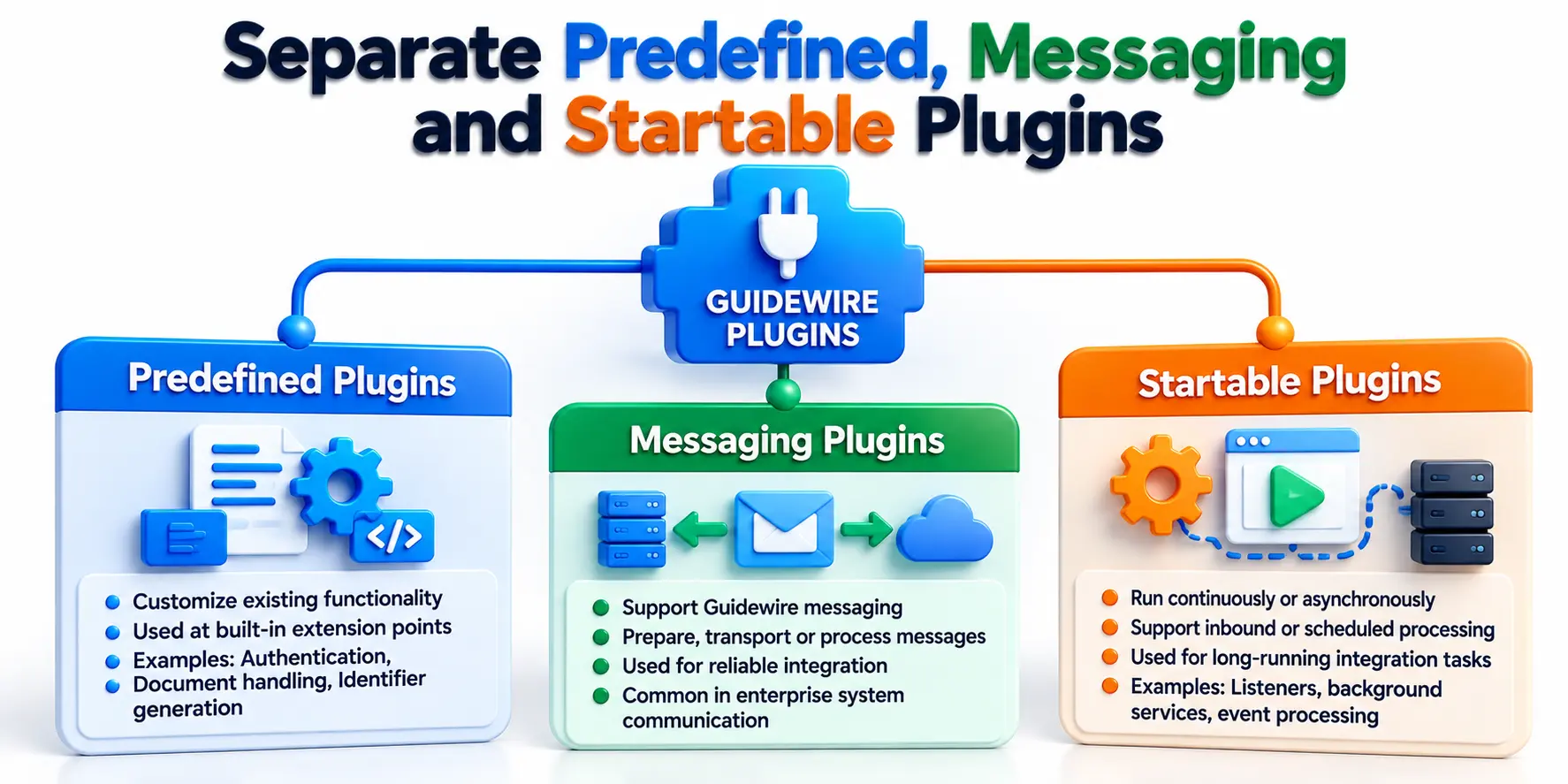
Guidewire plugin types make more sense when classified according to what the application needs them to accomplish.
Predefined plugins customize behavior at extension points already provided by InsuranceSuite. They are useful when Guidewire expects a defined operation but an implementation needs application-specific behavior.
Examples can involve:
Authentication-related functionality
Document operations
Number generation
Specialized data retrieval
Application-specific external service interaction
Messaging plugins participate in Guidewire's messaging architecture. They can support preparing messages, transporting them to external systems, or processing related responses. This is useful when a business transaction needs reliable communication beyond the immediate application operation.
Startable plugins are different because they can support continuously running or asynchronous integration responsibilities, such as listening for incoming information and processing it as it arrives.
The distinction matters architecturally. A requirement for an immediate calculation is different from reliable outbound messaging, while an inbound listener has different lifecycle requirements again. Choosing a plugin type based only on familiarity can create unnecessary complexity.
A developer learning through a guidewire course in pune should therefore practice mapping business requirements to communication patterns before writing implementations. That skill becomes much more valuable in real projects than memorizing plugin interface names.
Follow Plugins Through Real Insurance Use Cases
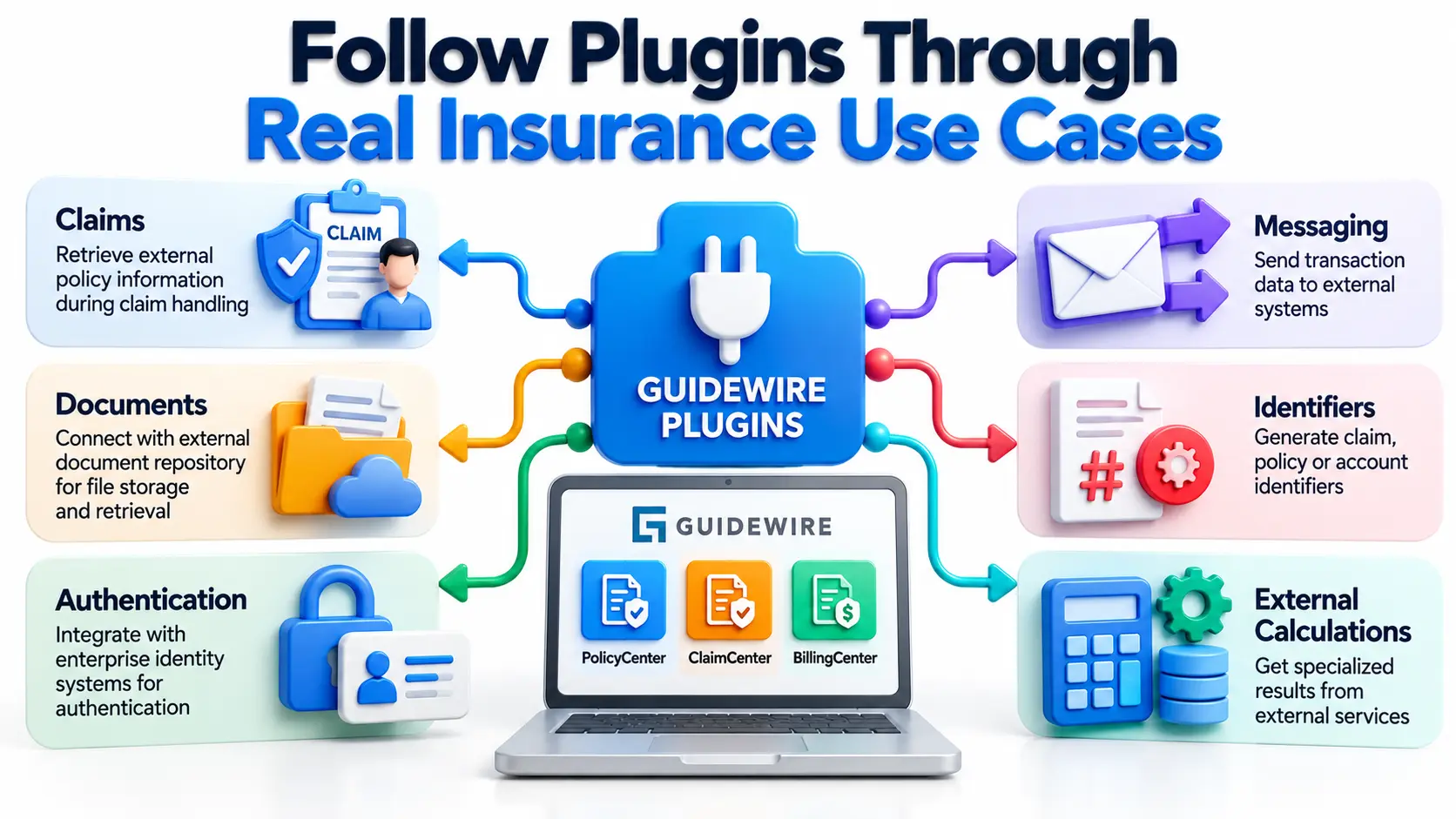
Plugins become much clearer when connected to insurance workflows. Consider document management. ClaimCenter may contain the claim and document metadata while an external document repository stores the actual file. A suitable plugin-based extension can allow the application to work with that repository while preserving the expected Guidewire contract.
Authentication is another example. An insurer may need authentication behavior connected to enterprise identity infrastructure rather than relying only on application-local behavior. A relevant plugin implementation can provide the required integration at the platform's defined extension point.
Other scenarios can include:
Claims: retrieving external policy information required during claim handling.
Documents: connecting InsuranceSuite functionality with document services.
Messaging: delivering transaction information to downstream applications.
Identifiers: generating claim, policy, account, or other business identifiers.
External calculations: obtaining specialized results needed by a business process.
Suppose an adjuster performs an action that requires information from a remote service. If the plugin call is synchronous, the user may effectively wait while the remote operation completes. A slow external service therefore becomes a Guidewire user-experience problem as well as an integration problem.
This is why architecture must consider timeout behavior, network latency, error handling, availability, and what should happen when the remote system cannot respond.
Know When a Plugin Is the Wrong Integration Choice
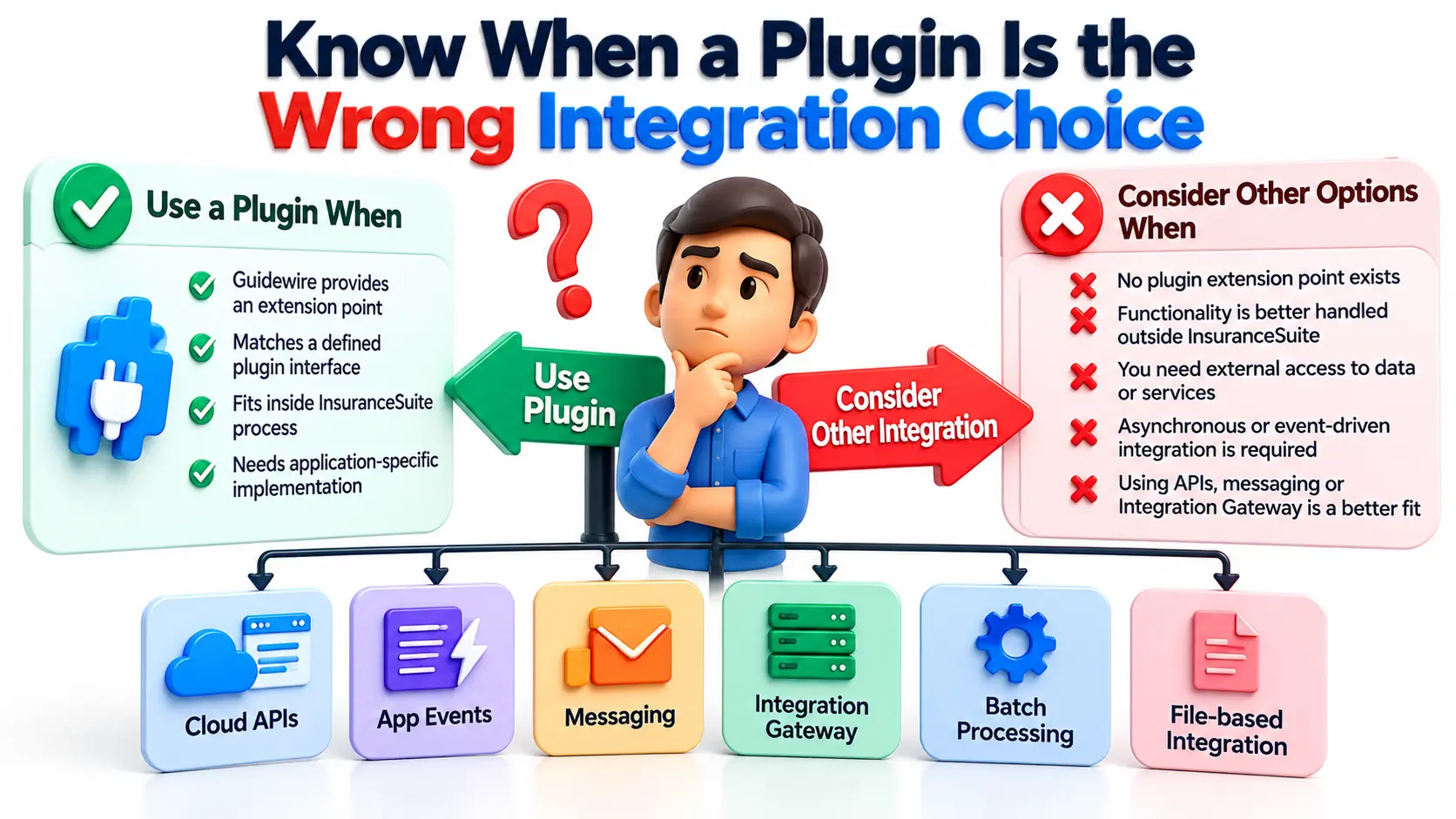
One of the biggest mistakes beginners make is assuming every external connection should become a plugin. Modern Guidewire architecture provides several integration mechanisms, and they solve different problems.
For Guidewire Cloud implementations, architects may also work with:
Cloud APIs for external applications requesting data or initiating actions
App Events for publishing important business events
Integration Gateway for integration and mediation logic
Messaging for reliable asynchronous communication
File-based integration for suitable bulk exchanges
A plugin is particularly meaningful when InsuranceSuite provides an extension interface and the requirement belongs naturally behind that contract. It should not become a convenient place to put arbitrary integration code.
Modern cloud architecture makes this distinction increasingly important. Moving integration concerns outside the InsuranceSuite core where appropriate can reduce coupling and make independent integration changes easier to manage.
At JastTech, this architectural thinking should be part of practical Guidewire learning: developers need to understand not merely how to configure a plugin, but why a plugin is appropriate compared with an API, event, messaging flow, batch process, or external integration layer.
The strongest Guidewire developer is not the person who uses plugins everywhere. It is the person who recognizes the correct integration boundary.
Build Plugins for Performance, Testing and Maintainability
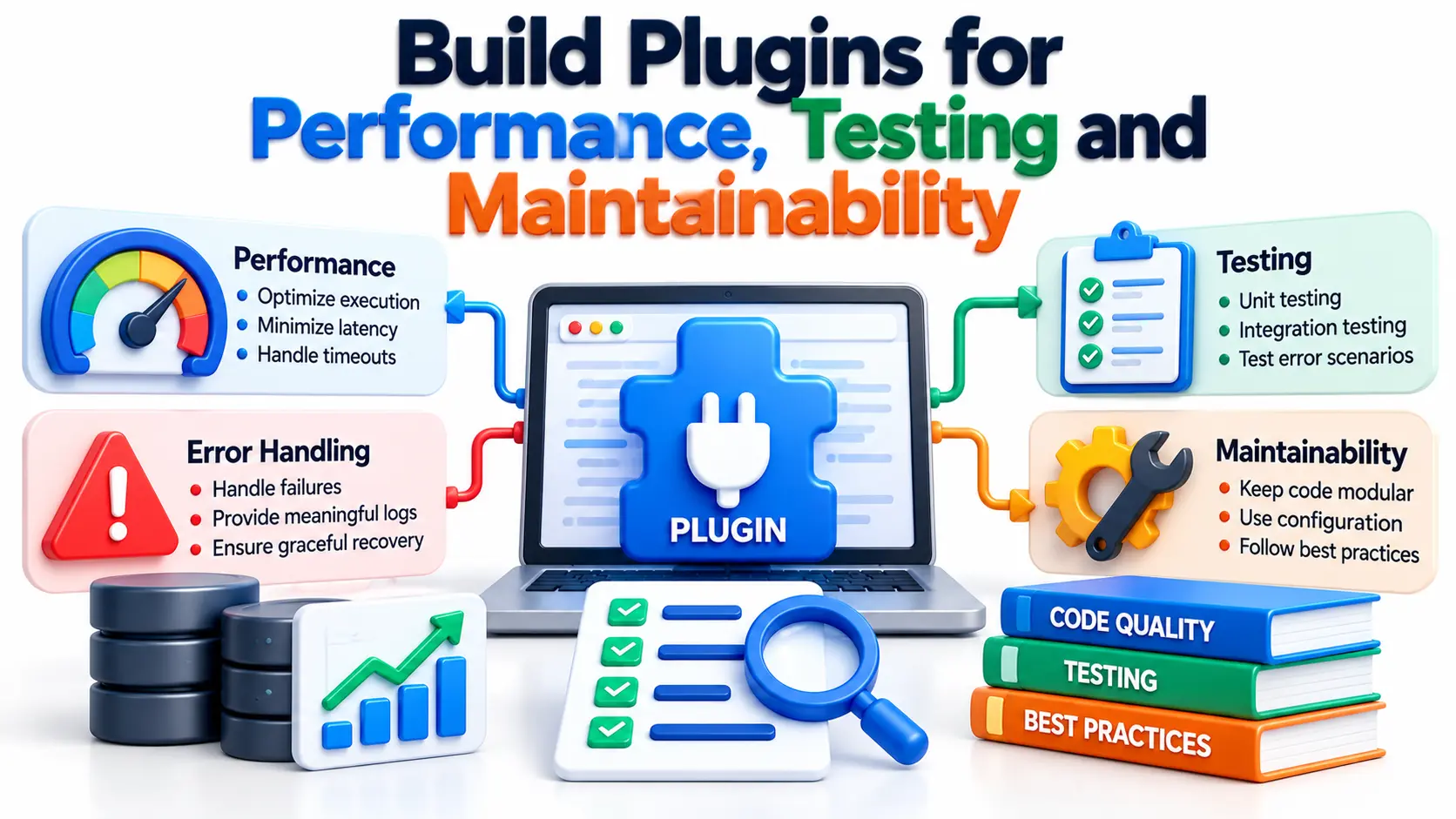
A technically working plugin is not necessarily production-ready. Plugins can sit directly in important business workflows, so poor implementation decisions can affect performance and reliability across the application.
Developers should evaluate several areas before deployment:
Keep responsibilities focused and avoid oversized implementations.
Handle exceptions deliberately instead of hiding failures.
Protect synchronous flows from excessive remote latency.
Avoid hard-coded environment-specific configuration.
Log enough context to make production troubleshooting possible.
Test failure paths, not only successful responses.
Understand restart or deployment requirements when registration changes.
Regression-test integrations when upgrading InsuranceSuite.
Testing should also happen at multiple levels. Unit tests can validate implementation logic, while integration testing confirms communication with dependent systems. End-to-end testing should prove that the complete insurance transaction still behaves correctly.
Consider a document integration. Testing only whether one document uploads successfully is inadequate. Engineers should also test unavailable repositories, invalid credentials, large files, timeouts, unexpected responses, authorization failures, and recovery behavior.
Observability matters just as much. When production fails, support teams need to determine whether the problem originated in InsuranceSuite, the plugin implementation, configuration, the network, credentials, or the external application.
That ability to trace a transaction from the Guidewire business action to the final external result is what turns plugin knowledge into real integration engineering.
Conclusion
Guidewire plugins are best understood as controlled extension points rather than miscellaneous pieces of custom code. An interface defines what InsuranceSuite expects, an implementation provides the behavior, and registration connects that implementation to the application. Predefined, messaging, and startable plugins then address different execution and integration requirements.
The more important lesson is architectural judgment. Modern Guidewire projects combine plugins with APIs, messaging, App Events, Integration Gateway, batch processes, and other integration mechanisms. Developers who understand where each pattern belongs can build solutions that are easier to test, troubleshoot, scale, and maintain—and that is far more valuable than simply knowing how to create a plugin.