

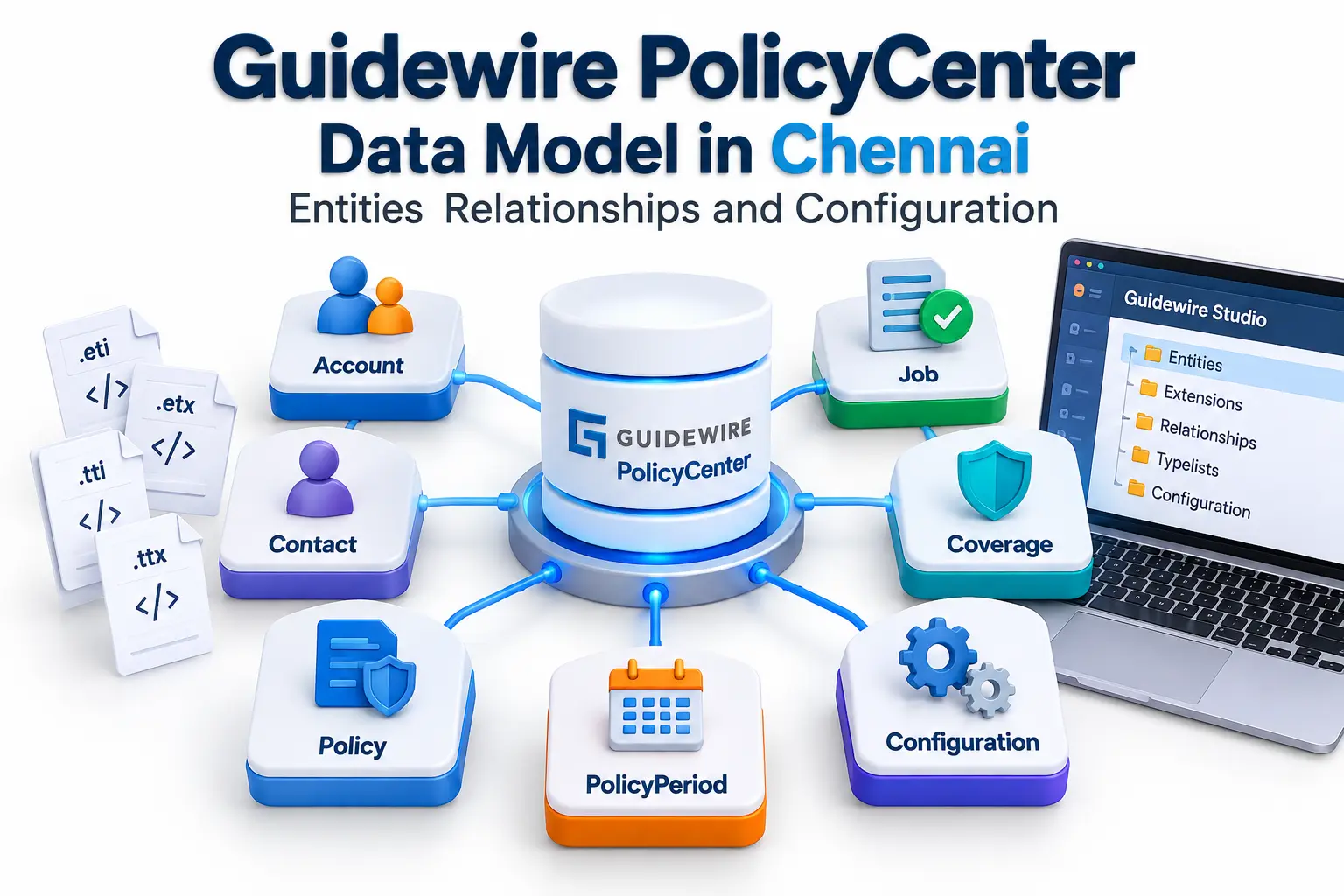
Guidewire PolicyCenter Data Model in Chennai Entities Relationships and Configuration
Navigate through this article using the table of contents below
Table of Contents
No headings found in this article.
Insurance applications manage thousands of policies, customers, transactions and coverage details. But how does Guidewire PolicyCenter organize this information without losing accuracy? The answer lies in its data model, which connects insurance business processes with structured, configurable data.
For developers working on Guidewire projects in Chennai, understanding the PolicyCenter data model is essential. From defining entities to managing relationships and configuring custom fields, these concepts help developers build reliable insurance applications that support real-world business requirements.
Understanding the Guidewire PolicyCenter Data Model Architecture
The Guidewire PolicyCenter data model provides the structural foundation for storing and managing insurance information. It defines how business objects such as accounts, policies, policy periods, contacts, and coverage details are represented within the application.
Rather than treating insurance information as disconnected database records, PolicyCenter organizes data through entities and relationships. These connections help developers access related information efficiently while maintaining consistency throughout insurance transactions. For professionals learning these concepts through a Guidewire course in Chennai, understanding the PolicyCenter data model is an important step toward working with insurance business logic, navigating entity relationships, and developing a clearer understanding of how PolicyCenter manages policy information.
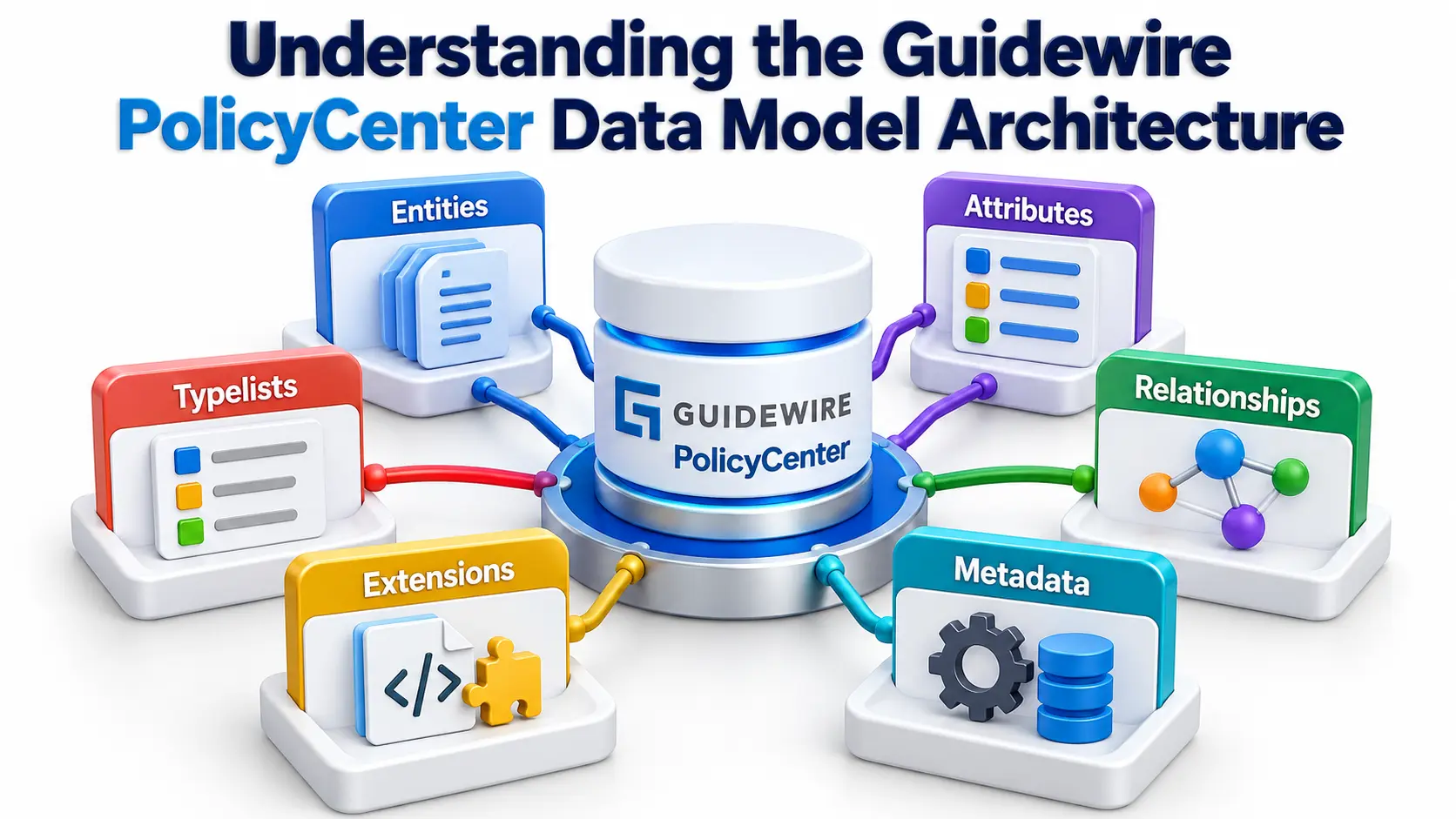
The architecture includes several important components:
Entities: Represent business objects such as Account, Policy and PolicyPeriod.
Attributes: Define individual data fields within entities.
Relationships: Connect entities through foreign keys and arrays.
Typelists: Provide predefined values for specific fields.
Extensions: Allow developers to add custom fields and entities.
Metadata: Defines how application data structures behave.
For example, an insurance company may maintain multiple policies under one customer account. Each policy can have multiple policy periods representing different terms or transaction versions.
PolicyCenter uses XML-based metadata definitions to describe these structures. Developers work with these definitions through Guidewire Studio and supported configuration tools.
Understanding this architecture helps developers design applications that remain maintainable as insurance products and business requirements evolve.
Exploring Core Entities in Guidewire PolicyCenter
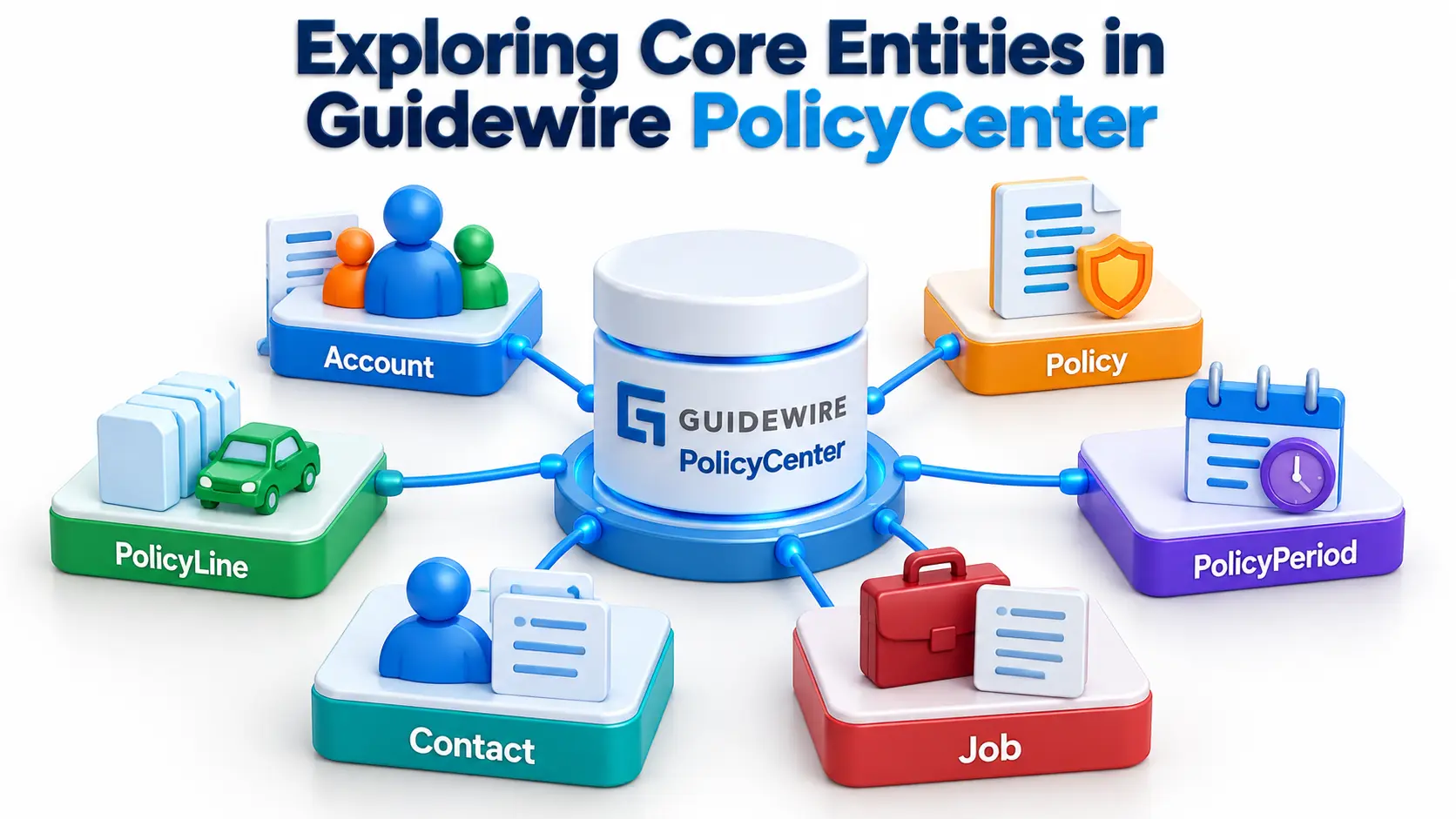
Entities are the building blocks of the Guidewire PolicyCenter data model. Each entity represents a specific business concept and contains attributes describing that concept.
Several core entities work together to support policy administration.
Account Entity
The Account entity represents an insurance customer account. It maintains account-level information and connects customers with their insurance policies.
Policy Entity
The Policy entity represents the overall insurance policy record across its lifecycle. It connects policy-level information with related policy periods and transactions.
PolicyPeriod Entity
PolicyPeriod represents a particular version of a policy term. It contains important information about policy status, effective dates and associated insurance details.
Job Entity
The Job entity represents insurance transactions such as submissions, renewals, policy changes and cancellations.
Contact Entity
The Contact entity stores information about individuals and organizations involved in insurance processes.
Consider a customer purchasing automobile insurance. The Account identifies the customer account, the Policy maintains the overall policy record, and PolicyPeriod represents the applicable policy version.
A Submission job manages the new-business transaction.
Developers must understand these distinctions because placing information in the wrong entity can create problems during renewals, endorsements and policy updates.
This entity-level knowledge is especially valuable when implementing insurance applications involving complex customer relationships and multiple policy transactions.
Read more :- Guidewire Billing Reconciliation in Chennai Handling Invoice Payment and Transaction Discrepancies
Understanding Entity Relationships and Data Connections
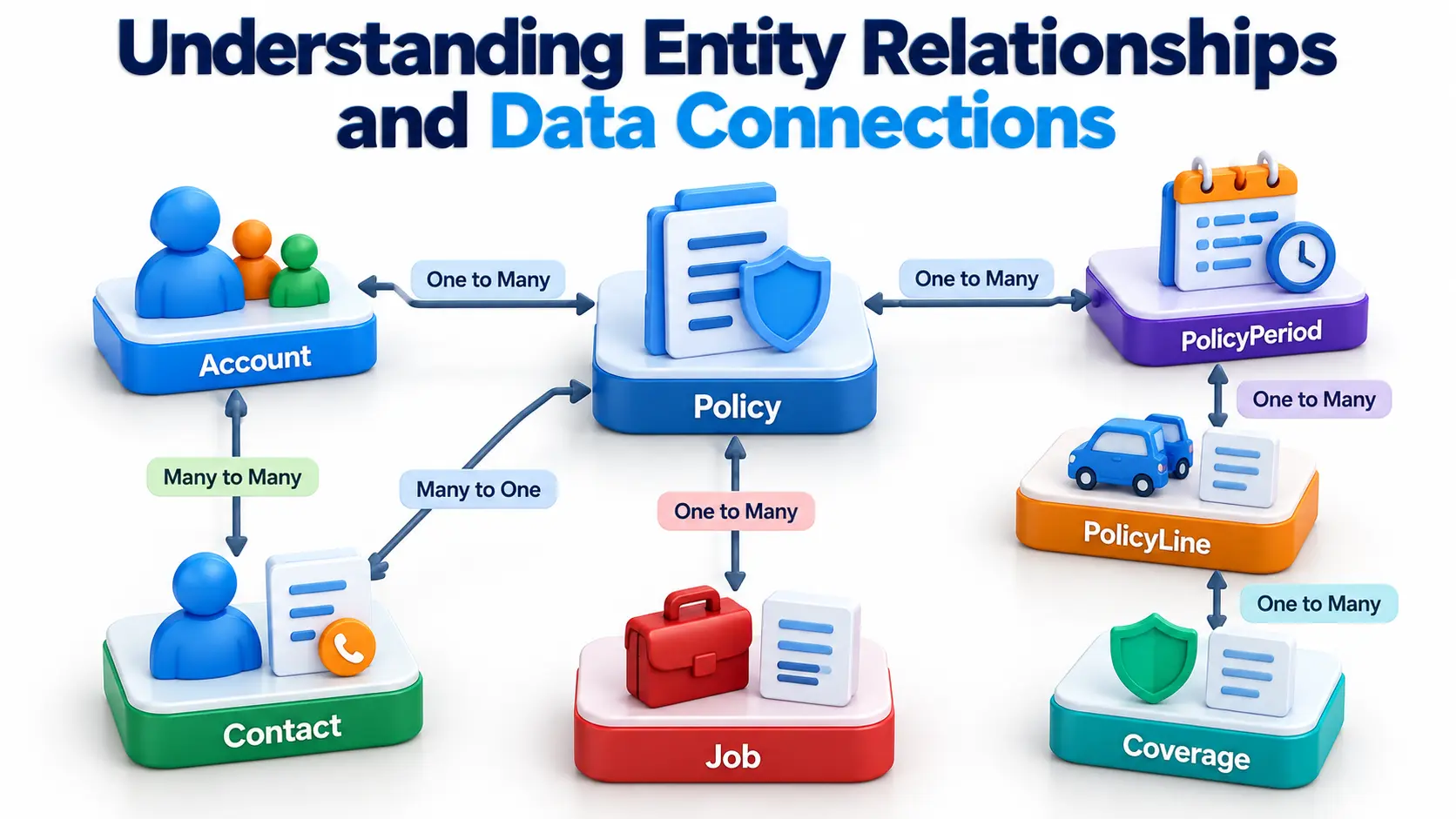
Relationships determine how information moves between different entities in Guidewire PolicyCenter.
A well-designed relationship structure allows developers to retrieve connected business information without unnecessary duplication.
PolicyCenter commonly uses the following relationship mechanisms:
Foreign Key: Connects an entity to another entity.
Array: Represents a collection of related entity records.
Edge Foreign Key: Supports particular relationship and graph-management requirements.
Subtype: Represents specialized entity types through inheritance.
For example, an Account can be associated with multiple Policy records. Each Policy can have multiple PolicyPeriod records, representing different policy terms and transaction branches.
Similarly, a PolicyPeriod can contain policy lines, locations and coverage-related information.
These relationships support important insurance operations, including policy issuance, renewals, endorsements and underwriting activities.
Example: Automobile Insurance
Imagine a customer purchases an automobile insurance policy and later adds another vehicle.
The application must identify the correct account, locate the policy, create the appropriate policy-change transaction and update the effective-dated vehicle information.
The relationships between Account, Policy, Job, PolicyPeriod and relevant policy-line entities make this possible.
Developers should also understand relationship ownership and referential integrity. Incorrect relationship configuration can cause data inconsistencies, persistence errors or unexpected transaction behavior.
Configuring Entities and Extending the PolicyCenter Data Model
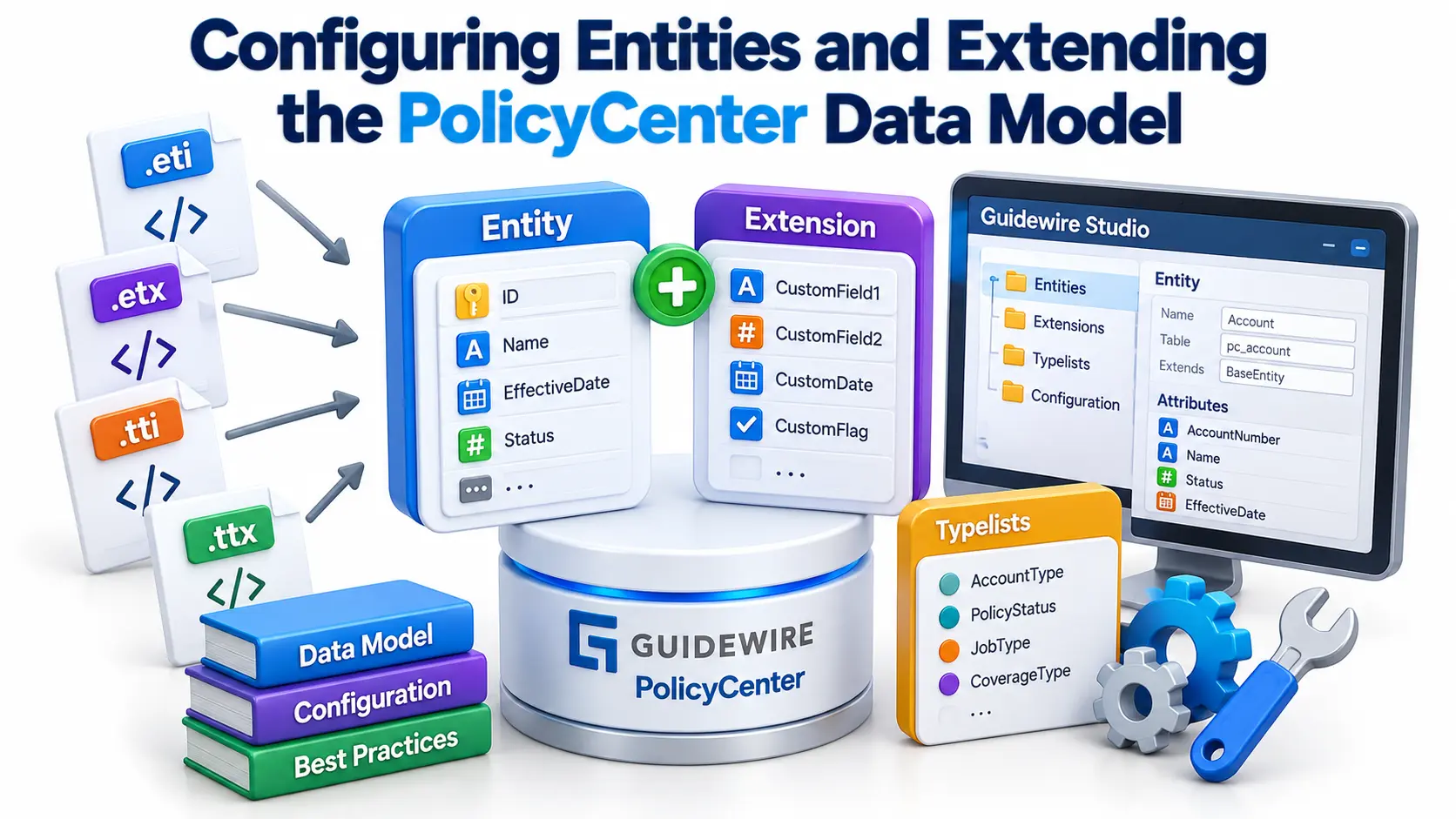
Insurance organizations frequently require additional fields and business-specific data structures that are not available in the standard application configuration.
Guidewire supports these requirements through data model extensions.
Developers generally use XML metadata files to define and extend entities.
Important file types include:
.eti files: Define entity structures.
.etx files: Extend existing entities.
.tti files: Define typelists.
.ttx files: Extend existing typelists.
For example, an insurer may need to capture a custom customer classification or an additional underwriting reference.
Instead of modifying the standard entity definition directly, developers can introduce supported extensions.
The configuration process typically involves identifying the correct entity, defining the additional attribute, applying appropriate constraints and validating the application behavior.
For developers pursuing guidewire training in chennai, practical exercises involving entity extensions and relationship configuration provide valuable experience with realistic insurance requirements.
Similarly, guidewire policy center training should explain how metadata changes interact with Gosu logic, user interfaces and application persistence.
Developers must also consider database indexing, validation requirements and upgrade compatibility.
Unnecessary customization can increase maintenance complexity, making careful data model design an important engineering responsibility.
Managing Effective-Dated Data and Policy Transactions
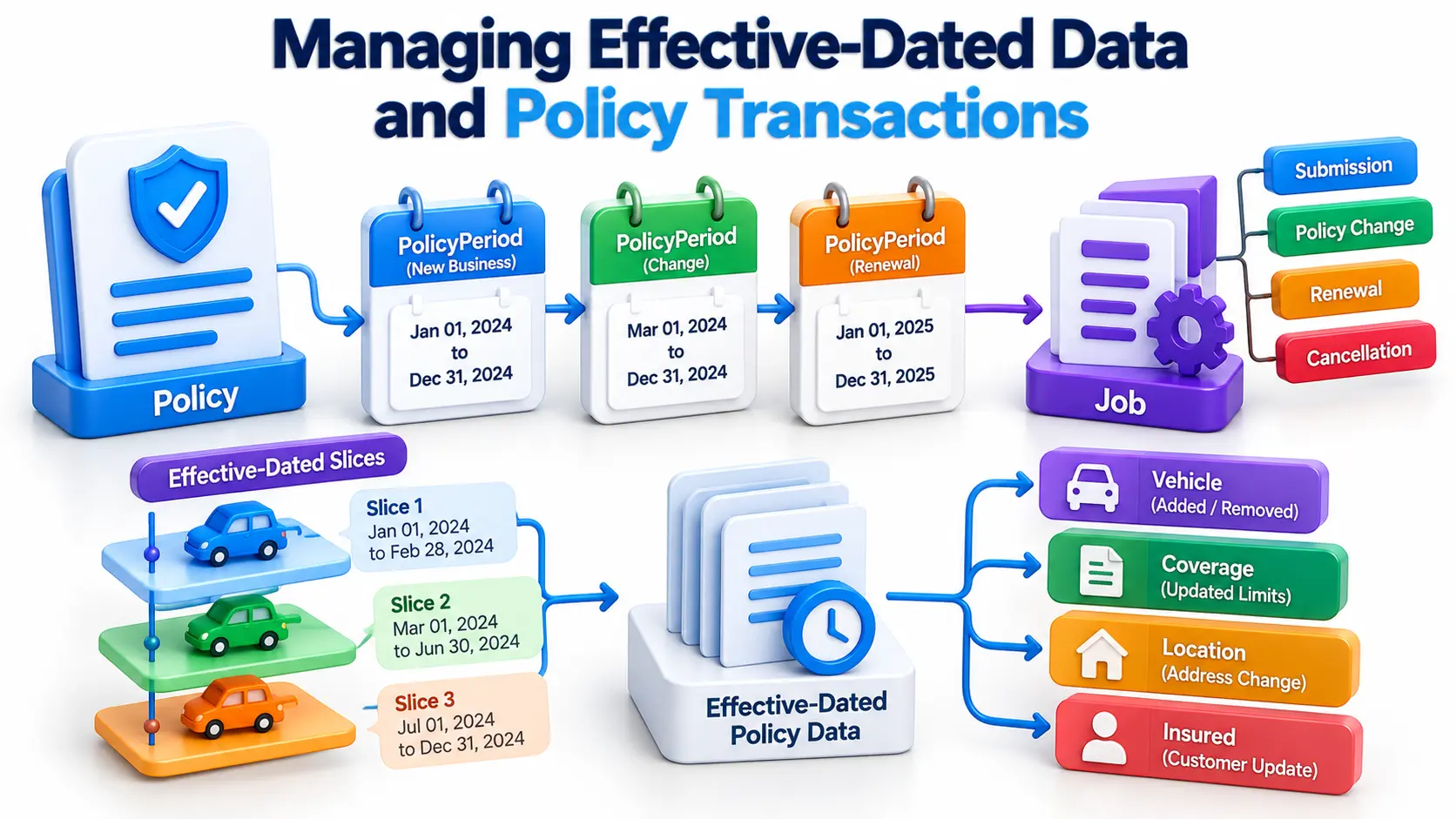
One of the most important features of Guidewire PolicyCenter is its ability to manage effective-dated insurance information.
Insurance policies change over time. Customers may add vehicles, update coverage limits, change addresses or renew policies for another term.
These changes must be recorded without incorrectly altering historical policy information.
PolicyCenter addresses this requirement through effective-dated entities and policy branches.
A PolicyPeriod acts as an effective-dated branch, while related effective-dated entities can represent information that changes during the policy term.
Two important concepts are:
Slice: Represents effective-dated information viewed at a particular date.
Window: Provides access to effective-dated information across a relevant period or branch.
Consider an automobile insurance policy effective from January through December.
In March, the customer adds a vehicle. In July, the customer removes another vehicle.
The application must preserve the appropriate vehicle information for each effective date.
Effective-dated modeling allows PolicyCenter to represent these changes while supporting the relevant policy transaction history.
Developers working with Gosu must understand effective-dated access patterns, branch context and transaction behavior.
Incorrect handling can produce inaccurate coverage information, unexpected validation failures or inconsistent policy calculations.
This makes effective-dated data knowledge essential for developers involved in policy changes, renewals and insurance product configuration.
Building Practical PolicyCenter Configuration Skills for Chennai Projects
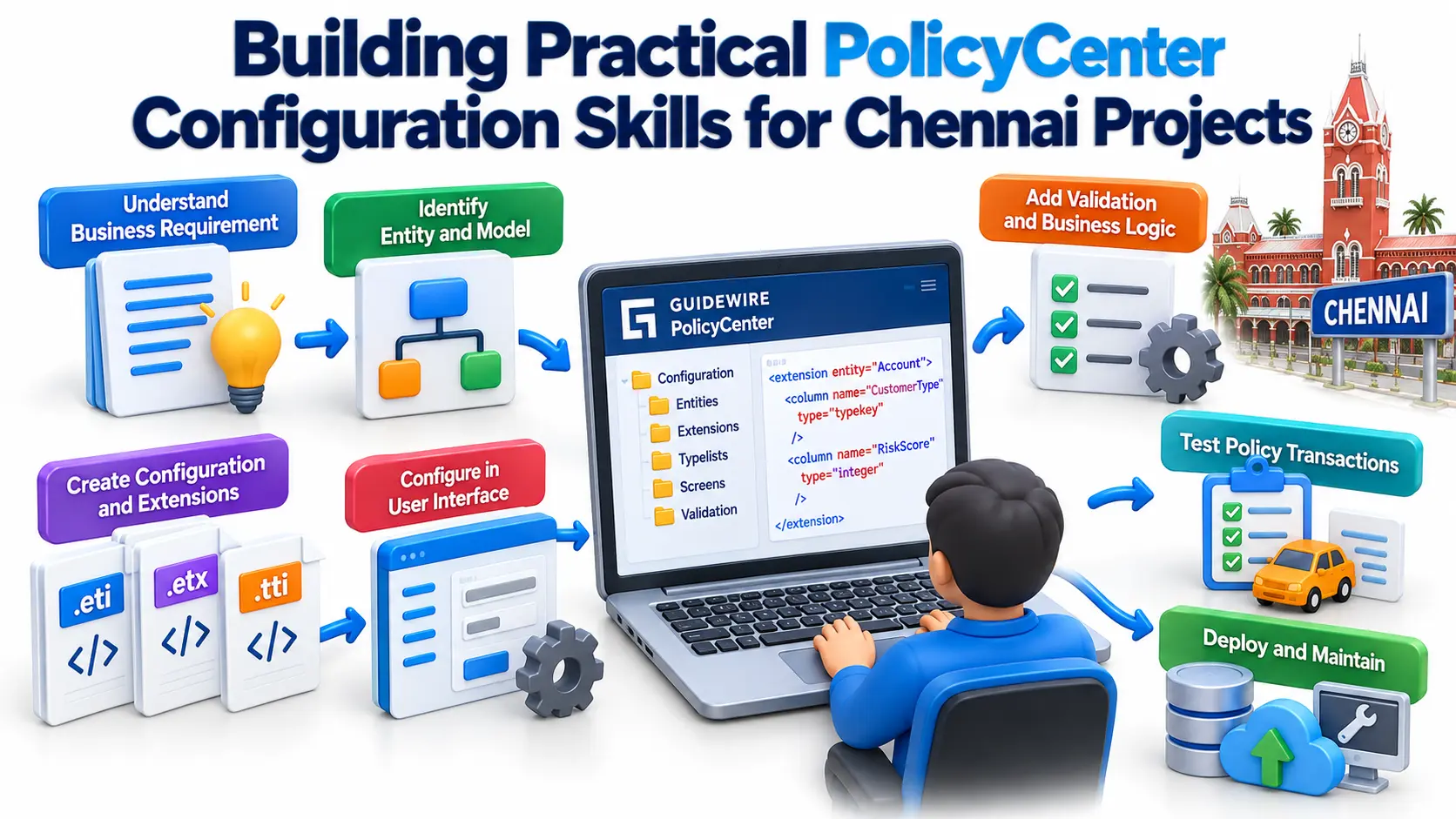
Understanding the data model becomes more valuable when developers apply their knowledge to realistic implementation scenarios.
Insurance technology projects require developers to translate business requirements into reliable application configurations.
A useful learning project involves extending an automobile insurance application with a custom underwriting field.
The implementation can follow these steps:
Identify the insurance requirement and relevant business entity.
Determine whether an existing field can satisfy the requirement.
Create a supported entity extension when necessary.
Configure the field in the appropriate user interface.
Add validation through supported configuration mechanisms.
Test the field during submission and policy-change transactions.
Verify persistence and effective-dated behavior where applicable.
For example, an insurer may require an additional vehicle-risk classification during underwriting.
Developers must determine whether the information belongs to a vehicle-level entity, a policy-level structure or another appropriate business object.
Choosing the correct location is important because the field's lifecycle determines how it behaves during policy changes.
JastTech emphasizes the importance of connecting technical learning with practical implementation scenarios.
For aspiring Guidewire developers in Chennai, hands-on experience with entities, Gosu, configuration files and insurance workflows can strengthen project readiness.
Developers should also become familiar with Guidewire Cloud API concepts, where application resources expose business information through configured API schemas and mappings.
Understanding how data model changes affect integrations helps developers work across configuration and integration responsibilities.
Conclusion
The Guidewire PolicyCenter data model forms the foundation of insurance policy administration by organizing business information through entities, attributes, relationships and effective-dated structures. Developers who understand these concepts can configure insurance applications more accurately, support complex policy transactions and reduce data-related implementation issues.
For professionals preparing for Guidewire development opportunities in Chennai, mastering data model configuration is an important technical milestone. Practical experience with entity extensions, relationship management, Gosu and policy lifecycle scenarios helps bridge the gap between theoretical knowledge and real insurance technology projects. JastTech supports this learning approach by focusing on industry-relevant technical concepts and practical development skills.