

Guidewire PolicyCenter vs ClaimCenter Complete Comparison for Beginners and Job Seekers
Navigate through this article using the table of contents below
Table of Contents
No headings found in this article.
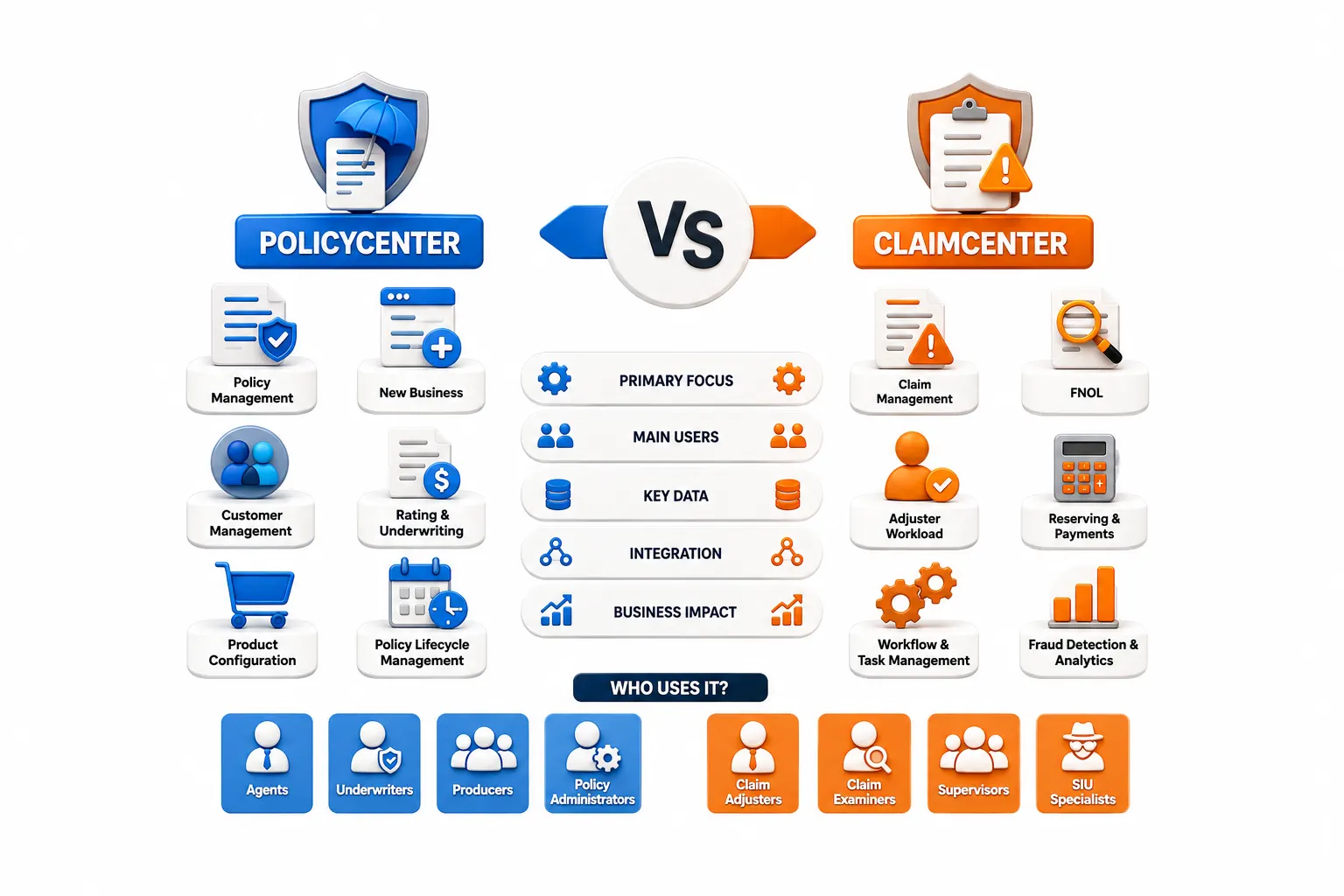
Picture two insurance professionals sitting in the same office. One spends her day setting up policies and pricing rules. The other spends his day investigating accidents and approving payouts. Both work in Guidewire, yet their daily reality couldn't be more different.
If you're trying to figure out Guidewire PolicyCenter vs ClaimCenter which is better for your career, you're really asking which of these two professionals you want to become. Let's break it down properly.
What Exactly Do PolicyCenter and ClaimCenter Do?
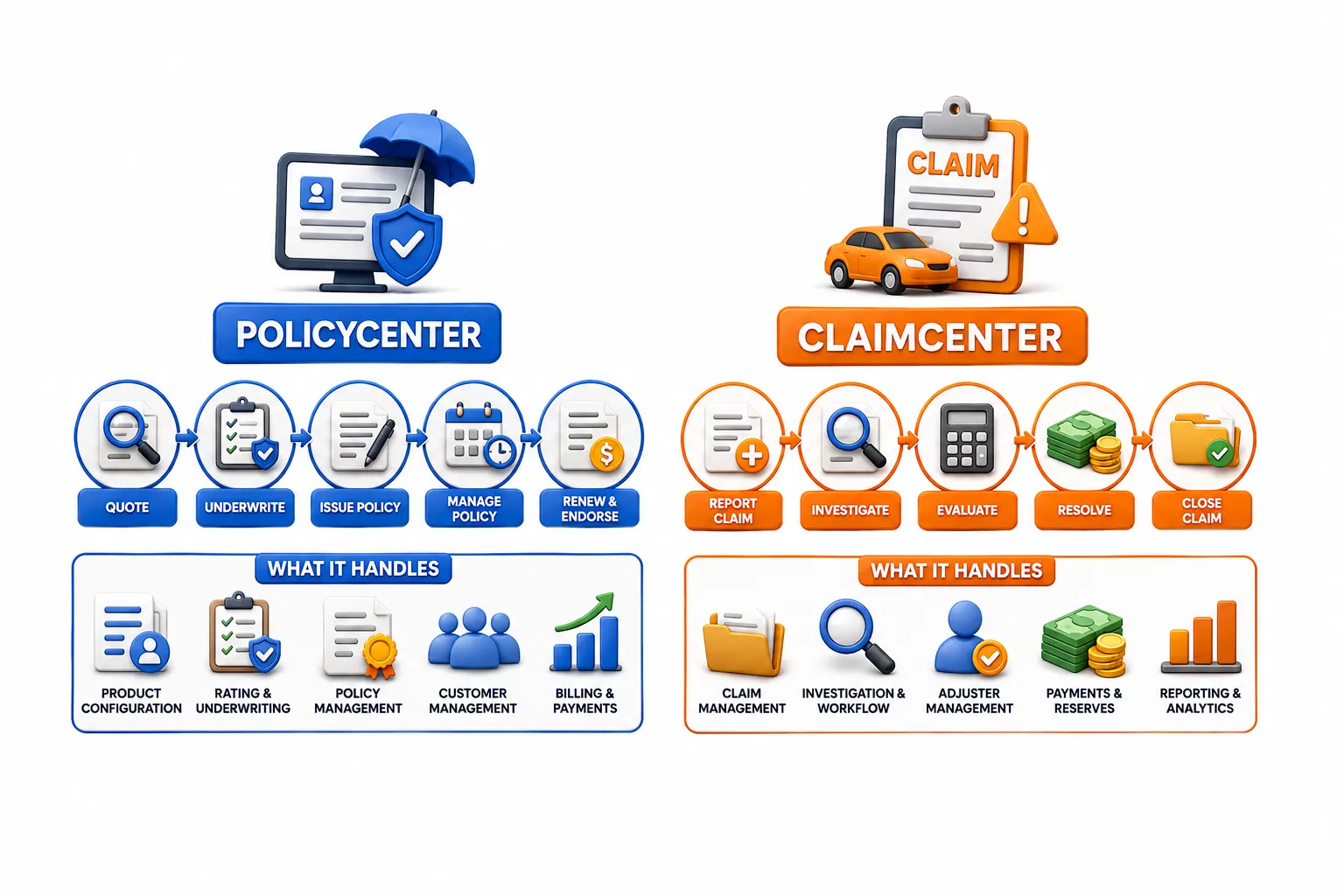
Guidewire isn't a single product. It's a suite, and PolicyCenter and ClaimCenter are its two biggest pillars, built to solve completely different problems.
PolicyCenter handles the front end of the insurance business. It manages quoting, underwriting, policy issuance, renewals, and endorsements. Think of it as the engine behind every new policy an insurer sells and every renewal notice a customer receives.
ClaimCenter, on the other hand, takes over once something goes wrong. A car accident, a house fire, a stolen laptop — ClaimCenter tracks the entire claims lifecycle, from the first report to the final settlement check.
Here's a simple way to remember it: PolicyCenter starts the relationship, ClaimCenter proves whether the insurer keeps its promise. Both run on the same core platform architecture, share similar configuration concepts like rules engines and workflows, but the business logic inside each is built for entirely separate purposes. Understanding this distinction early saves you months of confusion later, especially when you start reading job descriptions that assume you already know the difference.
Which One Is Actually Better for a Beginner to Learn First?
This is the question everyone asks, and honestly, there's no universally right answer — but there are useful patterns.
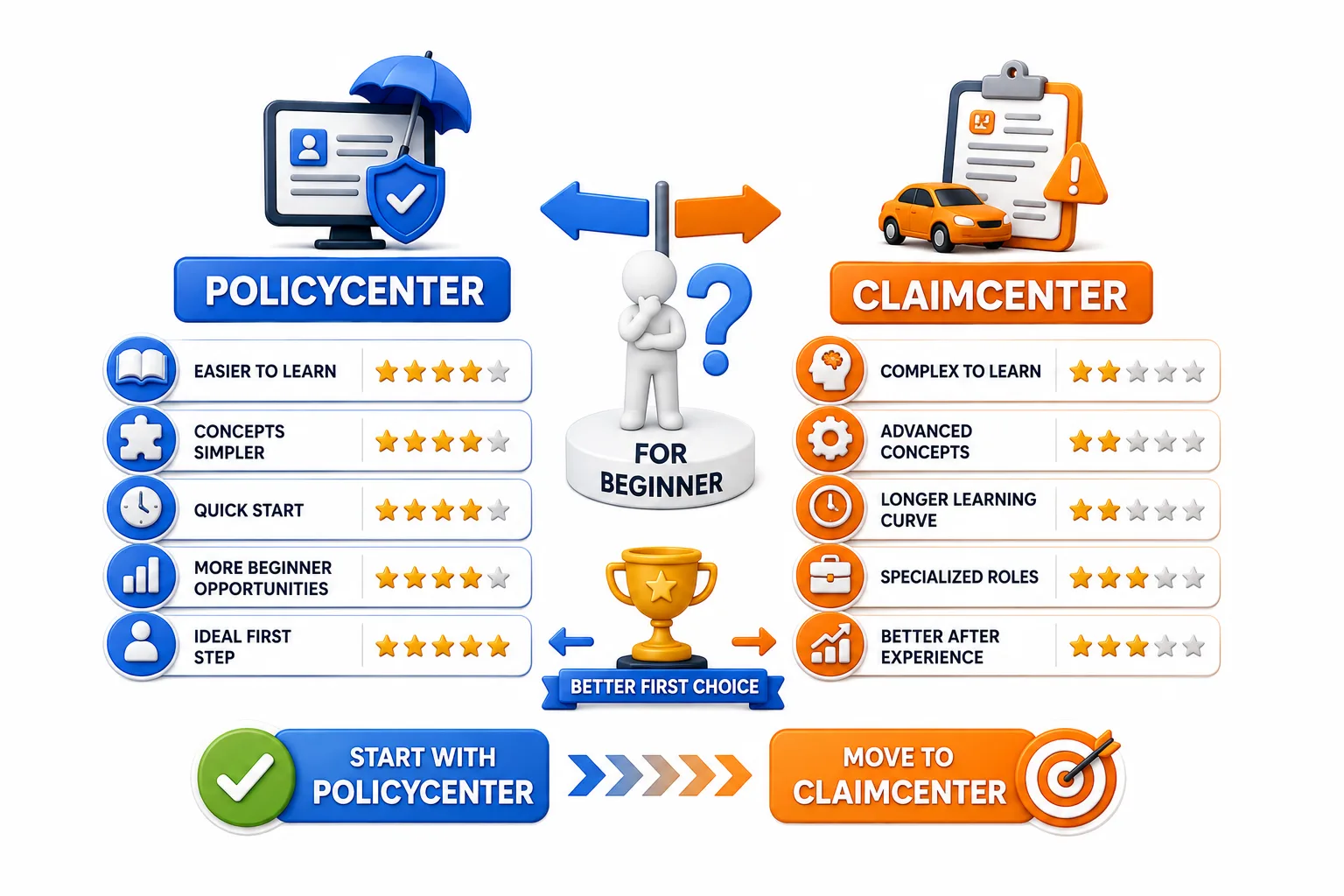
Many trainers and hiring managers suggest starting with PolicyCenter because its logic mirrors something you already understand: buying a product, customizing it, and renewing it. The workflows feel intuitive even before you touch a line of Gosu code.
ClaimCenter, meanwhile, involves more moving parts — exposures, coverages, reserves, subrogation — and can feel steeper for absolute beginners. That said, some learners find claims processing more engaging because it involves real-world scenarios and decision-making.
If you're still weighing Guidewire PolicyCenter vs ClaimCenter which is better as a starting point, consider your interest area. Enjoy structured configuration and business rules? Start with PolicyCenter. Fascinated by investigations, payments, and case management? ClaimCenter might hook you faster.
A structured path helps regardless of which you pick. Resources like this complete beginner-to-advanced Guidewire training guide walk through both modules in a logical sequence, which removes a lot of the guesswork.
Career Paths: Where Each Module Actually Takes You
Your module choice shapes your day-to-day work for years, so this deserves real thought.
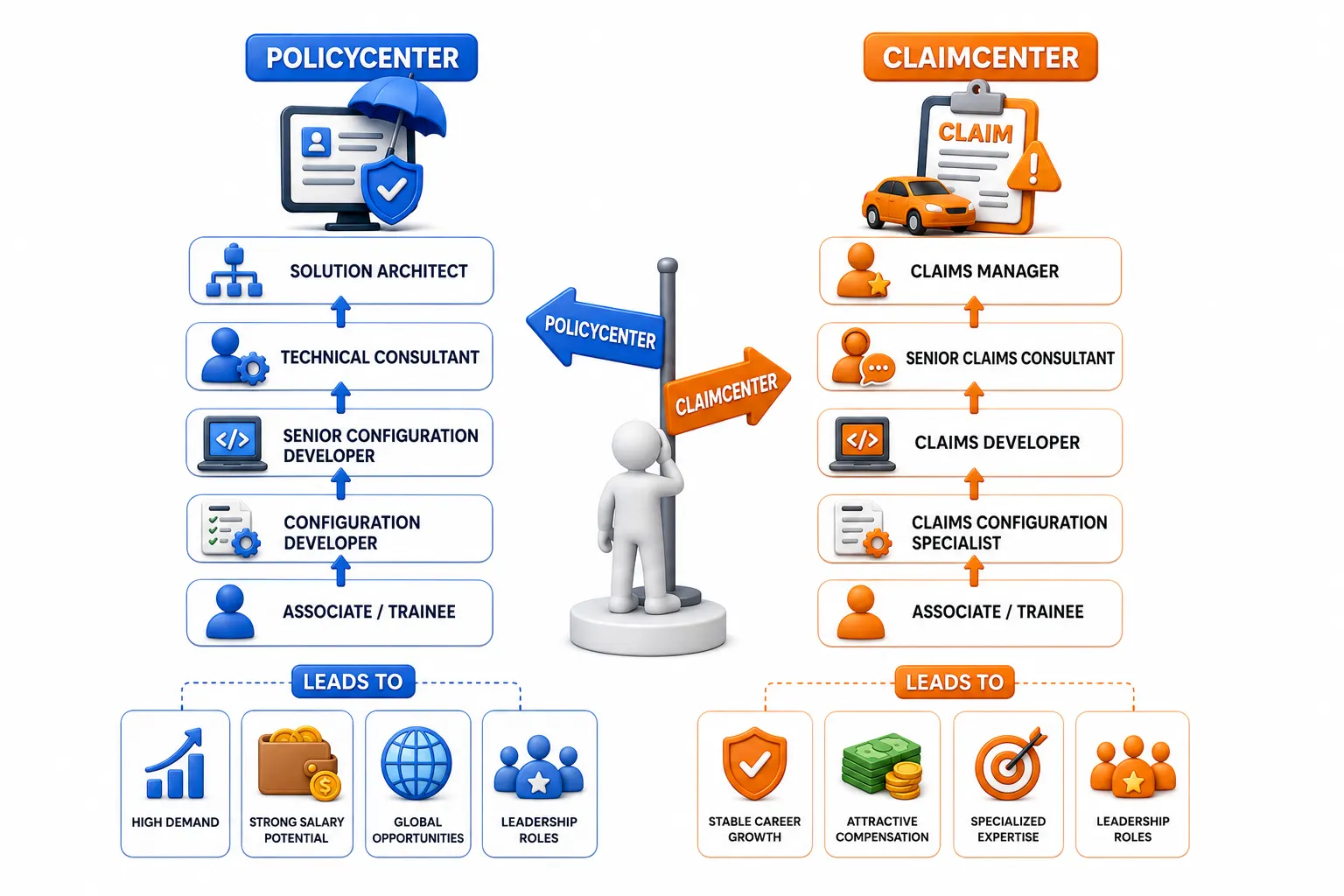
A PolicyCenter career typically leads toward roles in underwriting systems, rating configuration, and policy administration projects. You'll work closely with actuaries and product teams, translating pricing logic and eligibility rules into system configuration. Insurers constantly launch new products or adjust existing ones, so PolicyCenter specialists stay busy with product rollouts and rate changes.
A ClaimCenter career usually points toward claims operations, fraud detection tooling, and settlement workflow projects. You'll interact more with claims adjusters and business analysts who need faster, more accurate claim handling. Since claims directly affect customer satisfaction and company costs, this work often carries high visibility within an organization.
Some consultants eventually work across both modules, especially in smaller implementation teams where flexibility is valued. Larger enterprises, though, tend to hire specialists for each track separately.
When comparing Guidewire PolicyCenter vs ClaimCenter career growth, both offer strong long-term stability because Guidewire dominates a huge share of the property and casualty insurance software market. Neither path is a dead end — it genuinely comes down to which daily workflow suits you better.
Training Routes: How to Actually Get Job-Ready
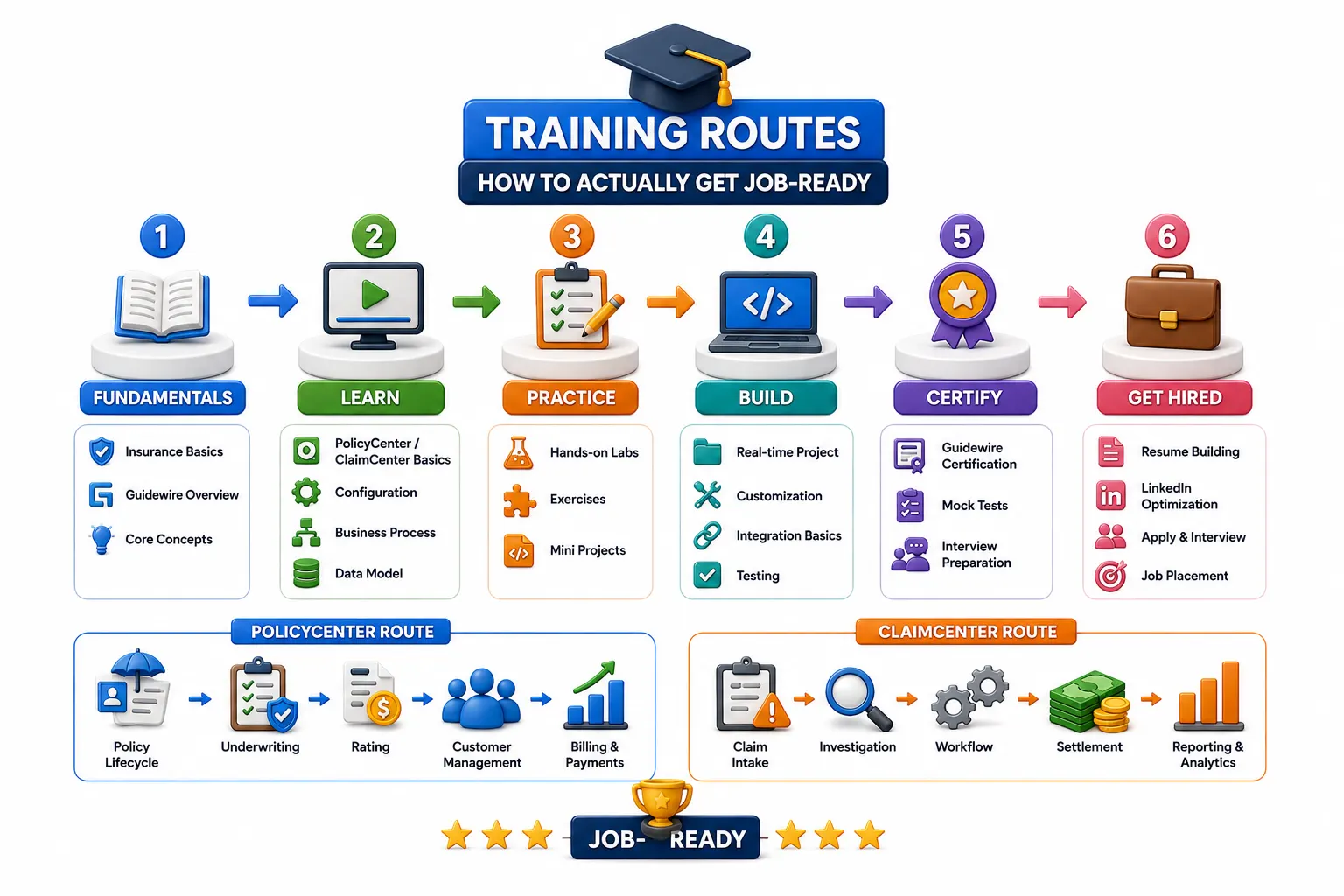
Reading documentation alone won't get you hired. You need structured, hands-on practice with real configuration scenarios.
Guidewire PolicyCenter vs ClaimCenter training programs typically follow a similar format: foundational platform concepts first, followed by module-specific configuration, integration basics, and finally a certification-track project. The foundational layer — Gosu scripting, PCF files, data model basics — overlaps heavily between both modules, so learning it once benefits you regardless of which specialization you choose later.
Good training also covers testing tools, deployment concepts, and how configuration changes move through different environments. Skipping this practical layer is a common mistake among self-taught learners who focus only on theory.
If you're preparing for certification exams specifically, a focused prep course matters more than generic tutorials. A dedicated Guidewire certification preparation course can help structure your revision around the actual exam blueprint instead of leaving you to guess which topics carry weight.
Whichever training route you choose, prioritize programs offering live project exposure. Employers consistently value candidates who've configured real business rules over those who've only watched recorded lectures.
Salary Expectations: Does the Module You Choose Matter?
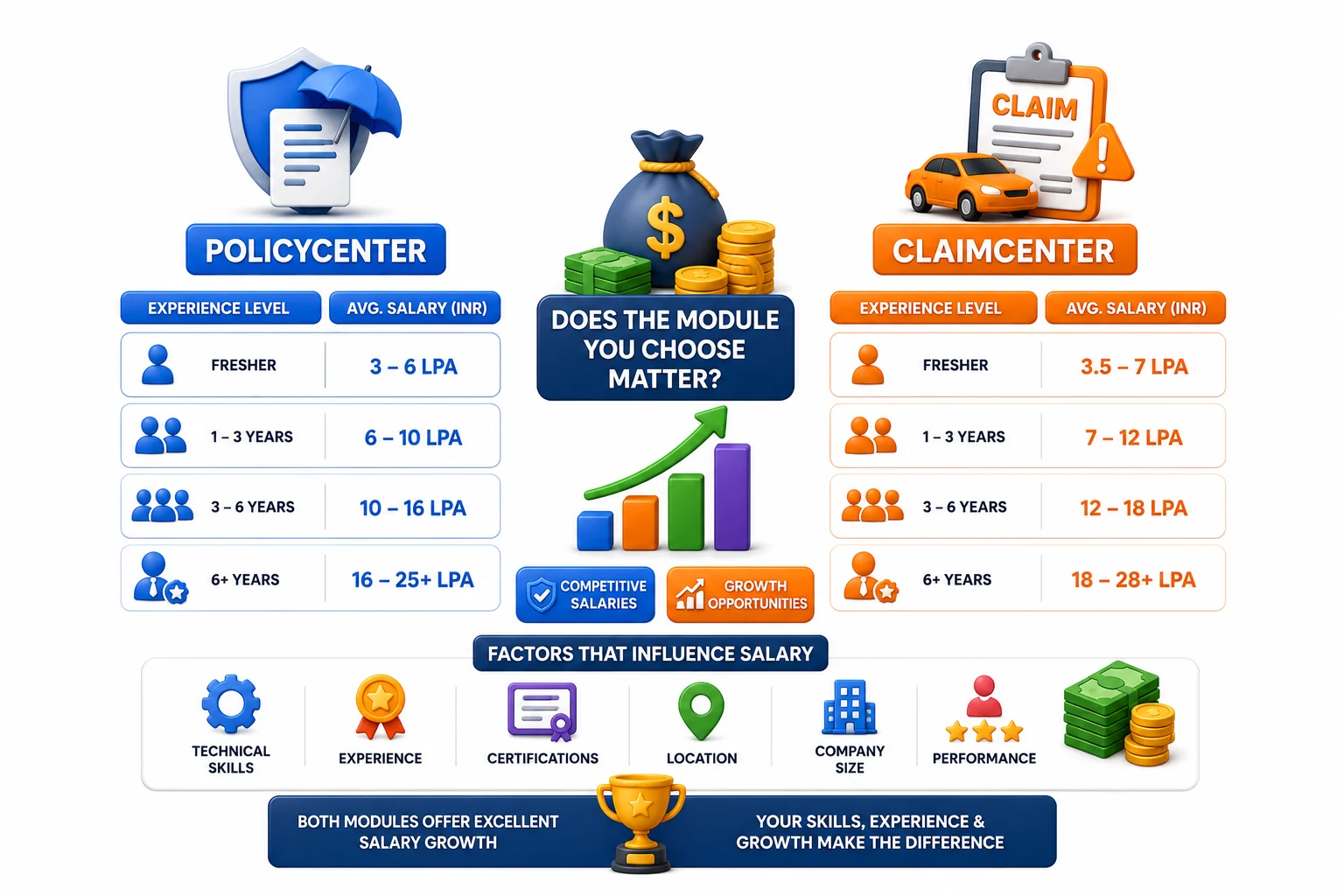
Money is naturally part of this decision, so let's address it honestly.
Salary differences between PolicyCenter and ClaimCenter specialists are generally modest rather than dramatic. Compensation depends far more on experience level, certification status, project complexity, and geographic location than on which single module you specialize in.
That said, a few patterns show up repeatedly in the job market. Professionals with Guidewire PolicyCenter vs ClaimCenter salary comparisons often find that PolicyCenter roles are slightly more abundant simply because more insurers actively configure and reconfigure products year-round. ClaimCenter roles, while fewer in raw numbers, sometimes command a premium in regions where claims transformation projects are actively underway.
Consultants who build cross-module skills — understanding both PolicyCenter and ClaimCenter, plus integration or BillingCenter basics — tend to earn more than narrow specialists. Breadth becomes a bargaining chip during contract negotiations and full-time offer discussions alike.
Bottom line: don't choose your module purely chasing a salary number you saw in a forum post. Compensation trends shift with market demand, and both specializations remain financially rewarding when paired with solid certification and real project experience.
Making Your Final Decision: A Practical Framework
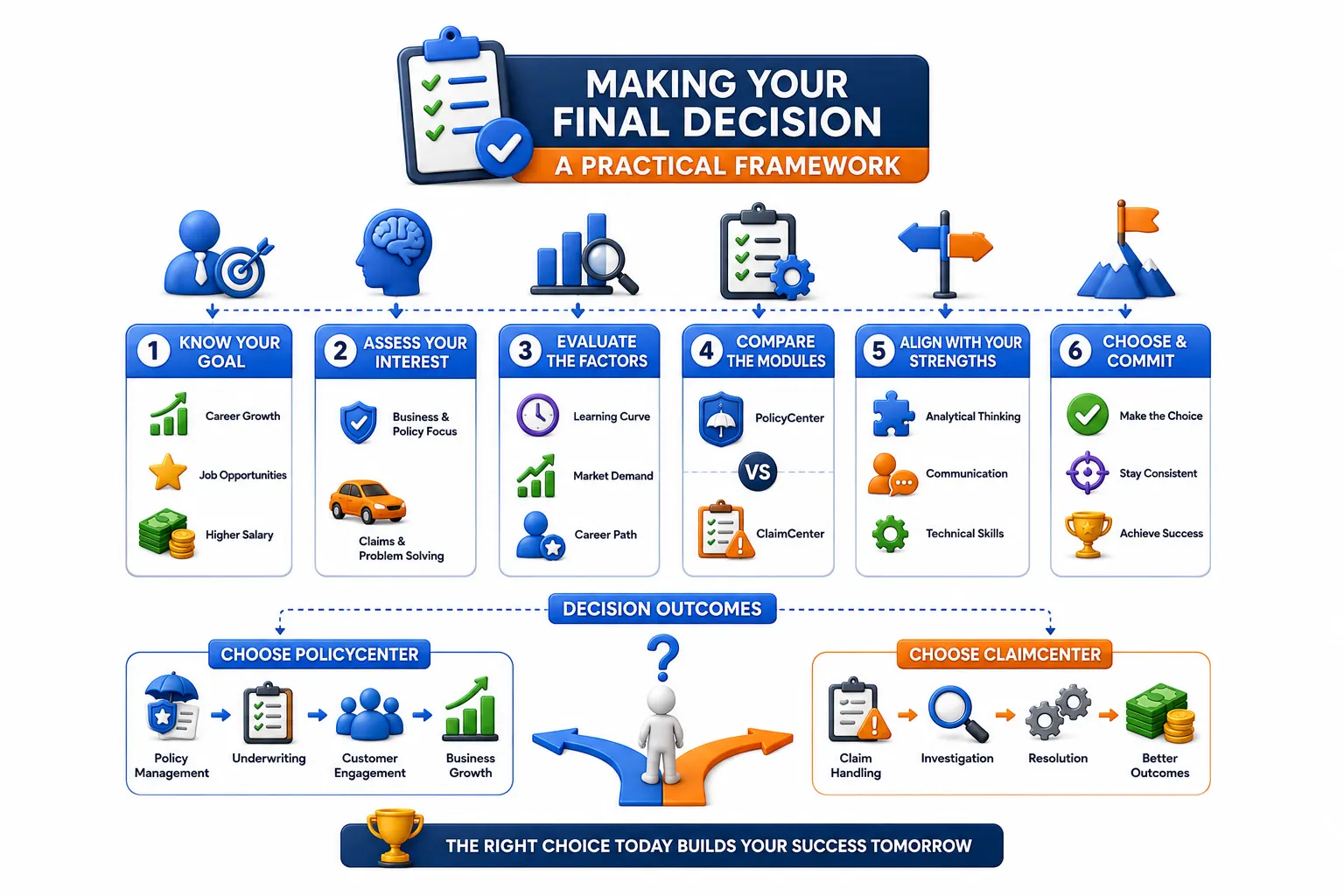
By now, the technical differences should be clear, so let's turn this into an actual decision.
Ask yourself three questions. First, do you enjoy structured rule-building and product logic, or do you prefer investigative, case-based work? Second, does your local job market show stronger demand for one module over the other? Third, are you aiming for a specific insurer or implementation partner that's currently staffed heavily on one type of project?
Your answers usually point toward a clear starting direction. And remember, this isn't necessarily permanent. Many professionals cross-train into the second module once they've built confidence and credibility in their first. Employers often support this because it makes you more versatile on implementation teams.
Rather than treating this as a permanent fork in the road, treat it as choosing where to plant your first flag.
Conclusion
Choosing between PolicyCenter and ClaimCenter isn't about picking a winner — both are essential pillars of the Guidewire ecosystem with strong, stable career paths. Match your choice to your natural interests, invest in solid training, and let your specialization grow from there. The insurance technology field rewards curiosity and consistency far more than which module you started with.