

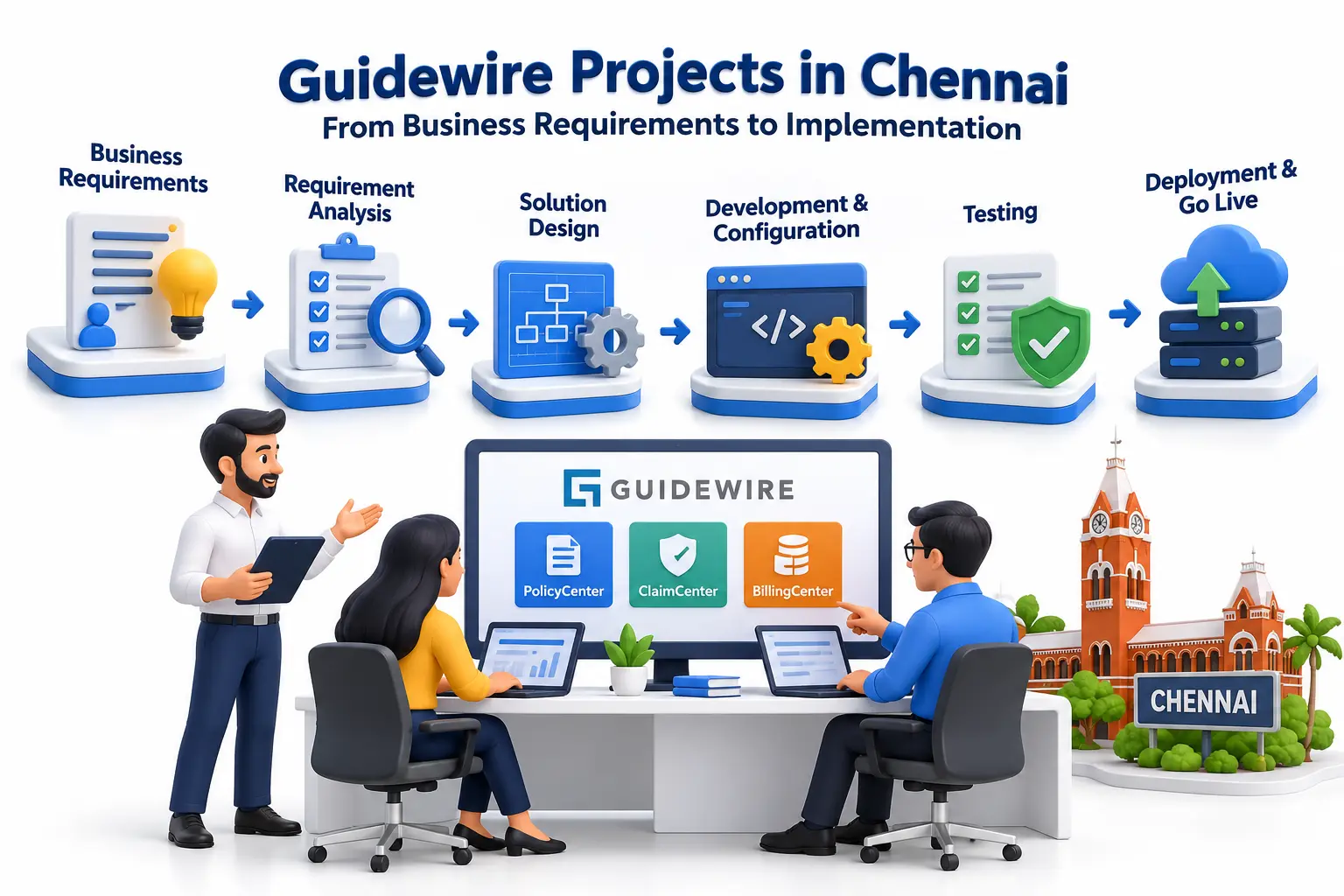
Guidewire Projects in Chennai From Business Requirements to Implementation
Navigate through this article using the table of contents below
Table of Contents
No headings found in this article.
A Guidewire project rarely begins with Gosu code. It starts with an insurance problem: change an underwriting rule, automate a claim decision, introduce a coverage, connect a payment service, or redesign a workflow. What happens next determines whether the implementation remains manageable or becomes expensive technical debt.
For professionals building Guidewire careers in Chennai, understanding this journey is more valuable than memorizing platform terminology. Real project knowledge means knowing how a requirement changes as business analysts, developers, testers, architects, integration teams, and stakeholders move it toward production.
Start With the Insurance Problem Before Thinking About Guidewire
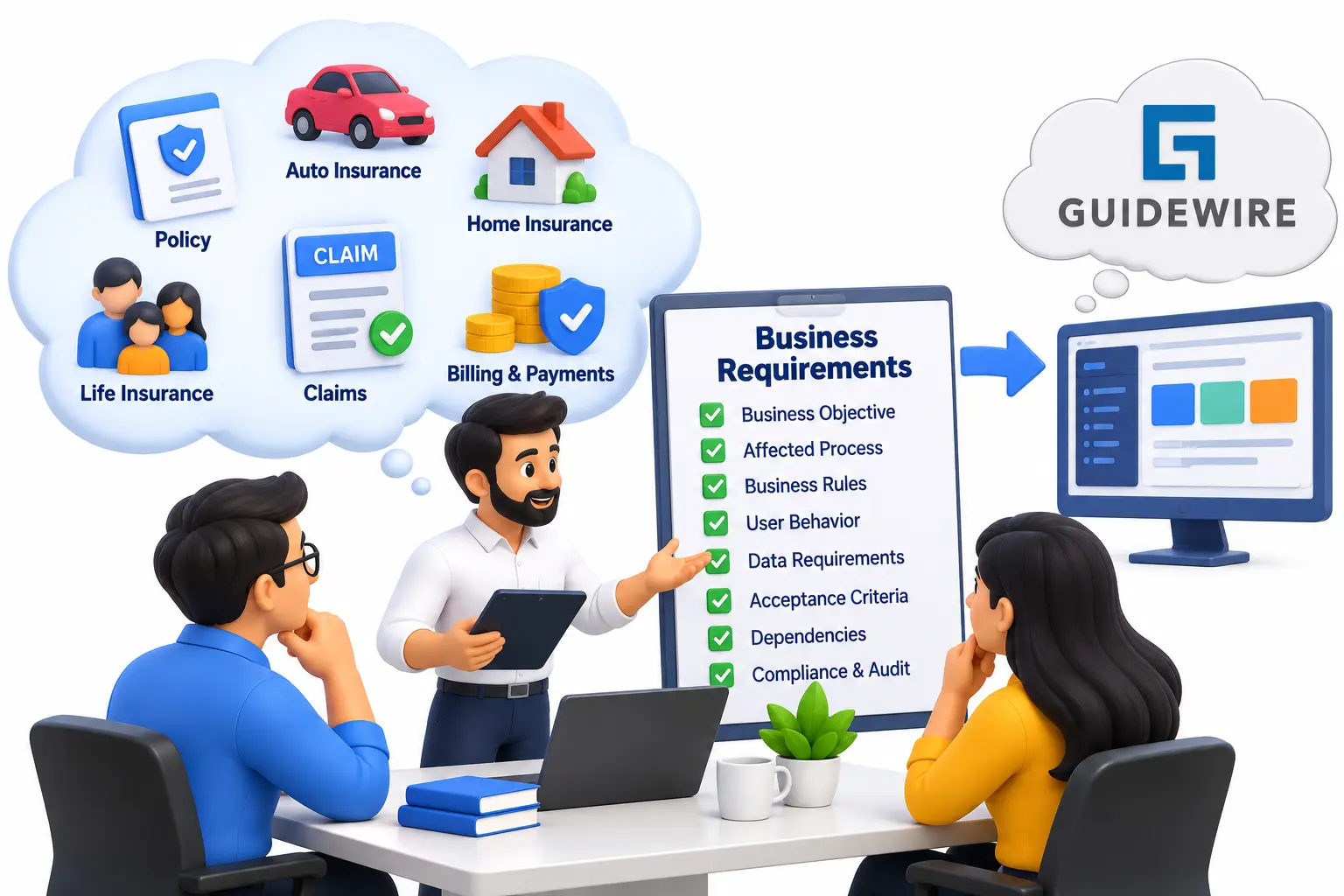
Imagine a motor insurer wants additional approval whenever a policy exceeds a defined risk threshold. The sentence sounds simple, but it is not yet an implementation-ready requirement.
A business analyst must uncover the actual behavior. Which products does the rule affect? When should the threshold be evaluated? Can an underwriter override it? What happens during renewal or endorsement? Does approval need an audit trail? These questions transform a business request into something a delivery team can build.
A useful requirement typically establishes:
Business objective and affected insurance process
Trigger conditions and exceptions
Expected user behavior
Required data
Acceptance criteria
Dependencies on other systems
Security or authorization requirements
This is why domain understanding matters in Guidewire work. A developer who understands only syntax may implement exactly what a ticket says while still solving the wrong business problem.
Turn Requirements Into Stories the Delivery Team Can Execute
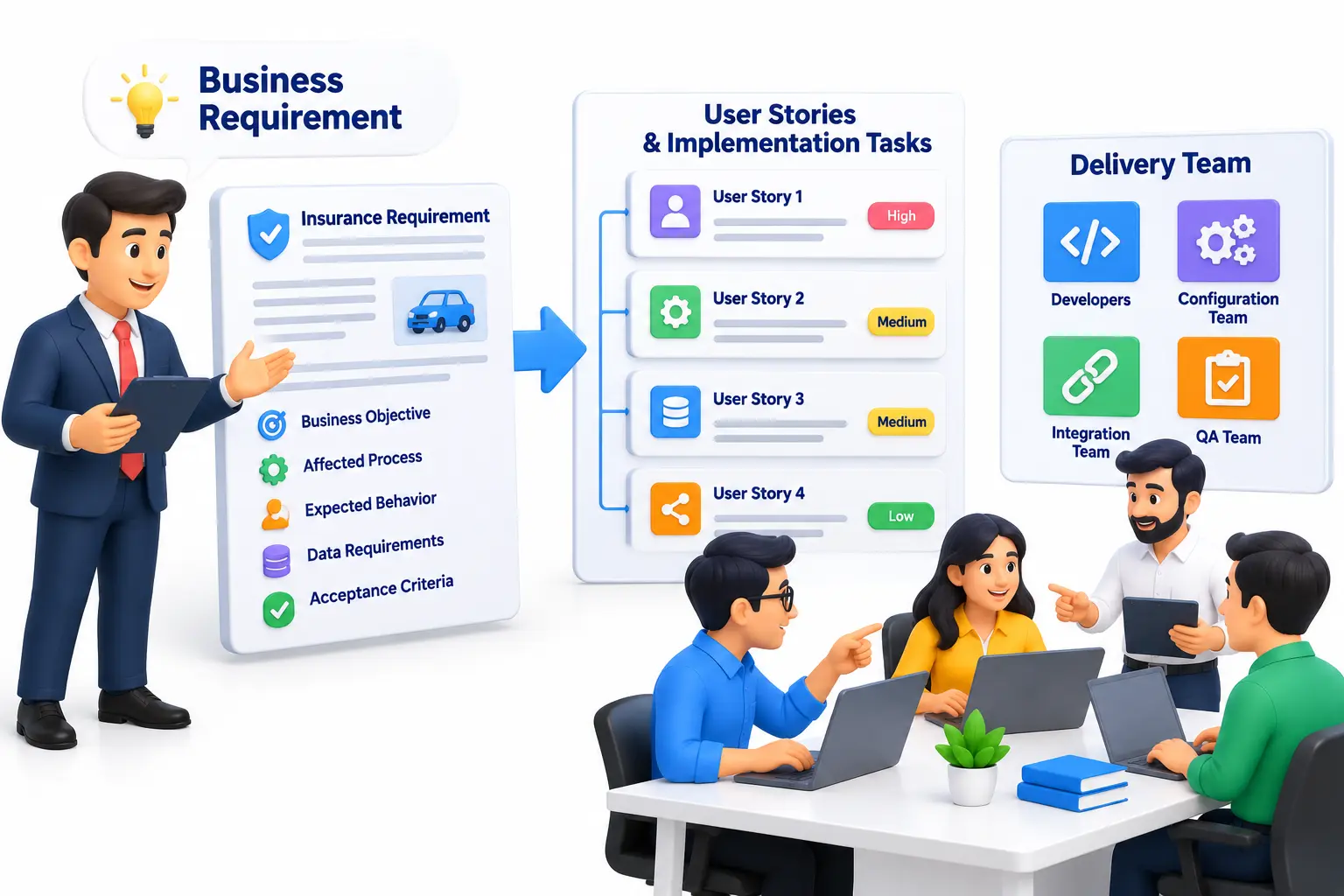
Once the requirement is understood, it normally becomes smaller stories or implementation tasks. A broad request such as “improve claims approval” may involve UI changes, business rules, permissions, data-model updates, notifications and integrations.
Before development begins, the team performs impact analysis. Developers inspect existing functionality instead of assuming every requirement needs something new. Architects may determine whether the solution belongs inside Guidewire or should remain in an external service.
For someone evaluating guidewire training in chennai, this requirement-analysis stage is an important sign of meaningful project exposure. JastTech can make project-based learning more useful when learners are asked to interpret insurance requirements and trace their technical impact rather than simply reproduce predefined configuration steps.
Good implementation thinking asks: What already exists? What needs to change? What else could this change affect? Those three questions can prevent unnecessary customization.
Convert the Story Into a Practical Guidewire Solution Design
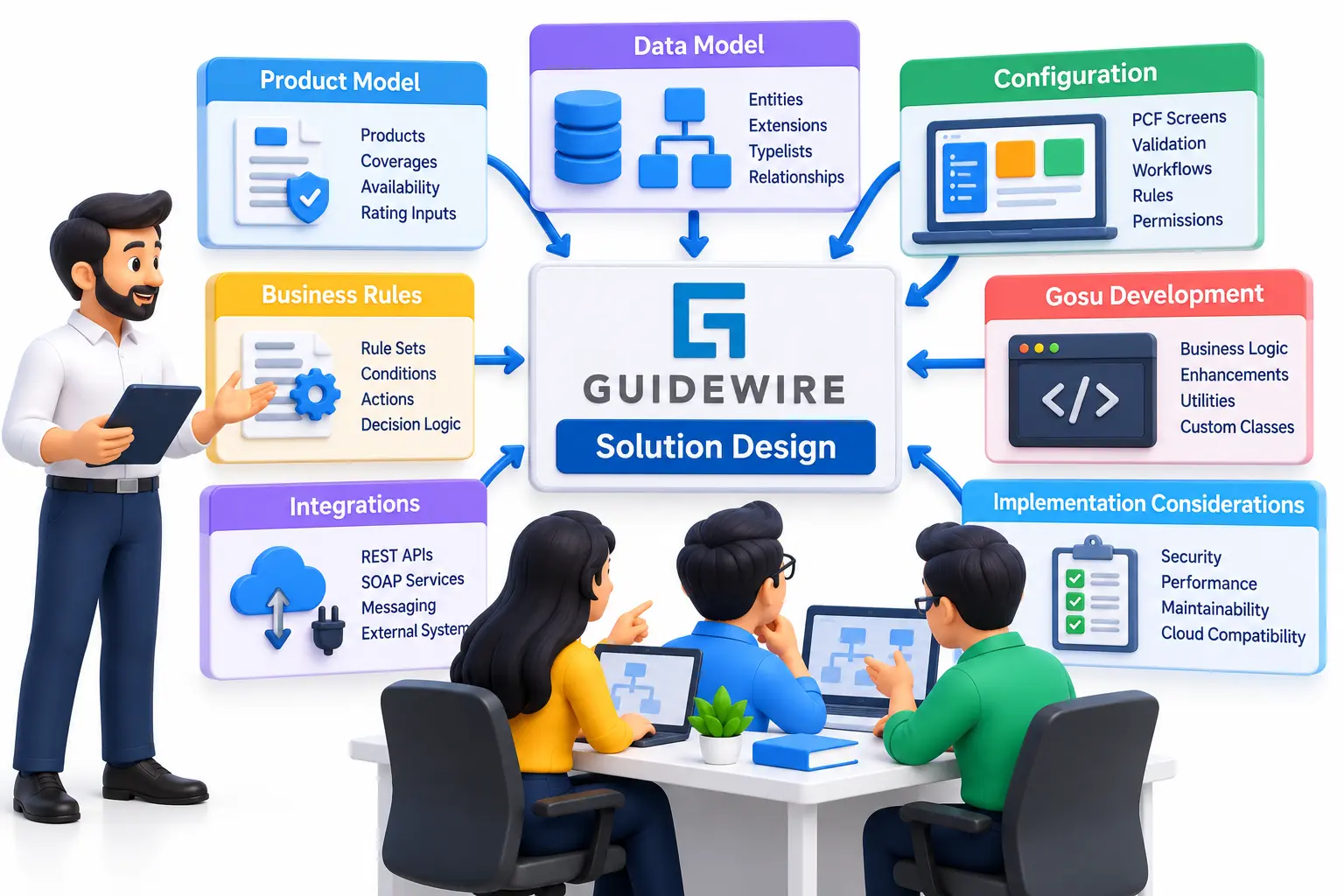
A requirement becomes technically useful only when the team decides where its behavior belongs.
Suppose an insurer wants a new optional vehicle coverage. That requirement could affect the PolicyCenter product model, availability rules, PCF screens, validation, rating inputs, documents, integrations and downstream billing. Treating it as one coding task would hide most of its impact.
Solution design therefore maps business behavior to platform components. Depending on the project, that can involve:
Product model and coverages
Entities and extensions
Typelists
PCF configuration
Gosu business logic
Rules and workflows
REST APIs or messaging
Plugins and external services
Modern Guidewire development also places increasing importance on APIs, cloud-compatible implementation patterns, security and maintainability. Guidewire itself emphasizes APIs and tooling for building and extending implementations, while its current security guidance treats security as something that belongs throughout development rather than at the end.
Professionals considering guidewire training in india should therefore look beyond application screens and Gosu syntax. Understanding why a solution belongs in configuration, integration, data modeling or an external service is closer to the decision-making required on real implementations.
Build Configuration and Integration as Connected Workstreams
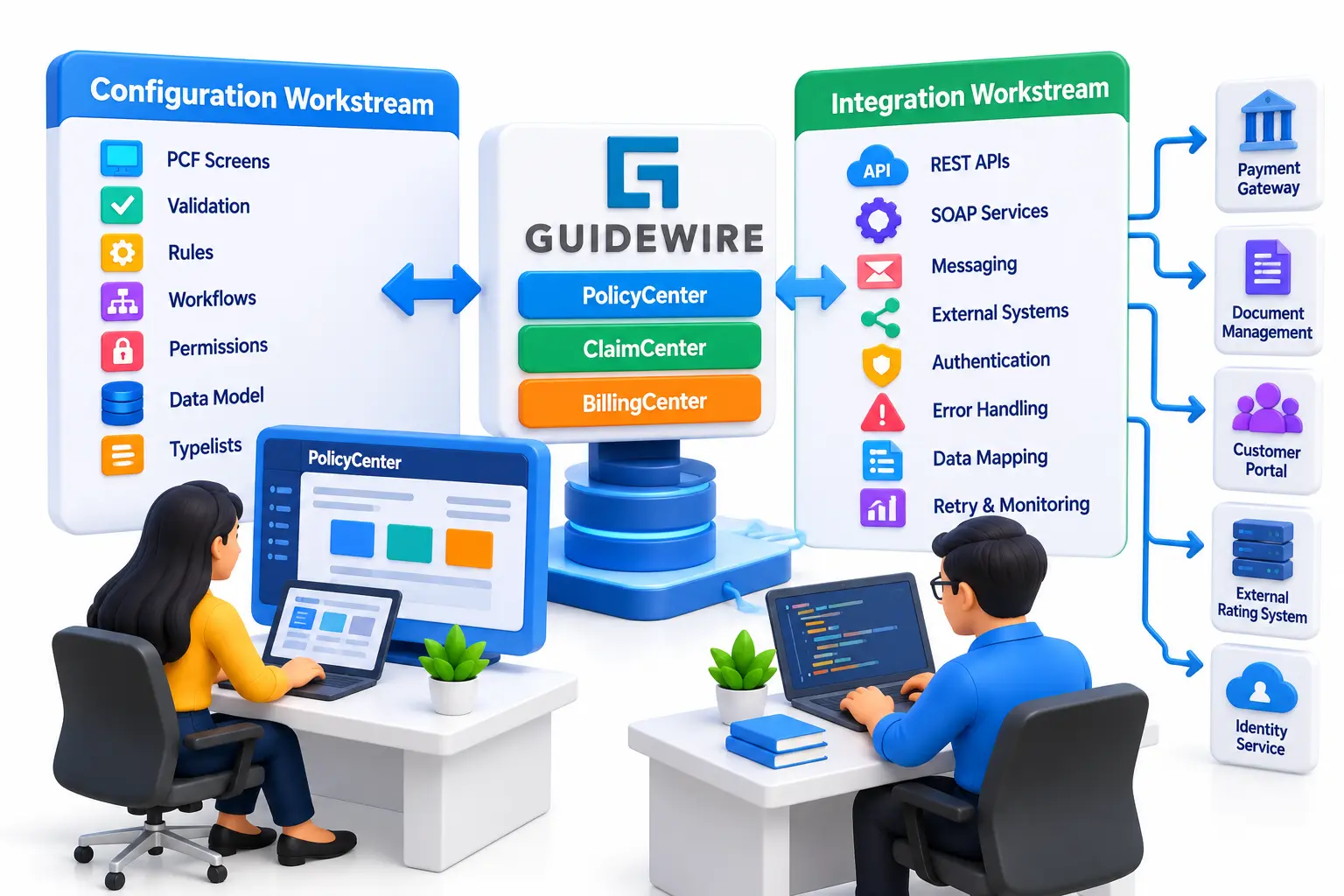
After design is approved, implementation begins. This is where beginners often assume a Guidewire developer simply starts writing Gosu. In reality, development may be distributed across several technical areas.
Configuration work can change screens, validation, rules, workflows, permissions or the data model. Integration work connects Guidewire with payment gateways, document systems, customer portals, identity services, external rating systems and other enterprise applications.
Consider a claims payment requirement. ClaimCenter may control the claim workflow and determine that payment is ready, while an external financial platform executes the transaction. The integration must define the request, authentication, error handling, response mapping, retry behavior and reconciliation.
That boundary matters. Building too much custom behavior inside the core application can make future maintenance harder, while moving everything outside Guidewire can create unnecessary complexity.
Strong developers therefore think beyond “Does my code run?” They consider transaction boundaries, failures, security, performance, observability and whether another team will understand the solution months later.
Test the Business Outcome, Not Just the Code
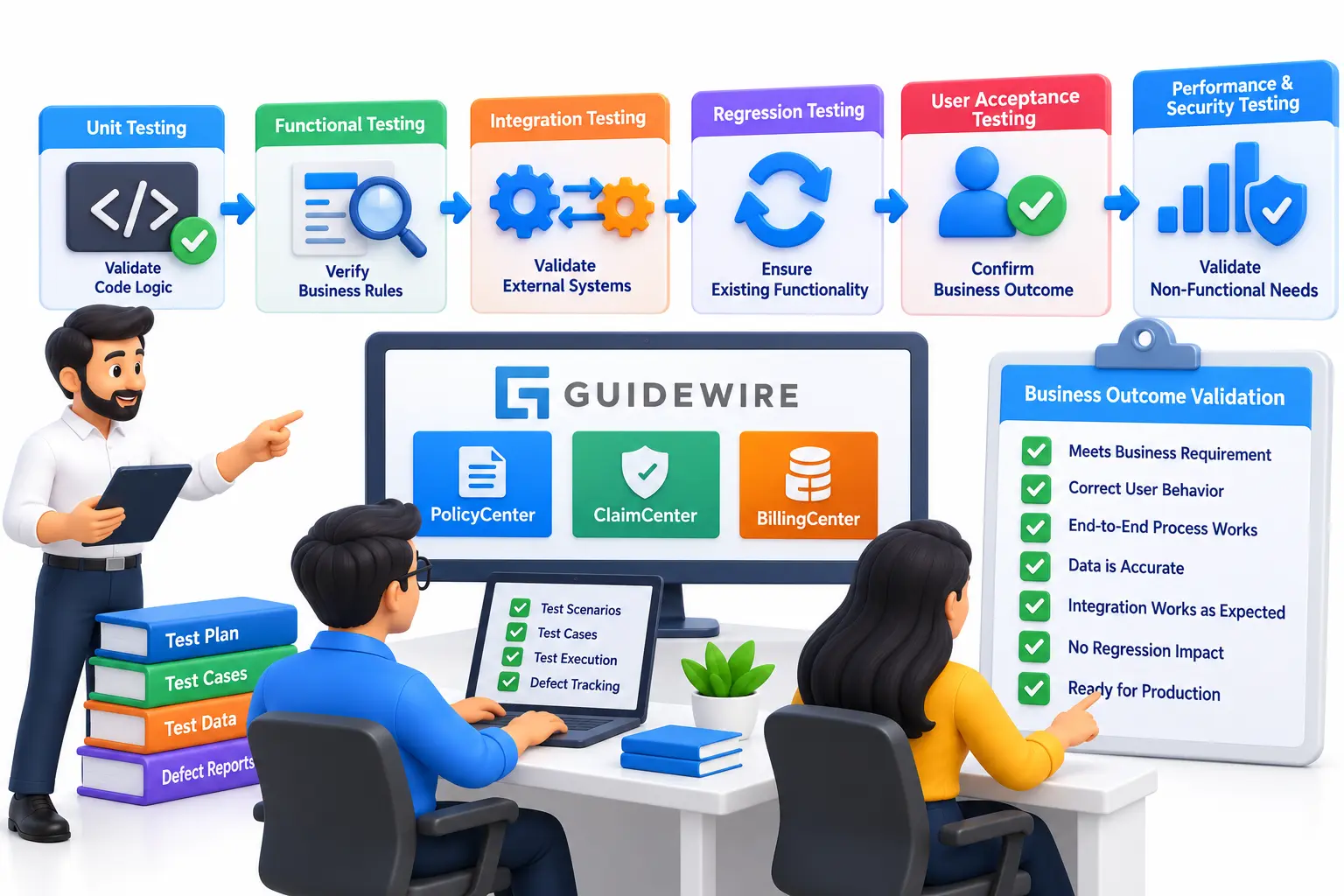
A successful compilation does not prove that an insurance requirement works.
Testing should trace the original acceptance criteria all the way through the implemented behavior. For the earlier underwriting example, testers would not verify only that an approval screen appears. They would test policies below and above the threshold, user permissions, overrides, renewals, endorsements and failure conditions.
Testing can span several layers:
Developer and unit-level validation
Functional testing
Integration testing
Regression testing
User acceptance testing
Performance and security validation
Guidewire’s current testing approach also supports behavior-driven scenarios across the software development lifecycle, reinforcing the idea that testing should represent user behavior and system outcomes rather than remain a final-stage activity.
Defects found here often reveal more than coding errors. A failed test may expose an ambiguous requirement, overlooked dependency, incorrect data assumption or incomplete integration contract. Mature project teams use those failures as feedback into design instead of treating testing as a separate downstream department.
Carry the Requirement Through Deployment and Production
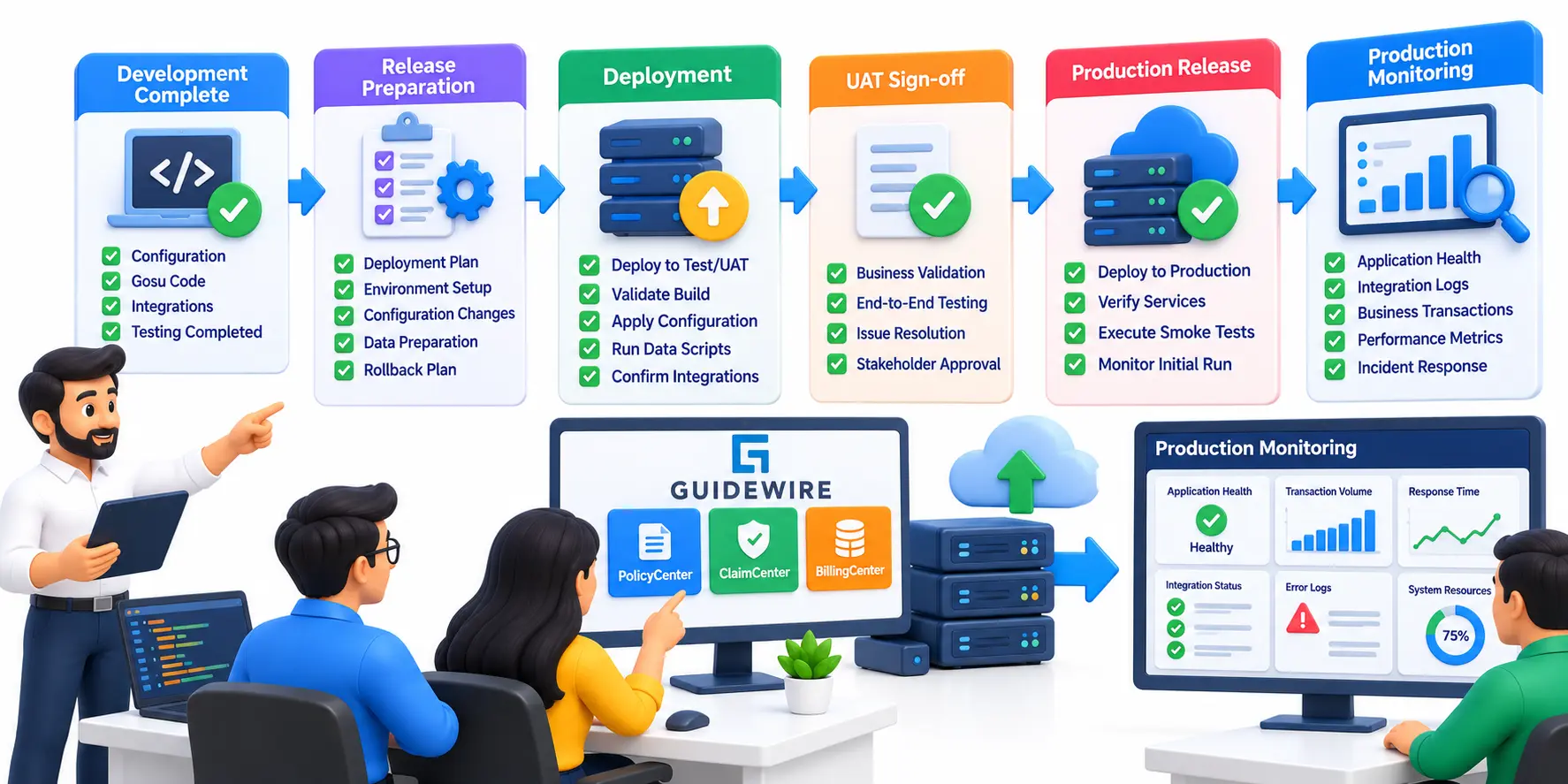
Passing UAT is an important milestone, but it is not the end of the requirement.
Before release, teams must consider deployment dependencies, configuration changes, database implications, integration readiness, monitoring, rollback planning and operational support. Cloud implementations also require teams to understand whether particular configuration changes fit the platform’s supported deployment patterns.
After production release, the most useful question changes from “Did deployment succeed?” to “Did the business outcome succeed?”
Teams may monitor:
Application and integration errors
Processing failures
Performance changes
Business transaction volumes
Unexpected user behavior
Production incidents
This closes the lifecycle. A requirement that began as a conversation becomes a story, then a technical design, implementation, tested capability and measurable production behavior.
For beginners, that complete chain is what makes a Guidewire project valuable. Knowing PolicyCenter or ClaimCenter features is useful; understanding how business intent survives every stage of delivery is what starts turning platform knowledge into implementation skill.
Conclusion
Guidewire projects in Chennai should not be understood simply as opportunities to configure screens, write Gosu or connect APIs. The real work is translating insurance requirements into reliable software while preserving business intent through analysis, design, development, testing and deployment.
That is also the difference between theoretical platform knowledge and project readiness. JastTech learners and aspiring Guidewire professionals can gain more practical value by practicing complete requirement-to-production scenarios: question the requirement, perform impact analysis, choose the right platform component, implement carefully, test against business outcomes and learn from production behavior. Once that mindset becomes natural, Guidewire concepts begin connecting into one coherent delivery process.