

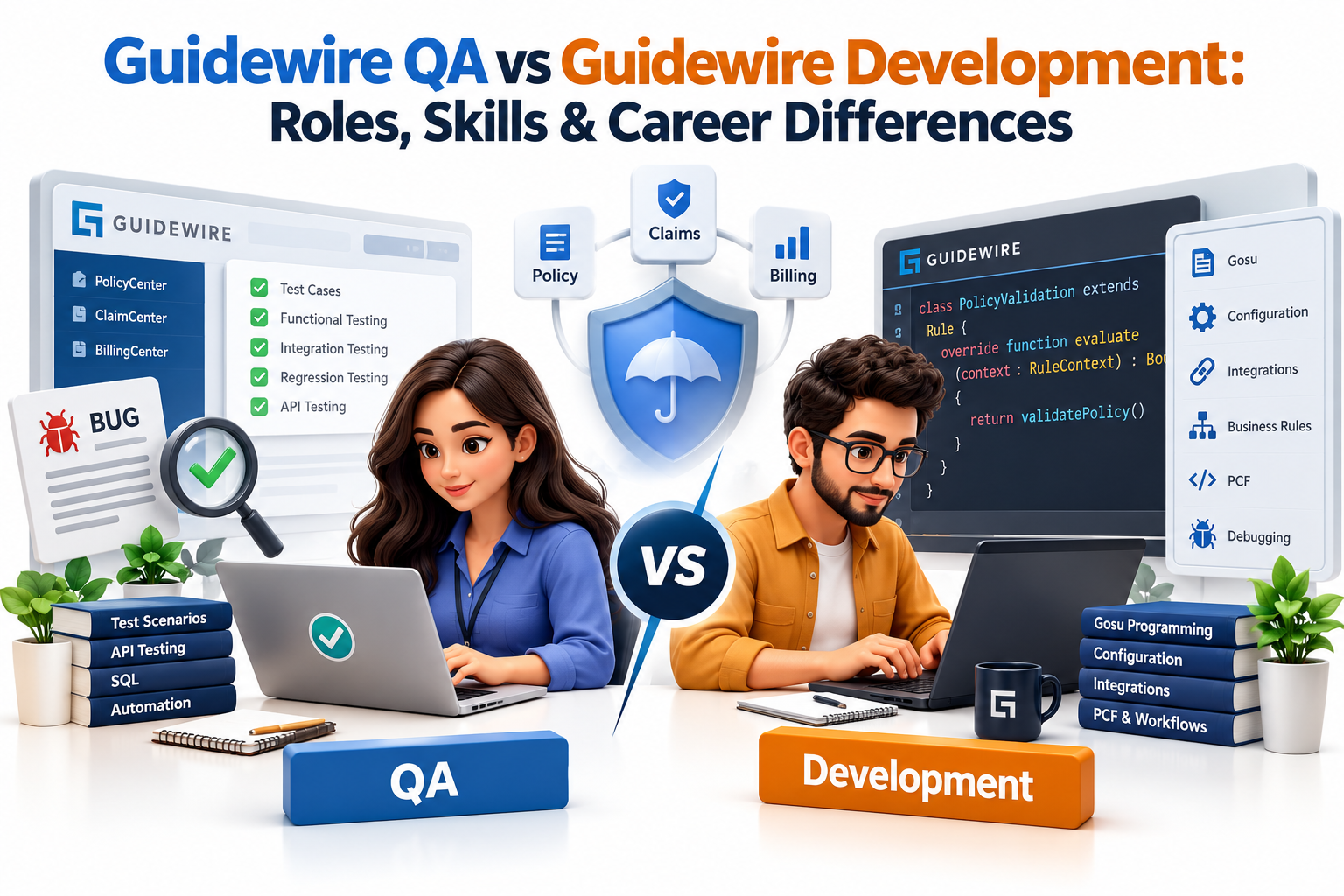
Guidewire QA vs Guidewire Development: Roles, Skills & Career Differences
Navigate through this article using the table of contents below
Table of Contents
No headings found in this article.
A successful Guidewire implementation depends on two things: building the right solution and ensuring it works flawlessly. But which side of this process should you choose—Quality Assurance or Development? Your decision can influence your daily responsibilities, technical skills, and long-term career growth.
Both career paths offer opportunities in insurance technology, but they demand different strengths. Whether you are a fresher, an experienced tester, or an aspiring developer, understanding these differences can help you choose a career that matches your abilities and professional goals.
What Does a Guidewire QA Professional Actually Do?
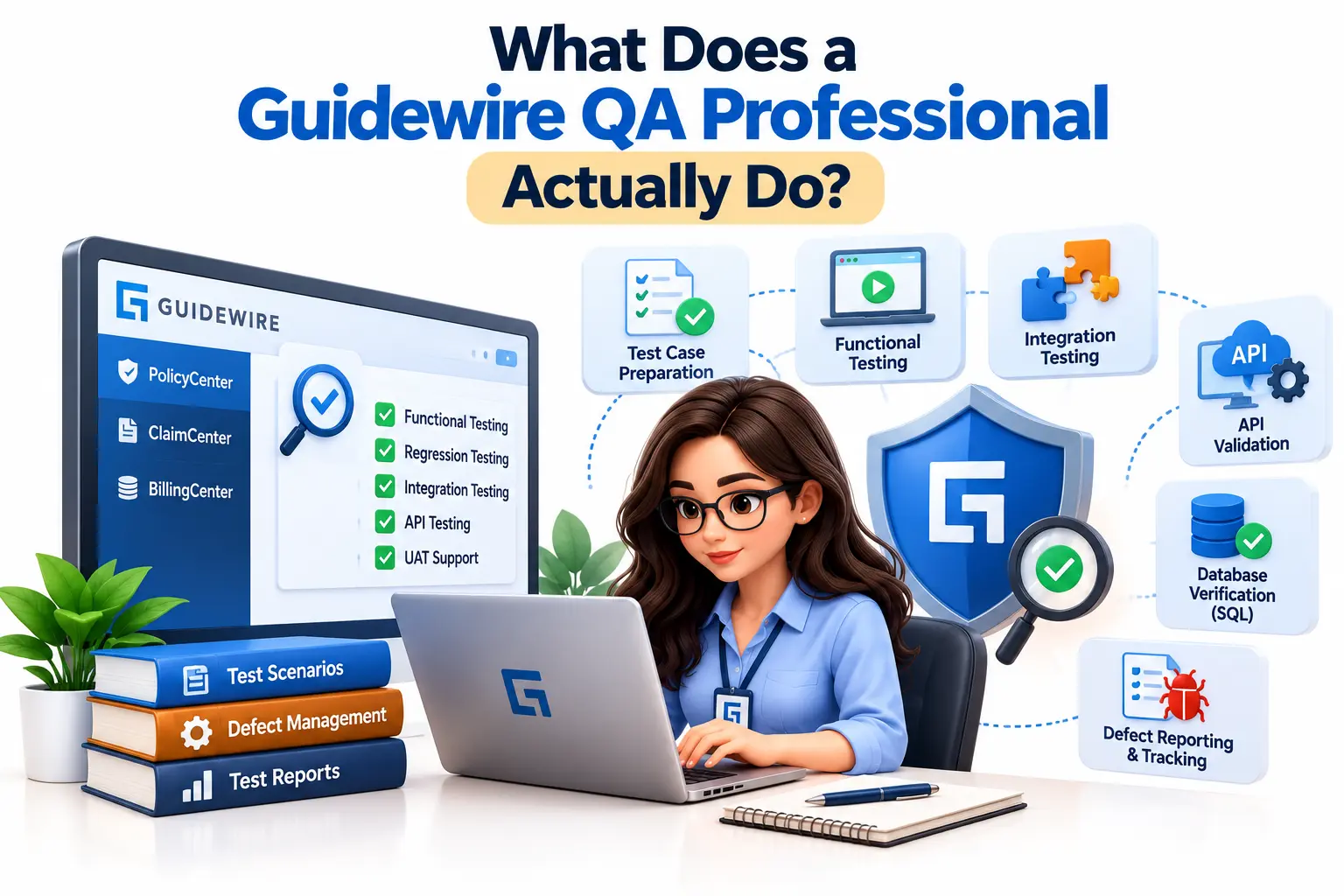
A Guidewire QA professional verifies that an insurance application behaves according to business requirements. Rather than assuming that a feature works because it has been implemented, the QA engineer checks its behavior under expected, unexpected, and exceptional conditions.
Consider an insurance company implementing a new policy renewal workflow in PolicyCenter. A QA engineer checks whether eligible policies renew correctly, premiums are calculated accurately, and invalid requests trigger appropriate errors.
Typical responsibilities include:
Understanding business requirements and preparing test scenarios.
Performing functional, integration, regression, and end-to-end testing.
Validating application behavior across PolicyCenter, ClaimCenter, or BillingCenter.
Testing REST and SOAP APIs using appropriate testing tools.
Using SQL to verify database records and investigate discrepancies.
Recording defects, attaching evidence, and collaborating with developers.
Supporting user acceptance testing and release validation.
Modern QA positions may also involve automation frameworks, CI/CD pipelines, and cloud-based testing. Therefore, Guidewire QA is not limited to manually clicking through screens. Experienced professionals often develop automation strategies, investigate complex integration failures, and improve overall software quality.
What Does a Guidewire Developer Do?
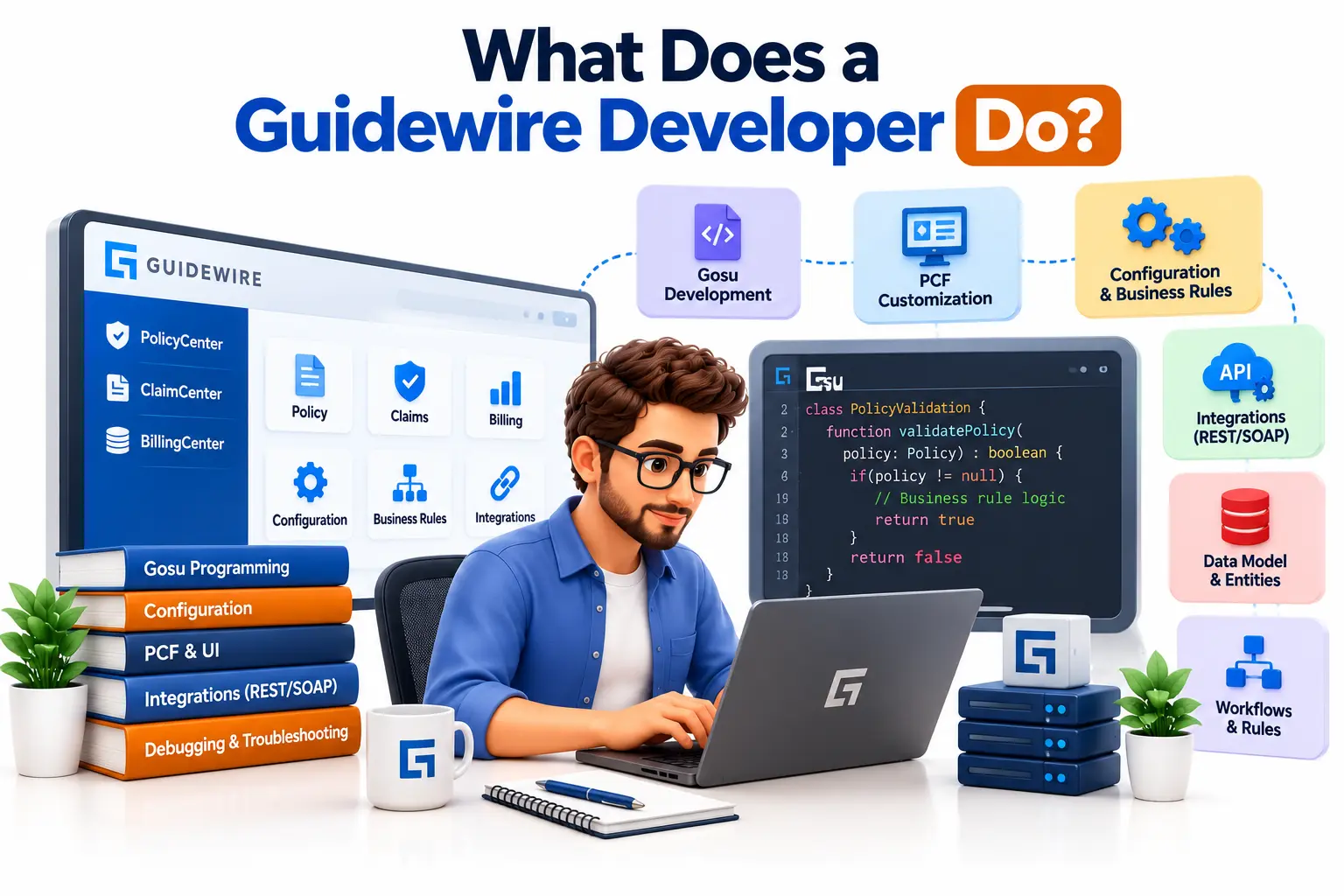
A Guidewire developer builds, configures, and extends insurance applications to satisfy business and technical requirements. The work involves translating requirements into application behavior, implementing business rules, developing integrations, and resolving technical issues.
For example, an insurer may require a customized validation rule that prevents a policy from being issued when mandatory underwriting information is missing. The developer implements the required logic, integrates it into the application workflow, and tests the resulting behavior.
Core responsibilities typically include:
Configuring PolicyCenter, ClaimCenter, or BillingCenter.
Writing business logic using Gosu.
Working with PCF screens, rules, entities, typelists, and workflows.
Developing integrations using APIs and relevant integration frameworks.
Troubleshooting application errors and performance problems.
Participating in code reviews, debugging, and release activities.
Supporting upgrades, cloud adoption, and ongoing application enhancements.
Depending on the project, developers may also work with data models, product configuration, messaging, and external systems.
Development generally requires more direct programming and configuration experience than entry-level manual testing. However, the level of complexity depends on the position: a configuration-focused developer and an integration specialist may have substantially different day-to-day responsibilities.
Guidewire QA vs Development: Essential Skills You Need
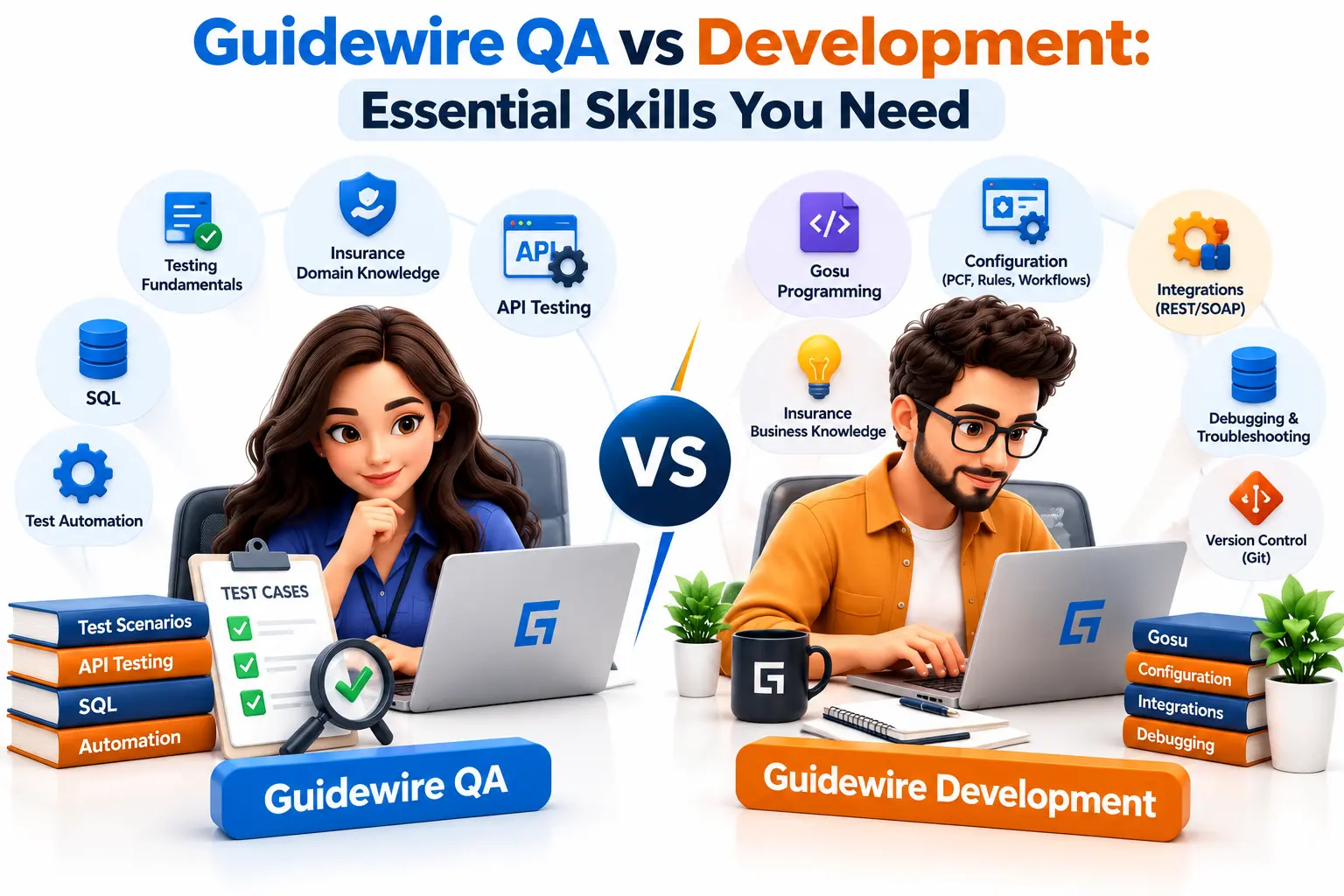
The most important difference between these roles is how professionals approach technical problems. QA engineers investigate whether a system meets its requirements, while developers determine how to implement and maintain the required functionality.
Skills for Guidewire QA
Testing fundamentals: Understand test cases, test plans, defect lifecycles, and regression testing.
Insurance workflows: Learn policy creation, endorsements, renewals, claims processing, and billing operations.
API testing: Validate requests, responses, status codes, and error handling.
SQL: Check stored records and investigate inconsistencies between application behavior and database results.
Automation: Learn a suitable programming language and tools such as Selenium or Playwright when relevant to the role.
Communication: Document reproducible defects and explain their business impact clearly.
Skills for Guidewire Development
Gosu programming: Understand syntax, object-oriented concepts, collections, and application-specific coding practices.
Configuration: Learn rules, PCF components, data models, and workflows.
Integration development: Understand REST/SOAP services, JSON, XML, and data exchange.
Debugging: Trace application behavior, identify root causes, and implement reliable fixes.
Version control: Use Git and understand code reviews and collaborative development.
Insurance knowledge: Translate business requirements into maintainable technical solutions.
Both careers benefit from analytical thinking, collaboration, and a sound understanding of the insurance domain. Neither path eliminates the need to understand how Guidewire applications function.
Career Growth, Opportunities, and Long-Term Prospects
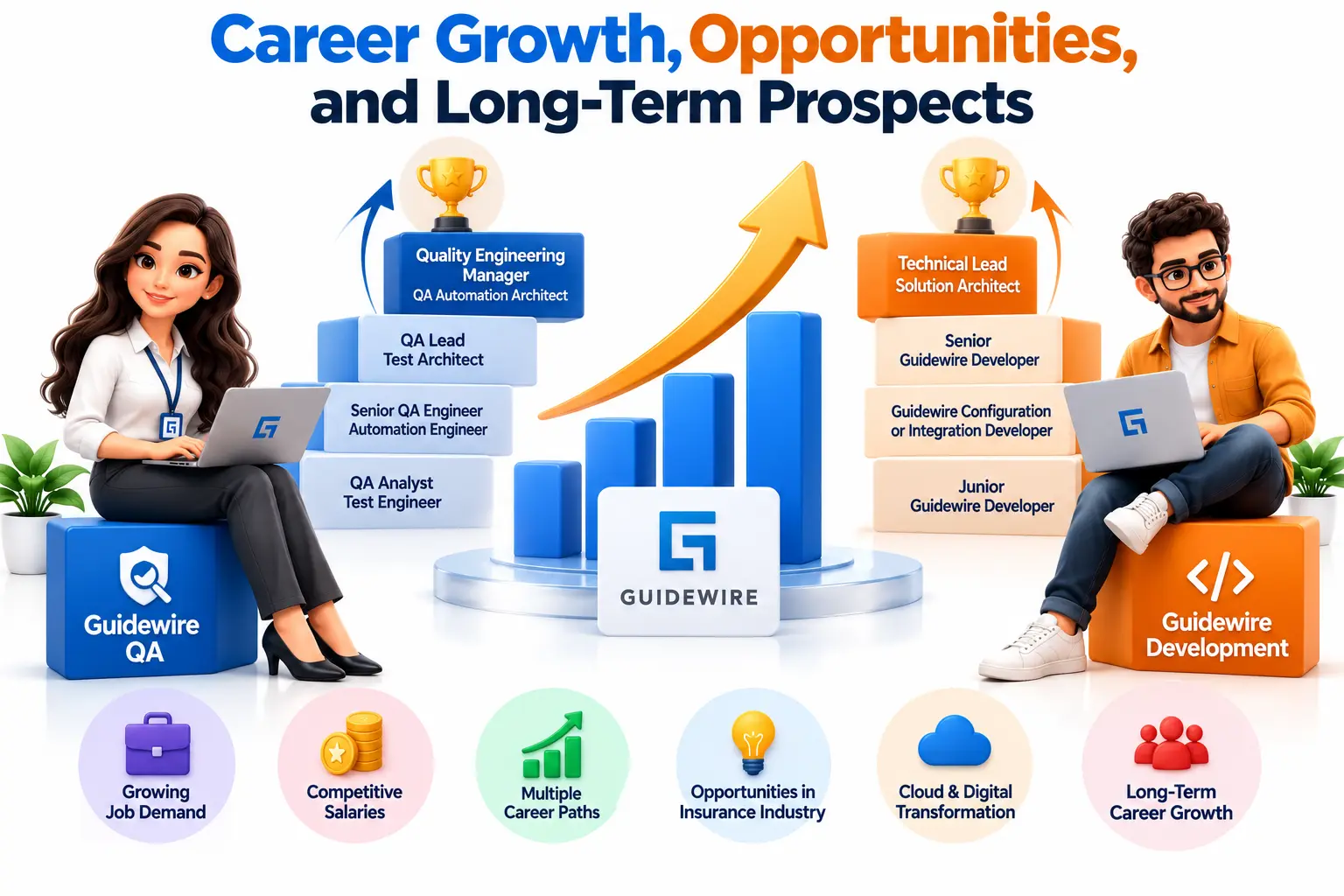
Guidewire QA and development offer different advancement opportunities, and neither guarantees faster promotion or higher compensation. Growth depends on technical expertise, project experience, communication, specialization, and the requirements of individual employers.
A QA professional may progress through roles such as:
QA Analyst or Guidewire Test Engineer.
Senior QA Engineer or Automation Engineer.
QA Lead or Test Architect.
Quality Engineering Manager or QA Automation Architect.
Professionals who develop strong automation, API testing, cloud validation, and framework-design skills can move beyond manual testing into broader quality engineering responsibilities.
A developer may progress through roles such as:
Junior Guidewire Developer.
Guidewire Configuration or Integration Developer.
Senior Guidewire Developer.
Technical Lead or Solution Architect.
Experienced developers can specialize in complex integrations, application architecture, cloud implementations, or technical leadership.
Demand varies by project and location. Insurance transformation programs require both reliable testing and effective development, although the balance between these skills changes across implementation stages.
For candidates exploring Guidewire Training in Hyderabad, reviewing current job descriptions can help identify whether local opportunities emphasize functional QA, automation, configuration, integrations, or cloud experience. Choose a learning path based on the skills employers actually request rather than assumptions about which role is automatically better.
How to Choose the Right Path and Prepare for Interviews
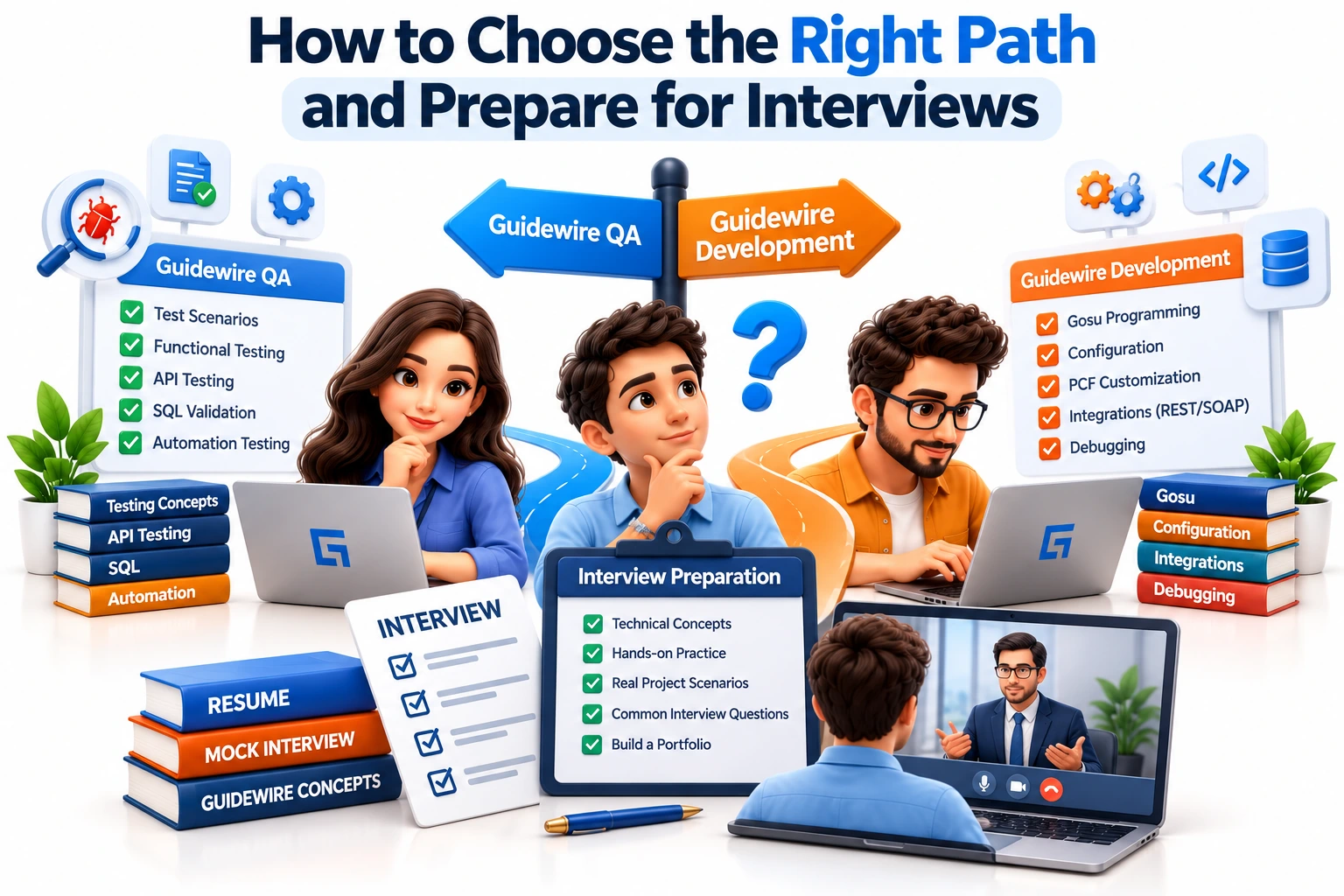
The best career path depends on the kind of work you enjoy and the technical skills you want to develop.
Choose QA if you enjoy:
Investigating unexpected application behavior.
Analyzing business requirements and identifying edge cases.
Testing workflows and validating data.
Finding defects and helping teams prevent production issues.
Building automated tests and improving release confidence.
Choose development if you enjoy:
Writing code and solving programming problems.
Implementing business rules and configuring applications.
Building integrations between enterprise systems.
Debugging technical issues and improving application behavior.
Designing maintainable solutions for complex requirements.
Whichever path you select, practical project experience matters. A certificate alone does not demonstrate that you can solve realistic implementation problems.
Prepare by building a small portfolio of exercises relevant to your chosen role. QA candidates can create test scenarios for policy issuance, renewal, claims, and billing, then document defects and perform API or SQL validation. Development candidates can practise Gosu fundamentals, configuration concepts, business rules, and integration scenarios in an appropriate learning environment.
During interviews, be prepared to explain your reasoning. A QA candidate should demonstrate how to isolate a defect, while a developer should explain how to investigate and implement a fix. Both should understand the business process behind the technical task.
JastTech can be considered as a learning resource for candidates seeking structured preparation in Guidewire concepts. Before enrolling in any training program, review its curriculum, practical exercises, trainer experience, and interview preparation support. Candidates researching Guidewire Training in Hyderabad should prioritize hands-on learning that aligns with their intended job role.
Build Your Guidewire Career Around Your Strengths
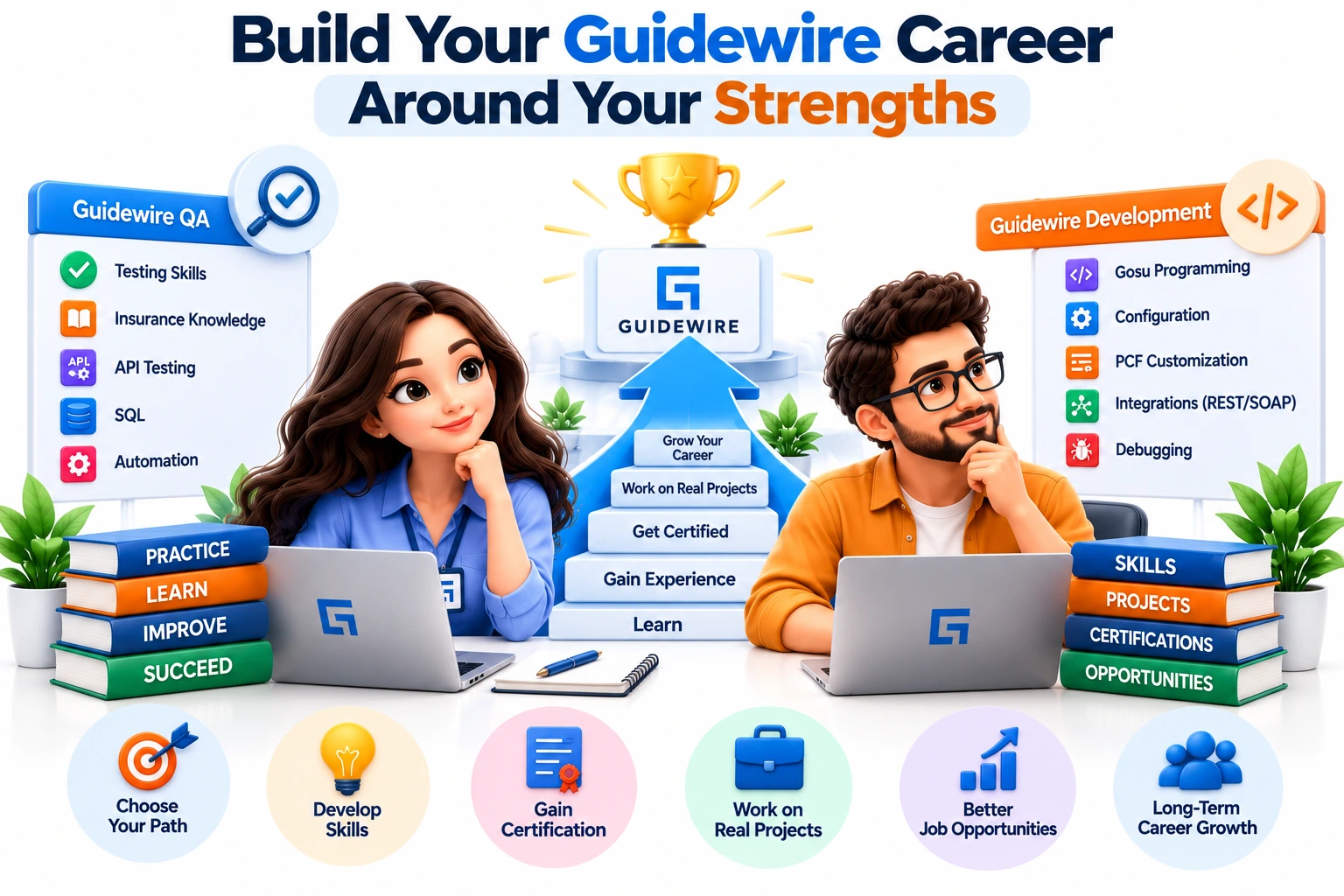
Guidewire QA and development contribute to the same objective: delivering dependable insurance software. QA professionals focus on validating functionality, identifying risks, and preventing defects, while developers build and customize the application through configuration, programming, and integrations. Both roles require insurance-domain understanding and continuous technical learning.
Your decision should reflect your interests rather than assumptions about salary, difficulty, or job security. If you enjoy systematic investigation and software quality, begin with QA and gradually explore automation. If programming and application design appeal to you, focus on Gosu, configuration, and integration development. With consistent practice, realistic projects, and targeted interview preparation, either path can provide a foundation for a long-term career in insurance technology.
For aspiring professionals, Guidewire Training in Hyderabad can be a useful starting point when the program provides role-specific instruction, practical exercises, and exposure to real-world insurance workflows. Choose a learning plan that develops demonstrable skills and prepares you for the responsibilities of your preferred role.
Conclusion
Guidewire QA and Guidewire Development offer valuable career opportunities in the insurance technology industry, but each path requires a different skill set and approach. QA professionals focus on validating application functionality, identifying defects, testing business workflows, and ensuring software quality. Developers concentrate on Gosu programming, application configuration, business rules, and integrations. Both roles require strong analytical thinking, insurance-domain knowledge, and continuous learning to stay relevant in a changing technology landscape.
Choosing the right path depends on your interests, technical strengths, and long-term career goals. If you enjoy testing, troubleshooting, and improving software quality, Guidewire QA may suit you, while development is ideal if you prefer programming and building applications. JastTech can help aspiring professionals explore structured learning opportunities and practical skill development. If you are considering Guidewire Training in Hyderabad, prioritize hands-on projects, real-world scenarios, and interview preparation to build the skills and confidence needed to pursue your chosen career path.