

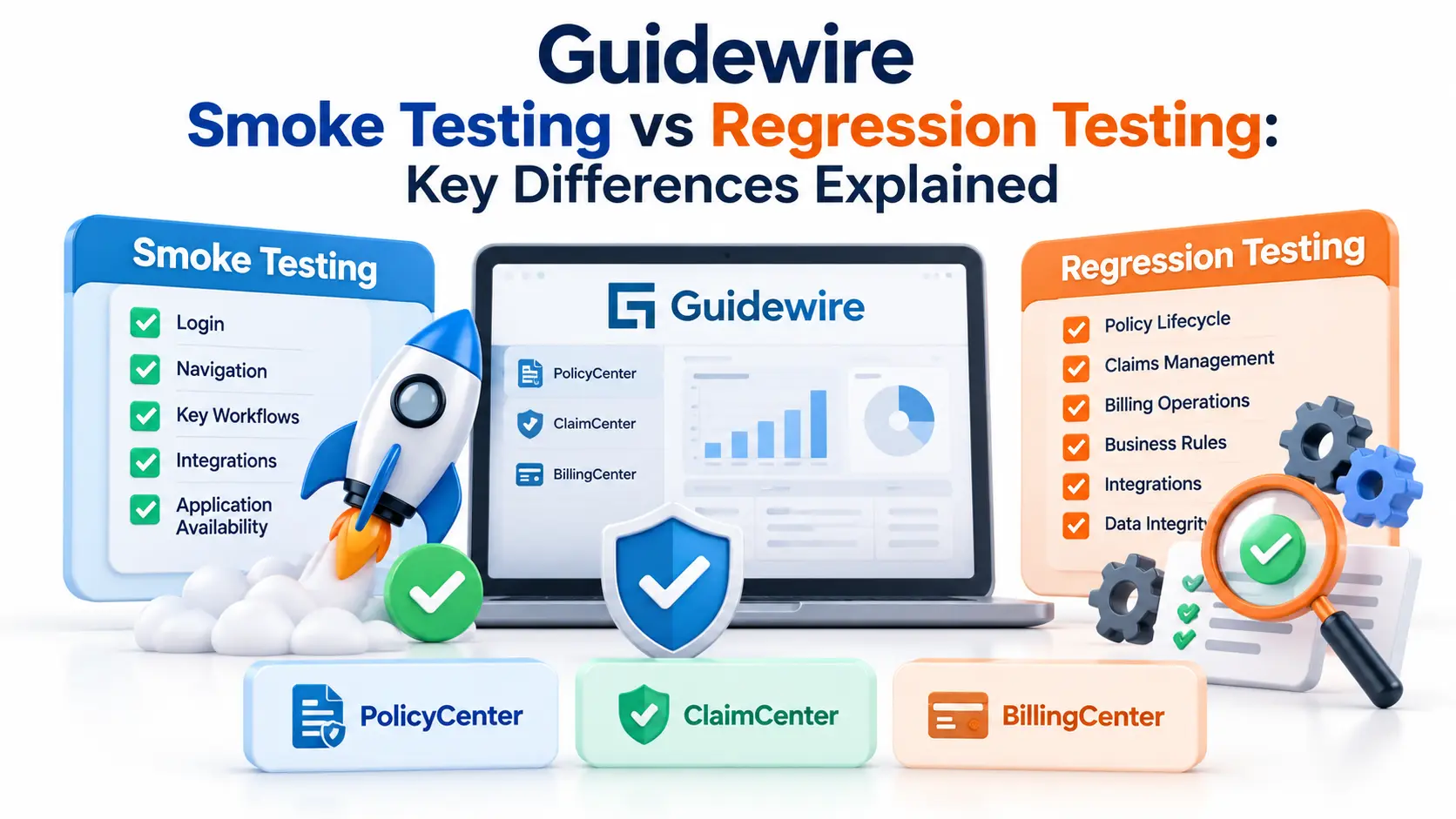
Guidewire Smoke Testing vs Regression Testing: Key Differences Explained
Navigate through this article using the table of contents below
Table of Contents
No headings found in this article.
A successful Guidewire deployment does not automatically mean an insurance application is ready for business. A login failure, broken claim workflow, incorrect premium calculation, or integration issue can disrupt critical operations. This is where smoke testing and regression testing become essential for validating application stability and protecting business functionality.
Although both testing approaches help maintain software quality, they serve different purposes. Understanding when to perform each test, what to validate, and how to prioritize test scenarios helps Guidewire QA teams identify defects earlier and release changes with greater confidence.
Understanding Smoke Testing in Guidewire Applications
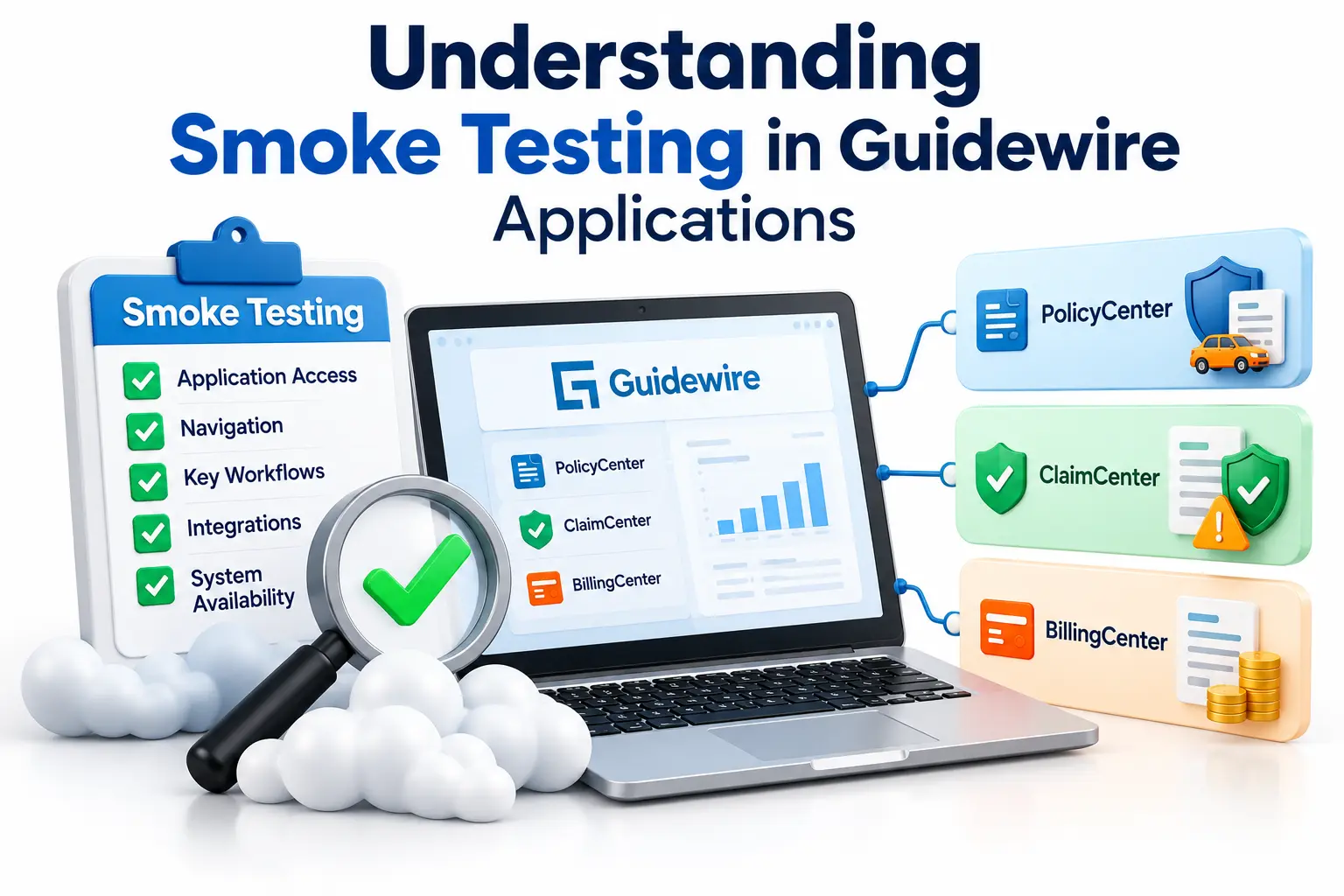
Smoke testing is an initial verification process that checks whether the most important application functions work after a new build, deployment, configuration change, or upgrade. Its primary objective is to determine whether the application is stable enough for more extensive testing.
In Guidewire environments, smoke testing focuses on essential insurance workflows across PolicyCenter, ClaimCenter, and BillingCenter. Testers verify that users can access the application, navigate important screens, perform basic transactions, and interact with critical services.
Typical smoke testing scenarios include:
PolicyCenter: Open an existing policy, access policy details, and initiate a basic policy transaction.
ClaimCenter: Search for an existing claim, open claim information, and verify that essential claim screens load correctly.
BillingCenter: Retrieve an account, view billing information, and confirm that essential payment-related screens are accessible.
Integrations: Check whether critical APIs and connected services respond as expected.
Application availability: Confirm that authentication, navigation, and essential application functions are operational.
Smoke testing does not attempt to validate every business rule or transaction variation. Instead, it identifies major failures quickly. If a critical workflow is unavailable, testers can report the issue before investing time in comprehensive regression execution.
Understanding Regression Testing in Guidewire
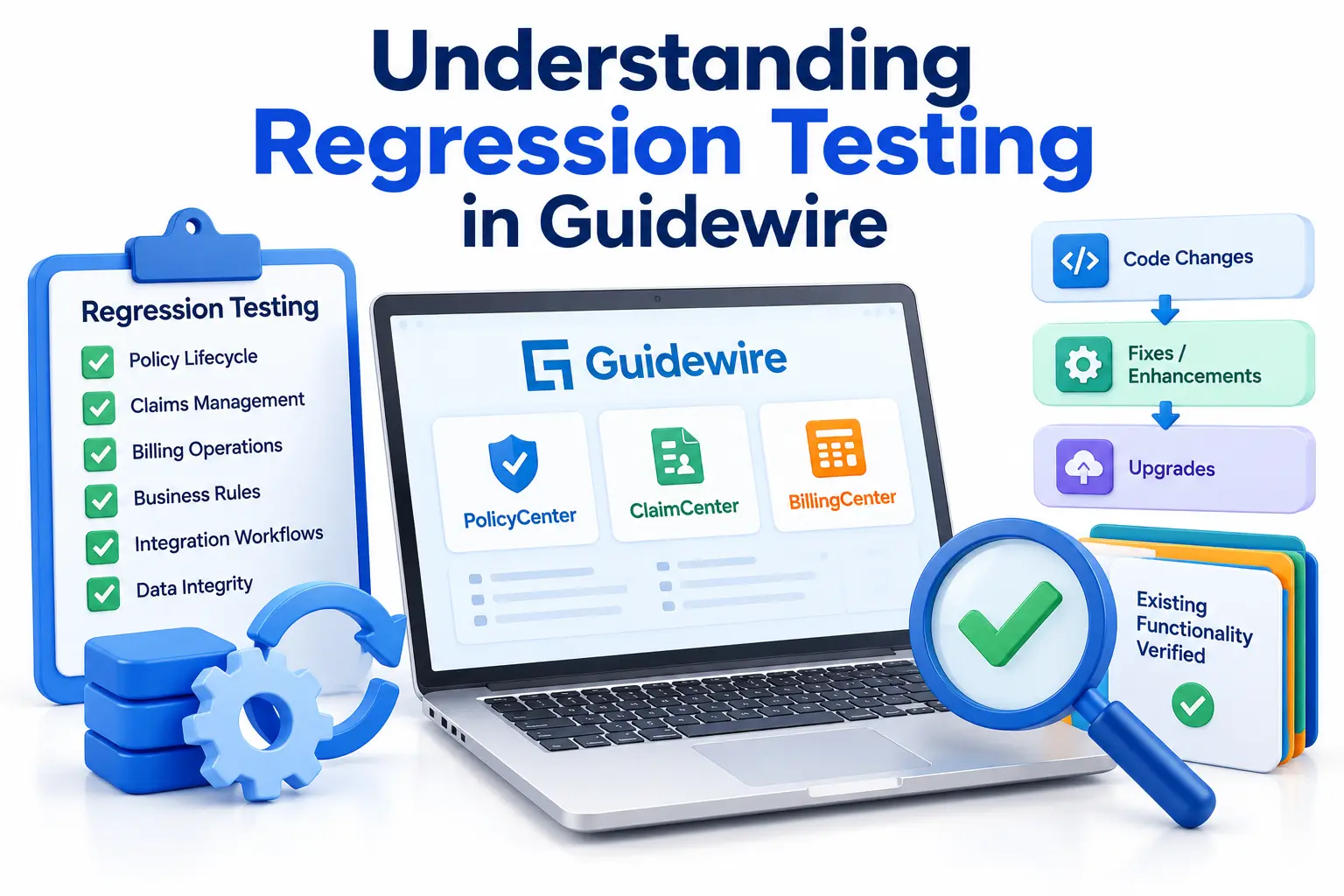
Regression testing verifies that existing functionality continues to work after code changes, defect fixes, configuration updates, enhancements, or platform upgrades. Unlike smoke testing, it examines a broader set of scenarios to identify unintended consequences introduced by recent changes.
Guidewire applications contain interconnected insurance processes. A modification to a rating rule in PolicyCenter, for example, may affect premium calculations, policy issuance, downstream billing information, or integration messages. Regression testing helps identify these problems before they reach production.
A well-designed regression suite may include:
Policy lifecycle: Validate submissions, quotations, underwriting decisions, policy issuance, renewals, and cancellations where applicable.
Claims management: Test claim creation, assignment, coverage verification, reserves, payments, and claim closure.
Billing operations: Verify invoice generation, payment allocation, outstanding balances, and billing adjustments.
Business rules: Confirm that eligibility conditions, rating logic, validation rules, and transaction restrictions remain correct.
Integration workflows: Check data exchanges between Guidewire applications and external services.
Data integrity: Ensure that important records, relationships, and transaction outcomes remain consistent.
Regression testing can be targeted or comprehensive. Targeted regression focuses on functionality affected by a specific change, while full regression covers a wider collection of established business scenarios. The appropriate approach depends on risk, release scope, available execution time, and required coverage.
Key Differences Between Smoke Testing and Regression Testing
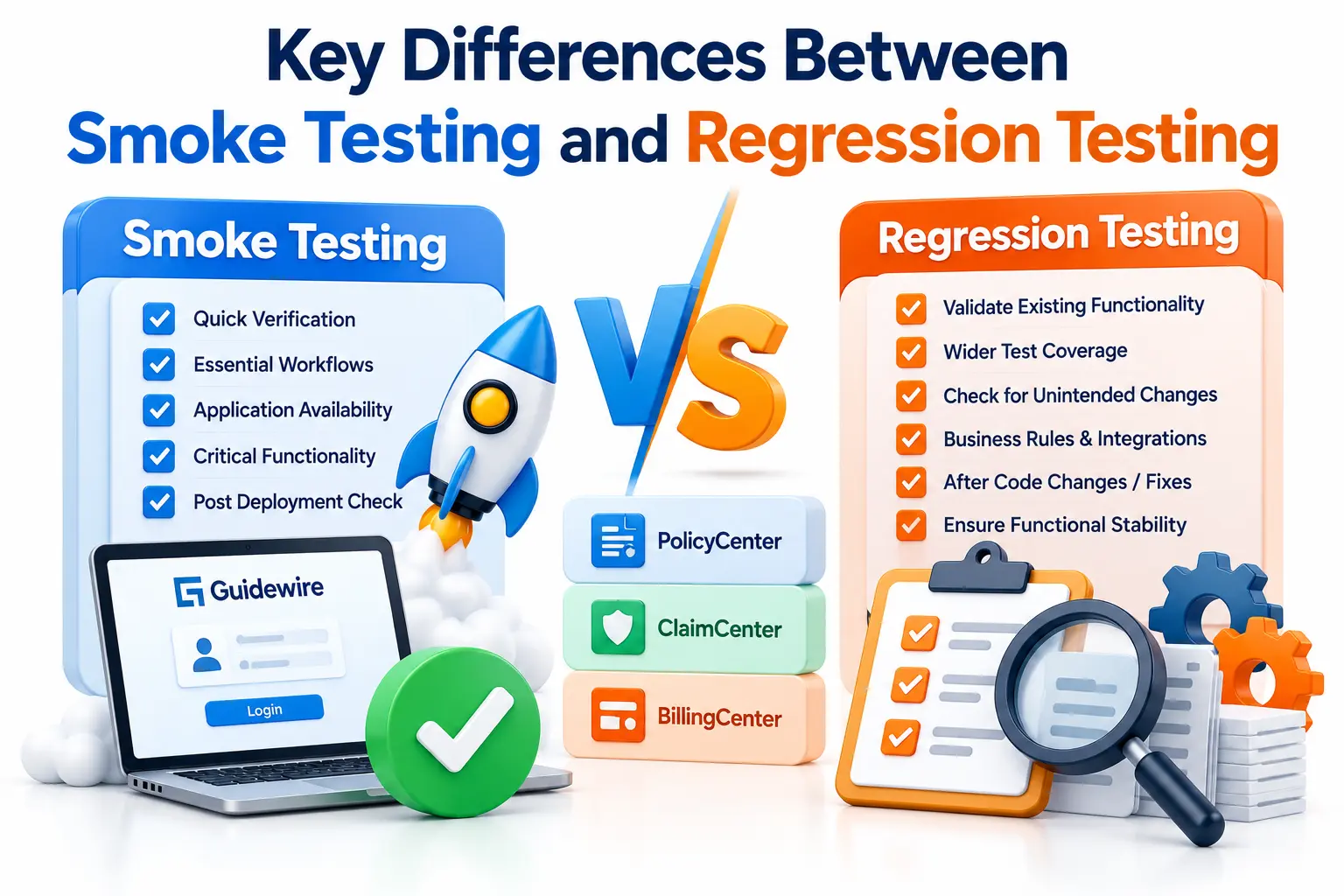
The fundamental difference is the purpose of each test. Smoke testing checks whether the application is sufficiently stable to proceed with further testing. Regression testing determines whether existing functionality remains correct after a change.
Their execution strategies also differ. Smoke testing usually involves a relatively small set of critical scenarios, making it suitable for rapid feedback after deployment. Regression testing involves more extensive coverage and may require detailed test data, multiple transaction paths, integration validation, and automated execution.
The following distinctions help QA teams select the appropriate approach:
Objective: Smoke testing identifies major application failures; regression testing detects unintended changes in existing functionality.
Scope: Smoke testing covers essential workflows; regression testing covers selected or extensive business scenarios.
Execution time: Smoke testing is generally shorter; regression testing can take considerably longer.
Test coverage: Smoke testing prioritizes application readiness; regression testing prioritizes functional stability and change impact.
Execution frequency: Smoke testing is useful after deployments and new builds; regression testing is valuable after code changes, fixes, enhancements, and upgrades.
Defect detection: Smoke testing catches critical availability and workflow problems; regression testing identifies functional defects, calculation errors, and broken dependencies.
Release decisions: Smoke testing helps determine whether detailed testing should proceed; regression results contribute to release-readiness decisions.
Neither approach replaces the other. A smoke test can pass even when a complex premium calculation is incorrect. Similarly, a regression suite cannot provide reliable evidence if the application is unavailable or its test environment is fundamentally broken.
When to Perform Each Test in a Guidewire Project
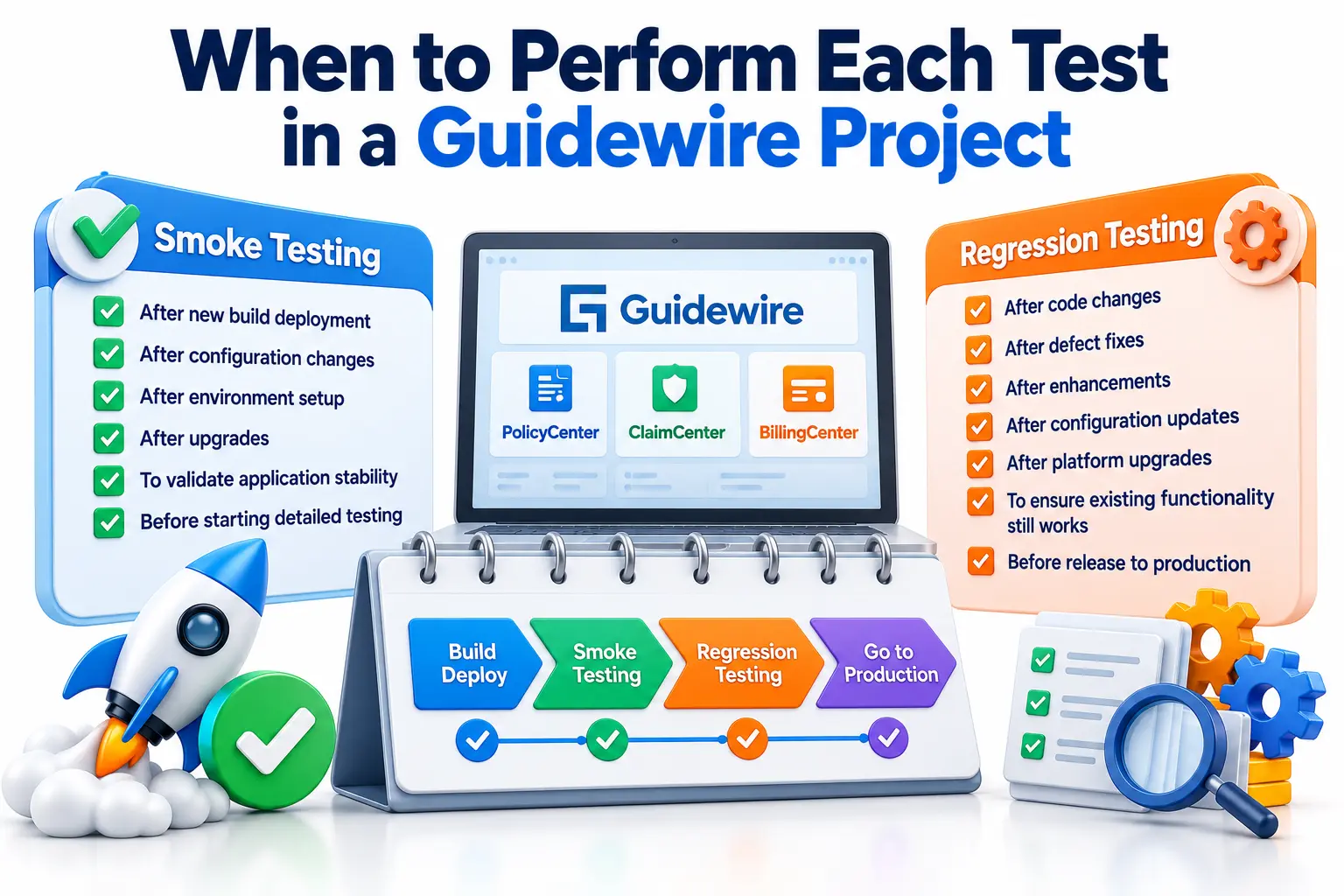
The best testing strategy places smoke testing and regression testing at appropriate points throughout the release lifecycle. Their sequence helps teams identify critical problems early and use testing resources efficiently.
After deploying a new build to a QA environment, testers should first confirm that the application is accessible and its essential workflows function correctly. If these checks fail, the team should investigate deployment issues, configuration problems, unavailable dependencies, or application errors before proceeding.
Once the application passes smoke testing, regression testing can begin. The suite should reflect the changes introduced by the release and the business risks associated with those changes.
For example, consider a PolicyCenter enhancement that modifies underwriting eligibility rules. Initial smoke tests may confirm that users can access the application and open a policy submission. Regression tests should then verify eligibility decisions, referral conditions, quotation outcomes, policy issuance, and relevant downstream processes.
A practical execution sequence includes:
Review deployment notes, defect fixes, and configuration changes.
Identify affected applications, integrations, and insurance workflows.
Execute critical smoke scenarios and investigate failures.
Select regression scenarios through impact and risk analysis.
Validate functional outcomes, integration behavior, and important data changes.
Record results, document defects, and communicate release risks.
Professionals developing these skills through Guidewire Testing Training can benefit from practicing this sequence with realistic insurance transactions, test data, and defect scenarios rather than relying exclusively on theoretical definitions.
Best Practices for Guidewire Smoke and Regression Automation
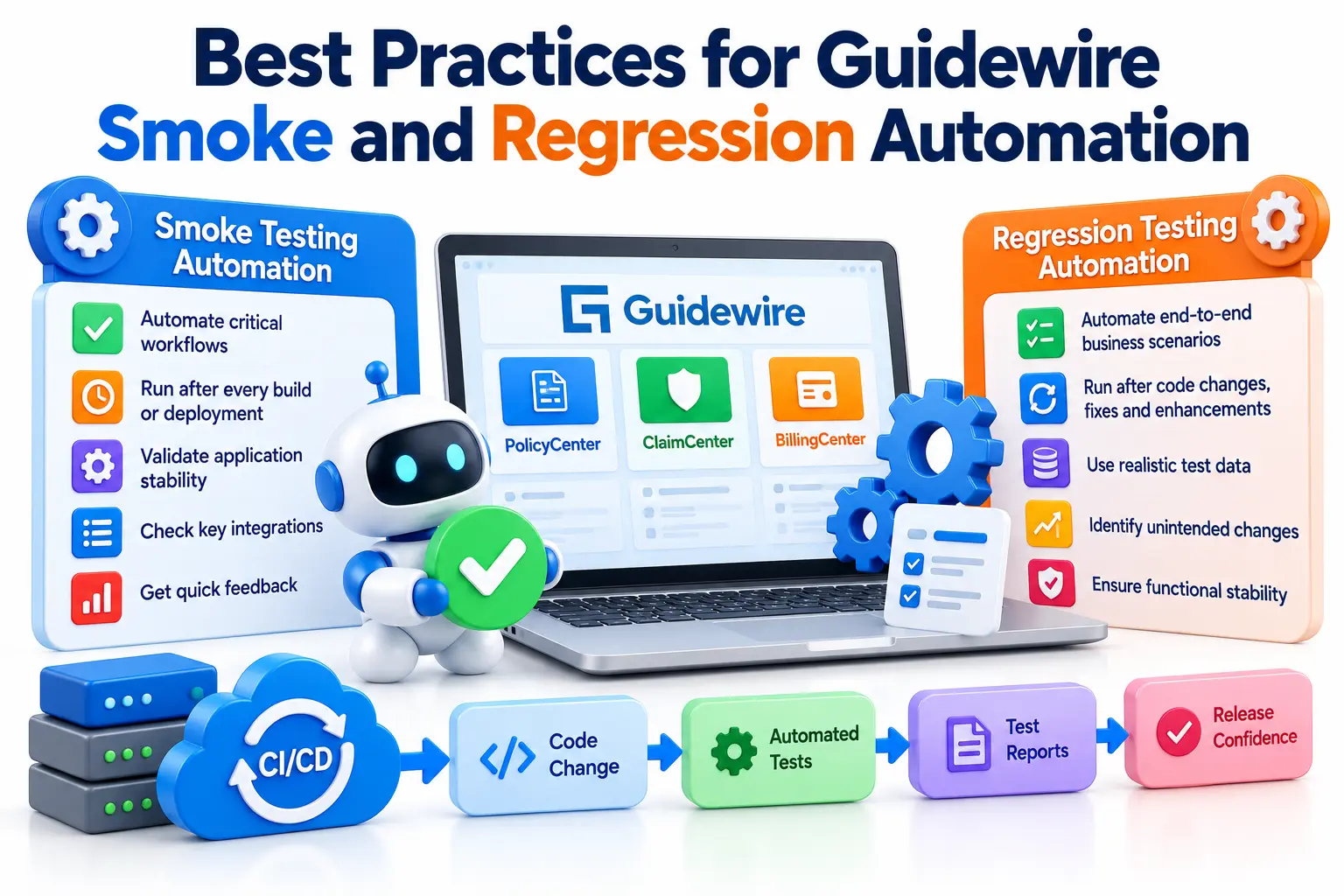
Automation can make testing faster, more consistent, and repeatable, especially when Guidewire applications undergo frequent deployments. However, successful automation depends on selecting meaningful scenarios, maintaining reliable test data, and ensuring that failures produce useful diagnostic information.
Smoke automation should prioritize critical workflows with clear pass-or-fail conditions. A compact suite is generally easier to maintain and execute quickly. Regression automation should focus on repeatable, high-value scenarios, particularly those involving complex business rules or functionality frequently affected by changes.
Guidewire's testing capabilities vary by product version, deployment model, and project configuration. Official Guidewire Cloud documentation describes supported testing frameworks and execution through configured CI/CD tooling. Teams should verify the capabilities available in their own environment rather than assuming every test framework or execution option is universally supported.
Consider these implementation practices:
Prioritize business risk: Automate scenarios that protect critical policy, claims, and billing operations.
Maintain test data: Use controlled, repeatable data that reflects the conditions required by each test.
Separate test failures from environment failures: Investigate authentication, connectivity, configuration, and dependency problems before classifying an unsuccessful run as an application defect.
Integrate testing into delivery workflows: Run appropriate smoke checks after deployment and schedule or trigger regression suites according to release risk.
Review automation regularly: Update scripts when application interfaces, workflows, configuration, or expected business outcomes change.
Preserve execution evidence: Capture relevant logs, error messages, test results, and reproducible steps for faster troubleshooting.
JastTech can emphasize these practical testing principles when helping aspiring Guidewire professionals understand how quality assurance supports reliable insurance software delivery. Learners exploring Guidewire Training in Chennai or Guidewire Training in Hyderabad should look for opportunities to practice deployment validation, test case design, defect reporting, and regression planning in realistic project scenarios.
Common Mistakes That Reduce Guidewire Testing Effectiveness
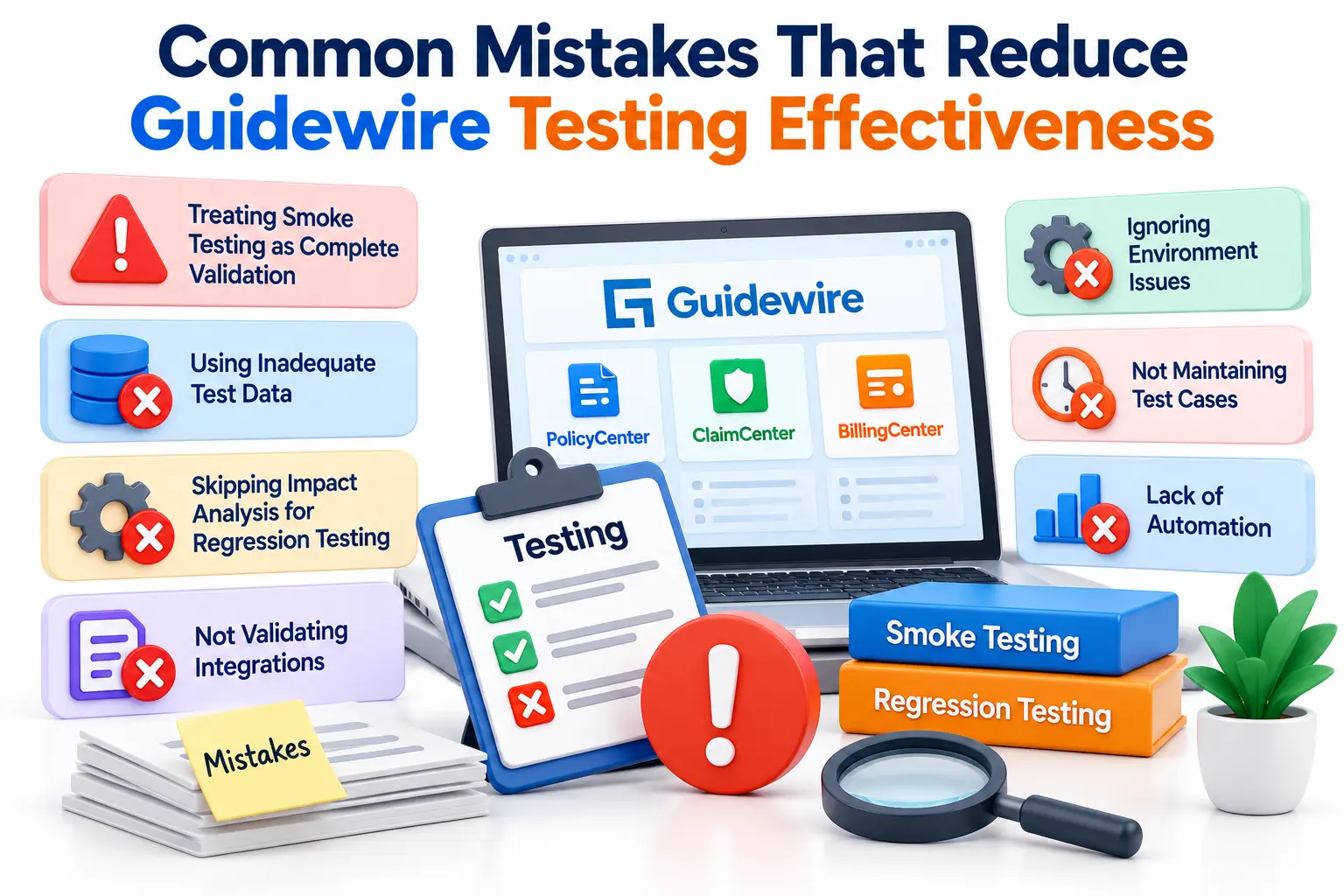
One frequent mistake is treating a successful smoke test as proof that the entire application is ready for production. Smoke tests cover only a limited set of critical functions. They cannot establish that every rating rule, billing calculation, claim transition, or integration behaves correctly.
Another mistake is running the same regression suite after every change without considering the actual impact. Although comprehensive testing is valuable for high-risk releases, indiscriminate execution can waste time and delay feedback. Risk-based test selection helps teams concentrate on affected workflows while preserving adequate coverage of critical business functions.
Test data and environment stability also deserve attention. A test may fail because an account is missing, a dependent service is unavailable, or an environment has incorrect configuration. Without investigating these possibilities, teams may incorrectly attribute environmental failures to application defects.
To improve testing effectiveness, teams should establish clear entry and exit criteria. Smoke testing should define which critical scenarios must pass before detailed testing proceeds. Regression testing should identify required coverage, acceptable results, unresolved defects, and the evidence needed for release approval.
Finally, teams should avoid measuring quality solely by the number of executed test cases. Meaningful coverage, reliable assertions, risk prioritization, defect detection, and reproducible results provide a stronger basis for assessing application readiness.
Conclusion
Smoke testing and regression testing serve complementary purposes in Guidewire projects. Smoke testing quickly establishes whether essential application functions are working, while regression testing checks whether changes have affected established business processes. Using both approaches in the correct sequence helps QA teams identify deployment problems early, investigate functional defects, and reduce avoidable production risks.
For effective results, Guidewire teams should combine risk-based test planning, dependable test data, appropriate automation, and clear release criteria. JastTech can use these principles to help learners understand practical testing responsibilities across PolicyCenter, ClaimCenter, and BillingCenter. Developing these skills prepares aspiring testers to contribute more confidently to insurance application quality, deployment validation, and reliable software delivery.