

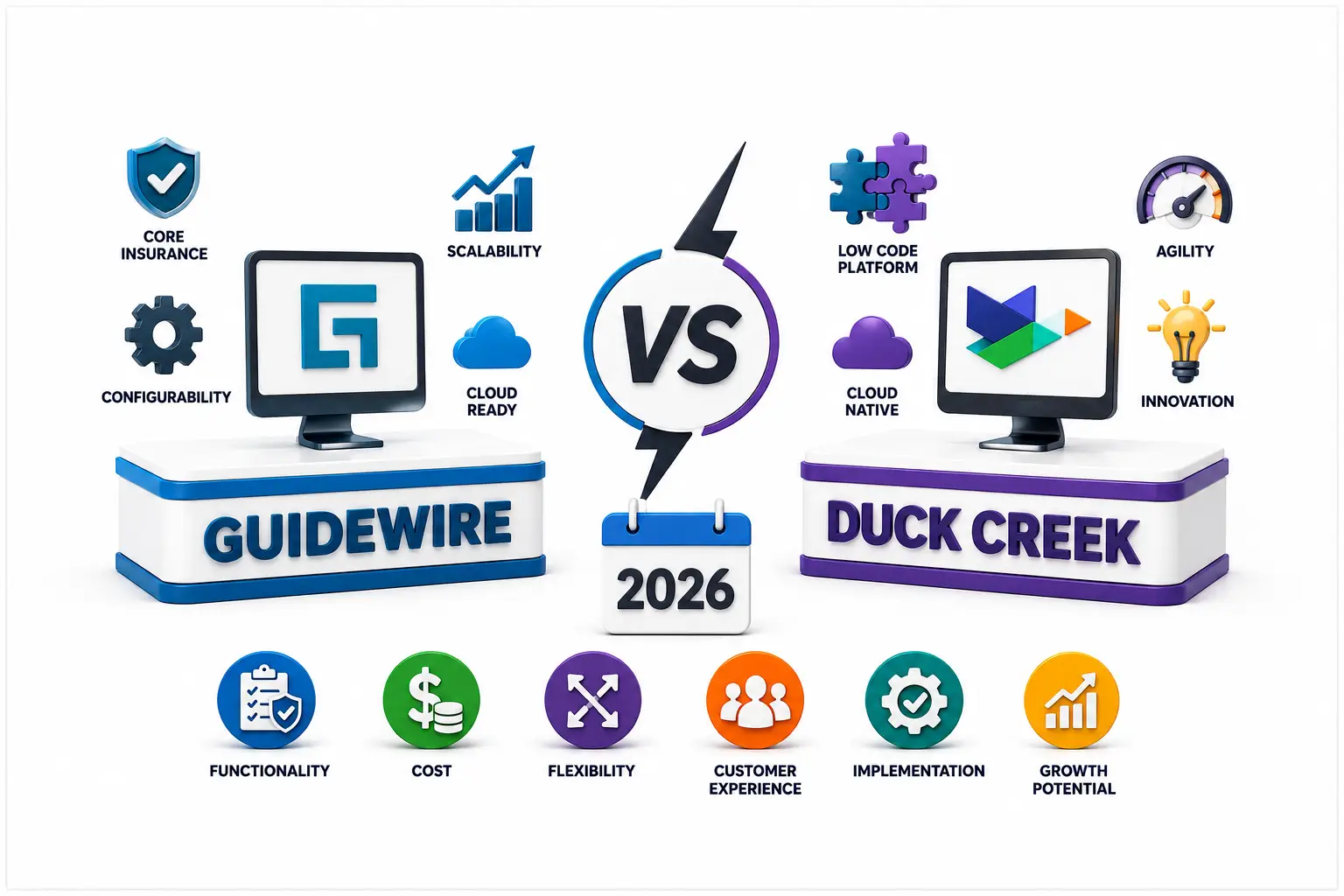
Guidewire vs Duck Creek: Which Insurance Platform Is Better in 2026
Navigate through this article using the table of contents below
Table of Contents
No headings found in this article.
Ask ten insurance IT leaders which core system they'd stake their next renewal cycle on, and you'll get ten different answers — plus at least three heated opinions.
That's the reality of the Guidewire vs Duck Creek debate heading into 2026. Both platforms power some of the world's biggest insurers, yet they solve the same problems in strikingly different ways. If you're an insurer weighing a switch, or a professional plotting your next career move, the choice matters more than most people realize.
Why Does This Rivalry Still Matter in 2026?

Core insurance platforms don't get replaced on a whim. Migrating from one system to another can take years and cost millions, so insurers tend to pick a side and stay loyal for a decade or more. That's exactly why the Guidewire vs Duck Creek comparison keeps resurfacing every planning cycle.
Guidewire built its reputation on deep configurability for large, complex carriers handling multiple lines of business. Duck Creek carved out its niche with a lighter, cloud-native footprint that smaller and mid-sized insurers found easier to adopt. Neither approach is objectively "wrong" — they simply serve different priorities.
In 2026, the conversation has shifted. Cloud adoption is no longer optional, and both vendors have rebuilt significant portions of their stacks around SaaS delivery. What used to be a clear architectural gap has narrowed, forcing buyers to look past marketing slides and dig into actual implementation experience, total cost of ownership, and how each platform behaves under real policy and claims volume.
Guidewire vs Duck Creek Architecture: What's Really Under the Hood?
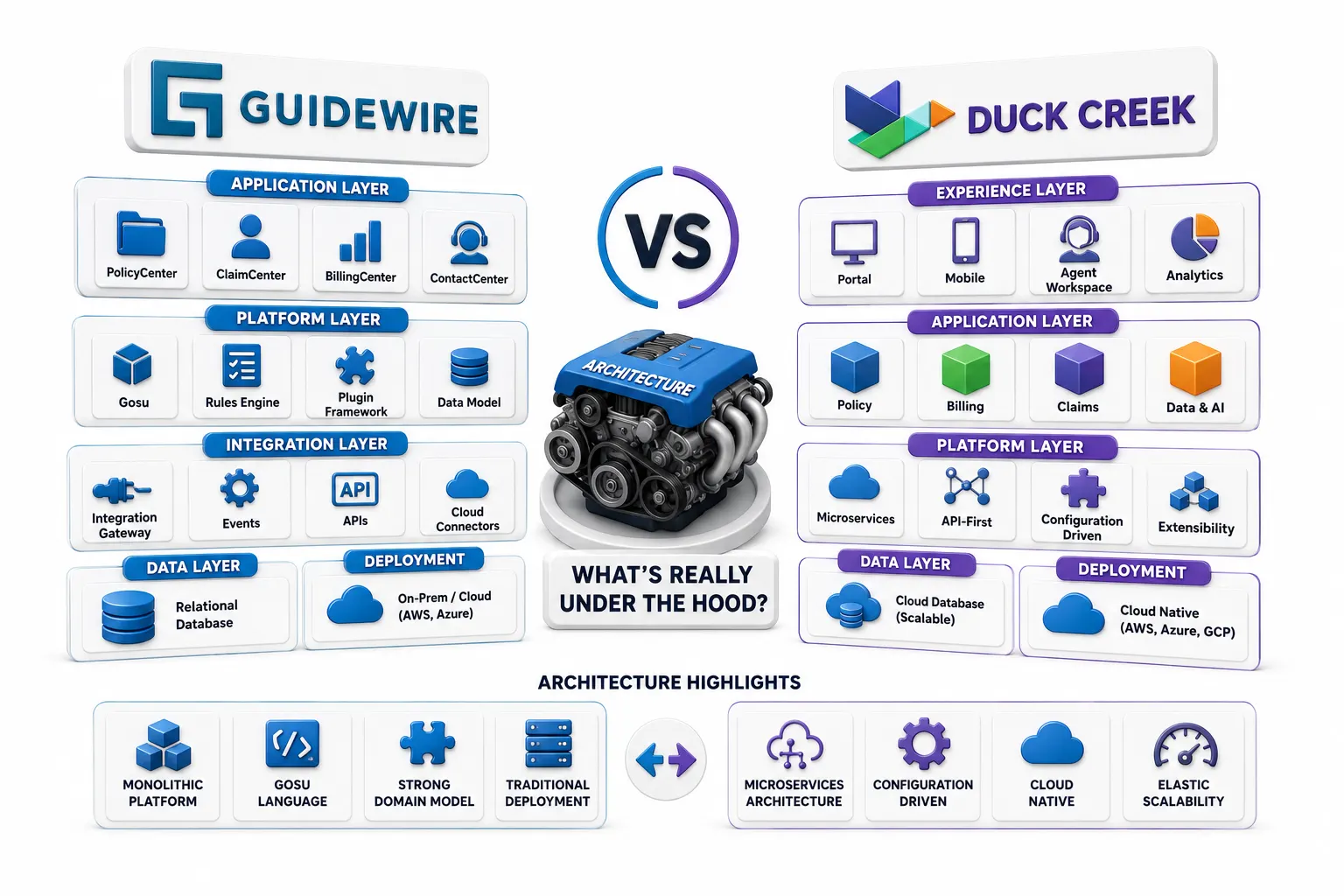
Architecture is where these platforms diverge most sharply, and it's the detail that shapes almost everything else — cost, flexibility, and hiring needs.
Guidewire's InsuranceSuite is built on a highly configurable, Java-based framework spanning PolicyCenter, ClaimCenter, and BillingCenter. It offers granular customization, which large carriers love, but that same flexibility demands specialized developers who understand Guidewire's proprietary configuration language, Gosu.
Duck Creek OnDemand, by contrast, leans into a more standardized, low-code approach. Its architecture separates business rules from core code more cleanly, which typically shortens implementation timelines. Many mid-market insurers find this appealing because it reduces the need for a large in-house development bench.
Here's a quick breakdown of the practical differences:
Guidewire: Deep customization, steeper learning curve, stronger fit for complex, multi-line carriers.
Duck Creek: Faster deployment, more standardized configuration, better fit for lean IT teams.
Neither architecture is inherently superior. The right answer depends on how much customization your business genuinely needs versus how much speed and simplicity you're willing to trade for it.
Implementation Speed: Which Platform Gets You Live Faster?
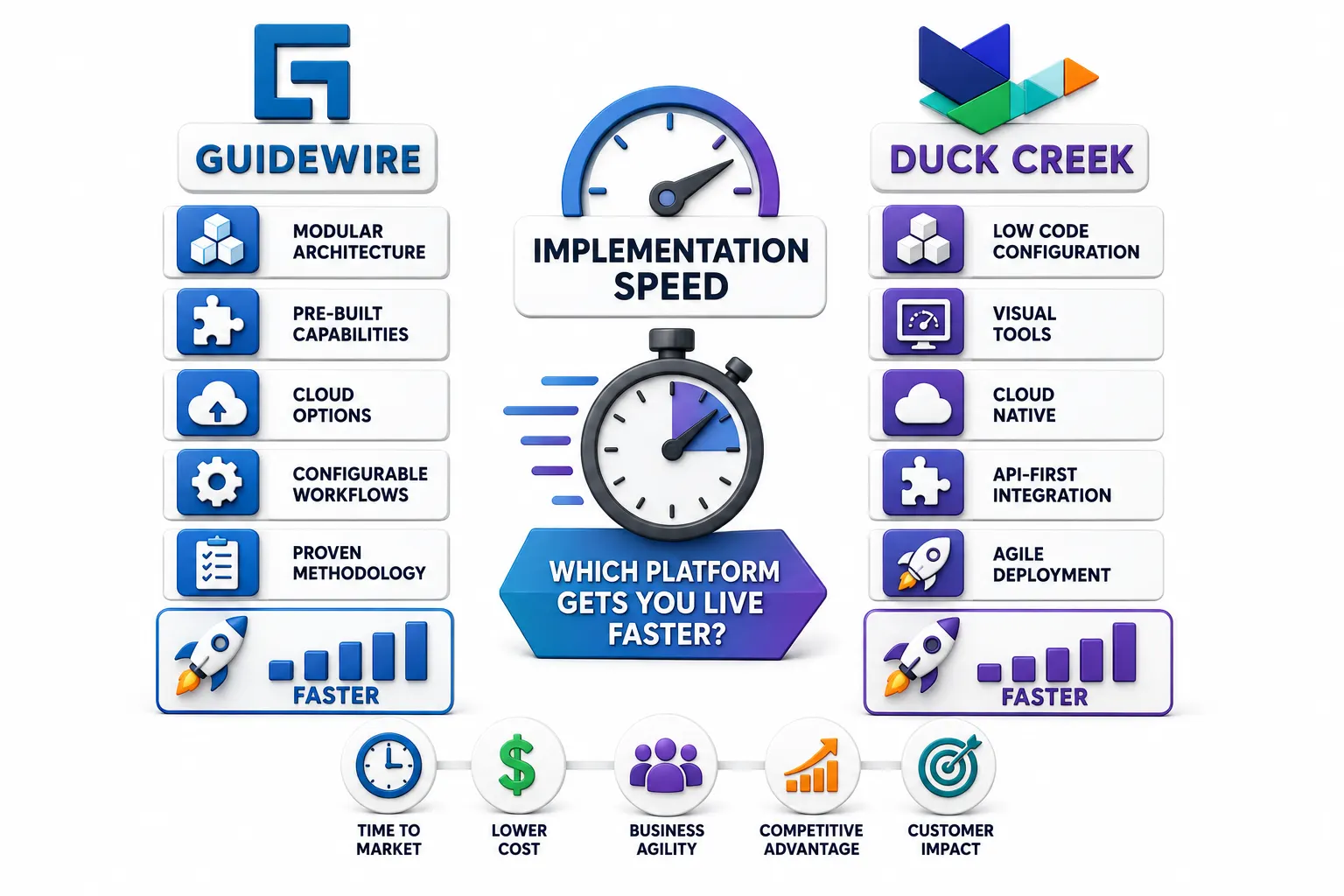
Time-to-market is often the deciding factor for insurers under pressure to modernize quickly, and this is where the two platforms tell very different stories.
Duck Creek generally wins on raw implementation speed. Its low-code configuration tools let business analysts, not just developers, adjust rules and workflows. A mid-sized insurer rolling out a new commercial line can often see a working prototype in weeks rather than months.
Guidewire implementations tend to run longer, particularly for large carriers layering in complex underwriting rules, legacy data migration, and multiple product lines. But that extra time often buys deeper long-term flexibility. Once configured, a Guidewire system can typically absorb future product changes without the rework that lighter platforms sometimes require.
There's a practical example worth noting: insurers running highly specialized commercial lines — think marine cargo or excess casualty — frequently gravitate toward Guidewire precisely because the upfront investment pays off when underwriting rules get genuinely complicated. Personal lines carriers with more standardized products often lean toward Duck Creek instead.
The honest takeaway is this: speed and depth pull in opposite directions, and no platform gives you both for free.
Guidewire vs Duck Creek Career: Which Path Pays Better in 2026?
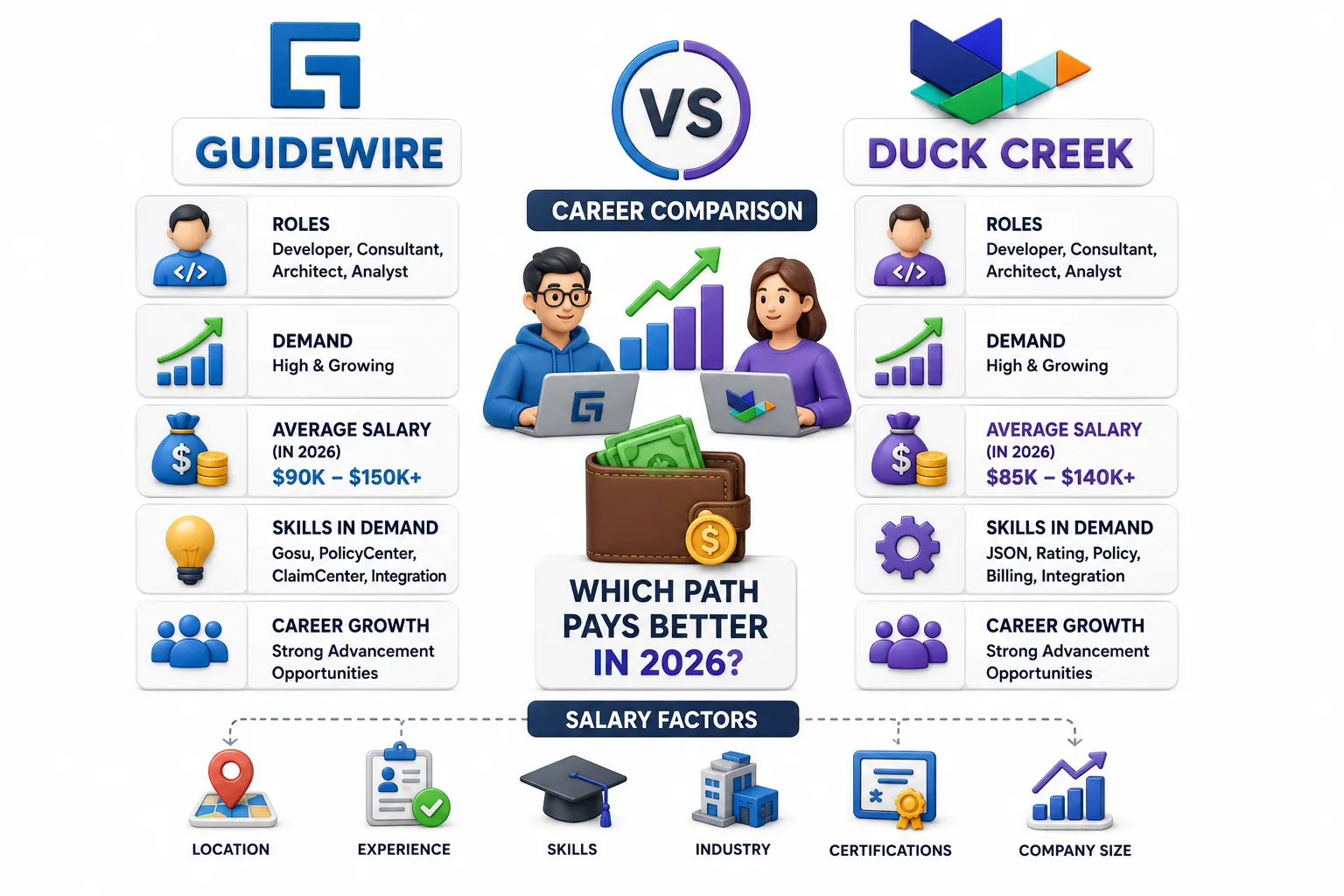
For professionals, the Guidewire vs Duck Creek career decision isn't just about salary — it's about where the job market is actually heading.
Guidewire currently holds a larger installed base among Tier 1 and Tier 2 carriers, which translates into more open roles, particularly for configuration developers, integration specialists, and business analysts fluent in PolicyCenter or ClaimCenter. Because Guidewire skills are more specialized, experienced professionals often command a premium, especially in markets like the US, UK, and India.
Duck Creek roles are growing steadily too, particularly as more mid-market insurers modernize. The lower technical barrier means it can be an easier entry point for professionals transitioning from general software or business analysis backgrounds.
A practical way to think about it: if you want depth and are comfortable with a longer learning curve, Guidewire offers a more defensible long-term specialization. If you want breadth and faster entry into insurtech, Duck Creek's more accessible tooling can get you contributing sooner.
Recruiters in this space consistently report that hybrid professionals — those comfortable with both platforms plus cloud fundamentals — are the ones landing the strongest offers in 2026.
Guidewire vs Duck Creek Training: What Should You Actually Learn First?
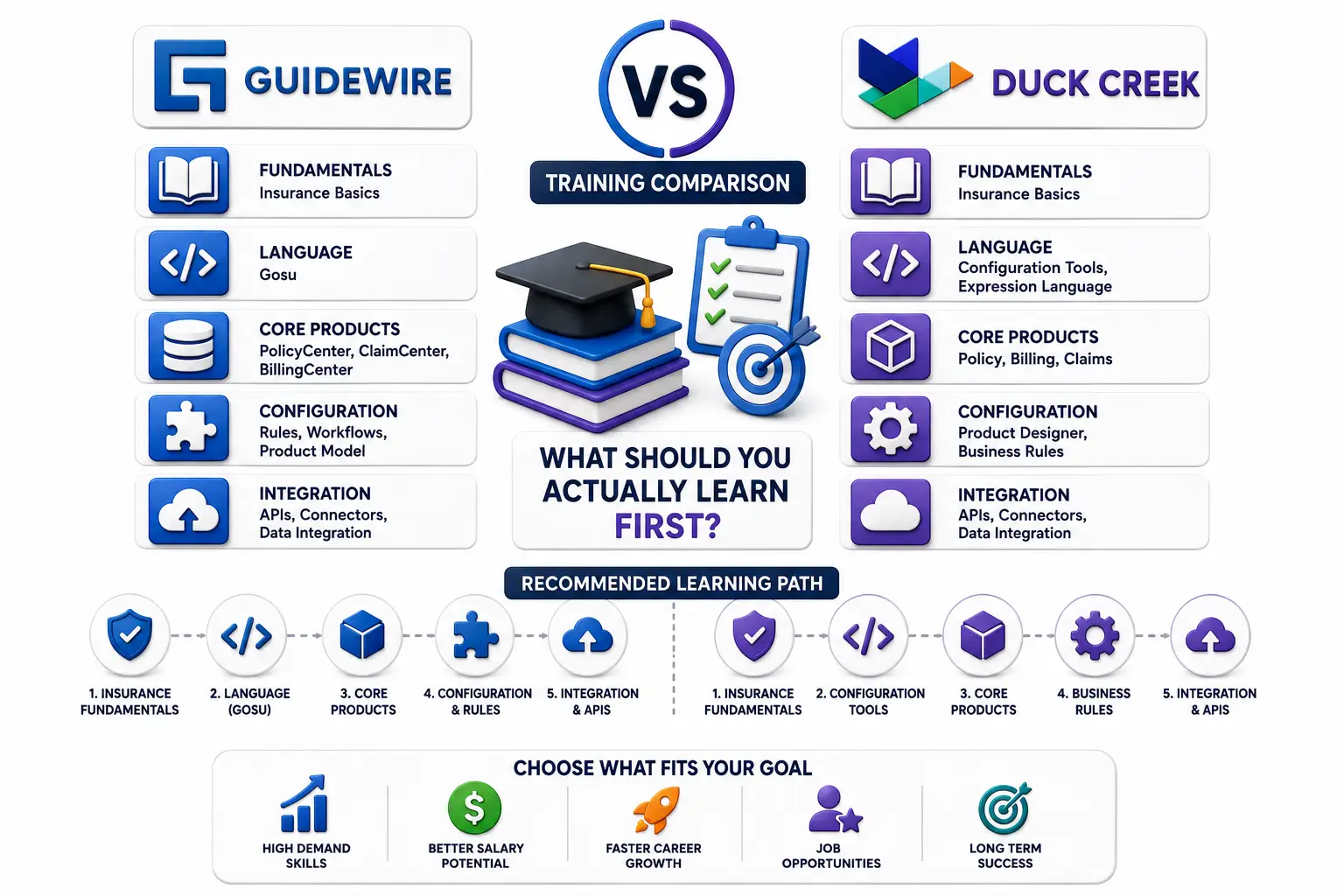
Choosing where to invest your learning hours matters just as much as choosing a platform to specialize in, and Guidewire vs Duck Creek training paths look quite different once you get past the surface.
Guidewire offers structured certification tracks through Guidewire University, covering configuration, integration, and cloud administration. These certifications carry real weight with employers because Guidewire vets them rigorously, and the Gosu programming language requires dedicated study time that most self-taught developers underestimate.
Duck Creek's training resources are comparatively lighter, reflecting the platform's low-code philosophy. Its Duck Creek Campus program focuses on practical configuration skills that can often be picked up through hands-on project work rather than lengthy classroom-style certification.
A useful approach for beginners: start with the fundamentals of insurance domain knowledge — policy lifecycles, claims workflows, and billing logic — before touching either platform's tooling. That foundation transfers regardless of which system you eventually specialize in, and it makes vendor-specific training dramatically easier to absorb.
Whichever path you choose, expect ongoing learning. Both vendors push quarterly updates, and staying current isn't optional if you want to remain competitive in this space.
Making the Call: Which One Actually Wins in 2026?

There's no universal winner here, and anyone claiming otherwise probably hasn't implemented either system at scale.
Guidewire tends to win when insurers need deep customization, operate across multiple complex lines, and have the budget and patience for a longer rollout. Duck Creek tends to win when speed, simplicity, and lower technical overhead matter more than granular configurability.
For carriers, the smartest move is mapping the decision to actual business complexity rather than industry hype. For professionals, building working knowledge of both platforms — even if you specialize in one — creates career insurance that neither vendor can offer on its own.
Conclusion
The Guidewire vs Duck Creek decision ultimately comes down to trade-offs between depth and speed. Guidewire rewards patience and complexity; Duck Creek rewards agility and simplicity. Know your priorities first, and the right platform reveals itself.