

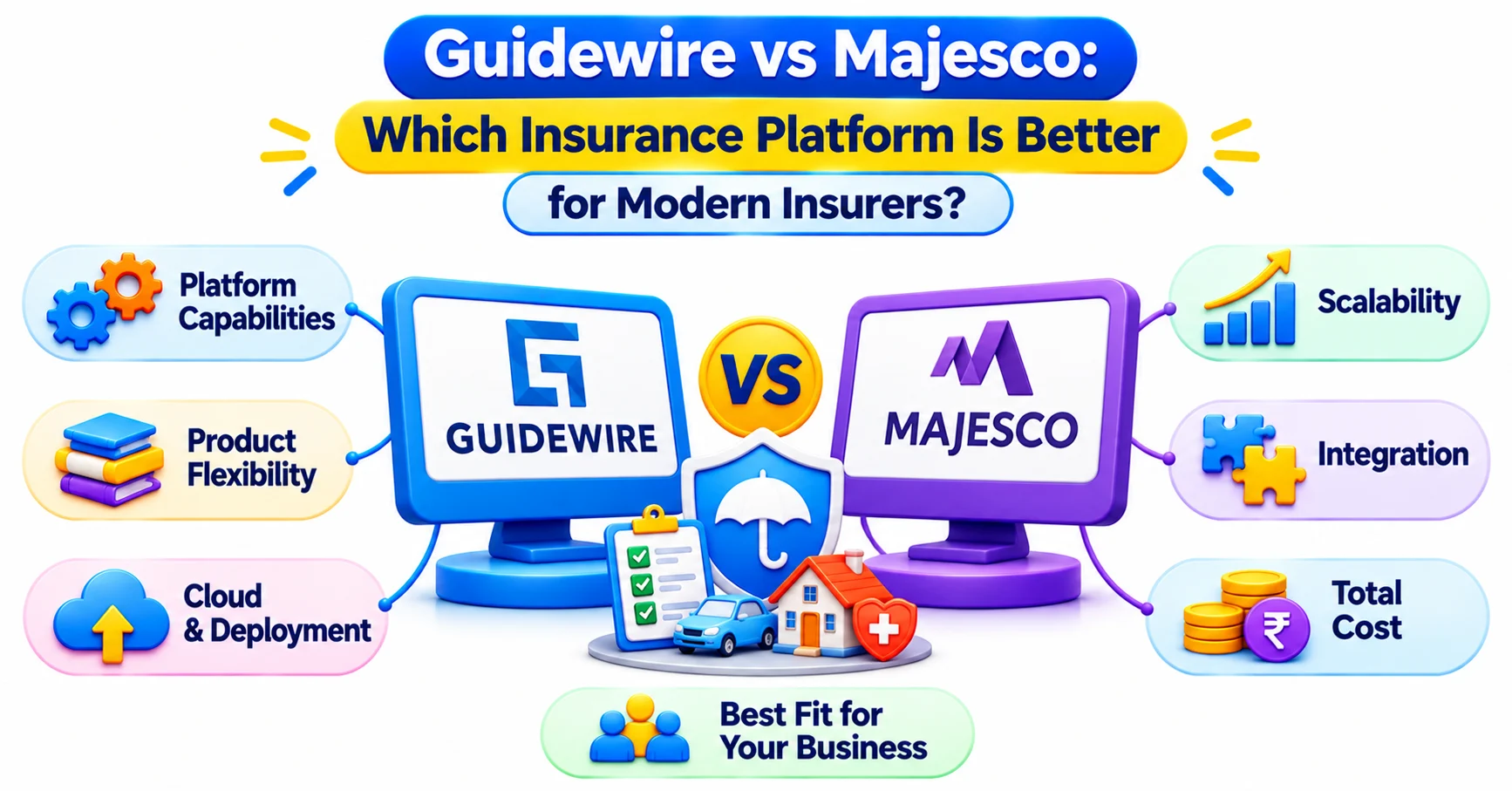
Guidewire vs Majesco: Which Insurance Platform Is Better for Modern Insurers?
Navigate through this article using the table of contents below
Table of Contents
No headings found in this article.
Most insurers never really choose a core system. They live with the choice for a decade or more, which is why the Guidewire vs Majesco question gets so much scrutiny once an aging policy platform starts blocking every new product launch. Technology teams exploring Guidewire training in Hyderabad usually hear this debate within the first week.
The honest answer has little to do with which vendor is bigger. It depends on your lines of business, how much you plan to customize, and who will run the platform after go-live.
Guidewire vs Majesco: How the Two Platforms Differ at the Core
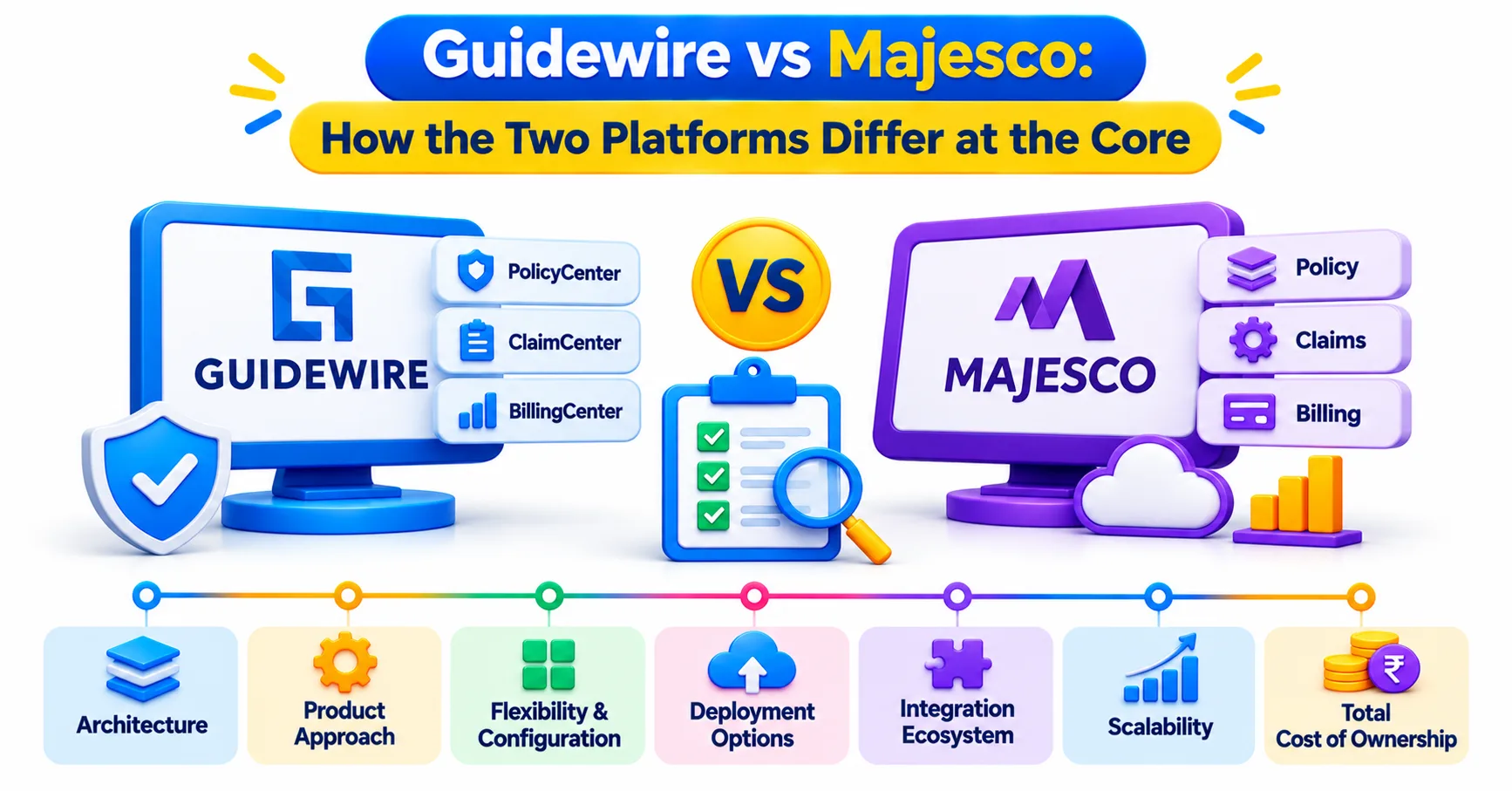
The short version: Guidewire is a property and casualty specialist with a deep, code-extensible core, while Majesco is a broader platform that covers P&C as well as life, annuity and, more recently, pension and retirement administration.
Guidewire’s flagship is InsuranceSuite, which combines PolicyCenter for underwriting and policy administration, BillingCenter for billing, and ClaimCenter for claims. Carriers that want a lighter footprint look at InsuranceNow, aimed at mid-sized insurers. Around the core sit a digital layer called Jutro, data and analytics products, and an integration framework, increasingly delivered through Guidewire Cloud Platform. Developers extend the system with Gosu, a language Guidewire built for this purpose.
Majesco has been owned by the private equity firm Thoma Bravo since 2020. It packages policy, billing, claims, digital and data capabilities as cloud-based, API-first products. Its P&C and life and annuity suites sit side by side, and its acquisition of Vitech, which closed in January 2026, extends the portfolio into pension and retirement administration.
A common misunderstanding is that the two are interchangeable because both handle policy, billing and claims. They share a category, not a history. Guidewire grew up serving large carriers with complicated personal and commercial P&C lines. Majesco grew by offering carriers one vendor across several types of insurance.
Deployment style is another difference worth noticing early. Both vendors now put cloud delivery at the center of their pitch, but the experience of getting there differs. Insurers with an existing on-premise Guidewire installation face a migration to Guidewire Cloud that has its own planning, testing and cost implications. Insurers moving off a legacy mainframe onto either vendor face a bigger leap altogether, because they are changing the operating model along with the software.
Vendors rename and repackage products often, so confirm current product names directly with each vendor before building a shortlist.
Which Lines of Business Does Each Platform Serve Best?
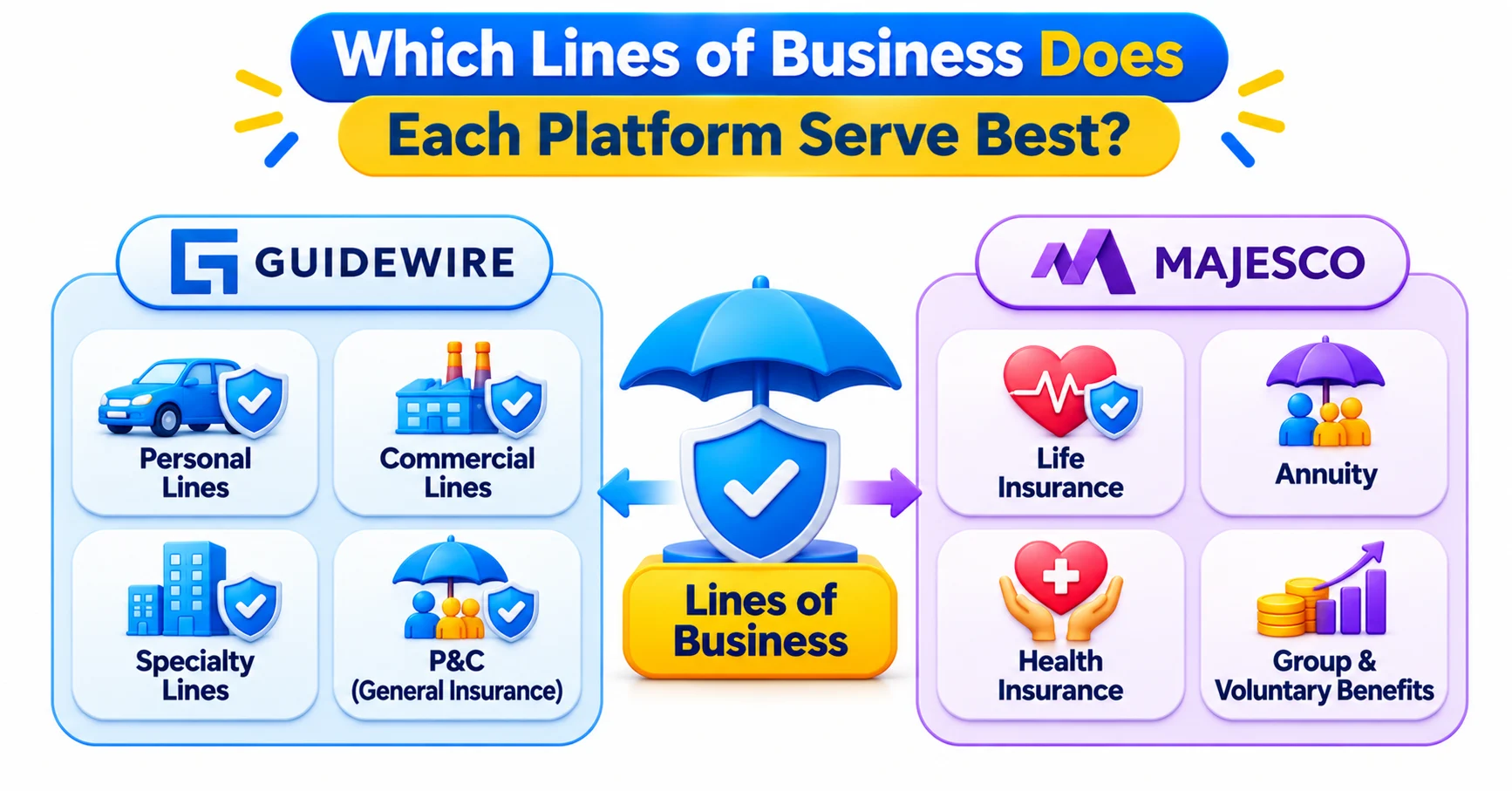
Start with your product mix, because it eliminates options faster than any feature comparison.
If your book is mostly P&C, with personal auto, homeowners, workers’ compensation or complex commercial lines, Guidewire is built for exactly that. Its data model handles things like multi-location commercial policies, endorsements, and effective-dated changes, where a policy looks different on March 1 than it did on January 1. Claims handling, including exposures, reserves and payments, is one of the reasons large P&C carriers shortlist it.
If your group sells life insurance, annuities or retirement products alongside P&C, Majesco deserves a serious look. Running two or three unrelated vendors for different product families creates duplicate integrations, separate customer views and inconsistent reporting. A vendor that spans both worlds can reduce that sprawl, although you should test whether the life and P&C products really share data and tooling or only share a brand.
Consider a hypothetical regional carrier writing homeowners and small commercial policies in six states. Its main pain is slow rate and form filing, so a P&C-focused platform with strong product configuration is the natural fit. Now imagine a mutual group with a life subsidiary and a P&C arm that wants one customer portal across both. The calculus shifts toward breadth.
Regulation adds another layer. Rate and form filings, state-specific rules, tax and surcharge calculations, and reporting requirements differ across jurisdictions, and a platform has to represent those differences without turning every state into a separate codebase. When you evaluate either vendor, ask to see how a single product is configured for two states with different rules. The answer tells you more about the platform’s product model than any slide about “agility”.
Distribution matters too. Carriers selling through independent agents, brokers, managing general agents and direct channels need quoting and binding to behave consistently across all of them. Ask each vendor how agent and customer portals connect to the core, and whether those pieces are part of the product or a separate project.
Mid-market carriers face a third question: whether a full enterprise suite is overkill. Both vendors offer options for smaller insurers, and an honest evaluation should compare those editions, not just the flagship products that dominate conference demos.
Architecture, Configuration and Customization: Where Projects Succeed or Stall
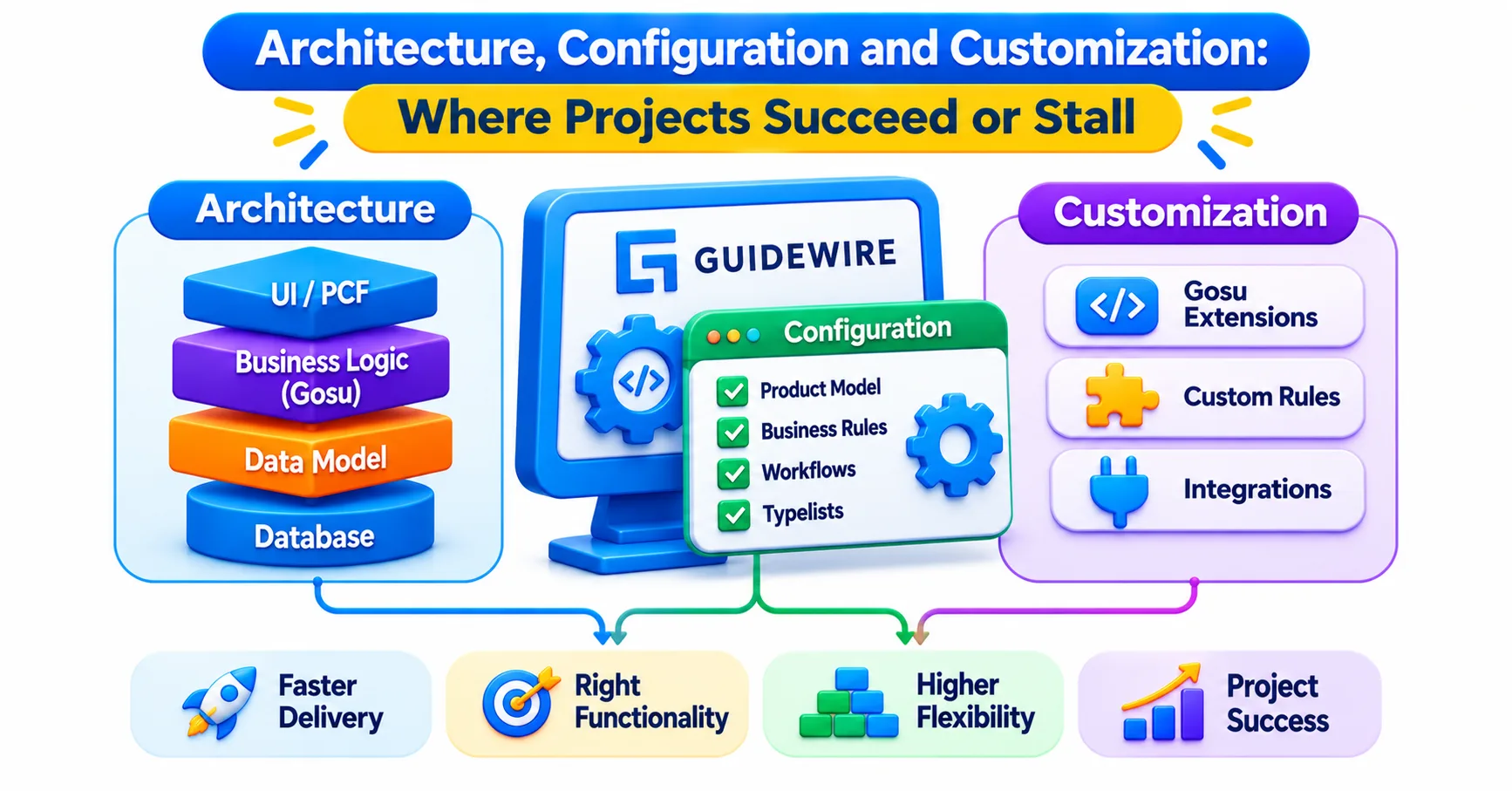
Every core platform promises configuration over customization. In practice, the boundary between the two decides whether your upgrade next year is a routine exercise or a six-month project.
Guidewire gives engineering teams a lot of room. Page configuration files define screens, typelists control the dropdown values used everywhere, entity extensions add fields to the data model, and Gosu handles business rules and integrations. That flexibility is why experienced developers like it, and also why undisciplined teams can bury themselves in custom code. Guidewire’s cloud delivery model pushes customers toward standard extension points and more frequent releases, so heavy customization carries a real cost.
Majesco’s pitch leans toward configuration, microservices and open APIs, with the platform delivered as a service. For insurers that would rather configure products and workflows than write code, that approach is attractive. The trade-off is that deeply unusual business requirements may need workarounds outside the product, and you should ask each vendor precisely where their extension boundaries sit.
Integration deserves its own scrutiny. Your core system will exchange data with rating engines, payment gateways, document generation tools, agent portals, data providers and regulatory reporting. Ask both vendors how a typical integration is built, how errors are retried, and how it survives a version upgrade. A solid grounding in Guidewire certification preparation shows how much of the platform’s behavior depends on understanding these extension and integration points.
Release management is the part buyers forget to ask about. Cloud platforms change on the vendor’s schedule more than yours, which means your regression suite, test data and integration contracts have to be ready for regular updates. An insurer with a mature automated testing practice will handle that rhythm comfortably. One that tests manually, a week before each go-live, will feel every release as a crisis, regardless of which vendor it picked.
A rule that holds for both: every customization you add today is a line item in every future upgrade. Teams that treat “the business wants it” as a complete justification usually regret it.
Implementation, Cost and Time to Value
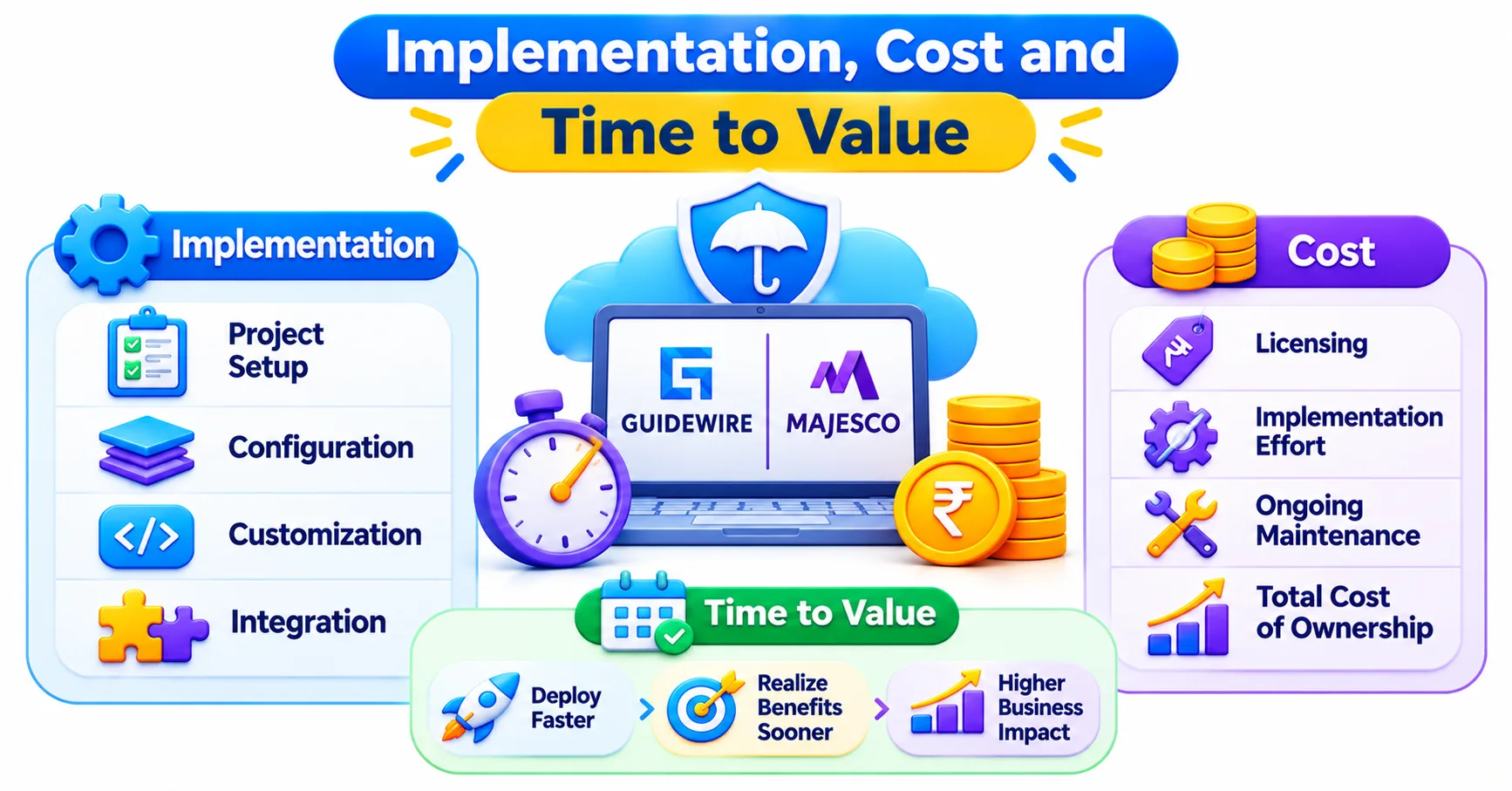
No honest article can quote a price for either platform, because neither vendor publishes one and real costs depend on scope. What can be said is what drives cost and delay.
Data migration is the quiet budget killer. Moving decades of policies, claims and billing history from a legacy mainframe system means cleaning inconsistent records, mapping old codes to new ones, and deciding what history truly needs to move. Many projects underestimate this work because the demo environment looks clean and the real data does not.
Product complexity is the second driver. Rolling out a simple personal lines product in one state is a very different job from migrating twelve commercial products across thirty jurisdictions. Phasing the rollout, by line, by state or by new business first and renewals later, usually lowers risk on either platform.
The third driver is people. Core transformations need business analysts who can turn underwriting rules into precise requirements, developers who understand the platform, testers who can handle regression across policy, billing and claims, and integration specialists. When projects fail, it is more often because of weak requirements and shifting scope than because the software could not do the job.
Testing deserves more attention than it usually gets in project plans. A policy change touches billing, a billing change touches claims payments, and an integration change can break all three. Insurers that invest early in automated regression and realistic test data find defects when they are cheap to fix. Those that rely on a short user acceptance phase at the end tend to discover problems in production, where every fix is also a customer complaint.
Time to value depends on what you replace first. Some insurers start with claims, where the benefits of faster handling are visible quickly. Others start with policy administration to launch new products. Choosing the sequence before choosing the vendor is a useful exercise, because it shows which platform’s strengths match your first twelve months and not your last.
Finally, look at the total cost over time, not the implementation quote. Hosting, release management, support, training and the ongoing cost of changes often exceed the initial build.
Talent, Skills and Career Considerations Around Each Platform
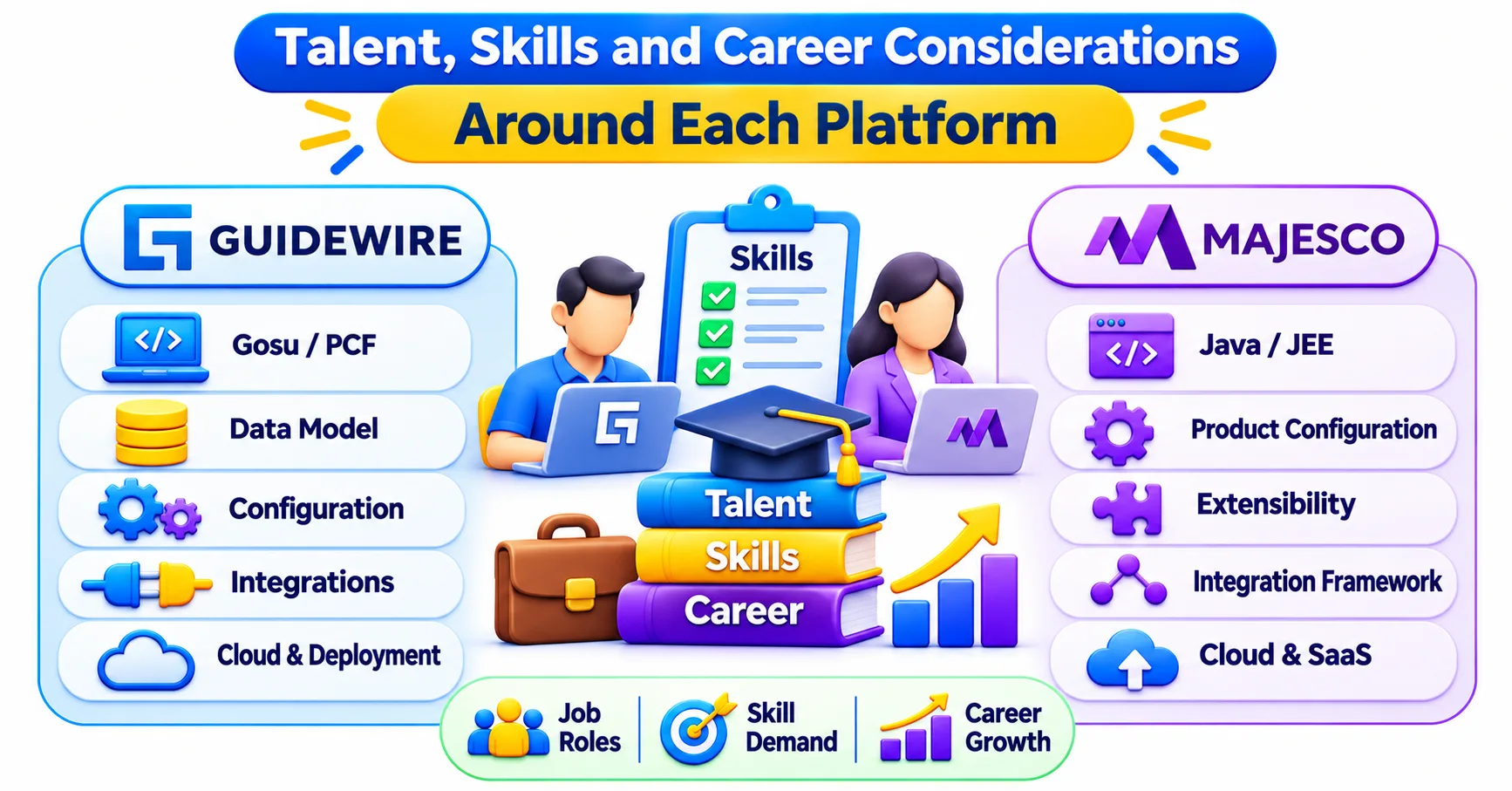
A platform is only as good as the team that can run it, and that makes the talent market a legitimate selection criterion, not an afterthought.
Guidewire has a large global ecosystem of implementation partners, certified professionals and training providers. For an insurer, that usually means hiring or contracting Guidewire developers, testers and analysts is a well-trodden path, although experienced people in popular roles are not cheap. For individuals, the range of roles is wide: Gosu developers, integration engineers, QA specialists, and business analysts who understand insurance workflows.
Training quality varies enormously, so it helps to look at how a program teaches. Good courses put learners through realistic scenarios such as issuing a policy, processing a mid-term change and settling a claim, rather than walking through menus. That hands-on habit is what hiring managers notice in interviews.
Majesco’s talent pool is more specialized. Skills there often come through the vendor, its partners, or consulting firms that focus on it. That is not a weakness in itself, but it affects how quickly you can staff a project or replace someone who leaves, so ask vendors plainly how many certified practitioners exist in your region.
For people building a career in insurance technology, the business analyst path is worth a mention because it is often misunderstood. You do not need to write code to contribute to a core implementation. You need to understand underwriting, claims and billing processes well enough to describe them clearly. A structured program such as the Guidewire business analyst training at JastTech covers that bridge between insurance operations and system configuration.
Interviews for these roles rarely stop at tool knowledge. A candidate asked about a mid-term cancellation, a premium audit or a subrogation recovery is expected to explain what happens to the policy, the money and the customer, then connect it to how the system records it. People who can do that move between projects and vendors more easily than those who memorized screens.
Whichever platform you pursue, the underlying knowledge transfers. Policy lifecycle, claims workflows, billing cycles, and regulatory reporting concepts are the same whether you work with Gosu or a configuration-driven toolset. Learning the insurance domain first makes any platform easier to pick up.
How to Decide: Questions Worth Asking Before You Sign
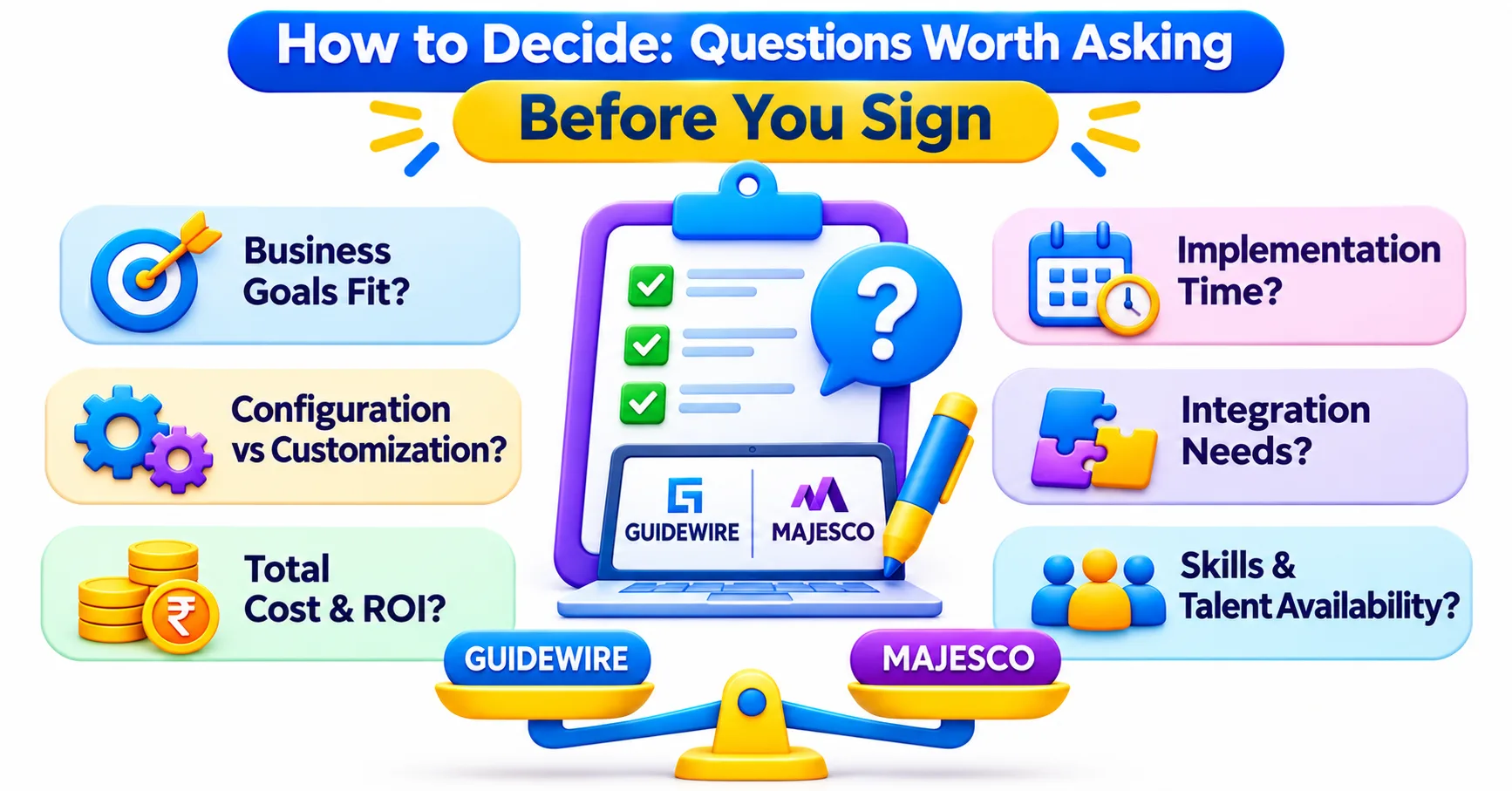
Run the decision as a structured evaluation, not a beauty contest. These questions tend to separate good fits from expensive mistakes:
Which lines of business must the platform support in year one, and which in year three?
Do we need one vendor across P&C and life, or deep P&C functionality?
How much of our competitive advantage lives in unusual products or rating logic?
Who will maintain the system after the implementation partner leaves?
How does each vendor handle upgrades, and what do reference customers say about them?
What does integration with our existing rating, payments and data tools look like in practice?
Ask both vendors to run your real scenarios, not their prepared scripts. Give them a messy mid-term policy change, a claim with multiple exposures, or a billing dispute from your own history, then watch how each platform handles it. Speak to reference customers of similar size and line mix, and ask what they would do differently.
Several mistakes show up repeatedly in core system selections. The first is buying for the demo, where a polished screen flow hides how much configuration sits behind it. The second is letting one department decide: claims, underwriting, finance and IT each see a different system, and a choice made by one of them tends to disappoint the others. The third is ignoring exit costs. Ask what moving data out of the platform would look like in ten years, because the answer reveals how open the data model really is.
Be skeptical of any analysis, including this one, that declares a universal winner. Analyst rankings and comparison sites can help frame a shortlist, but they cannot replace your own proof of concept.
As a rough guide: carriers focused on complex P&C operations with strong in-house or partner engineering capacity often lean toward Guidewire. Groups that span P&C and life, or that prefer a configuration-led, service-style model, often find Majesco worth a closer look. Treat that as a starting hypothesis to test, not a verdict.
Conclusion
Neither platform wins everywhere. The Guidewire vs Majesco decision comes down to product mix, appetite for customization, and the people available to run the system. Test both against your own scenarios, and the right choice usually becomes clear. The better platform is the one your team can actually run well.