


Guidewire’s Best Training Courses for Developers
Navigate through this article using the table of contents below
Table of Contents
No headings found in this article.
Learning Guidewire can become confusing surprisingly fast. PolicyCenter, ClaimCenter, BillingCenter, Gosu, integrations, Cloud, APIs and certifications all look important—but trying to learn everything simultaneously is one of the fastest ways to build knowledge without real development confidence.
The smarter approach is to treat Guidewire training as a developer roadmap. Start with insurance and platform fundamentals, build configuration skills, specialize in a core application, then move toward integration and Cloud engineering. The right sequence turns individual concepts into skills you can actually use on a project.
Start With InsuranceSuite and Developer Fundamentals
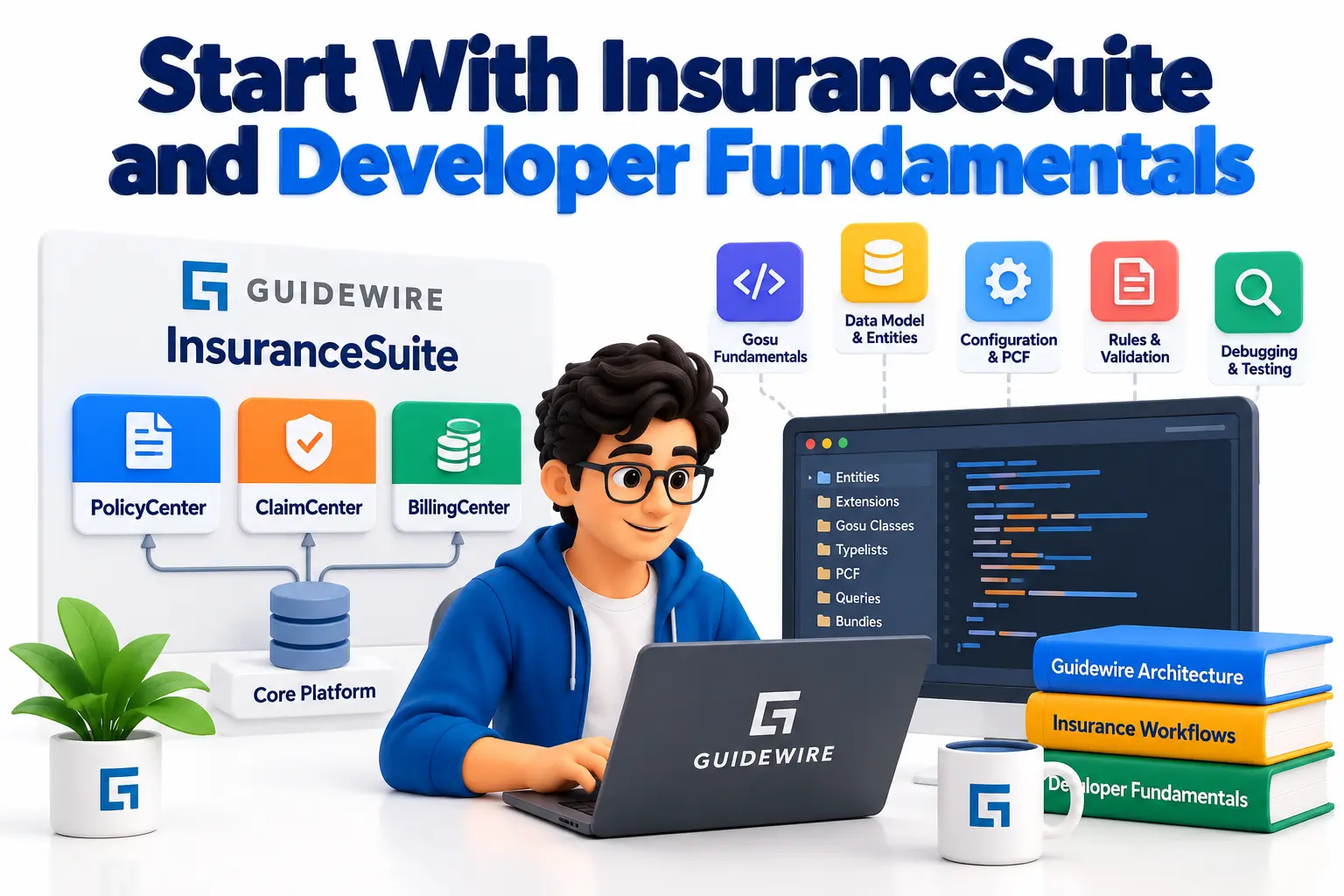
Before choosing an advanced Guidewire course, developers need to understand what they are actually developing. Guidewire InsuranceSuite supports core property and casualty insurance processes through PolicyCenter, ClaimCenter and BillingCenter. Code makes much more sense when you understand the business transaction behind it.
A strong foundation course should introduce the applications and the relationships between them. Developers should understand how a policy is created and changed, how a claim moves from first notice of loss through settlement, and how billing transactions connect with policy activity.
The technical foundation should then cover areas such as:
Guidewire application architecture
InsuranceSuite fundamentals
Guidewire Studio and development concepts
Gosu fundamentals
Entities and the data model
Typelists and extensions
PCF and UI configuration
Rules and validation
Queries and bundles
Basic debugging
This stage is particularly important for Java developers. Familiar programming concepts can accelerate learning, but Guidewire development requires understanding the platform's own data, configuration and transaction patterns.
JastTech can make this foundation more useful by connecting each technical concept with an insurance workflow. Instead of learning an entity or rule in isolation, developers should understand what business requirement caused that customization.
Choose PolicyCenter, ClaimCenter or BillingCenter for Technical Depth
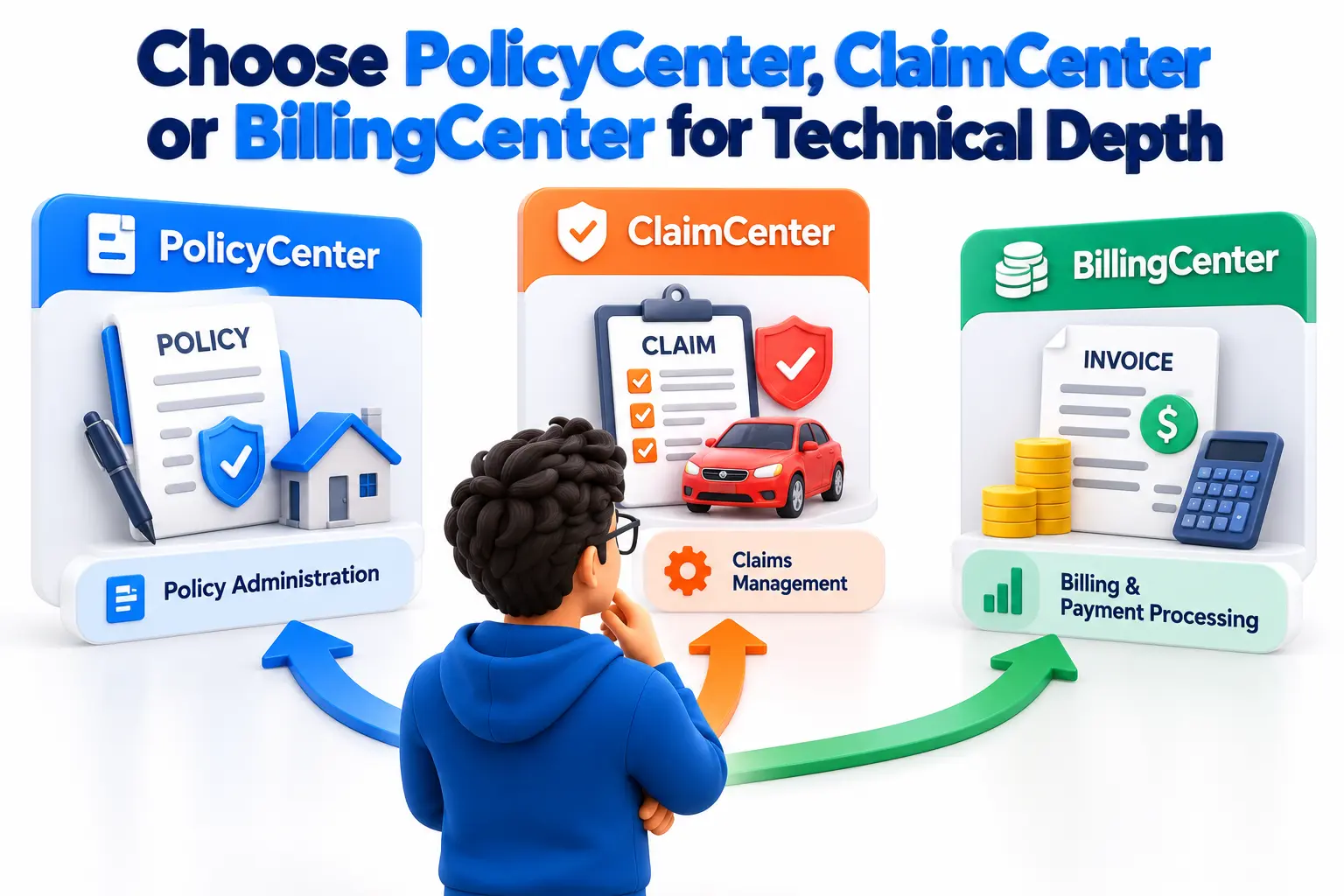
Once the platform foundation is clear, developers should stop trying to learn all three core applications at the same depth. Selecting one primary InsuranceSuite application creates stronger technical specialization.
PolicyCenter is appropriate for developers interested in policy administration, product models, underwriting and policy transactions. A practical PolicyCenter course should expose learners to submissions, renewals, changes, cancellations, underwriting rules and configuration around the policy lifecycle.
ClaimCenter focuses on claims operations. Developers encounter areas such as FNOL, exposures, activities, reserves, payments and claim workflows. BillingCenter instead concentrates on accounts, invoices, payment plans, transactions, delinquency and financial processes.
The best specialization therefore depends on the work you want to perform:
PolicyCenter: policy lifecycle and underwriting development
ClaimCenter: claims workflows and financial processing
BillingCenter: billing, payments and account management
The objective is not simply to memorize screens. Developers should trace a requirement from business workflow to data model, configuration, Gosu logic, UI behavior and testing. That is much closer to how knowledge is applied during implementation.
Build Configuration and Gosu Skills Through Real Requirements
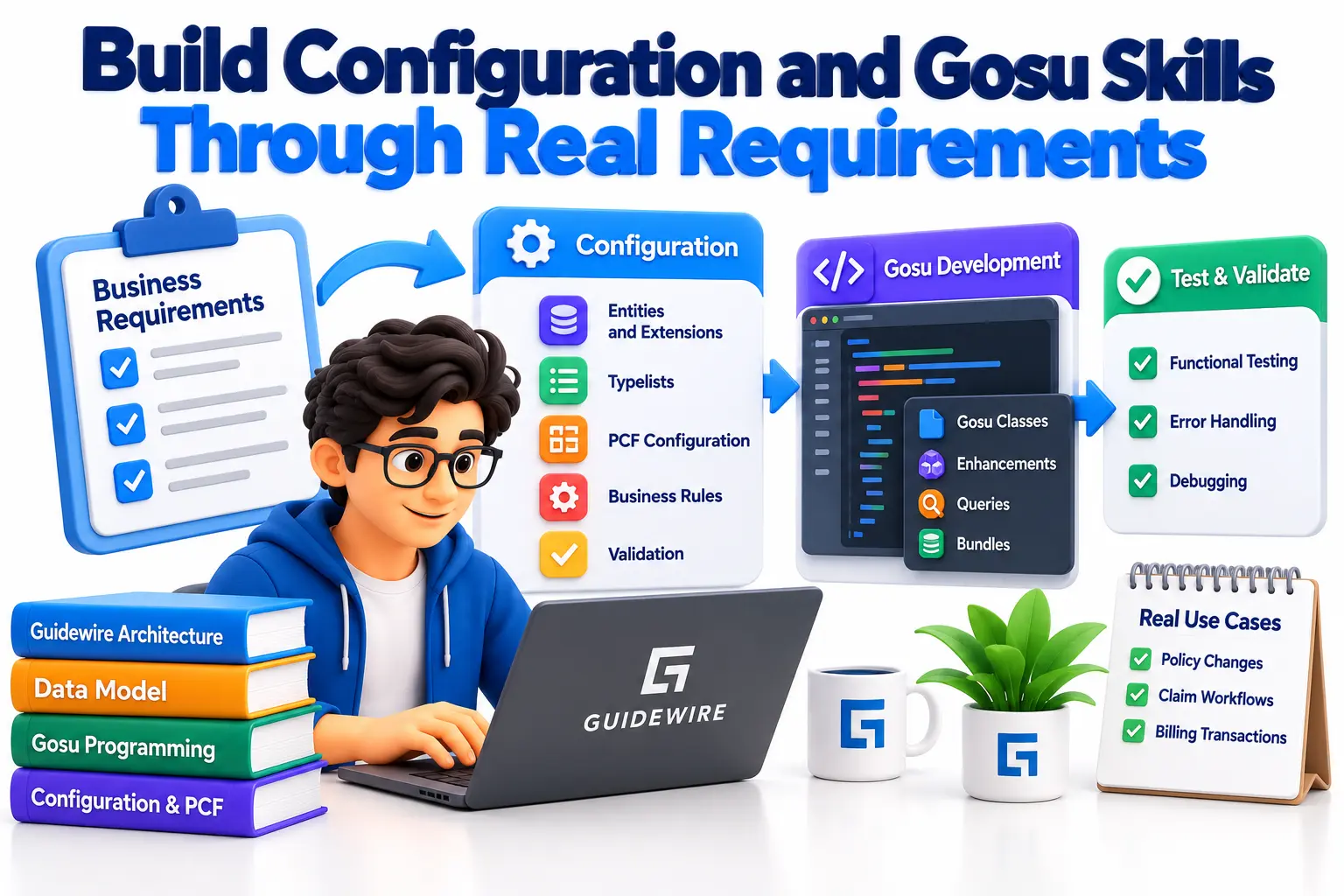
Knowing Gosu syntax does not automatically make someone a Guidewire developer. The important skill is knowing where code belongs, what platform behavior it changes and how that change affects the rest of the application.
Configuration training should therefore become requirement-driven. Consider a carrier that wants additional validation before allowing a policy transaction. A learner should determine what data is required, where validation belongs, how the user receives feedback and how the change should be tested.
A practical configuration course should include:
Entity extensions and relationships
Typelists
Gosu classes and enhancements
Queries and bundles
Business rules
PCF configuration
Validation
Error handling
Debugging
Upgrade-conscious customization
This is also where choosing structured guidewire training in chennai or guidewire training in bangalore should involve more than comparing course duration. Developers should inspect whether the curriculum includes coding exercises, realistic requirements, debugging scenarios and end-to-end project work.
For learners evaluating Guidewire Training in India, the strongest course is one that teaches why a solution is designed a certain way instead of providing only predefined code examples.
Add Integration Training After Configuration Fundamentals
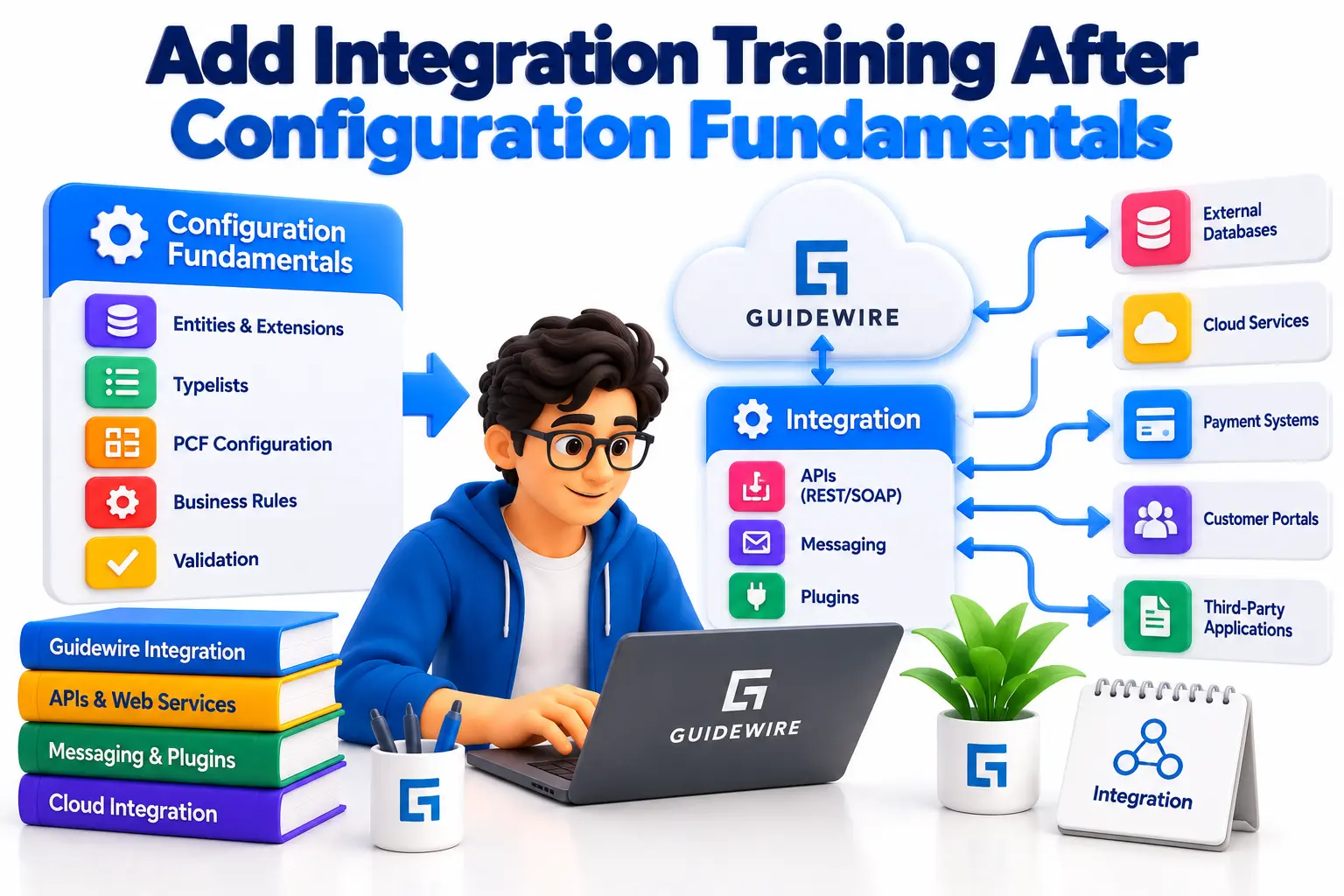
Modern insurance platforms rarely operate independently. Guidewire may need to communicate with payment providers, document systems, customer portals, rating services, identity platforms and numerous internal enterprise applications. That makes integration one of the most valuable advanced paths for developers.
However, integration training becomes much easier after learners understand InsuranceSuite entities, bundles and business transactions. Otherwise, APIs become disconnected technical exercises.
A strong integration course should progress through:
REST concepts and JSON
Guidewire Cloud APIs
Authentication and authorization concepts
Outbound and inbound communication
Messaging
Plugins
Events
Error handling
Integration Gateway concepts
External-system design
Observability and troubleshooting
Developers should practice complete scenarios. For example, a claim event could trigger communication with an external service, receive a response and update the appropriate insurance process.
The important skill is not merely sending an API request. Developers must reason about failures, retries, duplicate processing, transaction boundaries, security and data ownership. These are the questions that transform basic integration knowledge into enterprise engineering capability.
Make Guidewire Cloud Part of the Developer Roadmap
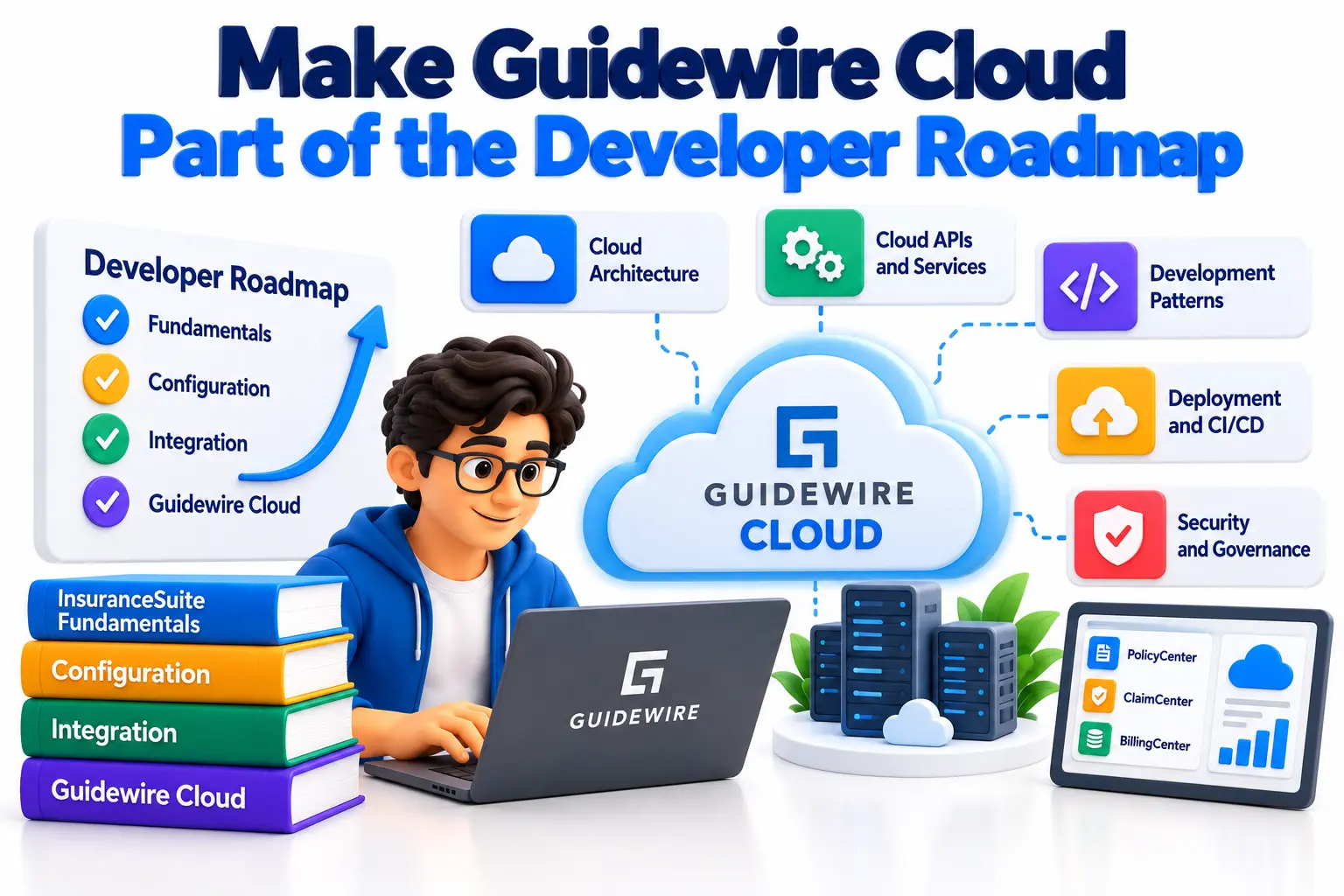
Guidewire development can no longer be approached only through traditional application customization. Current developer learning increasingly emphasizes Guidewire Cloud Platform, Cloud APIs, modern extension patterns and maintainable solutions.
Cloud learning should therefore follow—not replace—the InsuranceSuite foundation.
Developers should understand how Cloud changes their engineering decisions, including:
Cloud-compatible development patterns
API-driven integration
Deployment considerations
CI/CD awareness
Security responsibilities
Configuration versus customization
Upgrade-friendly extensions
Monitoring and troubleshooting
Release changes and continuous learning
This distinction matters because a developer who knows how an older implementation was customized may not automatically know the preferred approach for a modern Cloud implementation.
Developers interested in frontend and digital experience work can also explore Jutro. That path is particularly relevant to engineers with React and TypeScript experience who want to build insurance-facing digital applications connected with InsuranceSuite.
Cloud should therefore be viewed as an architectural layer in the learning journey rather than another isolated module.
Finish With a Project and Certification-Oriented Learning Path
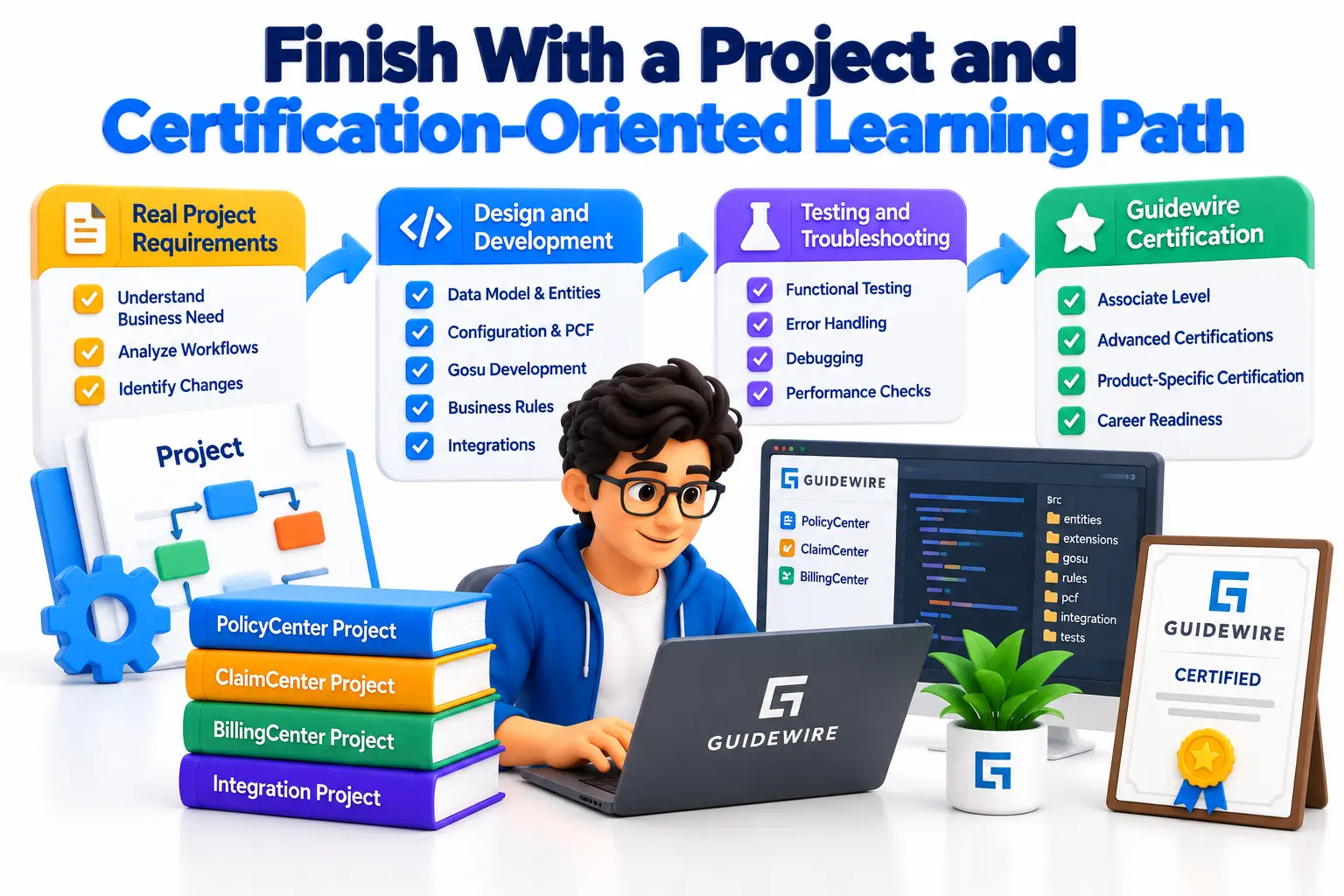
The final course in a developer roadmap should bring everything together. Tutorials can teach individual features, but project work tests whether the learner can connect insurance requirements, configuration, code, integrations and troubleshooting.
A useful project could begin with a business requirement and require the learner to:
Analyze the insurance workflow
Identify affected entities
Extend or configure the data model
Implement Gosu logic
Modify relevant UI behavior
Create an integration
Handle validation and errors
Test the complete transaction
Debug an intentionally introduced problem
Explain the architecture and design decisions
That final step—explaining decisions—is especially valuable. During technical interviews and real projects, developers are rarely evaluated only on whether they remember syntax. They need to explain why they chose a particular approach and what could fail.
Certification preparation should sit on top of practical learning rather than replace it. Current Guidewire pathways distinguish foundational Associate-level knowledge from deeper role- and product-oriented expertise. Developers should use certification as validation of structured skills while continuing to build hands-on implementation experience.
Conclusion
The best Guidewire training course is not necessarily the one with the longest syllabus. It is the one that gives developers the right progression: insurance workflows first, platform fundamentals next, deep product configuration after that, followed by integrations, Cloud engineering and realistic project execution.
For developers learning through JastTech, the goal should be bigger than completing modules. Build enough depth to trace a requirement from insurance need to technical design, code, integration, testing and troubleshooting. That is what turns Guidewire knowledge into practical engineering capability—and creates a foundation that can keep growing as the platform evolves.