

How Does SAP FICO Work? A Simple Guide for Beginners
Navigate through this article using the table of contents below
Table of Contents
No headings found in this article.
Enterprise resource planning software has transformed how organizations manage their operational data, financial transactions, and strategic decision-making. At the core of this modern digital infrastructure is SAP FICO, a leading module combination designed to streamline accounting processes and managerial control. To understand how businesses maintain transparent ledgers while optimizing operational efficiency, exploring a detailed SAP FICO training guide provides essential insights into real-world applications. By standardizing general ledgers, accounts payable, accounts receivable, and cost center management, this software ecosystem empowers corporations to meet strict regulatory compliance standards while gaining complete control over their financial operations worldwide.
Modern enterprises handle thousands of complex transactions every day, requiring automated systems that connect financial tracking with dynamic business analytics. SAP FICO addresses this challenge by dividing tasks between Financial Accounting (FI) for external stakeholders and Controlling (CO) for internal management. Mastering these financial processes through structured SAP training and certification courses online equips professionals with high-demand operational skills needed across global business environments. Through seamless data flow, real-time reporting, and automated reconciliation, SAP FICO ensures that organizational decision-makers maintain total financial visibility across all business units and international subsidiaries.
1. What is SAP FICO and Why Do Enterprise Businesses Rely on It?
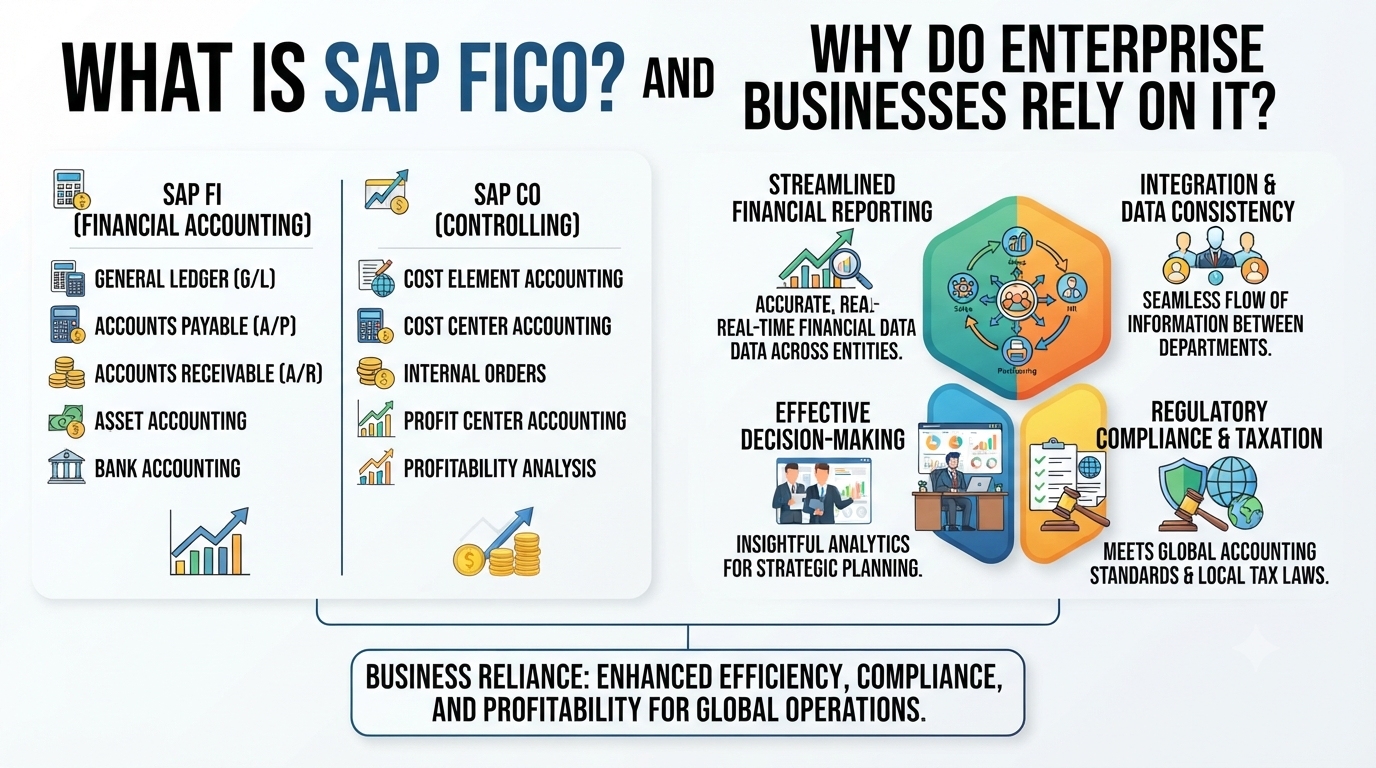
SAP FICO stands for Financial Accounting (FI) and Controlling (CO), representing two distinct yet closely linked sub-modules within the larger SAP Enterprise Resource Planning system. The FI component focuses primarily on tracking financial transactions for external reporting requirements, including balance sheets, profit and loss statements, and tax audits. On the other side, the CO component handles internal administrative cost structures, profitability analysis, budgeting, and performance management. Together, they form a robust framework that processes raw financial transactions into actionable corporate reporting and strategic business intelligence.
Large enterprises rely heavily on SAP FICO because it eliminates operational silos, automates repetitive accounting entries, and ensures consistent legal compliance across different geographical regions. Rather than managing fragmented accounting databases, companies use SAP FICO as a single source of financial truth. This central system helps eliminate human error, cuts down administrative processing costs, and speeds up monthly closing cycles. By standardizing record-keeping across departments like procurement, sales, and manufacturing, organizations achieve full financial transparency while staying compliant with international accounting standards.
2. Core Components of Financial Accounting (FI)
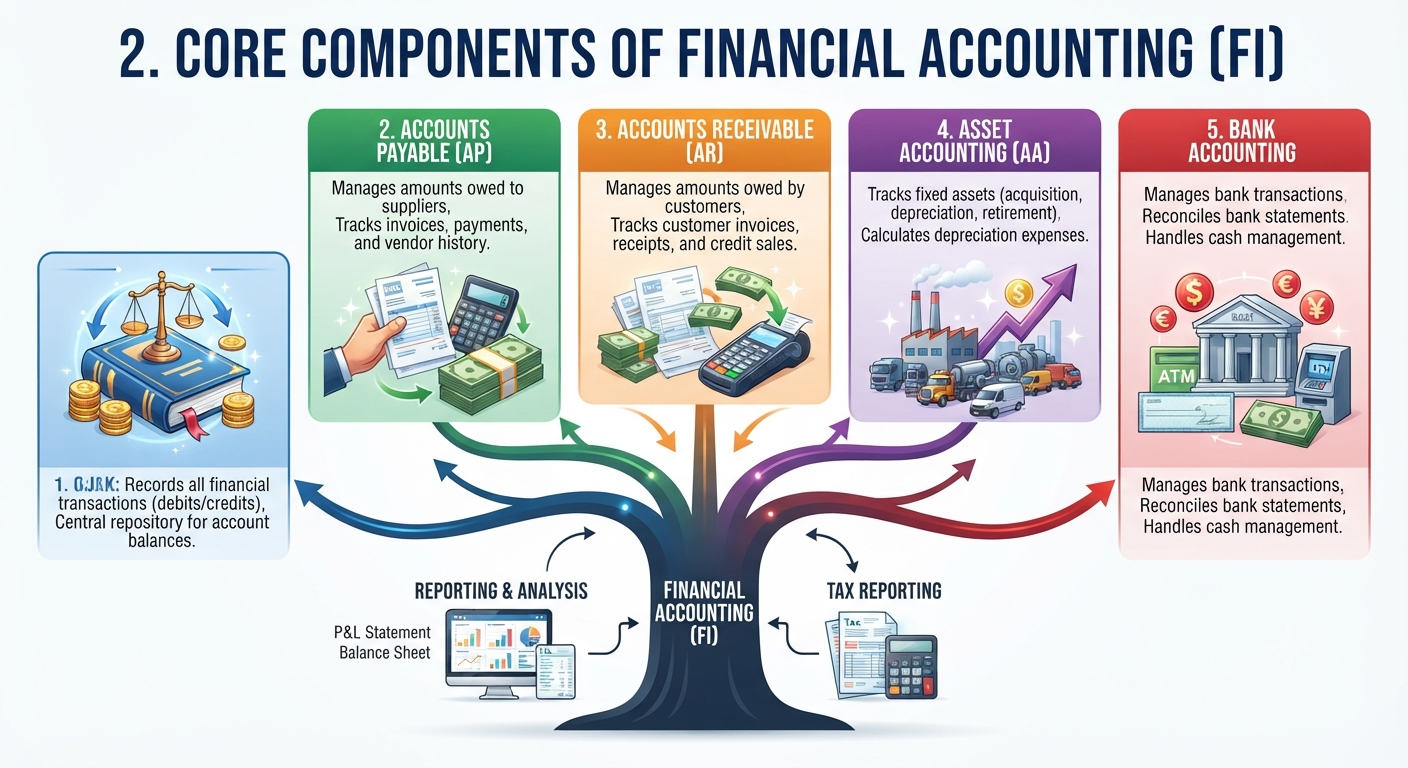
The Financial Accounting (FI) side of the system acts as the digital general ledger foundation for all corporate financial record-keeping and external audits. Key sub-modules include General Ledger (FI-GL), Accounts Payable (FI-AP), Accounts Receivable (FI-AR), Asset Accounting (FI-AA), and Bank Accounting (FI-BL). Together, these components track incoming revenue, outgoing operational expenses, fixed physical assets, and daily cash transactions. Every ledger entry automatically updates in real time, giving accounting teams an instant snapshot of corporate financial health and current liabilities.
Understanding how FI sub-modules function is essential for streamlining order-to-cash and procure-to-pay processes in any business setup. For instance, when a company purchases inventory, Accounts Payable logs the vendor invoice while General Ledger accounts automatically balance the corresponding liability. Similarly, Asset Accounting tracks asset depreciation over time according to specific legal tax rules. By standardizing these financial workflows, organizations reduce manual bookkeeping tasks, maintain reliable audit trails, and produce accurate financial statements for shareholders, tax agencies, and banking institutions.
3. Key Functions of Controlling (CO) for Management Decision-Making
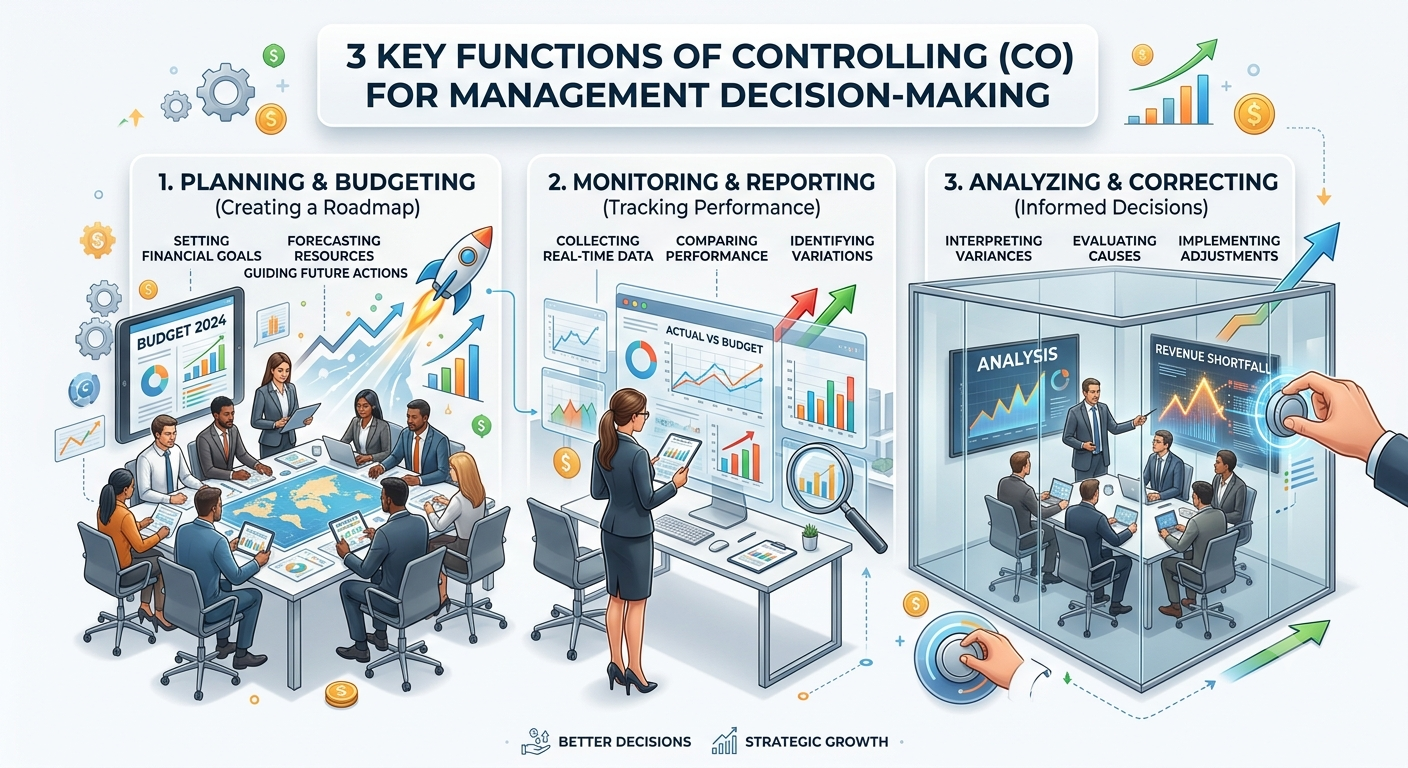
While FI delivers external financial reports, Controlling (CO) delivers internal operational reporting used by corporate executives, managers, and financial analysts. Sub-components like Cost Center Accounting (CO-CCA), Profit Center Accounting (CO-PCA), Internal Orders, and Profitability Analysis (CO-PA) track costs directly to specific departments, projects, or production lines. This granular tracking allows managers to pinpoint operational inefficiencies, allocate internal corporate resources wisely, and evaluate unit-level profitability.
By using the CO module, companies can compare actual spend against annual operating budgets in real time. For example, if a marketing campaign runs over budget, the system alerts managers before costs spiral out of control. Profitability Analysis also helps leadership evaluate which specific products or sales channels generate the highest net profit margins. By turning raw financial records into actionable internal performance metrics, Controlling helps leadership make smarter, data-backed operational decisions.
4. How Financial Accounting (FI) and Controlling (CO) Integrate Seamlessly
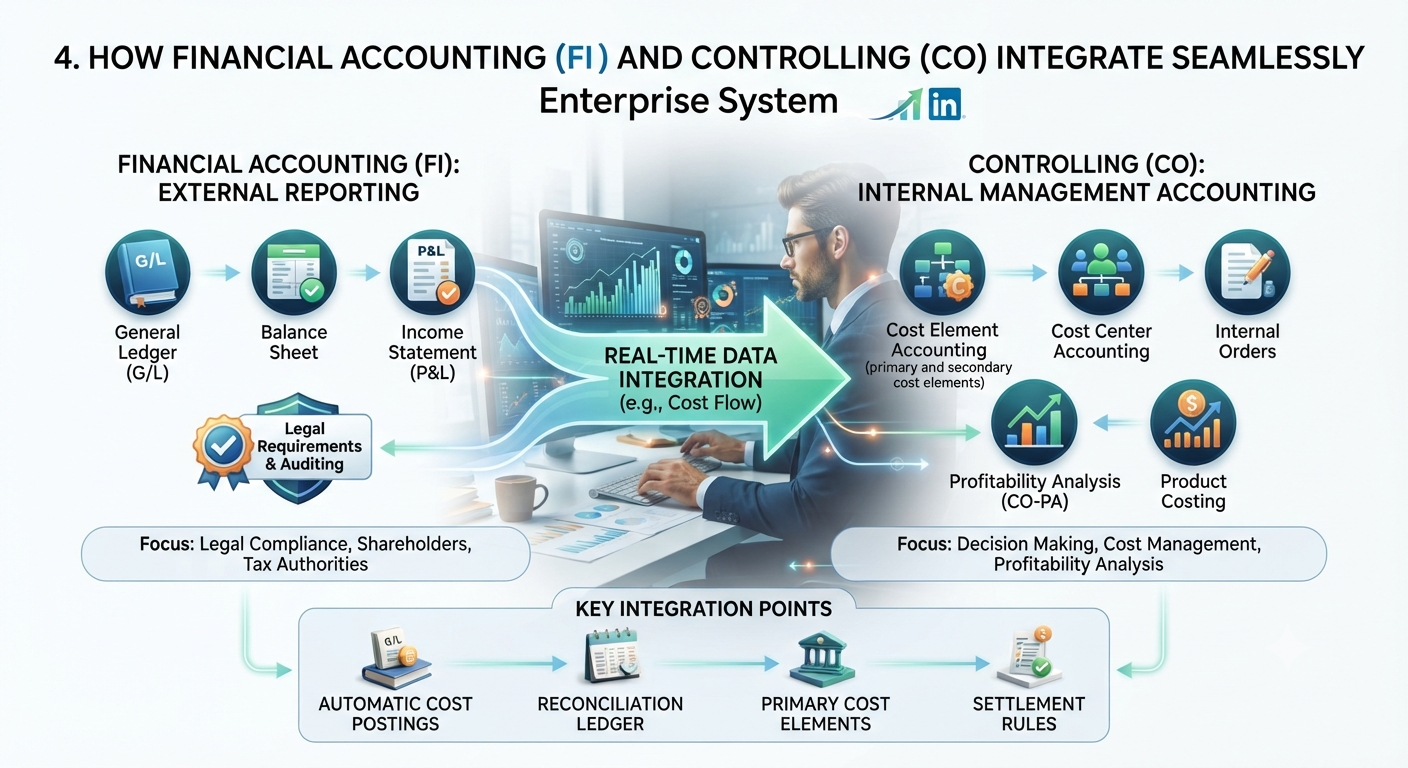
The real strength of SAP FICO lies in the seamless integration between its FI and CO sub-modules. Every time a primary financial transaction occurs within the FI system—such as paying a vendor or issuing a customer invoice—the system automatically passes relevant cost information to the CO module. This dynamic background posting ensures that external accounting ledgers and internal cost accounting reports always stay aligned, without requiring double data entry from finance teams.
This unified architecture eliminates discrepancies between management accounting metrics and external financial audit statements. For instance, an operational expense posted to a General Ledger account in FI instantly updates the corresponding department cost center in CO. This automated synchronization speeds up monthly ledger reconciliations and reduces software overhead costs. As a result, businesses run leaner financial operations with accurate, audit-ready numbers across every organizational level.
5. Integrating FICO with MM, SD, and Other SAP Modules
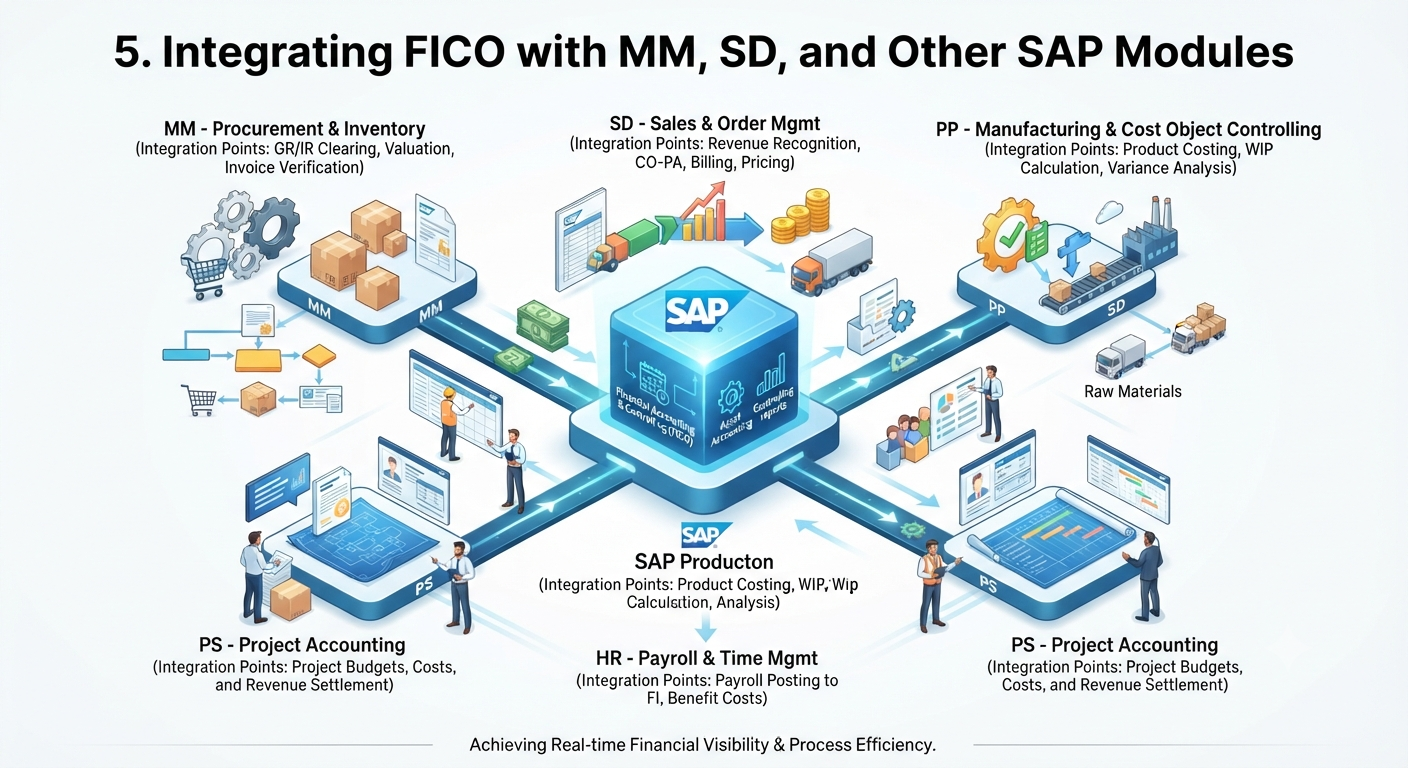
SAP FICO does not operate in isolation; it integrates directly with other enterprise SAP modules, including Materials Management (MM), Sales and Distribution (SD), and Human Capital Management (HCM). When the warehouse team posts a goods receipt in MM, the system automatically posts an inventory credit entry in FICO. Similarly, when a customer order ships through SD, the system automatically creates a customer billing document and updates Accounts Receivable in real time.
This cross-module integration builds an automated, end-to-end business workflow across procurement, logistics, sales, and corporate accounting. Manual reconciliations between sales logs and financial ledgers become a thing of the past because every physical inventory movement triggers a corresponding financial entry. This connected network speeds up order-to-cash processing, improves inventory tracking, and gives operational leaders a clear, real-time view of company cash flow.
6. Business Benefits of Implementing SAP FICO in Modern Enterprises
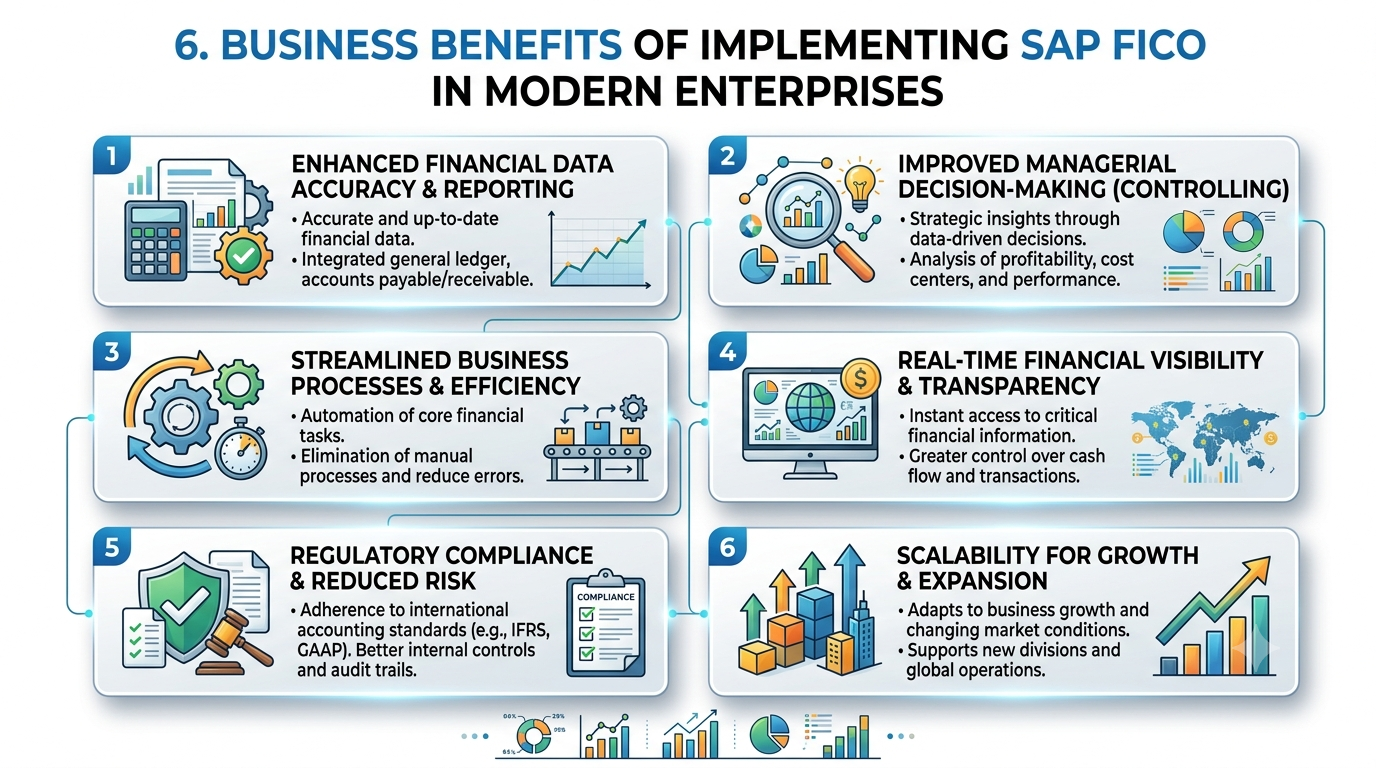
Implementing SAP FICO brings clear operational benefits, starting with enhanced financial data integrity and faster month-end closing procedures. Automated workflows replace error-prone manual spreadsheets, helping organizations close accounting books in days rather than weeks. Built-in compliance features ensure companies follow local tax requirements and global accounting regulations—such as GAAP and IFRS—reducing legal exposure and financial audit penalties.
Beyond legal compliance, SAP FICO gives leadership real-time financial reporting and customizable dashboards for better long-term planning. Executives can instantly run balance sheets, evaluate cash positions, and forecast future revenue across global subsidiaries. This instant visibility helps companies adapt quickly to market shifts, control administrative overhead, optimize supply chain spend, and maintain a clear competitive edge in demanding international markets.
7. Career Opportunities and Industry Demand for SAP FICO Professionals
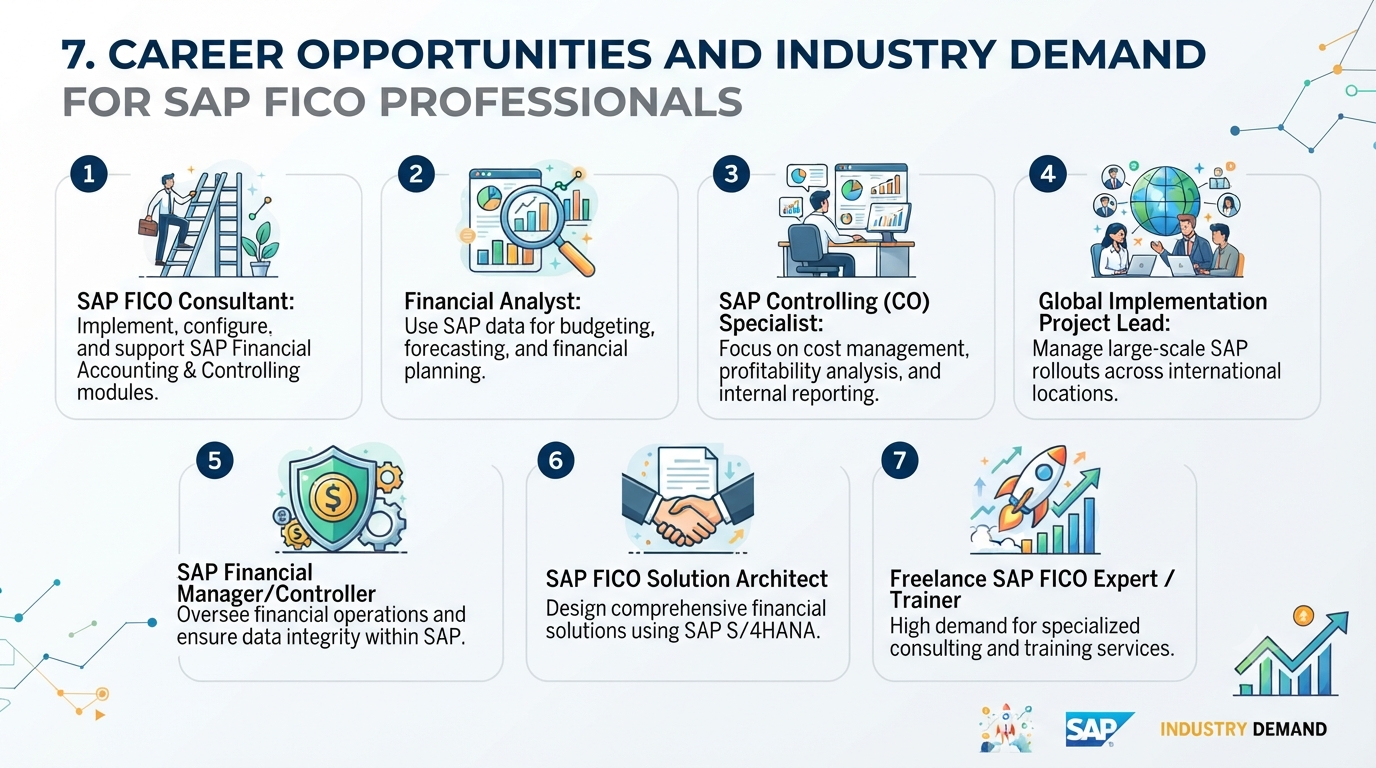
The growing adoption of SAP ERP systems across manufacturing, healthcare, technology, retail, and finance has created strong global demand for skilled SAP FICO professionals. Popular career paths include SAP FICO Functional Consultant, Systems Analyst, Financial Analyst, End-User Specialist, and Enterprise Solution Architect. These professionals design customized financial workflows, manage system rollouts, configure module settings, and train corporate finance teams to maximize software return on investment.
Building expertise in SAP FICO offers long-term career growth and strong earning potential across international job markets. As enterprises upgrade legacy software platforms to modern cloud systems like SAP S/4HANA, certified professionals are vital for leading smooth digital transformations. Whether you come from a finance, accounting, or IT background, mastering SAP FICO opens doors to strategic consulting positions and leadership roles within major global organizations.
Conclusion
Mastering SAP FICO is one of the most effective steps you can take toward establishing a rewarding, future-proof career in modern enterprise finance and IT consulting. As businesses worldwide continue to digitize their operations and upgrade to advanced cloud platforms like SAP S/4HANA, the demand for skilled professionals who understand integrated accounting workflows remains at an all-time high. By bridging the gap between external regulatory compliance (FI) and internal strategic decision-making (CO), SAP FICO acts as the central financial engine for global organizations.
Whether you are a finance professional looking to leverage technology, an IT specialist aiming to specialize in enterprise software, or a complete beginner seeking a high-growth career path, gaining practical expertise in SAP FICO opens doors to top-tier global opportunities. Investing time in structured learning and hands-on system configuration will give you the practical skill set needed to drive real business value, streamline complex financial processes, and lead enterprise digital transformations with confidence.