

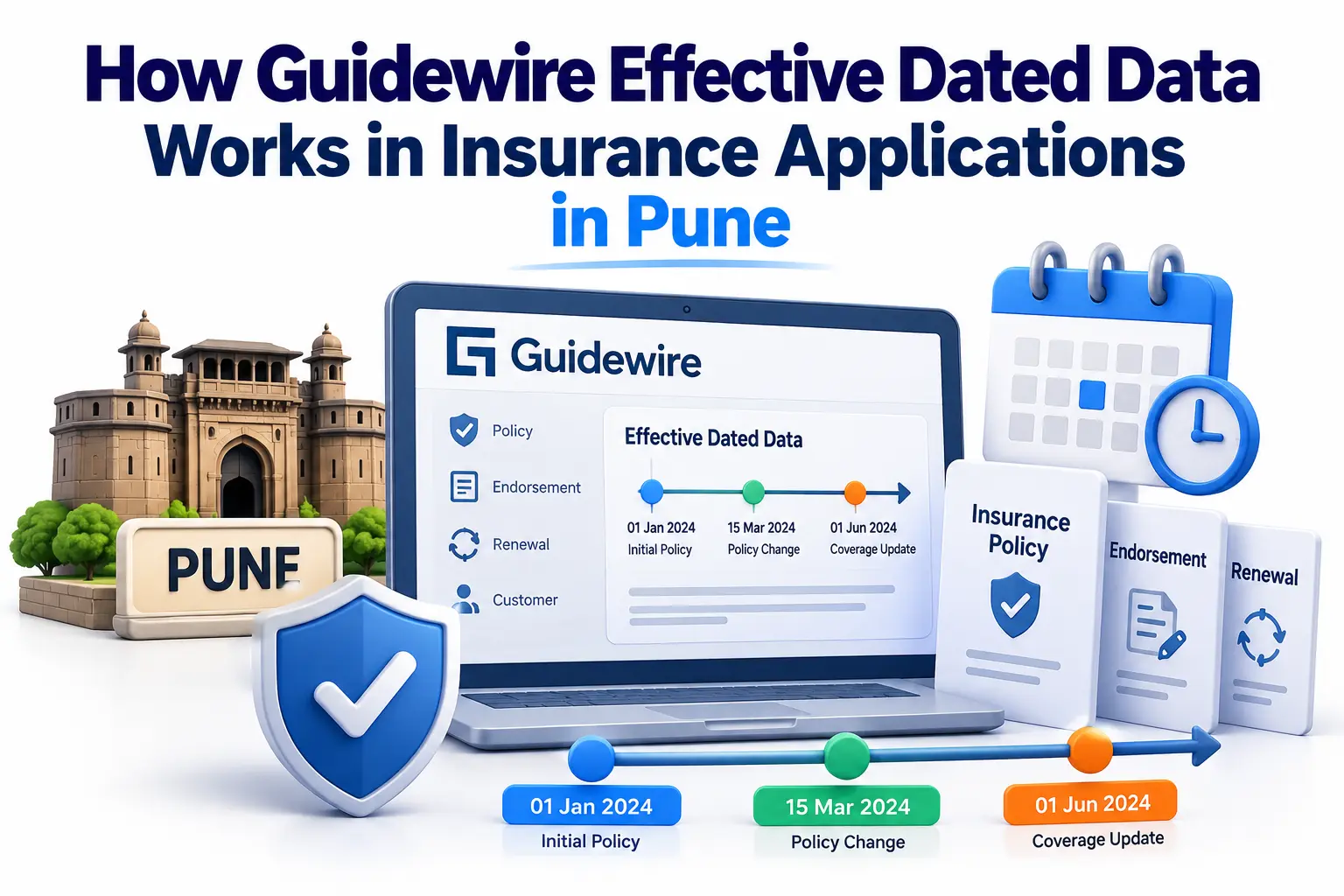
How Guidewire Effective Dated Data Works in Insurance Applications in Pune
Navigate through this article using the table of contents below
Table of Contents
No headings found in this article.
Insurance policies are constantly changing, but what happens when a customer requests a modification that should take effect next month? How do insurance applications maintain historical records while calculating accurate premiums? The answer lies in Guidewire Effective Dated Data, a powerful feature of PolicyCenter.
For insurance technology professionals in Pune, understanding effective-dated data is essential for working with policy transactions, endorsements, renewals, and insurance workflows. This concept helps developers and business analysts manage policy changes without losing historical accuracy or disrupting existing coverage.
Understanding Effective Dated Data in Guidewire PolicyCenter
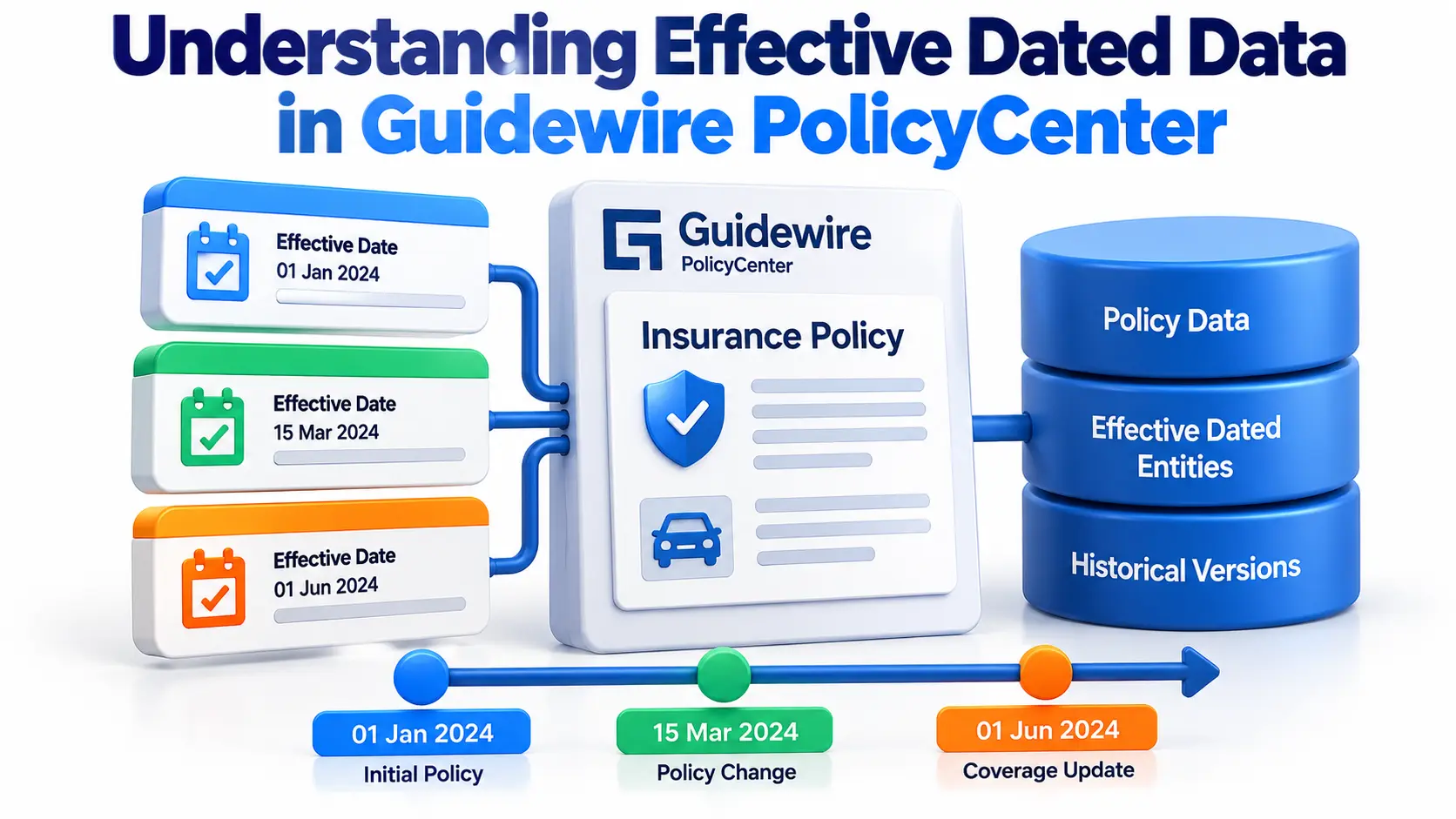
Effective-dated data is a fundamental concept in Guidewire PolicyCenter that allows insurance applications to manage information based on when it becomes valid. Unlike traditional database records that primarily represent current values, effective-dated entities maintain different versions of insurance information across specified periods.
Consider a customer purchasing automobile insurance on January 1. The policy initially covers one vehicle. On March 15, the customer adds another vehicle, and on June 1, the customer changes the coverage limit. PolicyCenter must accurately represent each modification while preserving the appropriate policy information for earlier dates.
Effective-dated data supports this requirement through time-based entity versions associated with policy periods and transactions.
Important concepts include:
Effective Date: The date when a particular insurance change becomes applicable.
Expiration Date: The date when that version stops being applicable.
Policy Period: The contractual period associated with an insurance policy transaction.
Effective-Dated Entity: An entity whose information can vary across effective-time intervals.
Policy Transaction: A business operation such as a policy change, renewal, or cancellation.
Understanding these concepts helps insurance technology professionals interpret how PolicyCenter manages changing policy information.
How Guidewire Uses Effective Dates to Manage Policy Changes
Insurance companies frequently process policy modifications after the original policy becomes active. These changes may include adding insured assets, modifying deductibles, updating coverage limits, or removing insured drivers.
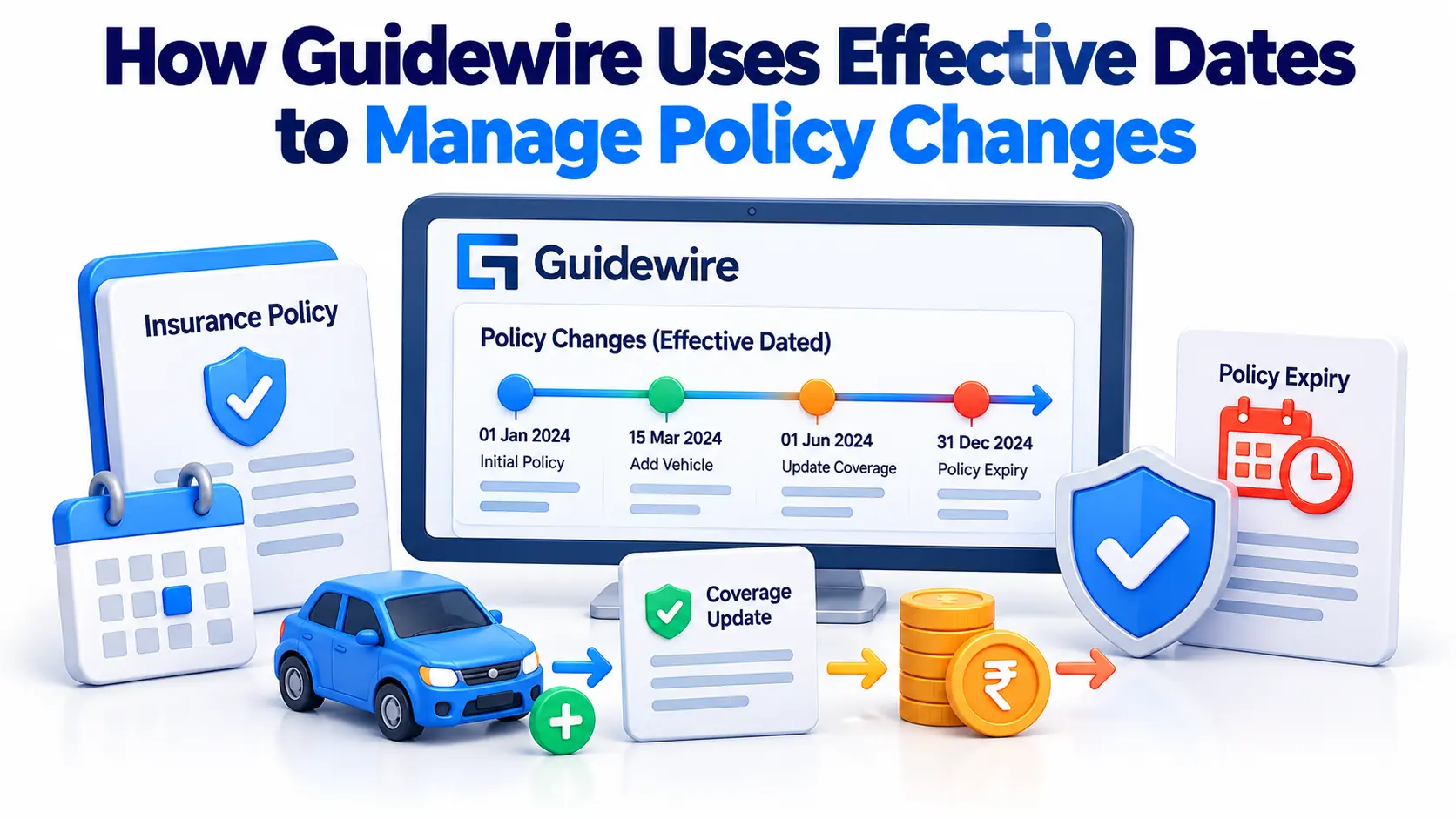
Guidewire PolicyCenter manages these modifications through effective-dated entity versions. Each version represents information applicable during a particular interval, allowing the application to determine the correct policy state for a requested date.
For example, consider an automobile insurance policy with the following timeline:
January 1: The policy begins with one insured vehicle.
March 15: A second vehicle is added.
June 1: Collision coverage limits are modified.
December 31: The policy reaches its expiration date.
When a user examines the policy as of February 1, the second vehicle should not appear. However, viewing the policy as of April 1 should reflect both vehicles.
This functionality becomes especially important during premium calculations and claim investigations.
Effective dating also helps distinguish when a change applies from when it was entered into the system. A policy change processed today may have a future or retroactive effective date, depending on business rules and insurer authorization.
This distinction helps maintain consistency between policy administration, billing calculations, and insurance coverage decisions.
Understanding Policy Periods, Branches, and Slices in Guidewire
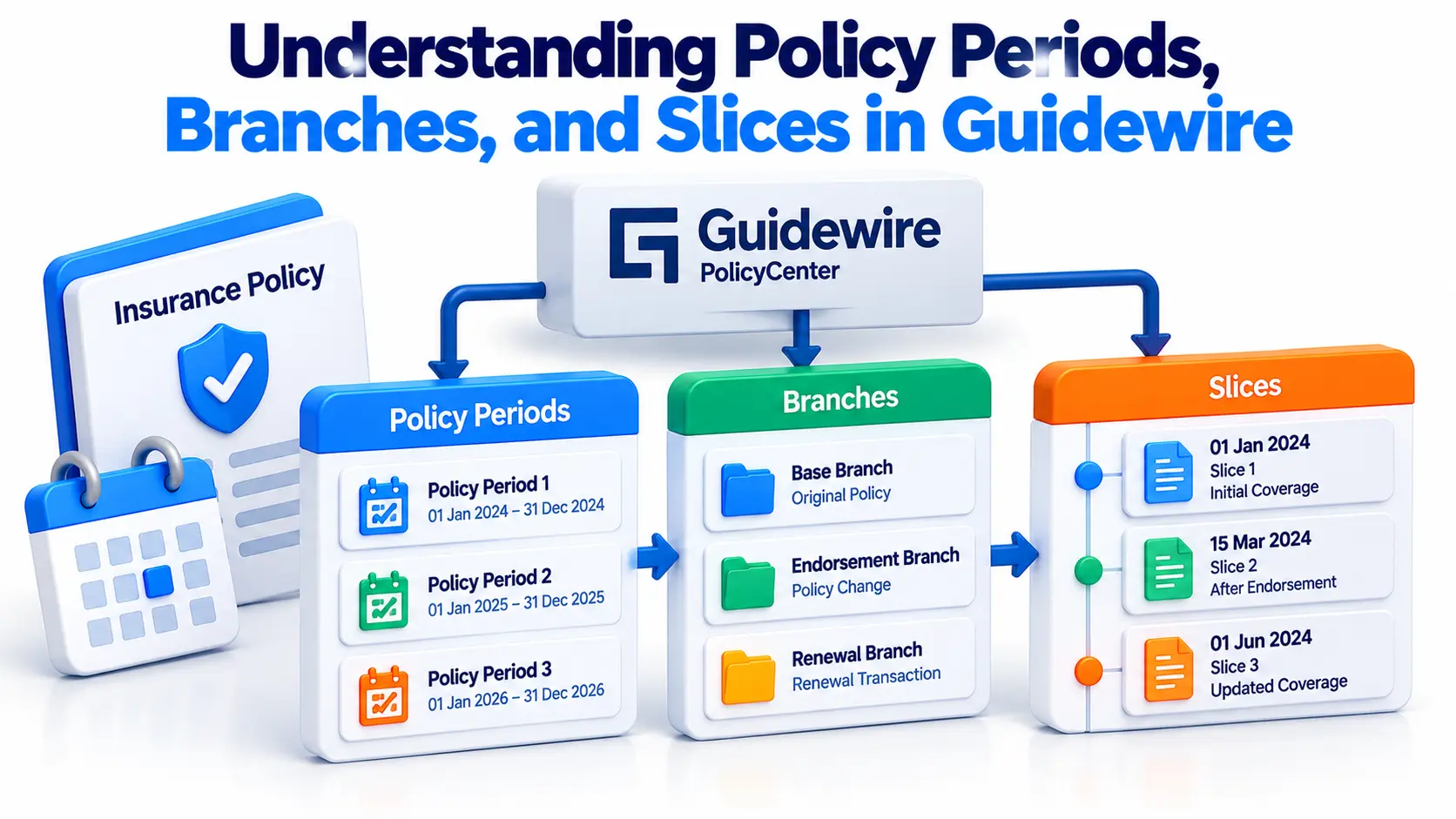
One of the most important aspects of Guidewire effective-dated data is understanding how PolicyCenter organizes policy information using policy periods, branches, and slices.
A policy period represents a version of the policy associated with a particular transaction. A branch provides the effective-dated view of that policy period, including the entity versions relevant to the transaction.
A slice represents the policy information applicable at a particular effective date within that branch.
For example, an insurance developer investigating coverage on May 10 can use an appropriate effective-dated slice to examine the policy information applicable on that date.
Three concepts are particularly important:
Branch: Represents the effective-dated entity graph associated with a policy period.
Slice: Provides a date-specific view of effective-dated information.
Window: Provides access to effective-dated information across the relevant time interval.
Developers must understand these distinctions when working with Gosu code, entity relationships, and policy transactions.
A slice is useful when retrieving information valid on one specific date. A window is useful when examining how information changes across time.
However, effective-dated operations must be handled carefully because changing entities within an incorrect temporal context can produce unintended results.
For professionals exploring guidewire training in pune, practical exercises involving branches, slices, and windows provide valuable experience with real PolicyCenter development scenarios.
How Effective Dated Data Supports Endorsements and Renewals
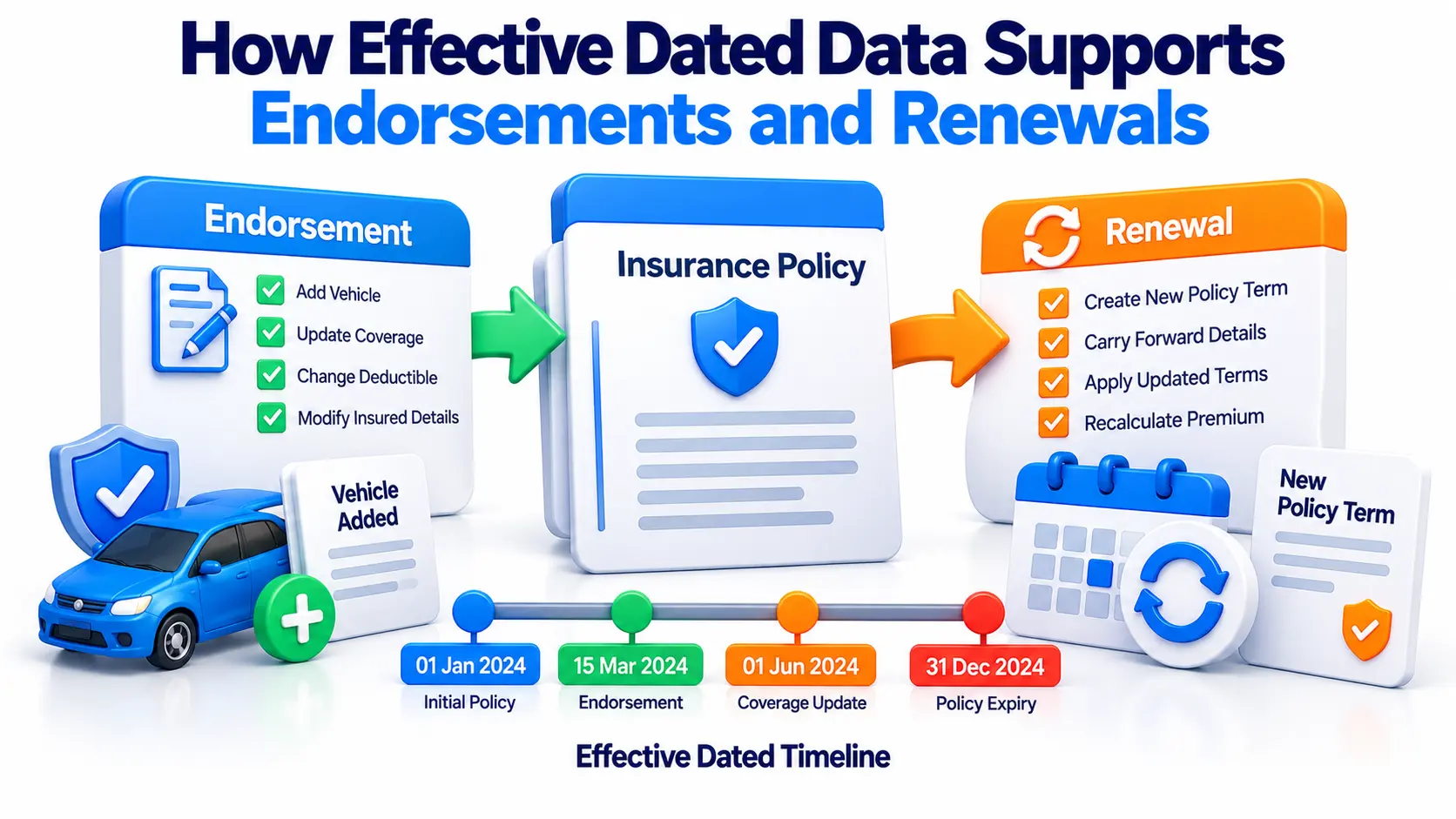
Policy endorsements are among the most common insurance operations requiring effective-dated data.
An endorsement modifies an existing insurance policy during its active period. Examples include adding property coverage, changing vehicle details, updating insured locations, or adjusting deductibles.
Suppose a commercial insurance customer increases a property coverage limit from ₹20 lakh to ₹35 lakh effective July 1.
PolicyCenter must maintain the earlier coverage information for the period before July 1 while applying the updated limit from the endorsement's effective date.
The application must also support the premium implications of the modification.
A typical endorsement workflow includes:
Selecting the existing insurance policy.
Initiating a policy change transaction.
Specifying the endorsement's effective date.
Updating the required insurance information.
Validating underwriting and business rules.
Calculating applicable premium changes.
Completing the transaction according to insurer workflows.
Effective-dated entities allow the application to preserve the appropriate coverage timeline throughout this process.
Renewals introduce another important scenario.
When an insurance policy approaches expiration, PolicyCenter can create a renewal transaction for the next policy term. Information from the expiring policy may be carried forward and adjusted according to renewal rules.
Developers must understand how effective-dated data behaves across policy transactions because endorsements and renewals involve different business processes.
For learners pursuing Guidewire Business Analyst , understanding these workflows is particularly valuable when preparing requirements, defining acceptance criteria, and validating insurance transaction behavior.
Managing Effective Dated Entities Through Gosu and Guidewire Configuration
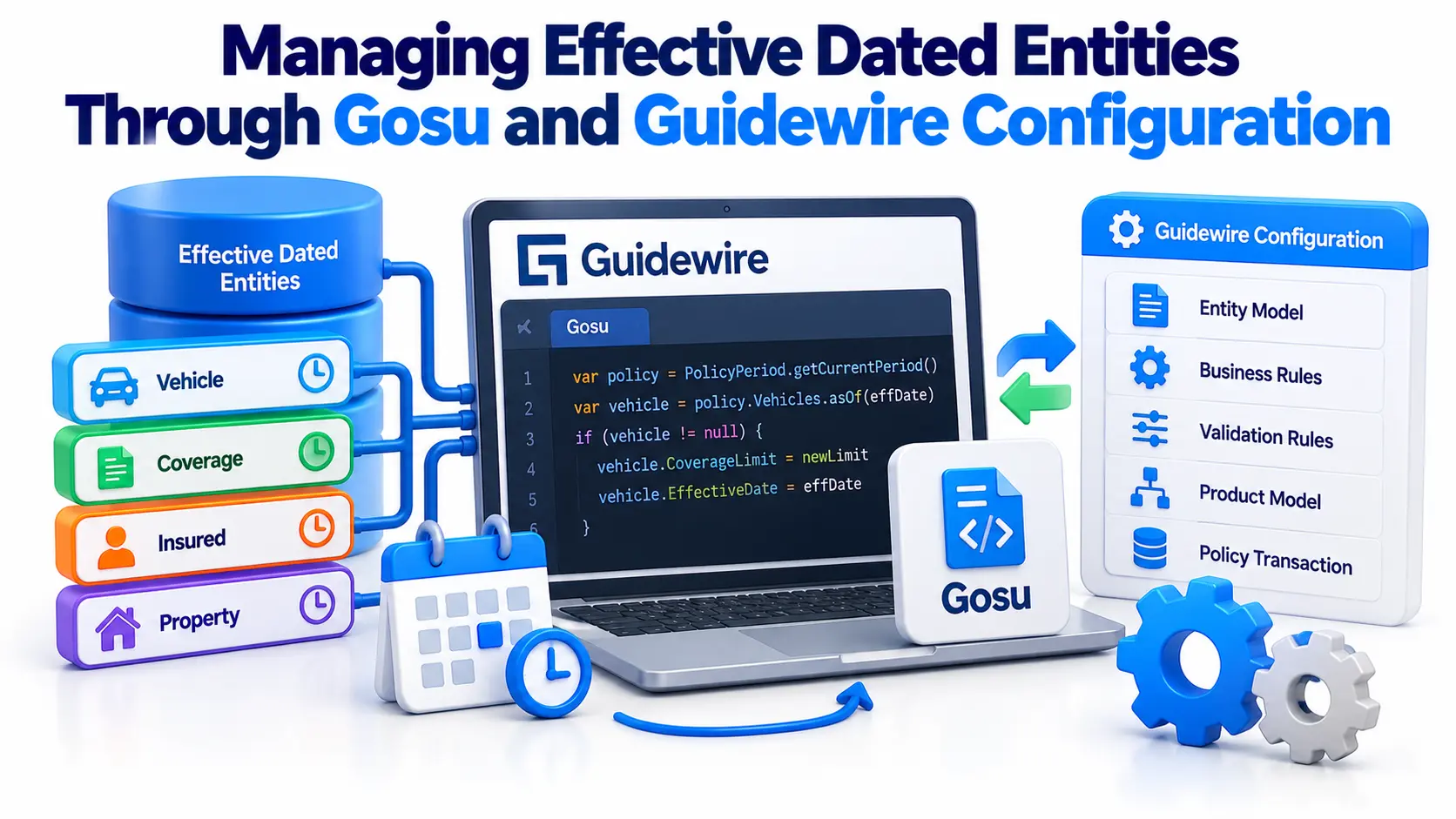
Guidewire developers work with effective-dated information through PolicyCenter's entity model, Gosu programming language, and supported application APIs.
Gosu is used to implement insurance business logic, validations, calculations, and application behavior.
However, effective-dated entities require additional attention because developers must consider both the entity's data and its temporal context.
For example, changing an insured vehicle's information may require the developer to identify the correct policy transaction, retrieve the appropriate entity version, and apply modifications within the supported transaction context.
Important development considerations include:
Entity relationships: Effective-dated entities may have relationships with other policy entities, including vehicles, coverages, and insured risks.
Temporal consistency: Changes must respect the appropriate effective and expiration dates.
Transaction boundaries: Modifications should occur within valid PolicyCenter transaction and bundle contexts.
Validation rules: Business logic must prevent invalid coverage combinations and inconsistent policy information.
Performance: Developers should avoid unnecessary loading or processing of large effective-dated entity graphs.
Testing is equally important.
A developer should verify whether a policy modification behaves correctly before, on, and after its effective date.
For example, when a vehicle is added effective September 10, test cases should confirm that the vehicle is excluded from the applicable policy view on September 9 and included on September 10.
Through guidewire training in india, learners can strengthen these concepts by building realistic PolicyCenter configuration exercises and testing insurance transaction scenarios.
Why Effective Dated Data Skills Matter for Guidewire Careers in Pune
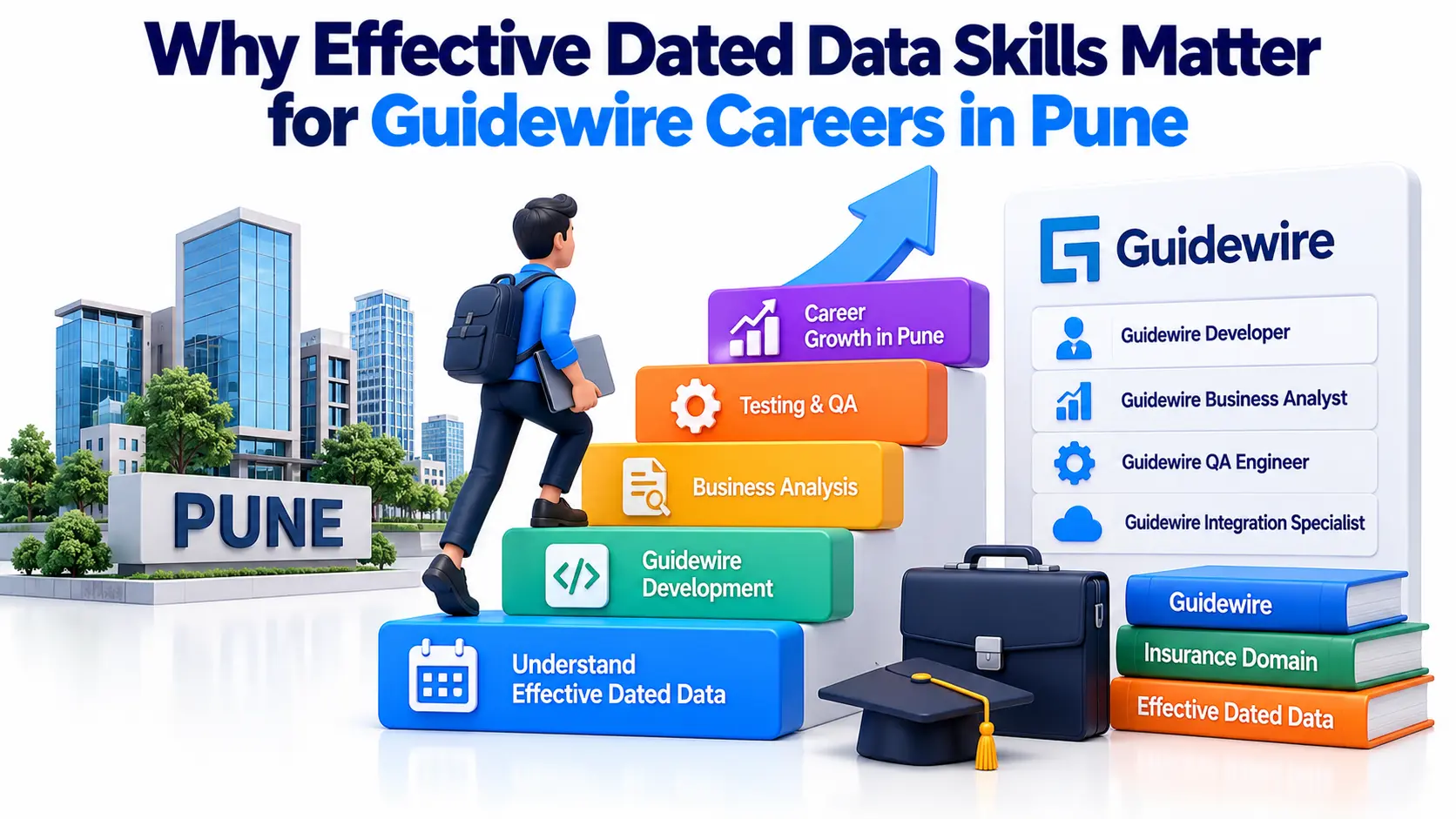
Pune has an established technology ecosystem supporting enterprise applications, financial services, and insurance technology projects.
Professionals working with Guidewire implementations benefit from understanding how insurance business requirements translate into PolicyCenter configuration, data structures, and transaction behavior.
Effective-dated data is especially relevant for developers, business analysts, QA engineers, and integration specialists.
A Guidewire developer may need to investigate why a coverage modification appears on an unexpected date.
A business analyst may need to explain how a backdated endorsement affects policy information.
A QA engineer may need to validate whether different policy versions return the expected coverage details.
An integration specialist may need to ensure that external systems receive information corresponding to the appropriate policy transaction and effective date.
These scenarios demonstrate why effective-dated data knowledge extends beyond database design.
At JastTech, learners can focus on connecting insurance domain concepts with practical Guidewire development skills, including PolicyCenter workflows, Gosu fundamentals, entity relationships, and testing.
For professionals preparing for Guidewire opportunities in Pune, understanding effective-dated data provides a foundation for discussing real insurance application behavior during technical interviews.
Rather than memorizing definitions, candidates should practice explaining how policy changes affect coverage timelines, entity versions, and transaction processing.
Conclusion
Guidewire Effective Dated Data plays a critical role in maintaining accurate insurance information throughout the policy lifecycle. By using effective dates, policy periods, branches, slices, and windows, PolicyCenter supports complex insurance transactions while preserving the appropriate historical and future policy states. Understanding these mechanisms helps professionals work more effectively with endorsements, renewals, coverage modifications, and insurance application development.
For aspiring Guidewire professionals in Pune, mastering effective-dated data can strengthen both technical knowledge and insurance domain expertise. Through structured learning, practical PolicyCenter exercises, and realistic transaction scenarios, learners can develop the skills required to understand enterprise insurance applications. JastTech supports career-focused learning that connects Guidewire fundamentals with practical development and business analysis concepts.