

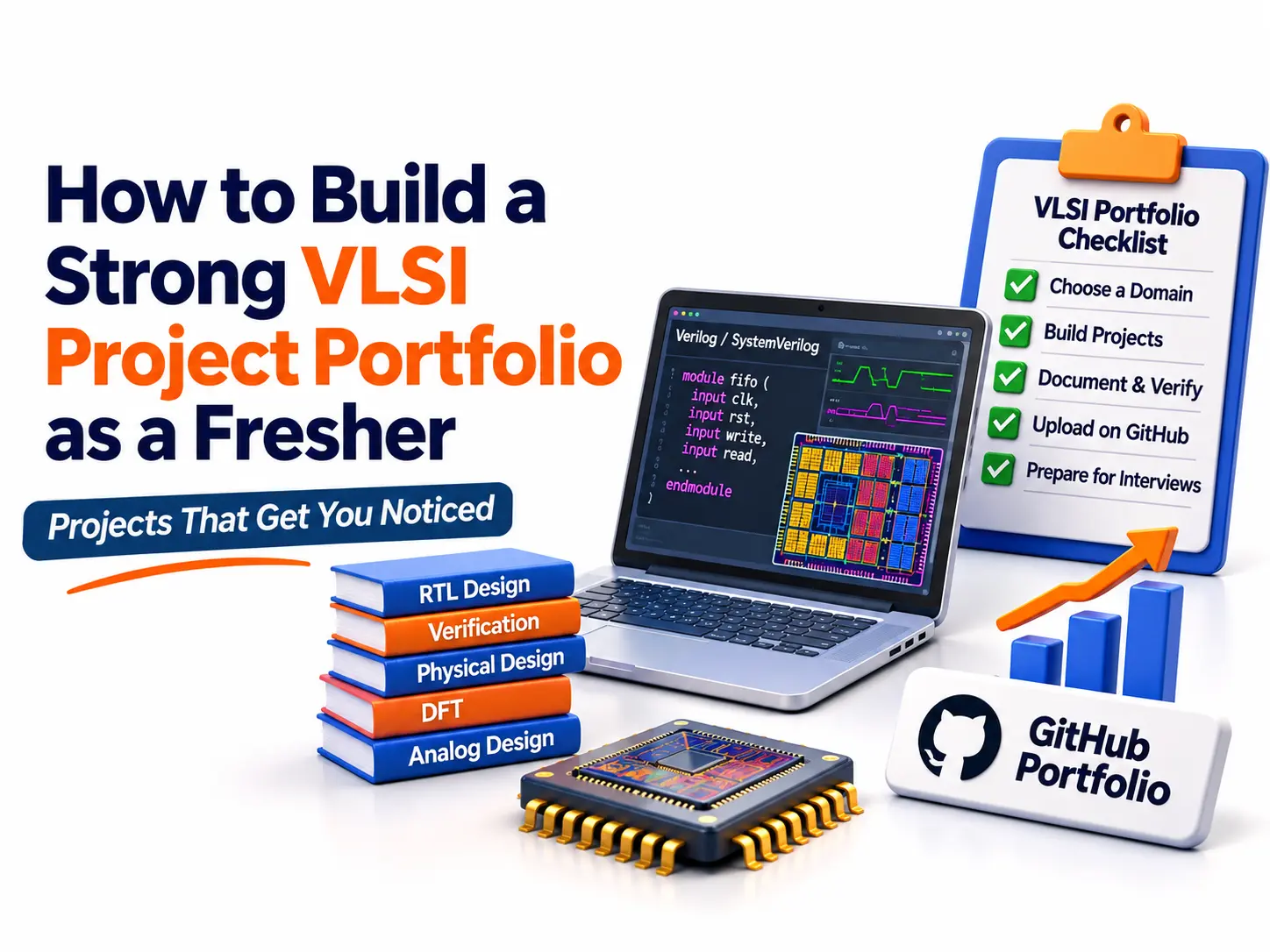
How to Build a Strong VLSI Project Portfolio as a Fresher
Navigate through this article using the table of contents below
Table of Contents
No headings found in this article.
A degree in Electronics and Communication Engineering can introduce you to semiconductor technology, but does it prove that you can actually design, verify or implement a chip? For VLSI freshers, a strong project portfolio can provide that missing evidence.
Recruiters want more than certificates and theoretical knowledge. They want to understand how you approach engineering problems, use technical tools, debug errors and deliver working designs. Building the right portfolio can help you demonstrate these abilities and prepare for semiconductor industry opportunities.
Understand Which VLSI Domain You Want to Enter
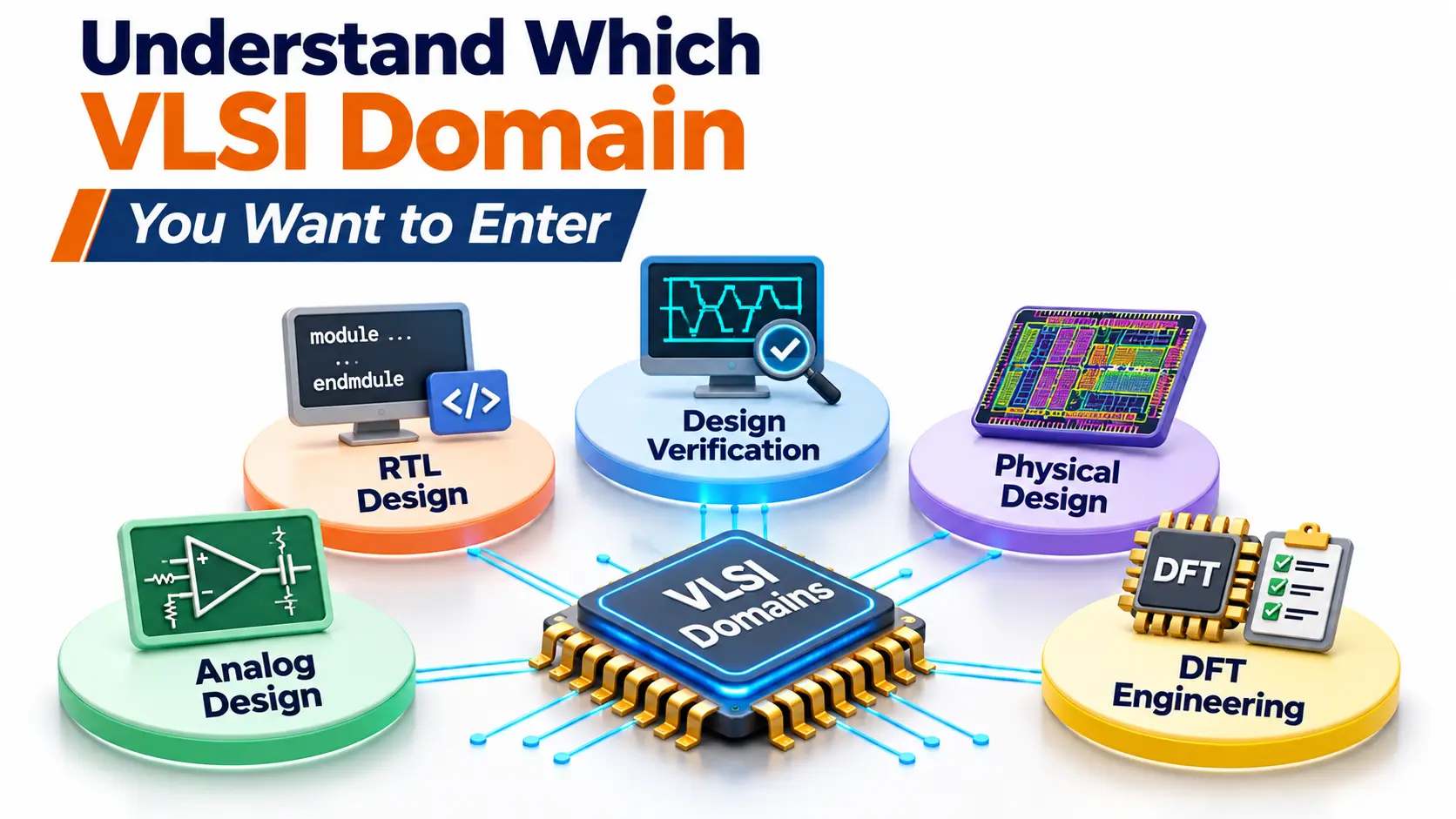
Before starting projects, identify the VLSI specialization that matches your interests and career goals. The semiconductor industry includes multiple engineering domains, and each requires different technical abilities. Building unrelated projects without a clear direction can make your portfolio look unfocused.
Freshers should understand the responsibilities associated with different roles before selecting projects.
Consider these major specializations:
RTL Design: Focuses on digital logic implementation using Verilog and SystemVerilog.
Design Verification: Involves verifying hardware functionality through testbenches, assertions and coverage analysis.
Physical Design: Concentrates on floorplanning, placement, clock tree synthesis, routing and timing closure.
DFT Engineering: Focuses on improving chip testability through scan insertion, ATPG and fault analysis.
Analog Design: Involves transistor-level circuit design, simulation and performance analysis.
For example, someone interested in RTL development can begin with an ALU, FIFO or UART controller. A candidate targeting verification can develop self-checking testbenches and explore SystemVerilog Assertions.
Similarly, aspiring physical design engineers should understand the complete RTL-to-GDSII flow. Candidates exploring DFT should learn scan architecture and ATPG fundamentals.
Choosing a specialization helps you build a portfolio that communicates a clear technical direction rather than presenting disconnected academic assignments.
Build Practical Projects That Demonstrate Technical Skills
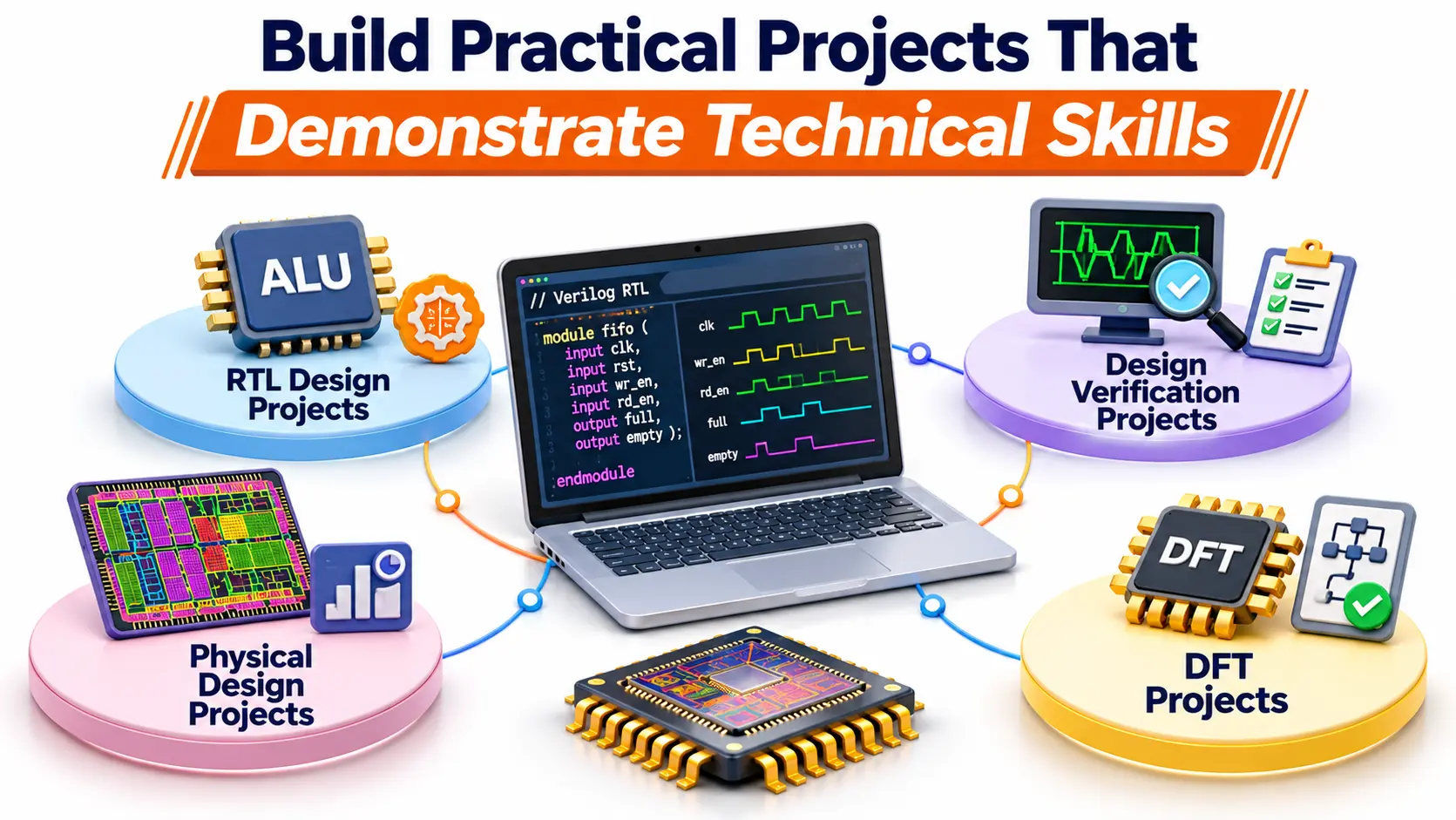
Project selection plays an important role in establishing your technical credibility. Instead of collecting numerous beginner-level assignments, focus on completing a few projects that demonstrate progressively stronger engineering capabilities.
A good portfolio should show that you understand digital fundamentals and can apply them to practical hardware problems.
Some useful project ideas include:
RTL Design Projects
Design an 8-bit ALU supporting arithmetic and logical operations.
Implement a synchronous FIFO with full and empty flag generation.
Develop a UART transmitter and receiver using Verilog.
Create a simple pipelined processor architecture.
Design Verification Projects
Develop a self-checking testbench for a FIFO.
Verify an APB interface using SystemVerilog.
Implement assertions for protocol checking.
Generate functional coverage reports for different operating conditions.
Physical Design Projects
Execute synthesis and floorplanning for a small RTL design.
Perform placement and clock tree synthesis.
Analyze setup and hold timing violations.
Complete an open-source RTL-to-GDSII implementation using a suitable platform.
DFT Projects
Implement scan chain architecture.
Explore stuck-at fault models.
Generate basic ATPG patterns.
Analyze fault coverage and testability.
The important factor is not the complexity of the project name. It is the technical work you can demonstrate. A properly verified FIFO with documented corner cases can provide stronger evidence than an advanced processor design that you cannot explain.
Document Every Project with Technical Evidence
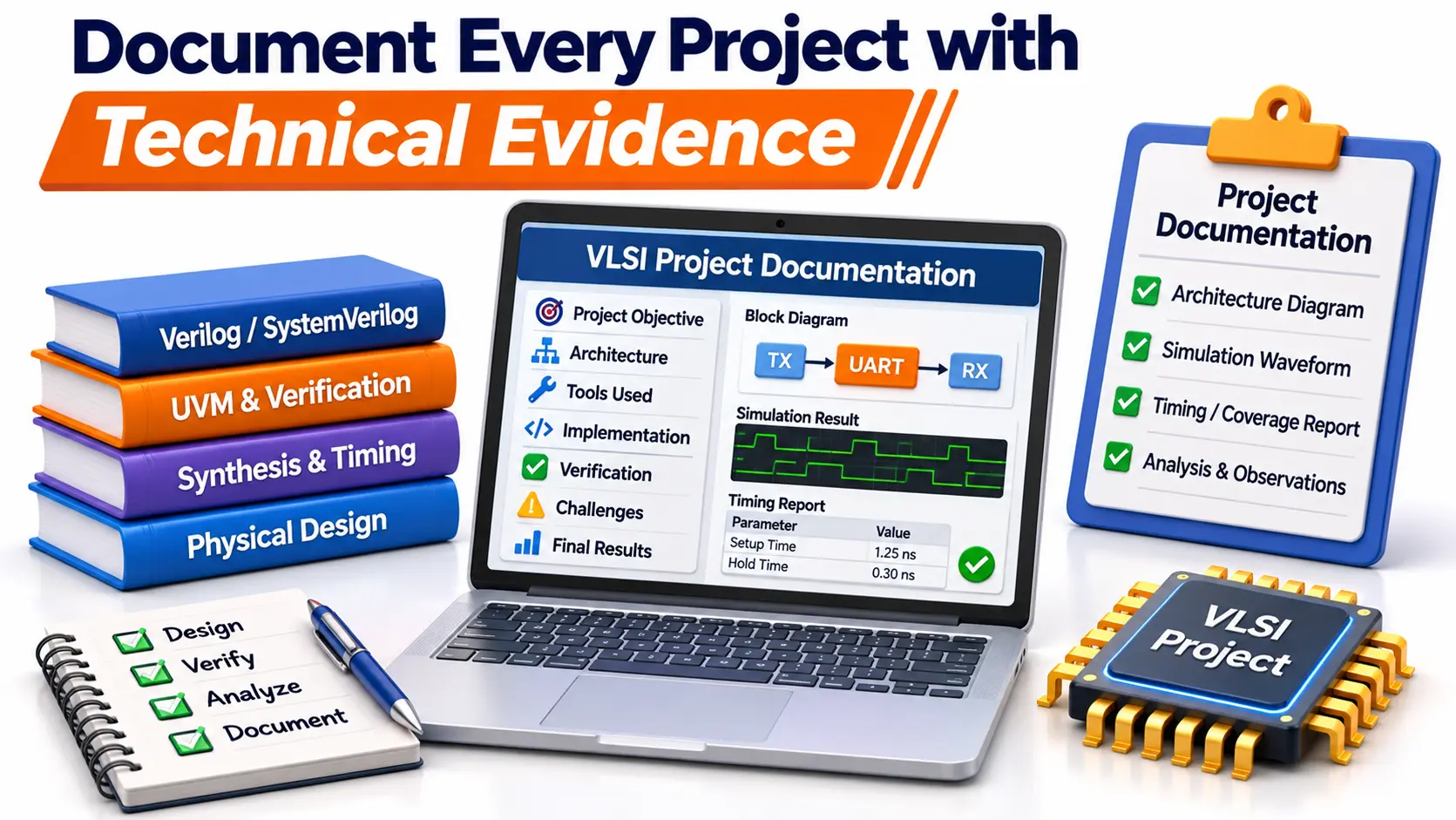
Completing a project is only one part of portfolio development. You must also communicate how the design works, what technical decisions you made and how you validated the implementation.
Every project should have a dedicated documentation section explaining its objective, architecture, implementation and results.
Include the following information:
Project Objective: Explain the engineering problem you intended to solve.
Architecture: Describe the functional blocks and their relationships.
Tools Used: Mention the HDL, simulator, synthesis platform or EDA software.
Implementation: Explain important design decisions and development stages.
Verification: Include test scenarios, expected behavior and actual results.
Challenges: Describe errors encountered and how you resolved them.
Final Results: Present relevant simulation outputs, timing reports or coverage results.
For example, when documenting a UART project, explain the baud-rate generator, transmitter state machine, receiver logic and serial communication behavior. Include waveform screenshots demonstrating successful transmission and reception.
For a physical design project, provide relevant floorplan screenshots, placement results, timing reports and implementation observations.
Candidates undertaking Physical Design Training should also understand how congestion, clock skew, setup violations and routing affect the final implementation.
Always use genuine results from your own implementation. Never publish fabricated timing numbers, coverage percentages or performance improvements.
Create a Professional GitHub Portfolio
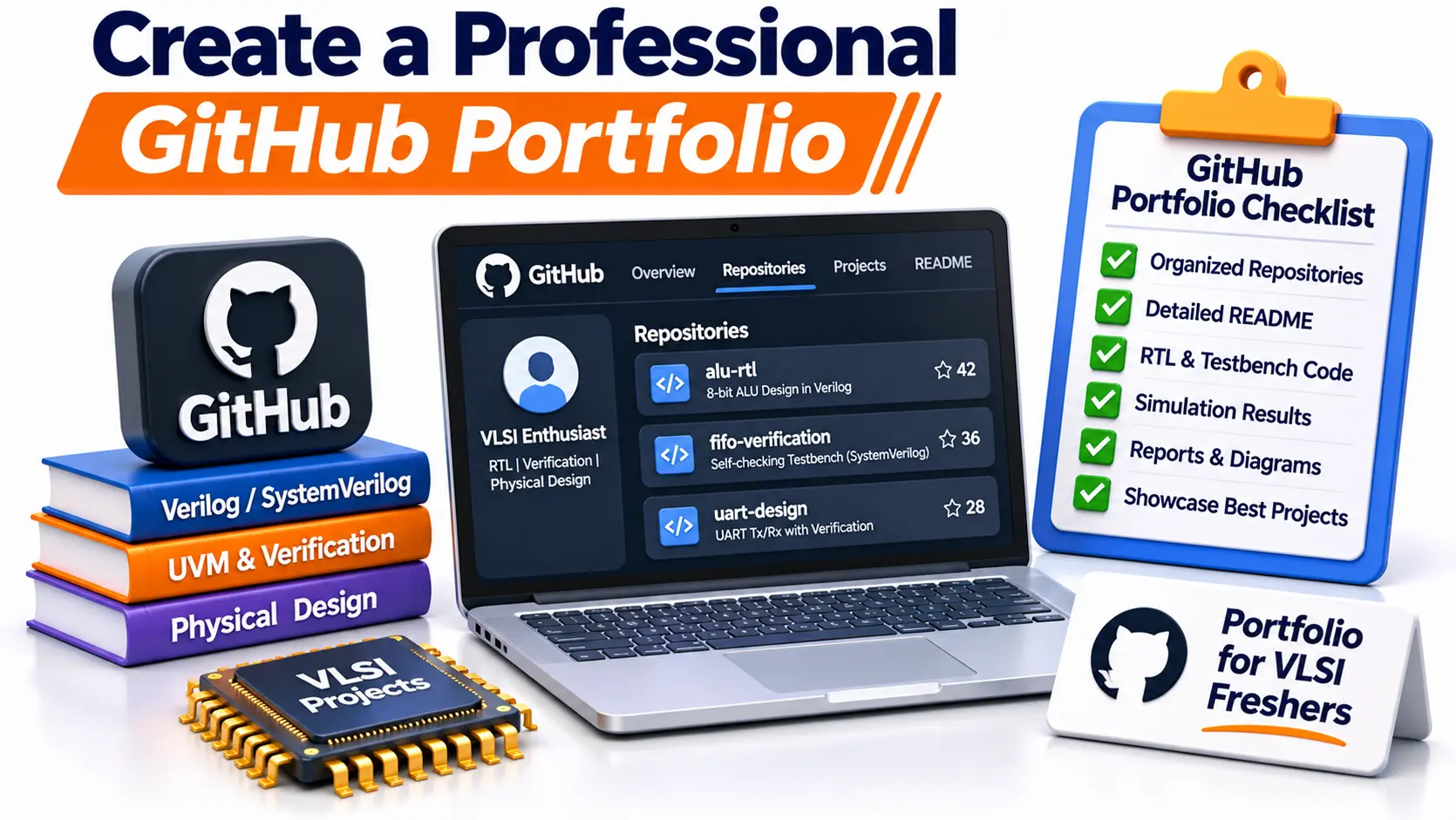
GitHub provides a convenient platform for organizing source code and demonstrating your practical engineering experience. A properly maintained profile allows recruiters and technical interviewers to explore your projects without depending entirely on your resume descriptions.
Start by creating a professional GitHub profile with a clear introduction explaining your technical interests and specialization.
Organize your repositories using descriptive project names. Avoid uploading every assignment into one unstructured folder.
A useful repository structure could look like this:
Project name and objective.
README documentation.
RTL source files.
Testbench files.
Simulation scripts.
Architecture diagrams.
Waveform screenshots.
Synthesis or implementation reports.
Final observations.
For example, a UART repository should separate transmitter RTL, receiver RTL, baud-rate generation and verification components wherever appropriate.
Include instructions explaining how someone can run your simulation. Mention the required tools and commands instead of assuming that readers already understand your development environment.
Maintain meaningful commit messages such as "Added FIFO overflow checking" rather than repeatedly writing "updated files."
Your GitHub profile should highlight your strongest two or three projects. A smaller collection of complete, understandable repositories is generally more convincing than dozens of unfinished uploads.
Showcase Debugging, Optimization and Problem-Solving Skills
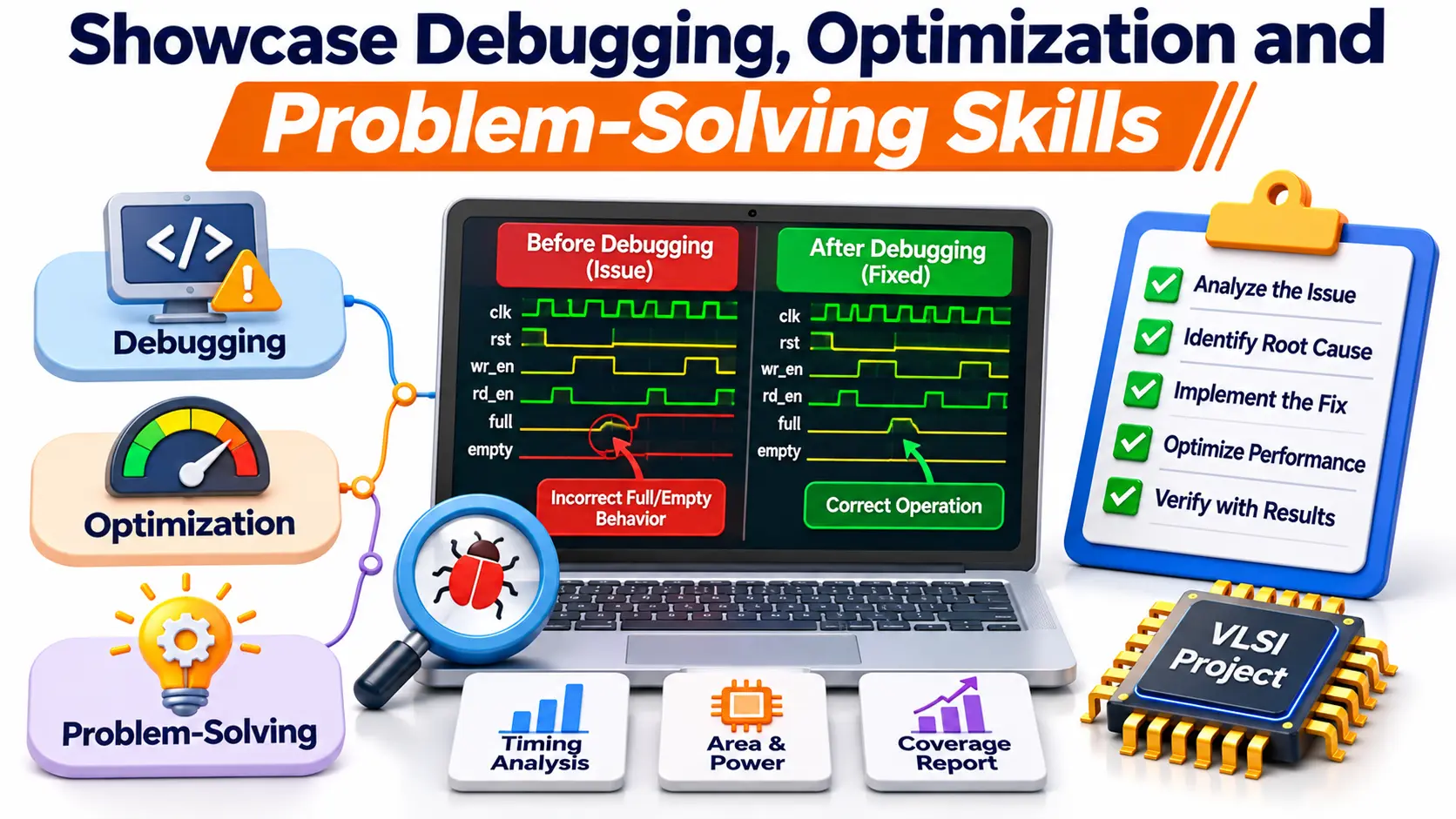
One major difference between an academic project and an industry-oriented engineering project is the ability to identify and resolve technical problems.
A strong portfolio should demonstrate not only successful results but also the engineering reasoning behind those results.
Consider a FIFO implementation that produces incorrect empty and full flags during simultaneous read and write operations. Instead of simply correcting the RTL, document the original issue, reproduce the failure and explain the changes made to resolve it.
Similarly, physical design projects can demonstrate how timing violations are identified and addressed.
Useful technical evidence includes:
Setup and hold timing analysis.
Clock skew observations.
Logic synthesis reports.
Area and power estimates.
Functional coverage reports.
DRC and LVS results, where applicable.
Before-and-after comparisons supported by actual measurements.
You can also include short explanations of why you selected a particular architecture or implementation approach.
For example, explain why a synchronous FIFO was suitable for a particular application or how changing the clock tree strategy influenced timing.
Candidates pursuing VLSI Training Hyderabad opportunities should focus on developing these practical problem-solving abilities alongside their theoretical understanding.
This documentation becomes especially valuable during interviews because it gives you real engineering experiences to discuss rather than relying on memorized technical definitions.
Connect Your Portfolio with Your Resume and Interview Preparation
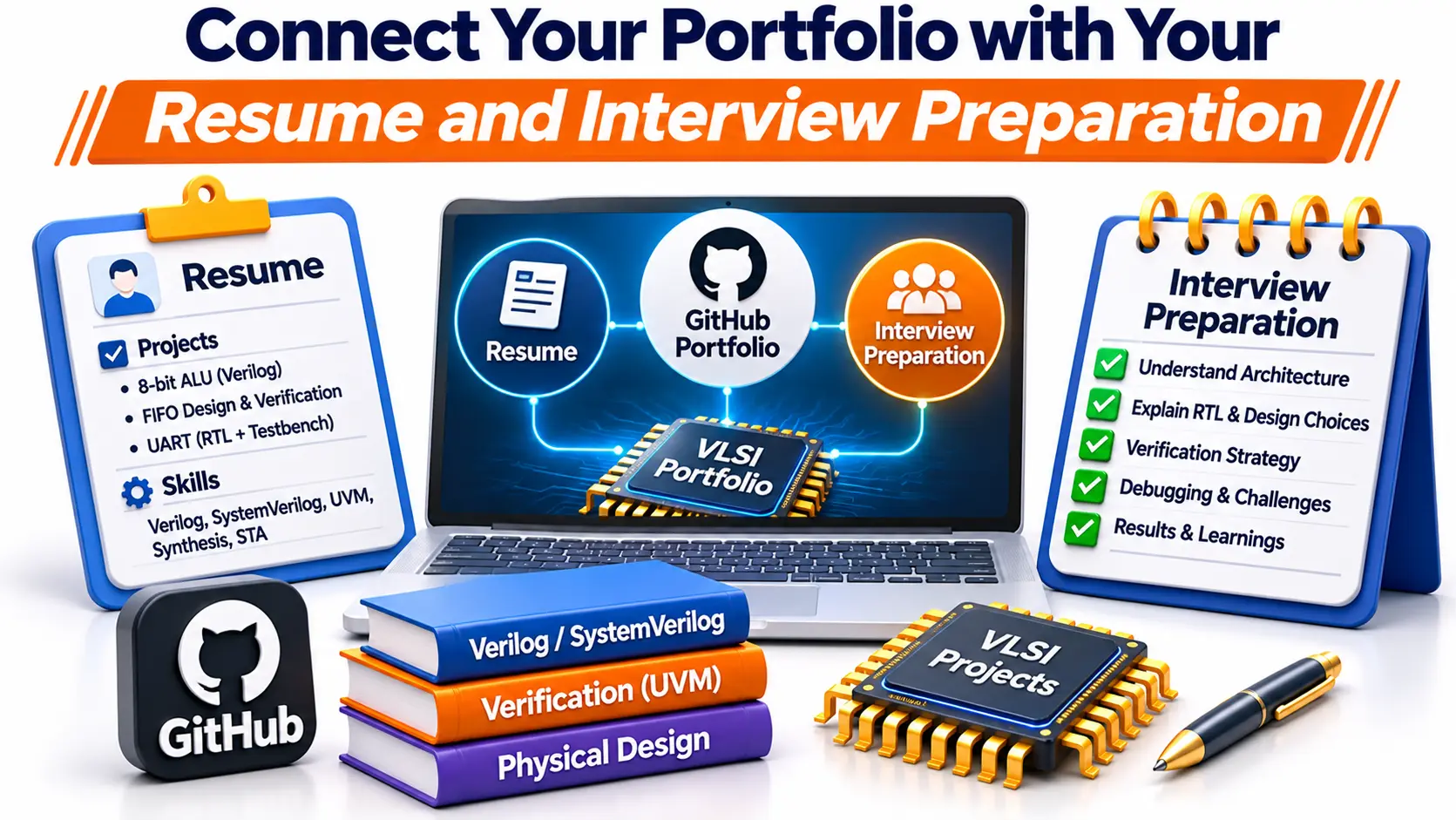
A portfolio becomes more valuable when it is integrated with your professional profile. Your resume, GitHub repositories and LinkedIn profile should communicate the same technical strengths.
For freshers, projects can provide evidence of practical abilities when professional semiconductor experience is limited.
Follow these steps to connect your portfolio with your job applications:
Add your GitHub profile link to your resume.
Mention two or three relevant projects prominently.
Describe the technologies and tools used.
Include measurable results wherever available.
Highlight your individual contribution to team projects.
Keep your LinkedIn technical profile updated.
Prepare to explain every project mentioned in your resume.
Avoid writing generic statements such as "Worked on VLSI projects using Verilog." Instead, describe what you actually implemented.
For example: "Designed and verified an 8-bit ALU supporting multiple arithmetic and logical operations using Verilog, with a self-checking testbench and waveform-based functional validation."
Before attending interviews, prepare explanations covering architecture, RTL coding decisions, verification strategies, debugging challenges and project limitations.
JastTech emphasizes practical semiconductor learning that connects fundamental concepts with implementation-oriented skills. Structured learning, project development and technical guidance can help freshers understand how their academic knowledge relates to industry expectations.
Remember that a portfolio does not guarantee employment. However, it gives interviewers something concrete to evaluate and gives you an opportunity to demonstrate your engineering knowledge with confidence.
Conclusion
Building a strong VLSI project portfolio requires more than completing assignments or uploading source code. It involves selecting the right specialization, implementing meaningful projects, documenting technical decisions, verifying functionality and presenting measurable results. Freshers who demonstrate these abilities can communicate their practical knowledge more effectively to semiconductor recruiters.
Start with one project that matches your preferred engineering domain and complete it properly before moving to more advanced implementations. Gradually build your GitHub presence, improve your debugging skills and prepare to explain your technical decisions. With consistent effort and practical learning, JastTech can help aspiring engineers develop a stronger foundation for pursuing opportunities in the semiconductor industry.