


How to Prepare for a Guidewire Interview and Improve Your Chances of Getting Hired
Navigate through this article using the table of contents below
Table of Contents
No headings found in this article.
Knowing 100 Guidewire definitions may help you answer the first few questions. It will not necessarily help when an interviewer gives you a broken business process and asks how you would investigate it. That is where real interview preparation begins.
Strong candidates connect insurance workflows, Guidewire architecture, configuration, Gosu, integrations, debugging, and project experience into one clear story. Instead of memorizing everything, you need to understand what your target role expects and learn how to demonstrate that knowledge under pressure.
Prepare for the Role, Not Just the Technology
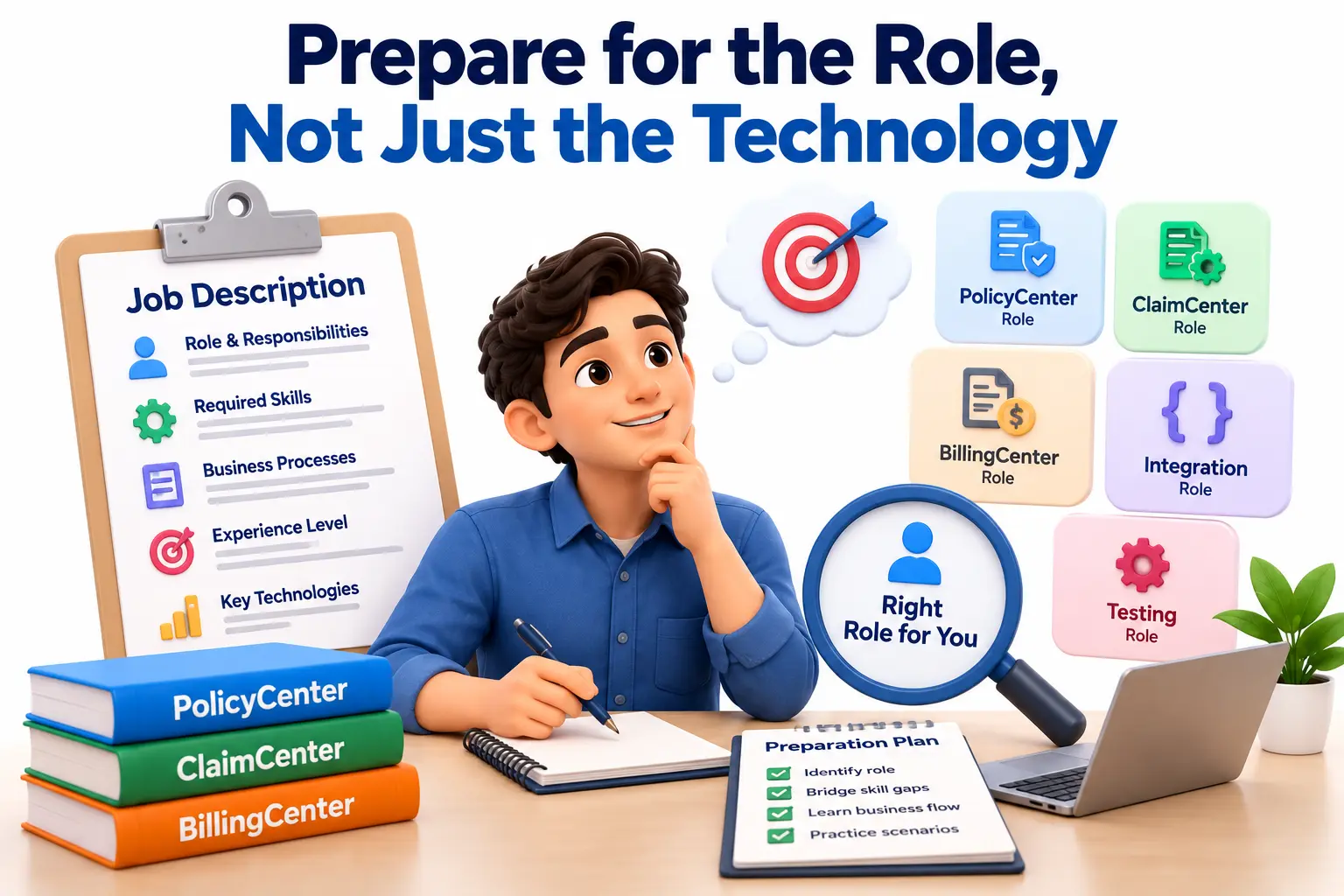
Before studying technical questions, read the job description carefully. A PolicyCenter configuration developer, ClaimCenter developer, integration developer, tester, and BillingCenter specialist may all work with Guidewire, but their interviews can examine very different areas.
Create a preparation checklist directly from the job description. Identify every repeated technology, application, business process, and responsibility. Then classify your preparation into three categories:
Concepts you can explain confidently
Concepts you understand but cannot apply practically
Skills or workflows you still need to learn
If the position emphasizes PolicyCenter, for example, you should understand policy transactions and product configuration rather than spending equal time on every InsuranceSuite application. For ClaimCenter, study claim lifecycle concepts, exposures, activities, reserves, payments, and relevant configuration. Your preparation becomes much more efficient when every study session has a role-specific purpose.
JastTech encourages learners to approach interview preparation this way because employers ultimately recruit for responsibilities, not for the number of definitions a candidate can memorize.
Build the Technical Foundation Interviewers Can Test
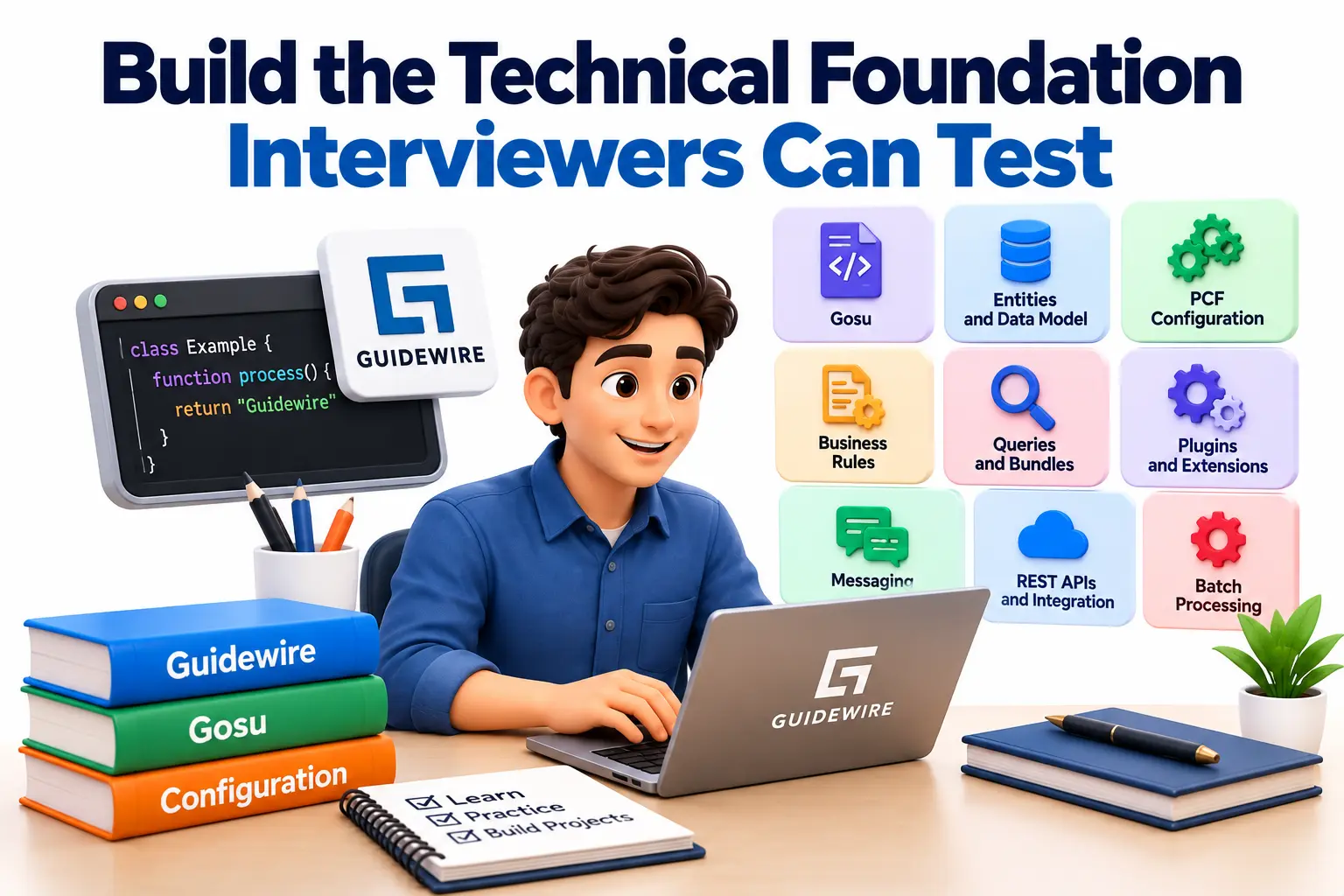
Your next priority is the technical layer underneath your chosen specialization. For development and configuration roles, revise Gosu carefully. Be comfortable with classes, functions, properties, collections, enhancements, null handling, exception handling, and the way business logic interacts with Guidewire objects.
Then move into platform concepts. Depending on the position, preparation should include:
Entities and entity relationships
Typelists and typekeys
PCF configuration
Business rules
Queries and bundles
Validation
Plugins
Messaging
Batch processes
REST integrations
Debugging and logs
Do not prepare these as isolated definitions. If asked about an entity, you should be able to explain why you might extend the data model, how relationships affect the application, and what problems a poor implementation could create.
Current Guidewire environments also make Cloud and API awareness increasingly relevant. You do not need to pretend to have production experience you lack, but understanding REST concepts, authentication, application environments, deployments, and integration boundaries can make your technical answers more complete.
Connect Guidewire Knowledge With Insurance Business Flows
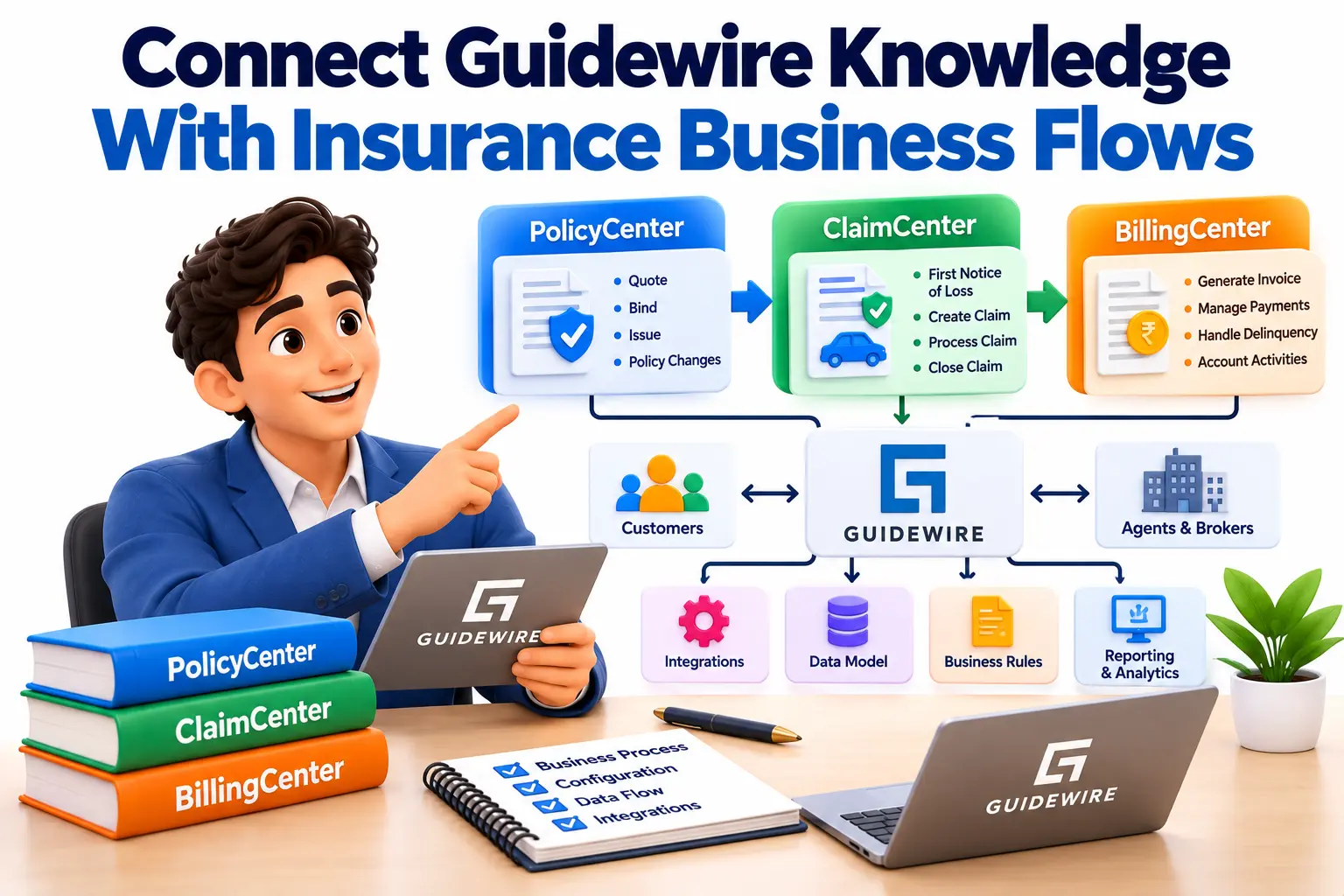
One of the easiest ways to expose memorized knowledge is to ask a candidate what happens before and after a technical action. You might know how to configure something, but do you understand the business process that configuration supports?
During your guidewire interview, practice explaining an end-to-end flow instead of only individual screens. PolicyCenter candidates might trace submission through quoting, binding and issuance. ClaimCenter candidates can follow a claim from first notice of loss through exposures, reserves, payments and closure.
Candidates taking guidewire training in india should therefore evaluate preparation by the workflows they can independently explain and implement, rather than simply by course completion. Training becomes useful when it creates practical reasoning that survives follow-up questions.
The same principle applies when preparing for guidewire billingcenter responsibilities. Understand why invoicing, payment plans, payments, delinquency, commissions and account-level activities exist and how changes elsewhere in the insurance lifecycle can influence billing.
Business knowledge gives technical answers context. Instead of saying, “I configured a rule,” explain which business event triggered it, what information it evaluated, what action occurred, and how you verified the result.
Practice Scenario-Based Questions Like a Troubleshooter
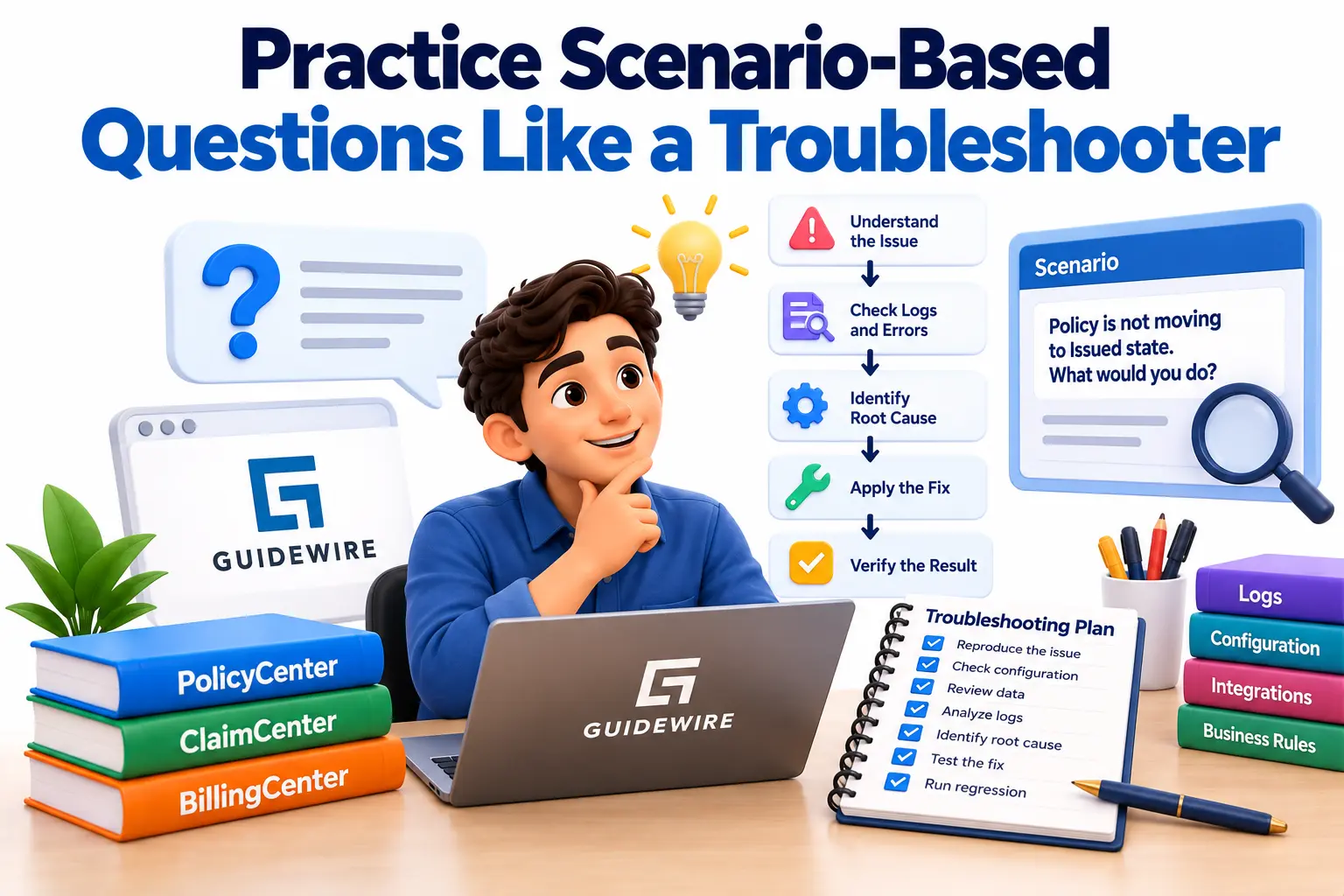
Scenario questions separate candidates who have read Guidewire material from candidates who can reason through a system. An interviewer may deliberately give you incomplete information. Your job is not always to produce an instant answer; it is to show a structured investigation process.
Imagine a transaction that previously worked but suddenly fails after a change. Instead of guessing, organize your response:
Reproduce the issue consistently.
Identify the affected transaction and environment.
Review logs and error details.
Determine whether configuration, data, integration, permissions, or another dependency changed.
Narrow the failure to the responsible component.
Test the smallest reasonable fix.
Run regression checks before considering the problem resolved.
This method is more persuasive than jumping directly to a technical buzzword. Interviewers can ask follow-up questions such as, “What if there is no error in the application log?” or “What if it only happens for one account?” A structured approach lets you adapt.
Create at least five scenarios from every major skill on your resume. Practice explaining the symptom, investigation, root cause, solution, and verification. This simultaneously prepares you for technical, project and troubleshooting discussions.
Turn Your Project Experience Into Evidence
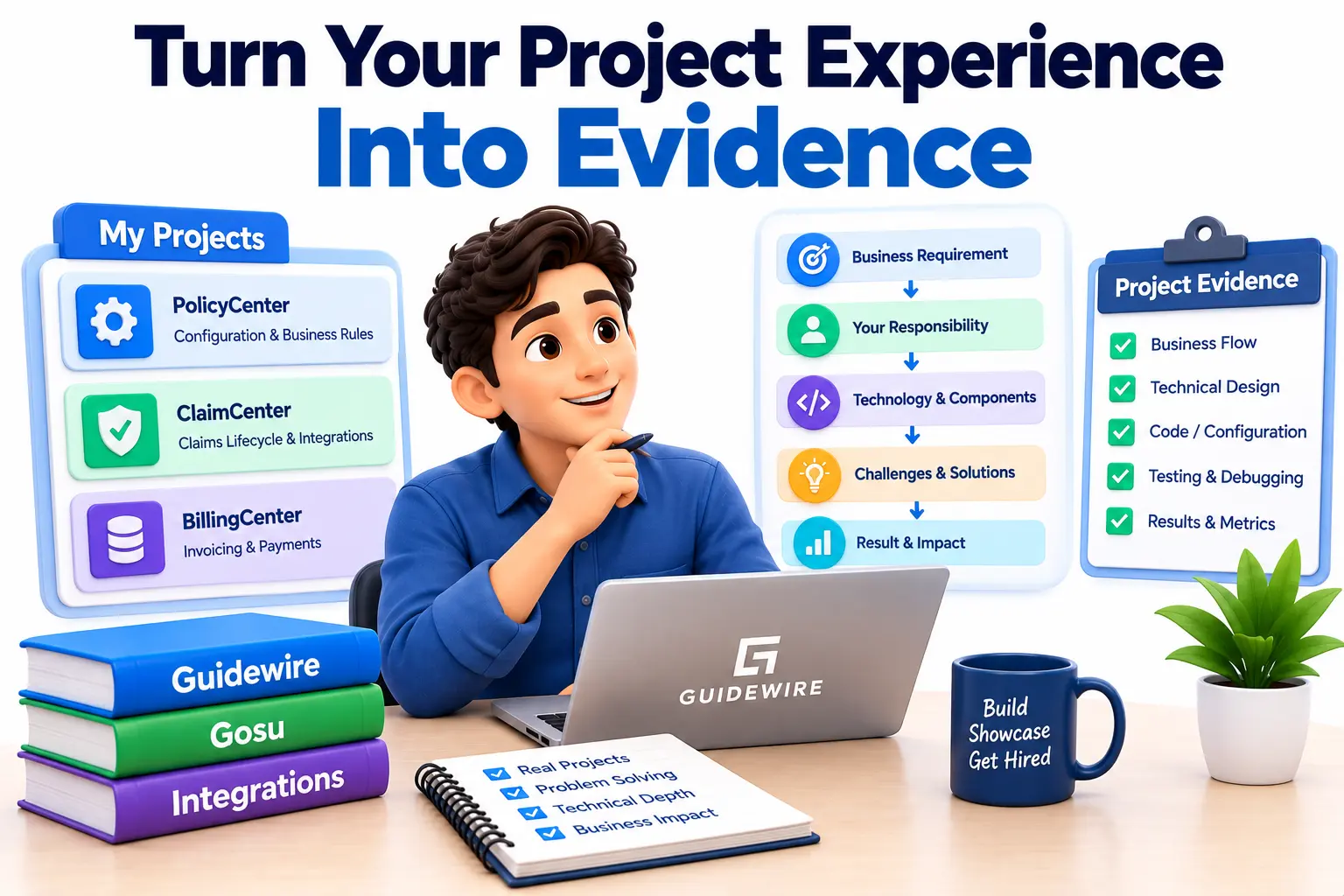
A resume may say “worked on PolicyCenter configuration,” but that statement gives an interviewer very little evidence. Before the interview, convert every major project into a story you can defend technically.
For each project, write down the business requirement, your responsibility, the Guidewire components involved, your implementation approach, the biggest challenge, how you tested it, and the final result. Experienced candidates should also be prepared to explain trade-offs and what they would improve if they redesigned the solution today.
If you are a fresher without production experience, do not invent commercial project work. Build smaller realistic exercises instead. A well-understood practice project is more defensible than fabricated experience because you can explain every decision.
Your project explanation should answer three hidden questions: What did you personally do? Why did you choose that approach? How did you know it worked?
Also revisit every technology listed on your resume. If Gosu, REST APIs, SQL, PolicyCenter, ClaimCenter, Java, testing, or integrations appear there, assume an interviewer can ask about them. Removing unsupported claims can actually make your profile stronger because everything remaining becomes evidence you can confidently defend.
Rehearse the Interview Before the Real Interview
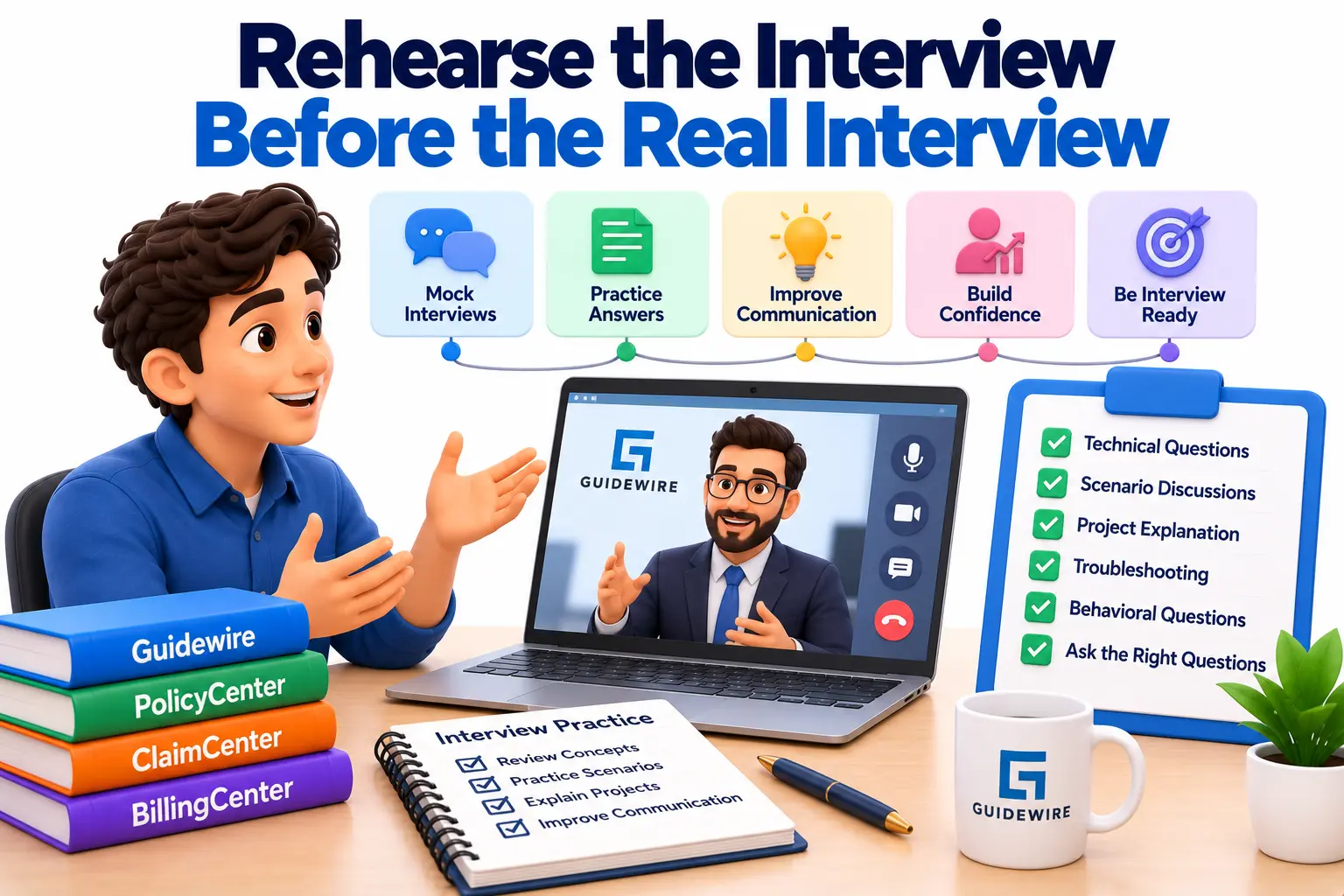
Knowledge retrieval under interview pressure is different from quietly reading notes. During the final stage of preparation, stop consuming new material and start practicing answers aloud.
Run mock sessions covering introductions, fundamentals, module-specific questions, Gosu or coding, scenarios, projects, debugging, integrations, and behavioral questions. Record yourself occasionally. You will quickly notice answers that are too long, vague, overly theoretical, or dependent on memorized wording.
For technical questions, use a simple answer pattern: define the concept, explain where it fits, provide an example, and mention an important consideration. For project questions, explain the requirement, your action, technical reasoning, problem encountered, and measurable or observable result.
Do not bluff when you do not know something. Explain what you understand, state the boundary of your knowledge, and describe how you would investigate the problem. Technical interviews often test reasoning as much as recall.
Finally, prepare intelligent questions for the interviewer. Ask about the application you would work on, configuration versus integration responsibilities, Cloud environment, team structure, release process, testing responsibilities, or typical project challenges. Good questions demonstrate that you are evaluating the actual engineering role rather than simply trying to clear an interview.
Conclusion
Getting hired for a Guidewire role requires more than collecting hundreds of interview questions. The strongest preparation connects platform fundamentals with insurance processes, hands-on configuration, integrations, troubleshooting, and project reasoning. When you understand those connections, unexpected questions become easier because you can reason toward an answer instead of searching your memory for one.
Build depth in the role you are targeting, turn projects into evidence, practice realistic scenarios, and rehearse how you explain technical decisions. Whether you learn independently or develop practical skills through JastTech, focus on becoming someone who can explain not only what Guidewire does, but why a solution works and how you would investigate it when it does not.