

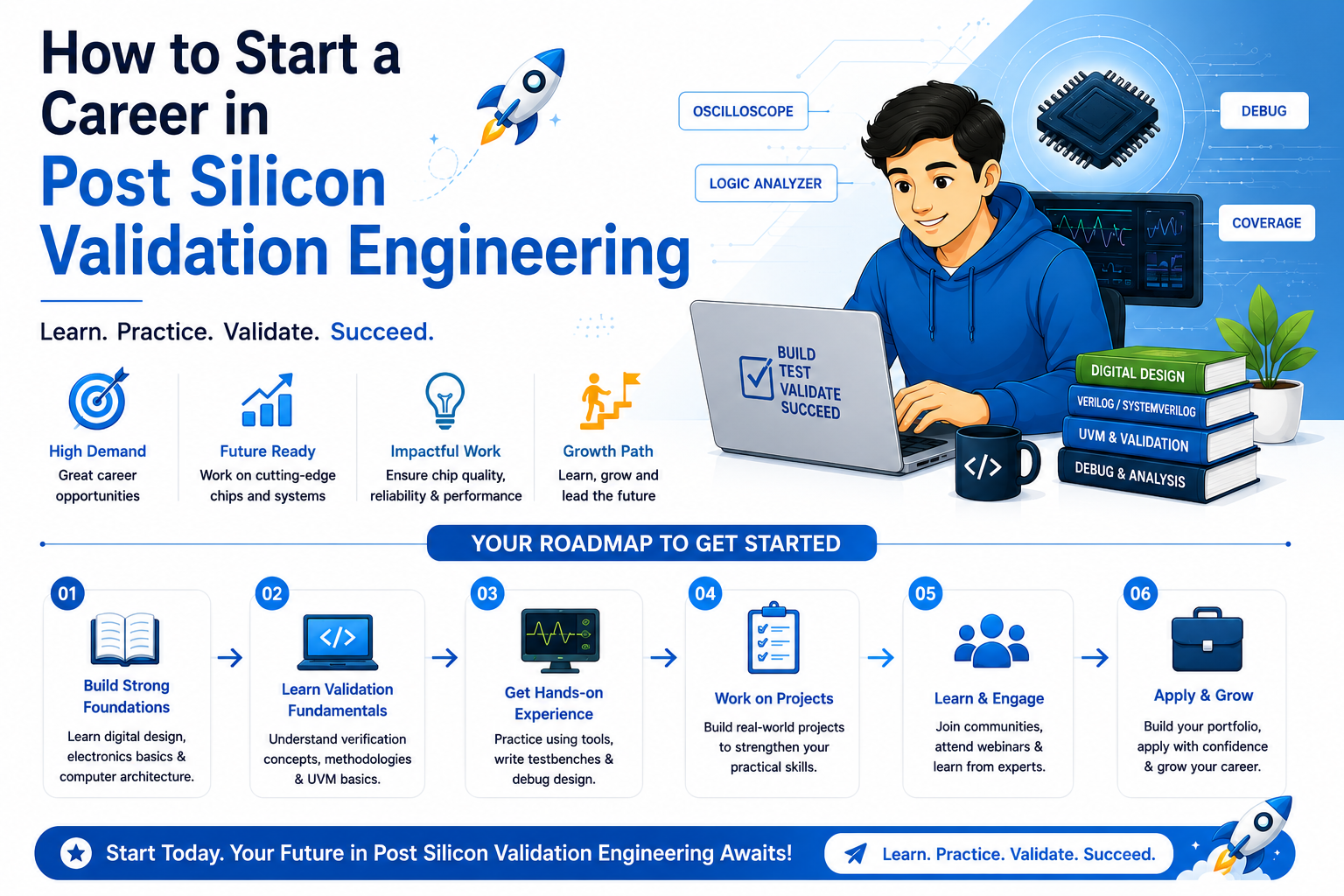
How to Start Your Career as a Post Silicon Validation Engineering
Navigate through this article using the table of contents below
Table of Contents
No headings found in this article.
Thousands of chips fail their first power-on test every year, and someone has to find out why before the product ever reaches a customer. That someone is a post-silicon validation engineer, and right now, demand for this role is outpacing the number of trained candidates.
If you are exploring a career in post silicon validation, searching for the right post silicon validation training, or trying to map out a roadmap to start post silicon validation, this guide gives you the complete, structured path most other resources skip over.
1. What Is Post-Silicon Validation, and Why Does It Matter?

Post-silicon validation is the process of testing a manufactured chip on real hardware to confirm it behaves exactly as intended, after fabrication, not just in simulation. Pre-silicon verification can model behavior mathematically, but it can never fully predict how a chip reacts to real voltage noise, real temperature swings, or real workloads running on actual boards.
This is exactly why companies treat post-silicon validation engineers as the final gatekeepers before mass production. A missed bug at this stage doesn't just cost engineering time, it can mean a product recall, a damaged reputation, or millions of dollars in lost revenue. For someone starting a career in post silicon validation, understanding this responsibility early shapes how seriously you should approach the learning process.
The role sits at the intersection of hardware, software, and pure detective work. You are reading datasheets one hour and debugging a failing handshake on an oscilloscope the next, which is exactly why this field attracts engineers who enjoy variety over routine.
2. Skills You Need Before You Start Applying
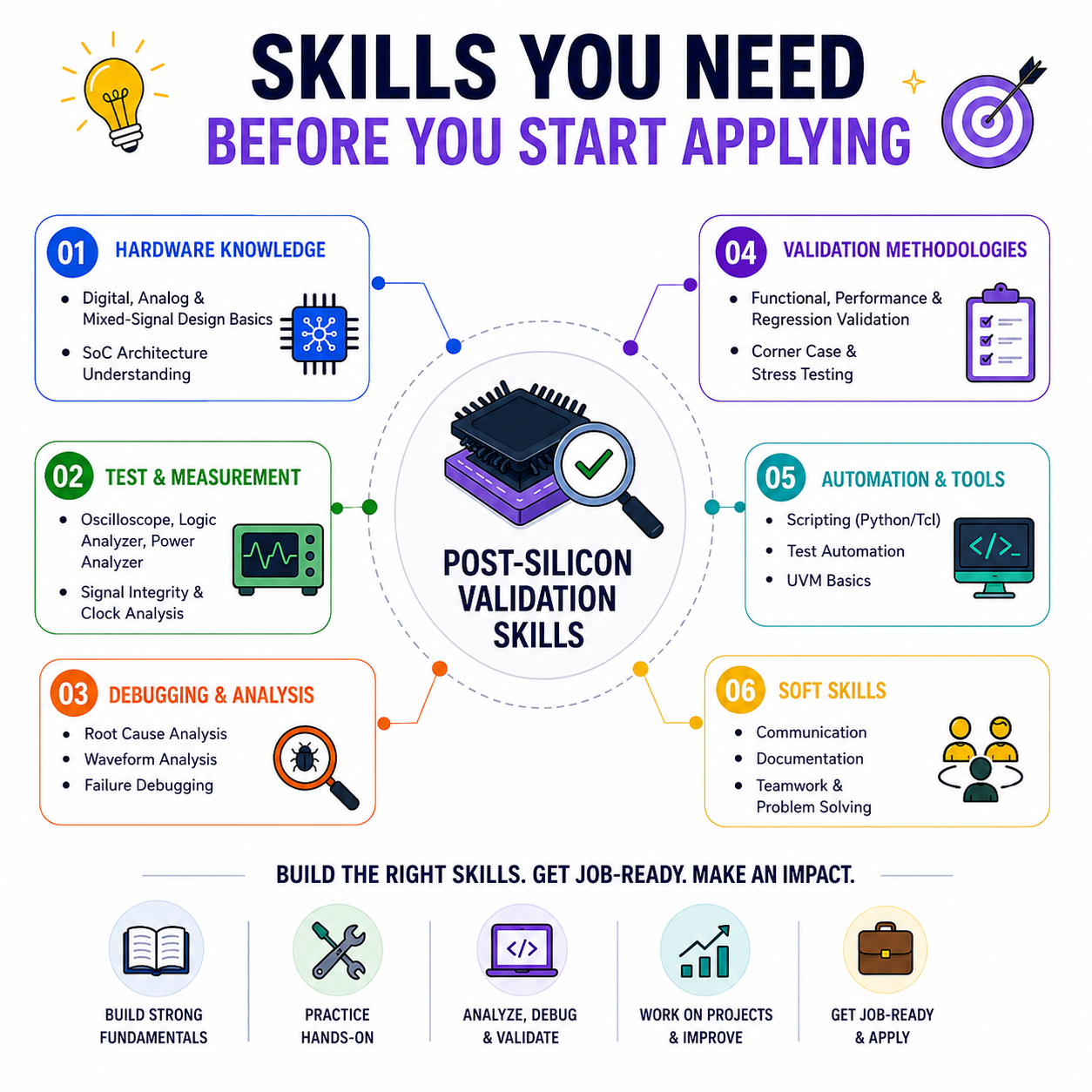
Before chasing job listings, build the foundational skill set that every recruiter screens for. This is also exactly what a good post silicon validation course should be teaching you in a structured order rather than leaving you to piece it together yourself.
Digital logic and SoC fundamentals: clocks, resets, buses, and basic chip architecture
Lab instrument familiarity: oscilloscopes, logic analyzers, JTAG debuggers, protocol analyzers
Scripting and automation: Python or Perl for writing and running test scripts at scale
Protocol knowledge: PCIe, USB, I2C, SPI, UART, and SD/eMMC interfaces
Operating system and firmware basics: Linux, BIOS/UEFI, and driver-level debugging
You don't need to master all five before applying anywhere, but you should be able to speak intelligently about each one in an interview.
3. The Step-by-Step Roadmap to Start Post Silicon Validation
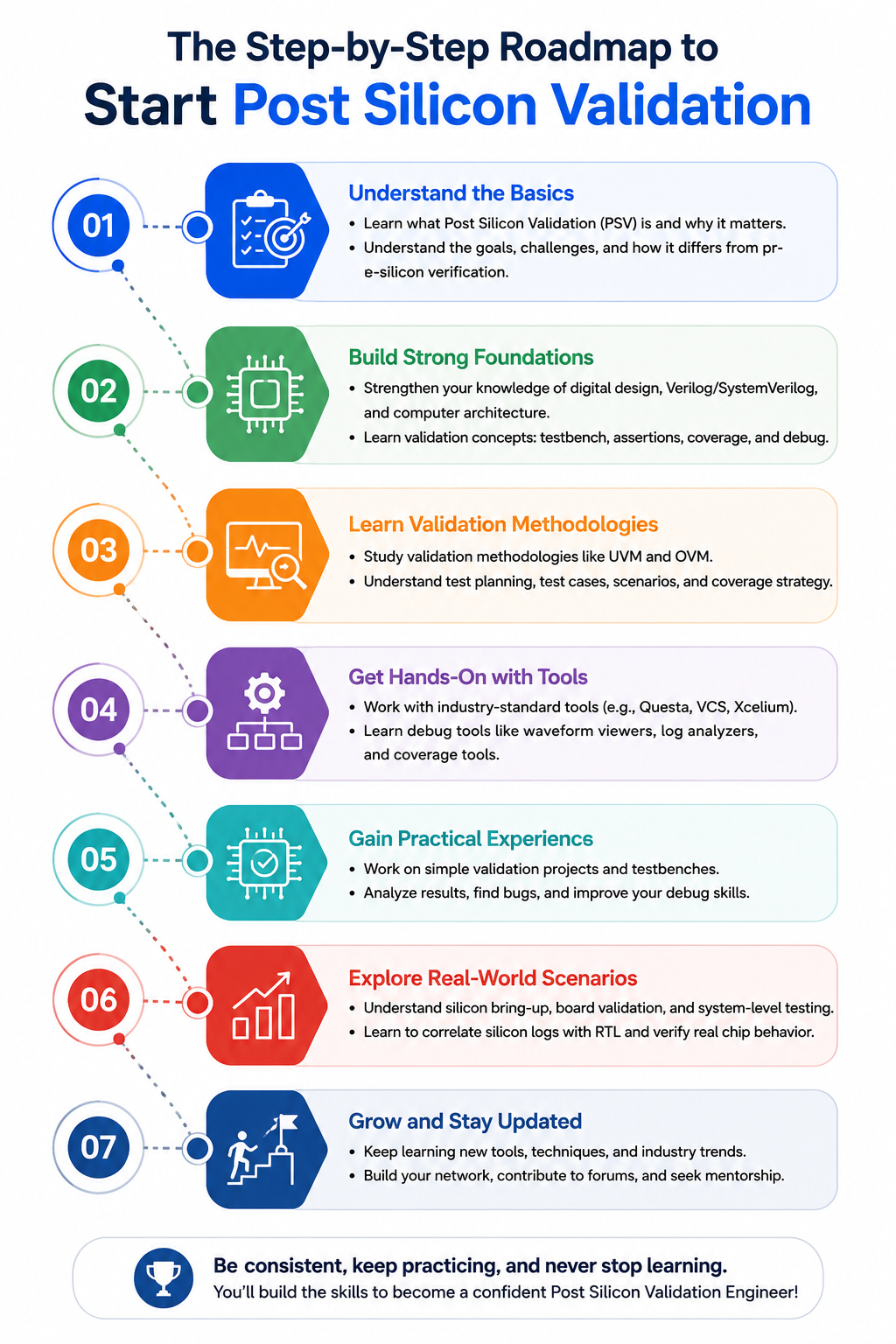
This is the roadmap to start post silicon validation that most career guides gloss over with vague advice like "learn the basics and apply." Here is the actual sequence that works:
Step 1: Strengthen your digital logic and computer architecture fundamentals
Step 2: Enroll in a structured post silicon validation training program or course
Step 3: Get hands-on lab time with real FPGA or ASIC development boards
Step 4: Build one personal bring-up project and document your debug process
Step 5: Apply to internships or entry-level roles at fabless companies, IDMs, or test labs
Most beginners skip straight from step one to step five, which is exactly why their applications get filtered out. Steps two through four are what actually make a resume stand out.
4. Choosing the Right Post Silicon Validation Training
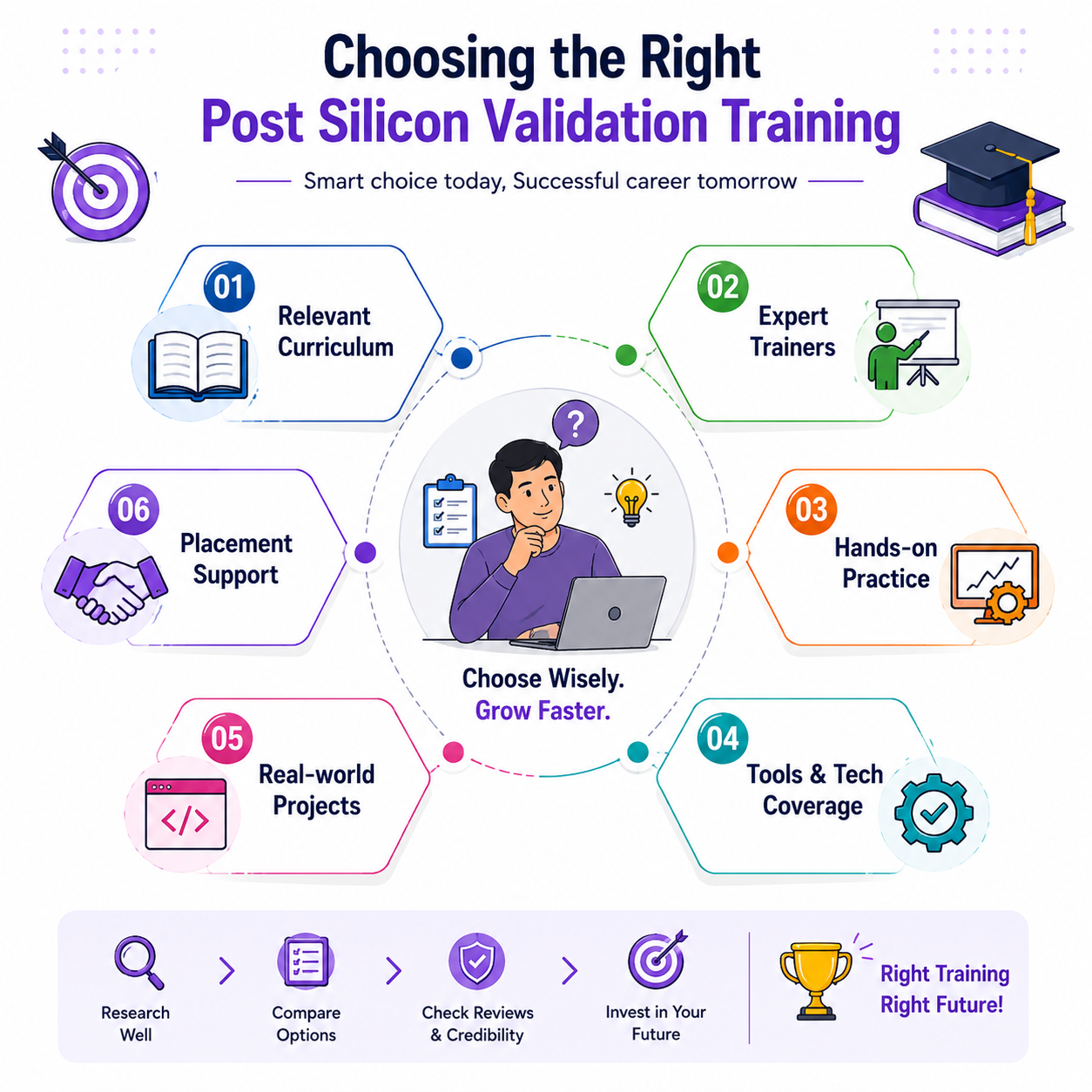
Not all training programs are built equally, and this is the single biggest decision point in your entire journey. A weak post silicon validation course with only slides and no lab access will leave you with knowledge but no provable skill.
Hands-on lab access with real hardware, not simulated environments only
Exposure to industry-standard tools: oscilloscopes, JTAG, protocol analyzers
A real project you walk away with and can describe confidently in interviews
Mentors who are practicing validation engineers, not just certified trainers
Placement support: resume help, mock interviews, and employer connections
5. Career Growth and Salary Outlook

A career in post silicon validation typically starts as an intern or junior validation engineer, working under senior engineers on bring-up and basic functional testing. Within two to three years, most engineers move into independent validation ownership, handling full subsystems and leading debug efforts on their own.
From there, the path branches into senior validation engineering, team leadership, or even a lateral move into design and pre-silicon verification for those who want broader exposure. Demand is accelerating further due to AI chips, automotive SoCs, and edge devices, all of which require extensive real-silicon testing before shipping at scale, keeping this career path well-positioned through 2026 and beyond.
Compensation reflects this demand. Entry-level validation engineers in major semiconductor hubs routinely start in a competitive range comparable to design and verification roles, and that gap narrows further as experience grows, since validation expertise becomes harder to replace the deeper a chip's complexity goes.
6. Common Mistakes Beginners Make
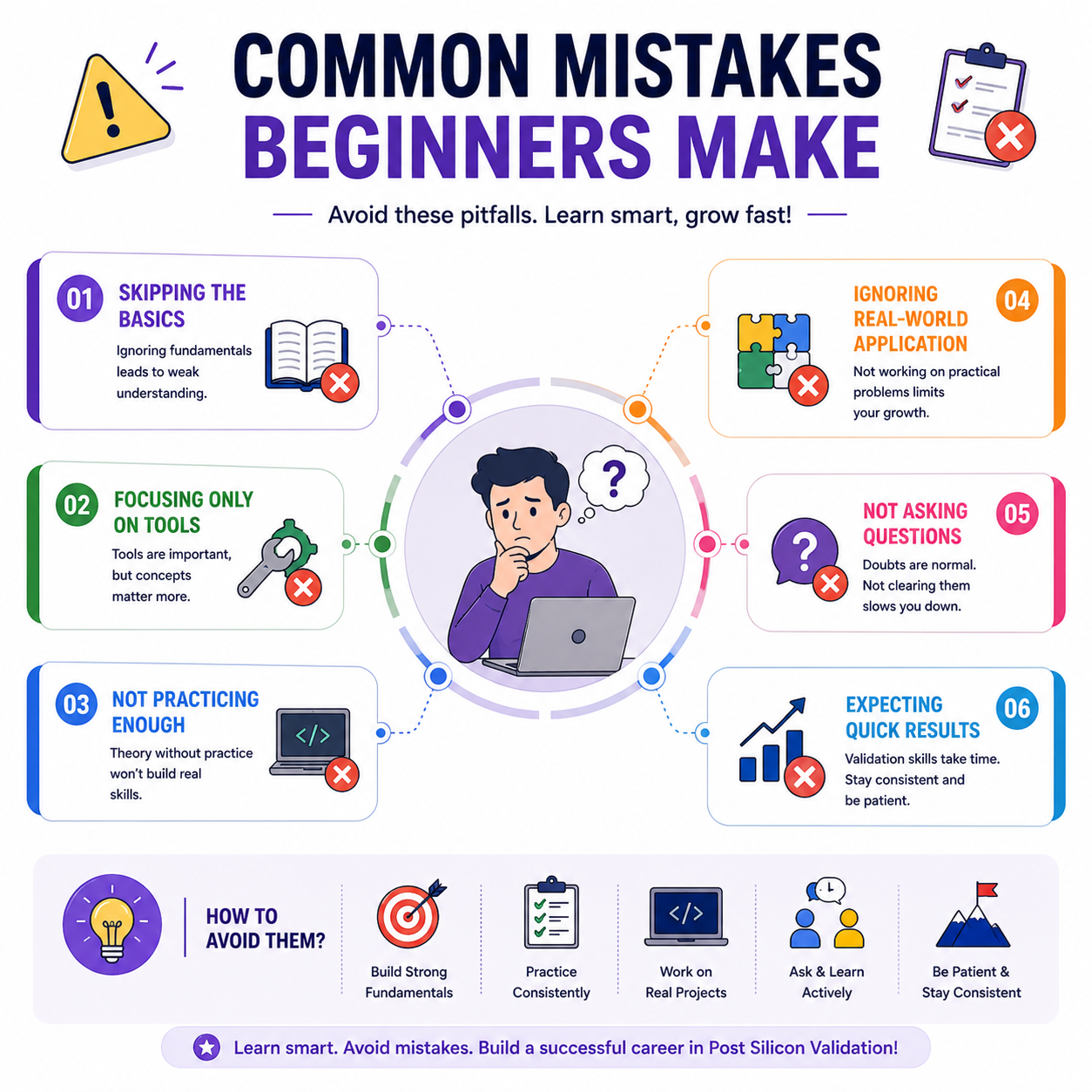
Avoiding a handful of predictable mistakes puts you ahead of most self-taught candidates competing for the same roles.
Skipping digital logic and SoC fundamentals to jump straight into lab tools
Learning only theory with zero hands-on board bring-up experience
Treating Python and scripting as optional rather than essential
Choosing a course based on price alone, ignoring lab access and placement support
If you correct just these four habits early, you will already be ahead of a large share of the candidates applying for the same entry-level positions.
Final Thoughts
A career in post silicon validation rewards people who are equally comfortable with theory and hands-on lab debugging. Start with strong fundamentals, choose a post silicon validation training program that gives you real project experience, and follow the roadmap step by step rather than skipping ahead. The chips of tomorrow, from AI accelerators to automotive processors, will need validation engineers who can find what simulation missed, and that demand is only growing.