

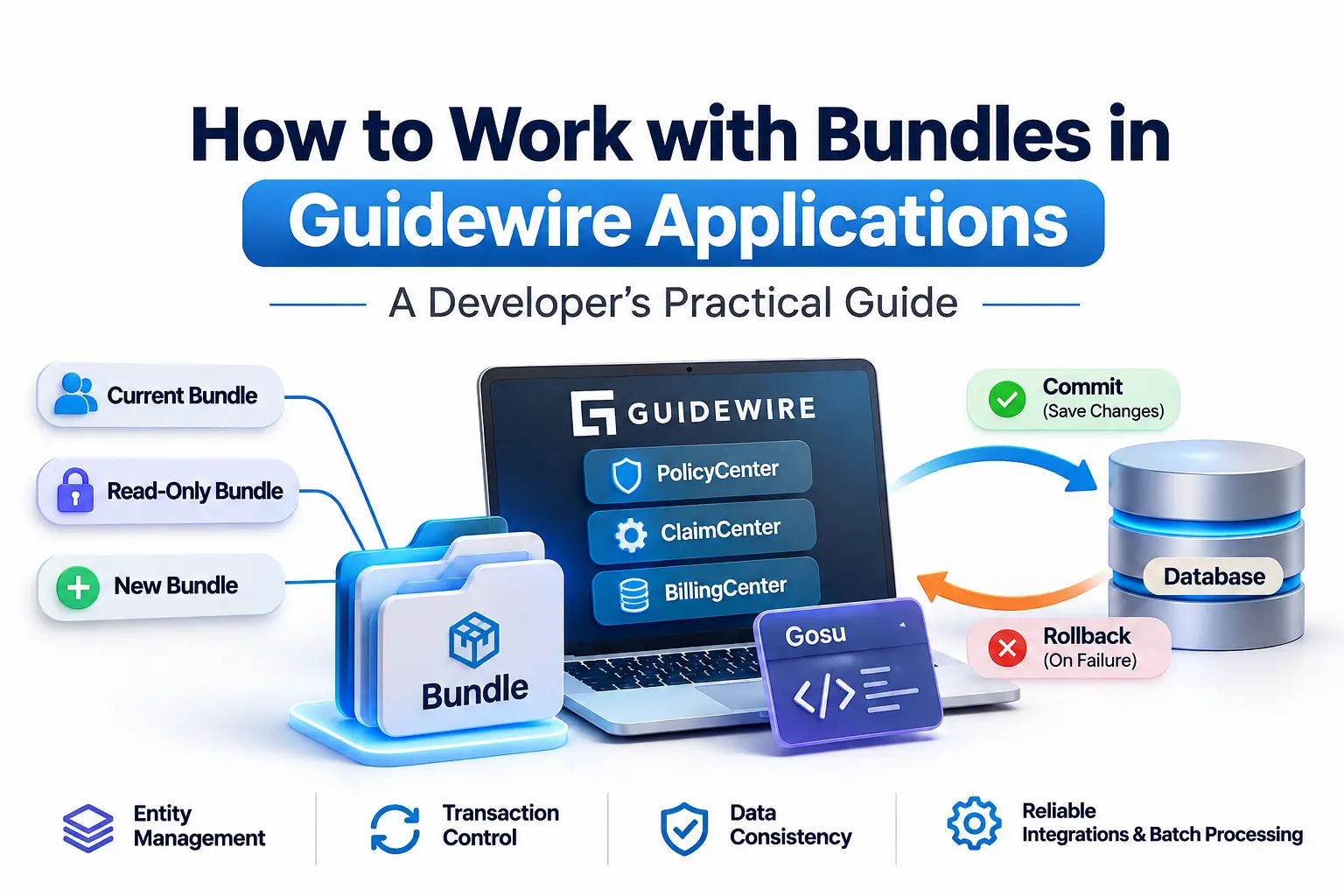
How to Work with Bundles in Guidewire Applications
Navigate through this article using the table of contents below
Table of Contents
No headings found in this article.
A small mistake in database transaction management can create major problems in an insurance application. In Guidewire, bundles help developers control how entity changes are processed, saved, and rolled back. Understanding them is essential for building reliable applications.
Whether you work with PolicyCenter, ClaimCenter, or BillingCenter, understanding bundle management can improve your Gosu programming skills. Let's explore how bundles work, when to use them, and how to handle them effectively in real development scenarios.
Understanding Bundles in Guidewire Applications
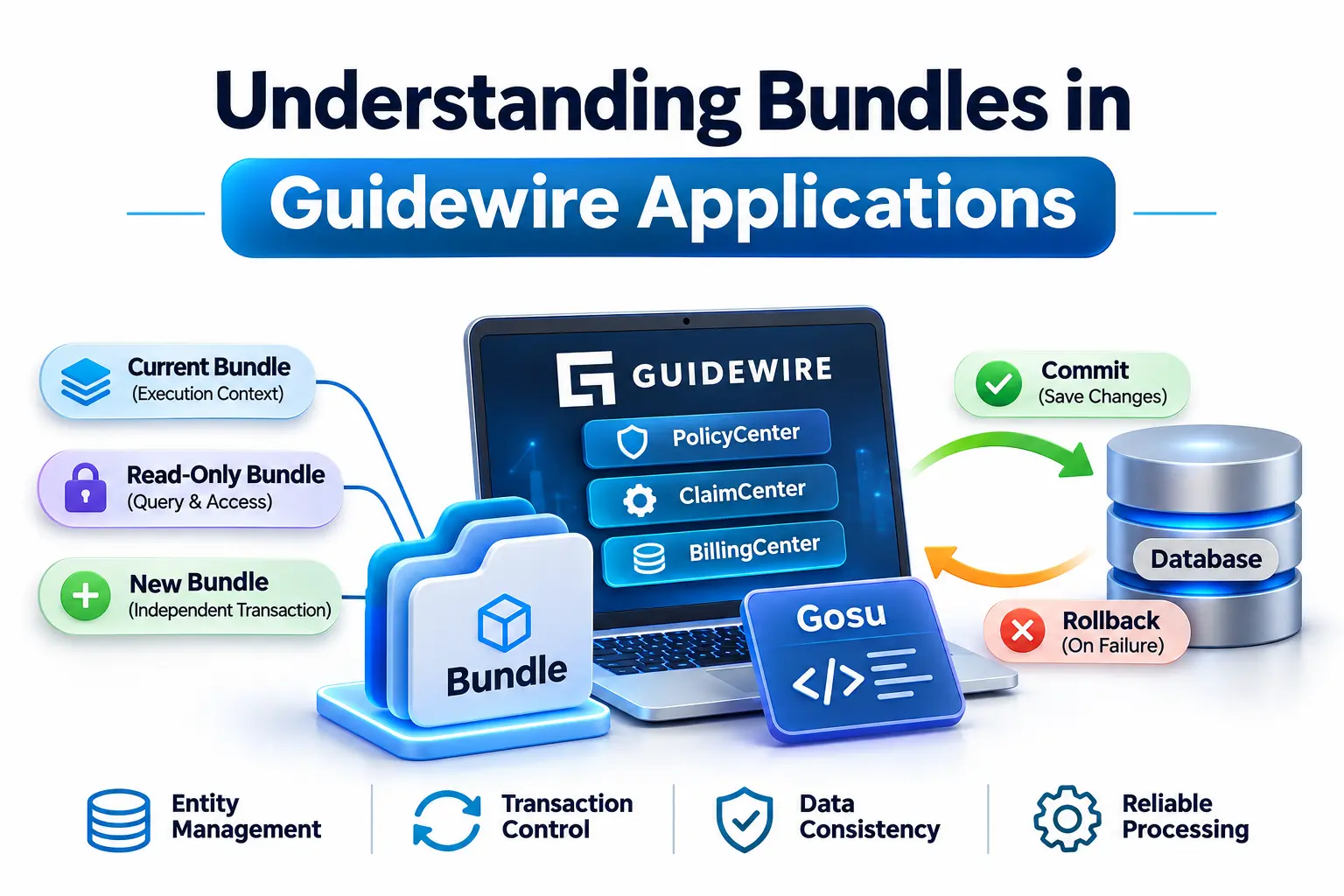
A bundle in Guidewire is an in-memory collection of entity instances representing database records. It provides a controlled environment where developers can create, modify, or retire entities before saving changes to the database.
Guidewire uses bundles to manage database transactions. When a bundle is committed successfully, its changes are saved as a single database transaction. If the commit fails, the transaction is rolled back, preventing partial updates from being persisted.
For example, consider a ClaimCenter application where a developer needs to update a claim's status and create an associated activity. Both operations can be performed within the same writable bundle.
Important characteristics include:
Entity management: Bundles contain new, modified, and retired entity instances.
Transaction control: Changes are committed together.
Data consistency: Failed transactions are rolled back.
Controlled modifications: Entity changes must happen in an appropriate writable bundle.
Understanding this concept is important because almost every meaningful Gosu development task involving database modifications requires correct transaction handling.
Different Types of Bundles and Their Purposes
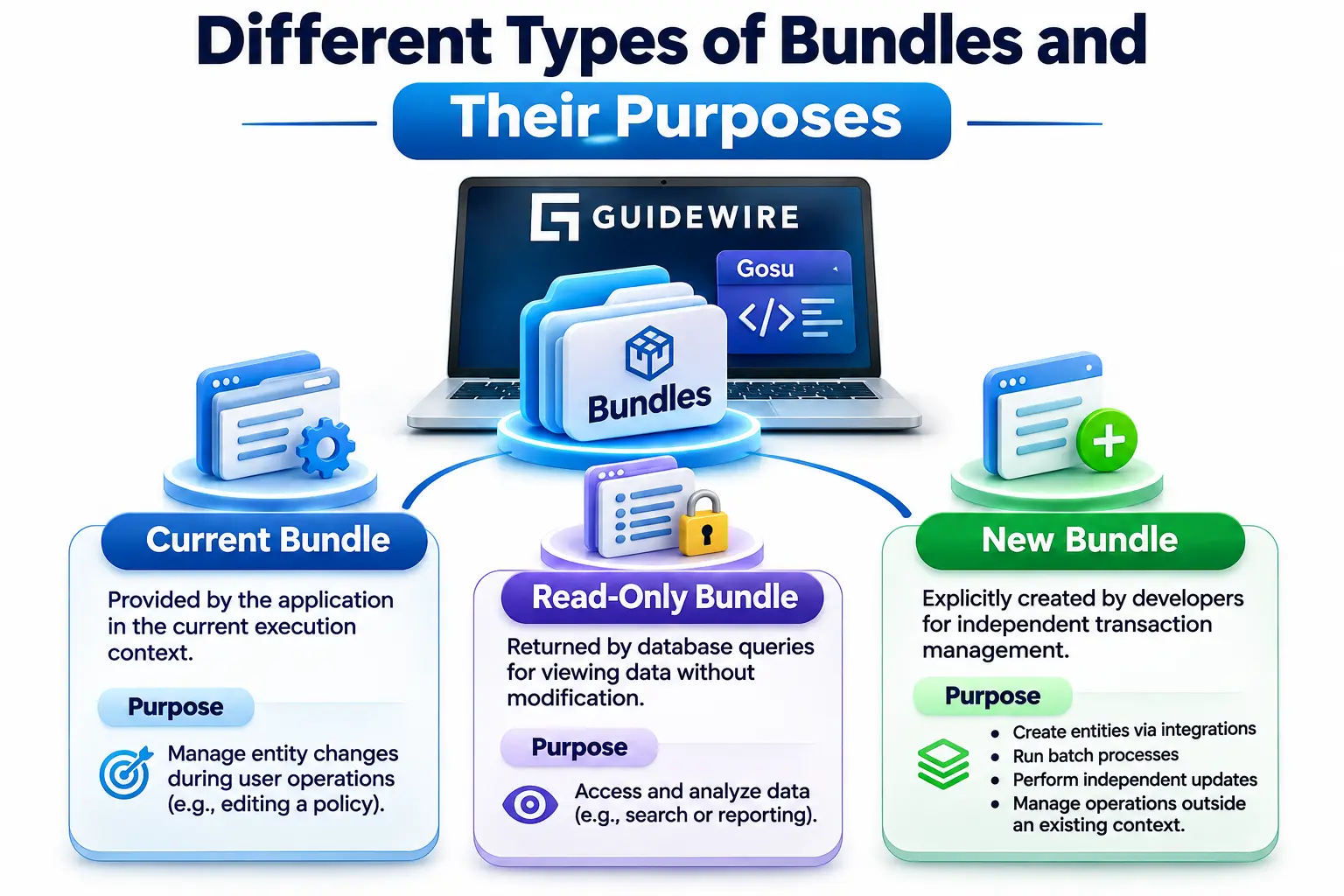
Guidewire developers commonly work with current bundles, read-only bundles, and new bundles. Each serves a different purpose depending on the application context and development requirement.
Current Bundle
The application provides a current bundle when executing certain operations. It contains the entities available within the current execution context. Depending on the situation, it can be writable or read-only.
For example, when a user edits a policy in PolicyCenter, the application manages the relevant entity changes through its transaction context.
Read-Only Bundle
Database query results are generally returned through read-only bundles. Developers can access the retrieved information but cannot directly modify entities within that bundle.
If modifications are necessary, the entity must first be made available in a writable bundle.
New Bundle
A new bundle is explicitly created by developers when independent transaction management is required.
Common use cases include:
Creating entities through integration services.
Updating records in custom batch processes.
Performing independent database operations.
Managing entity modifications outside an existing writable context.
Choosing the correct bundle type helps prevent transaction errors and improves application reliability.
Creating and Managing Bundles Using Gosu
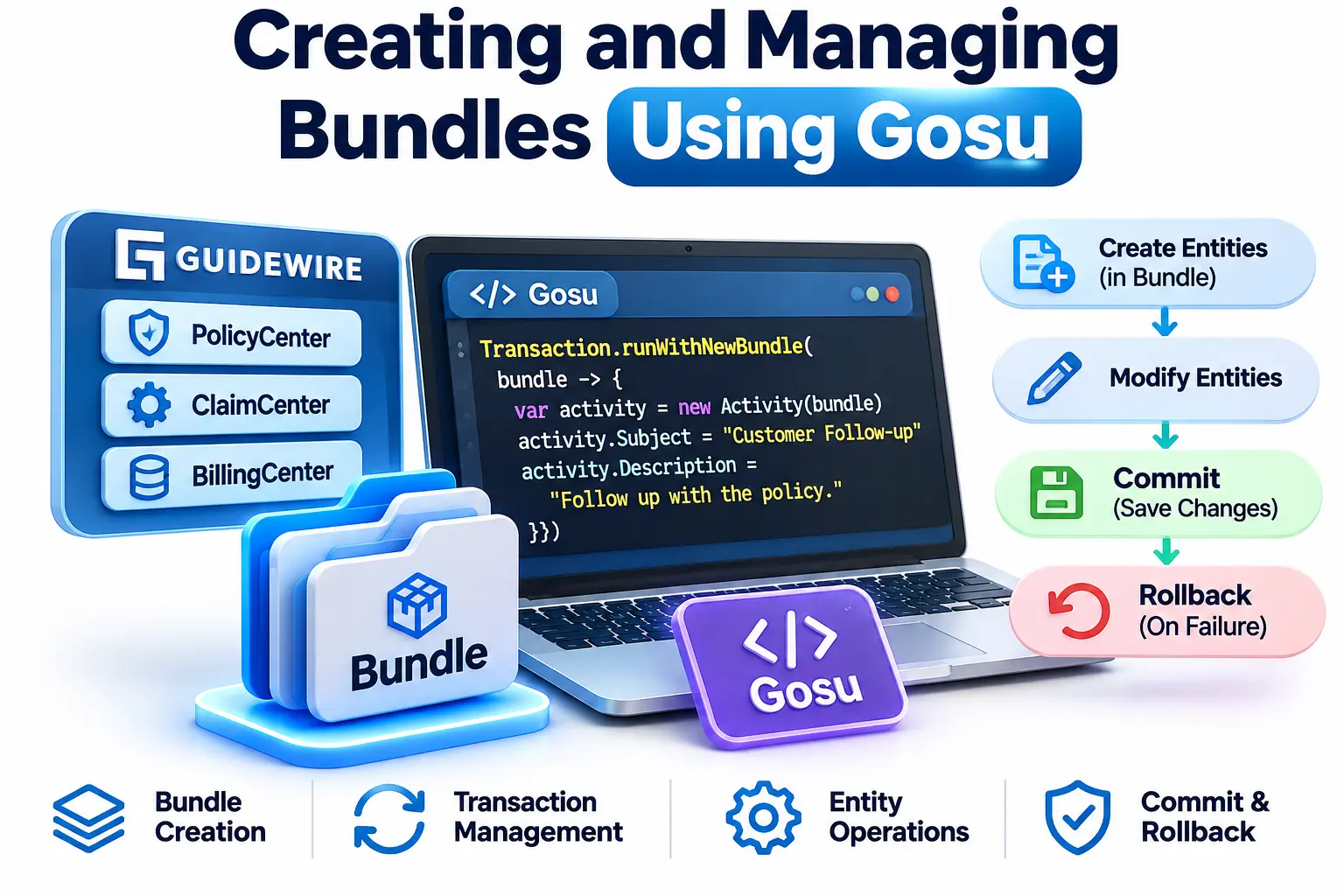
Gosu provides APIs that allow developers to create bundles and manage entity modifications. One commonly used approach is Transaction.runWithNewBundle().
Consider a scenario where an integration service needs to create a new activity associated with an account.
A simplified Gosu example is:
This example demonstrates creating a new entity inside a writable bundle. The runWithNewBundle() method manages the bundle lifecycle and commits it when the code block completes successfully.
Developers should understand the following considerations:
Use the appropriate bundle API for the execution context.
Ensure new entities are associated with the intended bundle.
Perform related entity modifications within the same transaction when appropriate.
Avoid unnecessary manual commits.
Handle exceptions according to the application's transaction requirements.
Another approach is to create a bundle explicitly using the applicable bundle API and commit it when the operation is complete. Unlike runWithNewBundle(), explicit bundle management requires developers to manage the commit themselves.
The exact API and package references should always be checked against the Guidewire version used in the project.
Working with Bundles in Integrations and Batch Processes
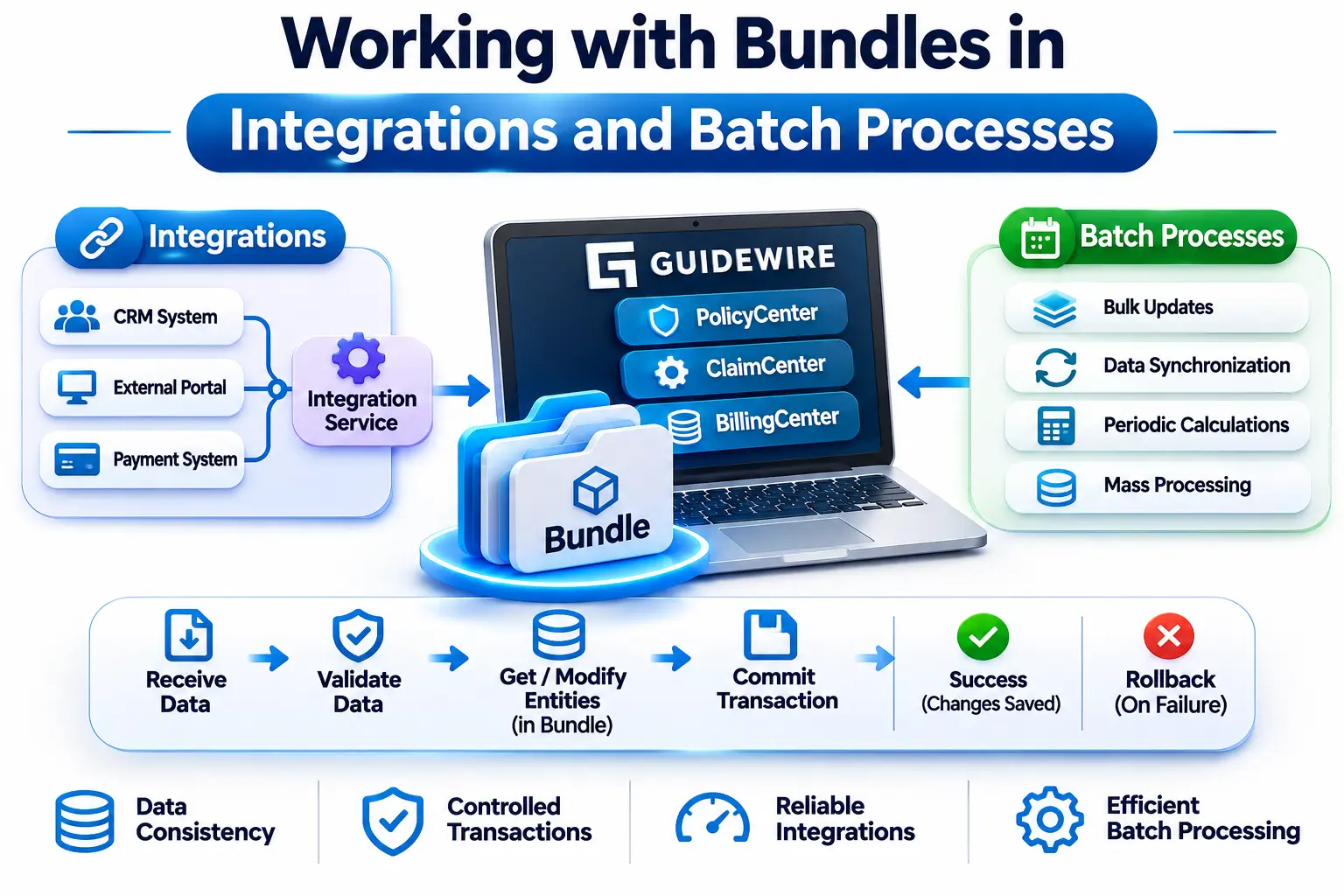
Bundle management becomes particularly important when working with external systems and background processing.
In a typical insurance application, integration services exchange information with external platforms. For example, an external customer management system might send updated customer information to PolicyCenter.
The integration must retrieve the required entity, perform validations, modify the appropriate records, and persist the changes using a suitable writable bundle.
A typical integration workflow involves:
Receiving data from an external system.
Validating incoming information.
Identifying the relevant Guidewire entity.
Creating a writable bundle.
Updating the required entity attributes.
Committing the transaction successfully.
Returning an appropriate response.
Batch processes follow a similar approach but usually handle larger volumes of records.
For example, a batch process might update specific policy-related information across multiple accounts. Developers must consider transaction boundaries and avoid creating unnecessarily large bundles.
Important practices include:
Divide large processing workloads into manageable transactions.
Avoid keeping bundles open longer than necessary.
Handle individual record failures appropriately.
Maintain sufficient logging for transaction failures.
Use suitable integration users and permissions.
These practices help developers build integrations that remain reliable even when processing large amounts of insurance data.
Common Bundle Errors and Troubleshooting Techniques
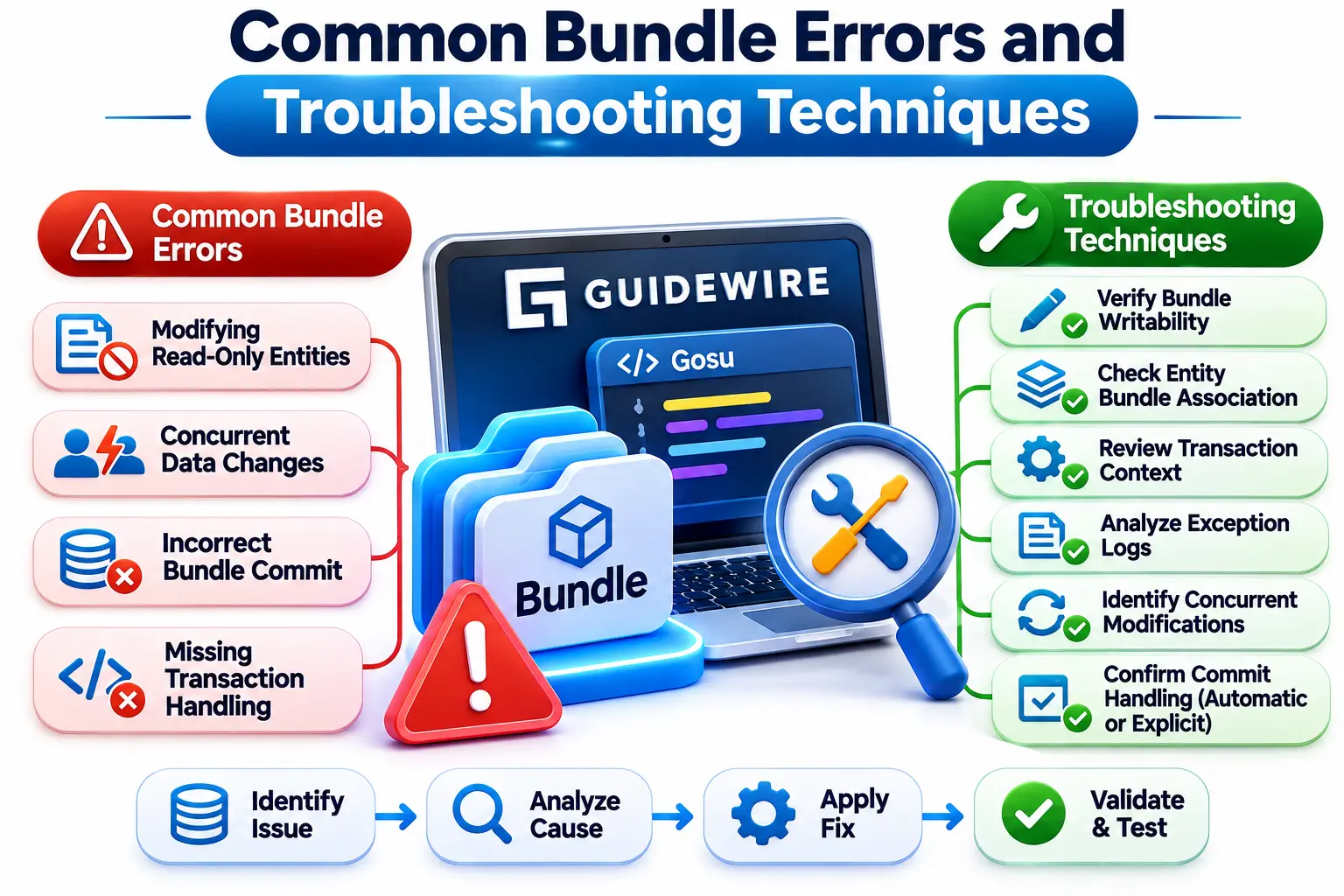
Incorrect bundle management can result in runtime exceptions, failed transactions, and data consistency problems. Developers should understand common issues before implementing complex application logic.
Modifying Read-Only Entities
One common mistake is attempting to update an entity retrieved through a read-only query bundle.
The solution is to add or retrieve the entity within an appropriate writable bundle before modifying it.
Concurrent Data Changes
Concurrency problems occur when multiple transactions attempt to modify the same database record.
For example, two users might update the same claim simultaneously. If one transaction commits before the other, the second transaction may encounter a concurrent data change exception.
Developers should handle these situations through appropriate transaction boundaries, exception handling, and application-level conflict management.
Incorrect Bundle Commit
Committing the current bundle manually in the wrong execution context can interfere with the application's normal transaction lifecycle.
Developers should avoid explicit commits when the framework manages the transaction automatically.
Missing Transaction Handling
Integration and batch code that modifies persistent entities must use the appropriate transaction management mechanism.
A practical troubleshooting checklist includes:
Verify whether the bundle is writable.
Check whether entities belong to the intended bundle.
Review the transaction execution context.
Examine exception messages and application logs.
Identify concurrent modifications.
Confirm whether the commit is managed automatically or explicitly.
Understanding these problems helps developers diagnose issues instead of repeatedly modifying code without identifying the underlying cause.
Best Practices for Effective Bundle Management
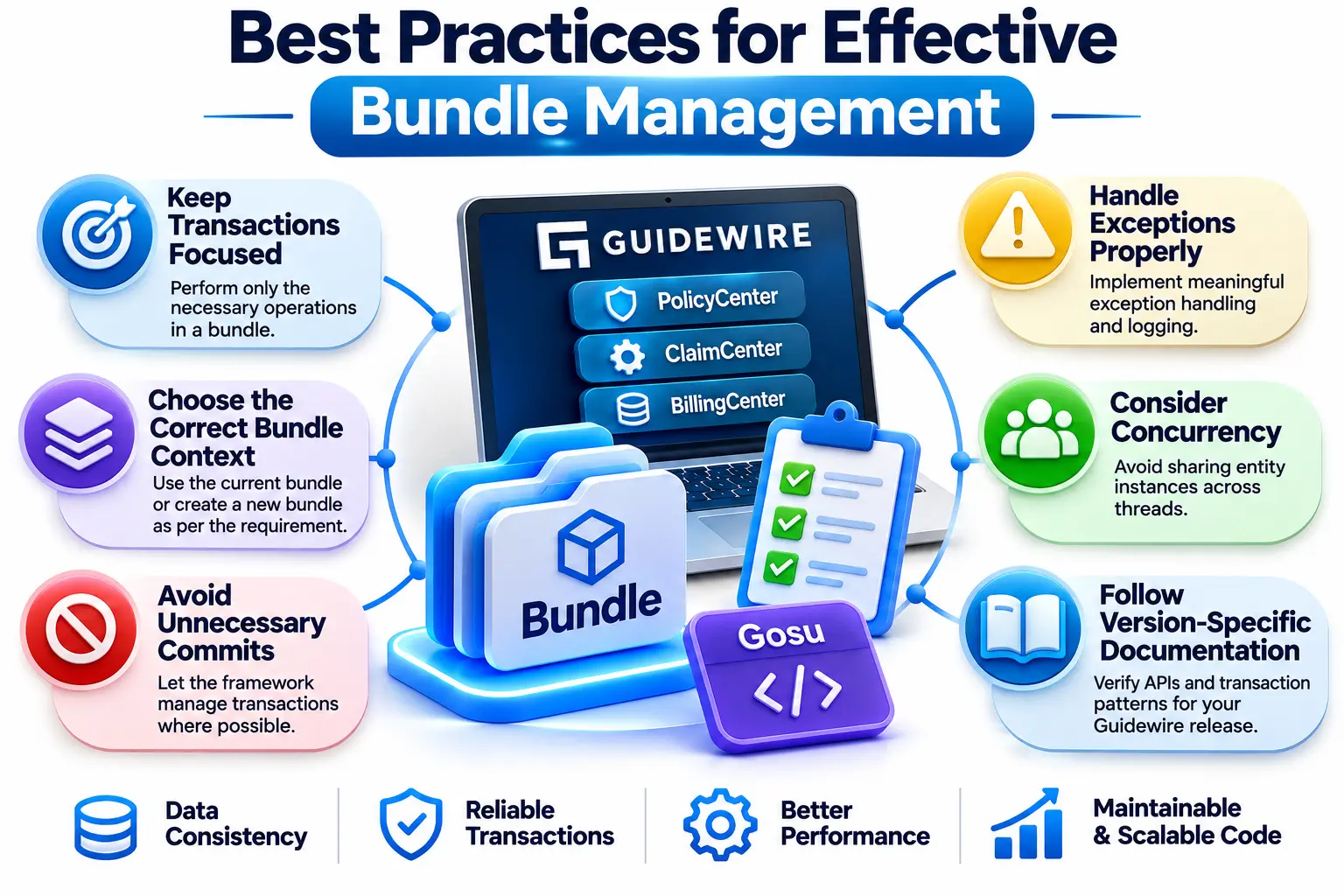
Writing Gosu code that works is only one part of Guidewire development. Developers must also ensure that their transaction logic remains maintainable, efficient, and reliable.
Following established bundle management practices can significantly reduce application-level issues.
Keep Transactions Focused
Perform only the necessary operations within a bundle. Avoid combining unrelated business operations into one unnecessarily large transaction.
Choose the Correct Bundle Context
Understand whether the current execution context provides a writable bundle or requires a new one.
Avoid Unnecessary Commits
Allow the application framework to manage transactions wherever automatic processing is supported. Explicit commits should only be used in appropriate situations.
Handle Exceptions Properly
Implement meaningful exception handling and logging so that transaction failures can be investigated.
Consider Concurrency
Do not assume that bundle instances are thread-safe. Avoid sharing entity instances across threads without appropriate synchronization and supported application patterns.
Follow Version-Specific Documentation
Guidewire APIs and implementation details can change between releases. Developers should verify package references and supported transaction patterns before implementing custom functionality.
For engineers looking to strengthen these skills, practical exercises involving entity creation, modifications, integrations, and batch processing provide valuable development experience. JastTech focuses on helping learners understand such concepts through structured technical learning and practical application.
Conclusion
Bundles are fundamental to transaction management in Guidewire applications. They provide developers with a structured way to manage entity modifications, database commits, and transaction rollbacks. Understanding current, read-only, and new bundles helps developers select the correct approach for different development scenarios. From Gosu programming to integration development and batch processing, effective bundle management is essential for maintaining data consistency.
Developers who want to build stronger Guidewire application development skills should practise working with real business scenarios instead of learning transaction concepts only theoretically. JastTech provides learning opportunities for aspiring Guidewire professionals, including those exploring Guidewire Training in Pune, with an emphasis on understanding application development concepts and industry-relevant technical skills.