

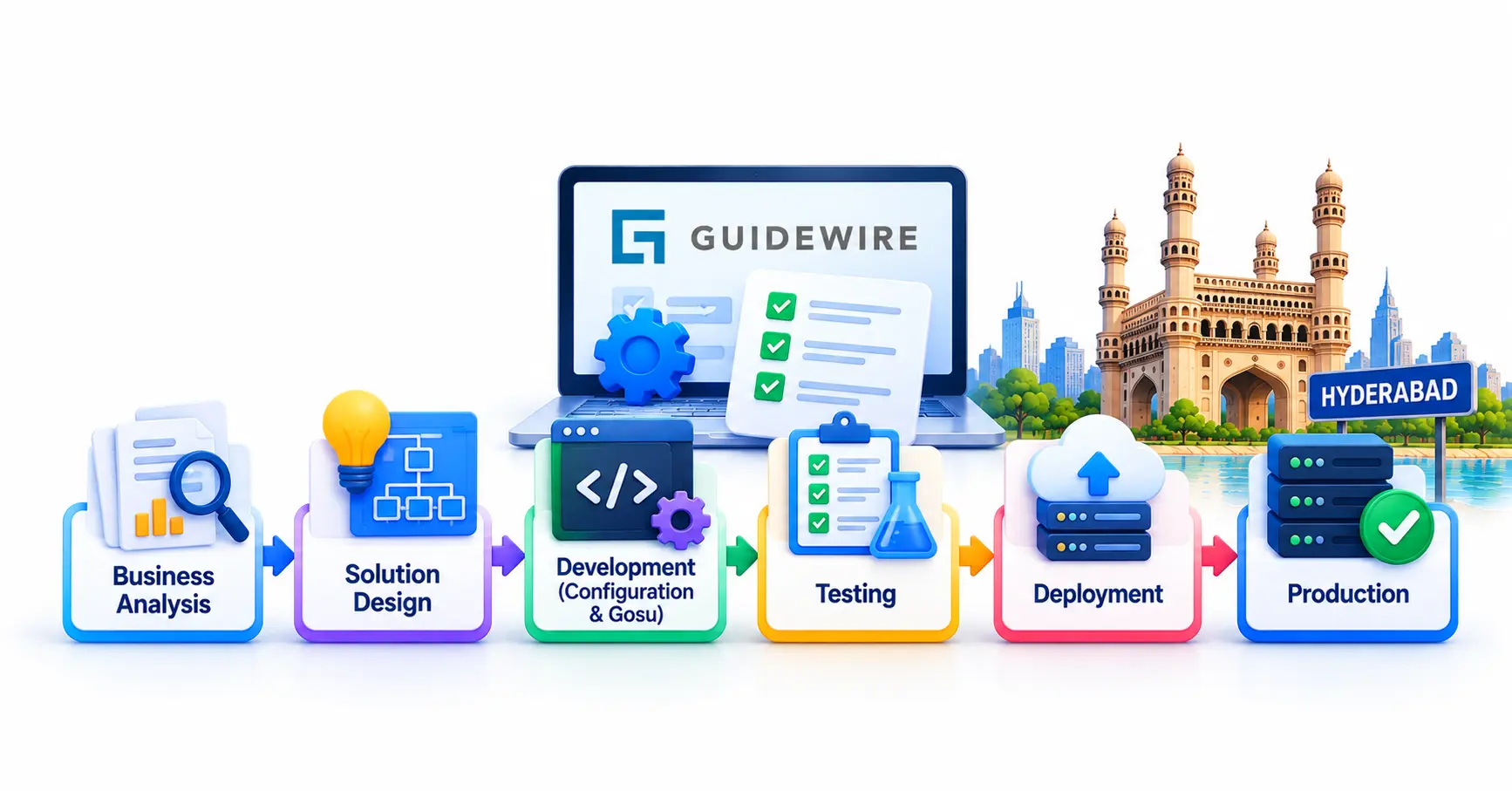
Inside a Guidewire Implementation Project: From Business Analysis to Production in Hyderabad
Navigate through this article using the table of contents below
Table of Contents
No headings found in this article.
A Guidewire implementation project rarely fails because the software can’t do something. It usually stumbles in the gap between what a business analyst wrote down and what a developer understood. Anyone who starts with Guidewire training in India soon finds that the real education begins when a live project does.
In Hyderabad, where many insurance technology teams deliver work for carriers around the world, that journey follows a fairly predictable path. Here is how it runs, from the first requirements workshop to the production release.
What a Guidewire Implementation Project Actually Involves
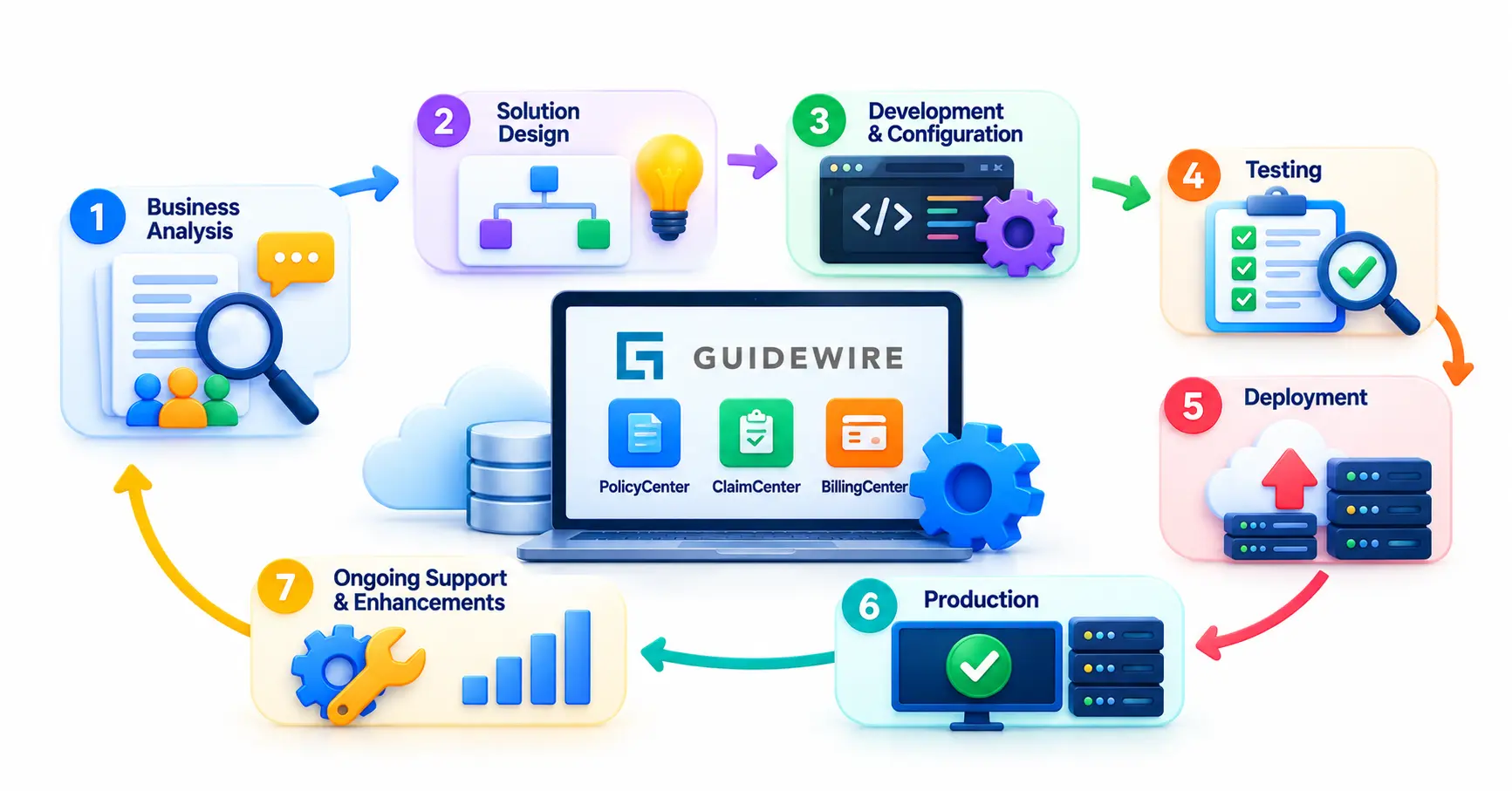
A Guidewire implementation project is the process of taking an insurer’s business rules, products, and workflows and building them into Guidewire InsuranceSuite, usually PolicyCenter, ClaimCenter, BillingCenter, or a combination. The platform arrives with a large amount of standard functionality. The project exists to shape that functionality around one carrier’s way of working.
That is the first thing beginners get wrong. Nobody is building an insurance system from scratch. Teams are configuring a mature product, extending it where the standard behaviour falls short, and connecting it to everything else the insurer runs, such as payment gateways, document systems, and reporting databases.
Most projects pass through the same broad stages: discovery, solution design, configuration and development, integration, data migration, testing, and go-live, followed by a support period often called hypercare. The stages overlap in practice, especially on agile programmes, but the order of dependencies stays the same. You cannot test what has not been designed, and you cannot design what has not been understood.
A project also changes shape depending on its scope. A carrier replacing a legacy policy system faces a very different effort than one adding a single line of business to an existing installation. Cloud delivery adds another layer, since environments, upgrades, and deployment pipelines follow Guidewire’s cloud practices rather than a carrier’s own servers.
Why does this matter before you pick up a single technical skill? Because every role on the team, from analyst to tester, makes decisions that ripple forward into the next stage. Seeing the whole chain makes you better at your own link.
Business Analysis: Where Requirements Are Won or Lost
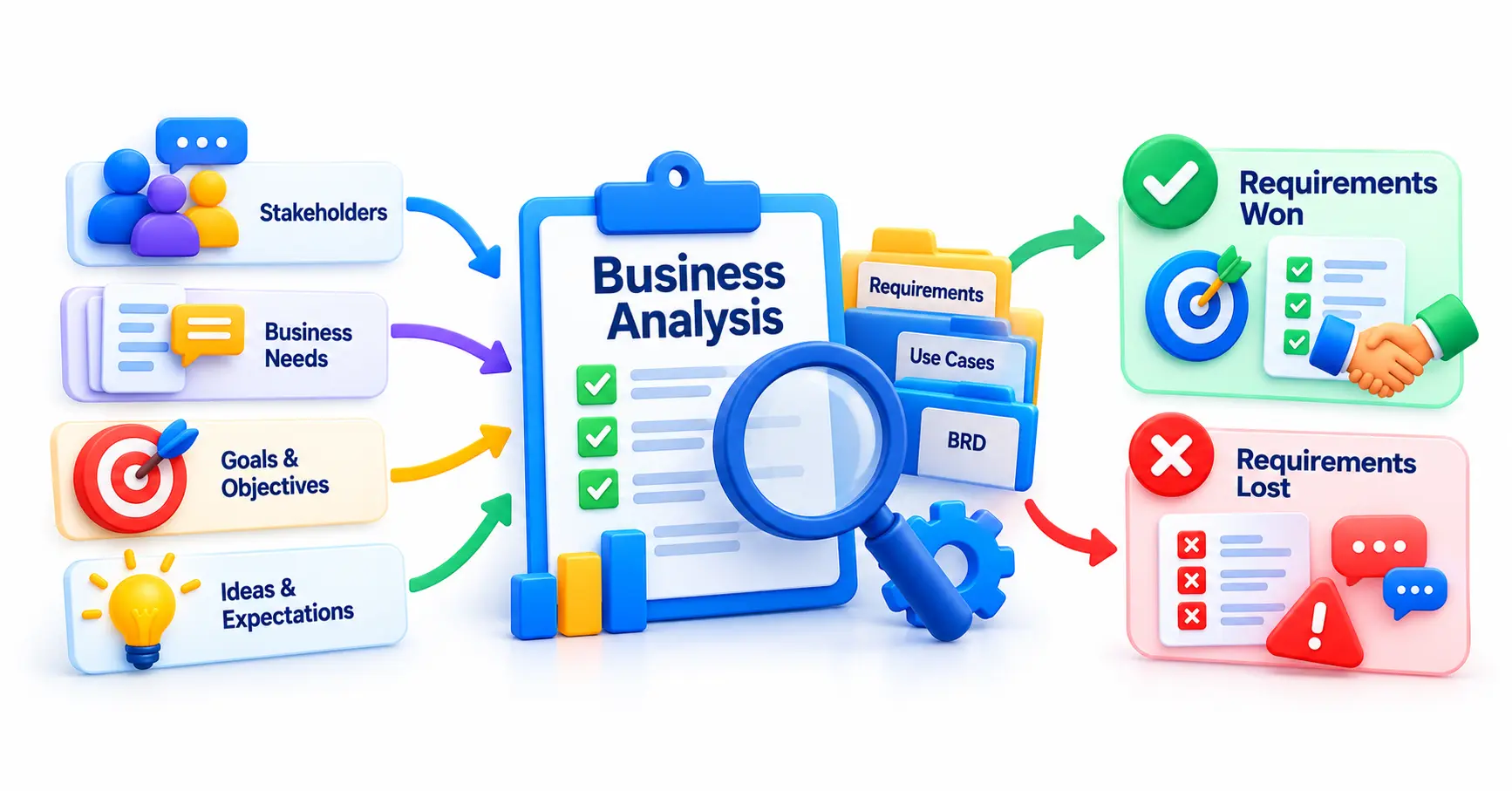
Business analysis is the stage where the insurer’s real needs get translated into something a delivery team can build. It begins with workshops involving underwriters, claims handlers, billing staff, and product owners, who each describe the same business from a different angle.
A Guidewire business analyst does more than collect requirements. The job is to understand how the standard product already behaves and then document only what must differ. Writing “the system shall allow a policy to be issued” is useless, since PolicyCenter already does that. Writing “a commercial auto policy with more than five vehicles needs underwriter referral before binding” is a requirement someone can act on.
Consider a hypothetical example. A carrier tells the team that claims above a certain value must go to a senior adjuster. A weak requirement stops there. A strong one records the threshold, who can change it, what happens to claims that cross the threshold after creation, and what the adjuster sees on screen. Each of those missing details would otherwise become a question during development, or worse, a defect found during testing.
Good analysts also learn the vocabulary early: effective dating, coverages, exposures, lines of business, and workflows. Those who want a structured route into this role can look at Guidewire business analyst training, which covers the analysis side of these projects in more depth.
The deliverables from this stage typically include a requirements document or backlog of user stories, process flows, and acceptance criteria. Their quality sets the ceiling for everything built afterwards.
Solution Design and the Fit-Gap Decision
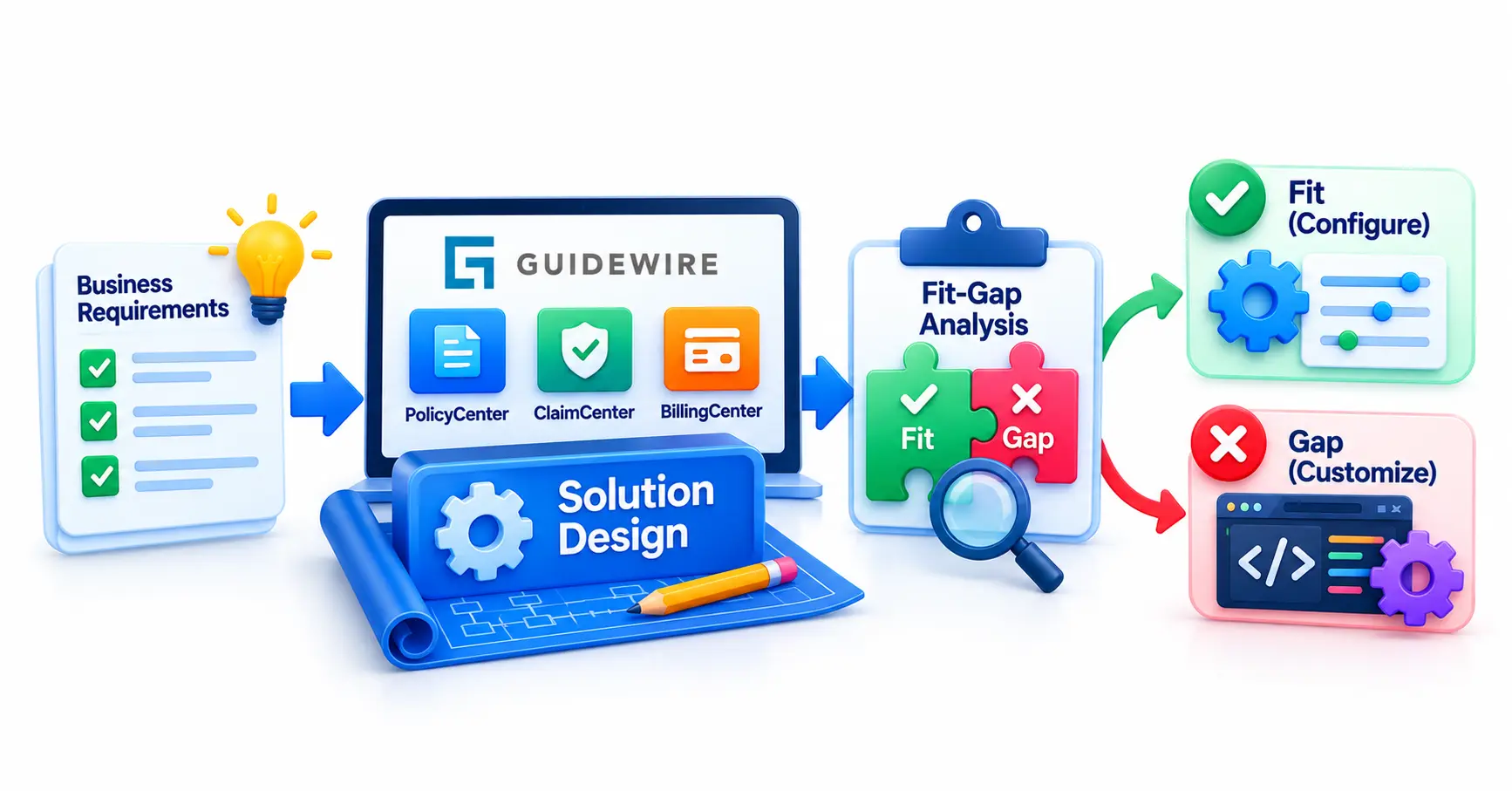
Once requirements exist, the team sorts them by one question: does the standard product already do this? That sorting exercise is the fit-gap analysis, and it shapes cost more than almost any other decision in the project.
A requirement that fits needs only configuration, such as adjusting a product model, updating a rule, or changing a page layout. A gap needs custom work, often in Gosu, Guidewire’s programming language, or through data model extensions. Each gap adds build effort, testing effort, and future upgrade effort.
Experienced architects push back on gaps. They ask whether the business really needs this behaviour or only believes it does because the old system worked that way. Sometimes the answer is to change the business process rather than the software. Sometimes the gap is genuine, such as a regulatory requirement specific to a state or country, and the custom build is justified.
Design documents capture these choices. They describe the data model changes, the page configuration, the rule logic, and the integration points. They also record what was deliberately left alone.
A common beginner mistake is treating customisation as a sign of skill. In reality, heavy customisation is usually a warning sign. It makes upgrades harder, slows testing, and pulls the project away from the product’s strengths.
The designer’s skill lies in restraint: using what Guidewire already provides, extending only where the business case is clear, and documenting the reasoning so the next team understands why a choice was made.
Configuration and Gosu Development Sprints
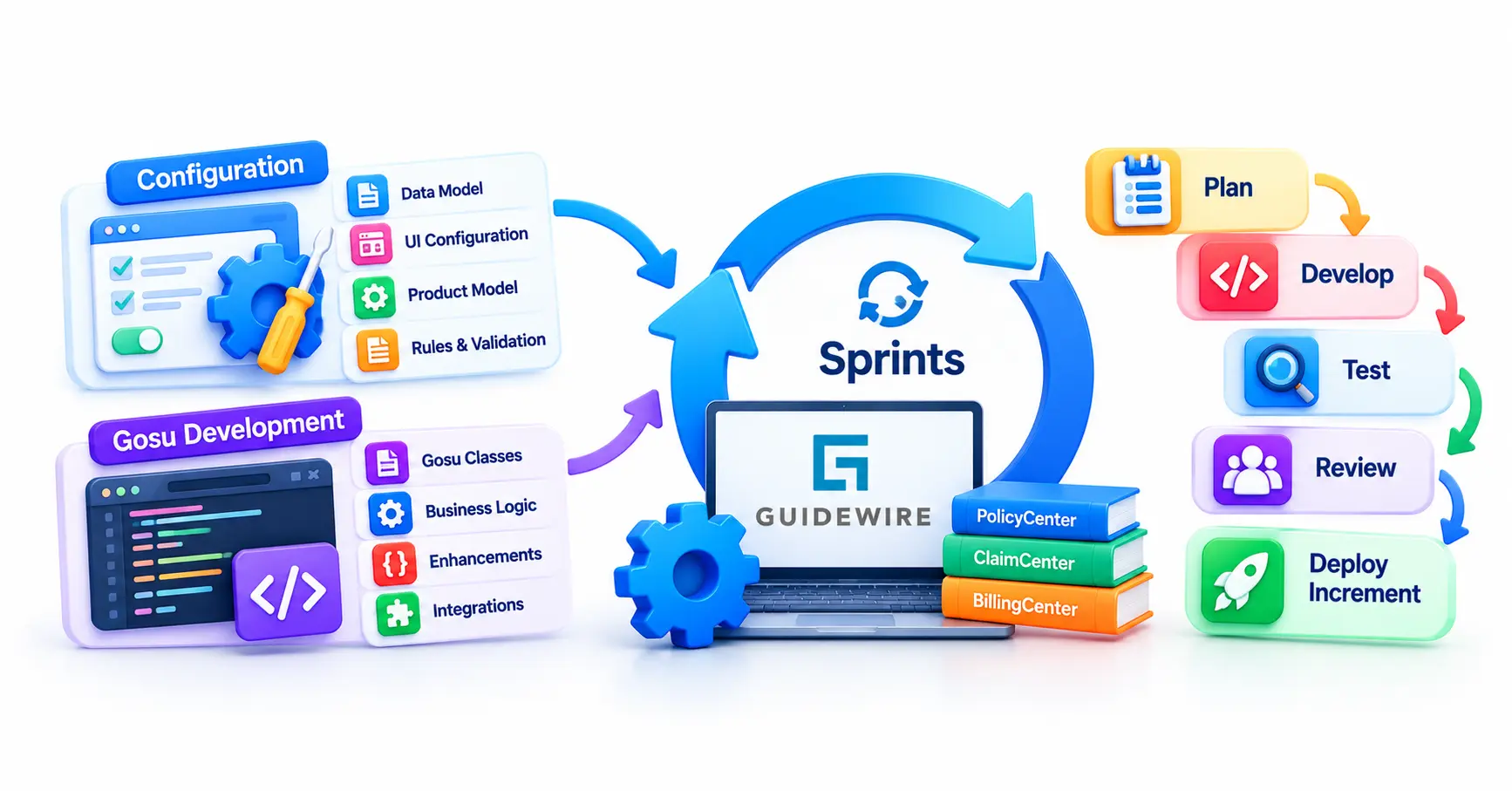
With design settled, the build phase begins. Most teams work in sprints of two to three weeks, delivering small slices of working functionality that the business can see and react to.
Configuration work covers the product model, typelists, page layouts, validation rules, and workflows. Development work covers Gosu code, data model extensions, and anything the standard tools cannot handle. In practice, a single story often mixes both. A new field on a claim screen, for instance, needs a data model extension, a page change, and perhaps a validation rule behind it.
Gosu looks familiar to anyone who has written Java, which is one reason developers from that background pick it up quickly. What takes longer is learning where code belongs. Placing logic in the wrong layer produces behaviour that is hard to trace and harder to fix.
Developers also lean on source control, code reviews, and automated unit tests. Reviews matter more than newcomers expect. A reviewer who knows the platform will catch a performance problem, such as a query inside a loop, long before it shows up under real data volumes.
A typical sprint cycle runs something like this:
The analyst refines the story and confirms acceptance criteria
The developer builds and writes unit tests
A peer reviews the code
A tester verifies the story in a shared environment
The business sees it in a sprint demo
When a demo reveals a misunderstanding, it costs a few days. When the same misunderstanding surfaces at user acceptance testing, it can cost weeks. Short feedback loops are the quiet strength of this stage.
Integrations and Data Migration: The Quiet Schedule Risks
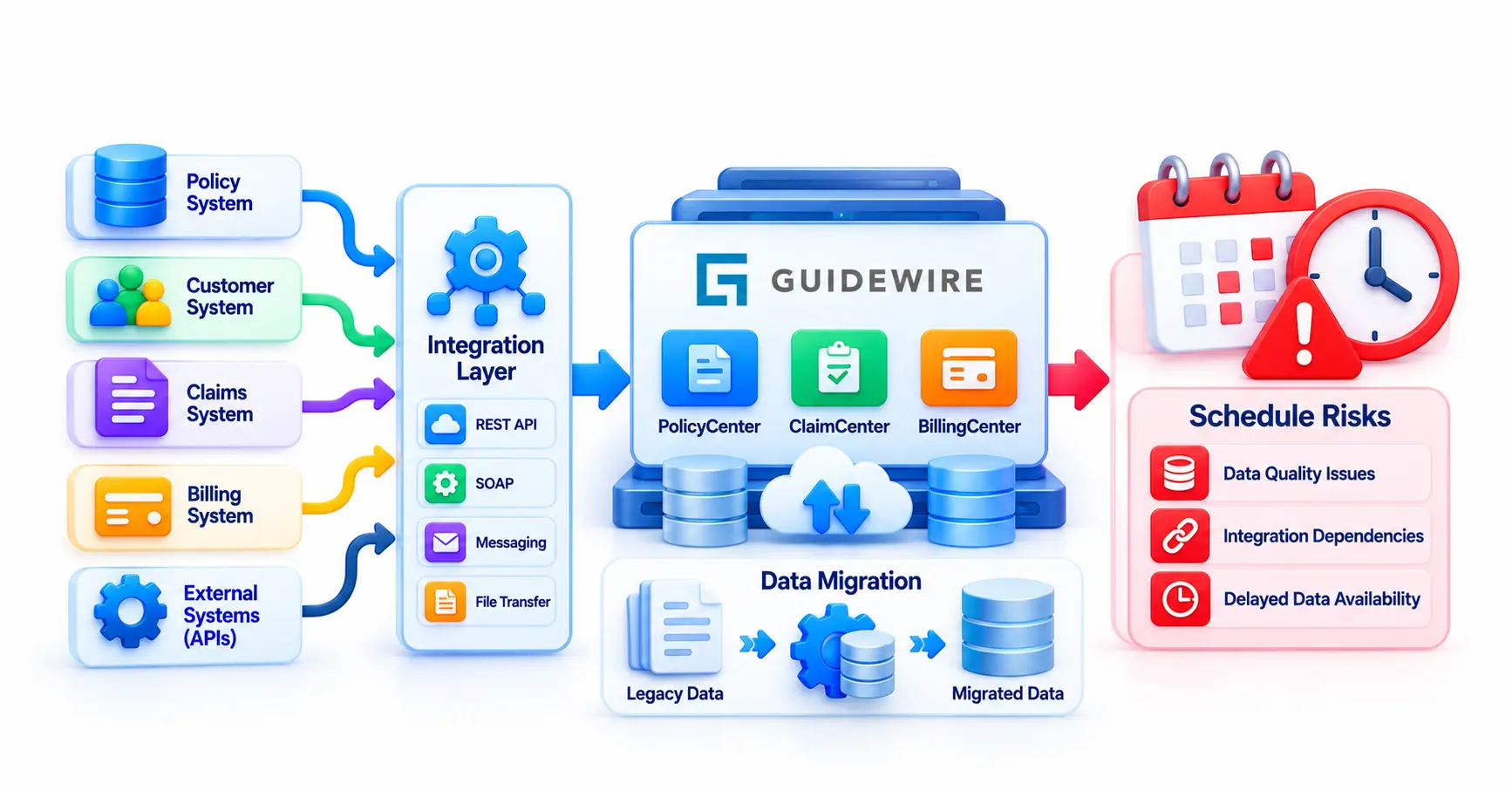
Two workstreams tend to threaten delivery dates more than the visible configuration work: integrations and data migration.
Guidewire never runs alone. A policy system talks to payment providers, document generation tools, rating engines, identity systems, and data warehouses. Each connection needs an agreed contract, test data, and a partner team that is ready on time. Teams choose between approaches such as messaging, which pushes events to other systems, and web services, which respond to requests. Understanding the trade-offs, covered in more detail in many integration-focused resources, helps teams avoid redesigning later.
The usual trouble is dependency. A developer can finish an integration on schedule and still wait weeks because the downstream system’s test environment isn’t available. Experienced project managers track these external dependencies as carefully as internal tasks.
Data migration carries its own difficulty. When an insurer moves from a legacy platform, existing policies and claims must come across accurately. Legacy data is rarely clean. Dates are missing, coverage structures don’t map neatly, and some records follow rules that no longer exist.
Teams generally run several migration rehearsals, comparing results against the source each time and fixing mapping errors before the final load. Skipping rehearsals is tempting when schedules tighten, and it is almost always a mistake.
Both workstreams reward early attention. Starting integration contracts and data mapping alongside design, rather than after configuration finishes, is one of the clearest differences between smooth projects and troubled ones.
Testing, UAT and the Road to Go-Live
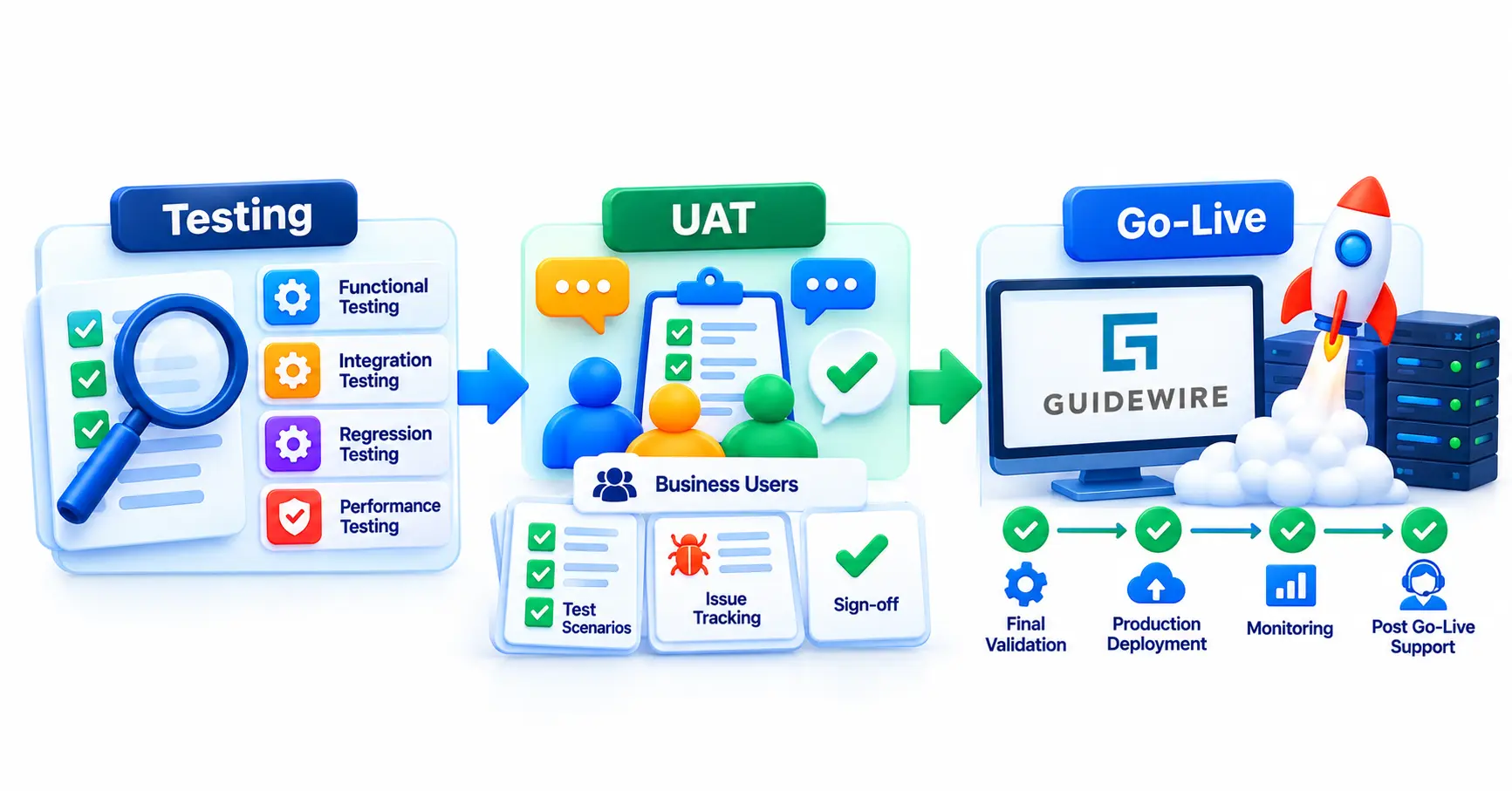
Testing on a Guidewire programme happens in layers. Developers write unit tests. Testers then run functional tests against each story, followed by system integration testing across connected applications, and performance testing to confirm the system holds up under realistic load.
User acceptance testing, or UAT, comes next. Here, business users rather than technical staff check that the system supports their real work. Underwriters process sample submissions, claims handlers walk through realistic losses, and billing staff test payment scenarios. Defects found here are often about workflow rather than code, which is why good UAT preparation includes scripts written in business language.
Environment management deserves attention too. Projects usually maintain separate environments for development, testing, UAT, and production, and keeping configuration consistent across them takes discipline. A defect that appears only in one environment often traces back to a configuration difference rather than a code error.
Before go-live, teams hold a readiness review covering open defects, migration results, performance outcomes, training status, and rollback plans. The release itself is typically scheduled for a quiet period, with the full team on call.
Then comes hypercare, the weeks after launch when the project team stays close to production. Real users reveal behaviour no test script anticipated, and quick fixes matter. Teams that document issues carefully during this period give the support organisation a much stronger foundation to inherit.
Testers deserve credit throughout. Their role is not only to find defects but also to protect the business from surprises on launch day.
Working in Hyderabad: Roles, Skills and How to Prepare
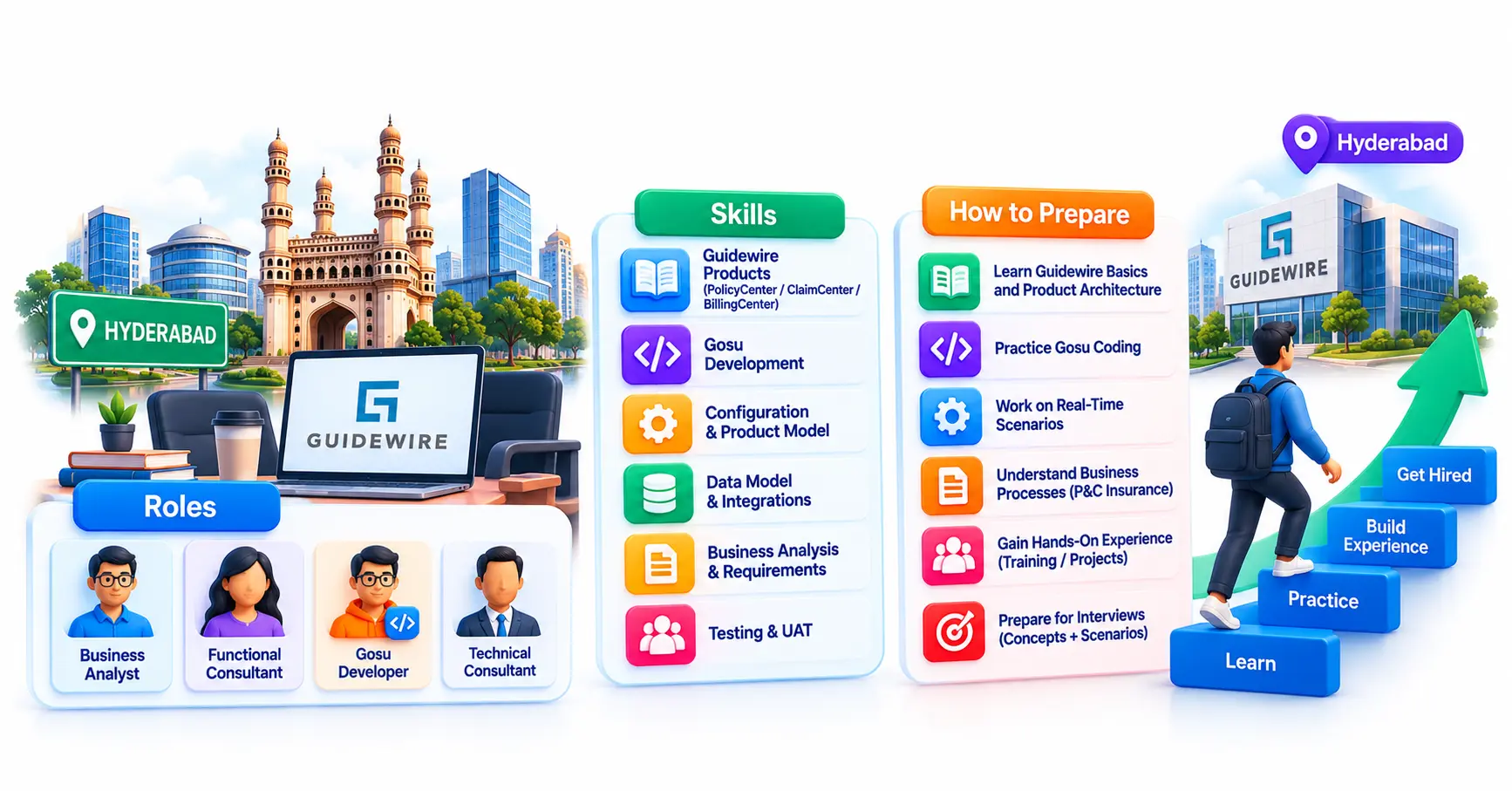
Hyderabad has become a notable base for insurance technology delivery, with teams working on implementation, support, and upgrade projects for carriers in several regions. That means a newcomer can find many different entry points, each matching a stage described above.
Roles on a typical team include business analyst, configuration specialist, Gosu developer, integration developer, QA engineer, and project or delivery manager. Skills overlap more than job titles suggest. A strong analyst understands enough Gosu to judge what is feasible. A strong developer understands enough insurance to question a requirement that doesn’t make business sense.
For beginners, a sensible preparation path starts with insurance fundamentals: how policies, claims, and billing work. Next comes the Guidewire product itself, then hands-on practice with configuration and, depending on your role, Gosu or testing. Realistic project exercises matter more than memorising screens, because interviewers tend to ask how you would handle a situation rather than recite a definition.
Learners based locally can explore Guidewire training in Hyderabad, where JastTech organises its course content around the way real projects are delivered. Those aiming at the analysis side can combine that with the business analyst track mentioned earlier.
Expect a learning curve. Guidewire is a large platform, and nobody understands all of it at the start. Choosing one role, building depth there, and widening your view gradually is a far more realistic plan than trying to learn everything at once.
Conclusion
A Guidewire implementation project is a chain of connected decisions, from the first analyst workshop to the final hypercare fix. Strength at any one link helps, but understanding how the links fit together is what makes professionals in Hyderabad valuable on real projects. Learn your role well, learn its neighbours, and the path from requirement to production becomes far less mysterious.