

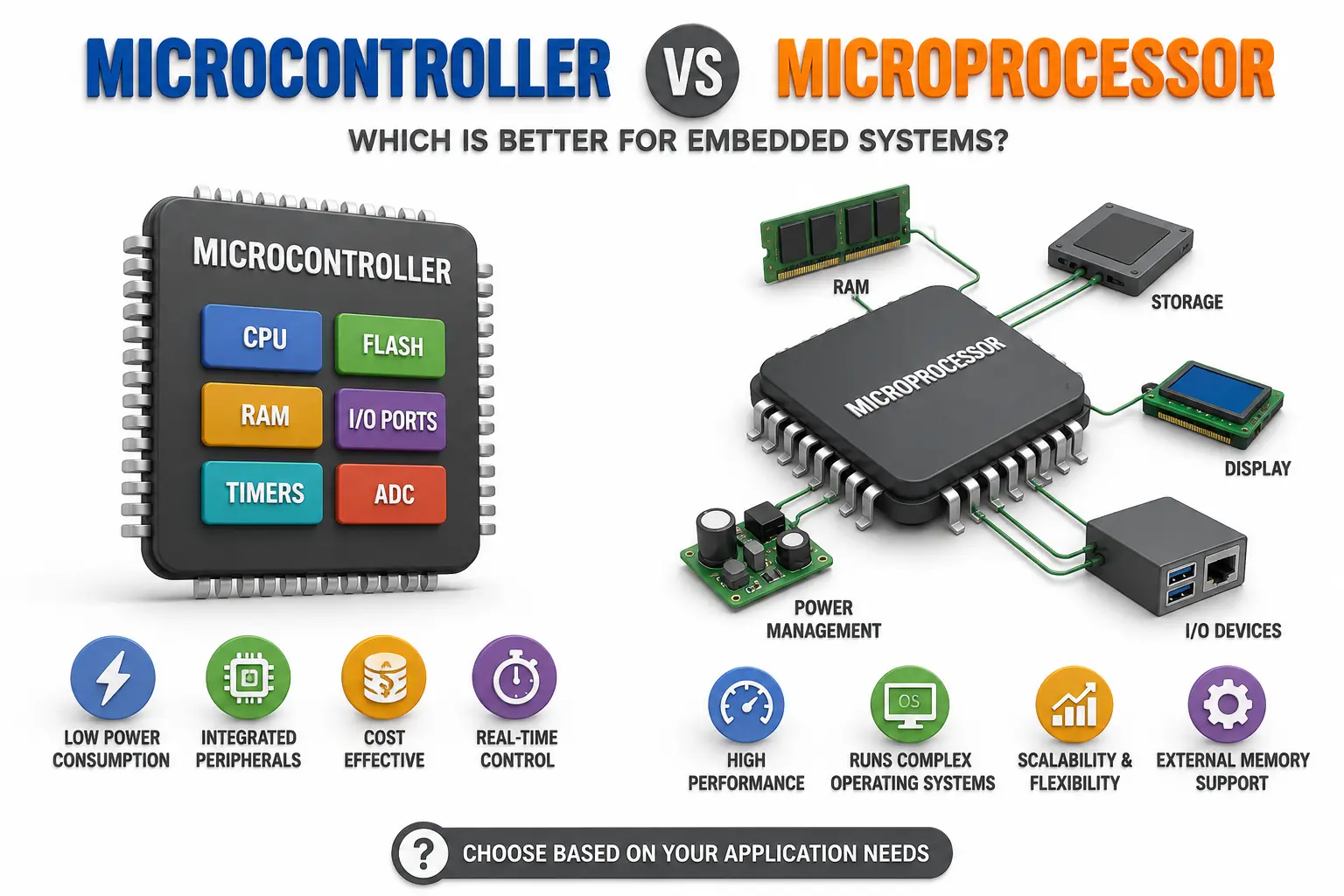
Microcontroller vs Microprocessor Which is Better for Embedded Systems?
Navigate through this article using the table of contents below
Table of Contents
No headings found in this article.
The choice between a microcontroller and a microprocessor can determine far more than processing speed. It affects power consumption, hardware complexity, software architecture, product cost, and even how easily an embedded product can scale.
For beginners, the distinction often looks simple: one has memory and peripherals built in, while the other relies on external components. In real engineering, however, the decision depends on workload, real-time requirements, connectivity, operating system needs, and product constraints.
Understanding the Core Difference
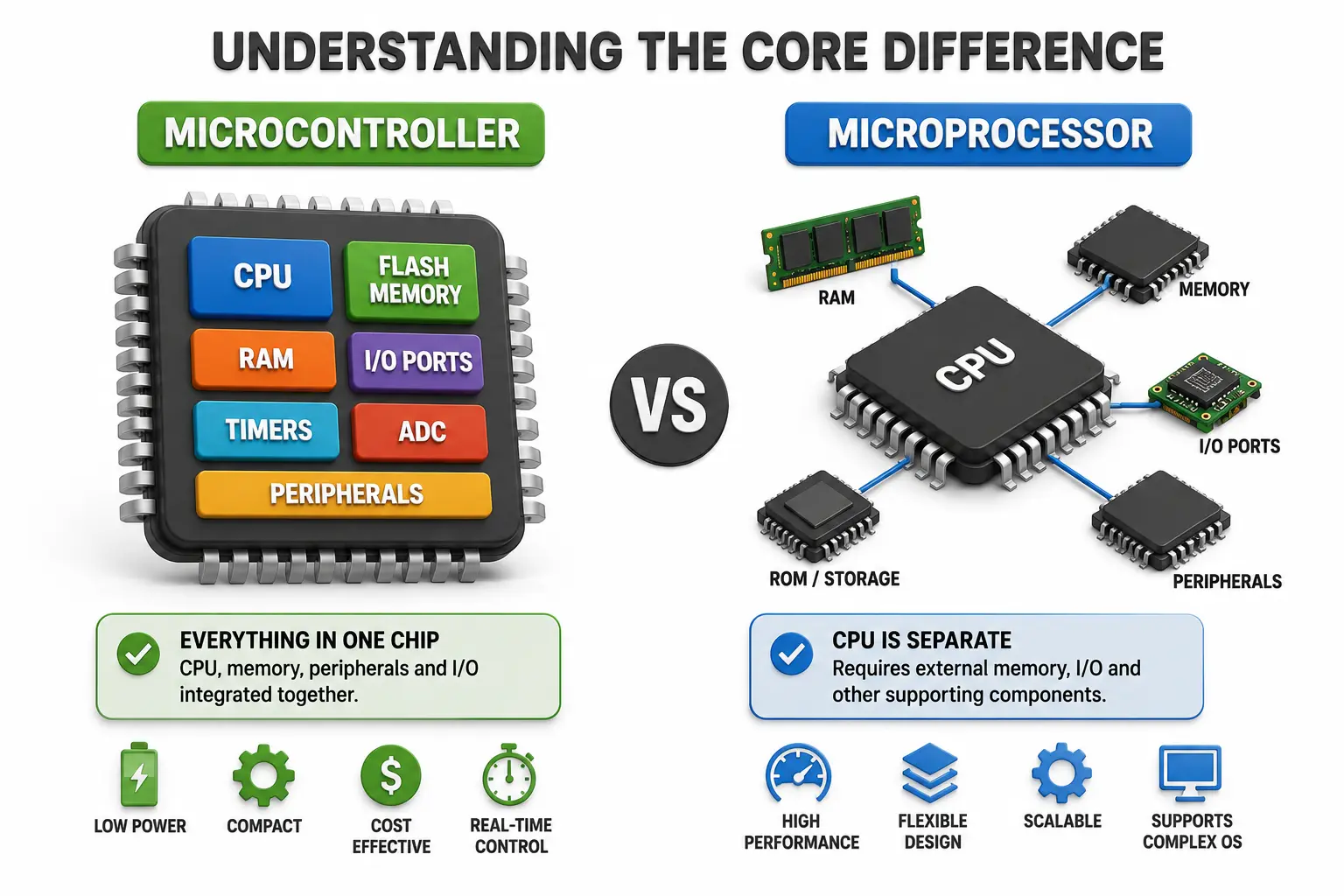
A microcontroller is essentially a compact computing system integrated into a single chip. It normally combines a processor core with Flash or other non-volatile memory, RAM, GPIO, timers, communication interfaces, and application-specific peripherals. This integration makes MCUs particularly effective for dedicated control tasks.
A microprocessor generally provides the processing core while relying on external memory and supporting hardware. This approach gives designers greater flexibility to build systems with substantial RAM, storage, displays, networking, and operating systems such as Linux.
The fundamental distinction can be summarized through these characteristics:
Microcontroller: Integrated CPU, memory, I/O, timers, and peripherals.
Microprocessor: Primarily a processing engine requiring external system components.
MCU strength: Deterministic control, low power, compact hardware, and efficient peripheral access.
MPU strength: Higher computational capability, memory capacity, multitasking, and software flexibility.
Neither device is universally better. The correct choice depends on what the embedded product must accomplish.
Architecture, Memory and Processing Capability
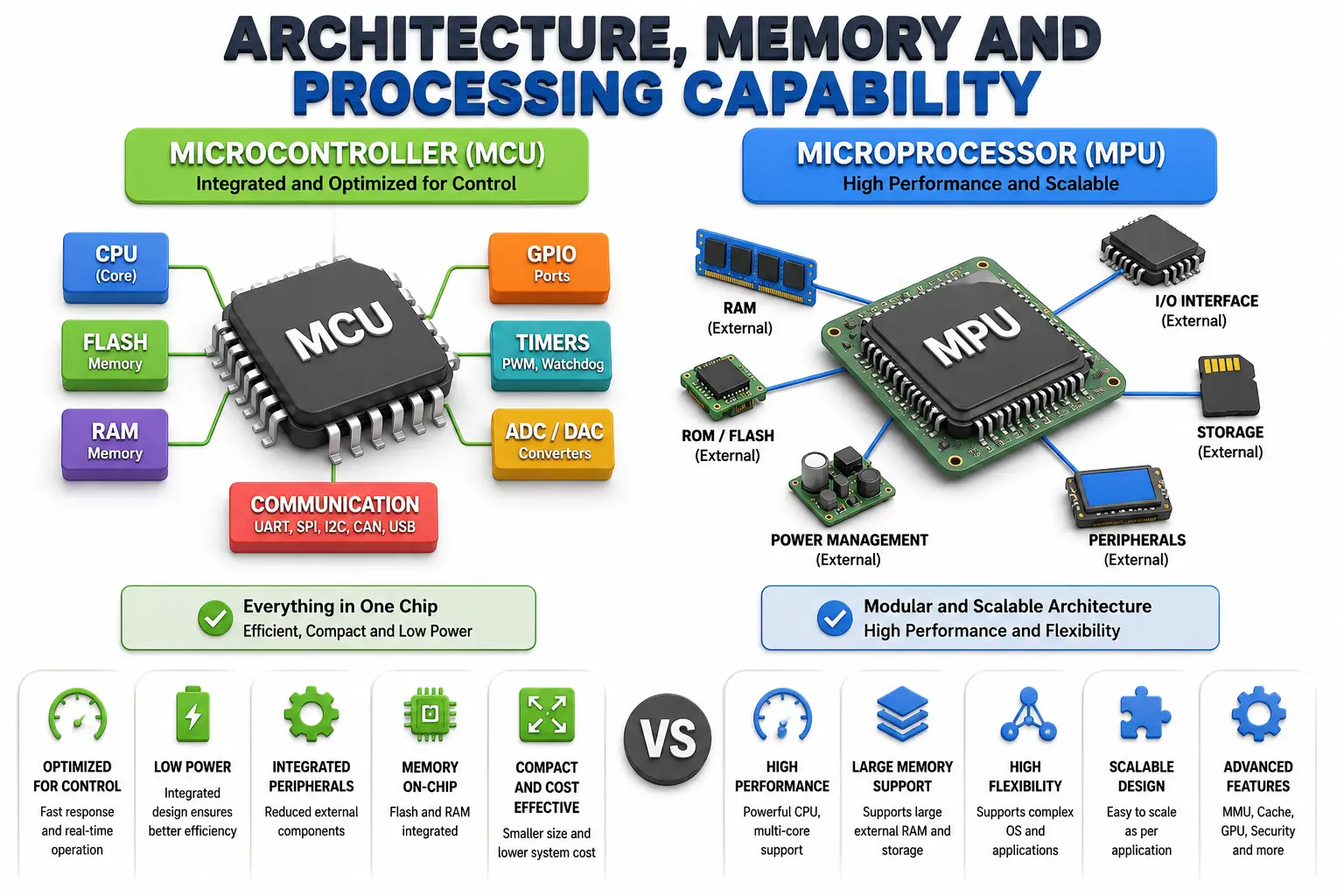
The architecture of an MCU is optimized for controlling hardware efficiently. Many modern microcontrollers use 32-bit ARM Cortex-M, RISC-V, or other architectures and can include DSP instructions, floating-point units, cryptographic accelerators, ADCs, PWM controllers, CAN interfaces, USB, Ethernet, and wireless connectivity.
Microprocessors typically operate with substantially larger external memory systems. They may include multiple CPU cores, caches, memory-management units, high-speed interfaces, graphics capabilities, and hardware virtualization or security features. This makes them suitable for applications where the processor must manage complex software stacks.
A useful engineering distinction is therefore:
Choose an MCU when the workload is primarily control-oriented and event-driven.
Consider an MPU when the workload requires large software frameworks, significant memory, or intensive computation.
Use an MPU when running a full operating system is a major requirement.
Use an MCU when predictable interrupt response and deterministic peripheral control are priorities.
Architecture should therefore be evaluated according to workload rather than processor frequency alone.
Microcontroller vs Microprocessor Applications
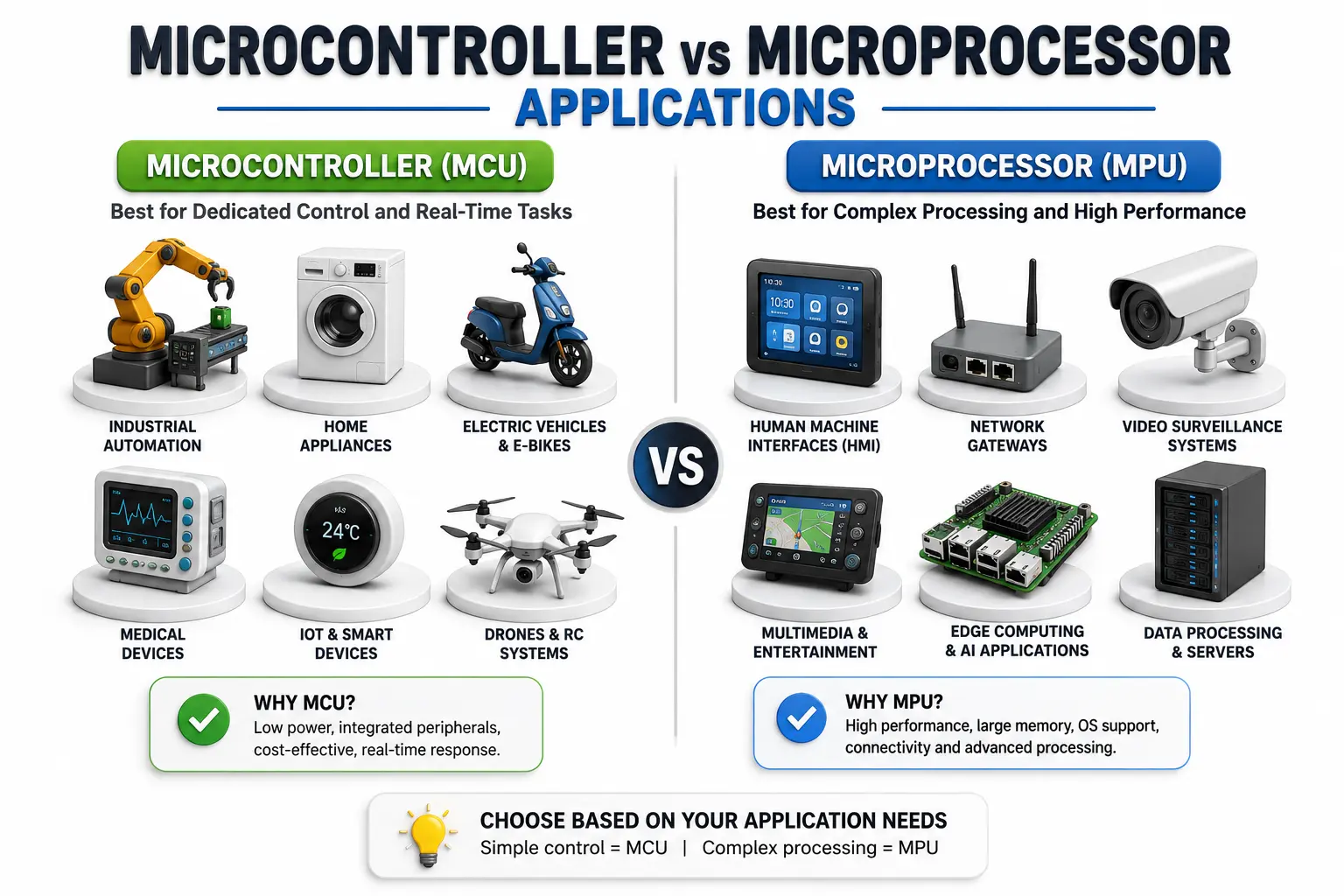
The application environment often provides the clearest answer. Microcontrollers are common in products that continuously monitor inputs, process relatively small amounts of data, and control physical hardware. Examples include motor controllers, sensors, smart appliances, automotive control modules, wearable devices, industrial controllers, and battery-operated IoT products.
Microprocessors become attractive when the embedded device behaves more like a small computer. A networked industrial gateway, advanced human-machine interface, multimedia device, edge-computing platform, or vision system may need substantial memory and operating-system support.
For example, a washing machine controller may need to read sensors, control a motor, operate buttons, and manage timing. An MCU can handle these tasks efficiently. A smart industrial panel with a graphical interface, database, Ethernet networking, remote management, and Linux applications may be better suited to an MPU.
The decision should begin with the product's required functions, not with a preferred chip family.
Performance, Power and Real-Time Requirements
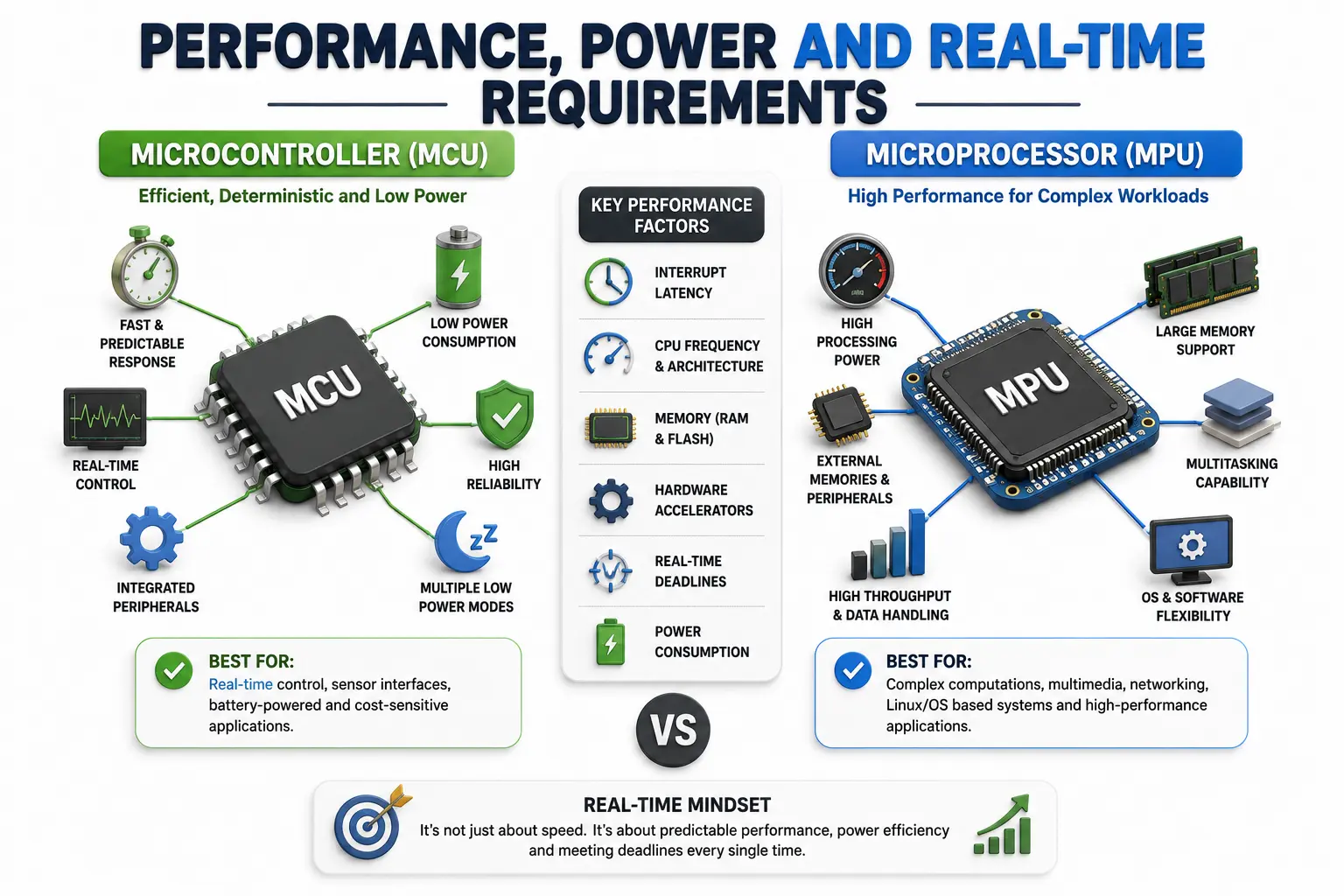
Performance is one of the most misunderstood aspects of this comparison. A higher clock frequency does not automatically make a processor better for every embedded application. Control systems frequently value predictable execution and fast interrupt handling more than maximum computational throughput.
Microcontrollers can deliver excellent performance per watt because their integrated design avoids unnecessary system components and allows aggressive sleep and low-power modes. This is especially important for battery-powered products where the processor may spend most of its life waiting for an event.
Microprocessors generally provide greater computing resources but may require more power because of external memory, higher-performance cores, operating systems, and additional interfaces.
When evaluating performance, consider:
Interrupt latency
CPU frequency and architecture
RAM and Flash requirements
Cache and memory bandwidth
Floating-point and DSP capability
Hardware accelerators
Real-time deadlines
Active and standby power consumption
For a control loop that must respond predictably, an MCU can outperform a more powerful processor in terms of system suitability.
Cost, Hardware Complexity and Development
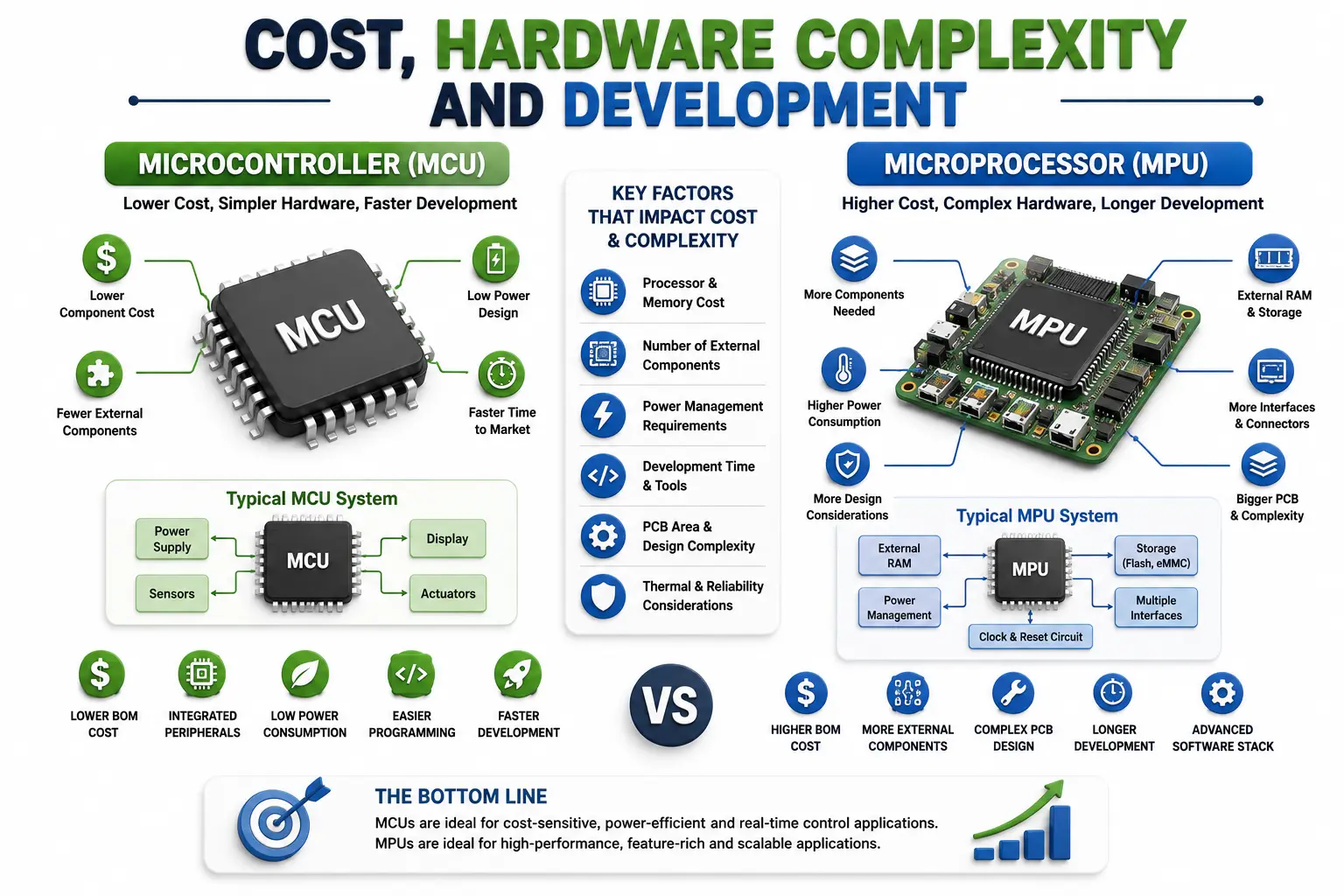
The purchase price of the processor is only one part of embedded-system economics. An MCU can reduce the bill of materials because memory, timers, communication interfaces, and other peripherals are already integrated. Fewer external components can also simplify PCB design and reduce board size.
An MPU-based system may require external DRAM, Flash storage, power-management circuitry, clocking components, and additional interfaces. However, its higher hardware complexity can be justified when the product requires advanced processing or a sophisticated software environment.
A realistic system-level comparison should consider:
Processor and memory cost
PCB area and component count
Power-management requirements
Software development effort
Operating-system requirements
Manufacturing complexity
Thermal design
Long-term component availability
For a small-volume prototype or student project, selecting a device that minimizes unnecessary complexity can accelerate development significantly. This is also why learning both architectures can strengthen an embedded engineer's design judgment. Training platforms such as JastTech can help beginners connect these concepts with practical embedded development.
Which One Should You Choose for Embedded Systems?
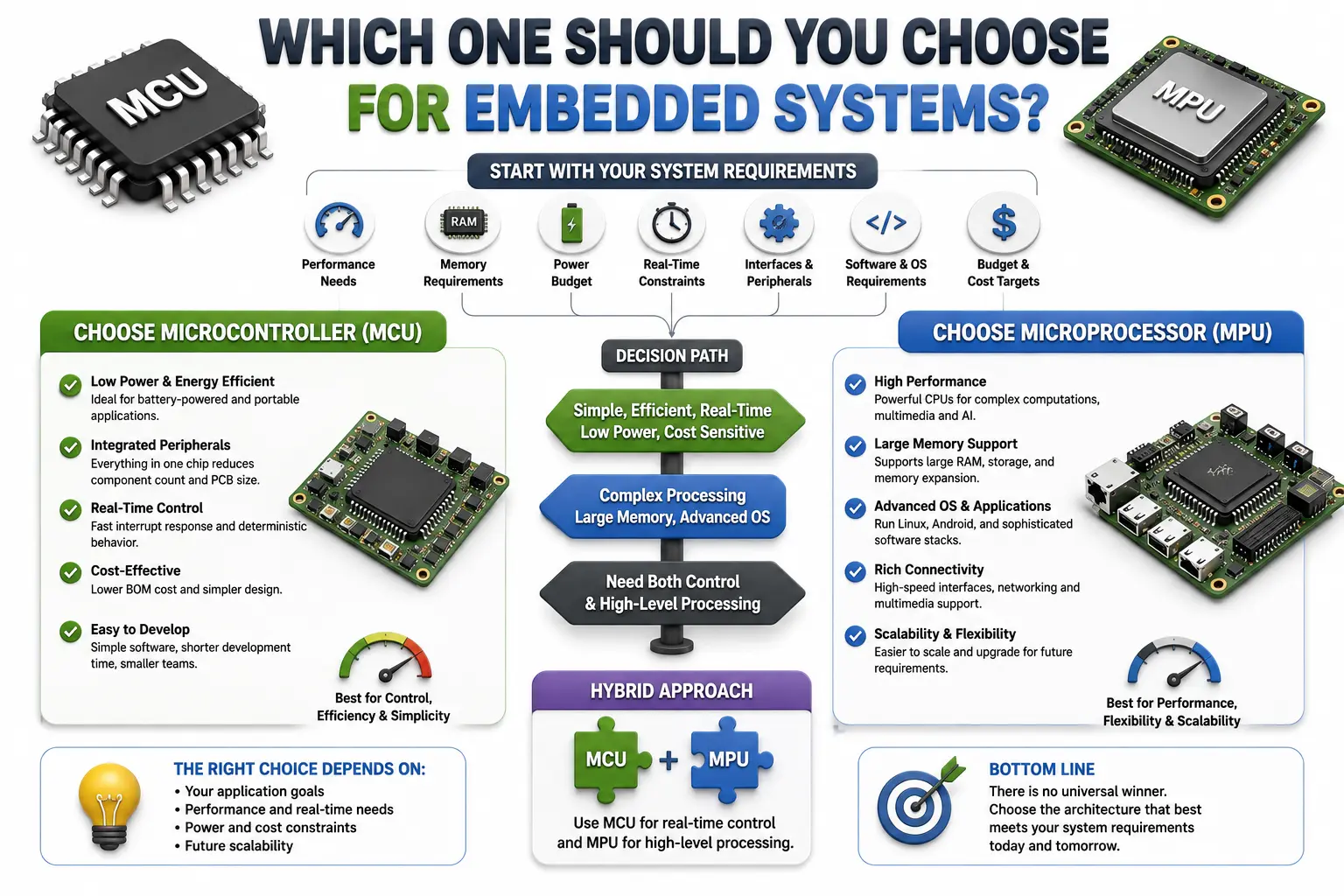
There is no universal winner. The better processor is the one that satisfies the product requirements without introducing unnecessary complexity, cost, power consumption, or performance limitations.
Choose a microcontroller when you need:
Low power consumption
Compact hardware
Fast and predictable control
Integrated peripherals
Lower system complexity
Real-time sensor and actuator management
Cost-sensitive embedded products
Choose a microprocessor when you need:
Large memory capacity
Complex multitasking software
Linux or another full operating system
Advanced graphical interfaces
High-performance networking
Multimedia or demanding computation
Greater application-level flexibility
The boundary is also becoming less rigid. Modern MCUs are increasingly capable, while MPU-based embedded platforms are becoming more power-efficient and integrated. Some systems may even combine both: an MPU handles high-level software while an MCU manages deterministic real-time control.
Conclusion
Ultimately, engineers should select the architecture by starting with system requirements: workload, latency, memory, power budget, interfaces, software stack, security, and cost. Once those constraints are defined, the appropriate processor family becomes much easier to identify.
Understanding this distinction is valuable for both product developers and aspiring embedded engineers because it develops the ability to make architecture decisions rather than simply memorize processor specifications. The strongest embedded designs are not necessarily built around the fastest chip; they are built around the chip that delivers the right balance of performance, reliability, power, and complexity.