

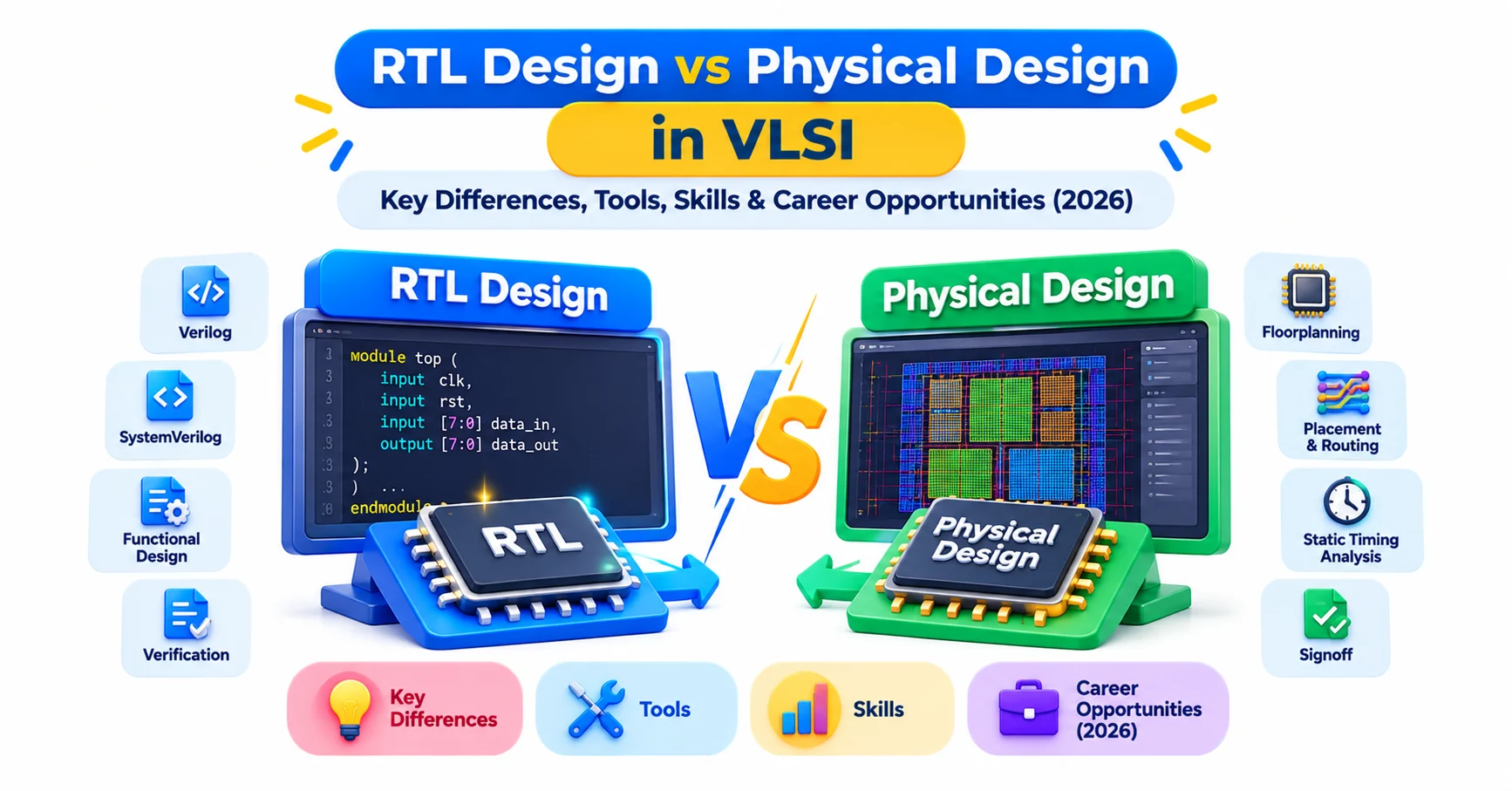
RTL Design vs Physical Design in VLSI: Key Differences, Tools, Skills & Career Opportunities (2026)
Navigate through this article using the table of contents below
Table of Contents
No headings found in this article.
A chip can pass every functional test and still fail on its first day in the lab, because one wire was too long or one clock edge arrived late. That gap is the heart of RTL design vs physical design: one team decides what the chip should do, and the other decides whether it can do it in real silicon. Many learners first meet this split while looking at RTL design and verification training, and the choice they make shapes their daily work for years.
The right answer rarely comes from salary comparisons. It comes from understanding how each role thinks, what it uses, and what a normal week looks like.
What RTL Design and Physical Design Actually Do
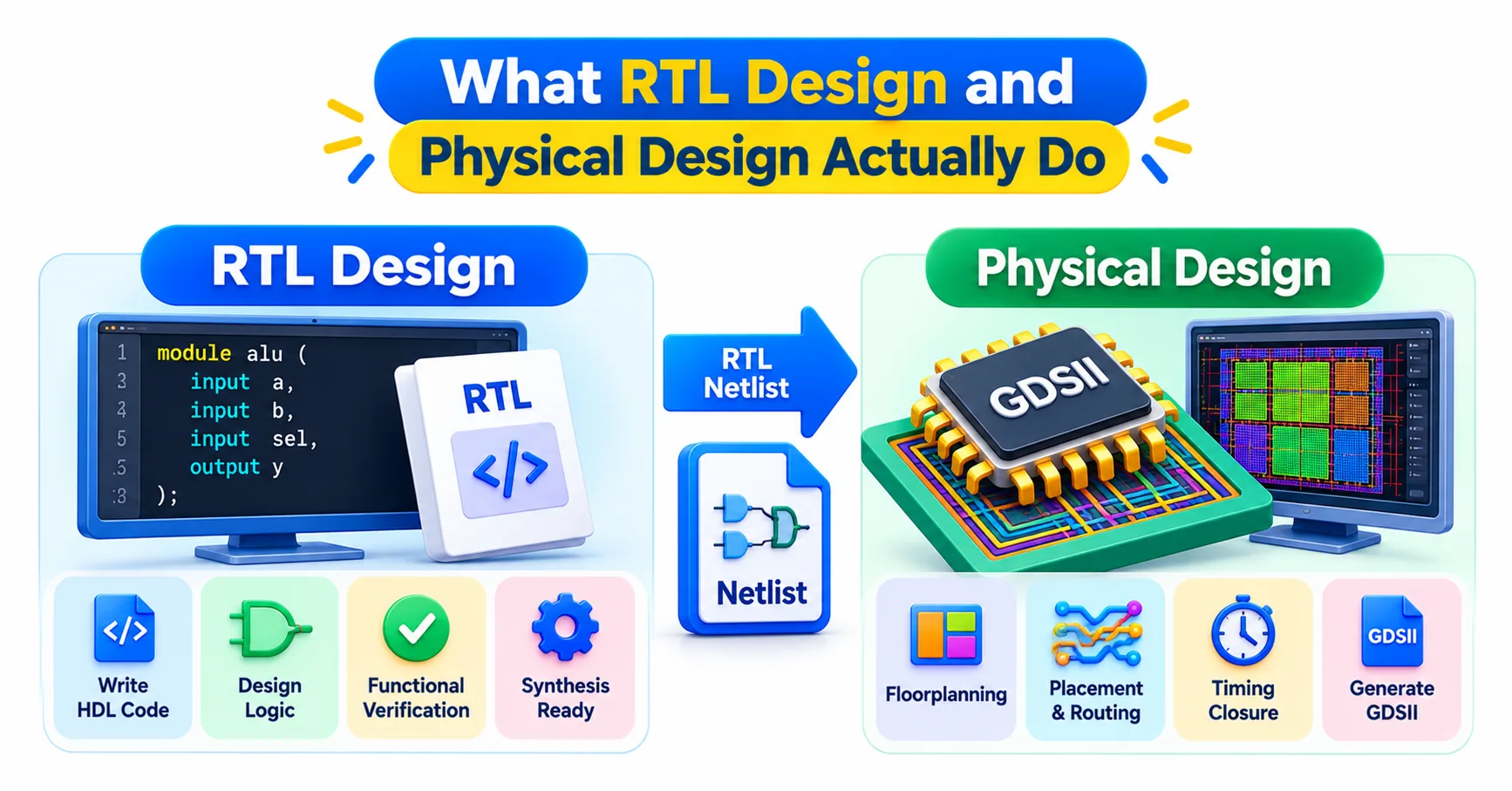
RTL design describes the behavior of a digital circuit using a hardware description language, usually Verilog or SystemVerilog. An RTL engineer writes code that says, in effect, “on every clock edge, take these inputs, apply this logic, and store the result here.” The code describes registers, the logic between them, and how data moves. It does not describe where anything sits on the chip.
Physical design starts where that description ends. Once the RTL has been converted into a gate-level netlist, the physical design engineer turns it into a layout, which is a precise geometric arrangement of transistors, cells, and metal wires that a foundry can manufacture. Their job is to make sure the design meets its targets for timing, power, and area while obeying the manufacturing rules of a specific process node.
A simple analogy helps. RTL is the architect’s functional plan: which rooms exist and how people move between them. Physical design is the construction drawing that decides where every wall, pipe, and cable physically goes, and whether the building fits on the plot.
The two roles also differ in how they measure success. An RTL engineer succeeds when the design behaves correctly and is clean enough for synthesis. A physical design engineer succeeds when the layout closes timing, stays within its power budget, and passes every physical check. Neither job is “easier,” but they reward different habits of mind.
How a Chip Travels From Code to Silicon
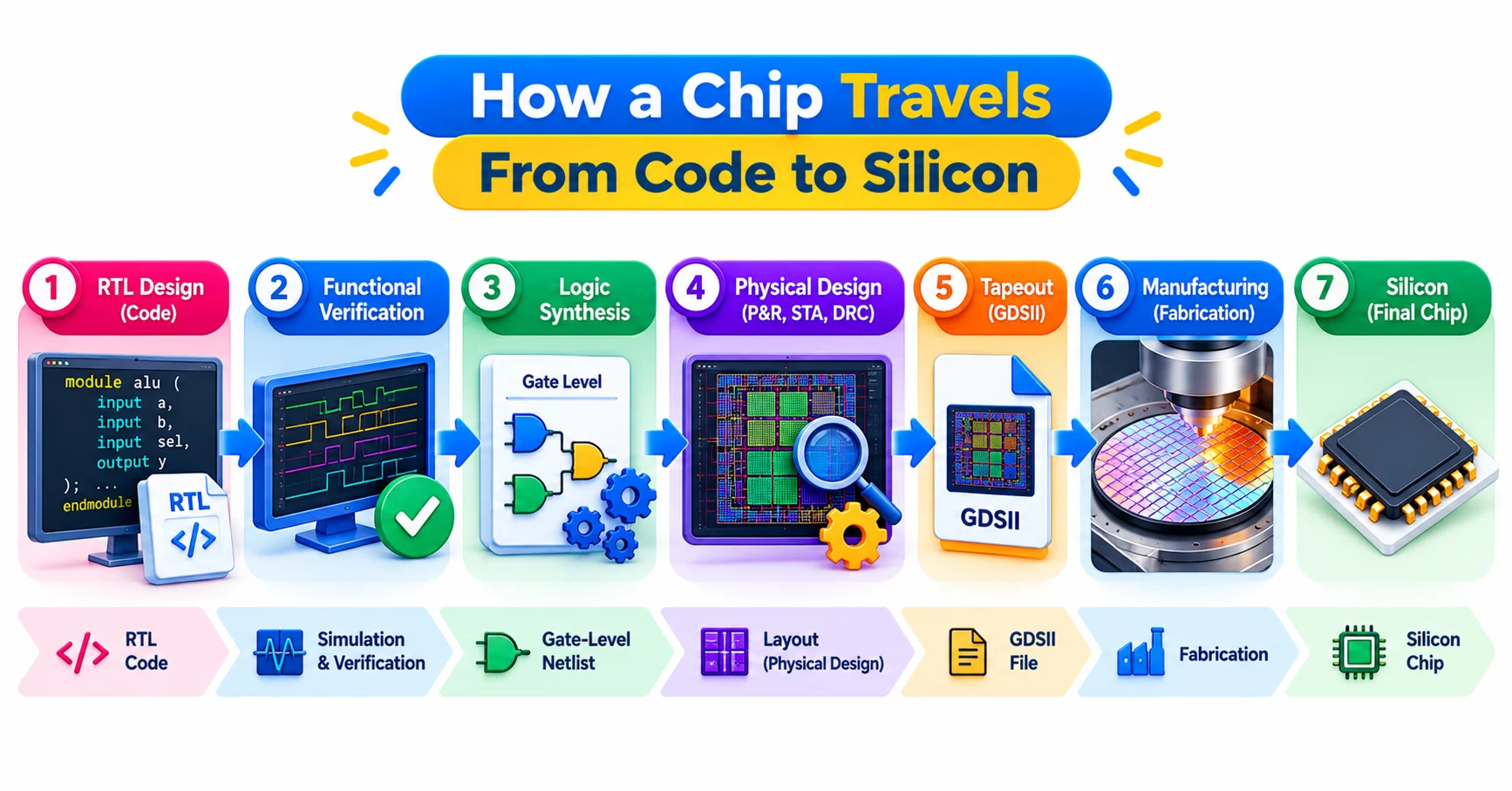
The two disciplines sit at different points on the same road, so the flow matters more than the definitions.
It begins with a specification. Architects define what the chip must do, and RTL designers turn that into synthesizable code. Verification engineers then test that code, often with more people than design itself, because a logic bug found after fabrication is enormously expensive.
Next comes logic synthesis. A synthesis tool maps the RTL onto a library of standard cells from the target technology and produces a gate-level netlist. This step is the handoff, and it is where many beginners get confused: synthesis is usually owned by the front-end side, but its output is the physical designer’s raw material.
Physical design then runs through a familiar sequence:
Floorplanning: deciding the chip’s shape, where large blocks and memories sit, and where power enters
Placement: positioning millions of standard cells
Clock tree synthesis: distributing the clock so every register sees it at nearly the same time
Routing: connecting all cells with metal layers
Signoff: checking timing, power, and manufacturing rules before the design goes to the foundry
A hypothetical example shows how the two sides interact. Suppose an RTL designer writes a long chain of logic between two registers. It works perfectly in simulation. During physical design, that path cannot meet the clock period after routing. The physical engineer may try tool-level fixes first, but sometimes the real cure is to pipeline the logic, which means going back to the RTL. Good teams treat this as a conversation, not a blame game.
Understanding that loop is more valuable than memorizing the steps. Problems found late are costly, and each side’s decisions constrain the other.
RTL Design vs Physical Design: Key Differences at a Glance
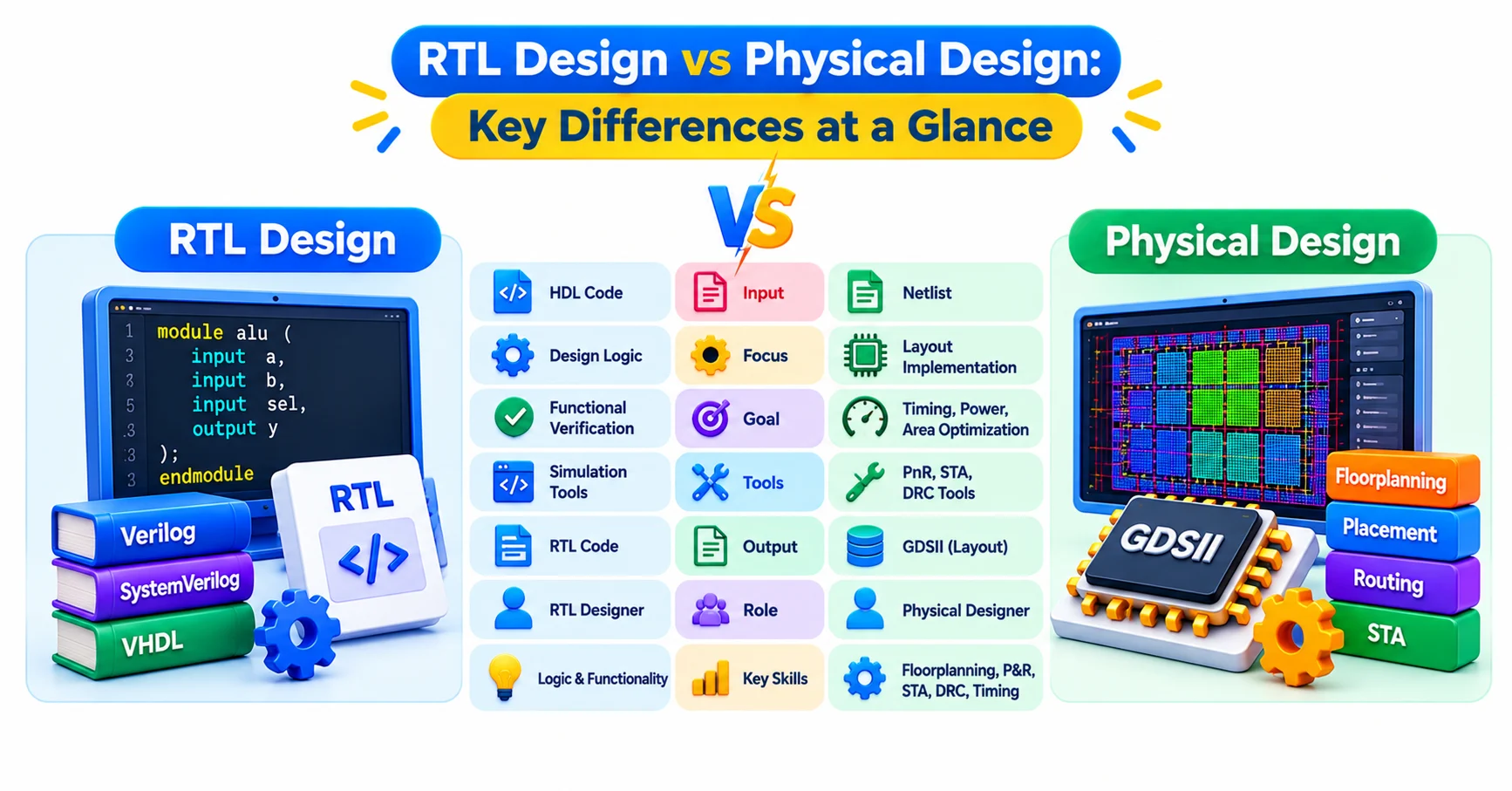
The clearest way to compare the two roles is side by side. The table below covers the points learners ask about most.
| Aspect | RTL Design | Physical Design |
|---|---|---|
| Core question | Does the circuit behave correctly? | Can this circuit be built to meet timing, power, and area? |
| Main input | Specification and architecture | Gate-level netlist, constraints, and technology files |
| Main output | Synthesizable RTL code | Final layout (GDSII) ready for the foundry |
| Primary languages | Verilog, SystemVerilog, VHDL | Tcl, Python, shell scripting |
| Way of thinking | Logical and architectural | Spatial, numerical, and constraint-driven |
| Typical problems | Functional bugs, clock domain crossings, poor coding style | Timing violations, congestion, IR drop, design rule violations |
| Feedback loop | Fast: simulate and see | Slow: long tool runs, iterative fixes |
| Closest neighbor | Verification and architecture teams | Foundry, library, and signoff teams |
Table 1: RTL design vs physical design compared across role, tools, and daily work
Two differences deserve extra attention. The first is the feedback loop. RTL work offers quick feedback through simulation, whereas a full physical design run on a large block can take many hours, so patience and careful planning matter more.
The second is abstraction. RTL lives at the level of logic and behavior. Physical design deals with real physics: resistance and capacitance of wires, signal delay, crosstalk, and voltage drop. A physical engineer needs to understand why a wire that looked harmless on paper now slows a critical path.
Tools You Will Use on Each Side
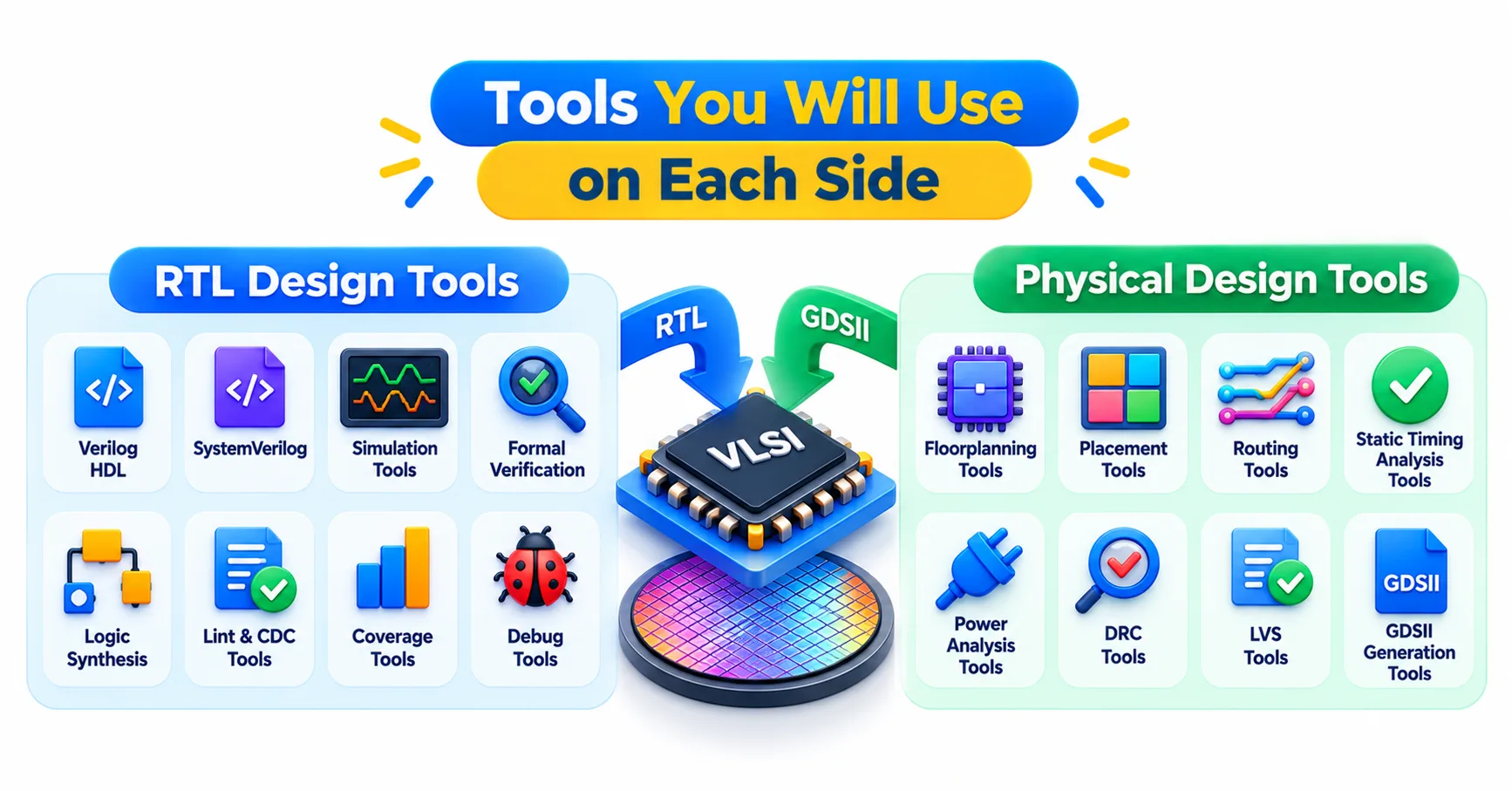
Tools in this field come from three major electronic design automation vendors, Synopsys, Cadence, and Siemens EDA, and most companies use a mix. Exact choices vary by employer, so treat the lists below as representative rather than universal.
On the RTL and front-end side, you will encounter:
Simulators: Synopsys VCS, Cadence Xcelium, and Siemens Questa
Synthesis: Synopsys Design Compiler and Cadence Genus
Lint and clock domain checks: tools such as Synopsys SpyGlass for catching structural problems early
Waveform debug: Verdi and similar viewers
On the physical design side, the toolbox looks different:
Place and route: Cadence Innovus and Synopsys IC Compiler II or Fusion Compiler
Static timing analysis: Synopsys PrimeTime and Cadence Tempus
Physical verification: Siemens Calibre for design rule and layout-versus-schematic checks
Power and IR analysis: Ansys RedHawk and Cadence Voltus
Parasitic extraction: Synopsys StarRC and similar tools
A common beginner mistake is to try to learn every tool before understanding the concepts. Tool interfaces change between versions, but ideas such as setup and hold timing, clock skew, and congestion remain constant. Learn the concept first, then see how each tool exposes it.
Another practical point: commercial EDA tools are licensed, so most people cannot practice at home in the same way they could with a programming language. Open-source options such as Icarus Verilog, Verilator, Yosys, and the OpenROAD project let you experiment with real flows without a license. They are not identical to industry tools, but they teach the same logic, and that is what interviewers care about.
Skills That Separate Strong Candidates From Average Ones

Both roles require a solid grounding in digital electronics, including combinational and sequential logic, finite state machines, and timing basics. Without that, neither side makes sense.
For RTL design, the skills that matter most are:
Writing clean, synthesizable Verilog or SystemVerilog, and knowing which constructs synthesize poorly
Understanding clock domain crossing, reset strategy, and FIFO design
Reading specifications and translating them into microarchitecture
Basic familiarity with verification, since you will debug your own code constantly
For physical design, the emphasis shifts:
A firm grasp of static timing analysis, including setup, hold, and why each violation happens
Comfort with scripting, particularly Tcl, because flows are automated
Knowledge of CMOS behavior, interconnect effects, and power concepts such as leakage and dynamic power
A debugging mindset that can work backward from a failing path to its root cause
The mistakes differ as well. RTL beginners often write code that simulates well but behaves unpredictably after synthesis, usually because of inferred latches or poor reset handling. Physical design beginners often fix violations one at a time without asking why they appear, which leads to endless iteration. Strong engineers in both areas learn to look for patterns instead of patching symptoms.
Soft skills count more than people expect. Chips are built by large teams, and an RTL engineer who documents interfaces clearly or a physical engineer who reports issues with useful context saves everyone time.
Career Paths, Choosing a Side, and Getting Started in 2026
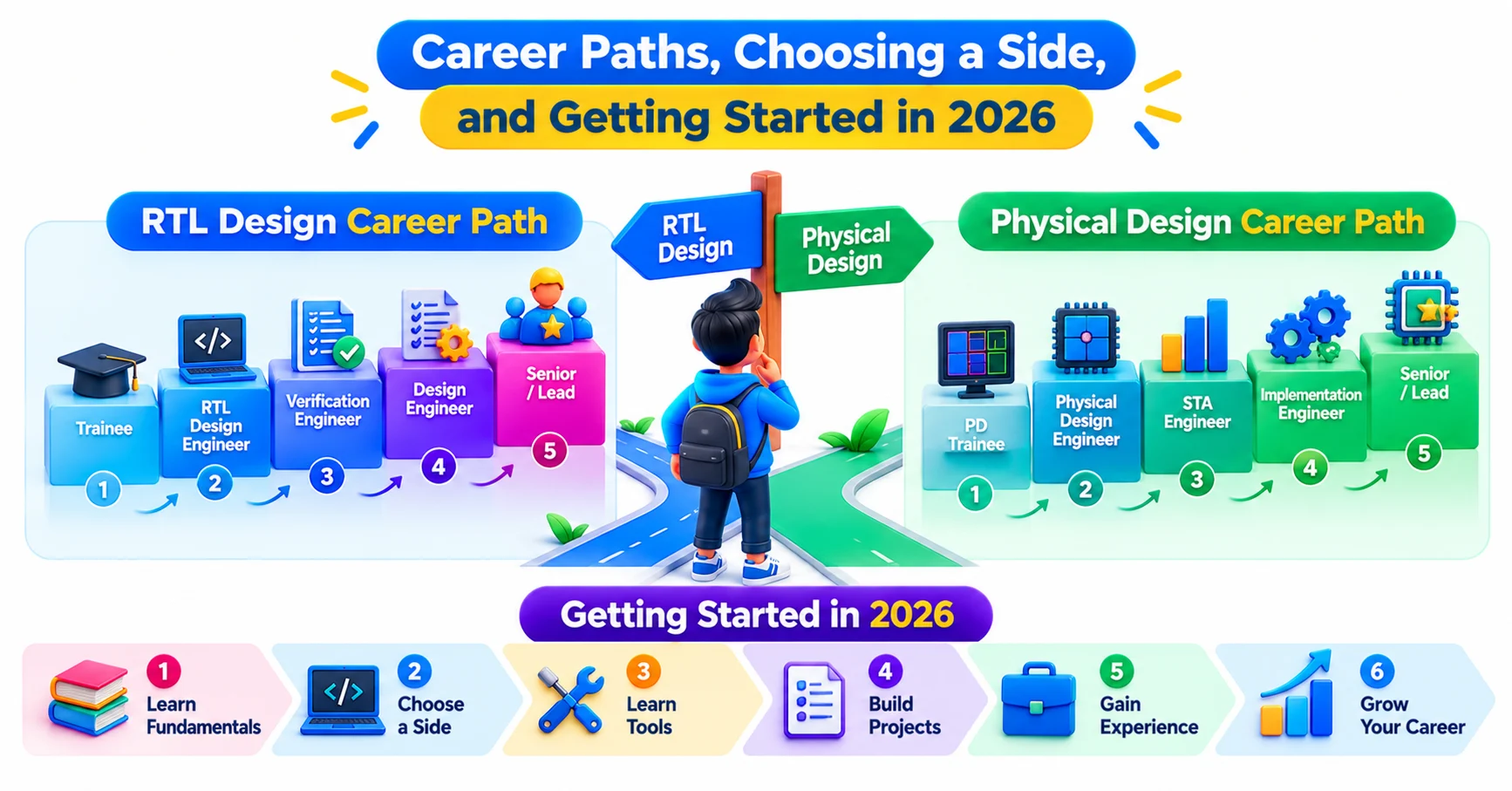
Both tracks lead to stable, specialized careers in semiconductor and electronics companies, and India has a growing design ecosystem with large design centers in cities such as Bengaluru and Hyderabad. Salaries and openings change with market conditions, so check current listings rather than relying on a single number from an article.
Typical RTL-side roles include RTL design engineer, front-end design engineer, and, closely related, design verification engineer. Physical design roles include physical design engineer, timing signoff engineer, and CAD or flow automation engineer. With experience, people on either side move toward technical lead, architect, or management positions, and some cross over, since an RTL engineer who understands physical constraints becomes far more valuable.
A practical way to choose is to ask what kind of problem you enjoy:
If you like building logic from a specification and seeing it work in simulation, RTL design is a natural fit.
If you prefer analyzing numbers, chasing down timing paths, and solving puzzles under tight constraints, physical design may suit you better.
If you are undecided, start with strong digital fundamentals, since they serve both paths.
For preparation, build one small project on each side. Design a simple UART or FIFO in Verilog and simulate it. Then take a small design through an open-source flow to see how placement and routing change the result. Structured programs help here, and learners who want to go deeper into layout, timing closure, and signoff can explore physical design training, while those leaning toward front-end work can follow the RTL route.
Whichever you choose, expect to keep learning. Process nodes, tools, and methodologies keep changing, and curiosity matters more than any single credential.
Conclusion
RTL design vs physical design is not a contest between a better and a worse career. It is a choice between defining what a chip does and making sure it can be built to do it. Understand the flow, learn the fundamentals, and try a small project on each side. JastTech offers training on both paths, so your direction can follow what genuinely holds your interest.