

RTL Design vs. Physical Design: Key Differences for VLSI Professionals in Hyderabad
Navigate through this article using the table of contents below
Table of Contents
No headings found in this article.
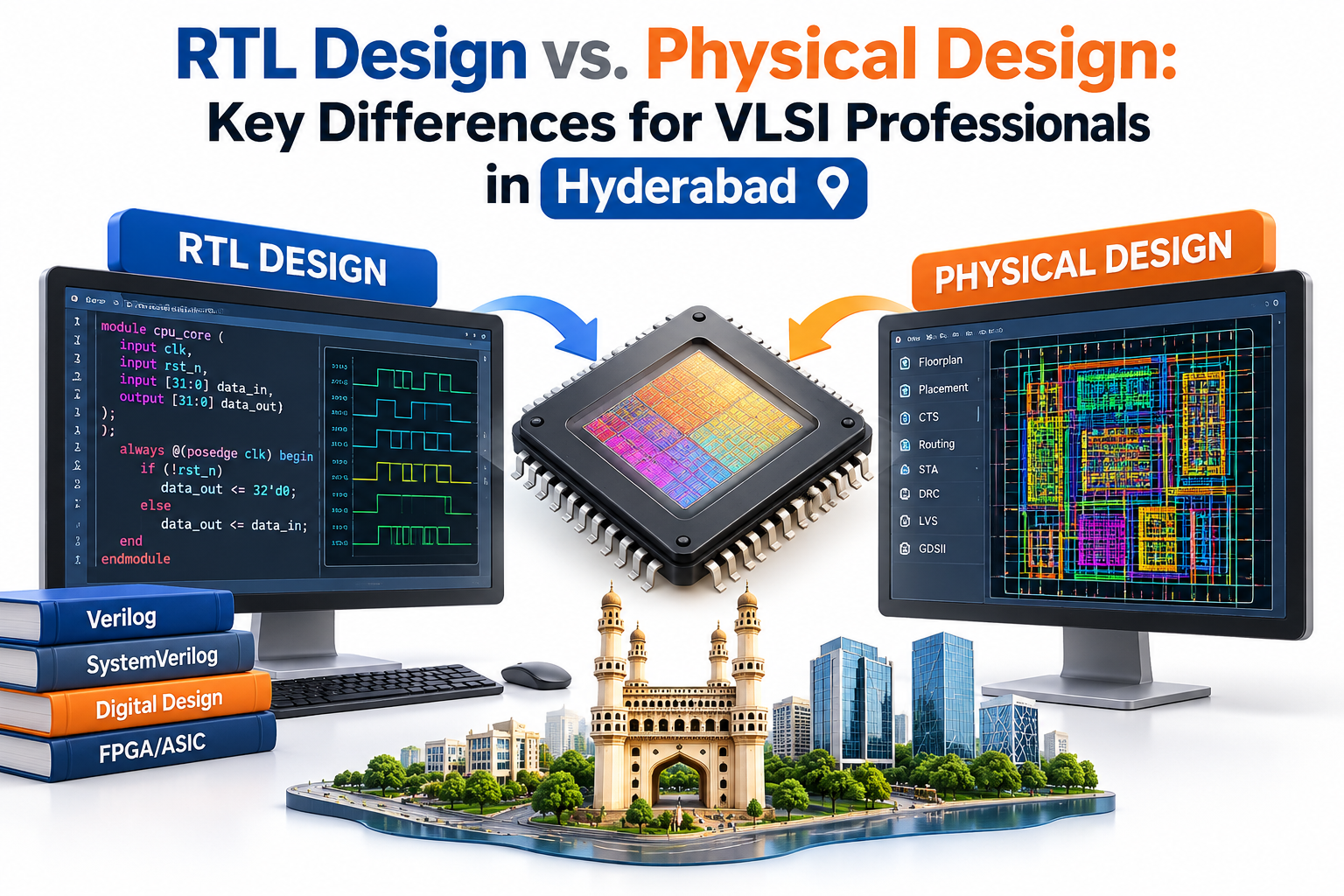
A chip begins with an idea, but turning that idea into working silicon requires two very different engineering skills. RTL Design defines how digital hardware behaves, while Physical Design transforms synthesized logic into a manufacturable layout. Understanding this difference can shape your entire VLSI career.
For engineering graduates and aspiring semiconductor professionals in Hyderabad, choosing the right specialization can save months of unfocused preparation. But which path suits your strengths, and what should you learn to become job-ready? Let’s explore the technical differences, essential skills, career opportunities, and practical learning strategies.
Understanding RTL Design and Physical Design Fundamentals
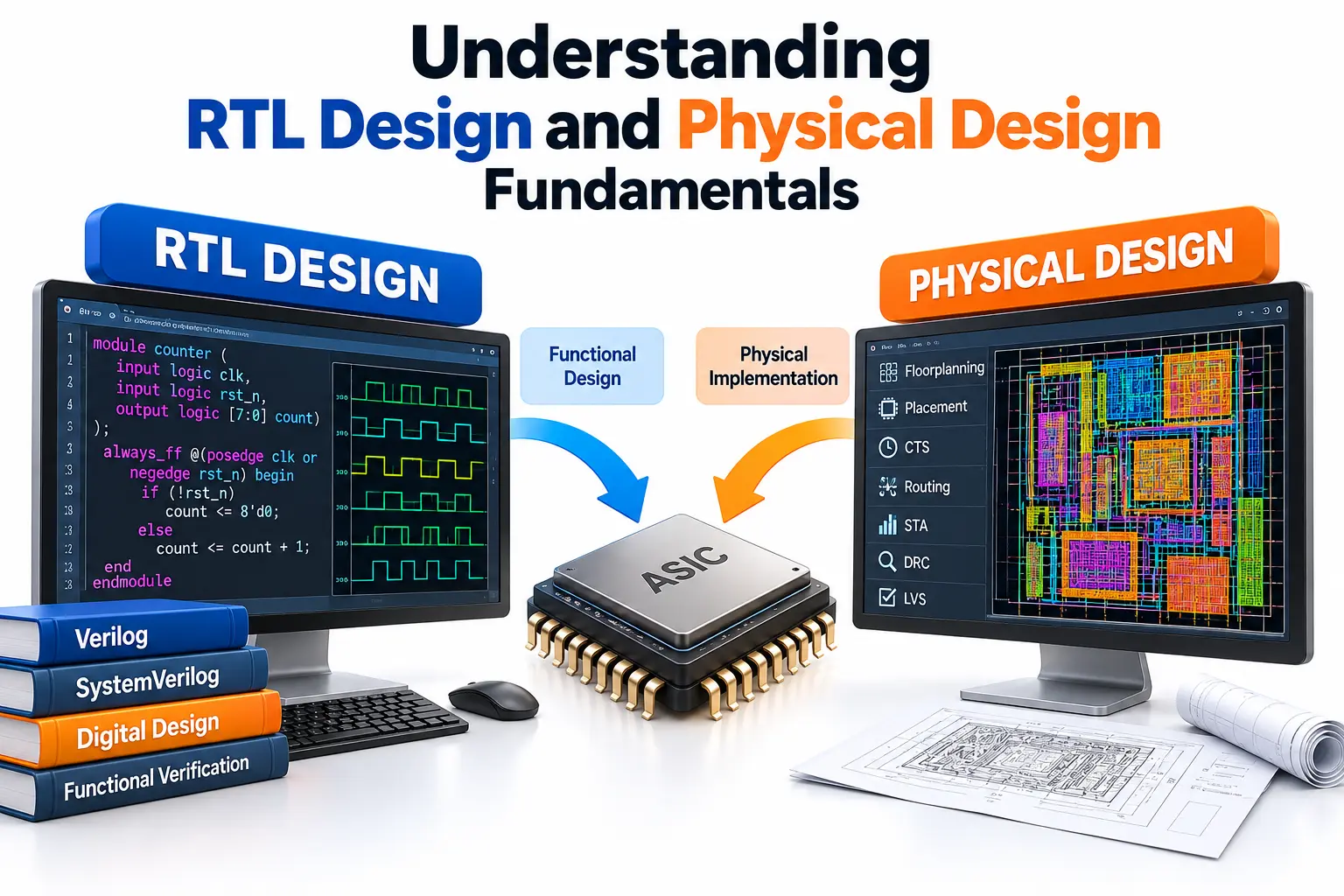
RTL Design, or Register Transfer Level Design, focuses on describing digital hardware functionality using hardware description languages such as Verilog and SystemVerilog. Engineers convert architectural specifications into synthesizable code that defines registers, combinational logic, state machines, counters, and data-processing operations.
An RTL Design Engineer must understand digital electronics, sequential logic, clocking, reset strategies, and synthesis behavior. The objective is to create hardware that performs the intended function while meeting design requirements. Simulation, linting, synthesis reports, and design reviews help identify functional errors and improve implementation quality.
Physical Design focuses on implementing synthesized logic within the physical boundaries of a chip. Engineers organize standard cells, build clock networks, connect signals, and optimize timing, power consumption, and area.
Typical Physical Design activities include:
Floorplanning and power planning.
Standard-cell placement and optimization.
Clock Tree Synthesis (CTS).
Routing and signal-integrity analysis.
Static Timing Analysis (STA) and timing closure.
Physical verification, including Design Rule Checking (DRC) and Layout Versus Schematic (LVS), where applicable.
Both specializations contribute to the same chip, but their daily responsibilities differ. RTL engineers primarily address functional hardware descriptions, whereas Physical Design engineers focus on implementation constraints and physical feasibility.
Key Technical Skills Required for Each Specialization
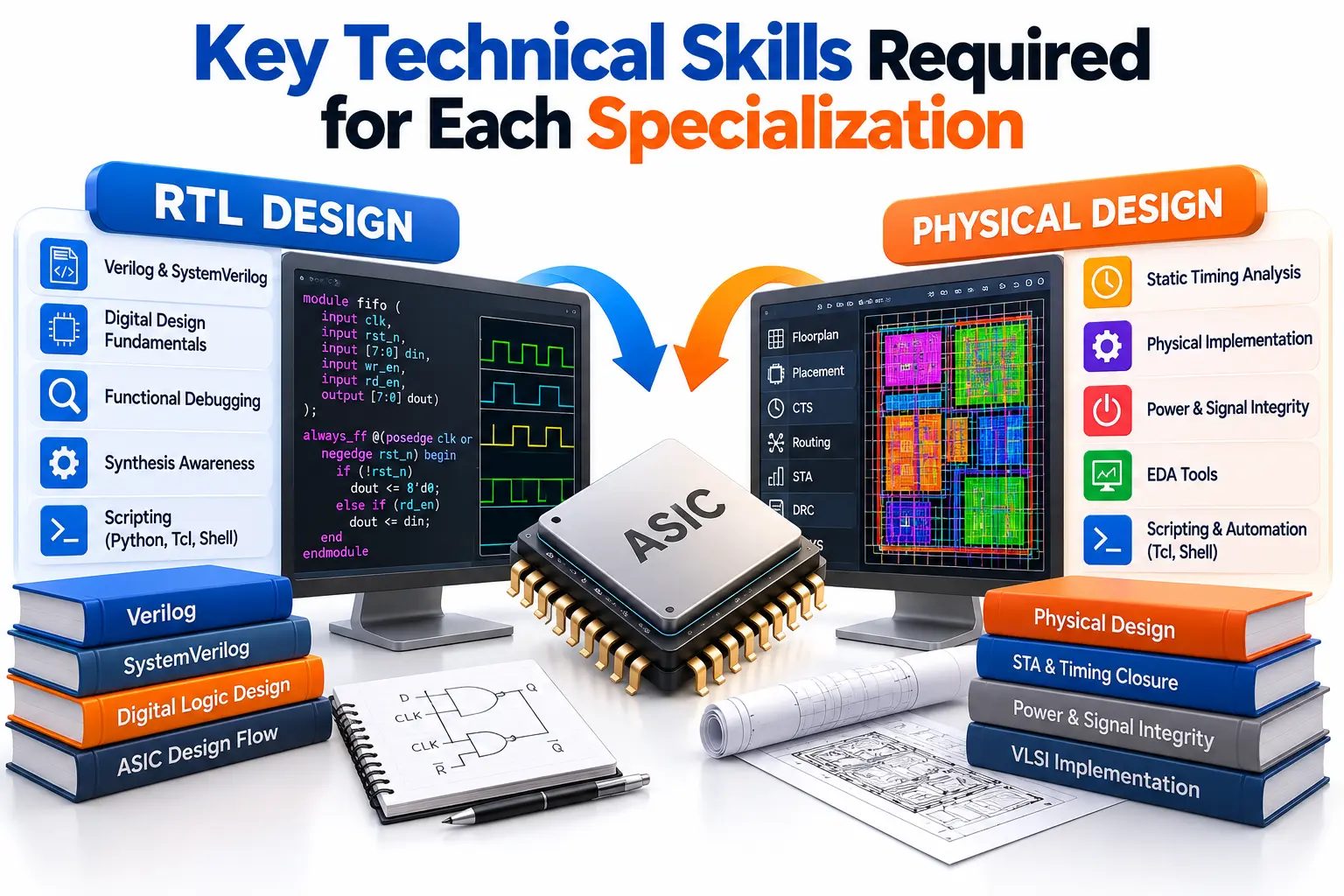
RTL Design requires a strong foundation in digital logic and the ability to translate specifications into reliable hardware descriptions. Engineers should understand blocking and non-blocking assignments, combinational and sequential processes, finite-state machines, parameterized modules, and synthesizable coding practices.
Important RTL skills include:
Verilog and SystemVerilog: Writing clear, synthesizable RTL and understanding language constructs.
Digital design fundamentals: Understanding counters, FIFOs, pipelines, registers, and state machines.
Functional debugging: Investigating simulation failures and correcting logic errors.
Synthesis awareness: Understanding inferred hardware, timing implications, and unintended latch creation.
Scripting: Using Python, Tcl, or shell scripting to automate repetitive tasks.
Physical Design requires a different technical emphasis. Engineers must understand how logical connectivity becomes a physical layout and how placement, routing, parasitic effects, and clock distribution influence circuit performance.
Essential skills include:
Static Timing Analysis: Understanding setup time, hold time, slack, timing paths, and constraints.
Physical implementation: Learning floorplanning, placement, CTS, routing, and optimization.
Power and signal integrity: Understanding IR drop, electromigration, crosstalk, and related design concerns.
EDA tools: Practising implementation and analysis workflows using suitable industry or open-source tools.
Scripting and automation: Using Tcl and shell scripting to manage implementation tasks and analyze reports.
Neither path is exclusively about operating software. Employers value engineers who can explain why a design behaves a certain way and how their decisions affect the final chip.
RTL-to-GDSII Flow: Where the Two Roles Connect
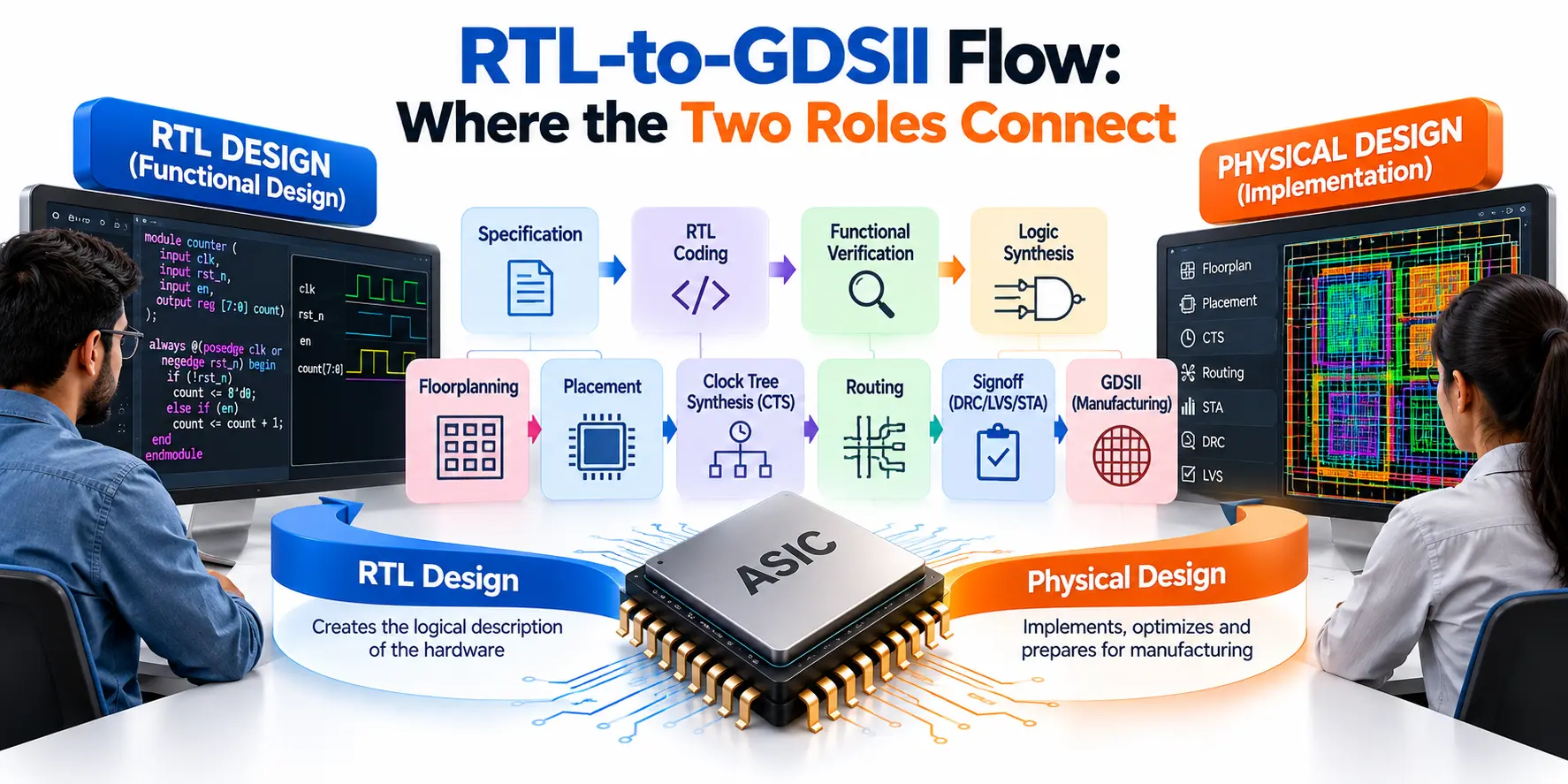
Understanding the complete ASIC design flow helps aspiring engineers see how RTL Design and Physical Design work together. The process begins with a functional specification and progresses through design, verification, implementation, and manufacturing preparation.
The simplified flow is:
Specification → RTL Coding → Functional Verification → Logic Synthesis → Floorplanning → Placement → Clock Tree Synthesis → Routing → Signoff → GDSII
RTL engineers develop the logical description, while verification engineers check whether the design satisfies its requirements. Synthesis converts RTL into a gate-level netlist using technology libraries and design constraints. Physical Design engineers then implement and optimize that netlist.
The handoff between these teams is not always straightforward. Physical implementation may expose timing problems caused by long logic paths, high fanout, congestion, or unrealistic constraints. Engineers may need to collaborate on logic restructuring, buffering, pipeline changes, or other improvements.
For example, an RTL block might pass functional simulation but fail to meet its target clock frequency after implementation. The Physical Design team investigates the critical timing path and determines whether placement, routing, or interconnect delay contributes to the failure. If physical optimization is insufficient, the RTL team may need to modify the design.
This collaboration demonstrates why understanding both front-end and back-end concepts is valuable, even when pursuing only one specialization. Those interested in back-end implementation should look for Physical Design Training that covers timing constraints, placement, CTS, routing, and signoff concepts.
Career Opportunities and Industry Expectations in Hyderabad
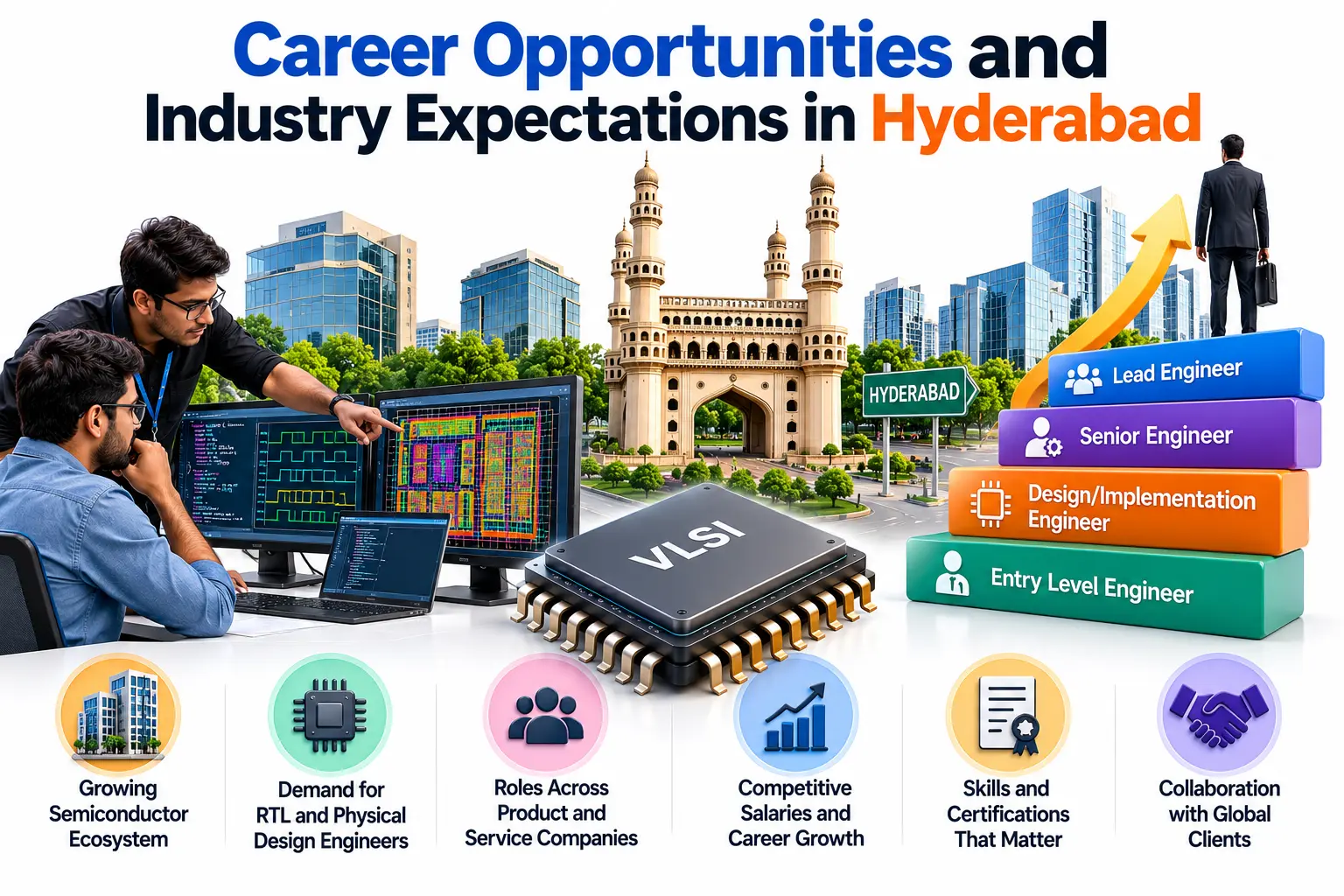
Hyderabad offers opportunities across semiconductor design, electronic design automation, embedded technology, and chip development. However, available positions depend on employer requirements, project demand, experience level, and the specific skills candidates demonstrate.
RTL Design professionals can explore roles such as:
RTL Design Engineer.
Digital Design Engineer.
ASIC Design Engineer.
Front-End Design Engineer.
Physical Design professionals can pursue roles such as:
Physical Design Engineer.
Place-and-Route Engineer.
Static Timing Analysis Engineer.
Implementation or Signoff Engineer.
Entry-level candidates should distinguish between learning a tool and demonstrating engineering competence. An applicant who understands timing reports, coding trade-offs, design constraints, and debugging methods can explain technical decisions more convincingly than someone who has only completed theoretical lessons.
JastTech can position its learning resources around this practical preparation. Candidates exploring VLSI opportunities should review job descriptions carefully, identify the technical requirements repeated across relevant openings, and develop projects that demonstrate those capabilities.
A useful job-readiness checklist includes:
Strong digital electronics fundamentals.
Knowledge of the selected specialization's design flow.
Practical experience analyzing simulation or implementation reports.
Confidence explaining technical projects during interviews.
Basic scripting skills and familiarity with engineering workflows.
Candidates should also remember that job titles vary between companies. Some positions combine synthesis, timing analysis, and implementation responsibilities, while others focus on narrowly defined stages of the design process.
Which Career Path Should You Choose?

The right specialization depends on the problems you enjoy solving. RTL Design is a natural fit for people who like digital logic, hardware architecture, coding, and functional problem-solving. Physical Design may suit candidates who enjoy timing optimization, analytical debugging, implementation constraints, and improving measurable design outcomes.
Before committing to a long training program, try a small project in each area.
For RTL Design, build a synchronous FIFO, an arbiter, or a finite-state machine. Write synthesizable Verilog, create a testbench, simulate normal and boundary conditions, and examine the synthesis results. Explain how your code maps to hardware and what happens when reset or control signals behave unexpectedly.
For Physical Design, take a small synthesized design through an available implementation flow. Examine floorplanning, placement, clock-tree construction, routing, and timing reports. Compare the results before and after optimization, paying attention to timing slack, congestion, and area.
When evaluating learning options, candidates searching for RTL Design and Verification Training in India should examine the syllabus for coding exercises, simulation, debugging, and project work.
Practical exposure matters more than selecting a specialization simply because it appears popular. Compare the work involved, assess your existing strengths, and choose the path in which you are willing to develop deeper expertise.
Building Industry-Ready VLSI Skills with JastTech
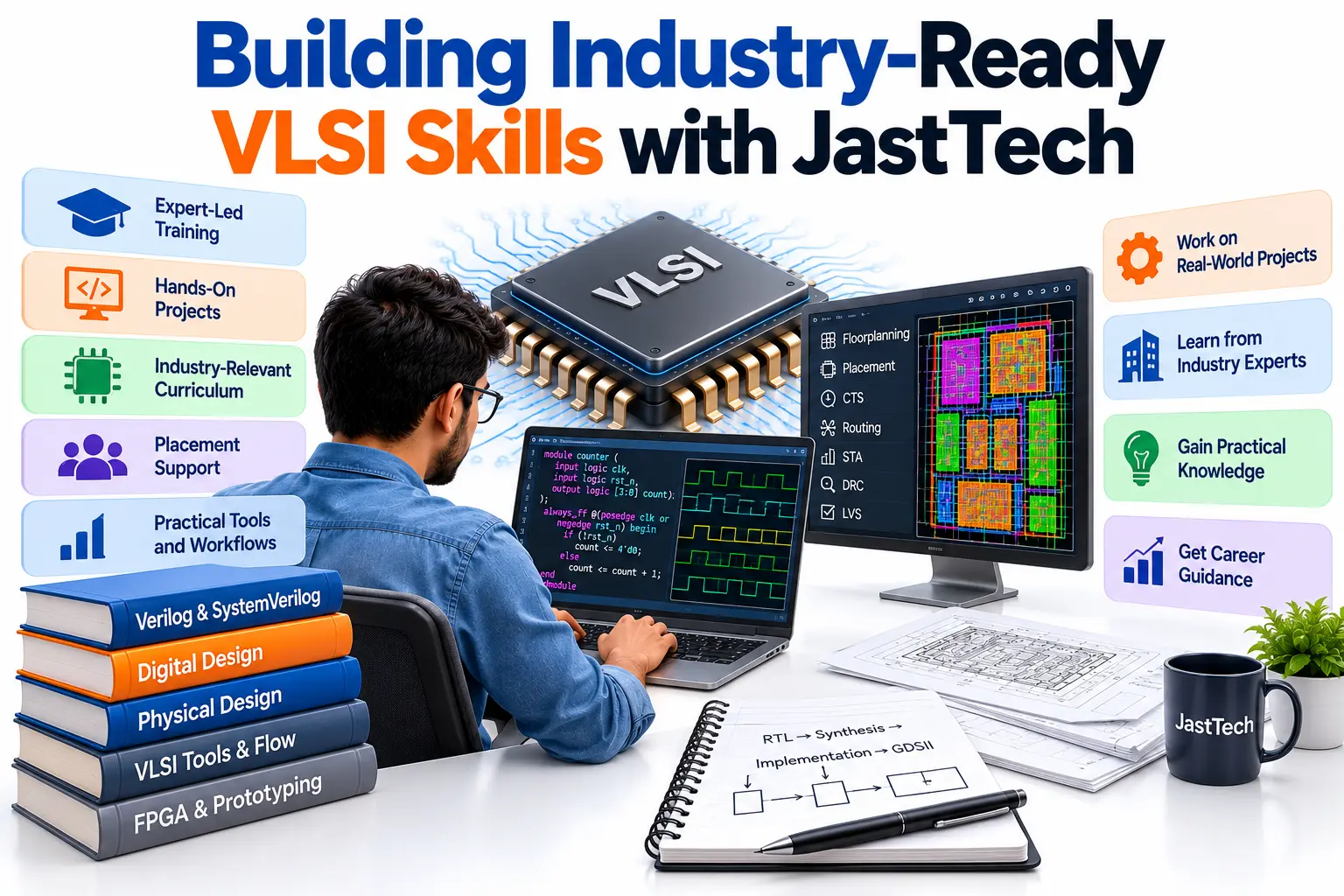
Choosing between RTL Design and Physical Design is only the first step. Becoming employable requires a structured learning plan that combines foundational knowledge, hands-on practice, project development, and interview preparation. A clear specialization helps candidates avoid learning disconnected concepts without understanding how they fit into the ASIC workflow.
JastTech can help learners explore a structured approach to VLSI skill development by emphasizing technical fundamentals, practical exercises, and career-oriented preparation. Candidates comparing training providers should assess instructor experience, laboratory access, project depth, curriculum relevance, and the quality of technical feedback. These factors provide a more meaningful basis for choosing a program than promotional claims alone.
For candidates researching the Best VLSI Training Institute in Hyderabad, the most useful question is whether the learning experience prepares them to solve real engineering problems. Look for opportunities to analyse reports, explain design decisions, debug failures, and present completed projects. Training can strengthen preparation, but employment ultimately depends on demonstrated ability, interview performance, and available opportunities.
The strongest VLSI career strategy is to master one specialization while developing enough knowledge of the complete design flow to collaborate effectively with other engineering teams.
Conclusion
RTL Design and Physical Design are complementary disciplines with different technical priorities. RTL engineers focus on describing correct hardware functionality, while Physical Design engineers transform synthesized logic into a layout that satisfies physical, timing, power, and manufacturing constraints. Both require strong fundamentals, analytical thinking, and practical problem-solving.
For aspiring semiconductor professionals in Hyderabad, the best choice is the one that matches their interests and long-term goals. Experiment with small projects, understand the relevant workflows, and build evidence of your technical skills before applying for positions. With focused preparation and continuous learning, you can develop a stronger foundation for a career in the VLSI industry.