

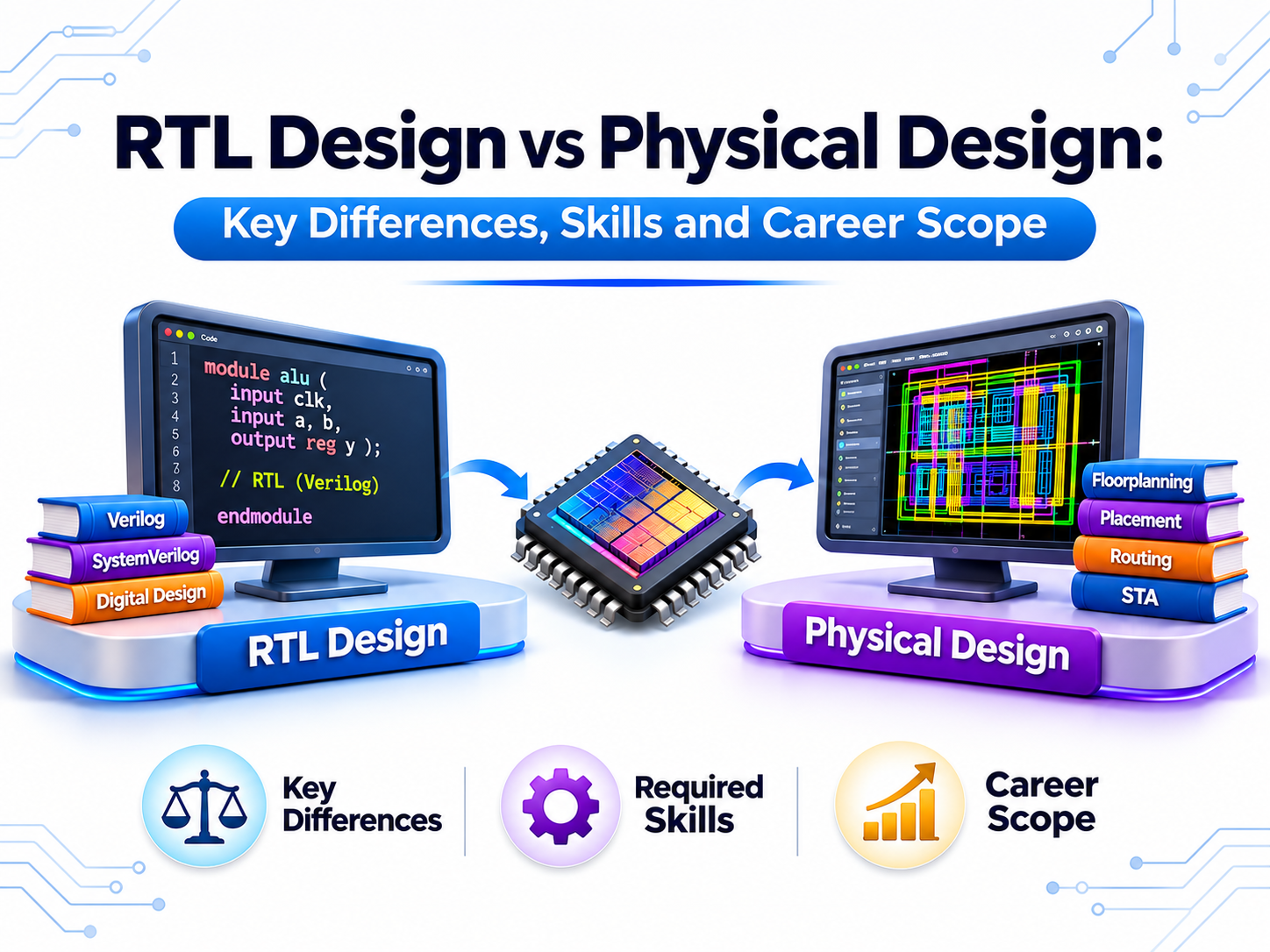
RTL Design vs Physical Design: Key Differences, Skills and Career Scope
Navigate through this article using the table of contents below
Table of Contents
No headings found in this article.
A semiconductor chip begins with an idea, but transforming that idea into working silicon requires several engineering stages. Two important stages are RTL design and physical design. Although they contribute to the same chip, their responsibilities, technical skills and daily challenges are significantly different.
For electronics graduates entering the semiconductor industry, choosing between these specializations can be confusing. Understanding how they work together, what skills companies expect and where each career can lead will help you make a more informed decision.
Understanding RTL Design and Physical Design in the VLSI Industry
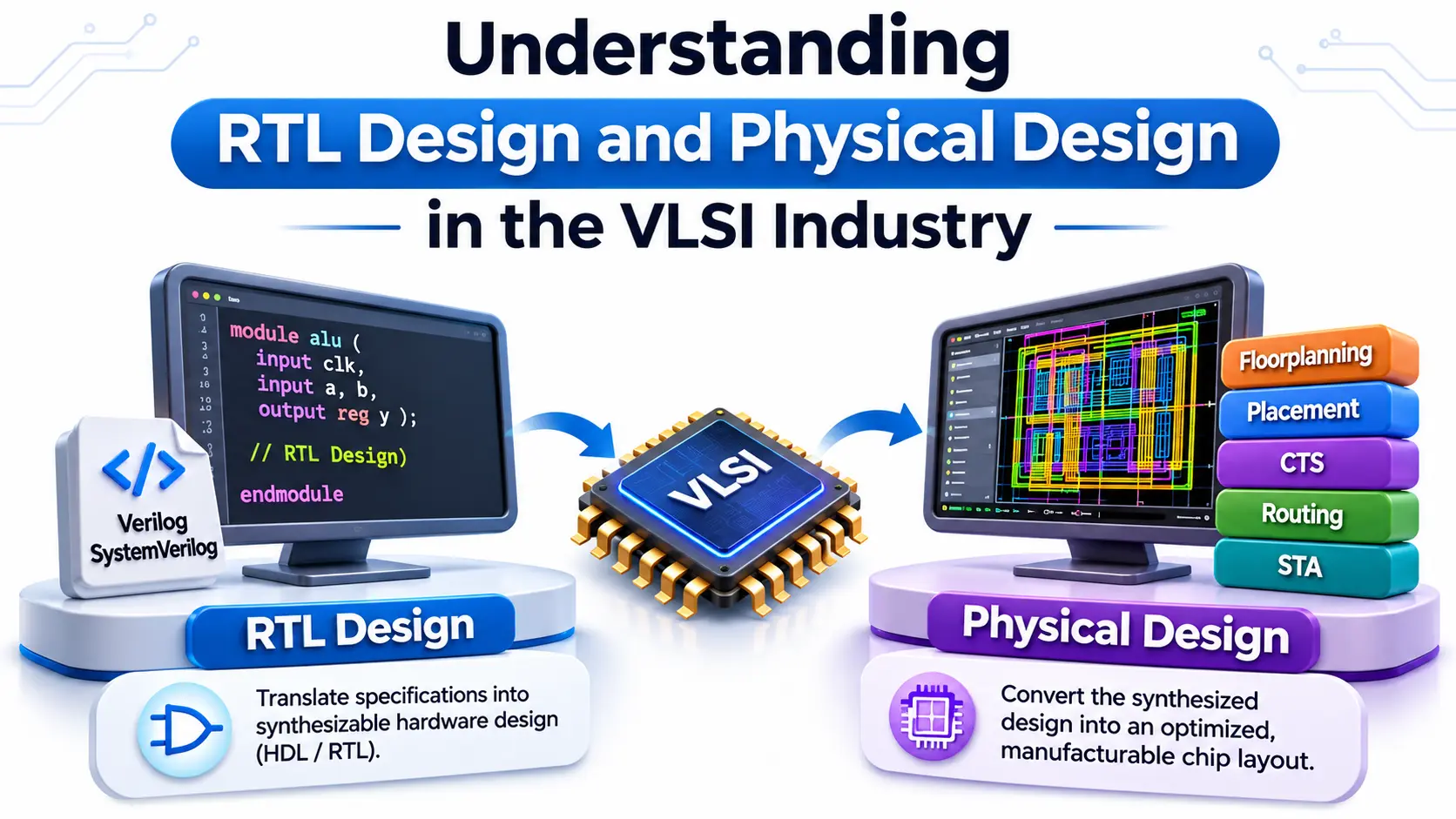
RTL (Register Transfer Level) design is the front-end stage of digital chip development. Engineers translate architectural specifications into synthesizable hardware descriptions using languages such as Verilog and SystemVerilog. They define registers, combinational logic, state machines, data paths and control signals.
For example, when developing a processor, an RTL engineer may design an arithmetic logic unit, instruction decoder or pipeline controller. The objective is to create hardware logic that performs the required operations correctly while considering performance, power and area requirements.
Physical design is a back-end implementation stage that converts the synthesized gate-level netlist into a manufacturable physical layout. Engineers determine how standard cells, memories, clock networks and interconnections are arranged on the chip.
Its major activities include:
Floorplanning and power planning.
Standard-cell placement and optimization.
Clock Tree Synthesis (CTS).
Global and detailed routing.
Static Timing Analysis (STA).
Physical verification and signoff.
Both specializations are essential. RTL defines the intended hardware functionality, while physical design ensures that the implementation satisfies real-world timing, power, area and manufacturing constraints.
Key Differences Between RTL Design and Physical Design
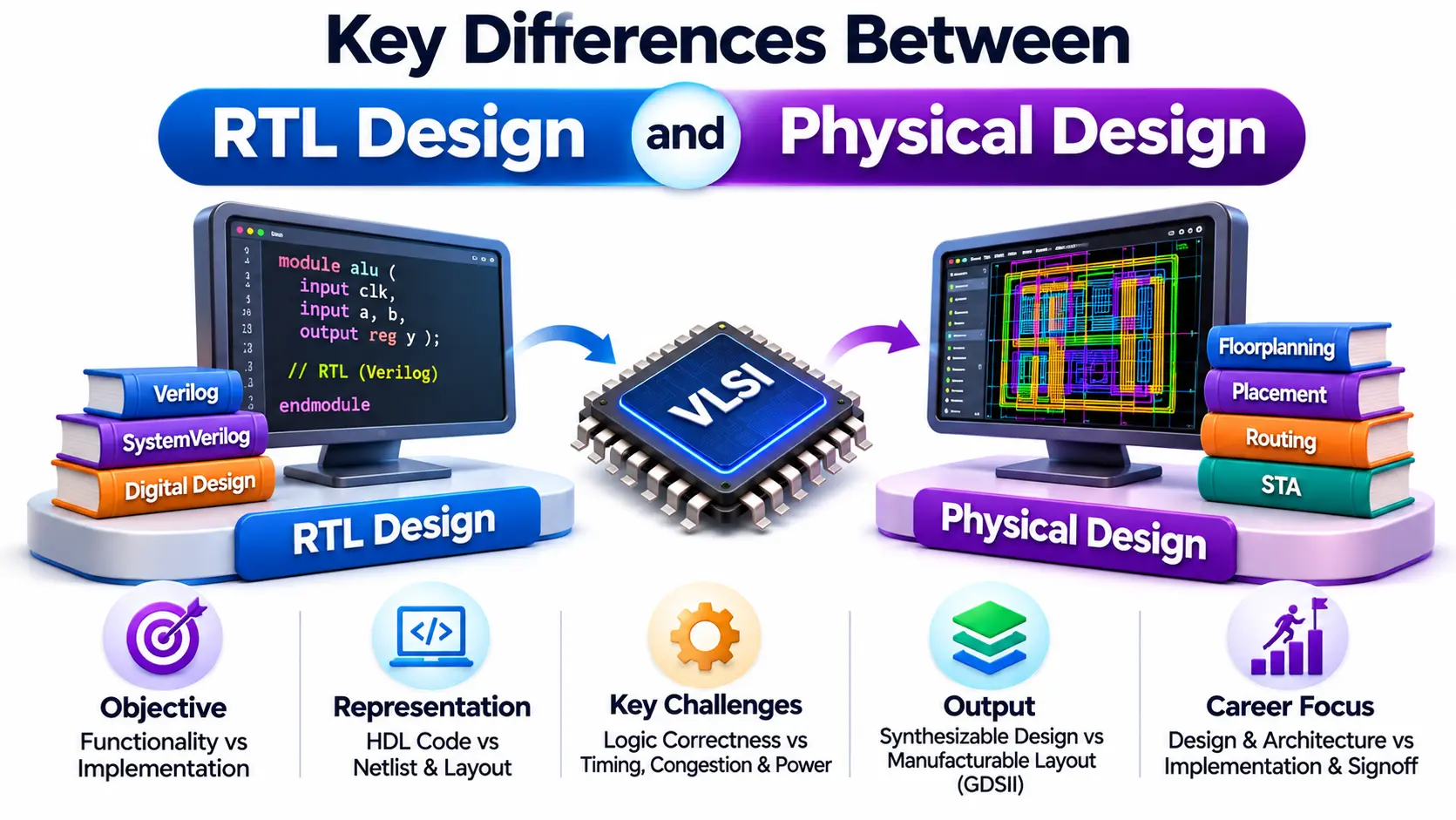
The biggest difference is the level at which engineers work. RTL engineers concentrate on describing digital hardware behavior, whereas physical design engineers focus on implementing that hardware within the physical boundaries of a semiconductor chip.
RTL engineers spend considerable time understanding specifications, developing microarchitecture, writing synthesizable code and debugging functional problems. Their decisions influence the quality of the synthesized netlist and subsequent implementation stages.
Physical design engineers work with netlists, technology libraries, timing constraints and layout databases. They analyze placement quality, routing congestion, clock distribution and parasitic effects to achieve design closure.
Some important differences include:
Primary objective: RTL focuses on functional hardware description; physical design focuses on physical implementation.
Main representation: RTL uses HDL code, while physical design uses netlists and layout databases.
Major challenges: RTL engineers handle logic correctness, coding quality and architectural decisions. Physical design engineers handle timing violations, congestion, power integrity and area optimization.
Expected output: RTL produces synthesizable design descriptions; physical design produces a verified layout database for manufacturing.
Problem-solving approach: RTL requires logical and architectural thinking, while physical design requires implementation analysis and optimization.
Understanding these differences is important before selecting a specialization.
Technical Skills and Tools Required for Both Career Paths
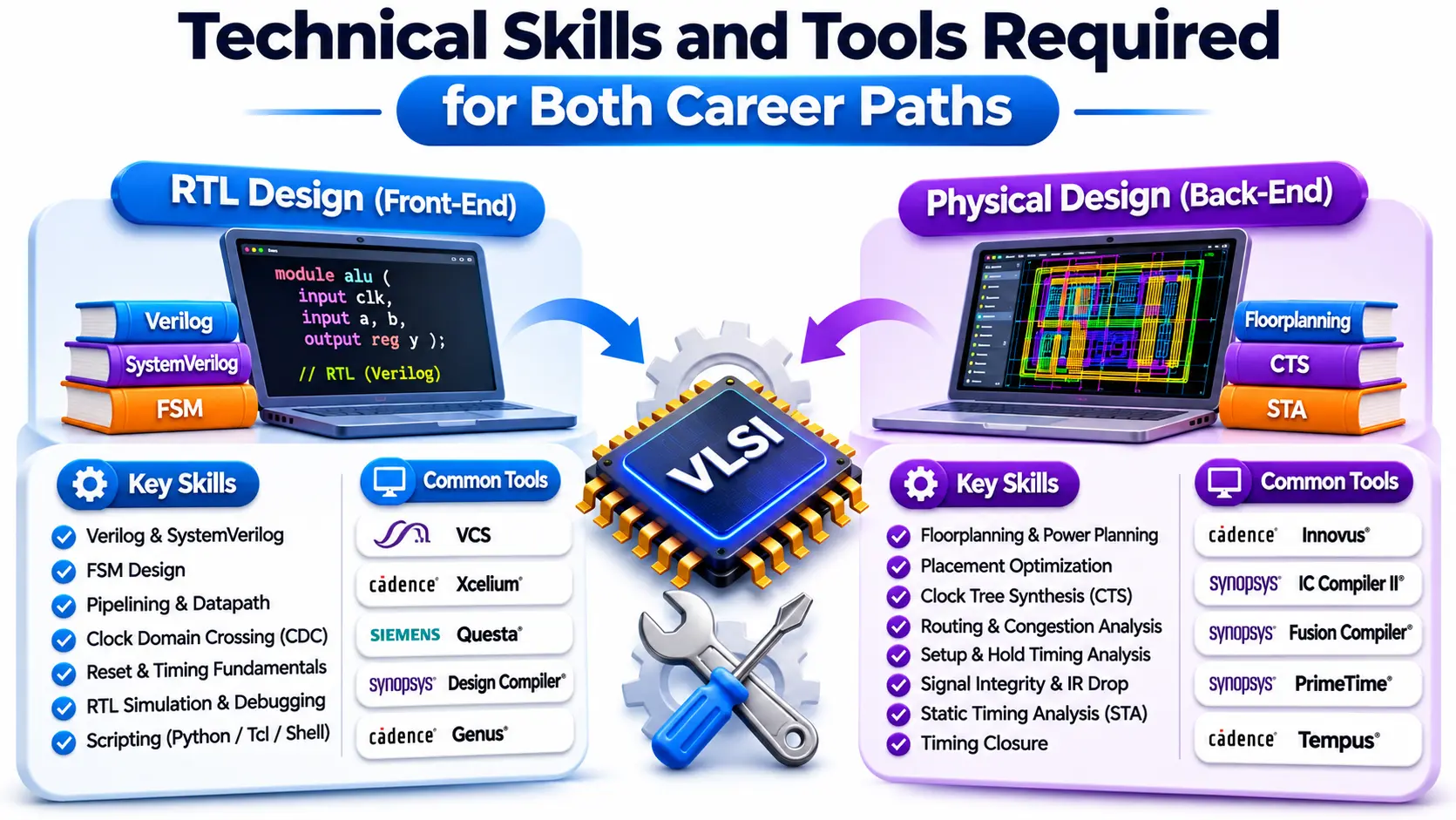
Both domains require strong digital electronics fundamentals, but their specialized skill requirements differ. A successful RTL engineer needs a deep understanding of digital logic, sequential circuits, combinational circuits and computer architecture.
Important RTL design skills include:
Verilog and SystemVerilog programming.
Finite State Machine (FSM) design.
Pipelining and datapath development.
Clock Domain Crossing (CDC) concepts.
Reset architecture and timing fundamentals.
RTL simulation, debugging and synthesis awareness.
Basic scripting using Python, Tcl or Shell.
Commonly used tools include Synopsys VCS, Cadence Xcelium, Siemens Questa, Synopsys Design Compiler and Cadence Genus.
Physical design requires a different technical foundation. Engineers must understand semiconductor implementation, timing analysis, standard-cell libraries and interconnect behavior.
Important physical design skills include:
Floorplanning and power planning.
Placement optimization.
Clock Tree Synthesis.
Routing and congestion analysis.
Setup and hold timing analysis.
Signal integrity and IR drop concepts.
Static Timing Analysis and timing closure.
Common industry tools include Cadence Innovus, Synopsys IC Compiler II, Fusion Compiler, PrimeTime and Cadence Tempus.
A structured Physical Design Training program should include practical exposure to these implementation stages rather than concentrating exclusively on tool commands.
Career Opportunities and Industry Scope in RTL and Physical Design
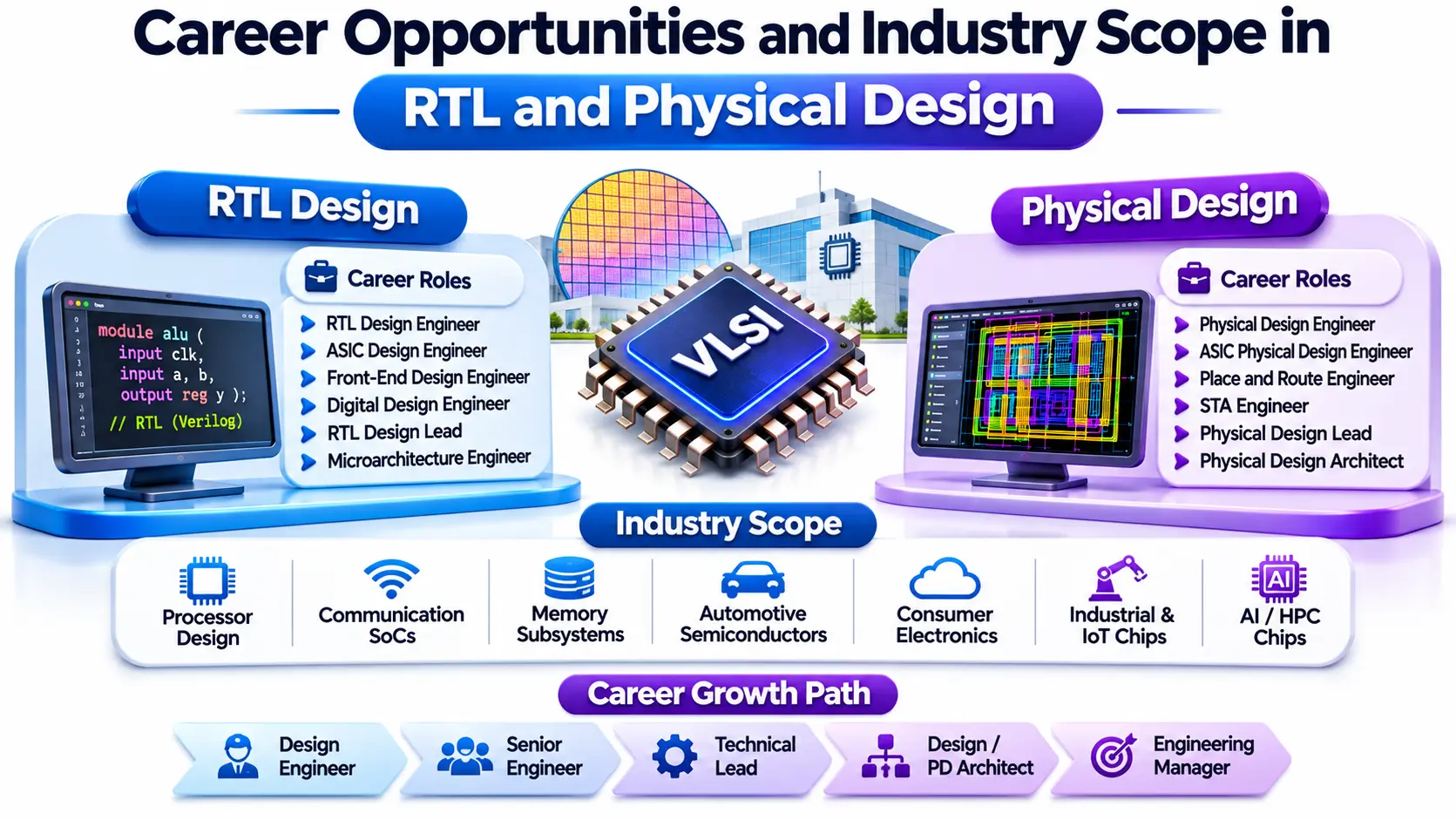
Both specializations offer opportunities in the semiconductor industry. However, their job responsibilities and professional development paths are different.
RTL engineers generally work in digital design teams responsible for developing processors, controllers, communication interfaces, memory subsystems and other digital IP blocks.
Typical job titles include:
RTL Design Engineer.
ASIC Design Engineer.
Front-End Design Engineer.
Digital Design Engineer.
RTL Design Lead.
Microarchitecture Engineer.
Physical design engineers work on converting synthesized designs into optimized layouts. Their responsibilities become increasingly specialized as they gain experience in implementation and signoff.
Typical job titles include:
Physical Design Engineer.
ASIC Physical Design Engineer.
Place and Route Engineer.
STA Engineer.
Physical Design Lead.
Physical Design Architect.
Both career paths can lead to senior engineering, technical leadership, architecture and engineering management positions.
India's growing semiconductor ecosystem is creating opportunities across chip design, verification, implementation and semiconductor development. However, hiring requirements vary according to company projects, experience levels and technical specialization.
Freshers should focus on building practical skills instead of depending entirely on certificates or salary expectations when evaluating career opportunities.
Which Career Path Is Better for Freshers and ECE Graduates?
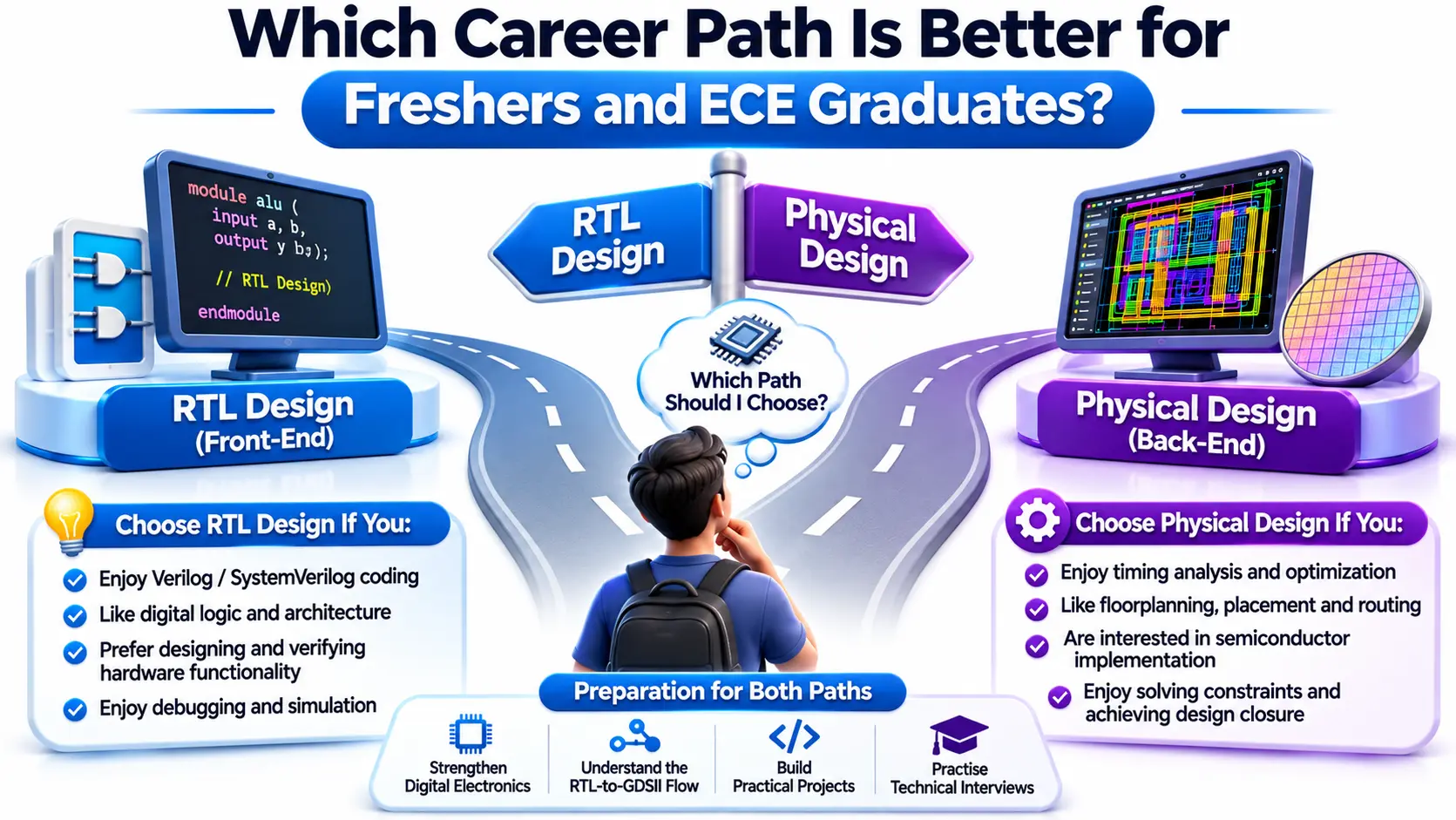
There is no universally better option between RTL and physical design. The right choice depends on your technical interests, problem-solving abilities and preferred engineering responsibilities.
RTL design may suit students who enjoy programming, digital logic, architecture and developing hardware functionality. If you like writing Verilog code, designing FSMs and debugging simulation waveforms, front-end design may be a suitable direction.
Physical design may suit students who enjoy timing analysis, optimization, semiconductor implementation and solving complex engineering constraints. If analyzing timing reports, understanding placement and improving routing quality interests you, back-end implementation may be a better choice.
Before selecting either specialization, consider these preparation steps:
Strengthen digital electronics and CMOS fundamentals.
Learn the complete RTL-to-GDSII design flow.
Understand synthesis and static timing analysis.
Practise domain-specific projects.
Develop scripting and Linux command-line skills.
Prepare for technical interviews using practical design scenarios.
Students searching for a VLSI training institute in Pune should evaluate whether the training includes structured technical modules, practical assignments, project exposure and interview preparation.
JastTech focuses on helping aspiring engineers understand industry-oriented VLSI concepts and develop the technical foundation required for semiconductor engineering roles.
How to Build Industry-Ready Skills Through Practical VLSI Projects
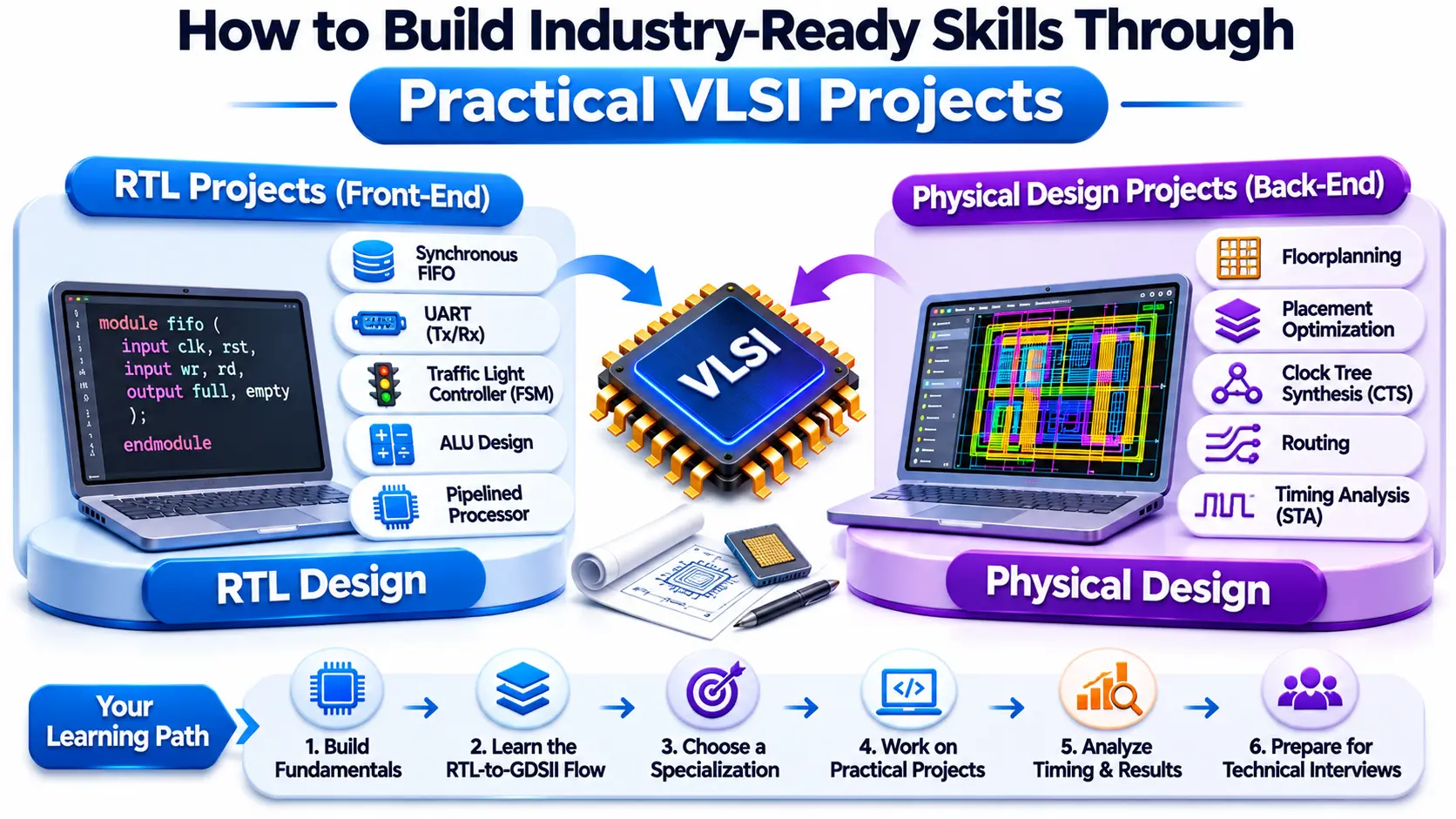
Theoretical knowledge is important, but practical implementation helps students understand how engineering concepts are applied in semiconductor development.
For RTL aspirants, projects should demonstrate coding ability, functional understanding and debugging skills. Suitable beginner projects include:
Synchronous FIFO design using Verilog.
UART transmitter and receiver.
Finite State Machine-based traffic light controller.
ALU design with multiple operations.
Simple pipelined processor architecture.
Students interested in physical design should understand how a synthesized design moves through implementation stages. Practical assignments can include floorplanning, placement optimization, clock tree generation and routing a small digital block.
A useful learning sequence includes:
Understand digital electronics and semiconductor fundamentals.
Learn the RTL-to-GDSII design methodology.
Select either front-end or back-end specialization.
Complete domain-specific projects.
Study timing reports and implementation constraints.
Practise technical interviews and project explanations.
Open-source tools such as Yosys, OpenROAD, Verilator and OpenSTA can also help students explore parts of the digital implementation flow.
The objective should be to understand why each engineering decision is made, not simply how to execute commands in an EDA tool.
Conclusion
RTL design and physical design are two closely connected specializations within the VLSI industry. RTL engineers develop the functional hardware description, while physical design engineers transform the synthesized logic into an optimized physical layout. Both require strong fundamentals, practical knowledge and continuous technical learning. Your choice should depend on whether you prefer developing digital logic or solving implementation and optimization challenges.
For aspiring semiconductor engineers, the best starting point is a strong understanding of digital electronics, computer architecture and the complete chip design process. JastTech aims to support students through industry-oriented learning, practical projects and specialized technical preparation. Developing demonstrable skills and understanding real engineering workflows can help freshers prepare for opportunities in the growing semiconductor industry.