

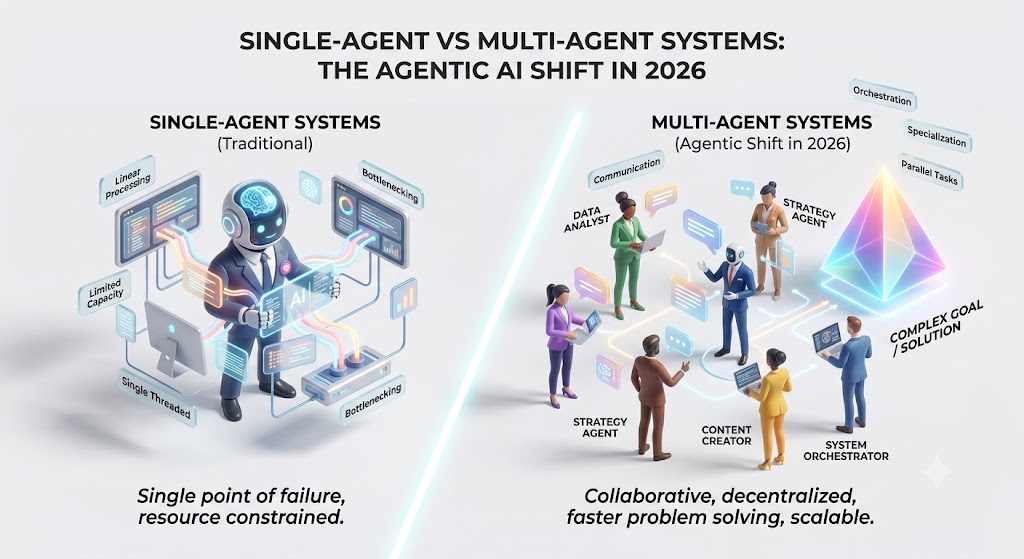
Single-Agent vs Multi-Agent Systems: The Agentic AI Shift in 2026
Navigate through this article using the table of contents below
Table of Contents
No headings found in this article.
Artificial Intelligence is no longer limited to answering questions or generating content. In 2026, AI is becoming capable of planning, reasoning, collaborating, and executing complex workflows with minimal human intervention. This transformation is being driven by Agentic AI, where autonomous agents work independently or together to accomplish sophisticated goals.
One of the biggest architectural decisions organizations now face is choosing between Single-Agent and Multi-Agent Systems. Understanding the strengths, limitations, and ideal use cases of each approach is becoming essential for AI engineers, software developers, automation specialists, and enterprises adopting intelligent automation.
Understanding Single-Agent and Multi-Agent Systems
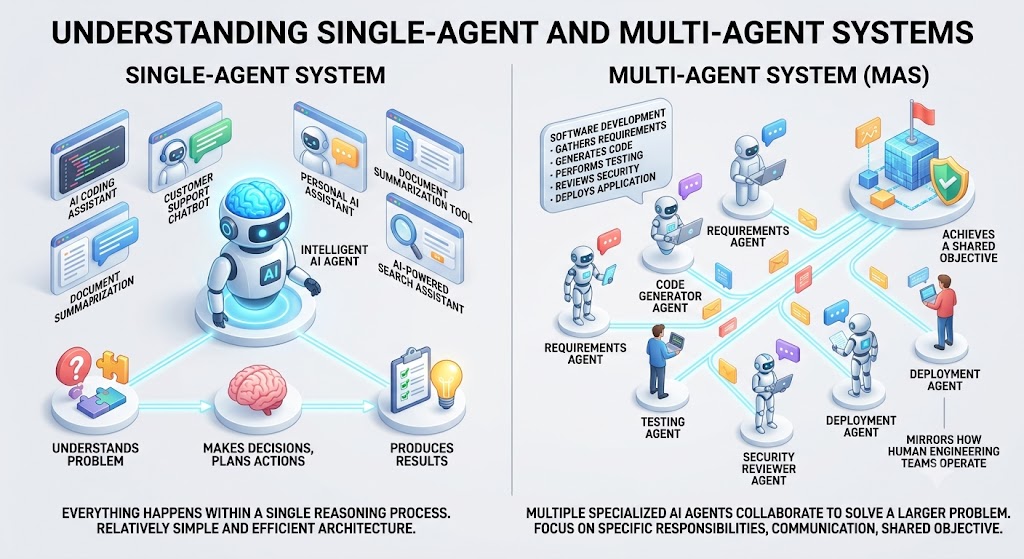
A Single-Agent System consists of one intelligent AI agent responsible for understanding a problem, making decisions, planning actions, and producing results. Everything happens within a single reasoning process, making the architecture relatively simple and efficient.
Common examples include:
AI coding assistants
Customer support chatbots
Personal AI assistants
Document summarization tools
AI-powered search assistants
A Multi-Agent System (MAS) involves multiple specialized AI agents collaborating to solve a larger problem. Instead of one model performing every task, different agents focus on specific responsibilities while communicating with one another to achieve a shared objective.
For example, in software development:
One agent gathers requirements.
Another generates code.
A third performs testing.
Another reviews security.
One deploys the application.
This collaborative approach mirrors how human engineering teams operate.
Why Multi-Agent AI Is Transforming Enterprise Automation
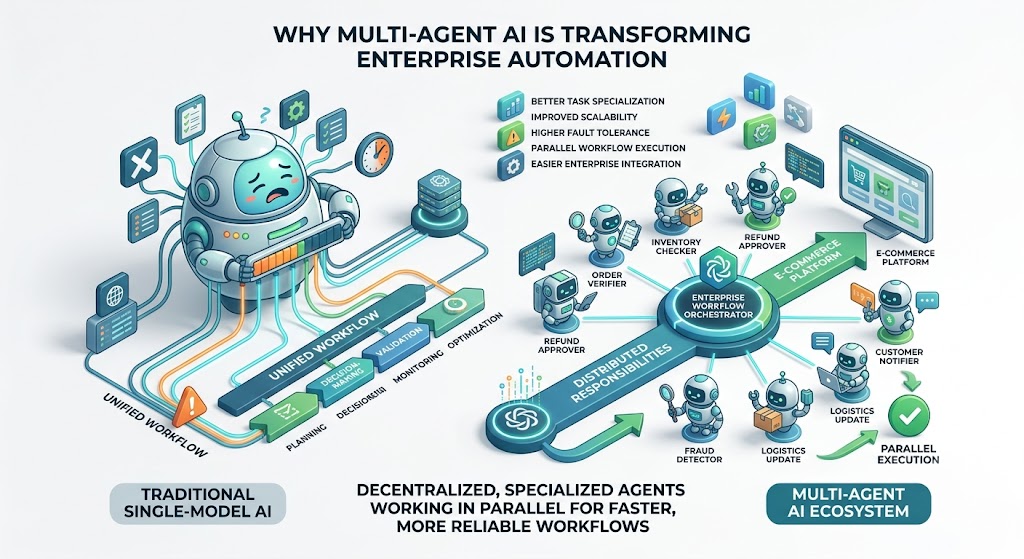
Businesses increasingly deal with workflows that involve planning, decision-making, validation, monitoring, and continuous optimization. A single AI model often struggles to manage every step efficiently.
Multi-agent systems solve this by distributing responsibilities among specialized agents.
Benefits include:
Better task specialization
Improved scalability
Parallel execution of workflows
Higher fault tolerance
Easier integration with enterprise systems
Consider an e-commerce platform handling customer returns. Instead of one AI making every decision, separate agents can verify orders, check inventory, approve refunds, detect fraud, update logistics, and notify customers simultaneously.
This reduces processing time while improving accuracy and reliability.
Single-Agent vs Multi-Agent: Choosing the Right Architecture
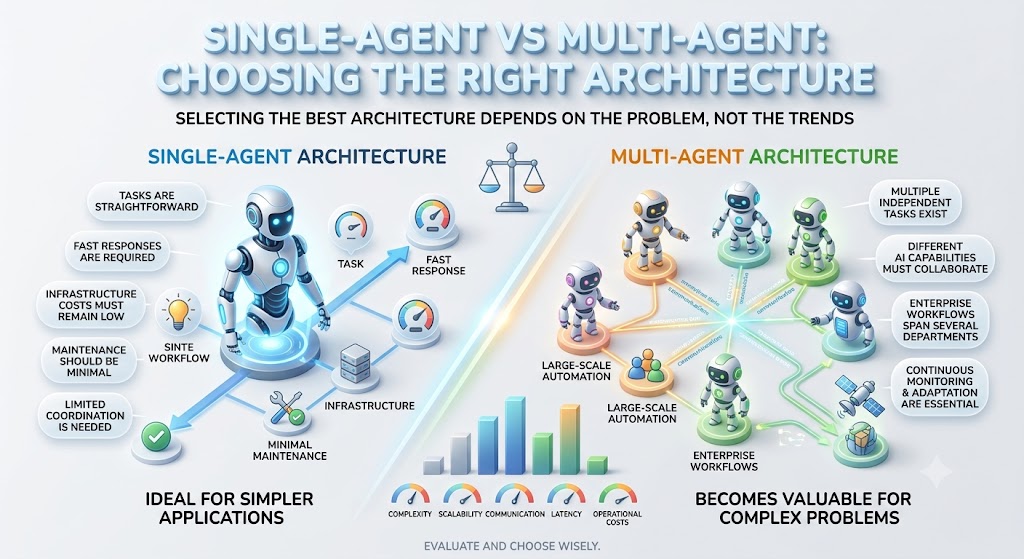
Although multi-agent systems receive significant attention, they are not always the correct solution. Simpler applications often perform better with a single-agent architecture.
Single-agent systems are ideal when:
Tasks are straightforward
Fast responses are required
Infrastructure costs must remain low
Maintenance should be minimal
Limited coordination is needed
Multi-agent systems become valuable when:
Multiple independent tasks exist
Large-scale automation is required
Different AI capabilities must collaborate
Enterprise workflows span several departments
Continuous monitoring and adaptation are essential
Engineers should evaluate complexity, scalability, communication requirements, latency, and operational costs before selecting an architecture.
The best architecture depends on the problem rather than current industry trends.
How Agentic AI Is Changing Software Engineering in 2026
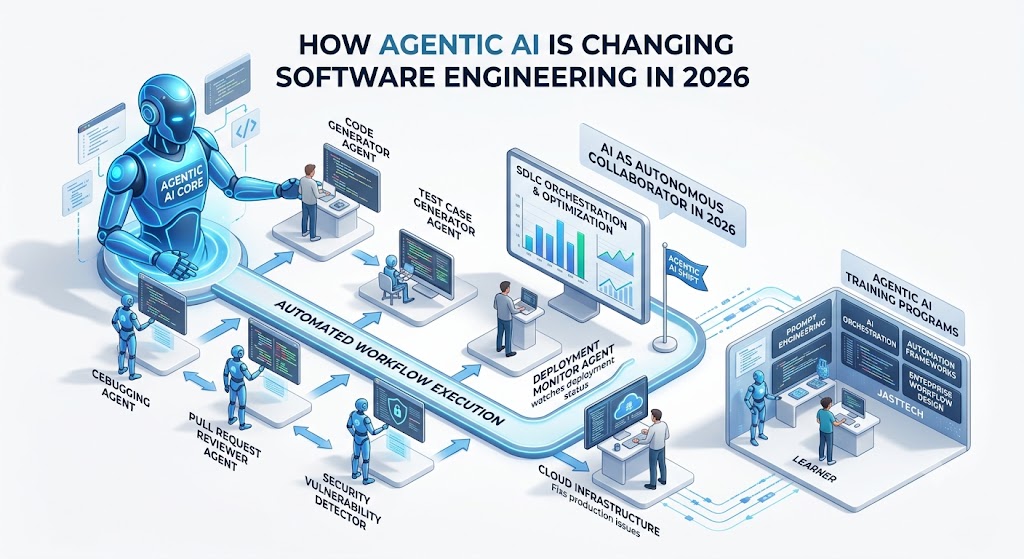
The shift toward Agentic AI has fundamentally changed software development practices. AI is evolving from an assistant into an autonomous collaborator capable of executing complete engineering workflows.
Modern development environments increasingly use AI agents for:
Writing production-ready code
Generating test cases
Reviewing pull requests
Detecting security vulnerabilities
Monitoring deployments
Managing cloud infrastructure
Debugging production issues
Instead of asking one chatbot to perform every task, organizations now deploy specialized AI agents working together across the Software Development Life Cycle (SDLC).
This approach improves software quality while allowing engineers to focus on architecture, innovation, and business requirements.
Training providers like JastTech are also introducing Agentic AI programs that combine prompt engineering, AI orchestration, automation frameworks, and enterprise workflow design to prepare professionals for this rapidly growing field.
Challenges Engineers Must Consider Before Building Multi-Agent Systems
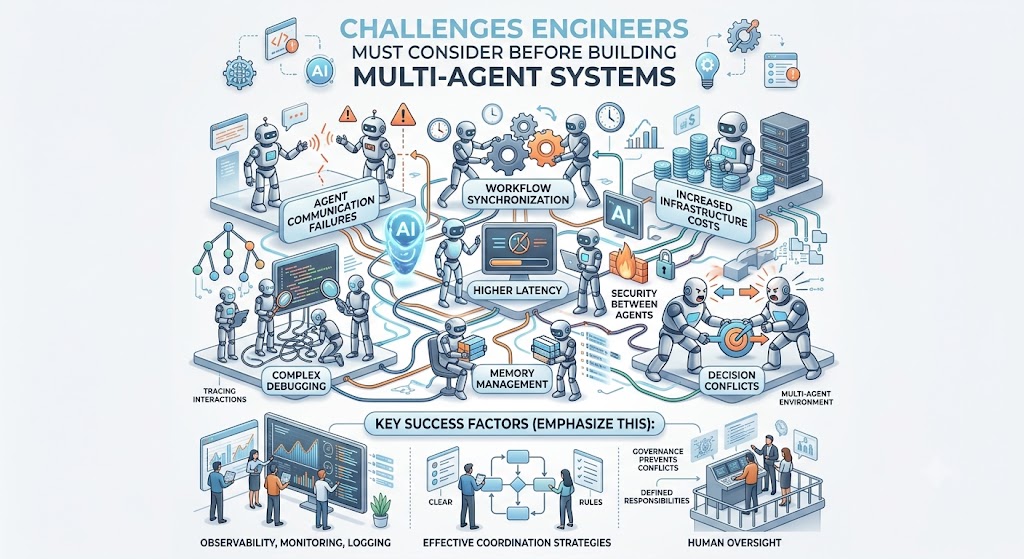
Despite their advantages, multi-agent systems introduce new engineering challenges that cannot be ignored.
Some common difficulties include:
Agent communication failures
Workflow synchronization
Increased infrastructure costs
Complex debugging
Higher latency
Security between agents
Memory management
Decision conflicts
Unlike a single-agent system, diagnosing failures in a multi-agent environment often requires tracing interactions across several autonomous components.
Engineers must also design effective coordination strategies, define agent responsibilities clearly, and establish governance rules to prevent conflicting decisions.
Successful implementations emphasize observability, monitoring, logging, and human oversight rather than fully autonomous execution.
Career Opportunities Created by the Agentic AI Revolution
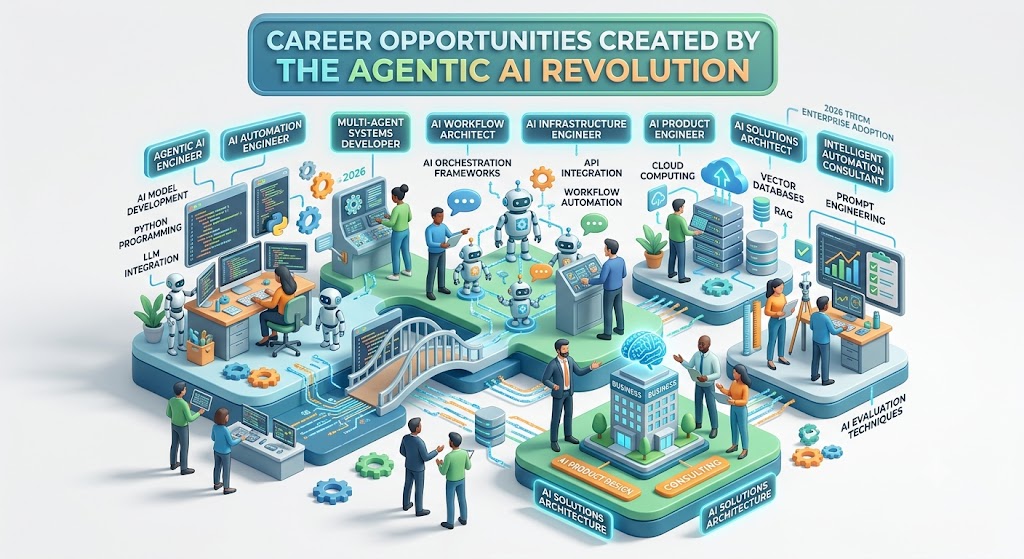
The rise of Agentic AI is creating entirely new job roles across technology industries. Organizations need professionals who understand both AI models and distributed intelligent systems.
High-demand roles include:
Agentic AI Engineer
AI Automation Engineer
Multi-Agent Systems Developer
AI Workflow Architect
AI Infrastructure Engineer
AI Product Engineer
AI Solutions Architect
Intelligent Automation Consultant
Required skills include:
Python programming
Large Language Models
Prompt engineering
AI orchestration frameworks
API integration
Cloud computing
Workflow automation
Vector databases
Retrieval-Augmented Generation (RAG)
AI evaluation techniques
Professionals who combine software engineering expertise with agentic system design are expected to remain highly valuable as enterprises continue adopting autonomous AI solutions throughout 2026 and beyond.
Conclusion
The debate between Single-Agent and Multi-Agent Systems is not about choosing a universally superior architecture. Instead, it is about selecting the right level of intelligence and collaboration for a specific business problem. Single-agent systems remain highly effective for focused, fast, and cost-efficient applications, while multi-agent systems excel in large-scale, dynamic, and collaborative environments that demand specialized reasoning and coordinated execution.
As Agentic AI reshapes software engineering, enterprise automation, and digital transformation, understanding these architectures will become a core skill for developers, AI engineers, and technology leaders. Investing in practical knowledge through continuous learning and industry-focused training from organizations such as JastTech can help professionals stay ahead of this shift and build successful careers in one of the fastest-growing areas of artificial intelligence.