

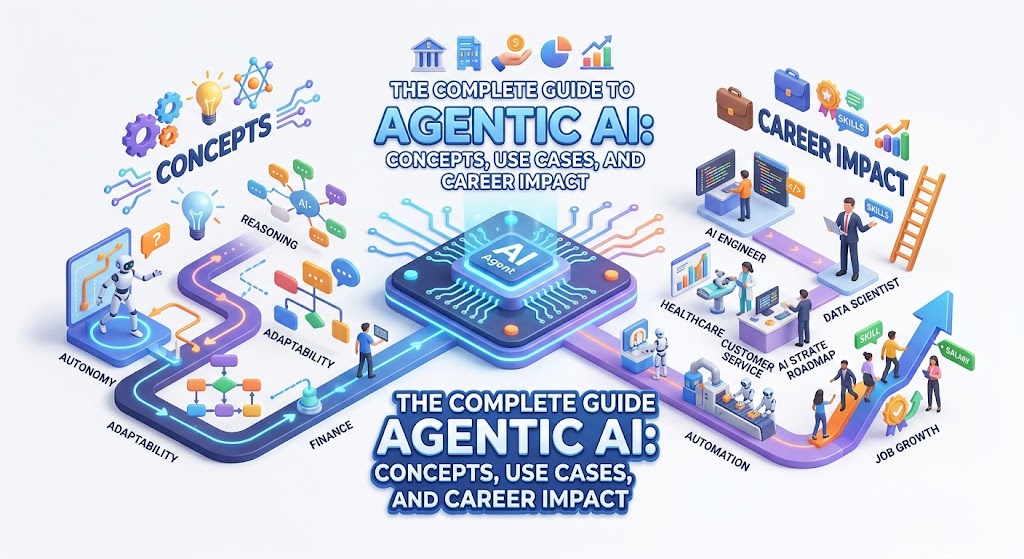
The Complete Guide to Agentic AI: Concepts, Use Cases, and Career Impact
Navigate through this article using the table of contents below
Table of Contents
No headings found in this article.
Artificial Intelligence has entered a new phase where models no longer simply answer questions—they can plan, reason, make decisions, and execute complex tasks with minimal human intervention. This evolution is known as Agentic AI, and it is reshaping how organizations automate work across industries.
Businesses are rapidly investing in autonomous AI systems that can solve multi-step problems, interact with external tools, and continuously improve through feedback. Whether you're an engineering student, software developer, or IT professional, understanding Agentic AI can open the door to one of the fastest-growing career paths in technology. At JastTech, learners are increasingly exploring Agentic AI to prepare for the next generation of intelligent automation.
What Is Agentic AI and Why Is It Different?
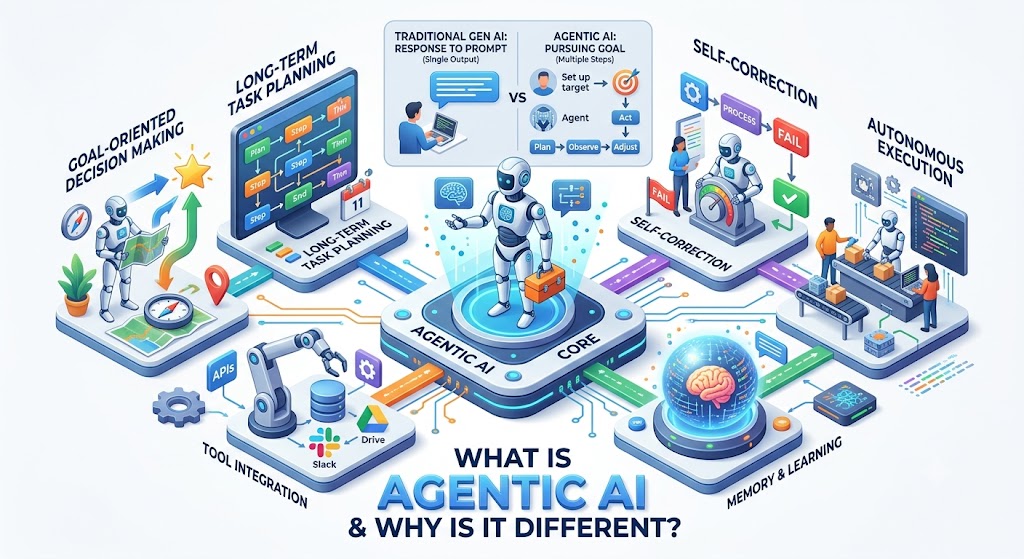
Agentic AI refers to artificial intelligence systems that can independently pursue goals instead of merely responding to prompts. Unlike traditional Generative AI, which creates text, images, or code based on user input, Agentic AI can plan multiple steps, use external tools, evaluate outcomes, and adjust its actions to complete an objective.
A modern AI agent combines several capabilities into one intelligent system. These include planning, reasoning, memory, decision-making, and execution, enabling it to perform tasks that once required continuous human guidance.
Core characteristics include:
Goal-oriented decision making
Long-term task planning
Tool integration with APIs and software
Memory for learning from previous interactions
Self-correction through feedback
Autonomous execution with limited supervision
This shift allows AI to move beyond answering questions and toward completing meaningful work across enterprise environments.
How Agentic AI Works Behind the Scenes
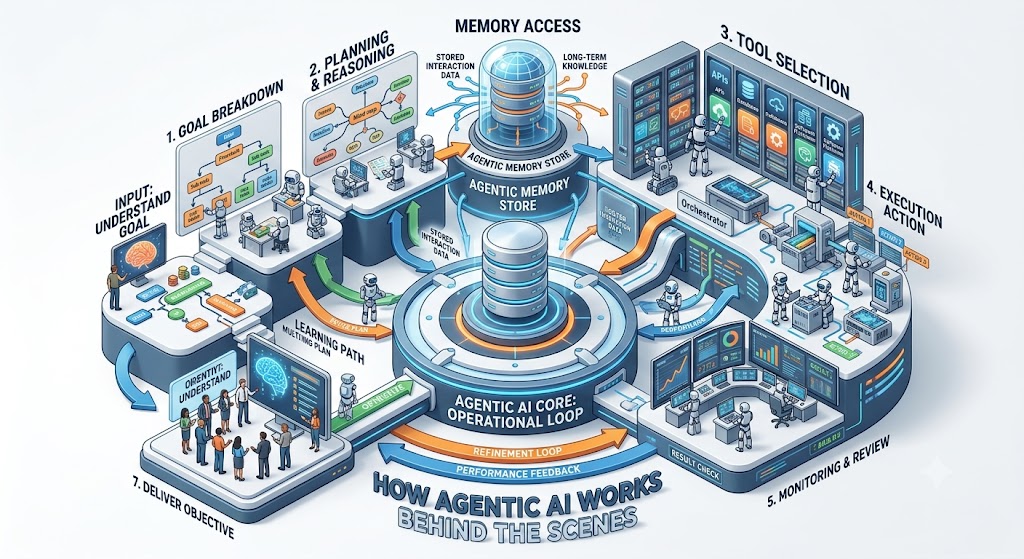
Agentic AI operates through a sequence of intelligent processes rather than a single model response. It begins by understanding the objective, breaking it into manageable subtasks, selecting appropriate tools, executing actions, reviewing the results, and refining its approach when necessary.
A typical workflow includes:
Understanding the user's goal
Planning multiple execution steps
Choosing tools such as databases, APIs, or software platforms
Executing actions in sequence
Monitoring outcomes
Revising plans when errors occur
Delivering the completed objective
Memory plays a critical role in this process. Instead of treating every interaction independently, the agent stores relevant information, enabling better decisions over time. This creates systems capable of handling increasingly complex workflows without repeated human instructions.
Real-World Use Cases Across Industries
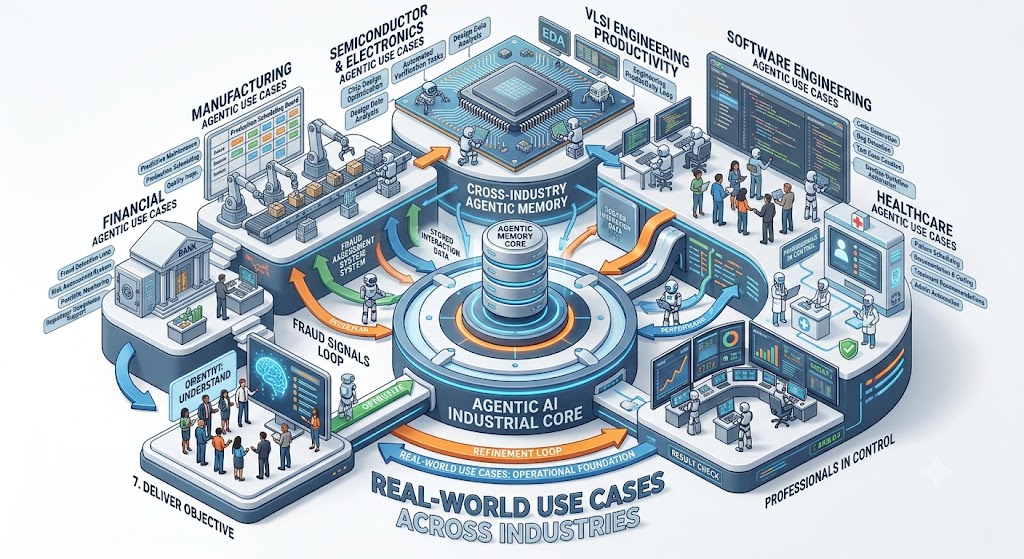
Agentic AI is no longer limited to research labs. Organizations are deploying autonomous AI systems to improve productivity, reduce costs, and accelerate decision-making.
Healthcare organizations use AI agents to assist with patient scheduling, medical documentation, treatment recommendations, and administrative automation while keeping healthcare professionals in control of final decisions.
Financial institutions leverage Agentic AI for:
Fraud detection
Risk assessment
Loan processing
Portfolio monitoring
Regulatory compliance support
Manufacturing companies apply intelligent agents to predictive maintenance, production scheduling, quality inspection, and supply chain optimization.
Software engineering teams use Agentic AI for:
Automated code generation
Bug detection
Test case creation
Documentation
DevOps workflow automation
Semiconductor and electronics companies increasingly explore AI agents to optimize chip design workflows, automate verification tasks, analyze design data, and improve engineering productivity, making Agentic AI especially valuable for VLSI professionals.
Agentic AI vs Generative AI: Understanding the Difference
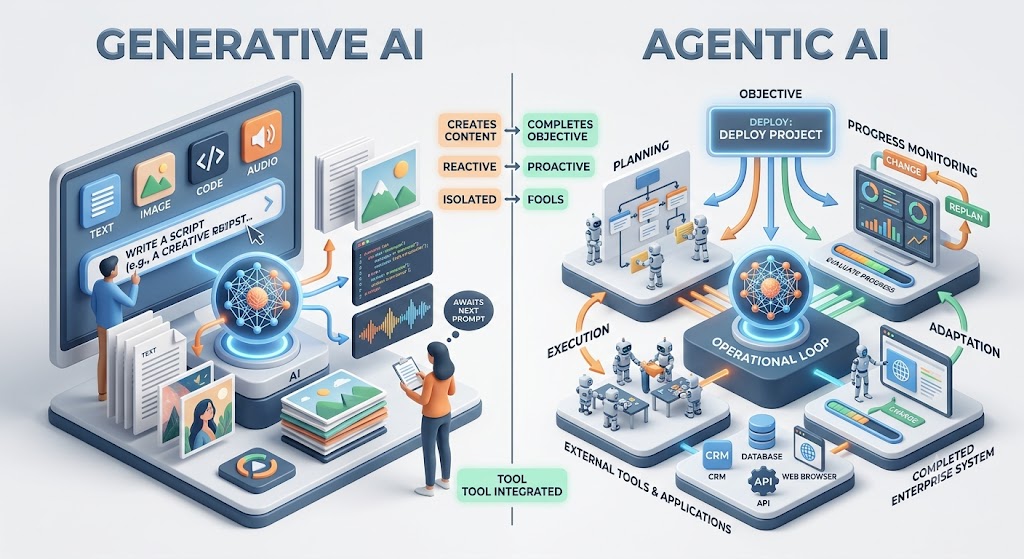
Although both technologies rely on advanced language models, their purposes differ significantly.
Generative AI primarily focuses on creating content. It responds to prompts by generating text, images, code, or audio, but usually waits for the next instruction before continuing.
Agentic AI extends those capabilities by actively working toward a defined objective. Instead of producing one response, it plans, reasons, executes tasks, monitors progress, and adapts when circumstances change.
Key differences include:
Generative AI creates content; Agentic AI completes objectives.
Generative AI is reactive; Agentic AI is proactive.
Agentic AI integrates external tools and applications.
Autonomous agents can manage multi-step workflows.
Agentic AI continuously evaluates progress before taking the next action.
This distinction explains why businesses increasingly see Agentic AI as the next evolution of enterprise automation rather than simply another AI chatbot.
Career Opportunities in Agentic AI
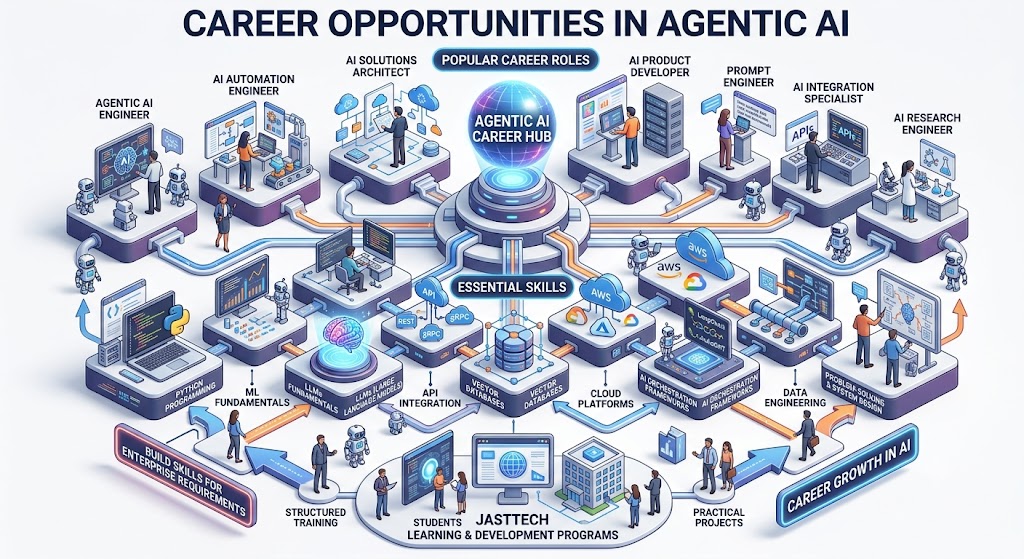
As organizations adopt autonomous AI systems, demand for professionals who can design, deploy, and manage intelligent agents continues to grow. Companies seek engineers who understand machine learning, software development, cloud platforms, APIs, automation frameworks, and large language models.
Popular career roles include:
Agentic AI Engineer
AI Automation Engineer
AI Solutions Architect
Machine Learning Engineer
AI Product Developer
Prompt Engineer
AI Integration Specialist
AI Research Engineer
Essential skills include:
Python programming
Machine Learning fundamentals
Large Language Models (LLMs)
API integration
Vector databases
Cloud platforms
AI orchestration frameworks
Data engineering
Problem-solving and system design
Learning these technologies through structured training, practical projects, and industry-focused programs offered by JastTech can help students and working professionals build skills aligned with current enterprise requirements.
The Future of Agentic AI and Why You Should Learn It Now
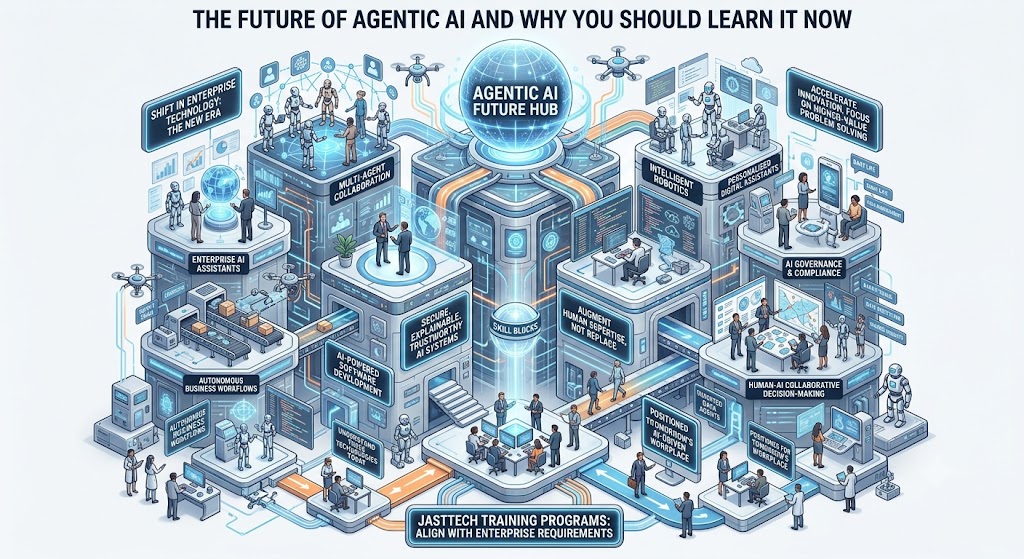
Agentic AI represents one of the most significant shifts in enterprise technology since cloud computing. Future AI systems will increasingly collaborate as multiple specialized agents working together to solve large-scale business challenges.
Emerging trends include:
Multi-agent collaboration
Enterprise AI assistants
Autonomous business workflows
AI-powered software development
Intelligent robotics
Personalized digital assistants
AI governance and compliance
Human-AI collaborative decision-making
Organizations will continue investing in secure, explainable, and trustworthy AI systems capable of operating responsibly within regulated industries. Professionals who understand these technologies today will be well positioned for tomorrow's AI-driven workplace.
Rather than replacing engineers, Agentic AI is expected to augment human expertise by automating repetitive tasks, accelerating innovation, and enabling teams to focus on higher-value problem solving.
Conclusion
Agentic AI is transforming artificial intelligence from a passive assistant into an autonomous problem solver capable of planning, reasoning, executing, and continuously improving. Its ability to combine language models with memory, external tools, and intelligent decision-making is creating new possibilities across healthcare, finance, manufacturing, software engineering, and semiconductor design. As organizations embrace intelligent automation, Agentic AI is becoming a foundational technology for digital transformation.
For students, engineers, and technology professionals, now is the ideal time to build expertise in this rapidly evolving field. Developing skills in Python, machine learning, APIs, cloud platforms, and AI orchestration frameworks will create strong career opportunities as enterprise adoption accelerates. Through practical, industry-focused learning programs, JastTech helps learners gain the knowledge and hands-on experience needed to succeed in the next generation of AI-powered engineering and automation.